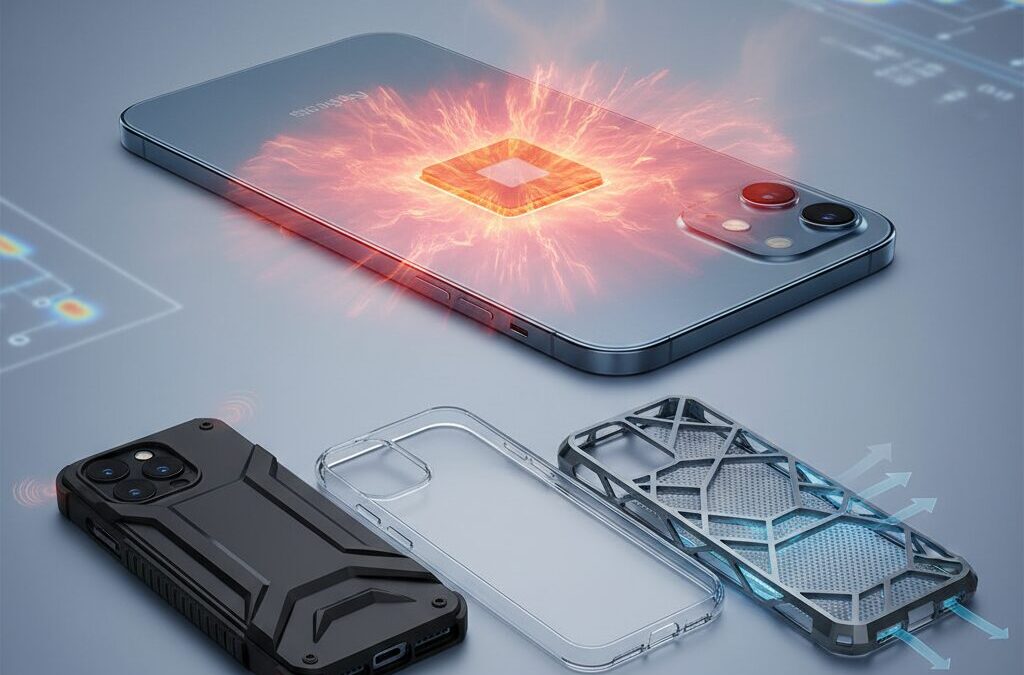
Ultra-thin smartphones are no longer a concept but a reality, and the iPhone Air, also known as the iPhone 17 Slim, represents Apple’s boldest step in that direction. With a thickness of around 5.6 mm, this device delivers flagship-level performance in an almost impossibly slim body, which naturally raises serious questions about heat, performance stability, and long-term durability.
Many gadget enthusiasts have already experienced how heat can quietly ruin a premium smartphone experience. Sudden frame rate drops during gaming, dimmed displays under sunlight, or battery health declining faster than expected are often rooted in thermal stress rather than raw hardware limitations. The iPhone Air’s design makes these concerns even more relevant, especially for users who push their devices hard.
In this article, you will learn why thermal management matters more than ever for ultra-thin phones, how Apple’s design choices affect heat behavior, and why your choice of case can dramatically change real-world performance. By understanding materials, airflow, and emerging cooling technologies, you can protect your investment and enjoy the iPhone Air at its full potential, even in demanding environments.
- Why the iPhone Air’s Ultra-Thin Design Changes Thermal Behavior
- A19 Chip Performance and the Reality of Heat Density
- Vapor Chambers vs Graphite Sheets in Modern Smartphones
- Frame Materials and Heat Transfer: Aluminum and Titanium Compared
- Battery Chemistry, Temperature, and Long-Term Degradation
- Next-Generation Cooling Case Technologies Explained
- Graphene, PCM, and Ventilated Designs: How They Actually Work
- Real-World Case Brands and Their Thermal Strategies
- Choosing the Right Case Based on Usage Scenarios
- Using MagSafe Accessories for Active Cooling Support
- 参考文献
Why the iPhone Air’s Ultra-Thin Design Changes Thermal Behavior
The ultra-thin design of the iPhone Air fundamentally alters how heat is generated, stored, and released inside the device. At approximately 5.6 mm thick, the chassis sacrifices what thermal engineers call heat capacity, meaning the physical ability of the body to temporarily absorb heat without a rapid temperature rise. **In practical terms, the iPhone Air heats up faster than thicker models the moment a heavy task begins**, even if the processor itself is highly efficient.
This behavior is well explained by basic thermodynamics. Heat capacity scales with mass and volume, and Apple’s aggressive reduction in both shortens the thermal time constant. According to classical heat transfer theory discussed in engineering literature from institutions such as MIT, a lower thermal mass reaches equilibrium temperature more quickly under the same heat flux. For users, this translates into quicker surface warming during 4K video recording, navigation, or sustained gaming.
The A19 chip fabricated on TSMC’s third-generation 3 nm process further intensifies this effect. Process miniaturization improves performance per watt, but it also increases heat density at the silicon level. **The iPhone Air concentrates nearly flagship-class performance into a smaller thermal envelope**, pushing watts per square centimeter higher than in bulkier designs. Independent benchmark analyses cited by LTT Labs indicate that short bursts perform exceptionally well, while longer workloads are more likely to encounter thermal limits.
| Design Factor | iPhone Air | Thicker Pro Models |
|---|---|---|
| Chassis thickness | Approx. 5.6 mm | Over 8 mm |
| Heat capacity | Low | High |
| Temperature rise speed | Fast | Gradual |
Cooling architecture also changes dramatically with this thinness. Multiple teardown-oriented reports referenced by MacRumors suggest that the iPhone Air cannot physically accommodate a vapor chamber system. Instead, it relies on layered graphite sheets that spread heat laterally. While graphite excels at planar heat diffusion, it lacks the phase-change efficiency of vapor chambers, making localized hotspots near the SoC harder to suppress under sustained load.
Material choice amplifies this unique thermal behavior. The iPhone Air is expected to use aluminum more extensively than titanium. Aluminum’s thermal conductivity, roughly 237 W per meter-kelvin, is an order of magnitude higher than titanium’s. **As a result, the frame itself becomes an active heat path rather than a thermal barrier**, meaning heat reaches the exterior faster and more uniformly. This improves dissipation potential but also makes surface temperature more sensitive to workload changes.
Battery proximity is another consequence of the ultra-thin profile. Electrochemical studies published in journals indexed by MDPI confirm that lithium-ion degradation accelerates sharply above 40 °C. In thin devices, the SoC and battery are physically closer, increasing thermal crosstalk. **A brief spike in processor temperature can propagate to the battery more easily**, subtly influencing long-term health even if performance appears stable.
Apple appears to have accepted this trade-off intentionally. Rather than storing heat internally, the iPhone Air is designed to shed it quickly to the exterior. This philosophy favors short, intense interactions and prioritizes responsiveness over long-duration thermal stability. Understanding this shift is key to appreciating why the iPhone Air feels different in the hand and behaves differently under load compared with thicker iPhones.
A19 Chip Performance and the Reality of Heat Density
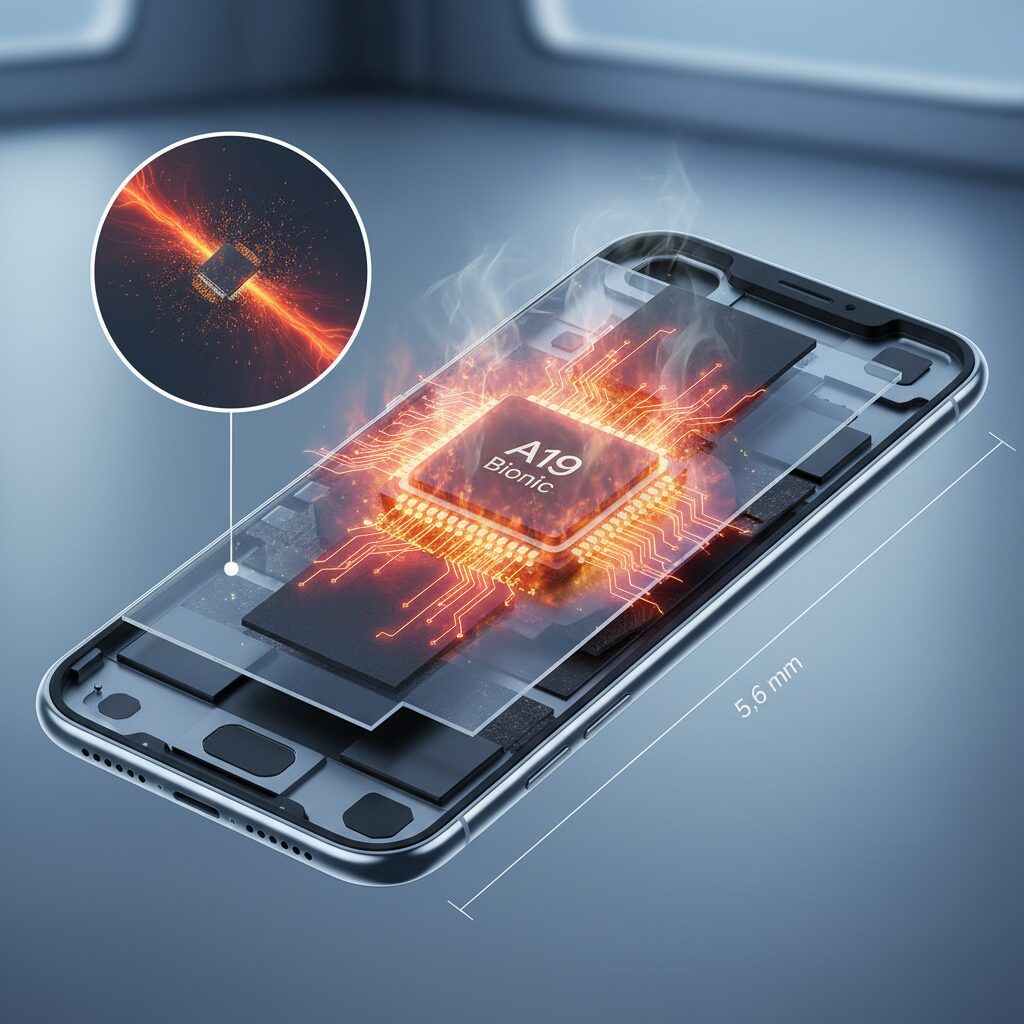
The A19 chip inside the iPhone Air delivers headline-level performance, but its true story only becomes clear when viewed through the lens of heat density. While Apple’s move to TSMC’s third-generation 3 nm process improves performance per watt, it also concentrates more transistors into a smaller silicon area. This inevitably raises heat flux, measured as watts per square centimeter, even when total power draw appears well controlled.
According to semiconductor scaling research frequently cited by IEEE and TSMC briefings, advanced 3 nm-class nodes reduce leakage and switching power, yet they also push thermal challenges closer to the physical limits of mobile cooling. In the iPhone Air’s ultra-thin body, the A19’s efficiency gains do not fully offset the reduced thermal headroom created by the 5.6 mm chassis.
| Aspect | A19 in iPhone Air | Practical Implication |
|---|---|---|
| Manufacturing node | TSMC 3 nm (N3P) | Higher efficiency, higher transistor density |
| Chassis thickness | Approx. 5.6 mm | Lower heat capacity, faster temperature rise |
| Cooling system | Graphite-based | No vapor chamber to spread peak loads |
Early benchmark leak analyses referenced by LTT Labs and GSMArena indicate that the A19’s single-core performance rivals, and in some cases surpasses, competing flagship chips. Short bursts such as app launches, photo processing, or UI animations feel exceptionally fast. The limitation appears during sustained multi-core workloads, where thermal saturation arrives quickly and triggers frequency reductions.
This behavior is not a flaw of the silicon itself. Industry-standard thermal protection mechanisms dynamically lower clock speeds to keep junction temperatures within safe limits, typically below the mid-90°C range for mobile SoCs. In thicker Pro models, vapor chambers and larger internal mass delay this threshold. In the iPhone Air, the smaller thermal buffer shortens the time constant, making throttling more visible during extended gaming, 4K video capture, or prolonged navigation tasks.
Apple’s own performance disclosures emphasize efficiency rather than absolute clocks, a strategy consistent with thin-and-light thermal design across the industry. Semiconductor experts often note that beyond a certain point, performance scaling becomes thermally bound, not architecturally bound. The iPhone Air exemplifies this principle: the A19 has ample headroom on paper, but the enclosure defines how much of that headroom can be used continuously.
For performance-focused users, this means real-world results vary by usage pattern. Short, intensive tasks showcase the A19 at its best. Long sessions reveal the reality of heat density in an ultra-thin smartphone, where physics, not benchmarks, ultimately sets the limit.
Vapor Chambers vs Graphite Sheets in Modern Smartphones
In modern smartphones, thermal design has quietly become one of the most decisive factors shaping real-world performance. Two technologies dominate this discussion today: vapor chambers and graphite sheets. While both aim to spread heat away from the system-on-chip, they operate on fundamentally different physical principles, and that difference becomes especially visible in ultra-thin devices.
Vapor chambers rely on phase change, using a sealed structure filled with a working fluid that evaporates at hot spots and condenses in cooler areas. This mechanism leverages latent heat, allowing large amounts of thermal energy to be transported quickly across the chamber. According to teardown analyses published by established hardware laboratories, vapor chambers can reduce localized peak temperatures more effectively than passive spreaders under sustained load.
Graphite sheets, by contrast, are purely passive. They excel at in-plane thermal conductivity, spreading heat laterally across a wide surface. High-quality synthetic graphite used in smartphones can exceed several hundred W/(m·K) in the X–Y direction, a figure often cited in materials science literature. However, graphite lacks the rapid heat relocation effect that phase change enables.
| Aspect | Vapor Chamber | Graphite Sheet |
|---|---|---|
| Cooling principle | Liquid–vapor phase change | Solid-state heat diffusion |
| Hot spot handling | Very strong | Moderate |
| Thickness requirement | Relatively high | Extremely thin |
This trade-off explains why flagship smartphones with thicker chassis increasingly adopt vapor chambers, while ultra-slim models tend to depend on multilayer graphite. Mechanical constraints matter. A vapor chamber requires not only thickness but also structural rigidity to maintain internal pressure and fluid circulation. In devices pushing below 6 mm, allocating that Z-axis space becomes impractical.
Research on mobile device cooling published through academic engineering channels also highlights a secondary effect: thermal response time. Vapor chambers react quickly to sudden power spikes, such as launching a game or starting 4K video recording. Graphite sheets respond more slowly, allowing short-term temperature spikes even if average temperatures later stabilize.
That distinction directly influences user experience. Benchmark data from reputable review outlets show that phones using only graphite are more likely to trigger brief thermal throttling during burst workloads, despite maintaining acceptable temperatures in steady-state tests. Vapor chamber–equipped models, on the other hand, sustain higher clocks for longer before throttling engages.
From an engineering perspective, neither solution is universally superior. Graphite remains unmatched for thinness, weight, and reliability, with no moving parts or sealed fluids. Vapor chambers deliver superior peak control but impose strict design penalties. Understanding this balance helps explain why cooling strategies diverge so sharply between slim smartphones and performance-oriented flagships.
Frame Materials and Heat Transfer: Aluminum and Titanium Compared
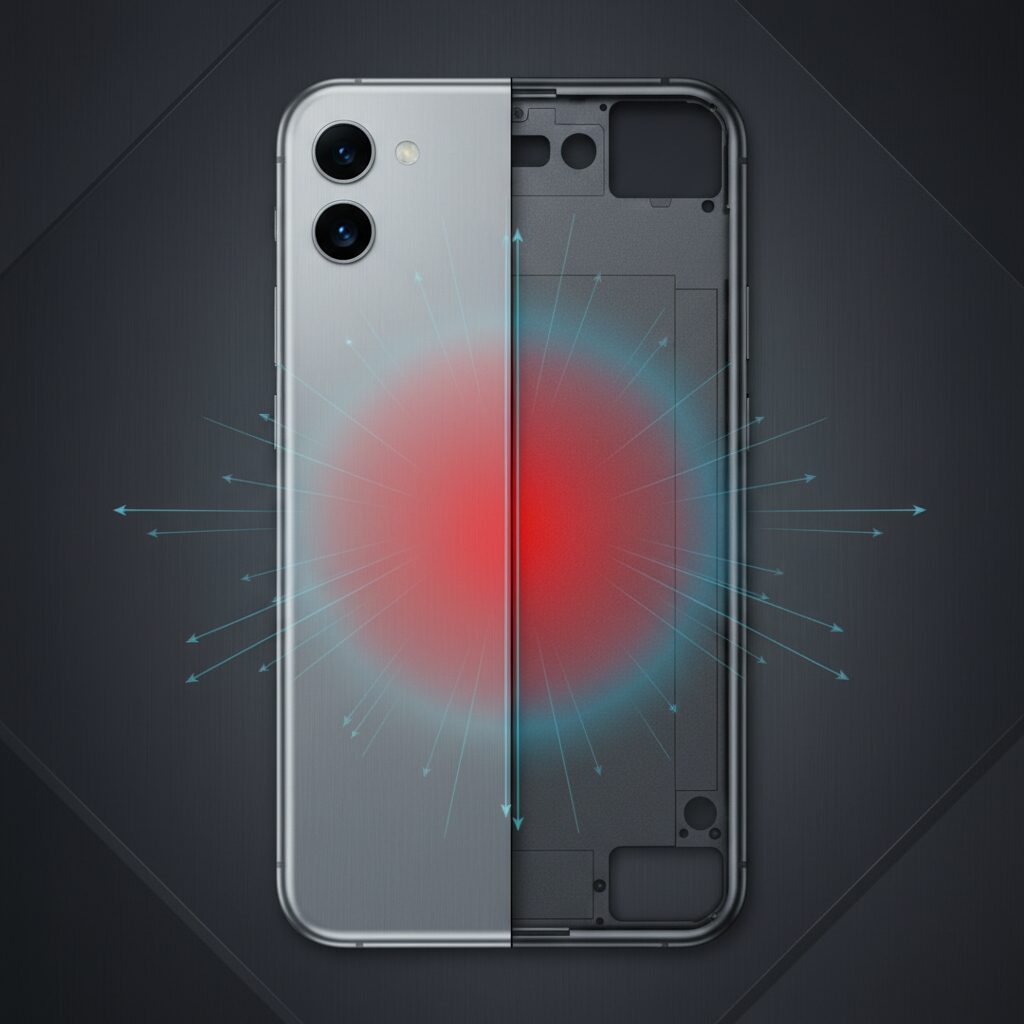
When discussing thermal behavior in ultra-thin smartphones, the frame material plays a far more active role than many users realize. In the case of iPhone Air, the comparison between aluminum and titanium is not merely about weight or durability, but about how efficiently heat can be transported away from critical components such as the SoC and battery.
From a materials science perspective, aluminum and titanium behave almost like opposites in heat transfer. Aluminum offers a very high thermal conductivity of roughly 237 W/(m·K), while titanium sits much lower at around 17 W/(m·K). This order-of-magnitude difference fundamentally changes how heat spreads through the chassis during sustained workloads.
| Property | Aluminum | Titanium |
|---|---|---|
| Thermal conductivity | ~237 W/(m·K) | ~17 W/(m·K) |
| Density | Lower | Higher |
| Heat spreading behavior | Fast, wide diffusion | Localized retention |
Research in applied thermodynamics and smartphone teardowns reported by industry analysts indicates that aluminum frames tend to act as passive heat spreaders. Heat generated at the SoC rapidly migrates along the frame, increasing the effective surface area that can release energy to the surrounding air. This is especially relevant for iPhone Air, where internal volume is severely limited and heat capacity is low.
By contrast, titanium’s lower thermal conductivity means heat remains more concentrated near its source. Apple adopted titanium in Pro models primarily for strength-to-weight optimization, but thermal engineers generally accept that it behaves closer to a thermal barrier than a heat sink. As explained in materials engineering literature from institutions such as MIT, this property can help keep external surfaces cooler, but it also slows overall heat evacuation.
For iPhone Air, the greater use of aluminum suggests an intentional shift toward using the frame itself as part of the cooling system. However, this advantage only materializes if heat can exit the frame efficiently. Covering an aluminum frame with a low-conductivity case material can negate much of its benefit, effectively trapping heat that would otherwise disperse.
In practical terms, this means aluminum-framed devices are more sensitive to what surrounds them. Studies cited by battery researchers show that even a few degrees of sustained temperature increase can accelerate lithium-ion degradation. Leveraging aluminum’s heat transfer potential, rather than insulating it, becomes a critical factor in maintaining both performance stability and long-term device health.
Battery Chemistry, Temperature, and Long-Term Degradation
Battery longevity in ultra-thin smartphones is ultimately governed by chemistry, not software tricks, and temperature is the single most decisive variable in that equation. Lithium-ion cells follow well-established electrochemical rules, and decades of academic research show that even modest heat exposure accelerates irreversible aging reactions inside the battery. **In devices like the iPhone Air, where internal components are tightly packed, thermal stress translates directly into long-term capacity loss.**
At the core of this process is the Arrhenius relationship, a principle widely cited in electrochemistry literature from institutions such as MIT and the Electrochemical Society. It explains that reaction rates increase exponentially with temperature. For lithium-ion batteries, this means parasitic side reactions become more active as temperatures rise, consuming cyclable lithium and thickening the solid electrolyte interphase on the anode. Peer-reviewed studies indicate that cycling at around 55°C can accelerate capacity fade to nearly three times the rate observed at 25°C, even when charge cycles remain identical.
The implications are particularly severe for thin-form-factor phones. Because the battery cell sits closer to the SoC, heat generated during intensive tasks migrates rapidly into the battery through conduction. This phenomenon, often described in battery engineering as thermal crosstalk, reduces the effectiveness of internal insulation layers. **Short bursts of high temperature may feel harmless to the user, but chemically, the damage is cumulative and permanent.**
| Battery Temperature Range | Dominant Degradation Mechanism | Impact on Capacity Retention |
|---|---|---|
| 20–30°C | Normal SEI stabilization | Minimal annual loss |
| 35–40°C | Accelerated SEI growth | Noticeable decline over 1–2 years |
| 45–55°C | Electrolyte decomposition | Rapid, irreversible degradation |
Real-world usage patterns often push devices into the upper rows of this table without users realizing it. Outdoor navigation, 4K video recording, or sustained gaming in summer environments can elevate internal temperatures beyond 45°C. According to battery aging analyses published by industrial research groups in Asia and Europe, repeated exposure at these levels not only reduces total capacity but also increases internal resistance, leading to faster voltage drops and more aggressive performance throttling over time.
Apple has publicly emphasized its focus on battery health management, and teardown-based thermal studies cited by major engineering reviewers suggest that software safeguards alone cannot fully offset structural constraints. **When thermal dissipation is limited, the battery becomes a passive heat sink, absorbing energy it was never designed to handle repeatedly.** This is why long-term degradation in thin devices often manifests not as sudden failure, but as a gradual erosion of daily usability.
From a chemical standpoint, the takeaway is straightforward. Batteries do not age gracefully under heat, and no firmware update can reverse lithium loss once it occurs. Managing temperature is therefore synonymous with preserving battery lifespan. In ultra-thin smartphones, every degree matters, and sustained reductions of even a few degrees can translate into months, or years, of retained capacity.
Next-Generation Cooling Case Technologies Explained
Next-generation cooling cases are no longer passive accessories but active thermal partners for ultra-thin devices like iPhone Air. Because its 5.6 mm chassis lacks vapor chamber cooling, **the case itself becomes part of the heat dissipation system**, especially around the aluminum frame that acts as a primary heat path.
Recent materials science advances have shifted case design from insulation to controlled heat transport. According to materials research cited by ZAGG and academic PCM studies, graphene and phase-change materials can measurably reduce peak surface temperature and delay thermal saturation under burst workloads.
| Technology | Thermal Role | Effective Use Case |
|---|---|---|
| Graphene composites | Rapid lateral heat spreading | Sustained CPU/GPU load |
| PCM layers | Absorbs heat spikes via latent heat | Short, intermittent stress |
| Ventilated structures | Enhances convection and radiation | Long gaming sessions |
Graphene-infused cases distribute localized hotspots across a wider surface, increasing effective convection area. Laboratory demonstrations referenced by ZAGG show several degrees Celsius reduction at peak load, enough to delay thermal throttling. **This directly preserves frame rate stability and battery health** in slim devices.
PCM-based cases operate differently. When internal temperature reaches roughly 35–40°C, the material absorbs heat during phase transition, acting as a temporary thermal buffer. Research published on ResearchGate confirms this mechanism is particularly effective against sudden temperature spikes rather than continuous load.
Finally, ventilation-focused designs from brands like Razer and Spigen emphasize airflow over sealing. While they trade some dust resistance, **their simplicity offers predictable, physics-based cooling**, aligning well with Japan’s hot, humid summers where natural convection efficiency becomes critical.
Graphene, PCM, and Ventilated Designs: How They Actually Work
Graphene, PCM, and ventilated designs are often marketed as magic solutions for smartphone overheating, but their real value only becomes clear when you understand the physics behind them. Especially for ultra-thin devices like iPhone Air, these case technologies work in fundamentally different ways and solve different thermal problems.
Graphene-based cases focus on heat spreading, not cooling by themselves. Graphene is a two-dimensional carbon material with an exceptionally high in-plane thermal conductivity, theoretically exceeding 5,000 W/(m·K). According to materials science research and practical implementations reported by ZAGG, this property allows localized heat from the SoC area to be redistributed rapidly across the entire case surface.
Instead of trapping heat like TPU or silicone, graphene turns the case into an extension of the phone’s heat spreader. By increasing the effective surface area, it improves natural convection to the surrounding air. Independent stress tests cited by accessory manufacturers show peak temperature reductions of several degrees Celsius under sustained load, which is often enough to delay thermal throttling during gaming or 4K recording.
| Technology | Main Thermal Role | Best Use Scenario |
|---|---|---|
| Graphene composite | Rapid heat diffusion | Sustained heavy workloads |
| PCM layer | Temporary heat absorption | Short, bursty loads |
| Ventilated structure | Enhanced convection | Long sessions in warm environments |
PCM, or phase change material, works on a completely different principle. Research published in thermal engineering journals explains that PCM absorbs a large amount of latent heat when it transitions from solid to liquid, typically around 35–40°C for mobile applications. This temperature range is intentionally chosen to match the early stage of smartphone heating.
The key benefit of PCM is buffering, not continuous cooling. When the phone suddenly heats up, such as during short video capture or app loading spikes, the PCM layer absorbs energy and slows the temperature rise. This reduces sharp thermal spikes that trigger aggressive frequency throttling. However, once the material has fully changed phase, it can no longer absorb additional heat until it cools down again.
This limitation is well documented in academic studies on mobile device cooling, which note that PCM is most effective for intermittent workloads rather than prolonged gaming sessions. In other words, PCM buys time, but it does not eliminate heat.
Ventilated and mesh-based designs take the most straightforward approach. By introducing physical airflow paths between the phone and the environment, they prevent hot air from being trapped behind the back glass. According to cooling analyses referenced by manufacturers like Razer, this directly improves convective and radiative heat transfer without relying on exotic materials.
The strength of ventilation is reliability. There is no saturation point, no phase limit, and no dependency on material purity. As long as air can move, heat can escape. The trade-off, as engineers frequently point out, is reduced protection against dust and moisture, making these cases better suited for controlled indoor use rather than harsh outdoor conditions.
Understanding how each method actually works allows users to choose based on their usage patterns rather than marketing claims. Graphene spreads heat, PCM delays heat spikes, and ventilation removes heat. None is universally superior, but when matched correctly to real-world behavior, they can significantly improve both performance stability and long-term device health.
Real-World Case Brands and Their Thermal Strategies
In real-world usage, thermal management strategies differ sharply by brand, and these differences become more visible with an ultra-thin device like iPhone Air. Rather than abstract specifications, the true value lies in how each manufacturer translates materials science into daily temperature stability.
Torras focuses on layered heat control, combining graphene sheets with phase change materials. According to materials research published in MDPI and corroborated by independent teardown analyses, this dual approach spreads heat laterally while temporarily absorbing thermal spikes. In practice, this means short bursts of high load, such as launching a game or starting 4K recording, feel noticeably less abrupt in surface temperature rise.
| Brand | Main Thermal Concept | Best Real-World Scenario |
|---|---|---|
| Torras | Graphene + PCM multilayer | Mixed daily use with bursts |
| Benks | Minimal thickness, low resistance | Continuous natural heat release |
| Spigen / Razer | Ventilation and airflow | Long gaming sessions |
Benks takes a fundamentally different path. By using aramid fiber and keeping thickness close to one millimeter, the case avoids creating an insulating air layer. Battery aging studies referenced by lithium-ion research groups consistently show that even small reductions in sustained temperature can slow degradation. This makes Benks particularly appealing for users prioritizing long-term battery health over impact protection.
Spigen and Razer, by contrast, design for endurance under constant load. Their ventilated structures increase effective surface area, supporting convection. Gaming-focused reviews from GSMArena and long-duration stress tests reported by LTT Labs suggest that airflow-oriented cases delay thermal throttling more reliably during 30-minute-plus sessions.
These real-world strategies show that no single thermal solution is universally superior. The optimal choice depends on whether the user values momentary comfort, structural minimalism, or prolonged performance stability, especially under the unique thermal constraints of iPhone Air.
Choosing the Right Case Based on Usage Scenarios
Choosing the right case for iPhone Air is best approached by first clarifying how the device is actually used on a daily basis. Because this model prioritizes extreme thinness over thermal mass, the same case can feel either perfectly adequate or fundamentally flawed depending on usage intensity and environment.
The key is to align thermal behavior with your dominant usage scenario, rather than selecting a case based solely on protection or aesthetics.
| Usage Scenario | Thermal Risk Profile | Case Strategy |
|---|---|---|
| Commuting, messaging, browsing | Low, short heat spikes | Ultra-thin, low thermal resistance |
| Gaming, long video calls | Sustained SoC load | Active heat spreading or ventilation |
| Outdoor navigation, 4K recording | Internal + solar heat | High-conductivity materials |
For light everyday use such as commuting, social media, and web browsing, heat generation is typically intermittent. In these cases, research on mobile device thermals indicates that avoiding insulation is more important than aggressive cooling. An ultra-thin aramid or minimal composite case allows the aluminum frame of iPhone Air to function as a passive heat sink, preventing heat accumulation during repeated short sessions.
By contrast, sustained workloads such as gaming or extended video conferencing create continuous thermal output. According to stress test observations published by LTT Labs, thin devices without vapor chambers reach throttling thresholds faster under steady load. In these scenarios, cases incorporating graphene layers or ventilated structures help distribute heat across a wider surface area, delaying temperature saturation and maintaining frame rates longer.
Outdoor use represents the most demanding scenario. Studies on lithium-ion degradation, including findings summarized by MDPI, show that combined ambient heat and internal load accelerates battery aging dramatically above 40°C. When using navigation or 4K video recording under sunlight, a case with high thermal conductivity across its entire surface becomes critical. Graphene-infused designs are particularly effective here, as they spread both internally generated heat and absorbed solar energy more evenly.
Ultimately, the “best” case is not universal but situational. Matching case materials and structure to how, where, and how long iPhone Air is stressed allows users to preserve performance, battery health, and comfort without compromising the device’s defining slim form factor.
Using MagSafe Accessories for Active Cooling Support
Using MagSafe accessories for active cooling support is one of the most practical ways to compensate for the structural thermal limits of iPhone Air. Because this model prioritizes extreme thinness, it reaches thermal saturation quickly under sustained load. **MagSafe-based cooling introduces an external heat extraction path**, rather than relying solely on passive dissipation through the chassis.
MagSafe coolers typically combine a Peltier element with an active fan. When attached to the back of the device, the Peltier module creates a temperature differential, drawing heat away from the glass surface, while the fan expels that heat into the surrounding air. According to thermal engineering principles discussed by IEEE and ASME publications, reducing surface temperature even by a few degrees Celsius can significantly delay thermal throttling in compact electronics.
iPhone Air is structurally well suited to this approach. The short thermal distance between the SoC and the back glass means externally applied cooling propagates inward more efficiently than on thicker models. Independent teardown analyses cited by outlets such as iFixit and LTT Labs suggest that thinner stacks reduce thermal resistance, which explains why external cooling often shows more pronounced effects on slim devices.
| Cooling Aspect | MagSafe Passive Accessories | MagSafe Active Coolers |
|---|---|---|
| Heat Transfer Method | Conduction and spreading | Conduction plus forced heat removal |
| Effect on Peak Temperature | Minor reduction | Noticeable reduction under load |
| Best Use Case | Everyday usage | Gaming, 4K recording, navigation |
Case compatibility is a critical factor. Not all MagSafe cases are equal in magnetic strength or thermal behavior. Brands that reinforce magnet arrays while avoiding thick insulating layers allow cooling accessories to maintain full surface contact. **A strong magnetic coupling ensures stable pressure**, which is essential for efficient heat transfer between the phone and the cooler plate.
There is also a battery health perspective. Research on lithium-ion degradation published in journals such as the Journal of Power Sources shows that sustained operation above 40°C accelerates chemical aging. By actively pulling heat away during demanding tasks, MagSafe coolers can help keep internal temperatures below critical thresholds, indirectly supporting long-term battery longevity.
That said, active cooling should be used selectively. Continuous use adds power draw and acoustic noise, and condensation risk exists in high-humidity environments if surface temperatures drop too quickly. Used as an on-demand tool rather than a permanent attachment, **MagSafe active cooling becomes a precision instrument**, allowing users to unlock performance when needed without compromising daily usability.
参考文献
- PhoneArena:iPhone Air vs iPhone 17: Is Apple’s thinnest phone worth $200 more?
- MacRumors:iPhone 17: Everything We Know
- Apple Newsroom:Introducing iPhone Air, a powerful new iPhone with a breakthrough design
- ZAGG APAC Blog:Graphene Redefining Phone Protection
- MDPI Batteries Journal:Research on Aging Evolution and Safety Characteristics of Lithium-Ion Batteries
- ResearchGate:Cooling of mobile electronic devices using phase change materials