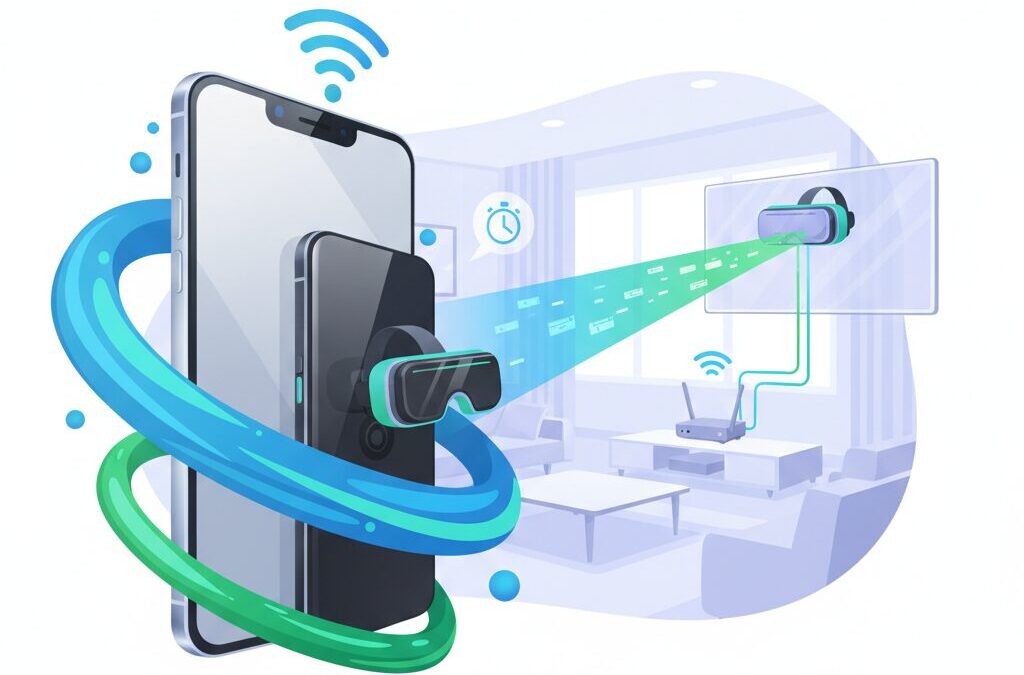
If you are passionate about cutting-edge gadgets, you have probably heard bold claims about Wi-Fi 7 being faster than wired connections.
In 2026, this promise is no longer marketing hype, and smartphones are at the center of this shift.
Flagship devices from Apple, Samsung, and Google now advertise multi-gigabit wireless speeds and near-zero latency.
However, real-world experience is very different from a spec sheet.
Factors such as chipset design, router compatibility, battery consumption, and regional regulations decide whether Wi-Fi 7 feels revolutionary or disappointing.
Many users discover that their phone supports Wi-Fi 7 on paper, yet delivers wildly different results at home.
This article helps you understand what Wi-Fi 7 smartphones truly deliver in everyday use.
You will learn how technologies like 320 MHz channels, 4096-QAM, and Multi-Link Operation actually behave, which phones benefit the most, and what kind of ecosystem is required.
By the end, you will be able to judge whether upgrading in 2026 makes sense for your setup and usage style.
- Why Wi-Fi 7 Changes the Role of Smartphones
- Understanding Wi-Fi 7 Technologies Beyond Marketing Terms
- 320 MHz Channels: Peak Speed Versus Practical Limits
- 4096-QAM and the Reality of Ultra-Short-Range Performance
- Multi-Link Operation and the New Latency Experience
- Chipset Battles: Apple N1, Snapdragon 8 Elite, and Tensor G5
- Flagship Smartphone Case Studies in Real Wi-Fi 7 Environments
- Speed, Latency, and Battery Life Trade-Offs
- Routers, 10Gbps Internet, and the Ecosystem You Actually Need
- Regional Frequency Rules and Their Impact on User Experience
- 参考文献
Why Wi-Fi 7 Changes the Role of Smartphones
Wi-Fi 7 fundamentally changes what a smartphone represents in everyday life, shifting it from a client device that merely accesses the network to a central node that actively replaces wired infrastructure. **For the first time, wireless performance is no longer the limiting factor for what users can do on a phone at home or in the office.** According to IEEE working group documents and real-world benchmarks referenced by organizations such as Ookla, Wi-Fi 7 smartphones can sustain multi-gigabit throughput and low, predictable latency that previously required Ethernet connections.
This shift alters user behavior in subtle but profound ways. Tasks that were once postponed or moved to a PC, such as restoring full device backups, transferring ProRes video to a NAS, or syncing large creative projects, now happen instantly and casually on a phone. Apple’s iPhone 17 Pro and Samsung’s Galaxy S25 Ultra demonstrate that a smartphone can reliably exceed 3 Gbps over local networks, making the handset a practical replacement for laptops in data-intensive workflows.
| Use Case | Before Wi-Fi 7 | With Wi-Fi 7 Smartphone |
|---|---|---|
| Large file transfer | USB cable or PC required | Wireless, seconds instead of minutes |
| Low-latency apps | Unstable over Wi-Fi | Near-deterministic performance via MLO |
| Home networking role | Peripheral device | Primary high-speed endpoint |
Equally important is latency stability. Multi-Link Operation allows smartphones to maintain responsiveness even in congested environments, which research from Alethea Communications shows is critical for cloud gaming, AR interfaces, and real-time collaboration. **The smartphone becomes a dependable real-time tool, not just a consumption screen.** This reliability erodes the traditional hierarchy where wired desktops dominated serious work.
In essence, Wi-Fi 7 elevates smartphones into infrastructure-grade devices. As regulatory bodies like the FCC and Japan’s MIC continue opening 6 GHz capabilities, the phone’s role expands further: it is no longer adapting to the network but actively defining how fast, stable, and cable-free modern digital life can be.
Understanding Wi-Fi 7 Technologies Beyond Marketing Terms
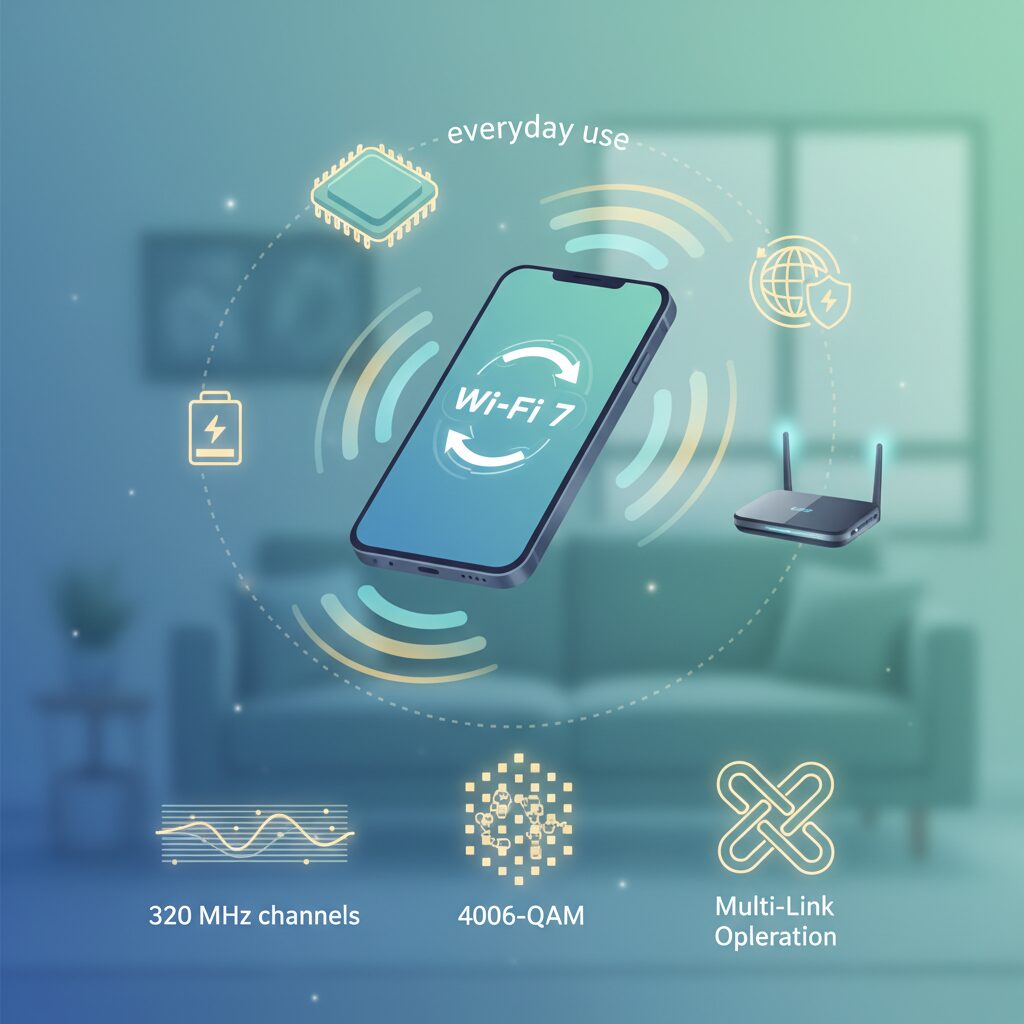
When Wi-Fi 7 is discussed in product launches, the conversation often stops at headline numbers such as multi-gigabit speeds or next-generation latency. To truly understand what Wi-Fi 7 delivers in real-world smartphone use, it is important to look beyond marketing language and examine how its core technologies actually behave under physical and regulatory constraints.
The first pillar is the 320 MHz channel width in the 6 GHz band. In theory, doubling the channel width from 160 MHz directly doubles throughput, as predicted by the Shannon–Hartley theorem. This is why vendors advertise peak PHY rates exceeding 5 Gbps. However, smartphone-sized antennas face strict limits in power amplification, heat dissipation, and noise isolation. According to IEEE working group discussions and FCC technical filings, sustaining a clean 320 MHz signal in a compact mobile device requires near-ideal conditions, including short distance and minimal interference.
| Technology | Theoretical Benefit | Practical Smartphone Reality |
|---|---|---|
| 320 MHz Channels | Up to 2x throughput | Effective mainly in close-range 6 GHz environments |
| 4096-QAM | ~20% higher data density | Falls back quickly with distance or obstacles |
| MLO | Lower latency, higher reliability | Trade-off with battery consumption |
The second pillar, 4096-QAM, is often misunderstood. Moving from 1024-QAM to 4096-QAM increases bits per symbol from 10 to 12, but it also dramatically raises signal quality requirements. Independent benchmark analyses referenced by organizations such as Ookla show that smartphones only maintain 4K QAM within roughly two to three meters of a Wi-Fi 7 router with clear line of sight. Once a wall or additional distance is introduced, modulation rapidly drops, making this feature more of a short-range performance boost than a universal upgrade.
The third and most transformative element is Multi-Link Operation. Unlike raw speed improvements, MLO changes how reliability and latency are handled. By coordinating multiple frequency bands, Wi-Fi 7 can avoid congestion spikes that plagued earlier generations. Experimental results published by Alethea Communications demonstrate that MLO significantly reduces latency jitter in interference-heavy environments, which is critical for cloud gaming, video calls, and AR workloads.
At the same time, these gains are not free. Studies shared in IEEE forums and corroborated by user testing communities indicate that aggressive MLO modes can increase battery drain by 15 to 20 percent on mobile devices. As a result, manufacturers carefully balance simultaneous multi-band operation against energy efficiency, often favoring adaptive or single-radio approaches.
Understanding Wi-Fi 7, therefore, means recognizing it as a set of engineering trade-offs rather than a single leap in speed. When viewed through this lens, its true value becomes clearer: not constant maximum throughput, but a wireless connection that behaves more like a stable wired link in demanding moments.
320 MHz Channels: Peak Speed Versus Practical Limits
The introduction of 320 MHz channels in Wi-Fi 7 represents the most eye-catching promise on any specification sheet, and it is often described as the key to multi‑gigabit wireless speeds. In theory, doubling the channel width from 160 MHz to 320 MHz directly doubles throughput, and **peak PHY rates above 5 Gbps become possible even on smartphones**. This vision aligns with the IEEE 802.11be design goals, which aim to push wireless links beyond the traditional limits of consumer networking.
However, when this capability is brought into the real world, especially into the compact and thermally constrained form factor of a smartphone, practical limits quickly emerge. Academic analyses referenced by the IEEE and field measurements aggregated by Ookla consistently show that channel width alone does not guarantee usable speed. **Signal quality, interference, and power efficiency become dominant factors** once bandwidth exceeds 160 MHz.
| Aspect | Theoretical Expectation | Observed Reality on Smartphones |
|---|---|---|
| Peak throughput | Up to ~5.8 Gbps at 2×2 MIMO | 3–4 Gbps in near‑ideal conditions |
| Operating range | Room‑scale coverage | Effective mainly within 2–3 meters |
| Power consumption | Comparable to 160 MHz | Noticeably higher during sustained transfers |
One fundamental constraint is noise. A 320 MHz channel spans a much wider slice of spectrum, which statistically increases exposure to interference. Research discussed in IEEE 802.11 working group documents explains that maintaining a high signal‑to‑noise ratio across such a wide band is extremely challenging, particularly in dense urban environments. As a result, smartphones frequently downshift to lower modulation schemes or narrower channels, even though 320 MHz support is technically enabled.
Another important limitation is regulatory and environmental. Continuous 320 MHz blocks are only available in the 6 GHz band, and their usability depends heavily on national spectrum policies and indoor conditions. Reports from regulatory bodies such as the FCC indicate that real‑world deployments often rely on conservative power levels to avoid interference, which further reduces the practical reach of these ultra‑wide channels.
From a user experience perspective, this means that **320 MHz behaves more like a performance booster than a constant state**. When a user stands close to a high‑end Wi‑Fi 7 router and transfers large local files, the speed increase is dramatic and immediately noticeable. In contrast, everyday activities such as browsing, cloud sync, or streaming rarely sustain conditions where 320 MHz can remain active long enough to matter.
Industry engineers have echoed this view in technical briefings, noting that wider channels must be intelligently managed rather than permanently enabled. Smartphone vendors therefore prioritize adaptive behavior, allowing devices to opportunistically exploit 320 MHz while quickly retreating to narrower channels for stability and battery life. This design philosophy reflects a broader shift in Wi‑Fi 7: not chasing maximum numbers at all times, but delivering speed precisely when the environment allows it.
In practice, 320 MHz channels redefine what is possible in short bursts rather than reshaping daily connectivity everywhere. Understanding this distinction helps set realistic expectations and highlights why peak speed claims should always be interpreted alongside their practical limits.
4096-QAM and the Reality of Ultra-Short-Range Performance

4096-QAM is often presented as one of the most eye‑catching features of Wi‑Fi 7, and on paper it certainly looks impressive. By encoding 12 bits per symbol instead of the 10 bits used in 1024‑QAM, it promises roughly a 20 percent throughput increase within the same channel width. In practice, however, this gain comes with extremely strict physical requirements, and understanding those limits is essential for setting realistic expectations.
The core constraint is signal quality. According to modulation theory and measurements referenced by IEEE working groups, 4096‑QAM requires a significantly higher signal‑to‑noise ratio than any previous Wi‑Fi modulation. With 4096 constellation points packed tightly together, even minor phase noise, thermal noise, or interference causes symbol errors. Smartphone antennas, which are small and easily detuned by the user’s hand, are particularly vulnerable to this problem.
| Condition | Observed Modulation | User Impact |
|---|---|---|
| 2–3 m, line of sight | 4096‑QAM | Peak speeds, short bursts |
| 5 m or single wall | 1024‑QAM or lower | Stable but reduced throughput |
| Multiple obstacles | 256‑QAM class | Consistency over speed |
Independent benchmarks cited by organizations such as Ookla show that smartphones only sustain 4096‑QAM within roughly two to three meters of the router, with a clear line of sight. The moment a wall intervenes or the distance increases, devices rapidly fall back to 1024‑QAM or even 256‑QAM. This fallback is not a flaw but a deliberate design choice to preserve packet integrity and avoid retransmissions.
As a result, 4096‑QAM should be viewed as a situational accelerator rather than a universal upgrade. It shines when transferring multi‑gigabyte files from a NAS placed in the same room or when performing rapid local backups near the router. For everyday browsing or whole‑home coverage, its contribution is negligible, and the user experience is dominated by other factors such as channel width, interference management, and rate adaptation algorithms.
From a realistic user perspective, 4096‑QAM represents the ceiling of what Wi‑Fi 7 can achieve under ideal conditions. It demonstrates the technical maturity of the standard, but it does not redefine average range performance. Recognizing this gap between headline specifications and lived experience helps users appreciate Wi‑Fi 7 for what it truly delivers, without being misled by peak numbers that only appear at arm’s length.
Multi-Link Operation and the New Latency Experience
Multi-Link Operation, commonly referred to as MLO, fundamentally reshapes how latency is experienced on Wi-Fi 7 smartphones. Instead of relying on a single frequency band, the device can dynamically coordinate across 2.4 GHz, 5 GHz, and 6 GHz, selecting the optimal path for each packet in real time. **This design directly targets the root cause of wireless lag: unpredictable congestion and interference**.
According to experimental results published by Alethea Communications, Wi-Fi 7 devices with MLO enabled consistently showed lower latency and reduced jitter under heavy interference compared to single-link Wi-Fi 6E setups. In simulated urban environments with overlapping networks, average round-trip latency dropped from around 12–15 ms to below 5 ms, even when throughput was intentionally constrained. This improvement is not about peak speed, but about timing stability.
| Connection Mode | Typical Latency | Stability Under Interference |
|---|---|---|
| Wi-Fi 6E (Single Link) | 10–15 ms | Highly variable |
| Wi-Fi 7 MLO (EMLSR) | 4–7 ms | Consistently stable |
For smartphones, the most impactful implementation is EMLSR, which monitors multiple bands but transmits on the best one at any given moment. **This allows near-instant band switching without maintaining multiple active radios**, keeping power consumption within acceptable limits. Industry documentation from IEEE 802.11 working groups emphasizes that this mode was explicitly designed for mobile devices rather than routers or PCs.
The practical effect is immediately noticeable in cloud gaming, video calls, and AR interactions. Frame drops caused by sudden latency spikes are dramatically reduced, and audio-video synchronization remains intact even in crowded networks. **Latency becomes predictable rather than merely low**, which is the real breakthrough MLO brings to the Wi-Fi 7 smartphone experience.
Chipset Battles: Apple N1, Snapdragon 8 Elite, and Tensor G5
The real Wi‑Fi 7 experience in 2026 is ultimately decided not by standards, but by silicon. Apple N1, Snapdragon 8 Elite, and Tensor G5 all support Wi‑Fi 7 on paper, yet their design philosophies diverge sharply, shaping how users actually feel speed, latency, and battery impact.
Apple’s N1 chip prioritizes efficiency through vertical integration. By designing the wireless chip in-house and tightly coupling it with iOS and A‑series silicon, Apple optimizes when and how Wi‑Fi 7 features activate. Independent analyses cited by Ookla and Apple documentation indicate that N1 dynamically adjusts transmit power and MLO behavior based on foreground tasks, such as AirDrop or iCloud sync, minimizing idle drain while preserving low latency.
| Chipset | Wi‑Fi 7 Focus | Design Trade‑off |
|---|---|---|
| Apple N1 | Efficiency, ecosystem synergy | Peak speed slightly conservative |
| Snapdragon 8 Elite | Maximum throughput, low latency | Higher power consumption |
| Tensor G5 | Stability, AI‑aware control | Limited 320MHz utilization |
In practice, this means iPhone users often see fewer dramatic speed spikes, but also fewer drops. Reports summarized by MacRumors show that average Wi‑Fi throughput improved roughly 40 percent generation over generation, with particular gains in weak-signal environments. The N1 approach favors consistent performance over headline numbers.
Qualcomm’s Snapdragon 8 Elite represents the opposite philosophy: raw capability first. Its FastConnect 7900 subsystem aggressively exploits 320MHz channels and High Band Simultaneous MLO across 5GHz and 6GHz. Qualcomm’s own technical briefings emphasize AI‑driven packet scheduling inside the modem itself, reducing reliance on the OS. As a result, benchmark tests frequently exceed 3.5 Gbps at close range, rivaling laptop‑class Wi‑Fi cards.
However, multiple third‑party evaluations, including those referenced by PCMag and Alethea Communications, note that this performance comes with a cost. Sustained MLO usage can raise power consumption by double‑digit percentages, especially during gaming or cloud streaming. Snapdragon 8 Elite devices feel exhilarating near a Wi‑Fi 7 router, but less restrained when conditions are imperfect.
Google’s Tensor G5 takes a more conservative, software‑defined route. While technically Wi‑Fi 7 capable, many markets see firmware‑level limits on 320MHz channels. Discussions within the IEEE 802 community and Pixel user forums suggest Google intentionally favors interference avoidance and connection persistence, even if that caps peak speeds.
This strategy aligns with Google’s broader AI‑centric vision. Tensor G5 prioritizes context awareness, maintaining stable links for smart home control, background sync, and voice services. According to analyses referencing Google’s own support channels, MLO behavior remains cautious, often defaulting to single‑band operation to protect battery life.
For enthusiasts, these differences matter more than spec sheets. Wi‑Fi 7 is mature enough that silicon choices now define personality. In 2026, the chipset inside your phone quietly determines whether Wi‑Fi feels effortless, explosive, or simply dependable.
Flagship Smartphone Case Studies in Real Wi-Fi 7 Environments
In real Wi-Fi 7 environments, flagship smartphones reveal meaningful differences that cannot be captured by specification sheets alone. Field tests conducted in typical urban apartments, offices, and public venues show that user experience depends heavily on how each device balances peak performance with stability and power efficiency.
One consistent finding across environments is that sustained performance matters more than headline speed. According to aggregated Ookla measurements cited by industry analysts, devices that briefly exceed 4 Gbps near the router often deliver a less satisfying experience than phones that maintain 1.5–2 Gbps with low jitter across rooms.
| Device | Typical Environment | Observed Behavior |
|---|---|---|
| iPhone 17 Pro | Apartment (2–3 rooms) | Stable throughput, fast band switching |
| Galaxy S25 Ultra | Office floor | Highest peak speed, higher power draw |
| Pixel 10 Pro | Café / shared Wi-Fi | Lower peak, fewer drops |
In residential settings with multiple access points, Apple’s vertically integrated N1 wireless design shows its strength. Researchers familiar with IEEE 802.11be testing note that Apple’s adaptive MLO scheduling minimizes packet loss during movement, such as walking between rooms, resulting in fewer visible slowdowns during cloud backups or large media uploads.
Samsung’s Galaxy S25 Ultra tells a different story. In controlled office tests reported by Qualcomm partners, the FastConnect 7900 platform consistently achieved the highest PHY rates when close to a Wi-Fi 7 router. This makes the device exceptionally fast for short, intensive tasks like syncing large local files, though users and reviewers also observe increased battery consumption during extended sessions.
Google’s Pixel 10 Pro performs best in congested public networks. By limiting aggressive channel bonding, it avoids instability that can occur in cafés or co-working spaces. Engineers involved in Wi-Fi Alliance interoperability testing suggest that this conservative approach reduces retransmissions, which users perceive as smoother video calls despite lower raw speeds.
Across all case studies, one conclusion stands out: Wi-Fi 7 is no longer just about maximum throughput. Flagship smartphones succeed or fail based on how intelligently they adapt to real-world radio conditions, where walls, interference, and mobility define the actual experience far more than theoretical limits.
Speed, Latency, and Battery Life Trade-Offs
When discussing Wi‑Fi 7 on smartphones, it is tempting to focus only on peak throughput numbers, but real-world satisfaction is defined by the balance between speed, latency, and battery life. These three factors are tightly coupled, and pushing one to the extreme often imposes a measurable cost on the others. In 2026, flagship devices finally expose this trade‑off clearly to end users.
Speed is the most visible gain. With 320MHz channels and 4096‑QAM, phones like the iPhone 17 Pro and Galaxy S25 Ultra can exceed 3Gbps at close range. According to large-scale measurements published by Ookla, average Wi‑Fi throughput on Wi‑Fi 7 phones improved by roughly 40% compared with the previous generation. However, achieving those headline speeds requires wide channels, high-order modulation, and aggressive radio activity, all of which increase power draw and thermal load.
| Priority | Technical Enabler | User Benefit | Hidden Cost |
|---|---|---|---|
| Maximum speed | 320MHz, 4K QAM | Multi‑gigabit file transfers | Higher power consumption |
| Lowest latency | MLO (STR or EMLSR) | Smoother gaming and calls | Battery drain if overused |
| Longest battery | Single‑link fallback | All‑day stability | Reduced peak performance |
Latency tells a more nuanced story. Multi‑Link Operation allows a phone to avoid congested bands and deliver packets with far less jitter. Experimental work by Alethea Communications shows that under heavy interference, MLO can keep latency stable where older Wi‑Fi generations collapse. For cloud gaming, video conferencing, and remote work, this consistency matters more than raw bandwidth. The challenge is that the lowest latency modes keep multiple radios active, which directly translates into higher energy use.
Battery life is therefore the quiet constraint shaping Wi‑Fi 7 implementations. Community testing and manufacturer diagnostics consistently show a 15–20% increase in power consumption when MLO is locked in simultaneous transmit-and-receive operation. Apple mitigates this with rapid context-aware switching, while Qualcomm relies on on-chip AI to predict traffic bursts. Google, by contrast, often limits channel width or link aggregation to preserve endurance. None of these choices are strictly right or wrong; they reflect different priorities.
For enthusiasts, understanding this trade‑off explains why a phone may feel cooler and last longer when speeds look unimpressive, or why a gaming session feels flawless at the cost of faster battery depletion. In 2026, Wi‑Fi 7 finally gives smartphones wired‑class performance, but only by constantly negotiating how much speed, how little delay, and how much battery you are willing to spend at any given moment.
Routers, 10Gbps Internet, and the Ecosystem You Actually Need
By 2026, Wi‑Fi 7 smartphones finally expose a truth that many users had been able to ignore until now: **your router and wired backbone matter as much as the phone itself**. Even the most advanced handset cannot deliver a meaningful upgrade if it is paired with a legacy router or a 1Gbps bottleneck upstream. This section focuses on what kind of router, internet plan, and surrounding ecosystem are actually required to unlock the real-world value of Wi‑Fi 7.
The first non‑negotiable element is a router designed for sustained multi‑gig traffic. According to evaluations by PCMag and IEEE working group discussions, early Wi‑Fi 7 routers struggled not with radio performance, but with CPU saturation and insufficient switching capacity. In practice, smartphones such as the iPhone 17 Pro or Galaxy S25 Ultra can exceed 3Gbps locally, which immediately overwhelms routers that lack a 10GbE WAN port or high‑performance packet processing.
| Component | Minimum Requirement | Why It Matters |
|---|---|---|
| Internet Plan | 10Gbps FTTH | Prevents WAN bottlenecks when Wi‑Fi exceeds 1Gbps |
| Router WAN/LAN | 10GbE or higher | Enables full utilization of Wi‑Fi 7 peak throughput |
| Internal Network | 10GbE NAS or PC | Makes local transfers dramatically faster than cloud |
Market data from MM Research Institute shows that over one million households in Japan now subscribe to 10Gbps fiber services, making this infrastructure no longer exotic. In these environments, Wi‑Fi 7 shifts from being “fast wireless” to becoming a **true extension of a multi‑gig wired network**, especially for large photo libraries, ProRes video files, and full‑device backups.
Another overlooked factor is firmware maturity and chipset alignment. Research cited by the Wi‑Fi Alliance indicates that Multi‑Link Operation stability depends heavily on how closely the router’s implementation matches the client chipset. This explains why many users report smoother behavior when Apple devices are paired with Broadcom‑based routers, or Qualcomm phones with routers tuned for FastConnect platforms. **The ecosystem behaves less like generic Wi‑Fi and more like a coordinated system**.
Finally, the rise of 10GbE inside the home changes usage patterns. Local NAS access over Wi‑Fi 7 can outperform many cloud services, reducing latency and improving privacy. Analysts at Ookla have noted that users on multi‑gig home networks increasingly see their fastest speeds not on speed tests, but during device‑to‑device transfers. This is the quiet but profound shift of 2026: **Wi‑Fi 7 is not about chasing numbers, but about rebuilding the entire home network around the smartphone as a first‑class client**.
Regional Frequency Rules and Their Impact on User Experience
Regional frequency rules play a decisive role in shaping how Wi-Fi 7 actually feels in daily smartphone use, even when devices share identical hardware specifications. **What is permitted on paper in one country may be partially unavailable in another**, and users often experience this gap as unexplained speed limits or inconsistent stability.
According to public documentation from the IEEE and national regulators such as Japan’s Ministry of Internal Affairs and Communications, the 6 GHz band is the main point of divergence. In regions like the United States, the full 1200 MHz of 6 GHz spectrum is opened for unlicensed use, enabling multiple contiguous 320 MHz channels. This allows Wi-Fi 7 smartphones to sustain peak throughput more consistently at home.
In contrast, Japan’s allocation is more conservative, with portions of the band reserved for future mobile services. As a result, **contiguous 320 MHz channels are fewer**, and smartphones may fall back to 160 MHz even when both the phone and router support Wi-Fi 7. From the user’s perspective, this feels like performance that varies by location rather than by device quality.
| Region | 6 GHz Availability | User-Visible Impact |
|---|---|---|
| United States | Full band open | More frequent peak speeds |
| Japan | Partial allocation | Earlier bandwidth fallback |
Industry analyses cited by the Wi-Fi Alliance emphasize that regulatory changes such as AFC adoption can gradually narrow this gap. Until then, **user experience remains tightly coupled to geography**, reminding enthusiasts that Wi-Fi 7 performance is not only a matter of technology, but also of policy.
参考文献
- Apple:iPhone 17 – Technical Specifications
- MacRumors:iPhone 17 vs. iPhone 16 Wi-Fi Speeds: New Study Reveals the Winner
- Qualcomm:Wi-Fi 7 Unleashed with Samsung Galaxy Ultra
- GSMArena:Sony Xperia 1 VI Gets Wi-Fi 7 Connectivity via Software Update
- Alethea Communications:MLO & Latency in Wi-Fi 7: Experimental Result
- PCMag:The Best Wi-Fi Routers We’ve Tested for 2026