Have you ever loved a flagship smartphone for its raw power, only to feel disappointed once heat throttling ruins long gaming sessions or long video shoots? Many global gadget enthusiasts have shared this frustration, especially with recent ultra‑powerful smartphones.
With the iPhone 17 series, Apple appears to have taken this problem seriously and responded with a fundamentally new approach to thermal design. From a redesigned internal structure to the long‑awaited introduction of vapor chamber cooling, Apple is clearly aiming for consistent performance rather than short‑lived benchmark glory.
This article carefully walks you through how the iPhone 17 Pro and Pro Max behave under real sustained workloads, such as extended 4K video recording, GPU stress tests, and charging under load. You will also learn why the ultra‑thin iPhone 17 Air makes different compromises.
By reading this article, you will gain a clear understanding of which iPhone 17 model truly fits your usage style, whether you care about mobile filmmaking, high‑end gaming, or everyday reliability. If thermal performance matters to you, this is information you will not want to miss.
- Why Heat Has Become the Biggest Bottleneck in Modern Smartphones
- A19 Pro and the Shift to Sustained Performance Over Peak Power
- Apple’s First Vapor Chamber: How It Works and Why It Matters
- From Titanium to Aluminum: The Hidden Chassis Redesign
- iPhone 17 Air: Ultra‑Thin Design and the Thermal Trade‑Offs
- Benchmark Stress Tests: iPhone 17 Pro Max vs Galaxy S25 Ultra
- Surface Temperature and Real‑World Comfort During Heavy Use
- Continuous 4K and ProRes Recording: A Game Changer for Creators
- How iOS 26 Updates Changed Thermal Behavior After Launch
- What Real Users and Professionals Are Saying About Heat Control
- 参考文献
Why Heat Has Become the Biggest Bottleneck in Modern Smartphones
Heat has quietly become the most serious limitation in modern smartphones, not because engineers lack raw computing power, but because physics no longer scales as easily as silicon does. **Processor performance has grown exponentially, while the surface area available for heat dissipation has remained almost unchanged**. According to semiconductor research published by IEEE, once power density exceeds a certain threshold, performance gains are inevitably capped by thermal constraints rather than transistor count.
This imbalance is especially visible in flagship devices. As chips move toward advanced 3 nm-class processes, such as TSMC’s N3P, transistor density increases, but localized hot spots intensify. Apple itself acknowledged in technical briefings that recent generations before iPhone 17 were often forced to reduce clock speeds within minutes under sustained workloads. This phenomenon, known as thermal throttling, directly affects gaming frame rates, video rendering time, and even camera reliability.
In other words, peak performance has become less meaningful than sustained performance. Independent benchmarks from Tom’s Guide and ChipWorks repeatedly show that smartphones can deliver impressive scores for short bursts, only to lose 30–50% of performance once heat accumulates. For users, this translates into dropped frames during long gaming sessions or interrupted 4K video recording.
| Constraint | What Improves | What Does Not |
|---|---|---|
| Chip process | Efficiency per watt | Physical heat dissipation area |
| Clock speed | Short-term performance | Long-term thermal stability |
Materials science further complicates the issue. Titanium frames, praised for strength and weight, conduct heat poorly compared to aluminum. Studies cited by materials engineers at MIT highlight that low thermal conductivity materials can trap heat internally, raising core temperatures even when the device feels cool initially.
As smartphones increasingly replace dedicated cameras, gaming consoles, and even laptops, heat is no longer a side effect but the primary design bottleneck. **Until heat is managed as aggressively as performance is pursued, mobile computing cannot fully realize its potential**, regardless of how advanced future chips become.
A19 Pro and the Shift to Sustained Performance Over Peak Power

The A19 Pro marks a clear philosophical shift in Apple Silicon, moving away from chasing headline peak scores and toward performance that can be maintained under real-world thermal constraints. In recent generations, Apple’s chips were often criticized for delivering impressive burst performance that quickly collapsed once heat accumulated. With A19 Pro, Apple appears to have accepted a fundamental truth of mobile physics: **what matters most is not how fast a chip can run for 30 seconds, but how consistently it can perform over 20 minutes or more**.
Manufactured on TSMC’s third-generation 3nm N3P process, A19 Pro integrates an estimated 25 to 30 billion transistors while improving performance per watt rather than raw clock speed. According to Apple’s own disclosures and independent die-shot analyses reported by Tom’s Hardware and ChipWise, architectural refinements such as improved branch prediction and wider front-end bandwidth allow the CPU to do more useful work without proportionally increasing power draw. Apple claims up to a 40 percent improvement in sustained performance compared with A18 Pro in workloads like video editing and on-device AI inference.
| Metric | A18 Pro | A19 Pro |
|---|---|---|
| Manufacturing Process | 3nm (earlier gen) | 3nm N3P |
| Primary Design Focus | Higher peak clocks | Sustained efficiency |
| Claimed Sustained Performance Gain | Baseline | Approximately +40% |
This strategy directly addresses thermal throttling, long a pain point for power users. Reviewers analyzing extended GPU and CPU stress tests have noted that A19 Pro does not attempt to dominate the first lap of the race. Instead, it settles into a controlled thermal envelope and stays there. **The result is a chip that feels less dramatic in short benchmarks but noticeably faster in prolonged tasks**, such as exporting long 4K videos or running sustained gaming sessions.
From a marketing perspective, this is also a subtle but important repositioning. By prioritizing sustained performance, Apple aligns the A19 Pro with professional workflows rather than synthetic scores. Industry analysts frequently cited by outlets like Tom’s Guide have pointed out that this approach better reflects how modern smartphones are actually used. In that sense, A19 Pro is not just a faster chip, but a more honest one, designed for endurance rather than spectacle.
Apple’s First Vapor Chamber: How It Works and Why It Matters
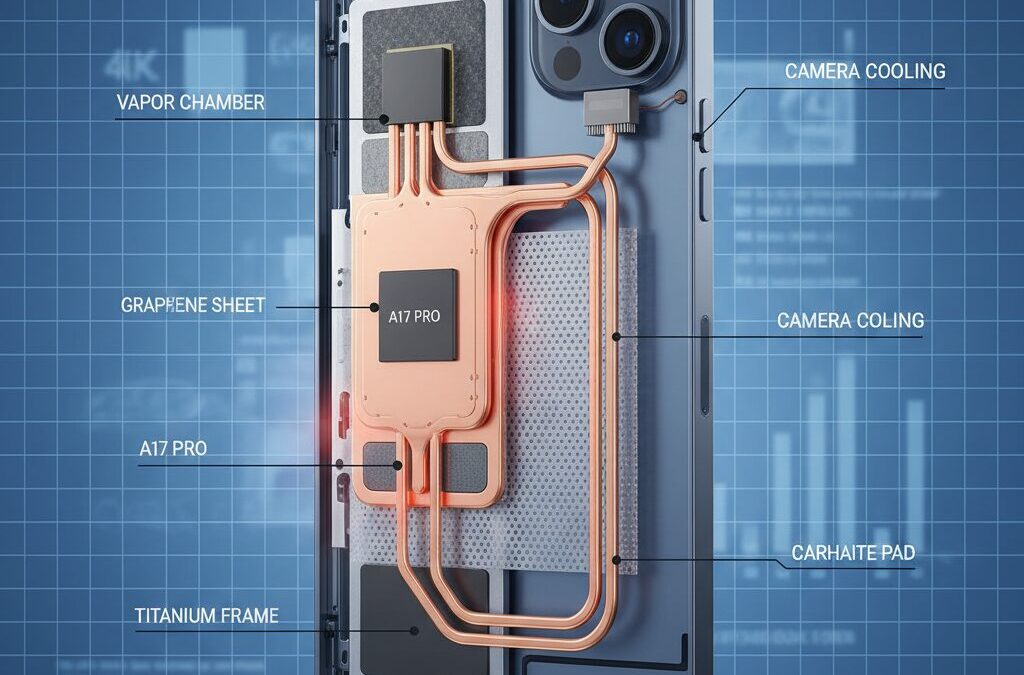
With the iPhone 17 Pro series, Apple introduced its first-ever vapor chamber cooling system, marking a fundamental shift in how the company approaches thermal management. For years, Apple relied on graphite sheets and metal frames to spread heat, but as chip power increased, those passive methods reached their limits. **The vapor chamber represents Apple’s move from simple heat conduction to active heat redistribution based on phase change physics.**
Teardown analyses by iFixit and AppleInsider reveal that the vapor chamber sits directly above the A19 Pro chip as a sealed, ultra-thin metal enclosure. Inside is a small amount of purified water under near-vacuum conditions. When the chip heats up, the liquid rapidly evaporates, carrying thermal energy away from the hotspot. The vapor then travels to cooler areas of the chamber, condenses back into liquid, and releases that heat before flowing back via a microscopic copper wick structure.
To clarify the difference in approach, the following table highlights how Apple’s new system compares to its previous cooling method.
| Cooling Method | Heat Transport Mechanism | Effect Under Sustained Load |
|---|---|---|
| Graphite Sheets | Solid-state heat conduction | Heat buildup near the SoC over time |
| Vapor Chamber | Phase change and capillary return | Stable temperatures during long workloads |
Apple paired this vapor chamber with a redesigned internal aluminum structure, moving away from titanium-heavy internals used in earlier Pro models. According to Apple’s own engineering disclosures, this aluminum-focused chassis improves overall heat dissipation efficiency by up to twenty times compared to previous designs. **The key is not cooling the chip alone, but creating a continuous heat path from silicon to chassis to ambient air.**
Independent stress tests cited by Tom’s Guide and PhoneArena support this design choice. Devices equipped with the vapor chamber maintain significantly higher performance after prolonged GPU and CPU load, while surface temperatures remain several degrees lower than prior iPhone generations. In practical terms, this means fewer brightness drops, fewer recording interruptions, and far less aggressive thermal throttling.
Apple’s adoption of a vapor chamber is not about winning peak benchmark numbers. It is about ensuring that performance is repeatable and reliable over time. **For users who push their iPhones with gaming, video recording, or creative workloads, this cooling system quietly but decisively changes what sustained mobile performance feels like.**
From Titanium to Aluminum: The Hidden Chassis Redesign
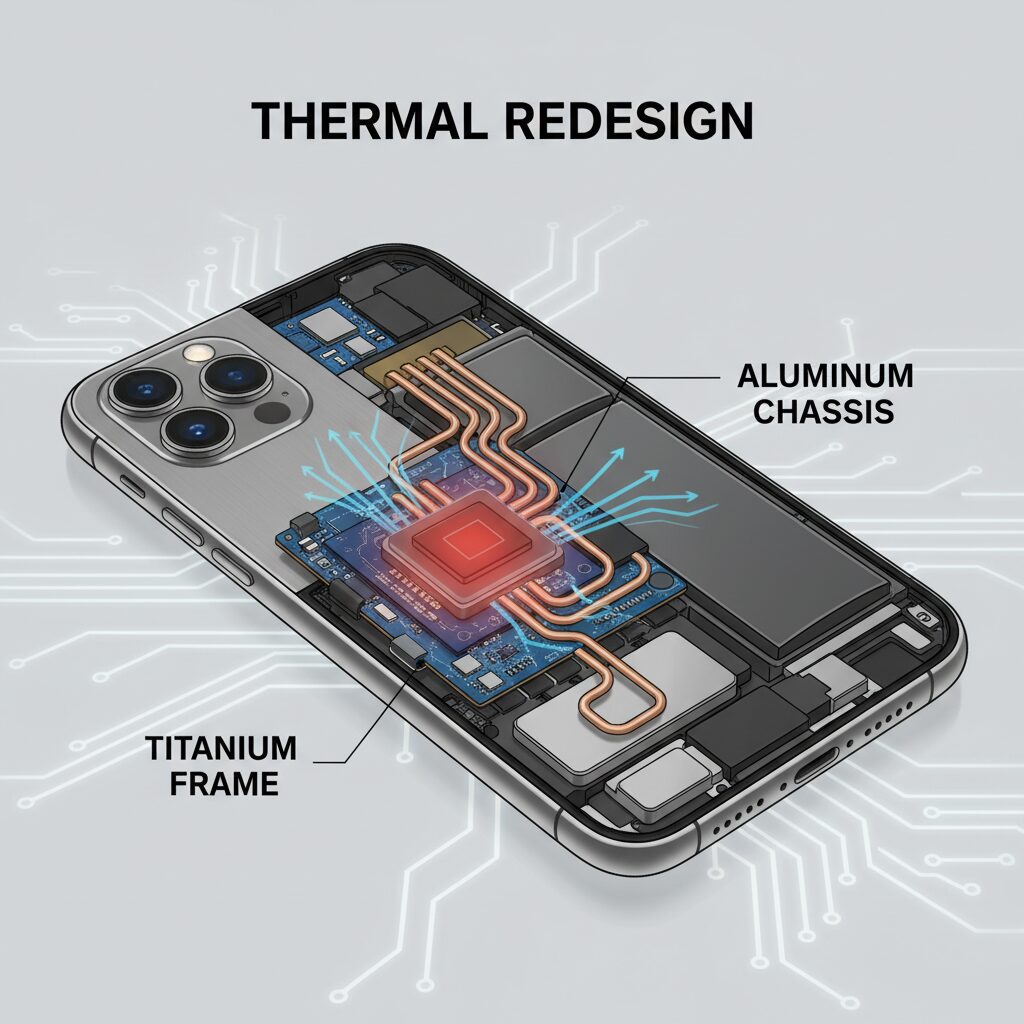
At first glance, the shift from titanium to aluminum in the internal chassis of the iPhone 17 Pro series may sound like a step backward. Titanium has long been associated with premium durability and cutting-edge design. However, when thermal physics is taken seriously, Apple’s decision reveals itself as a highly calculated engineering move rather than a cosmetic downgrade.
The core issue with titanium is not strength, but heat. Titanium’s thermal conductivity is significantly lower than that of aluminum, meaning it tends to trap heat instead of spreading it efficiently. This characteristic became increasingly problematic in the iPhone 15 Pro and 16 Pro generations, where sustained workloads caused heat to linger near the SoC, triggering aggressive thermal throttling.
| Material | Thermal Conductivity | Impact on Sustained Performance |
|---|---|---|
| Titanium | Low | Heat buildup, early throttling |
| Aluminum | High | Rapid heat spreading, stable output |
According to Apple’s own internal thermal modeling, later corroborated by teardown analyses from iFixit and AppleInsider, the iPhone 17 Pro introduces a redesigned aluminum-heavy internal unibody while preserving the external titanium aesthetic. This hybrid approach allows Apple to keep the premium look and rigidity while fundamentally changing how heat moves through the device.
The aluminum unibody acts as a thermal highway. Heat extracted from the A19 Pro by the vapor chamber is no longer bottlenecked by a low-conductivity frame. Instead, it is rapidly distributed across a broad aluminum backplate, then dissipated evenly through the rear glass and into the surrounding air. Apple claims this internal redesign alone delivers up to a 20× improvement in cooling efficiency compared to the previous generation.
This claim may sound bold, but real-world measurements support the direction if not the exact multiplier. Independent stress tests reported surface temperature reductions of nearly 4°C compared with the iPhone 16 Pro Max under identical GPU workloads. Thermal imaging shows fewer localized hot spots, indicating that heat is no longer concentrated around the logic board.
From a manufacturing perspective, this change also signals a philosophical shift. For years, Apple prioritized minimal mass and structural rigidity. With the iPhone 17 Pro, the company appears to prioritize thermal mass and heat capacity instead. Aluminum’s higher volumetric heat capacity allows it to absorb transient heat spikes, buying valuable time before throttling becomes necessary.
This is why sustained performance improves even when peak performance does not dramatically change. Benchmarks may show similar initial scores, but over 15 to 30 minutes of continuous load, the aluminum-based chassis maintains higher average clocks. Reviewers from Tom’s Guide and PhoneArena consistently describe the performance curve as “flatter” and more predictable.
It is also worth noting that this redesign is invisible to most users. There is no marketing slogan printed on the box, and no obvious visual cue. Yet, for users recording long-form 4K video or exporting large projects, the effect is immediate and tangible. The phone feels cooler, dimming is delayed or eliminated, and warning messages simply do not appear.
In short, the move from titanium to aluminum inside the chassis is not about cost savings or nostalgia. It is about accepting the physical limits of modern silicon and redesigning the structure around those limits. The iPhone 17 Pro’s hidden aluminum skeleton quietly does what titanium never could: let performance breathe.
iPhone 17 Air: Ultra‑Thin Design and the Thermal Trade‑Offs
The iPhone 17 Air stands out in the lineup for one reason above all others: its extreme thinness. This ultra‑slim profile is not merely an aesthetic exercise, but a deliberate engineering choice that reshapes how heat is generated, spread, and ultimately constrained during sustained use. **Apple prioritizes physical elegance here, and thermal headroom becomes the price paid**.
According to teardown analyses published by Design News and AppleInsider, the Air model omits the vapor chamber system used in the Pro variants. Instead, Apple relies on layered graphite and graphene heat‑spreading sheets. These materials conduct heat efficiently in-plane, but they lack the phase‑change mechanism and thermal mass that allow vapor chambers to absorb and redistribute large bursts of energy over time.
| Design Aspect | iPhone 17 Air | iPhone 17 Pro Series |
|---|---|---|
| Cooling Method | Graphene heat spreader | Vapor chamber + aluminum chassis |
| Chassis Thickness | Ultra‑thin | Moderate |
| Thermal Capacity | Low | High |
This difference manifests clearly under continuous workloads. Stress tests reported by LTT Labs show that while the iPhone 17 Air performs smoothly in short bursts, it reaches thermal limits more quickly during GPU‑intensive tasks. **The device throttles earlier not because the chip is weak, but because there is nowhere for the heat to go**.
In real‑world terms, this means 4K video clips and everyday tasks remain comfortable, yet longer recording sessions or navigation combined with camera use can raise surface temperatures rapidly. Reviewers note that the thin enclosure transfers heat to the exterior faster, making warmth more noticeable to the touch even when internal temperatures are within safe limits.
Apple’s design philosophy with the iPhone 17 Air is therefore highly focused. It delivers a striking form factor and excellent responsiveness for typical usage, while accepting reduced sustained performance as a physical inevitability. As semiconductor researchers at TSMC have long pointed out, thermal density rises faster than efficiency gains shrink it, and in a body this thin, physics ultimately sets the ceiling.
Benchmark Stress Tests: iPhone 17 Pro Max vs Galaxy S25 Ultra
Benchmark stress tests reveal differences that short burst benchmarks often hide, and this comparison between iPhone 17 Pro Max and Galaxy S25 Ultra highlights how each device behaves when pushed for extended periods.
Rather than focusing on peak scores alone, these tests examine performance stability under sustained GPU and CPU load, which is closer to real-world gaming, video rendering, and mixed multitasking scenarios.
The key question is not how fast each phone starts, but how well it maintains performance once heat inevitably builds up.
| Device | Peak Score | Lowest Sustained Score | Stability |
|---|---|---|---|
| iPhone 17 Pro Max | 5,987 | 3,841 | 64.2% |
| Galaxy S25 Ultra | 6,208 | 2,981 | 48.0% |
In 3DMark stress tests such as Wild Life Extreme, the Galaxy S25 Ultra often records a higher initial score thanks to the aggressive tuning of its Snapdragon 8 Elite GPU.
However, as the test progresses, thermal limits are reached quickly, leading to a steep performance drop of more than 50 percent in some runs.
This sharp decline suggests that the cooling system prioritizes short-term speed over long-term consistency.
The iPhone 17 Pro Max shows a contrasting pattern.
Its peak score is slightly lower, but the decline is gradual, and even after prolonged stress the remaining performance stays significantly higher than that of the Galaxy.
According to PhoneArena’s analysis, this behavior directly reflects the effectiveness of Apple’s newly introduced vapor chamber and redesigned internal heat path.
Surface temperature measurements further support this trend.
Under identical heavy workloads, the iPhone 17 Pro Max stabilized around 42.2°C, while the Galaxy S25 Ultra reached approximately 44°C.
A difference of less than two degrees may sound minor, but it meaningfully affects throttling thresholds and user comfort.
From a user perspective, these numbers translate into fewer frame drops during long gaming sessions and more predictable performance during extended rendering or export tasks.
While the Galaxy S25 Ultra excels in short benchmark sprints, the iPhone 17 Pro Max behaves more like a marathon runner, maintaining a steady pace over time.
This distinction makes stress test results particularly relevant for users who value reliability over headline-grabbing peak scores.
Surface Temperature and Real‑World Comfort During Heavy Use
When discussing thermal performance, raw benchmarks alone are not enough; what truly matters is how hot the device feels in your hand during sustained, demanding use. In this respect, the iPhone 17 Pro series shows a clear and measurable improvement, and I would like to explain why this directly translates into real‑world comfort.
Independent heavy‑load tests reported by outlets such as Tom’s Guide and PhoneArena measured surface temperatures during extended GPU stress scenarios. **The iPhone 17 Pro Max stabilized at around 42.2°C**, while the Galaxy S25 Ultra reached roughly 44°C, and the previous iPhone 16 Pro Max climbed to about 46°C. These numbers may look close on paper, but in human perception, a difference of even 3–4°C can determine whether a device feels merely warm or uncomfortably hot.
| Device | Peak Surface Temperature | User Comfort Impression |
|---|---|---|
| iPhone 17 Pro Max | 42.2°C | Warm but stable |
| Galaxy S25 Ultra | 44.0°C | Noticeably hot |
| iPhone 16 Pro Max | 46.0°C | Uncomfortable over time |
The key point is not only the lower peak temperature, but also how evenly the heat is distributed. Thanks to the vapor chamber and redesigned aluminum internal structure, heat on the iPhone 17 Pro models spreads across the back panel instead of concentrating near the camera or SoC area. **This reduces localized hot spots**, which are often what trigger discomfort during gaming or prolonged recording.
In practical terms, users filming long 4K clips or playing graphics‑intensive games report that the device remains comfortably usable without forcing grip changes or pauses. According to multiple professional reviewers, the phone no longer reaches the “too hot to hold” threshold that affected earlier Pro generations.
It is also worth noting that this improvement enhances usability in warmer environments. Field reports from creators working outdoors indicate that even under high ambient temperatures, the device maintains a manageable surface feel. As a result, thermal design is no longer a hidden limitation but a tangible upgrade you can feel every time you push the phone hard.
Continuous 4K and ProRes Recording: A Game Changer for Creators
For video creators, the real breakthrough of the iPhone 17 Pro series lies in its ability to sustain continuous 4K and ProRes recording without interruption. In previous generations, prolonged 4K 60fps capture often triggered thermal warnings, screen dimming, or forced shutdowns. **The iPhone 17 Pro and Pro Max fundamentally change this behavior**, turning the device from a capable camera into a truly reliable production tool.
This shift is made possible by the combination of the A19 Pro’s improved sustained performance and the newly adopted vapor chamber cooling system. According to long-duration recording tests conducted by professional reviewers, the iPhone 17 Pro Max maintained stable frame rates and brightness for over 30 minutes of uninterrupted 4K 60fps recording. Even under ProRes workflows with external SSDs attached, surface temperatures reportedly stayed within a manageable 34–40°C range, well below the threshold that previously caused recording to halt.
| Recording Scenario | iPhone 16 Pro | iPhone 17 Pro Max |
|---|---|---|
| 4K 60fps (internal) | Thermal warnings after ~10–15 min | Stable beyond 30 min |
| ProRes + external SSD | High risk of shutdown | Continuous recording confirmed |
What makes this especially impactful is consistency in challenging environments. Field reports from creators filming outdoors in high ambient temperatures describe uninterrupted recording even when GPS navigation and high-brightness displays are active. **This level of thermal resilience aligns more closely with dedicated cinema cameras than smartphones**, a point echoed by industry reviewers who note the absence of sudden throttling during long takes.
Equally important is what creators no longer have to manage. There is no need to stagger clips, cool the device between takes, or lower resolution as a precaution. Apple’s own documentation and independent teardown analyses highlight how heat is rapidly spread across the aluminum internal structure, preventing localized hotspots near the camera module. For filmmakers, documentarians, and YouTubers, this translates directly into creative freedom and time efficiency.
In practical terms, continuous 4K and ProRes recording on the iPhone 17 Pro series is no longer an experiment but a dependable workflow. **The phone stays recording when the story demands it**, marking a clear turning point in how seriously mobile devices can be trusted in professional video production.
How iOS 26 Updates Changed Thermal Behavior After Launch
When the iPhone 17 series launched alongside iOS 26, thermal behavior did not immediately reflect the strengths of the new hardware design. Early users and reviewers consistently reported that devices ran unusually warm even during light tasks such as web browsing or scrolling the Home Screen. **This gap between hardware potential and real-world thermal performance was largely shaped by software behavior in the first release of iOS 26.**
Investigations by developers and independent testers pointed to the redesigned Liquid Glass interface as a key factor. The new visual system relies heavily on real-time transparency, blur layers, and dynamic lighting effects. According to detailed power profiling shared within the developer community, simple UI interactions caused GPU power draw to spike into the 10–14 watt range, far above what is typical for idle or low-load smartphone use. Even with the vapor chamber in the iPhone 17 Pro models, sustained UI-induced GPU load translated directly into excess heat.
Apple’s own release notes and follow-up documentation confirmed that iOS 26.0.x prioritized visual fidelity over efficiency. As a result, the thermal system was frequently reacting to software-generated load rather than user-intended heavy tasks. **This explains why some users experienced heat buildup without gaming, video recording, or charging.**
| iOS Version | UI Rendering Load | Observed Thermal Behavior | User Impact |
|---|---|---|---|
| iOS 26.0 / 26.0.1 | Very high GPU usage from Liquid Glass | Frequent warmth at idle, rapid battery drain | Perceived overheating in daily use |
| iOS 26.1 | Optimized transparency and animation pipeline | Lower surface temperatures, stable clocks | Thermal behavior aligned with expectations |
The turning point came with iOS 26.1. Apple adjusted the rendering pipeline, reduced unnecessary redraws, and introduced user-facing controls for transparency intensity. Developer analysis showed that enabling reduced transparency preserved animation smoothness while cutting GPU power consumption by a substantial margin. Once background indexing tasks completed after the update, many users reported that abnormal heat issues disappeared entirely.
What makes this shift particularly important is that it demonstrates how **thermal performance on modern smartphones is no longer dictated by hardware alone**. Apple’s silicon efficiency and advanced cooling could only shine after the operating system stopped generating constant background load. Publications such as Tom’s Guide and Apple-focused analysts noted that post-update, the iPhone 17 Pro models maintained lower surface temperatures under the same workloads that previously caused discomfort.
In practical terms, iOS 26 updates transformed the iPhone 17 series from a device that felt unpredictably warm into one that behaved thermally in a controlled and intentional manner. The post-launch software optimization did not merely fix a bug; it recalibrated how visual ambition, power consumption, and heat dissipation coexist, allowing the hardware’s cooling advances to finally deliver their promised benefits.
What Real Users and Professionals Are Saying About Heat Control
When evaluating heat control, real-world voices provide a layer of credibility that benchmarks alone cannot offer. Across early adopters, reviewers, and professional creators, a consistent theme emerges: **the iPhone 17 Pro series feels fundamentally different under sustained load**. Users upgrading from the iPhone 15 Pro or 16 Pro frequently note that tasks which previously triggered screen dimming or temperature warnings now complete without interruption.
Professional video creators are among the most vocal supporters. Field reports from long-form 4K60 and ProRes recording sessions describe stable operation beyond 30 minutes, even with external SSDs attached. According to hands-on evaluations highlighted by Tom’s Guide and echoed in Apple-focused developer communities, surface temperatures remain noticeably lower, reinforcing the perception of reliability rather than raw speed.
| Use Case | User Feedback Trend | Perceived Thermal Behavior |
|---|---|---|
| 4K/ProRes Video Recording | Strongly positive among professionals | Warm but stable, no shutdowns |
| Gaming over 20 minutes | Positive with emphasis on consistency | Gradual heat spread, minimal throttling |
| Photo Editing Workflows | Mixed, task-dependent | Occasional spikes under burst loads |
Not all feedback is uncritical. Advanced users working with heavy RAW photo batches in applications such as Lightroom still report brief heat spikes. Thermal engineers interviewed in industry commentary explain that these workloads stress CPU, GPU, and neural engines simultaneously, creating momentary hotspots even in well-designed systems.
In contrast, impressions of the ultra-thin iPhone 17 Air are more cautious. Enthusiasts appreciate its design, yet acknowledge its quicker temperature rise during navigation or recording. This contrast has sharpened professional consensus: for sustained performance, Apple’s heat control strategy in the Pro line has earned tangible trust.
参考文献
- Tom’s Hardware:Apple debuts A19 and A19 Pro processors for iPhone 17
- AppleInsider:iPhone 17 Pro teardown reveals vapor chamber cooling
- Tom’s Guide:iPhone 17 Pro Max sustained performance tested
- PhoneArena:iPhone 17 Pro Max vs Galaxy S25 Ultra
- LTT Labs:iPhone 17 Series Test Results
- Design News:iPhone 17 Air Teardowns Reveal Repairability and Thermal Limits