
Smartphones are no longer disposable gadgets. Flagship models now cost well over $1,000, and foldables approach the price of a premium laptop. As devices become more powerful and more expensive, repair costs are rising just as dramatically, turning a cracked screen or worn-out battery into a serious financial decision.
In Japan, screen replacements for high-end phones can exceed $400, while logic board repairs on foldables can climb past $800. At the same time, users are keeping their devices longer than ever—often three to four years—because performance improvements no longer justify annual upgrades.
This article explores the full structure of the 2026 smartphone repair economy, from technical black boxes and parts pairing restrictions to insurance math and right-to-repair barriers. If you care about gadgets, resale value, and long-term ownership strategy, you will discover how to minimize risk and make smarter decisions in the age of ultra-expensive mobile hardware.
- From Disposable Gadget to High-Value Asset: The New Role of Smartphones
- How Expensive Is a Repair in 2026? Real Pricing from Flagship Devices
- Why Foldables Carry Extreme Repair Risk
- The Hidden Engineering Behind Soaring Repair Costs
- Waterproofing, Adhesives, and the 90-Minute Battery Swap
- Parts Pairing and Software Locks: The Rise of Serialized Components
- Right to Repair vs. Regulation: Why Japan Faces Unique Barriers
- Users Are Waiting Longer to Upgrade: Data on the 3–4 Year Cycle
- Battery Degradation as the #1 Upgrade Trigger
- Insurance Economics: When Does Coverage Actually Pay Off?
- Carrier Protection vs. Third-Party Mobile Insurance
- Resale Value, Official Repairs, and Long-Term Ownership Strategy
- Sustainability Pressure and the Expanding Global Repair Market
- Future Innovations: Modular Design and Self-Healing Materials
- 参考文献
From Disposable Gadget to High-Value Asset: The New Role of Smartphones
Smartphones are no longer disposable gadgets that you casually replace every two years. Today, they function as high-value personal assets that demand strategic ownership.
In Japan, flagship models now exceed 200,000 yen, and foldable devices approach 300,000 yen. At that price level, a smartphone competes with premium home appliances or even entry-level motorcycles in terms of financial weight.
This structural shift has fundamentally changed how we perceive damage, repair, and lifecycle value.
A modern smartphone is not just a communication tool — it is a capital asset with maintenance costs, depreciation risk, and resale value.
Repair pricing illustrates this transformation clearly. For example, replacing the logic board of a foldable flagship such as the Pixel 10 Pro Fold can exceed 125,000 yen according to official service pricing from iCracked. That single repair rivals the cost of a new mid-range device.
Even mainstream models are no exception. A display repair for devices like the Pixel 8a approaches 23,980 yen, while iPhone 16 Pro screen repairs are listed around 55,800 yen when using genuine parts through authorized channels.
These numbers redefine what “damage” means financially.
| Repair Item | Approximate Cost (JPY) | Asset Impact |
|---|---|---|
| Logic Board (Foldable) | 125,000+ | Comparable to new mid-range phone |
| Flagship Display | 55,000+ | Major capital loss event |
| Battery Replacement | 19,000–26,000 | Life-extension investment |
According to the NTT Docomo Mobile Society Research Institute, smartphone penetration in Japan has reached 97 percent. The market is fully saturated, which means growth no longer comes from new users but from replacement cycles.
At the same time, survey data shows that nearly 40 percent of users now replace their phones after about three years, and average usage has stretched toward four years or more. This is classic durable-goods behavior.
The psychology has shifted accordingly. Over 76 percent of respondents say replacing a phone within two years feels wasteful. That sentiment only emerges when a product is perceived as an asset rather than a consumable.
The consequence is simple but profound: ownership now includes risk management. A cracked display is no longer a minor inconvenience — it can represent a five-figure financial shock. A motherboard failure can erase over 100,000 yen in value overnight.
In economic terms, smartphones have entered the category of depreciating capital goods. They require maintenance, protection strategies, and sometimes insurance-like hedging decisions.
This evolution reshapes consumer behavior. Buyers evaluate resale value, authorized repair history, and long-term software support before purchase. The device in your pocket is now part of your balance sheet.
Understanding this new role is essential. Once you recognize your smartphone as a high-value asset, every decision — from case selection to repair channel choice — becomes a strategic financial move rather than a casual tech preference.
How Expensive Is a Repair in 2026? Real Pricing from Flagship Devices
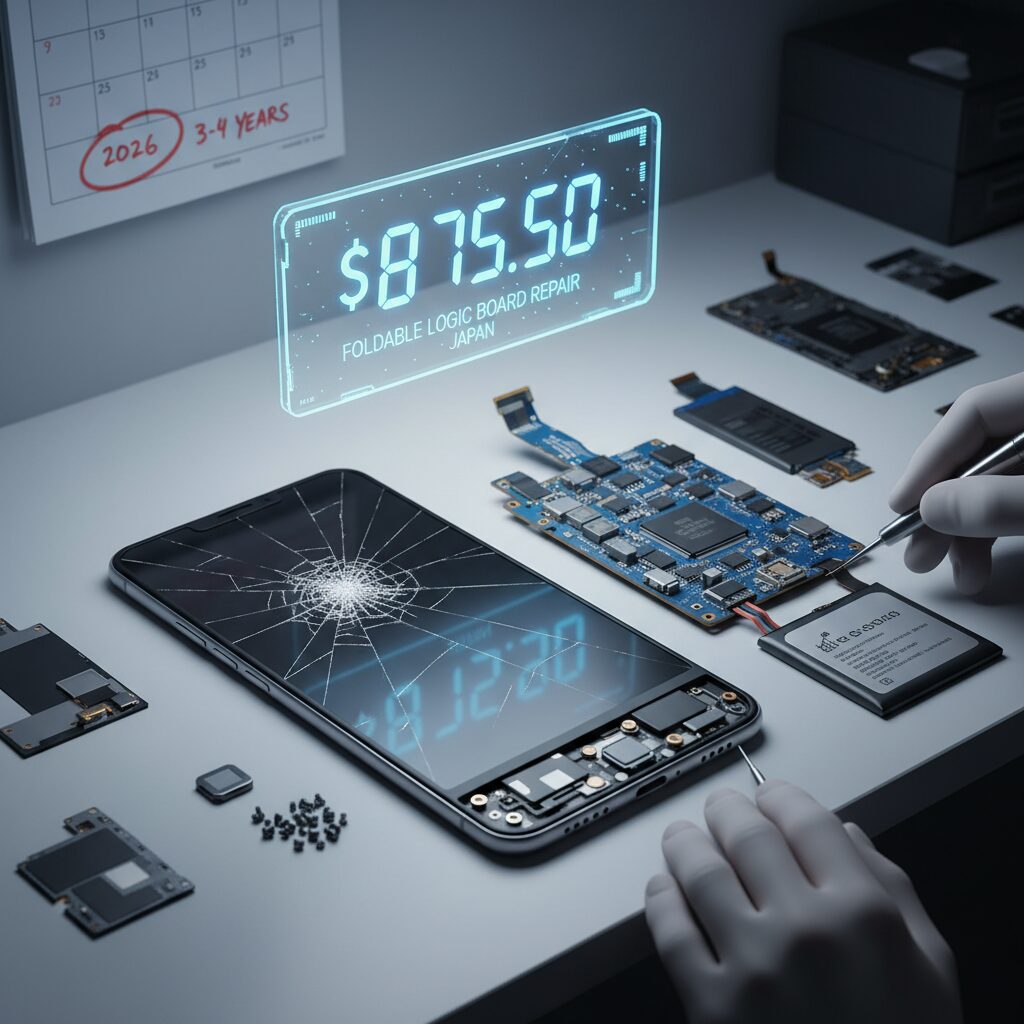
In 2026, smartphone repair costs have reached a level that fundamentally changes how we think about ownership. What used to be a minor inconvenience costing a few thousand yen has become a financial decision that can rival buying a new mid-range device. Flagship models in particular reveal just how expensive a single accident can be.
The data from authorized repair provider iCracked shows how steep the reality is for current premium devices in Japan. When you look at actual listed prices for parts replacement, the numbers are difficult to ignore.
| Device | Screen Repair | Battery Replacement | Logic Board Repair |
|---|---|---|---|
| iPhone 16 Pro | 55,800円 | 19,400円 | – |
| Pixel 10 Pro Fold | 33,880円 (outer) | 26,180円 | 125,180円 (512GB) |
| Pixel 8a | 23,980円 | – | 66,880円 (128GB) |
The most shocking figure is the Pixel 10 Pro Fold’s logic board replacement at 125,180円. Because modern smartphones integrate the SoC, RAM, storage, and communication modules into a single high-density board, failure means replacing the entire core. This “all-or-nothing” design structure is one of the biggest drivers of soaring repair costs.
Screen repairs are no longer simple glass swaps either. The iPhone 16 Pro’s 55,800円 display repair reflects its integrated Super Retina XDR panel with ProMotion and sensor assemblies. According to repair pricing disclosed by independent repair providers using genuine parts, the entire display module must be replaced as a unit, leaving little room for partial fixes.
Foldable devices introduce another layer of risk. Even replacing only the outer display of the Pixel 10 Pro Fold costs 33,880円, while rear panel damage reaches 28,380円. When two displays and a hinge mechanism are involved, the probability and financial impact of damage both increase.
Even more revealing is the mid-range segment. The Pixel 8a, positioned as a more affordable option, still carries a 66,880円 logic board repair cost. In relative terms, that can represent a substantial percentage of the device’s retail price. For many users, the repair-to-replace calculation becomes psychologically tilted toward buying new.
Battery replacement, once a low-cost way to extend lifespan, now sits near 20,000円 for premium models like the iPhone 16 Pro and over 26,000円 for the Pixel 10 Pro Fold. Considering that many users upgrade primarily due to battery degradation, this price point turns routine maintenance into a strategic decision.
As Japan’s smartphone penetration has reached 97% according to NTT Docomo’s Mobile Society Research Institute, the market is fully mature. With average usage periods extending beyond three years, repair pricing is no longer a niche concern. It directly shapes ownership economics.
The takeaway is clear: in 2026, flagship repair costs are not incidental expenses. They are high-stakes financial events that can exceed 100,000円 in worst-case scenarios. For gadget enthusiasts investing over 200,000円 in a device, understanding these real-world repair numbers is no longer optional—it is essential to making rational upgrade and protection decisions.
Why Foldables Carry Extreme Repair Risk
Foldable smartphones are marketed as the pinnacle of mobile innovation, but from a repair economics perspective, they carry significantly higher structural risk than conventional slab devices.
When a single failure can trigger a five-figure repair bill, ownership shifts from excitement to exposure. That risk is not theoretical. It is already visible in official repair pricing.
The combination of dual displays, complex hinge systems, and ultra-dense internal architecture creates a repair profile that is fundamentally more fragile and more expensive.
| Component (Pixel 10 Pro Fold) | Repair Cost (JPY) | Risk Characteristic |
|---|---|---|
| Logic Board (512GB) | 125,180 | All-or-nothing replacement |
| Outer Display | 33,880 | High exposure to impact |
| Rear Camera Module | 43,780 | Precision optical assembly |
According to iCracked’s official repair pricing as of 2026, replacing the logic board alone exceeds 125,000 yen. That figure rivals the cost of an entire midrange smartphone or even a laptop.
Unlike older devices where individual chips could theoretically be serviced, modern foldables integrate SoC, memory, storage, and communication modules into a single high-density board. A localized failure often means total board replacement.
This “all-or-nothing” architecture dramatically amplifies financial downside.
The display structure introduces a second layer of vulnerability. Foldables contain both an external screen and a large flexible internal OLED panel. Each layer adds surface area, exposure points, and mechanical stress variables.
The hinge mechanism—an engineering achievement in itself—also becomes a failure multiplier. It must endure repeated folding cycles while maintaining dust resistance and display alignment.
Even minor misalignment or particulate intrusion can cascade into screen damage, making foldables mechanically more complex and statistically more exposed.
There is also a hidden economic dimension: foldables sit at the very top of pricing tiers, often approaching 300,000 yen at launch. As device value increases, repair pricing scales accordingly because replacement parts are premium-tier components.
Camera systems, for instance, continue to grow in sensor size and stabilization complexity. The 43,780 yen rear camera repair cost reflects not just glass replacement, but recalibration of precision optical hardware.
When combined with currency pressures and imported component costs, particularly under prolonged yen weakness, parts pricing compounds further.
Finally, foldables face a resale sensitivity problem. Because resale value depends heavily on cosmetic and structural integrity, even minor hinge wear or display creasing can materially reduce secondary market price.
This creates a double penalty: higher probability of expensive repair and greater depreciation if left unrepaired.
Owning a foldable is not just a hardware decision. It is a high-stakes risk allocation choice.
The Hidden Engineering Behind Soaring Repair Costs

Behind every ¥50,000 screen replacement or ¥120,000 logic board swap lies an invisible layer of engineering decisions that most users never see. Modern smartphones are no longer assemblies of easily swappable parts. They are densely integrated systems where performance, thinness, and water resistance are prioritized over modularity.
According to repair pricing disclosed by authorized providers such as iCracked, replacing the logic board of a Pixel 10 Pro Fold can exceed ¥125,000. This is not simply a matter of expensive silicon. It reflects how today’s System on a Chip, memory, storage, and connectivity modules are permanently integrated into a single board, eliminating the possibility of replacing individual components.
The structural shift becomes clearer when you compare older modular designs with current flagship architectures.
| Design Factor | Engineering Goal | Repair Impact |
|---|---|---|
| Adhesive Sealing (IP68) | Water and dust resistance | Heat-assisted opening, resealing labor |
| Stacked Logic Boards | Space efficiency | Full board replacement only |
| Serialized Components | Security & authentication | Software pairing required |
Waterproofing alone adds significant labor complexity. To maintain IP68 standards, manufacturers rely on industrial adhesives and precision gaskets. Opening the device requires controlled heating and specialized tools. After repair, technicians must reapply seals and use pressure systems to restore structural integrity. iCracked’s documented repair times—up to 90 minutes for certain internal replacements—reflect this hidden procedural burden.
Then there is component density. In foldable devices like the Pixel 10 Pro Fold, hinge mechanisms and dual-display assemblies introduce mechanical layers that dramatically increase disassembly steps. What appears to be “just a screen repair” can involve near-complete teardown and recalibration.
Apple’s architecture demonstrates another layer of engineering complexity: serialized parts pairing. Displays, batteries, and cameras are digitally linked to the logic board. Without proprietary configuration tools, the device may display “Unknown Part” warnings or restrict features. This security-oriented design enhances anti-counterfeit protection but effectively turns hardware replacement into a software-dependent process.
Currency dynamics compound the issue. Many high-value components—OLED panels, advanced image sensors, and leading-edge SoCs—are traded globally in U.S. dollars. A weaker yen increases procurement costs, which are ultimately reflected in Japanese repair pricing. The result is a structural cost escalation driven by both engineering and macroeconomics.
In short, soaring repair costs are not accidental. They are embedded in a design philosophy that favors performance density, environmental sealing, and ecosystem control. For gadget enthusiasts, understanding this hidden engineering layer is essential to interpreting why a cracked screen now feels closer to servicing a luxury device than fixing a consumer electronic.
Waterproofing, Adhesives, and the 90-Minute Battery Swap
Modern smartphones achieve IP68-level water and dust resistance, but that durability comes at a cost. To keep water out, manufacturers rely on strong industrial adhesives, precision-cut gaskets, and tightly compressed seals that turn the device into a near-monolithic structure.
According to repair providers such as iCracked, even a routine battery replacement can require up to 90 minutes of labor. The time is not spent only on swapping the cell itself, but on carefully reversing and then restoring this sealed architecture.
The workflow typically begins with controlled heating. Technicians use heat plates or hot air tools to soften the perimeter adhesive that bonds the display or rear glass to the frame. Too little heat, and the panel will crack. Too much, and internal components such as OLED layers or battery cells may be damaged.
Once opened, the device loses its factory seal. From that moment, every step must anticipate the final stage: re-establishing water resistance. This is where adhesive selection and application become critical.
| Stage | Technical Purpose | Risk Factor |
|---|---|---|
| Heating & Opening | Soften waterproof adhesive | Panel cracking, flex damage |
| Battery Removal | Detach stretch-release adhesive | Cell deformation, fire hazard |
| Re-sealing | Restore dust/water barrier | Incomplete adhesion, IP degradation |
Battery removal itself is no longer trivial. Many flagship devices use stretch-release adhesive strips anchored beneath the battery. If these tear during extraction, technicians must carefully pry the cell out, increasing both time and safety precautions.
After replacement, new adhesive frames and sealing tapes must be applied with millimeter precision. The device is then pressed using calibrated tools to ensure uniform pressure distribution. Without this step, micro-gaps can compromise waterproofing.
Industry commentary around Apple’s Self Service Repair program in the United States has highlighted how large and specialized the required equipment can be. Even professional-grade presses and heating modules are sometimes necessary, reinforcing how far modern devices have moved from user-serviceable design.
What used to be a 20-minute battery swap in the early smartphone era has evolved into a procedure involving thermal management, adhesive chemistry, and structural recalibration. The adhesive is no longer glue; it is part of the engineering system that maintains rigidity and environmental resistance.
For consumers, this explains why labor costs are substantial even when the battery component itself is relatively inexpensive. The true expense lies in preserving the device’s original integrity after it has been surgically opened.
The 90-minute battery swap is not inefficiency—it is the price of modern waterproof industrial design.
As devices become thinner and more tightly integrated, adhesives increasingly replace screws and modular fasteners. This trend enhances durability and aesthetics but simultaneously raises the skill threshold for safe repair.
Understanding this trade-off helps clarify why authorized repair providers emphasize controlled environments and certified tools. Waterproofing, adhesive engineering, and structural compression are now inseparable from even the simplest internal replacement.
In the era of sealed smartphones, every battery exchange is effectively a reconstruction project, not a parts swap.
Parts Pairing and Software Locks: The Rise of Serialized Components
One of the most decisive shifts in today’s repair economy is the rise of parts pairing and serialized components. Modern smartphones are no longer just assemblies of interchangeable hardware. Instead, each critical component is cryptographically linked to the device’s logic board, turning repair into a software-controlled process rather than a purely mechanical one.
This practice, often called serialization, assigns a unique identifier to parts such as displays, batteries, and camera modules. That identifier is stored in secure hardware areas like Apple’s Secure Enclave and verified by the operating system after installation. Without proper authorization, the device may still function, but not fully.
The technical flow can be summarized as follows.
| Component | Serialized? | Risk Without Official Pairing |
|---|---|---|
| Display | Yes | True Tone disabled, warning message |
| Battery | Yes | Battery health not displayed |
| Rear Camera | Yes | Feature limitations or alerts |
Even if a replacement part is genuine and harvested from another identical device, the system may flag it as an “Unknown Part” unless it is re-registered through the manufacturer’s proprietary configuration tools. Reports from repair communities and industry observers show that such warnings are persistent and visible in system settings.
More importantly, this is not merely cosmetic. Functional degradation is built into the software layer. In certain cases, features like True Tone calibration or battery maximum capacity indicators disappear. Historically, some models even disabled Face ID after unofficial display replacement. These outcomes shift the value proposition of third-party repair dramatically.
From the manufacturer’s perspective, serialization is positioned as a security and quality-control measure. By tightly coupling hardware and firmware, companies can reduce counterfeit parts, prevent malicious component swaps, and maintain performance calibration standards. Security researchers have acknowledged that component authentication can mitigate certain supply chain attacks.
However, the economic implications are profound. Independent repair shops without access to official pairing tools face structural disadvantages. Authorized providers such as IRPs can complete system configuration through cloud-based tools, but their pricing often aligns closely with official service centers, limiting cost competition.
This creates a controlled ecosystem in which repair is technically possible but economically gated. The presence of serialized components transforms what used to be a parts market into a permissions market. Hardware availability alone is no longer sufficient; software authorization becomes the real currency.
For resale value, the impact is equally significant. Devices carrying a recorded “Unknown Part” history may experience reduced trade-in value or rejection in secondary markets. As a result, consumers must evaluate not only immediate repair costs but also long-term asset depreciation tied to serialization status.
Parts pairing represents a fundamental redesign of repairability in the smartphone era. It embeds control at the firmware level, reshaping incentives across manufacturers, authorized networks, independent technicians, and end users. In this environment, the question is no longer whether a component can be physically replaced, but whether it can be digitally accepted.
Right to Repair vs. Regulation: Why Japan Faces Unique Barriers
While the global Right to Repair movement is gaining momentum, Japan faces structural and legal barriers that make the debate uniquely complex.
In the United States and parts of Europe, legislation increasingly pushes manufacturers to provide parts, tools, and manuals to consumers and independent repair shops. In contrast, Japan’s regulatory environment creates friction at the intersection of radio law, certification, and market practice.
The issue in Japan is not simply manufacturer resistance—it is the collision between repair freedom and strict telecommunications regulation.
Regulatory Constraints Unique to Japan
| Factor | Impact on Self-Repair | Practical Consequence |
|---|---|---|
| Technical Conformity Mark (Giteki) | Device must comply with radio law after modification | Self-repair may risk invalidating certification |
| Registered Repair System | Only certified businesses can ensure compliance | Individuals lack a clear legal pathway |
| Component Pairing | Software locks require manufacturer authorization | Functional limitations after unofficial repair |
The most significant barrier is Japan’s Technical Conformity Certification system. Devices with wireless functionality must maintain compliance under the Radio Act. If a consumer disassembles and modifies a device, questions arise about whether the original certification remains valid.
Although registered repair businesses can operate within regulatory boundaries, there is no practical framework for individuals to re-certify a repaired device. This creates legal ambiguity that discourages manufacturer-supported self-repair programs.
As industry observers have pointed out, even if parts and manuals were made available domestically, post-repair compliance would remain a gray zone under current law.
Market Structure and Manufacturer Control
Japan’s repair ecosystem is also shaped by manufacturer-driven serialization systems. As documented in user reports and repair industry analyses, replacing displays, batteries, or cameras without authorized system configuration can trigger “Unknown Part” warnings or disable features such as True Tone or battery health indicators.
This technical architecture effectively ties hardware legitimacy to cloud-based authorization. Independent shops without official access cannot fully restore device functionality, even when using genuine donor parts.
The result is a de facto gatekeeping system where regulatory rigidity and software-level controls reinforce each other.
Unlike in some Western markets, Japan’s high smartphone penetration rate—97% according to NTT Docomo’s Mobile Society Research Institute—means the market is mature and replacement-driven. Consumers are not demanding radical repair experimentation; they prioritize stability and resale value.
Because resale prices drop significantly when “Unknown Part” histories are recorded, many users avoid unofficial repair channels. This economic pressure reduces grassroots momentum for aggressive Right to Repair reform.
In other words, the Japanese barrier is not cultural reluctance alone. It is a system where telecommunications law, certification logistics, serialization technology, and resale economics collectively constrain repair freedom.
Until regulatory reform clarifies post-repair compliance standards and separates safety concerns from manufacturer ecosystem control, Japan’s Right to Repair debate will remain structurally different from that of the US or EU.
Users Are Waiting Longer to Upgrade: Data on the 3–4 Year Cycle
The era of two-year upgrades is effectively over. In Japan’s fully saturated smartphone market, users are holding onto their devices longer than at any point in the past decade.
According to NTT Docomo’s Mobile Society Research Institute, smartphone penetration reached 97% in 2024. This means growth no longer comes from first-time buyers, but almost entirely from replacement demand.
What stands out is the clear shift toward a 3–4 year replacement cycle.
| Survey Indicator | Result | Implication |
|---|---|---|
| Most common upgrade timing | “Around 3 years” (39.7%) | 3 years becoming the norm |
| Combined 3–4 year users | 51% | Majority extend beyond 2 years |
| View on 2-year upgrades | 76.5% say “wasteful” | Psychological resistance to short cycles |
| Average usage period (Cabinet Office) | 4.5 years | Smartphones as durable goods |
Press release data cited by PR TIMES shows that 39.7% of users replace their smartphones “around three years,” while 51% report upgrading every three to four years. The Cabinet Office’s consumer trend survey places the average usage period at 4.5 years.
In practical terms, the 3–4 year cycle has become the new standard.
This is not merely about frugality. It reflects structural changes in hardware performance. Devices released three years ago still handle messaging, streaming, social media, and even high-resolution photography without noticeable lag. Performance gains between generations have become incremental rather than transformative.
Equally important is the pricing environment. With flagship models exceeding 200,000 yen and foldables approaching 300,000 yen, consumers increasingly treat smartphones as high-value assets rather than disposable gadgets.
When 76.5% of respondents say upgrading within two years feels “wasteful,” that sentiment signals a deeper behavioral shift. Users now calculate opportunity cost. They compare marginal improvements in camera zoom or AI features against six-figure price tags.
Repair economics also reinforce this cycle. If a battery replacement costs around 20,000 yen, many users prefer extending device life by another year or two instead of committing to a full replacement. The logic becomes: delay the 200,000 yen expense by spending a fraction on maintenance.
The longer upgrade cycle is therefore not accidental; it is economically rational.
For manufacturers and carriers, this creates tension. Revenue models historically relied on predictable two-year turnover. Now, elongated ownership compresses sales frequency and increases competition for each replacement decision.
For consumers, however, the 3–4 year cycle represents empowerment. In a mature, saturated market, users are no longer upgrading on autopilot. They are waiting, comparing, and timing their purchases strategically.
The data makes one point unmistakable: smartphones have crossed the line from trend-driven electronics to long-term personal infrastructure. And infrastructure is not replaced lightly.
Battery Degradation as the #1 Upgrade Trigger
For today’s smartphone users, battery degradation has quietly become the single most powerful upgrade trigger. According to survey data cited in PR TIMES reports, the top reason for replacing a device is not performance slowdown or OS support limits, but the simple fact that the battery no longer lasts a full day. This shift reveals a crucial truth: modern smartphones are functionally durable, yet energetically fragile.
As chip performance has plateaued for everyday tasks, even a three- or four-year-old flagship remains fast enough for social media, streaming, and productivity apps. However, lithium-ion batteries are chemically consumable components. With each charge cycle, internal resistance increases and maximum capacity declines. Over time, users experience sudden shutdowns, aggressive power throttling, and the anxiety of constantly searching for a charger.
If performance no longer forces upgrades, battery health does.
The economic tension becomes clearer when examining real repair pricing in Japan as of 2026.
| Device | Battery Replacement Cost |
|---|---|
| iPhone 16 Pro | 19,400 yen |
| Pixel 10 Pro Fold | 26,180 yen |
Spending around 20,000 to 26,000 yen to restore endurance sounds rational compared to buying a 200,000-yen flagship. Yet behavioral data shows many users still choose replacement over repair. Why?
First, battery degradation is gradual but psychologically exhausting. Unlike a cracked screen, which is a visible event, battery decline erodes trust daily. When 76.5% of users say replacing within two years feels wasteful, it implies they want to extend usage. But once battery life drops below a practical threshold, inconvenience outweighs frugality.
Second, replacement economics are influenced by resale value. A device with degraded battery health commands lower trade-in prices. If users anticipate upgrading within a year anyway, they may avoid paying for battery service and instead allocate that money toward a new model.
Third, rising battery replacement costs reduce the psychological gap between “repair” and “upgrade.” When the fee approaches 10–15% of a new device’s price, some consumers reinterpret the expense as sunk cost and prefer investing in fresh hardware with full warranty coverage.
Importantly, battery degradation is predictable. Lithium-ion cells typically begin noticeable decline after several hundred charge cycles, which for heavy users can occur within two to three years. This timeline closely aligns with the emerging 3–4 year replacement average reported in domestic surveys. The battery, not the processor, now defines the lifecycle.
For gadget enthusiasts, this reframes strategic decision-making. Monitoring battery health metrics, understanding charge cycle habits, and calculating the break-even point between replacement and resale become critical. In the high-cost repair economy of 2026, battery health is no longer a maintenance detail—it is the central lever that determines when and why users upgrade.
Insurance Economics: When Does Coverage Actually Pay Off?
As smartphone repair costs surge into five-figure territory, insurance stops being a convenience add-on and becomes a financial hedge. The real question is not whether coverage feels reassuring, but when it mathematically pays off.
Let us model the economics using a high-end device such as the iPhone 16 Pro. According to independent repair pricing in Japan, a screen replacement costs around 55,800 yen, while full device replacement in severe cases can exceed 100,000 yen.
| Scenario (3 Years) | Total Cost Without Insurance | Total Cost With Carrier Plan |
|---|---|---|
| No Damage | 0 yen | ≈39,600 yen (1,100×36) |
| 1 Screen Repair | 55,800 yen | ≈44,600 yen (premium+deductible) |
| Total Loss | 100,000+ yen | ≈50,000 yen range |
The break-even point becomes clear. If you never break your phone, insurance is a pure sunk cost. If you crack the screen once in three years, savings are marginal. However, insurance becomes economically rational when the probability of catastrophic loss rises.
Behavioral economics explains why many users still enroll. Research in risk theory, including work summarized by the OECD on consumer insurance behavior, shows people overweight low-probability, high-impact risks. A 120,000 yen shock feels psychologically intolerable even if statistically unlikely.
This is particularly relevant for foldable smartphones. With motherboard replacement exceeding 120,000 yen in some cases, a single accident can wipe out the equivalent of a mid-range device purchase. In such categories, coverage functions less as repair savings and more as capital protection.
On the other hand, market data projects Japan’s mobile insurance sector growing at over 11% CAGR through 2032. This growth reflects a structural shift: as device prices approach luxury-asset levels, risk management becomes normalized.
Ultimately, the decision hinges on three variables: device value, personal breakage history, and liquidity tolerance. If absorbing a sudden six-figure expense would not disrupt your finances, self-insuring may yield better expected value. If not, paying a predictable monthly premium effectively converts volatility into stability.
Insurance pays off not when repairs are common, but when financial shock is unacceptable. Understanding that distinction transforms coverage from emotional comfort into a calculated economic strategy.
Carrier Protection vs. Third-Party Mobile Insurance
When your smartphone now costs over ¥200,000, protection is no longer optional—it is a strategic decision. The real question is whether to rely on carrier protection plans or choose third-party mobile insurance.
Both options promise peace of mind, but their cost structures, claim processes, and risk coverage differ significantly. Understanding those differences is essential in today’s high-repair-cost environment.
| Item | Carrier Protection | Third-Party Insurance |
|---|---|---|
| Monthly Fee | ¥1,000–¥1,340 (high-end models) | Around ¥700 |
| Repair Method | Direct repair or device exchange | User pays first, reimbursed later |
| Coverage Scope | Single device tied to contract | Multiple devices possible |
| Contract Dependency | Linked to carrier plan | Independent of carrier |
Carrier protection plans, such as those offered by major Japanese telecom operators, typically cost around ¥1,000 per month for flagship devices. According to official carrier disclosures, users also pay a service fee when filing a claim. However, the process is seamless. You visit a shop or request an exchange, and the replacement device arrives quickly.
This simplicity matters. With OLED display repairs exceeding ¥50,000 and motherboard replacements surpassing ¥100,000 in some cases, eliminating upfront shock can be psychologically and financially valuable.
Third-party mobile insurance, on the other hand, operates more like traditional insurance. Providers such as small-amount short-term insurers offer plans around ¥700 per month and often allow multiple devices under one contract. Market research projects Japan’s mobile insurance sector to grow at an annual rate exceeding 11% through 2032, reflecting rising demand for flexible alternatives.
However, reimbursement models require documentation—photos, repair estimates, and claim forms. You typically pay repair costs first and receive compensation later. For users without cash reserves, this can be a hidden burden.
The strategic difference becomes clear when considering total risk exposure. Carrier protection is tightly integrated with official repair channels, preserving resale value and avoiding “unknown part” complications. Third-party insurance offers broader device coverage but leaves repair shop choice—and quality control—to the user.
If you frequently upgrade through carrier programs, bundled protection may align with your lifecycle. If you purchase SIM-free devices or manage multiple gadgets, independent insurance can deliver superior cost performance.
Ultimately, this is not just about monthly fees. It is about liquidity, device ecosystem, and risk tolerance. In a repair economy where a single accident can cost six figures in yen, the right protection model should match how you actually use—and replace—your devices.
Resale Value, Official Repairs, and Long-Term Ownership Strategy
In a market where flagship smartphones exceed ¥200,000 and logic board repairs can top ¥120,000, resale value is no longer a secondary concern. It directly determines your real cost of ownership. According to Japan’s mature smartphone market data, where average usage now stretches to 3–4 years, more users are optimizing not just how they buy, but how they exit.
The difference between official and unofficial repairs often appears at the moment of resale. Devices repaired with genuine parts through authorized channels retain traceable service history. In contrast, third‑party repairs using non‑certified components can trigger “Unknown Part” warnings or functional limitations, which significantly reduce trade‑in eligibility.
| Repair Path | System Pairing | Resale Impact |
|---|---|---|
| Manufacturer / IRP (genuine parts) | Officially configured | Stable trade‑in valuation |
| Non‑authorized repair | Potential mismatch | Price reduction or rejection |
Apple’s component serialization system, for example, links displays, batteries, and cameras to the logic board. Without proper system configuration, warning messages may persist. Industry reports indicate that such flags can materially affect buyback pricing in the secondary market.
This creates a strategic dilemma. A cheaper repair today may cost more tomorrow through depreciation. If a screen repair costs ¥55,800 and unofficial service saves ¥15,000, but reduces resale value by ¥30,000, the apparent savings reverse.
Another critical variable is battery health. Surveys show battery degradation is the top trigger for replacement decisions. However, replacing a battery officially—around ¥19,400 for recent premium models—can extend usability by one to two years. If that extension allows you to sell the device before performance complaints emerge, the net resale outcome often improves.
Insurance also interacts with resale logic. Carrier programs typically provide certified replacement units. Even if monthly fees accumulate to nearly ¥40,000 over three years, a properly documented replacement maintains trade‑in eligibility. From a portfolio perspective, this acts as downside protection against catastrophic loss, not merely repair savings.
For foldable devices, the calculus becomes even sharper. With motherboard repairs exceeding ¥120,000 in some cases, an uninsured major failure can instantly erase residual value. In such segments, official coverage may be rational even for careful users.
Ultimately, smart ownership follows three principles: preserve cosmetic condition aggressively, document every official intervention, and time resale before battery or performance decline becomes visible. In a high‑cost repair economy, disciplined lifecycle management separates enthusiasts who lose money from those who strategically circulate capital into their next device.
Sustainability Pressure and the Expanding Global Repair Market
As smartphones evolve into long-term assets rather than disposable gadgets, sustainability pressure is reshaping the repair economy in a profound way. With high-end models exceeding 200,000 yen and foldables approaching 300,000 yen, extending device lifespan is no longer just a financial decision—it is an environmental imperative.
According to the European Commission, electronic waste is one of the fastest-growing waste streams globally. Smartphones, packed with rare earth elements and high-energy manufacturing processes, carry a significant carbon footprint before they even reach consumers. This reality is accelerating regulatory and market-driven support for repair over replacement.
Repair is shifting from a cost burden to a sustainability strategy—both for consumers and for regulators.
In Europe, policy frameworks increasingly require manufacturers to disclose repairability information and ensure parts availability over extended periods. While Japan has not implemented identical legislation, the global supply chain nature of smartphone manufacturing means these regulatory currents inevitably influence product design and service models worldwide.
Market projections reinforce this structural shift. Industry analyses indicate that the global smartphone repair services market is expected to grow steadily from 2026 through 2033, driven not only by rising device prices but also by sustainability awareness and longer replacement cycles.
| Driver | Impact on Repair Market | Long-Term Effect |
|---|---|---|
| Rising device prices | Higher incentive to repair | Extended usage cycles |
| E-waste regulations | Parts supply obligations | Design for repairability |
| Consumer awareness | Preference for sustainable choices | Brand differentiation |
What is particularly interesting is the cultural shift among tech-savvy users. Surveys in Japan show that average smartphone usage now stretches to around 3–4 years, with many users expressing that replacing a device within two years feels wasteful. This mindset aligns closely with sustainability narratives emerging in Europe and North America.
At the same time, manufacturers face a delicate balancing act. On one hand, they must respond to environmental expectations and regulatory scrutiny. On the other hand, complex device architectures—sealed batteries, integrated displays, serialized components—naturally limit ease of repair. The tension between environmental responsibility and product integration defines the next phase of competition.
Service models are also adapting. Premium in-store repair with certified parts targets users who value transparency and resale integrity. Meanwhile, mail-in and cost-optimized repair platforms aim to lower operational overhead and appeal to price-sensitive segments. This emerging dual structure reflects both sustainability ideals and economic realities.
Looking ahead, sustainability pressure will likely influence hardware engineering itself. Improved sealing technologies that allow disassembly without compromising water resistance, modular battery access inspired by regulatory guidance, and longer-term software support are all responses to a single macro force: devices must last longer.
The expanding global repair market is not merely a reaction to high prices—it is a structural response to environmental accountability. For gadget enthusiasts, this shift creates a new lens through which to evaluate devices: not only performance and design, but lifecycle durability and repair ecosystem strength.
In this context, repairability becomes a competitive metric. Brands that align profitability with sustainability may define the next era of premium hardware, where longevity is as aspirational as innovation.
Future Innovations: Modular Design and Self-Healing Materials
As repair costs continue to rise, the next frontier is not just cheaper service but fundamentally different hardware design. Manufacturers and regulators are increasingly discussing modular architectures and self-healing materials as structural solutions to the repair economy’s bottlenecks.
These innovations directly address the cost drivers identified earlier: sealed construction, high-density integration, and full-module replacement. Instead of replacing an entire logic board or display assembly, future devices may allow targeted swaps at the component level.
Modular design aims to separate high-risk components from core systems. Rather than soldering memory, storage, and connectivity onto a single dense board, critical wear parts such as batteries, charging ports, and even camera modules could be isolated into replaceable units.
European regulatory momentum is accelerating this direction. The European Commission has emphasized repairability and spare-part availability in its sustainability framework, pushing manufacturers to rethink permanent adhesive sealing and inaccessible battery placement.
| Design Approach | Current Model | Modular Future |
|---|---|---|
| Battery | Adhesive-sealed, tool-intensive | User-replaceable or pull-tab system |
| Camera Module | Integrated with calibration lock | Independent module with software pairing support |
| Charging Port | Board-level soldered | Sub-board replaceable unit |
For example, sub-board architecture already exists in limited form. Some devices isolate the charging port on a daughterboard, allowing cheaper repair without replacing the main logic board. Expanding this philosophy across more components could drastically reduce repair invoices.
Self-healing materials represent a different but equally disruptive approach. Research published in advanced materials science journals has demonstrated polymers capable of repairing micro-cracks when exposed to heat or light. While currently more common in coatings and experimental displays, the concept is gaining attention for consumer electronics.
In practical terms, a self-healing back panel could reduce cosmetic damage from drops. Minor abrasions would recover over time, preserving resale value and minimizing replacement demand. Considering how resale value is impacted by visible damage, this alone could shift lifecycle economics.
More ambitiously, researchers have explored self-healing conductive materials that restore electrical pathways after small fractures. Though not yet commercially mainstream in smartphones, such technologies could mitigate failure in flexible displays, especially relevant for foldable devices where mechanical stress is constant.
The economic implications are significant. If minor structural damage no longer requires full panel replacement, the average cost per incident declines. This weakens the current dynamic where a single crack leads to a 50,000-yen module swap.
However, modularity and self-healing introduce trade-offs. Increased connectors may reduce water resistance, and healing polymers must maintain optical clarity and durability. Engineers must balance repairability with thinness, rigidity, and premium feel.
Still, as sustainability pressures intensify and consumers extend device ownership to three or four years, design philosophy is gradually shifting. Instead of maximizing integration at all costs, the next wave of innovation may prioritize controlled disassembly and material resilience.
If the past decade optimized smartphones for performance density, the coming decade may optimize them for longevity density. For informed users, these shifts signal a future where repair decisions become less punitive and more predictable.
参考文献
- iCracked:Google Pixel Repair Service
- iCracked:iPhone 16 Pro Repair Service Pricing
- NTT Docomo Mobile Society Research Institute:2024 Survey Results: Smartphone Adoption Reaches 97%
- PR TIMES (WACARU NET):39.7% Replace Smartphones Every Three Years; 76.5% Say Upgrading Within Two Years Is Wasteful
- Reddit (r/applehelp):iPhone 12 Pro Unknown Part Message and Camera Issue
- TechnoEdge:Is SoftBank’s ‘New Toku-Suru Support (Premium)’ Worth It?
- PressWalker:Japan Mobile Phone Insurance Market Forecast 2025–2033
- Pando:Comprehensive Smartphone Repair Services Market Research 2026–2033