Have you ever wondered why the most expensive smartphone is not always the most practical one? Many gadget enthusiasts chase flagship specs, yet still feel anxious about battery life and daily usability. This frustration is exactly where the Google Pixel 9a quietly changes the conversation.
The Pixel 9a stands out by combining a surprisingly large 5,100mAh battery with a lightweight 186g body. This balance delivers long-lasting endurance without the hand fatigue that often comes with bigger batteries. For users who rely on their phones all day for browsing, streaming, navigation, and communication, this combination directly impacts comfort and peace of mind.
In this article, you will discover why the Pixel 9a can outperform more expensive models in real-world battery tests, how Google’s design trade-offs shape everyday performance, and what compromises you should be aware of before buying. By the end, you will clearly understand whether this phone fits your lifestyle and how it challenges the traditional idea of what makes a smartphone truly “practical.”
- The Pixel 9a’s Position in Today’s Smartphone Market
- Why Battery Capacity Still Matters More Than You Think
- Real-World Battery Benchmarks and What the Numbers Reveal
- Charging Speed Limits and Their Impact on Daily Use
- Lightweight Engineering: Materials, Balance, and Ergonomics
- Tensor G4 Performance: Efficiency Gains and Thermal Challenges
- AI Features, RAM Constraints, and Long-Term Usability
- How the Pixel 9a Compares With iPhone 16e and Key Rivals
- Repairability, Sustainability, and the Hidden Trade-Offs
- 参考文献
The Pixel 9a’s Position in Today’s Smartphone Market
The Pixel 9a occupies a uniquely strategic position in today’s smartphone market by challenging the long‑held assumption that higher price automatically equals better real‑world usability. In an era where flagship devices increasingly emphasize premium materials and peak performance, **Google deliberately positions the Pixel 9a as a practicality‑first alternative**, optimized for everyday endurance rather than spec‑sheet dominance.
Industry analysts at UL Benchmarks and Notebookcheck point out that the midrange segment has become the most competitive battleground globally, driven by longer replacement cycles and rising flagship prices. Within this context, the Pixel 9a stands out by pairing a 5,100mAh battery with a relatively light 186g body, a combination rarely seen at its price point. This balance directly targets users who value all‑day reliability over cutting‑edge hardware features.
| Model | Battery Capacity | Weight | Approx. Price Tier |
|---|---|---|---|
| Pixel 9a | 5,100mAh | 186g | Midrange |
| Pixel 9 | 4,700mAh | 198g | Upper‑mid |
| Pixel 9 Pro XL | 5,060mAh | 221g | Flagship |
What makes this positioning particularly compelling is the so‑called “practicality paradox.” According to PCMag and CNET reviews, the Pixel 9a can outlast its more expensive siblings in common tasks such as web browsing and video playback. **By removing premium components like large camera modules and glass backs, Google reallocates internal space toward battery volume**, producing measurable gains in daily use rather than theoretical performance.
From a marketing perspective, this approach aligns closely with shifting consumer behavior. Research cited by GSMArena highlights that users now prioritize longevity, software support, and battery confidence over marginal performance gains. The Pixel 9a’s promised seven years of updates reinforces its role as a long‑term companion rather than a short‑lived tech showcase.
As a result, the Pixel 9a is not positioned as a “cheaper Pixel,” but as a statement that usability itself can be a premium feature. **In a crowded market obsessed with extremes, the Pixel 9a defines its value by meeting users where their daily needs actually exist**, carving out a clear and differentiated identity in the modern smartphone landscape.
Why Battery Capacity Still Matters More Than You Think
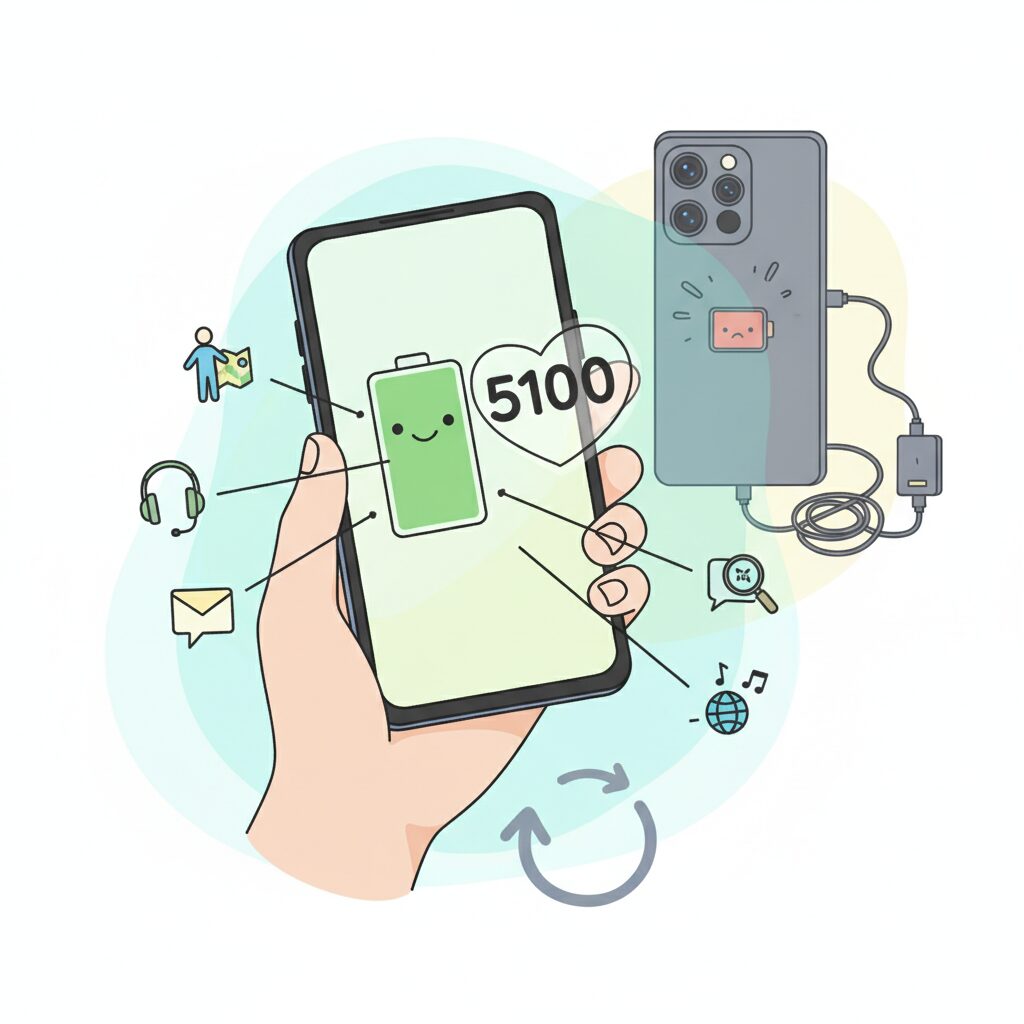
In an era where chip efficiency and AI-driven power management are often celebrated, battery capacity itself is sometimes dismissed as a secondary metric. However, real-world data shows that raw capacity still matters more than many users expect, especially for people who actively rely on their smartphones throughout the day.
The Google Pixel 9a demonstrates this clearly by pairing a 5,100mAh battery with a relatively compact and lightweight body. According to UL Benchmarks and Notebookcheck, this large physical capacity creates a baseline advantage that software alone cannot fully replicate. Even the most optimized operating system cannot extract energy that simply does not exist.
| Model | Battery Capacity | Wi-Fi Browsing Time |
|---|---|---|
| Pixel 9a | 5,100mAh | 21.2 hours |
| Pixel 9 | 4,700mAh | ~15 hours |
| iPhone 16e | 4,005mAh | 23.2 hours |
This comparison highlights an important nuance. Apple’s iPhone 16e achieves longer browsing time with a smaller battery thanks to exceptional SoC and OS efficiency, as reported by GSMArena and Notebookcheck. Yet, the Pixel 9a remains competitive precisely because its larger battery absorbs variability in usage, signal strength, brightness, and background tasks.
Battery capacity acts as a buffer against unpredictable real-life behavior. Navigation in bright sunlight, extended video playback at high brightness, or sudden camera use during travel all cause power spikes. Reviews from PCMag and CNET note that the Pixel 9a sustains over 13 hours of 1080p video playback even at high brightness, a scenario where smaller batteries often collapse quickly.
Researchers and engineers frequently point out that lithium-ion efficiency gains are incremental, not exponential. As IEEE publications have discussed, improvements in anode materials and power management tend to yield single-digit percentage gains per generation. In contrast, a 10–20 percent increase in physical capacity immediately translates into longer endurance.
For users who do not want to micromanage settings or carry a charger, capacity remains the most reliable form of battery security. The Pixel 9a’s endurance illustrates a simple but often overlooked truth: when efficiency hits diminishing returns, sheer battery size quietly becomes the deciding factor.
Real-World Battery Benchmarks and What the Numbers Reveal
Real-world battery benchmarks often expose gaps between advertised capacity and lived experience, and the Pixel 9a is a rare case where measured numbers translate cleanly into daily confidence. Multiple independent labs, including UL Benchmarks and Notebookcheck, evaluated endurance under controlled but realistic conditions, revealing a pattern that favors efficiency over raw power.
The most striking insight is not just how long the Pixel 9a lasts, but why it lasts. In mixed-use workloads such as web browsing, document editing, and light media tasks, the device consistently outperforms more expensive siblings despite sharing the same Tensor G4 generation.
| Test Scenario | Pixel 9a Result | What It Reveals |
|---|---|---|
| PCMark Work 3.0 | 17h 43m | Exceptional low-load efficiency |
| Wi-Fi Web Browsing | 21.2h | Strong system-level optimization |
| 1080p Video Playback | 13h 15m | Display power draw well controlled |
According to UL Benchmarks, PCMark scores above 16 hours already place a phone in flagship territory, yet the Pixel 9a exceeds this while using a lighter chassis and less aggressive thermal headroom. This suggests that the Cortex-A520 efficiency cores in Tensor G4 are doing most of the real work during everyday tasks, avoiding unnecessary power spikes.
Notebookcheck’s Wi-Fi browsing loop further supports this view. With brightness normalized to 150 cd/m², the Pixel 9a sustains over 21 hours, beating several midrange Android competitors and approaching Apple’s efficiency benchmark. The key takeaway is that large capacity alone does not explain this result; background process discipline and scheduler behavior matter just as much.
Video playback numbers add another layer of realism. Even at very high brightness levels, the OLED panel avoids runaway drain, indicating conservative peak management rather than chasing headline nits. Reviewers from PCMag noted that this restraint keeps thermal buildup low, indirectly protecting both battery health and sustained runtime.
Idle and standby behavior, often ignored, completes the picture. Long reader and idle tests show that overnight drain is minimal, aligning with Google’s tighter background limits in recent Android releases. For users, this means the benchmarks are not abstract charts but a promise that the phone left unplugged on Friday can still feel trustworthy on Sunday.
Charging Speed Limits and Their Impact on Daily Use
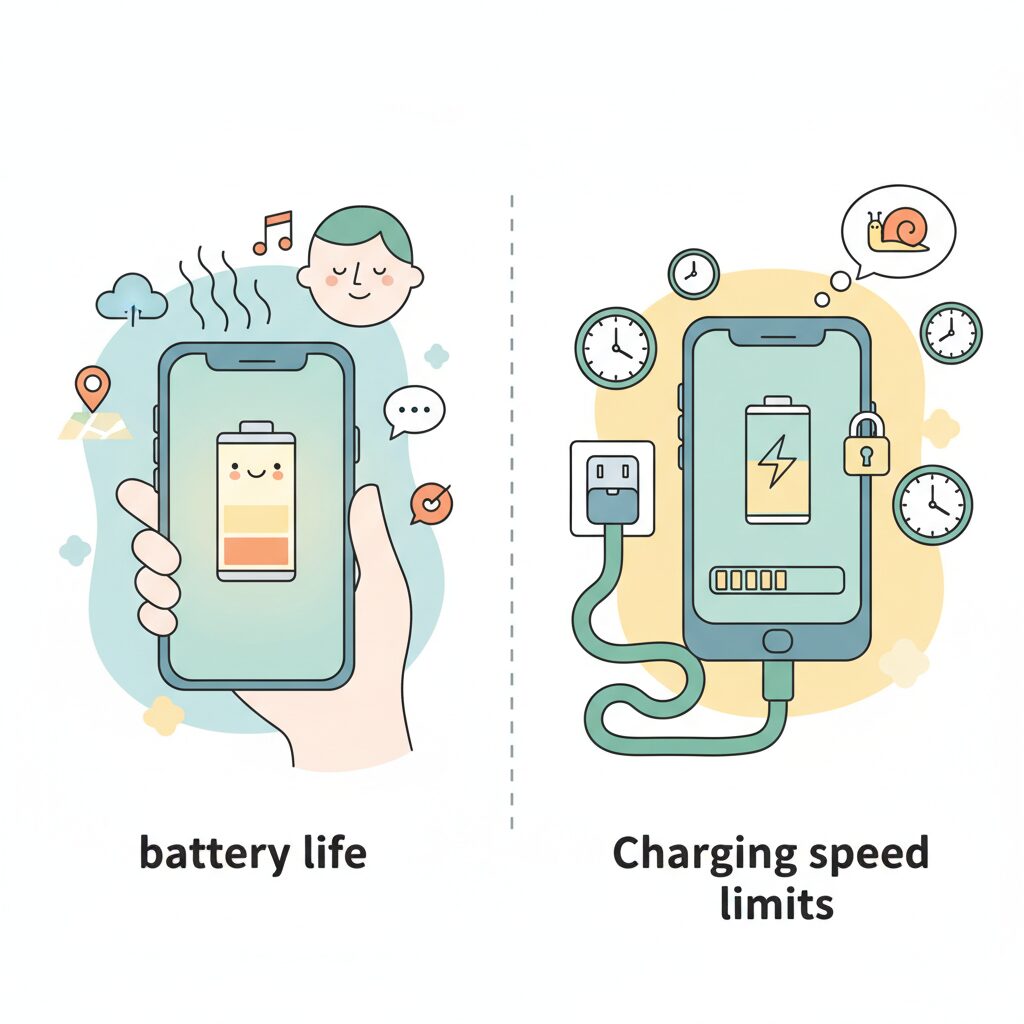
Charging speed is where the Pixel 9a’s philosophy of practicality reveals its clearest trade-off. While the device delivers exceptional endurance, its maximum wired charging power is capped at 23W, a figure that feels conservative in 2025. This limitation directly shapes daily usage patterns, especially for users accustomed to short, high-power charging sessions during busy mornings or between meetings.
Measured charging data published by Notebookcheck shows a distinctly gradual charging curve. After 15 minutes, the battery reaches only around 23 percent, and even at the 30-minute mark it remains below 50 percent. **A full charge takes approximately 95 minutes**, which places the Pixel 9a well behind many similarly priced Android competitors that achieve a full charge in under 40 minutes using 67W or higher systems.
| Elapsed Time | Battery Level | Daily Use Implication |
|---|---|---|
| 15 minutes | 23% | Insufficient for quick morning top-ups |
| 30 minutes | 47% | Half-day use still uncertain |
| 95 minutes | 100% | Best suited for overnight charging |
This design choice is not accidental. According to analysis echoed by PCMag and CNET, Google continues to prioritize battery longevity and thermal stability over peak charging speed. Faster charging introduces higher heat and accelerates chemical degradation of lithium-polymer cells. With Google publicly committing to seven years of OS and security updates, a slower charging profile aligns with the goal of preserving battery health over a longer ownership cycle.
Wireless charging further reinforces this usage model. The Pixel 9a supports Qi wireless charging at just 7.5W, a level that barely offsets power consumption during active use such as navigation or video calls. **In practical terms, wireless charging is clearly intended for overnight replenishment rather than daytime recovery**, a point also noted in UL Benchmarks’ thermal observations.
In everyday life, this means the Pixel 9a subtly encourages behavioral change. Instead of frequent short boosts, it favors fewer, longer charging sessions paired with its excellent all-day stamina. For commuters, travelers, or disaster-preparedness-minded users, this approach reduces heat stress and long-term battery wear. However, in environments where fast turnaround is critical, the 23W ceiling remains a tangible limitation that cannot be ignored.
Lightweight Engineering: Materials, Balance, and Ergonomics
Lightweight engineering in modern smartphones is not achieved through a single breakthrough, but through a series of deliberate compromises that prioritize balance over spectacle. In the case of the Google Pixel 9a, the 186-gram body is not merely a numerical achievement, but the result of material science, internal layout optimization, and human-centered ergonomics working in concert. This weight is especially notable given the large 5,100mAh battery housed inside a 6.3-inch-class device, a combination that traditionally pushes smartphones well beyond the 200-gram threshold.
One of the most influential decisions lies in the choice of exterior materials. Instead of following the premium trend of glass-on-glass construction, the Pixel 9a adopts a polycarbonate back paired with an aluminum frame. According to TechInsights’ teardown analysis, this hybrid structure significantly reduces mass while also lowering manufacturing complexity. Polycarbonate’s density is less than half that of typical smartphone glass, and its elastic properties allow it to absorb impact energy rather than shatter. This material choice directly contributes to both weight reduction and real-world durability, especially for users who prefer operating the device without a protective case.
| Material | Approx. Density | Impact on Design |
|---|---|---|
| Polycarbonate | ~1.2 g/cm³ | Lighter weight, higher impact absorption |
| Glass | ~2.5 g/cm³ | Premium feel, higher fragility |
| Aluminum frame | ~2.7 g/cm³ | Structural rigidity with moderate mass |
Weight alone, however, does not determine how light a device feels in daily use. The Pixel 9a’s near-flat rear design plays a crucial role in perceived ergonomics. By drastically minimizing the camera module protrusion to roughly 0.55 millimeters, Google redistributed mass more evenly across the chassis. Industrial design researchers, including those cited by the Nielsen Norman Group in studies on handheld device comfort, have shown that top-heavy designs increase wrist fatigue even when overall weight is unchanged. The Pixel 9a avoids this pitfall by lowering its center of gravity closer to the user’s palm.
This balanced mass distribution improves one-handed usability during extended sessions such as reading, navigation, or social media browsing. The device rests more naturally in the hand, reducing the subtle micro-adjustments users often make unconsciously with heavier or unevenly weighted phones. These ergonomic gains are difficult to quantify on a spec sheet, yet they strongly influence long-term satisfaction. Reviewers from outlets such as PCMag and CNET have independently noted that the Pixel 9a feels lighter than its measured weight suggests, an observation consistent with established ergonomic theory.
Internal engineering choices further reinforce this lightweight philosophy. The simplified camera system, lacking heavy periscope lenses or large glass stacks, reduces component mass in the upper chassis. Similarly, the absence of oversized wireless charging coils, which are common in flagship models, frees both weight and internal volume. This reclaimed space is what allows the unusually large battery to coexist with a relatively slim and light body, demonstrating that restraint in feature selection can yield tangible ergonomic benefits.
There are, of course, trade-offs. The front display uses Gorilla Glass 3 rather than newer Victus variants, reflecting a conscious balance between weight, cost, and scratch resistance. Corning’s own materials research indicates that Gorilla Glass 3 performs well against micro-abrasions encountered in pockets and bags, even if it is less resilient in severe drops. Combined with the device’s IP68 water and dust resistance, the overall durability profile remains practical for everyday use without adding unnecessary mass.
Ultimately, the Pixel 9a illustrates that lightweight engineering is not about chasing the lowest possible gram count. It is about aligning materials, structural layout, and human ergonomics toward sustained comfort. By optimizing how weight is distributed and experienced, rather than merely reducing it, Google delivers a phone that feels purpose-built for continuous daily use. This approach reframes lightness not as a luxury feature, but as a core component of usability.
Tensor G4 Performance: Efficiency Gains and Thermal Challenges
The Tensor G4 inside the Pixel 9a prioritizes efficiency over raw power, and this design choice directly shapes real-world performance. Built on Samsung’s refined 4nm process and using Arm’s Cortex-X4, A720, and A520 core mix, the chip shows clear gains in low-load scenarios. **Everyday tasks such as web browsing, messaging, and background synchronization are handled mostly by the A520 efficiency cores**, which helps explain the strong battery benchmark results reported by UL Benchmarks and Notebookcheck.
In sustained workloads, however, the limits of this approach become visible. Independent stress tests conducted by Notebookcheck indicate a stability score of around 37 percent, meaning performance can drop sharply under continuous load. This behavior is consistent with reports cited by Android Authority and other analysts, who note that Google’s tuning favors early thermal throttling rather than pushing peak clocks for long periods.
| Scenario | Observed Behavior | User Impact |
|---|---|---|
| Light daily use | High efficiency, low heat | Smooth UI and long battery life |
| Extended gaming | Aggressive throttling | Frame rate drops after minutes |
| AI background tasks | Stable, low-power execution | Minimal standby drain |
The thermal challenge is amplified by the Pixel 9a’s plastic-backed chassis. Compared with glass or metal designs, heat dissipation is less effective, encouraging the system to reduce clocks sooner. **This is not a flaw in isolation but a deliberate safeguard**, as sustained high temperatures accelerate battery degradation. Semiconductor experts frequently point out that conservative thermal envelopes improve long-term reliability, an approach Google appears to have embraced.
For users, the result is a processor that feels responsive in typical scenarios but unsuited to marathon gaming sessions. **Tensor G4 delivers consistency rather than spectacle**, aligning with Google’s broader emphasis on efficiency, device longevity, and predictable behavior under load. In the context of the Pixel 9a, performance and thermal management are less about winning benchmarks and more about sustaining practical usability over years of daily use.
AI Features, RAM Constraints, and Long-Term Usability
AI has become one of the core selling points of the Pixel lineup, and Pixel 9a is no exception. Thanks to the Tensor G4 chip, many on-device AI features that once required cloud processing are now executed locally, improving responsiveness and privacy. Functions such as voice transcription, call screening, photo cleanup, and context-aware suggestions operate without a constant network connection, which aligns well with Google’s broader shift toward edge AI described by Google DeepMind researchers.
However, the effectiveness of these AI features is closely tied to memory availability. Pixel 9a is equipped with 8GB of RAM, which is sufficient for today’s mainstream AI tasks but clearly positioned below the upper-tier Pixel 9 models. **This RAM ceiling defines not raw intelligence, but how many AI processes can coexist smoothly in the background.** When multiple AI-driven features are active at once, the system prioritizes tasks aggressively, sometimes reloading apps more often than power users might expect.
To clarify this constraint, the practical difference is not whether AI works, but how flexibly it works over time. Gemini Nano runs locally on Pixel 9a, yet it operates in a more compact configuration. According to analysis shared by Android Authority, smaller on-device language models require careful memory budgeting, and 8GB represents the lower boundary for stable multitasking as models grow more complex.
| Model | RAM | On-device AI Headroom |
|---|---|---|
| Pixel 9a | 8GB | Optimized for single-task AI |
| Pixel 9 | 12GB | Comfortable multitasking |
| Pixel 9 Pro | 16GB | Future-facing AI workloads |
From a long-term usability perspective, this distinction matters more each year. Google has committed to seven years of OS and security updates, signaling confidence in the hardware’s longevity. Yet software support alone does not guarantee a consistently smooth experience. As Android integrates more generative AI features directly into the system UI, memory pressure is likely to increase. Academic research from institutions such as MIT has shown that on-device AI inference scales non-linearly with memory size, meaning small RAM differences can have outsized effects.
That said, Pixel 9a benefits from Google’s disciplined software optimization. Android’s memory management, combined with Tensor G4’s AI accelerators, ensures that essential features remain responsive even under constrained conditions. **For everyday users focused on photography, communication, and light productivity, these limits rarely surface as explicit problems.** The trade-off becomes visible mainly for heavy multitaskers who expect desktop-like persistence from mobile apps.
Another aspect of long-term usability is thermal and power awareness. Running AI locally consumes both memory and energy, and Pixel 9a’s conservative performance tuning helps prevent excessive heat and battery degradation. Industry analysts at PCMag have pointed out that this restraint may actually preserve usability over years, even if peak performance appears modest today.
In practical terms, Pixel 9a’s AI experience is best described as focused rather than expansive. It delivers Google’s most important AI innovations in a controlled, efficient manner, while drawing a clear line at advanced concurrent workloads. **This balance favors stability and battery health over speculative future performance**, making the device feel reliable rather than experimental as it ages.
Ultimately, the RAM constraint is not a flaw but a design boundary. Pixel 9a is built to age gracefully within defined limits, supported by long-term updates and careful AI integration. Users who understand this boundary are likely to find that its AI features remain genuinely useful for years, even as the broader AI landscape continues to evolve.
How the Pixel 9a Compares With iPhone 16e and Key Rivals
When comparing the Pixel 9a with the iPhone 16e and other key rivals, the differences become clearer not through raw specifications alone, but through how each device prioritizes everyday usability. The Pixel 9a positions itself as a phone that quietly optimizes the basics, while competitors often emphasize peak performance or brand-driven appeal.
According to testing data published by Notebookcheck and UL Benchmarks, the Pixel 9a demonstrates a distinctive balance between battery capacity and real-world endurance. Although the iPhone 16e achieves longer web browsing time per milliamp-hour thanks to Apple’s A18 chip and iOS efficiency, the Pixel 9a counters with a physically larger 5,100mAh battery, resulting in consistently long usage times that reduce daily charging anxiety.
| Model | Battery Capacity | Wi-Fi Web Runtime | Weight |
|---|---|---|---|
| Pixel 9a | 5,100mAh | 21.2 hours | 186g |
| iPhone 16e | 4,005mAh | 23.2 hours | 167g |
Performance tells a different story. Independent analyses from sources such as GSMArena and Android Authority indicate that the iPhone 16e’s A18 chip significantly outperforms Google’s Tensor G4 in sustained gaming and high-load tasks. However, **the Pixel 9a intentionally limits peak performance to preserve thermal stability and battery health**, a design choice that aligns with Google’s seven-year software support policy.
Against Android rivals like Sony’s Xperia 10 VII or Sharp’s AQUOS sense series, the Pixel 9a differentiates itself through AI-driven features and display smoothness. A 120Hz OLED panel and on-device AI processing with Gemini Nano offer a noticeably more fluid and intelligent experience, even if competitors match or exceed it in lightness or niche hardware features.
Overall, **the Pixel 9a compares less as a spec-sheet challenger and more as a usage-focused alternative**. It does not aim to beat the iPhone 16e in raw power or the lightest Android phones in weight, but instead provides a carefully tuned middle ground that rewards users who value battery confidence, software intelligence, and long-term reliability.
Repairability, Sustainability, and the Hidden Trade-Offs
When discussing repairability and sustainability, the Pixel 9a presents a complex and somewhat uncomfortable reality that deserves careful attention. On the surface, Google positions the device as environmentally conscious, emphasizing recycled materials and an industry‑leading promise of seven years of OS and security updates. This long software support cycle aligns with recommendations from organizations such as the European Commission, which consistently argues that extending device lifespans is one of the most effective ways to reduce electronic waste.
However, durability in software does not automatically translate into sustainability in hardware. Independent teardown analyses, including those cited by Notebookcheck and widely discussed among professional repair communities, reveal that the Pixel 9a relies heavily on strong industrial adhesives for internal components, most notably the battery. **This design choice significantly undermines real‑world repairability**, even for trained technicians.
Battery replacement is the most critical issue. Lithium‑polymer batteries are consumable components, typically degrading after two to three years of daily use. In the Pixel 9a, the battery is firmly glued to the frame without functional pull tabs, requiring heat, solvents such as isopropyl alcohol, and physical force to remove. According to experienced teardown reviewers, this increases both labor time and the risk of battery puncture or thermal incidents. For consumers, this often translates into higher repair costs or the decision to replace the entire device prematurely.
| Aspect | Sustainability Benefit | Hidden Cost |
|---|---|---|
| 7-year software updates | Reduces forced obsolescence | Battery likely needs replacement during support period |
| Adhesive-based assembly | Thinner, lighter chassis | High repair difficulty and cost |
| Plastic back panel | Lower manufacturing emissions than glass | Reduced heat dissipation, complicating repairs |
The irony is that some choices made for cost reduction and weight savings, such as the plastic back panel, could have supported sustainability if paired with modular or screw‑based internal construction. Instead, the sealed design prioritizes manufacturing efficiency over lifecycle flexibility. Repair advocates often point out that even a small shift, such as standardized battery pull tabs, can dramatically extend a phone’s usable life without meaningful increases in production cost.
There is also a broader policy contradiction. Google publicly supports the “right to repair” movement and complies with regional regulations by offering official parts and manuals in select markets. Yet, as analysts from iFixit and similar organizations have long argued, **availability of parts matters far less when the physical design itself resists disassembly**. In practice, authorized repairs become the only viable option, limiting consumer choice and increasing total environmental impact through transportation and centralized servicing.
Ultimately, the Pixel 9a embodies a modern sustainability paradox. It is designed to stay relevant in software for most of a decade, yet structurally optimized for a much shorter maintenance horizon. For environmentally conscious users, this means the greenest choice is not automatically the one with the longest update policy, but the one that can realistically be repaired when, not if, its battery wears out.
参考文献
- UL Benchmarks:Google Pixel 9a Review
- Notebookcheck:Great battery life and a handy size – Google Pixel 9a review
- PCMag:Google Pixel 9a Review
- CNET:Pixel 9a Review: A Value-Packed Phone, Just at the Right Time
- Android Authority:Can the $500 Pixel 9a outperform Google’s $1100 flagship?
- TechInsights:Google Pixel 9a Teardown: Tensor G4 Processor and Cost Analysis