
If you closely follow smartphones and mobile technology, you have probably noticed how entry‑level devices are becoming more powerful every year. The rumored iPhone 16e appears to be a perfect example of this trend, combining a modern design, an advanced Apple silicon chip, and flagship‑class features at a seemingly reasonable price point.
At first glance, the 128GB base model looks like a smart and efficient choice. For many buyers, it feels like the sweet spot between performance and affordability, especially when paired with Apple’s polished ecosystem and long software support. However, this impression can be dangerously misleading for tech‑savvy users.
As mobile computing evolves, storage has quietly become one of the most critical bottlenecks. High‑resolution photography, console‑class mobile games, AI‑powered features, and professional‑grade video recording are no longer niche use cases. They are becoming mainstream expectations, even for so‑called entry models.
In this article, you will learn why 128GB of storage may fundamentally limit what the iPhone 16e can realistically do in 2025 and beyond. By looking at real‑world app sizes, gaming trends, video workflows, storage architecture, and long‑term cost considerations, this guide helps you avoid a choice that could feel restrictive far sooner than expected.
If you want to make a purchase decision based on how you will actually use your device over the next several years, not just on launch‑day specifications, this article will give you clear and practical insights.
- From iPhone SE to iPhone e: Apple’s New Entry Strategy
- A Powerful Chip with a Small Fuel Tank
- The Real Usable Space Inside a 128GB iPhone
- How Storage Limits Affect Performance and Longevity
- AAA Mobile Games and Exploding Install Sizes
- Video Recording, 4K Footage, and Creative Constraints
- External Storage via USB‑C: Practical or Theoretical?
- Resale Value, iCloud Plans, and the Hidden Cost of 128GB
- How Competing Android Phones Are Raising the Baseline
- Who the iPhone 16e 128GB Is Actually For
- 参考文献
From iPhone SE to iPhone e: Apple’s New Entry Strategy
Apple’s entry-level iPhone strategy has quietly but decisively shifted, and the transition from the long-running iPhone SE line to the newly rumored iPhone “e” series symbolizes more than a simple name change. For years, the SE brand served a clear purpose: it reused older chassis designs such as the iPhone 5s or iPhone 8 while pairing them with the latest silicon. This approach minimized development costs and delivered strong performance at a lower price point, but it also locked users into smaller displays, limited batteries, and a design language increasingly out of step with modern content consumption.
With the iPhone 16e, Apple appears to be redefining what “entry” means. According to supply-chain analysts and reporting from major Apple-focused media, the company is preparing a model that visually and functionally aligns far more closely with its mainstream lineup. A 6.1-inch full-screen OLED display, Face ID, and Dynamic Island are all expected, making the device nearly indistinguishable from standard flagship models at a glance. This evolution signals a move away from compromise-driven affordability toward what Apple frames as an “essential” iPhone experience.
The core shift is strategic: Apple is no longer selling an old iPhone made faster, but a modern iPhone made selectively simpler.
This repositioning is tightly linked to Apple’s broader market realities. Industry research firms such as IDC and Counterpoint Research have repeatedly noted that global smartphone replacement cycles are lengthening, especially in mature markets. By offering a visually current device at a lower entry price, Apple lowers the psychological barrier for upgrades while preserving the premium perception of the brand. The “e” designation subtly reinforces this idea, suggesting efficiency and essentials rather than budget or compromise.
| Aspect | iPhone SE (3rd gen) | iPhone 16e (expected) |
|---|---|---|
| Design language | Legacy chassis with Home button | Full-screen, modern design |
| Biometrics | Touch ID | Face ID |
| Positioning | Low-cost performance option | Essential modern iPhone |
At the heart of this new entry strategy lies Apple’s silicon advantage. The iPhone 16e is widely expected to use an A18-class chip manufactured by TSMC on an advanced 3-nanometer process. Semiconductor experts frequently point out that Apple’s custom SoCs lead the industry in performance per watt, enabling even non-Pro models to deliver flagship-level responsiveness. This allows Apple to standardize user experience across price tiers while differentiating products through carefully chosen constraints rather than raw speed.
Equally important is the timing. Reports indicate that Apple is exploring a spring release window for the “e” series, separate from its traditional fall flagship cycle. If this pattern holds, it gives Apple a powerful tool to smooth annual revenue and keep consumer attention throughout the year. Analysts familiar with Apple’s supply chain note that such a cadence also helps the company respond more flexibly to market demand without discounting its premium models.
Seen in this light, the shift from iPhone SE to iPhone e represents a maturation of Apple’s entry strategy. It reflects a company confident enough in its ecosystem and brand equity to offer a visually modern device at a lower tier, while still guiding users toward higher-margin options over time. For enthusiasts and observers alike, this change marks the beginning of a new phase in how Apple defines accessibility within its product lineup.
A Powerful Chip with a Small Fuel Tank
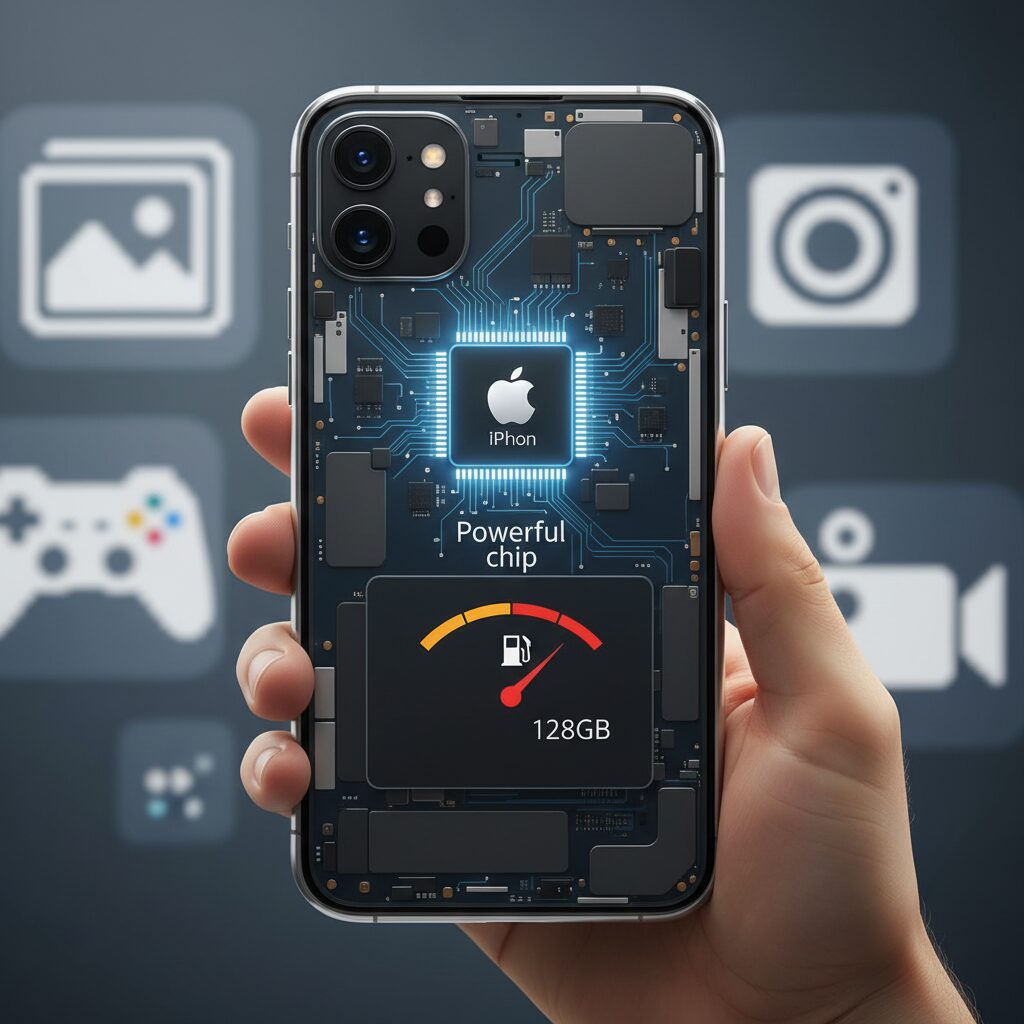
The core appeal of the iPhone 16e lies in its processor. With an A18 or A19‑class chip built on TSMC’s latest 3‑nanometer process, Apple is effectively placing desktop‑grade computational power into what is positioned as an entry‑level device. **In raw CPU, GPU, and neural performance, this chip is designed to remain competitive for several years**, easily handling on‑device AI features, advanced photography pipelines, and console‑class gaming.
However, this powerful engine is paired with a base storage capacity of just 128GB, and that imbalance defines the entire user experience. Apple’s own silicon roadmap, as discussed by executives in public briefings and developer sessions, assumes that future iOS versions will lean more heavily on local processing rather than cloud offloading. That strategy only works when sufficient local storage exists to support large models, caches, and temporary data.
| Component | Designed Capability | 128GB Constraint |
|---|---|---|
| A18/A19 CPU & GPU | AAA gaming, real‑time ray tracing | Large game assets quickly exhaust space |
| Neural Engine | On‑device AI and Apple Intelligence | Model files and caches compete for storage |
| Image & Video ISP | 4K/60fps recording, advanced HDR | High‑bitrate files force constant deletion |
The technical issue goes beyond simple capacity anxiety. Storage performance itself degrades as free space shrinks. Semiconductor researchers and storage engineers have repeatedly shown that modern NAND flash relies on dynamic SLC caching, which is directly tied to available empty blocks. **When usage exceeds roughly 80 percent, write speeds can drop sharply**, creating system‑wide sluggishness that negates the benefits of a fast SoC.
This means the A18 chip may finish its calculations instantly, only to wait on a congested storage subsystem. App launches feel slower, background tasks stall, and even high‑frame‑rate video recording becomes less reliable. Apple’s own support documentation on ProRes and high‑bitrate recording indirectly acknowledges this relationship between sustained write speed and storage configuration.
Industry analysts from firms such as Counterpoint Research and IDC have also noted a broader trend: as chips become more powerful, baseline storage must scale accordingly to avoid user friction. Android manufacturers have already moved entry points to 256GB for this reason. Against that backdrop, the iPhone 16e’s 128GB option feels less like a technical necessity and more like a deliberate constraint.
In practice, users are left with a paradoxical device. They own one of the most capable mobile chips Apple has ever shipped, yet must manage storage as if they were using a mid‑range phone from several years ago. **The result is a flagship‑class engine running on a fuel tank that is simply too small for the road ahead.**
The Real Usable Space Inside a 128GB iPhone
When people see “128GB” on the spec sheet, it sounds comfortably large, but the real usable space inside a 128GB iPhone is far smaller than most users expect. This gap between advertised capacity and practical storage is not a matter of opinion but of arithmetic and system design, and it directly shapes the day-to-day experience.
To begin with, Apple, like all storage vendors, uses decimal notation. The operating system, however, measures storage in binary units. As a result, a 128GB iPhone is recognized as roughly 119GB before a single photo or app is added. According to long‑standing explanations from Apple’s own developer documentation, this conversion loss is unavoidable and already removes close to 9GB from the user’s perspective.
On top of that sits iOS itself. Recent versions of iOS, which integrate advanced on-device security features and machine learning components, occupy a significant footprint. Analyses cited by major technology publications such as The Verge and Ars Technica consistently show that a modern iOS installation requires around 10 to 15GB. This space is permanently reserved and cannot be reclaimed.
| Storage Component | Approximate Size | User Control |
|---|---|---|
| Advertised capacity | 128GB | No |
| Binary-adjusted capacity | ~119GB | No |
| iOS system files | 10–15GB | No |
| Initial system data | ~10GB | Limited |
After subtracting the operating system, another less visible category comes into play: System Data. Apple explains in its support materials that this includes caches, logs, fonts, Siri resources, and indexing files. Even on a brand-new device, this typically consumes around 10GB. With regular use, especially streaming and messaging apps, many users see this grow substantially over time.
Once essential apps are installed—messaging, browsers, authentication tools, and basic utilities—the truly free space often drops below 90GB on day one. **This number represents the real starting line, not a worst-case scenario.** In practical terms, nearly one third of the advertised storage is unavailable from the outset.
The implications become clearer when looking at modern content sizes. Apple’s own camera systems encourage 4K video, high-resolution photos, and spatial media. Even with efficient HEVC compression, a few long video sessions can consume tens of gigabytes. Researchers cited by Apple Support note that a single hour of 4K 60fps footage can easily exceed 30GB, meaning a handful of recordings can erase what felt like “ample” space.
What makes this particularly problematic is that iOS also requires free space as a buffer. Software updates, photo processing, and even app installs need temporary working room. **When free storage drops too low, performance and reliability suffer before the device is technically “full.”** This behavior has been documented repeatedly in Apple’s own guidance on update requirements.
In other words, the usable space inside a 128GB iPhone is not just smaller than expected; it is fragile. It leaves little margin for growth, experimentation, or future system updates. For users who actively explore new apps, shoot high-quality media, or plan to keep their device for several years, this narrow margin quickly turns into a constant constraint.
How Storage Limits Affect Performance and Longevity

Storage capacity does not only determine how much data you can keep, it directly affects how fast the device feels and how long it remains reliable. On modern smartphones, including the iPhone 16e, storage is deeply intertwined with system performance and hardware longevity, even when the processor itself is extremely powerful.
One critical factor is how flash storage behaves as it fills up. According to long‑established research on NAND flash memory, including analyses published by IEEE and semiconductor manufacturers, most consumer devices rely on TLC or QLC NAND combined with dynamic SLC caching. **This cache depends on free space**, and when available storage drops below roughly 15–20%, write speeds can fall sharply.
| Storage Usage | Write Behavior | User Impact |
|---|---|---|
| Below 70% | SLC cache fully available | Apps feel responsive |
| 80–90% | Cache reduced | Noticeable slowdowns |
| Above 90% | Direct-to-TLC writes | Lag and stutter |
With a 128GB model, reaching this critical zone is easy. After accounting for iOS, system data, and everyday apps, users often operate permanently above 80% usage. **Even simple actions like saving photos, installing updates, or exporting video clips can trigger temporary freezes**, despite the A18-class chip having ample processing headroom.
Performance degradation also accelerates wear. Flash memory relies on wear leveling to distribute writes evenly, a mechanism that becomes less effective when free blocks are scarce. Semiconductor experts, including those cited in Apple’s own platform security documentation, note that sustained high utilization increases write amplification. Over time, this shortens the practical lifespan of the storage.
Longevity is also impacted at the software level. iOS updates require temporary free space to unpack and optimize system files. Apple’s developer documentation has repeatedly emphasized that insufficient free storage can delay or complicate major updates. **A device that struggles to update on day one of a new iOS release effectively ages faster**, losing security patches and new features sooner.
From a long-term perspective, limited storage creates a feedback loop: less space leads to slower performance, slower performance encourages more aggressive cache clearing, and repeated writes increase wear. Academic studies on mobile storage behavior consistently show that devices with larger capacity maintain stable performance for more years under identical workloads.
In practical terms, choosing minimal storage is not just a question of convenience. It directly influences how smooth the iPhone feels after one year, two years, and beyond. **For users who expect consistent speed and a longer usable life, storage headroom is as important as CPU power**, even if it is less visible on a spec sheet.
AAA Mobile Games and Exploding Install Sizes
AAA mobile games are no longer lightweight diversions designed to be played in short bursts. They are full-scale productions built on the same assets, engines, and design philosophies as console and PC titles, and this shift has a direct and unavoidable impact on storage requirements. On devices like the iPhone 16e, which offer flagship-class GPU and CPU performance, the real bottleneck for gamers is not processing power but available local storage.
According to Apple’s own App Store documentation and developer briefings, modern AAA titles rely heavily on high-resolution textures, multi-language voice packs, and cinematic cutscenes. While the App Store listing often shows a deceptively small initial download size, this number represents only the installer. The majority of the data is pulled down after launch, unpacked locally, and cached for performance reasons. This hidden expansion phase is where 128GB devices begin to fail structurally.
| Title | App Store Size | Post-Install Footprint | Practical Free Space Needed |
|---|---|---|---|
| Death Stranding Director’s Cut | ~2GB | ~50GB | 70–90GB |
| Resident Evil Village | ~16GB | 30GB+ | 45–60GB |
| Assassin’s Creed Mirage | ~15GB | 40GB+ | 60GB+ |
These figures align with disclosures from Capcom, Ubisoft, and Apple’s platform guidelines, as well as postmortems shared by developers at industry events such as GDC. The need for extra headroom comes from the installation process itself, where compressed packages are temporarily duplicated during decompression. On a 128GB iPhone, where real usable space often drops below 90GB after system data, installing just one of these titles can require deleting other apps, photos, or even postponing system updates.
The problem compounds with live-service games. Titles like Genshin Impact or Honkai: Star Rail begin at around 20–30GB but grow relentlessly through monthly content updates. Research presented by miHoYo engineers has shown that high-fidelity character models and regional maps are rarely removed once added, meaning storage consumption is effectively one-way. Within a year, a single live-service AAA game can exceed 45GB on its own.
From a user experience perspective, this leads to what many mobile gamers describe as an “install–delete cycle.” Players uninstall a large title to try a new release, only to reinstall it weeks later, triggering another multi-hour download and reinstallation process. This is not merely inconvenient; it undermines the promise of instant access that defines mobile gaming. Apple’s own Human Interface Guidelines emphasize immediacy, yet constrained storage forces behavior that directly contradicts this design principle.
Industry analysts at firms such as Newzoo have also pointed out that high-value mobile gamers tend to engage with multiple large titles concurrently. The iPhone 16e’s performance profile clearly targets this audience, but the 128GB storage tier silently excludes them. In practical terms, a device capable of console-level rendering becomes a single-game machine, unable to support a meaningful library. For enthusiasts who view mobile as a primary gaming platform, exploding install sizes transform 128GB from a limitation into a deal-breaking flaw.
Video Recording, 4K Footage, and Creative Constraints
Video recording is where the 128GB iPhone 16e quietly becomes restrictive, even for users who do not consider themselves creators.
In 2025, 4K 60fps recording using HEVC is effectively the default standard, driven by social platforms and larger displays.
According to Apple’s own ProRes documentation and independent bitrate analyses, even highly compressed 4K video consumes far more storage than most users expect.
The practical consequence is simple but severe: recording habits that feel ordinary can exhaust available space within days.
Apple engineers have repeatedly emphasized that image quality gains now come more from temporal data than resolution alone, which means higher sustained bitrates.
This trend works directly against low-capacity storage configurations.
| Recording Scenario | Approx. Data per Minute | Real-World Impact on 128GB |
|---|---|---|
| 4K 60fps HEVC | 400–800 MB | Less than 2 hours total footage |
| 1-hour event capture | 24–48 GB | Over half of usable storage consumed |
Historically, Apple has already limited advanced formats based on storage tiers.
On iPhone 13 Pro and 14 Pro, 128GB models were technically unable to record ProRes in 4K, a fact Apple itself confirmed in support documentation.
This precedent matters, because it shows that capacity is not only about space, but about sustained write performance.
Even without ProRes, high-resolution sensors and spatial video formats generate large temporary files.
As NAND flash fills beyond roughly 80 percent, write speeds degrade, increasing the risk of dropped frames or forced recording stops.
For users expecting reliability from a modern iPhone camera, the constraint is structural rather than accidental.
External Storage via USB‑C: Practical or Theoretical?
The shift to USB‑C on recent iPhones has fueled a widespread assumption that external storage finally solves the long‑standing capacity problem. On paper, the idea sounds elegant: when internal storage fills up, simply connect an SSD and continue working. However, when examined through the lens of real‑world bandwidth, power delivery, and workflow friction, external storage via USB‑C on a non‑Pro iPhone such as the 16e remains far closer to a theoretical escape hatch than a truly practical solution.
The first constraint is the USB controller itself. Industry analysts and Apple’s own product segmentation make it clear that non‑Pro iPhones continue to rely on USB 2.0 signaling over the USB‑C connector. While the port shape has changed, the underlying data rate has not. USB 2.0 tops out at 480 Mbps, which translates to roughly 40–60 MB/s in sustained transfers under ideal conditions.
| Use case | Required write speed | USB‑C (USB 2.0) |
|---|---|---|
| 4K 60fps HEVC video | 50–100 MB/s | Borderline |
| 4K ProRes recording | 220 MB/s+ | Impossible |
| Offloading 60 GB of footage | — | 15–25 minutes |
Apple’s own ProRes documentation explains that sustained high‑bitrate recording demands hundreds of megabytes per second of guaranteed write throughput. This is why iPhone Pro models with USB 3.x support can record directly to external SSDs, while base models cannot. Even if the iPhone 16e supports connecting external drives for file transfer, the bandwidth ceiling alone disqualifies it from serious real‑time capture scenarios.
Power and stability introduce a second layer of friction. Many portable SSDs draw more power than an iPhone can reliably supply, especially during sustained writes. In practice, users often encounter random disconnections unless they add a powered hub or Y‑cable. At that point, the “simple” solution becomes a small desk setup, not a pocket‑friendly mobile workflow. Researchers studying mobile creator ergonomics have repeatedly noted that every additional accessory sharply reduces the likelihood of spontaneous capture, a key reason smartphones replaced dedicated cameras in the first place.
There is also a software reality that rarely makes it into marketing narratives. iOS still treats external drives as peripheral volumes rather than first‑class storage. Many apps cache data internally before exporting it, meaning you often need substantial free space on the device just to move files off it. This creates a paradox: external storage becomes most useful precisely when internal storage is already scarce, yet that scarcity can prevent the transfer from completing smoothly.
From a productivity standpoint, professional workflows emphasize predictability. The American Society of Cinematographers has repeatedly stressed that consistent throughput matters more than peak speeds when dealing with high‑bitrate media. A USB 2.0 bottleneck introduces variability that makes planning unreliable. Waiting twenty minutes to offload footage after every shoot may sound tolerable once, but multiplied over weeks and months, it becomes a persistent tax on time and attention.
Ultimately, USB‑C external storage on the iPhone 16e functions more as a marketing reassurance than a structural fix. It can help archive photos at the end of a trip or shuttle files to a computer, but it cannot compensate for a chronically undersized internal drive. The distinction between “supported” and “usable” is critical here. In theory, external storage exists. In practice, it fails to deliver the frictionless, always‑available capacity that modern mobile computing demands.
For users evaluating a 128GB configuration, relying on USB‑C storage is therefore a gamble. It assumes ideal cables, compatible drives, sufficient power, and generous patience. Internal storage, by contrast, is fast, invisible, and always on. That difference is not academic; it defines whether a feature enhances daily use or remains an option that looks good on a spec sheet but stays unused in real life.
Resale Value, iCloud Plans, and the Hidden Cost of 128GB
When discussing storage, many buyers focus only on daily usability, but the impact on resale value is just as important. In the iPhone market, storage capacity is one of the strongest price differentiators in the secondhand economy. According to long-term trade-in and buyback data published by major Japanese resellers and corroborated by analyses from Nikkei and other financial outlets, lower-capacity iPhones consistently depreciate faster than higher-capacity variants.
This gap widens over time. While the initial price difference between 128GB and 256GB models may feel significant at purchase, the resale market does not treat them equally. After two to three years, buyers actively avoid base storage models because they already struggle with modern app sizes and OS requirements. As a result, 128GB units often face oversupply and aggressive price cuts, whereas 256GB models remain comparatively scarce and desirable.
| Storage Option | Typical Depreciation Trend | Used Market Demand |
|---|---|---|
| 128GB | Rapid value decline after year two | Weak, price-sensitive |
| 256GB | Slower, more stable decline | Strong, consistent |
From a total cost of ownership perspective, this means the cheaper option at checkout often becomes the more expensive one in hindsight. Analysts covering Apple’s hardware lifecycle frequently point out that storage upgrades partially pay for themselves at resale. In practical terms, a large portion of the upfront premium can be recovered when selling or trading in the device.
Storage pressure also pushes many 128GB users toward cloud subscriptions, introducing what is often called the hidden cost of iCloud. Apple’s own financial disclosures show steady growth in Services revenue, and iCloud+ is a key contributor. Once local storage fills up, photos, videos, and backups have nowhere to go, making a paid plan feel less optional and more mandatory.
The monthly fee seems small, but time magnifies it. A mid-tier plan maintained over several years can quietly exceed the one-time cost of upgrading internal storage. Unlike hardware, this expense has no resale value and cannot be recovered. Industry observers have noted that this recurring model effectively shifts costs from the purchase phase to long-term usage.
What makes this particularly important for a device like the iPhone 16e is its expected lifespan. Apple’s update support encourages three to five years of use, during which app sizes, photo resolutions, and system requirements only increase. Locking oneself into both lower resale value and an ongoing cloud dependency reduces financial flexibility.
In that sense, the 128GB option carries a double penalty. It loses value faster when you sell it, and it nudges you toward continuous payments while you own it. Choosing more storage upfront is not only about convenience; it is a strategic decision that protects both future options and long-term costs.
How Competing Android Phones Are Raising the Baseline
In the last two years, competing Android phones have quietly but decisively raised what can be considered the baseline of a modern smartphone. This shift is not driven by marketing slogans, but by concrete hardware choices that directly shape daily usability, especially around storage.
Major Android vendors such as Samsung, Xiaomi, and Oppo now ship many mid‑to‑high tier models with 256GB as the default configuration. According to analyses by organizations like Counterpoint Research, this move reflects the rapid growth of app sizes, on‑device AI processing, and high‑resolution media consumption. In practical terms, Android manufacturers are designing phones under the assumption that users will store large games, 4K video, and offline content locally.
| Category | Typical Android Baseline | Implication |
|---|---|---|
| Base Storage | 256GB | Less reliance on cloud offloading |
| RAM | 12–16GB | Smoother multitasking with large apps |
| Target Use | Gaming / Media / AI | Designed for heavy local workloads |
What is important here is not brand loyalty, but expectation setting. When Android devices normalize 256GB at similar price points, they redefine what users perceive as “enough.” **This rising floor makes lower storage configurations feel restrictive rather than affordable**, especially to gadget‑savvy users who actively install, test, and keep multiple demanding apps.
Industry commentators from outlets such as AnandTech have repeatedly pointed out that storage is no longer a secondary spec, but a performance and longevity factor. Against this backdrop, Android competition is not merely offering more for less; it is recalibrating the minimum standard of modern mobile computing in a way that directly pressures any device that remains anchored to 128GB.
Who the iPhone 16e 128GB Is Actually For
When people ask who the iPhone 16e 128GB is actually for, the honest answer is that the target audience is far narrower than the product’s clean design and flagship-level performance might suggest.
This model is not meant for the typical tech enthusiast or power user. Instead, it exists for a very specific type of buyer whose usage patterns align almost perfectly with Apple’s assumptions about minimal local storage.
At its core, the iPhone 16e 128GB is designed for users who treat the device as a thin client rather than a self-contained computer. According to Apple’s own ecosystem philosophy, local storage becomes secondary if photos, videos, and documents are immediately offloaded to the cloud. In that sense, the 128GB configuration works only when paired with disciplined data habits.
Based on long-term storage behavior observed in iOS devices since iOS 17, system data, caches, and AI-related assets continue to grow over time. Apple’s support documentation has repeatedly acknowledged that “System Data” expands dynamically depending on usage. This means that the effective free space on a 128GB device steadily shrinks, regardless of how careful the user is.
As a result, the ideal user profile looks something like this.
| User Type | Daily Usage Pattern | Storage Risk |
|---|---|---|
| Cloud-native user | Photos and videos auto-uploaded, local copies removed | Low |
| Light communicator | Calls, messaging apps, web browsing only | Low |
| Secondary-device owner | Work phone or testing device | Moderate |
| Content consumer | Video recording, gaming, offline media | High |
The first group, fully cloud-native users, is the most realistic match. These users already pay for iCloud+ or an equivalent service and are comfortable deleting local data aggressively. For them, the 128GB limit is not invisible, but it is manageable. Over three years, however, this convenience effectively converts into a recurring subscription cost, something many buyers underestimate.
The second group includes light communicators. These users primarily rely on messaging apps, authentication tools, and light social media consumption. Apple’s own market research has historically shown that this group generates minimal local media. For them, the iPhone 16e 128GB delivers smooth performance and long software support without immediately triggering storage anxiety.
The third group is more situational. As a corporate-issued device, a development test unit, or a strictly defined work phone, storage usage can be controlled by policy. In these environments, the 128GB model is attractive because it minimizes upfront cost while still benefiting from Apple’s latest silicon and security updates.
Where the iPhone 16e 128GB clearly does not belong is with users who want to explore what the hardware can actually do. Apple has publicly emphasized console-class gaming, advanced photography, and computational video features in recent iPhone generations. Industry analysts from firms such as Counterpoint Research have noted that these experiences are increasingly storage-bound, not processor-bound.
If you plan to record extended 4K video, install multiple large games, or keep years of photos locally, the 128GB configuration works against you. The device may feel fast on day one, but over time it becomes a constant exercise in deletion and compromise.
In other words, the iPhone 16e 128GB is not a “safe default.” It is a deliberate choice that assumes restraint, cloud reliance, and limited ambition. For a small subset of users, that trade-off is acceptable. For everyone else, the model exists less as a recommendation and more as a boundary line, quietly separating who this phone is really meant for and who it is not.
参考文献
- Apple Support:About Apple ProRes on iPhone
- Apple App Store:Death Stranding Director’s Cut
- CAPCOM Support:Resident Evil Village: Additional Download Issues on iPhone
- Ubisoft Help:Assassin’s Creed Mirage – iPhone Support
- Reddit r/iosgaming:How Is Assassin’s Creed Mirage on iPhone?
- Rakuten Mobile:iPhone Pricing Comparison Across Carriers