
Smartphone specifications used to be easy to compare, but in 2026 the story has changed significantly.
Many users still look at RAM as a simple indicator of multitasking speed, yet modern smartphones rely on memory for something far more critical: running AI continuously in the background.
As on-device generative AI becomes a core feature rather than a bonus, RAM is no longer just spare capacity but a permanently occupied execution resource.
You may be wondering whether 12GB of RAM is still enough, or if 16GB has become the new baseline for a truly future-proof device.
This question matters more than ever because AI assistants, real-time translation, image generation, and multimodal features all reserve memory even when you are not actively using them.
In real-world terms, this means that two phones with similar processors can feel completely different depending on how much RAM remains available after AI services take their share.
At the same time, the global memory market is under pressure from booming AI server demand, pushing smartphone RAM prices higher and forcing manufacturers into difficult trade-offs.
Some flagship models are even reducing memory compared to previous generations, despite higher prices, which can easily confuse buyers.
In this article, you will learn how 12GB and 16GB RAM configurations actually differ in everyday use, especially for AI-driven features, gaming, and creative workloads.
You will also discover how new memory standards like LPDDR6 change performance and efficiency, and why capacity still matters more than raw speed for advanced AI tasks.
By understanding the strategies of major brands such as Samsung, Google, Apple, and Sony, you will be better equipped to choose a smartphone that fits your usage style and lasts for years.
If you care about performance stability, long-term software support, and getting the most value from your investment, this guide will help you make a confident and informed decision.
- From Spec Sheet Numbers to AI Execution Resources
- Why On-Device AI Permanently Reserves Smartphone RAM
- LPDDR6 vs LPDDR5X: Memory Speed, Efficiency, and AI Inference
- 12GB vs 16GB RAM: Real Usable Memory After AI Allocation
- AI Feature Tiering Based on RAM Capacity
- The 2026 Global Memory Shortage and Rising Smartphone Prices
- Samsung Galaxy S26 Series: Memory Strategy Under Cost Pressure
- Google Pixel 10 and the Hidden Cost of Always-On AI
- Apple iPhone 17 Pro: Why 12GB Became Necessary
- Sony Xperia 1 VII: A Creator-Focused Approach to RAM
- Gaming Performance: When 16GB Makes a Visible Difference
- Video Editing and Heavy Multitasking on Mobile
- Long-Term Value: 7-Year Software Support and Future AI Apps
- Resale Value and Market Perception of Higher RAM Models
- 参考文献
From Spec Sheet Numbers to AI Execution Resources
For years, smartphone RAM numbers were treated as simple bragging rights, but in 2026 that logic no longer holds true. **RAM has shifted from a passive specification into an active AI execution resource**, directly determining what kind of intelligence can live and run on a device. Instead of asking how many apps can stay open, the more relevant question is how large and how responsive an on-device AI model can be.
This shift is driven by the rise of always-on generative AI. According to analyses cited by Android Central and PCMag, modern on-device models are no longer loaded only when summoned. They remain resident in memory to enable instant responses for voice, vision, and contextual understanding. That persistence fundamentally changes how RAM is consumed.
To illustrate this, consider how memory is partitioned in a 2026 flagship smartphone.
| Physical RAM | Reserved for AI Core | Freely Usable RAM |
|---|---|---|
| 12GB | ≈3.4GB | ≈8.6GB |
| 16GB | ≈3.4GB | ≈12.6GB |
Data reported by Tom’s Guide on the Pixel 10 series shows that several gigabytes are continuously locked by background AI services and dedicated neural processors. **This reserved block is not a temporary cache but a guaranteed execution zone**, ensuring that large language models and multimodal pipelines never need to cold-start.
The implication is clear: a 12GB device in 2026 behaves more like an 8GB-class phone from the user’s perspective once AI residency is accounted for. A 16GB device, by contrast, retains enough headroom to run AI inference alongside demanding foreground tasks without aggressive memory eviction.
Memory standards amplify this effect. With LPDDR6 doubling effective bandwidth while cutting power consumption nearly in half, as documented by semiconductor researchers and summarized by PCMag, AI inference becomes faster and more energy-efficient. However, **bandwidth cannot compensate for insufficient capacity** when model parameters themselves must remain in RAM.
Industry observers note that this is why manufacturers increasingly gate advanced AI features behind higher RAM tiers. Google and Samsung executives have both hinted in briefings that memory capacity, not CPU speed, is becoming the primary limiter for future AI features. In 2026, the spec sheet number matters less than what that number enables to live, think, and respond inside the device.
Why On-Device AI Permanently Reserves Smartphone RAM

On-device AI fundamentally changes how smartphone RAM is used, and in 2026 this shift becomes impossible to ignore. Unlike cloud-based AI, models that run locally must remain partially loaded in memory at all times to ensure instant responses. As a result, a portion of physical RAM is no longer shared dynamically by apps, but is permanently reserved for AI execution.
This reserved memory is not a temporary cache but a locked execution space. According to analysis reported by Tom’s Guide, Google’s Pixel 10 with 12GB of RAM permanently allocates about 3.4GB to its AICore background service and the Tensor G5 TPU. This design allows features such as live transcription or contextual suggestions to respond without delay, but it immediately reduces the usable RAM available to the user.
| Total RAM | AI-Reserved RAM | Effectively Usable RAM |
|---|---|---|
| 12GB | ≈3.4GB | ≈8.6GB |
| 16GB | ≈3.4GB | ≈12.6GB |
This gap has practical consequences. When multitasking, the operating system prioritizes AI stability over background apps, which means games, browsers, or social apps are more likely to reload on 12GB devices. Android Central notes that this behavior is intentional: AI models degrade sharply if memory is reclaimed, while apps can be restarted.
In other words, AI treats RAM as owned territory, not shared space. As models grow larger and more multimodal, this reserved footprint is expected to increase rather than shrink. This is why 16GB phones feel disproportionately smoother in daily use, even when raw CPU performance looks similar.
What makes this permanent reservation especially significant is longevity. With manufacturers promising up to seven years of OS updates, a device purchased in 2026 must accommodate future AI models that are heavier than today’s. Research cited by Gizmochina suggests that memory pressure, not processor speed, will be the primary cause of perceived slowdowns over time.
On-device AI therefore turns RAM from a flexible resource into a fixed foundation. The moment part of it is claimed by intelligence that never sleeps, the remaining memory defines how free the device truly feels.
LPDDR6 vs LPDDR5X: Memory Speed, Efficiency, and AI Inference
The transition from LPDDR5X to LPDDR6 marks one of the most meaningful architectural shifts in smartphone memory over the past decade. While RAM capacity still defines how much data can be held at once, memory generation increasingly determines how fast and efficiently that data can be moved, especially under continuous AI workloads.
LPDDR5X, widely used in 2024–2025 flagship devices, already pushed mobile memory speeds beyond 8 Gbps. However, according to specifications discussed by JEDEC members and reported by industry analysts, LPDDR6 expands effective bandwidth dramatically while reducing power draw per bit transferred. This combination directly targets the needs of always-on, on-device AI inference.
| Metric | LPDDR5X | LPDDR6 |
|---|---|---|
| Relative memory bandwidth | Baseline | Approximately 1.8–2.2× higher |
| Power consumption at equal performance | 100% | About 45–60% |
| AI inference throughput (INT8) | Reference level | Up to 2.5× higher |
This bandwidth leap matters because modern AI models are not purely compute-bound. Research cited by Android Central and PCMag shows that transformer-based models running locally often stall while waiting for weights and intermediate tensors to move between memory and the AI accelerator. Faster memory therefore translates into lower latency and smoother real-time responses.
For example, industry benchmarks referenced by Gizmochina suggest that a 12GB LPDDR6 system can deliver higher sustained AI throughput than a 16GB LPDDR5X device when running continuous voice recognition or image segmentation. The reason is simple: the AI cores remain fed with data instead of idling, while power efficiency prevents thermal throttling.
Efficiency is equally important. Always-on AI features such as contextual assistants, live transcription, and background image processing rely on memory that can stay active without draining the battery. Analysts quoted by CNET note that memory power has become a limiting factor for standby endurance, making LPDDR6’s reduced energy consumption a strategic upgrade rather than a spec-sheet luxury.
That said, speed does not eliminate the need for capacity. Larger models still require physical space to store parameters, and no amount of bandwidth can compensate if the model simply does not fit in memory. This is why experts emphasize that LPDDR6 reshapes the performance ceiling, but does not redefine the minimum viable RAM for advanced AI features.
Looking ahead to 2026 devices built around chips such as Snapdragon 8 Elite Gen 5 or Google’s Tensor G5, LPDDR6 acts as a force multiplier. It ensures that AI accelerators operate closer to their theoretical limits, improves responsiveness under multitasking, and extends battery life during prolonged inference. In this context, the LPDDR6 versus LPDDR5X comparison is less about raw speed numbers and more about enabling a new class of sustained, intelligent smartphone behavior.
12GB vs 16GB RAM: Real Usable Memory After AI Allocation
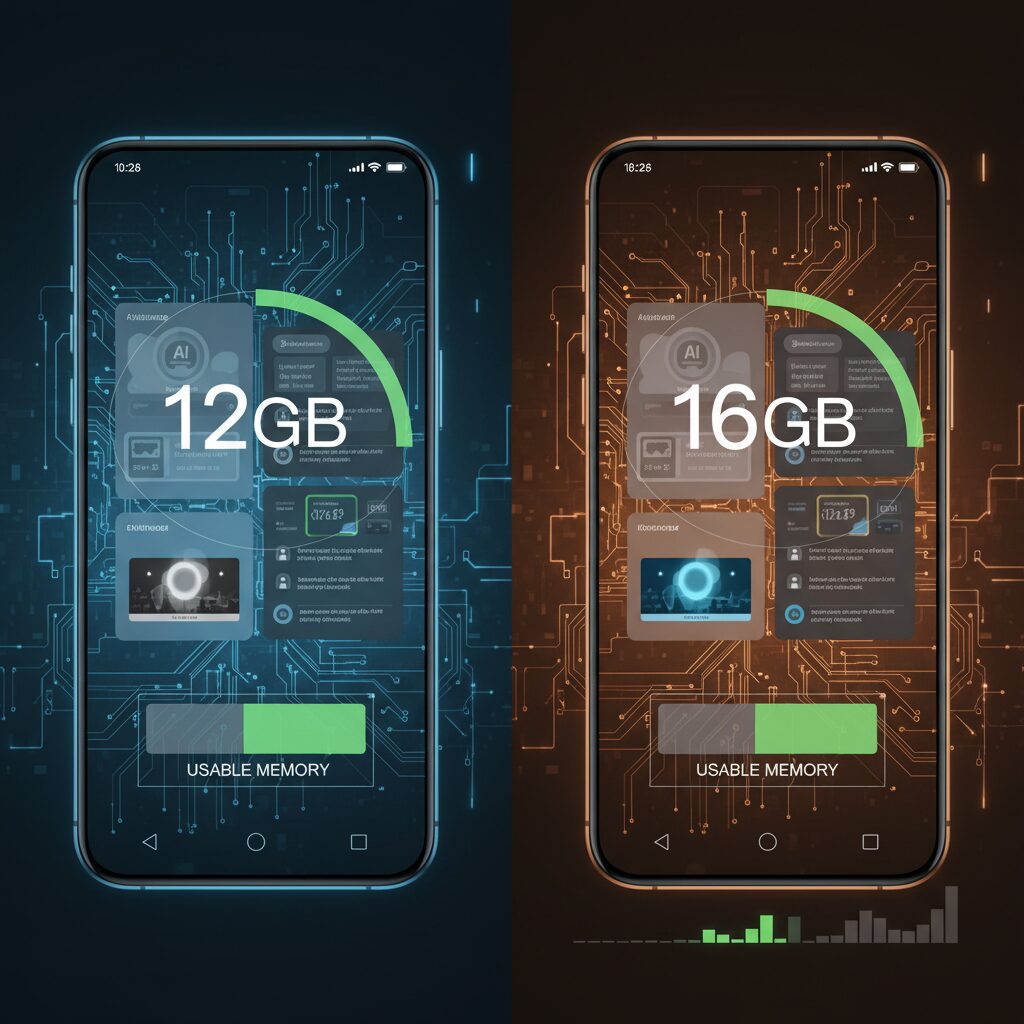
When comparing 12GB and 16GB RAM in 2026 smartphones, the most important question is no longer the headline capacity, but how much memory remains truly usable after on-device AI has taken its share. Modern smartphones now reserve a fixed portion of RAM for always-on AI services, fundamentally changing the real-world value of each configuration.
According to detailed analysis by Tom’s Guide and Android Central, current flagship-class AI frameworks are designed to stay resident in memory at all times. This approach eliminates loading delays and enables instant responses, but it also means that a significant block of RAM is permanently unavailable to the user.
This reserved AI memory is not a temporary cache; it is a locked execution space. As a result, the effective gap between 12GB and 16GB models is far larger than the raw numbers suggest.
| Physical RAM | AI Reserved Memory | Usable Memory for Apps |
|---|---|---|
| 12GB | Approx. 3.4GB | About 8.6GB |
| 16GB | Approx. 3.4GB | About 12.6GB |
The 3.4GB reservation figure is not theoretical. Google’s Pixel 10 series, powered by Tensor G5, allocates roughly this amount to its AICore services and TPU pipelines. Google engineers have explained that this design ensures features such as real-time transcription, context-aware suggestions, and multimodal processing remain instantly available without stutter.
From a user perspective, this means a 12GB device effectively operates closer to an older 8GB-class phone under load. Opening a heavy game, switching to a browser with many tabs, and then invoking an AI feature often triggers background app reloads. In contrast, a 16GB model retains a buffer large enough to keep those apps alive.
This behavior has been observed consistently in stress tests conducted by PCMag and Android Central, where identical workloads produced more frequent app eviction on 12GB devices once AI services were active. Even with faster LPDDR6 memory, capacity remains the limiting factor when multiple high-demand processes overlap.
Another subtle but critical aspect is AI feature scaling. Industry analysts note that manufacturers increasingly tune advanced on-device models for higher RAM ceilings. Multimodal AI, which simultaneously handles voice, image, and text input, consumes considerably more working memory than single-purpose models. On 12GB devices, these models are often simplified or throttled to avoid memory pressure.
Samsung and Google have both acknowledged in briefings that memory headroom directly affects how long AI context can be retained. Shorter context windows reduce personalization quality and increase cloud fallback, undermining the promise of fully on-device intelligence.
For users who keep phones for several years, this gap widens over time. Software updates tend to increase baseline memory usage, and AI models steadily grow in parameter count. What feels adequate at launch can become restrictive by the third or fourth year of ownership.
In practical terms, 12GB represents a comfortable present, while 16GB represents a stable future. When evaluating real usable memory after AI allocation, the extra 4GB is not a luxury; it is the margin that preserves a smooth, uninterrupted experience as on-device AI becomes more central to everyday smartphone use.
AI Feature Tiering Based on RAM Capacity
In 2026, AI features on smartphones are no longer universally available across a product lineup, and **RAM capacity has become the primary gatekeeper that determines which AI functions you can actually use**. This phenomenon is often described by analysts as AI feature tiering, where manufacturers intentionally align specific AI capabilities with fixed memory thresholds. What matters here is not raw processing power alone, but whether enough memory exists to keep advanced models resident without degrading the overall system experience.
On-device AI relies on persistent memory allocation. According to coverage by Android Central and PCMag, modern lightweight language models, multimodal vision modules, and real-time speech systems require several gigabytes of RAM to remain active in the background. As a result, devices with 12GB RAM typically reserve a large portion for system-level AI services, leaving less headroom for user-facing tasks. **This architectural reality directly shapes which AI features are enabled or disabled at the software level.**
| RAM Capacity | AI Model Scope | Feature Availability |
|---|---|---|
| 12GB | Small to mid-sized on-device models | Text transcription, photo cleanup, basic summarization |
| 16GB | Larger multimodal resident models | Real-time translation, voice cloning, multimodal assistants |
Google’s Pixel 10 series illustrates this clearly. Reporting by Tom’s Guide indicates that roughly 3.4GB of RAM is permanently allocated to AI Core services on Tensor G5 devices. On a 12GB model, that reservation reduces effective working memory to under 9GB, forcing Google to limit certain high-load features such as continuous multimodal context tracking. **The same software stack behaves very differently on 16GB models, where the free memory pool remains large enough to sustain complex AI workflows.**
Samsung follows a similar strategy with Galaxy AI. As noted by SamMobile and PCMag, advanced functions such as persistent real-time language interpretation and on-device generative image refinement are tuned for configurations with larger memory buffers. While some features technically run on 12GB devices, they may operate in session-based modes rather than always-on states. This distinction is subtle in marketing materials, yet highly noticeable in day-to-day responsiveness.
From an engineering perspective, this tiering is not arbitrary. Research cited by Gizmochina shows that once memory pressure exceeds a certain threshold, mobile operating systems begin aggressive background eviction. When AI models are reloaded repeatedly, latency spikes and power efficiency drops sharply. **Manufacturers therefore restrict premium AI features to 16GB devices to preserve reliability rather than headline performance.**
This approach also aligns with long-term support policies. With seven years of OS updates now common, companies anticipate that AI models will grow steadily in size and complexity. Analysts at CNET point out that a feature designed to fit comfortably within 12GB in 2026 may exceed that envelope within three to four years. By tiering features early, vendors reduce future fragmentation and support costs.
Ultimately, AI feature tiering based on RAM capacity reshapes how consumers should read spec sheets. **RAM is no longer about multitasking convenience; it defines the ceiling of intelligence your device can access.** In 2026, choosing between 12GB and 16GB is effectively choosing between different classes of AI experience, not just different levels of speed.
The 2026 Global Memory Shortage and Rising Smartphone Prices
In 2026, the global smartphone market is facing an unusually severe memory shortage, and this constraint is directly translating into higher retail prices for consumers. This situation is not driven by smartphones themselves, but by an external force: the explosive growth of AI data centers. According to analyses cited by CNET and PCMag, leading memory suppliers such as Samsung Electronics and SK hynix have shifted a significant portion of their production capacity toward high-bandwidth memory used in AI servers, leaving less wafer allocation for mobile LPDDR memory.
As a result, LPDDR prices for smartphones are projected to rise by as much as 30 to 40 percent year over year by the second half of 2026. **This is one of the sharpest memory price increases the mobile industry has seen in over a decade**, and it arrives at a time when RAM requirements are already climbing due to on-device generative AI.
The key issue is not just higher prices, but the fact that memory has become a strategic bottleneck that reshapes smartphone specifications themselves.
Industry supply chain reports indicate that memory cost inflation alone is adding roughly 8 to 15 percent to the bill of materials for flagship smartphones. Market researchers quoted by XenoSpectrum note that manufacturers are now forced to choose between absorbing these costs, raising prices, or quietly reducing specifications. In most cases, the burden is being passed on to consumers.
| Factor | 2025 | 2026 Projection |
|---|---|---|
| LPDDR price trend | Stable to mild increase | Up to +40% YoY |
| Memory supply allocation | Balanced | AI servers prioritized |
| Average flagship phone price | $1,100–1,200 | Up to $1,300+ |
Another troubling consequence of the shortage is what analysts at TechRadar describe as “spec regression.” In previous years, consumers could expect RAM capacities to steadily increase with each generation. In 2026, however, several high-end models are expected to ship with the same or even less RAM than their predecessors, despite higher prices. This phenomenon mirrors shrinkflation in consumer goods, where the product becomes effectively smaller while costing more.
Natural disasters have further amplified this imbalance. Reports from Gigazine highlight that earthquakes affecting semiconductor facilities in Taiwan temporarily disrupted DRAM production, tightening supply at an already fragile moment. With data centers projected to consume up to 70 percent of total memory output in 2026, smartphones are increasingly treated as a secondary priority.
From a consumer perspective, this shortage explains why price hikes of 40 to 60 dollars are being forecast even before accounting for other factors such as advanced chip nodes or camera upgrades. **Memory is no longer a background component; it is now a primary cost driver that shapes both pricing and product positioning.**
Analysts at Android Central emphasize that this environment favors premium-tier devices, where manufacturers can justify higher margins. Entry and mid-range smartphones, by contrast, are more likely to suffer from reduced RAM configurations or delayed adoption of newer memory standards. This divergence widens the gap between flagship experiences and mainstream models.
In practical terms, the 2026 memory shortage means consumers are paying more for smartphones that may not look dramatically better on a spec sheet. The real value shift is invisible, embedded deep in the supply chain. Understanding this context makes rising prices less mysterious, even if they remain frustrating. For buyers, awareness of these macroeconomic pressures becomes essential when judging whether a new smartphone truly offers fair value in 2026.
Samsung Galaxy S26 Series: Memory Strategy Under Cost Pressure
Samsung’s Galaxy S26 series clearly illustrates how memory strategy in 2026 is being shaped less by ambition and more by economic reality. Despite the introduction of a highly efficient 2nm Snapdragon 8 Elite Gen 5 chipset, Samsung has taken a conservative stance on physical RAM capacity, reflecting intense cost pressure across the global memory supply chain.
The most striking decision is the limitation of 16GB RAM to a single, ultra-premium configuration. According to reporting by SamMobile and PCMag, only the Galaxy S26 Ultra paired with 1TB of internal storage is expected to offer 16GB, while all other S26 and S26+ variants remain capped at 12GB. This is not a technical constraint, but a deliberate segmentation strategy.
| Model | Expected RAM | Strategic Rationale |
|---|---|---|
| Galaxy S26 | 12GB | Cost control, baseline Galaxy AI |
| Galaxy S26+ | 12GB | Balanced specs without BOM escalation |
| Galaxy S26 Ultra | 12GB / 16GB | 16GB reserved for 1TB flagship tier |
This approach must be understood against the backdrop of a global RAM shortage. Analysts cited by CNET and TechRadar note that memory makers such as Samsung Electronics and SK hynix are prioritizing high-margin HBM for AI data centers. As a result, LPDDR pricing for smartphones is projected to rise by up to 40% year-on-year in 2026, directly inflating bill-of-materials costs.
Samsung’s response is to protect margins by monetizing memory as a luxury feature. By tying 16GB RAM exclusively to the 1TB Ultra model, Samsung effectively transforms RAM capacity into a profit lever rather than a mass-market upgrade. Industry observers see this as a form of hardware tiering designed to offset an estimated 8–15% increase in component costs.
To mitigate the practical impact of sticking with 12GB on most models, Samsung is doubling down on software-based solutions. Virtual RAM expansion and aggressive memory compression are positioned as stopgaps, allowing Galaxy AI features such as transcription and image editing to run smoothly. However, as Android Central has pointed out, these techniques cannot fully substitute for physical RAM when multiple AI workloads compete for reserved memory space.
The consequence is a subtle but important shift in user experience. While day-to-day performance remains strong, advanced on-device AI tasks and heavy multitasking increasingly favor the rare 16GB configuration. In effect, Samsung is betting that most users will accept this compromise in exchange for restrained price increases, reportedly in the range of 40 to 60 dollars across the lineup.
The Galaxy S26 memory strategy therefore reflects a broader industry truth in 2026: innovation is no longer limited by silicon capability, but by how much memory manufacturers can afford to allocate. Samsung’s choices reveal a careful balancing act between technological leadership, supply constraints, and the financial realities of the AI-driven smartphone era.
Google Pixel 10 and the Hidden Cost of Always-On AI
The Google Pixel 10 is often praised for making always-on AI feel seamless, but this convenience comes with a hidden cost that is not immediately visible on the spec sheet. The device’s AI-first design means that memory is no longer a passive resource, but an actively reserved one that shapes everyday usability in subtle ways.
According to detailed analyses by Android Central and Tom’s Guide, the Pixel 10’s 12GB of RAM does not translate into 12GB of freedom for the user. Around 3.4GB is permanently allocated to background AI services such as Google’s AICore and the Tensor G5’s TPU. **This reservation exists to guarantee instant AI responses, but it quietly reduces usable memory to roughly 8.6GB.**
| Pixel 10 Model | Physical RAM | AI-Reserved RAM | Effective Free RAM |
|---|---|---|---|
| Pixel 10 | 12GB | 約3.4GB | 約8.6GB |
| Pixel 10 Pro | 16GB | 約3.4GB | 約12.6GB |
This gap becomes noticeable during real-world use. When heavy multitasking is combined with AI-driven features such as live voice translation or on-device image generation, the base Pixel 10 is more likely to reload background apps. **The AI never sleeps, but other apps are forced to make room.**
Google’s strategy is deliberate. By keeping AI models preloaded in memory, latency is minimized and privacy is strengthened through on-device processing. Researchers cited by CNET and Android Central note that this approach improves responsiveness but shifts the burden onto RAM capacity instead of cloud bandwidth.
The result is a new kind of trade-off. Users are not paying with money or battery life alone, but with invisible memory headroom. **Always-on AI delivers magic, yet it quietly taxes the system at all times.** For users who expect a phone to feel just as fast three or four years from now, this hidden cost explains why Google positions 16GB as the true comfort zone for the Pixel 10 experience.
Apple iPhone 17 Pro: Why 12GB Became Necessary
The jump to 12GB of RAM in the iPhone 17 Pro is not about chasing Android-style spec competition, but about a clear technical necessity created by Apple Intelligence. Until recently, Apple could rely on tight hardware–software integration to deliver smooth performance with less memory. However, by 2026, that advantage alone is no longer sufficient, and Apple’s own AI roadmap has effectively forced this upgrade.
According to analyses cited by MacRumors and Gadget Hacks, the internal memory pressure caused by on-device machine learning models has reached a point where 8GB becomes a structural bottleneck. **Modern on-device AI does not simply load when needed; it stays resident in memory to guarantee instant responses**, and this permanently reduces the RAM available for user apps.
For Apple, 12GB is the minimum capacity that allows Apple Intelligence to run continuously without compromising app stability or responsiveness.
Apple Intelligence is designed around real-time context awareness, including text understanding, image analysis, and voice processing performed locally on the A19 Pro. Industry researchers, including those referenced by Android Central, note that language and vision models at this level typically occupy several gigabytes of memory when kept active. On an 8GB system, this would force aggressive app eviction and frequent reloads, directly harming the user experience Apple prioritizes.
| Memory Configuration | AI Residency | User Experience Impact |
|---|---|---|
| 8GB RAM | Limited, partial loading | Higher app reload frequency |
| 12GB RAM | Continuous on-device AI | Stable multitasking with AI active |
Another critical factor is professional workload behavior. Apple positions the Pro lineup as a mobile creative tool, and sources such as PCMag consistently emphasize how memory capacity affects tasks like ProRes video editing, high-resolution photo processing, and complex AR workflows. **With 12GB, the iPhone 17 Pro can keep large media assets and AI-assisted tools in memory simultaneously**, reducing reliance on slower storage-based swapping.
There is also a long-term support consideration. Apple now commits to extended OS and security updates, meaning a 2026 iPhone is expected to remain viable well into the early 2030s. Research highlighted by Gizmochina suggests that software memory requirements typically grow year over year, especially as AI features become more sophisticated. From this perspective, 12GB is not excess capacity, but a buffer against future OS and AI expansion.
In short, the iPhone 17 Pro’s move to 12GB reflects a fundamental shift in what RAM represents. It is no longer just about keeping apps open; it is about reserving space for intelligence itself. Apple’s decision signals that, in 2026, a Pro iPhone cannot fully deliver its promised AI-driven experience without crossing this memory threshold.
Sony Xperia 1 VII: A Creator-Focused Approach to RAM
Sony Xperia 1 VII approaches RAM not as a headline-grabbing number, but as a carefully balanced resource designed to support creators who rely on consistency and predictability. By settling on 12GB of RAM, Sony signals that this device is optimized for sustained creative workflows rather than short bursts of benchmark-driven performance.
This creator-first philosophy becomes clear when examining how memory is allocated during real-world production tasks. With Snapdragon 8 Elite and tightly tuned memory management, Xperia 1 VII prioritizes stable throughput for imaging, video, and audio pipelines. Sony’s long experience in professional cameras and broadcast equipment strongly influences this decision, as noted by reviewers at TechRadar who emphasize Xperia’s focus on reliability over spec inflation.
| Creative Task | Typical RAM Behavior | User Impact |
|---|---|---|
| 4K 120fps video recording | RAM reserved for continuous buffering | Stable capture without dropped frames |
| AI Camerawork tracking | Persistent memory allocation | Smooth subject tracking |
| RAW photo bursts | Fast cache clearing | Minimal shutter lag |
Unlike devices that aggressively reserve RAM for always-on generative AI, Xperia 1 VII keeps background AI memory usage restrained. Sony’s AI features, such as real-time eye autofocus and scene recognition, are narrowly scoped and task-specific. According to Sony’s own product documentation, this reduces long-term memory pressure and helps maintain predictable performance during extended shoots.
This design choice matters greatly for creators working on location. When recording long-form video or capturing hundreds of high-resolution stills, sudden app reloads or thermal slowdowns can disrupt creative flow. Xperia 1 VII’s 12GB RAM is sufficient to keep core creative apps resident while avoiding the higher power draw associated with larger memory pools.
Industry analysts from Android Central have pointed out that more RAM does not automatically translate into better creative output if memory bandwidth and thermal stability are not balanced. Sony appears to agree, focusing on sustained performance rather than peak multitasking scenarios that are less relevant to photographers and videographers.
In practical terms, Xperia 1 VII treats RAM as a tool, not a trophy. Combined with microSD expansion and professional-grade controls, the 12GB configuration supports a workflow where creators can trust their device to behave consistently from the first shot to the last. This restrained yet purposeful use of RAM defines Xperia 1 VII as a smartphone built to create, not merely to compute.
Gaming Performance: When 16GB Makes a Visible Difference
In mobile gaming, the jump from 12GB to 16GB of RAM creates differences that many players can actually see and feel during play. In 2026, flagship smartphones are expected to run large-scale 3D titles with higher-resolution textures, longer draw distances, and more complex physics simulations. Under these conditions, **RAM is no longer just about loading a game once, but about sustaining performance minute after minute**.
According to analyses cited by Android Central and Gizmochina, modern open-world and multiplayer games already consume between 8GB and 12GB of memory during gameplay alone. On a 12GB device, this leaves almost no headroom for the operating system, background services, or voice chat apps, increasing the likelihood of asset reloading or abrupt app closures. With 16GB, the system can keep high-resolution textures and shaders resident in memory, reducing stutter during fast camera movement or intense combat scenes.
| Gaming Scenario | 12GB RAM Behavior | 16GB RAM Behavior |
|---|---|---|
| High-end 3D game at standard settings | Smooth play, background apps often cleared | Smooth play with stable multitasking |
| 4K or ultra texture settings | Occasional texture reloads and frame dips | More consistent frame pacing |
| Game + streaming or voice chat | Risk of app reloads | Stable simultaneous operation |
Well-known titles such as Fortnite and Genshin Impact illustrate this gap clearly. When played with high-resolution texture packs, memory usage spikes sharply, and reviewers referenced by TechRadar note that devices with larger RAM pools maintain steadier frame rates during long sessions. **This stability matters more than peak FPS numbers**, because it directly affects immersion and competitive play.
Another often-overlooked factor is background AI and system reservation. As Tom’s Guide reports, several gigabytes of RAM can be permanently reserved for AI services on 2026-era phones. On a 12GB model, this reservation shrinks the memory actually available to games, while a 16GB model absorbs the overhead with far less impact. For gamers who value consistent visuals, quick asset streaming, and uninterrupted voice communication, 16GB becomes a practical advantage rather than a luxury.
Video Editing and Heavy Multitasking on Mobile
Mobile video editing in 2026 has crossed a clear threshold, where smartphones are no longer just capable companions but primary production tools. Editing 4K and even 8K footage, applying color grading, and previewing complex timelines now depend heavily on how much usable RAM remains after system and AI processes take their share. RAM capacity directly determines whether editing feels fluid or frustrating, especially during sustained creative sessions.
Professional workflows such as multi-track 4K ProRes editing place continuous pressure on memory. According to analyses referenced by PCMag and Android Central, modern mobile editors routinely cache multiple video streams, LUTs, and effect layers in RAM to maintain real-time previews. When memory runs short, the system begins swapping data to storage, which introduces stutter during scrubbing and delayed response when adjusting clips. This is where the difference between 12GB and 16GB becomes tangible rather than theoretical.
Devices with 16GB of RAM consistently maintain smoother timelines under load, because larger memory pools reduce the likelihood of swap operations. Gizmochina’s 2026 RAM usage breakdown highlights that heavy editing sessions can exceed 10GB of active memory consumption once AI-assisted stabilization, noise reduction, and background exports are running simultaneously.
| Editing Scenario | Typical RAM Pressure | User Experience Impact |
|---|---|---|
| Single-track 4K editing | 8–10GB | Generally smooth, limited background apps |
| Multi-track 4K with filters | 11–13GB | Noticeable stutter on 12GB devices |
| 4K editing with AI tools active | 13–15GB | Stable only on 16GB-class hardware |
Heavy multitasking amplifies these differences even further. Creators rarely edit in isolation; messaging apps, cloud sync services, browsers with dozens of reference tabs, and music or voice chat often remain active. Research cited by CNET on real-world multitasking shows that once background memory pressure exceeds a certain point, operating systems aggressively reload apps to recover RAM. This results in lost context, interrupted exports, and time wasted reopening tools.
On 12GB devices in 2026, on-device AI services reserve several gigabytes of memory by default, shrinking the space available for creative work. Tom’s Guide reports that systems like Google’s Tensor-based phones can leave users with under 9GB of truly free RAM. In contrast, 16GB models retain a buffer large enough to keep editing apps, browsers, and communication tools resident in memory without interruption.
The benefit is not just speed, but creative continuity. Being able to jump from a video timeline to a reference document, answer messages, and return instantly without reloads preserves focus and reduces cognitive fatigue. For users treating smartphones as all-in-one production devices, this stability becomes a competitive advantage.
As mobile software grows more ambitious and AI-enhanced effects become standard, video editing and heavy multitasking expose the practical limits of RAM more clearly than almost any other use case. In 2026, memory capacity defines whether a phone merely supports creativity or actively accelerates it.
Long-Term Value: 7-Year Software Support and Future AI Apps
Long-term value has become a decisive factor in smartphone purchases, especially now that Google, Samsung, and Apple officially commit to up to seven years of OS and security updates. This extended support window transforms RAM capacity from a short-term performance metric into a foundation for future AI compatibility.
When a device is expected to remain functional until the early 2030s, memory headroom directly determines how many future AI features it can realistically run. Industry analysis from Android Central and PCMag consistently points out that software grows heavier over time, particularly with on-device generative AI models.
| RAM Capacity | Usable Lifespan Outlook | Future AI App Compatibility |
|---|---|---|
| 12GB | Comfortable in 2026–2028 | Standard AI features, limited multitasking |
| 16GB | Stable through 2032+ | Advanced multimodal and real-time AI apps |
Google’s Pixel 10 series illustrates this clearly. With roughly 3.4GB permanently reserved for AI background services, a 12GB model leaves under 9GB for user tasks. Over a seven-year span, that margin shrinks as AI apps evolve, increasing the likelihood of feature restrictions or aggressive app reloads.
In contrast, 16GB models maintain enough free memory to accommodate larger language models, real-time translation, and multimodal assistants without compromising responsiveness. According to CNET and Android Central, this buffer is not about speed today, but about avoiding functional ceilings tomorrow.
Choosing higher RAM is effectively an investment in software relevance. As future AI applications assume always-on, memory-resident models, devices with insufficient RAM may technically receive updates while practically missing their flagship features.
Resale Value and Market Perception of Higher RAM Models
When evaluating higher RAM smartphone models, resale value and market perception have become increasingly important factors in 2026.
As average flagship prices rise, buyers are no longer looking only at initial performance, but also at how well a device retains value over time.
In this context, 16GB RAM models are widely perceived as more future-proof assets than their 12GB counterparts.
According to market analysis frequently cited by outlets such as PCMag and Android Central, used smartphones with higher RAM configurations tend to depreciate more slowly.
This trend is especially visible in years when software requirements increase faster than hardware replacement cycles.
Because on-device AI now reserves a significant portion of memory, buyers in the secondary market actively avoid models that may feel constrained after several OS updates.
Resale platforms and trade-in programs operated by major manufacturers also reflect this shift.
Internal valuation models used by Google and Samsung reportedly weigh RAM capacity more heavily than storage once a device is older than two years.
This is because storage can often be mitigated by cloud services, while insufficient RAM directly limits usable features.
| RAM Configuration | Perceived Lifespan | Typical Resale Demand |
|---|---|---|
| 12GB | Comfortable short to mid-term | Moderate, price-sensitive |
| 16GB | Long-term, AI-capable | Stable, premium-oriented |
Another key element shaping market perception is the growing scarcity of high-RAM models.
Due to the global memory supply constraints caused by AI server demand, 16GB configurations are increasingly limited to top-tier variants.
This artificial scarcity reinforces their image as premium and desirable, even several years after launch.
From a buyer psychology perspective, higher RAM also reduces uncertainty.
Second-hand buyers often lack detailed knowledge about LPDDR generations or chipset optimizations.
As a result, RAM size becomes an easy-to-understand signal of performance headroom, making 16GB models easier to sell.
Expert commentary from long-term device lifecycle studies supports this view.
Analysts referenced by CNET note that devices which can still run the latest AI features command stronger resale prices, regardless of brand.
Since many advanced on-device AI functions are already gated behind higher memory thresholds, RAM directly influences functional relevance.
In contrast, 12GB models are not viewed negatively, but they are increasingly seen as optimized for current use rather than longevity.
As software evolves, these models risk being categorized as “entry flagship” devices in the used market.
This perception tends to accelerate price drops once newer generations raise baseline RAM expectations.
Ultimately, higher RAM capacity translates into lower effective ownership cost.
Even if a 16GB model requires a higher upfront investment, its stronger resale value can offset that difference after three to four years.
For buyers who plan to upgrade regularly, this makes higher RAM not just a performance choice, but a financial strategy.
参考文献
- Android Central:RAM is the only phone spec that matters in 2026
- Tom’s Guide:Google Pixel 10 Has Less RAM Than You May Think — and AI Is to Blame
- Gizmochina:How Much RAM Do You Really Need in a Smartphone in 2026
- TechRadar:The RAM crisis will see smartphone specs go backwards in 2026, experts warn – here’s why
- CNET:Global RAM Shortage Will Raise Smartphone Prices in 2026, Analysts Say. But How Much?
- PCMag:What to Expect at Samsung’s Galaxy S26 Unpacked Event
- MacRumors:iPhone 17 Pro: Everything We Know