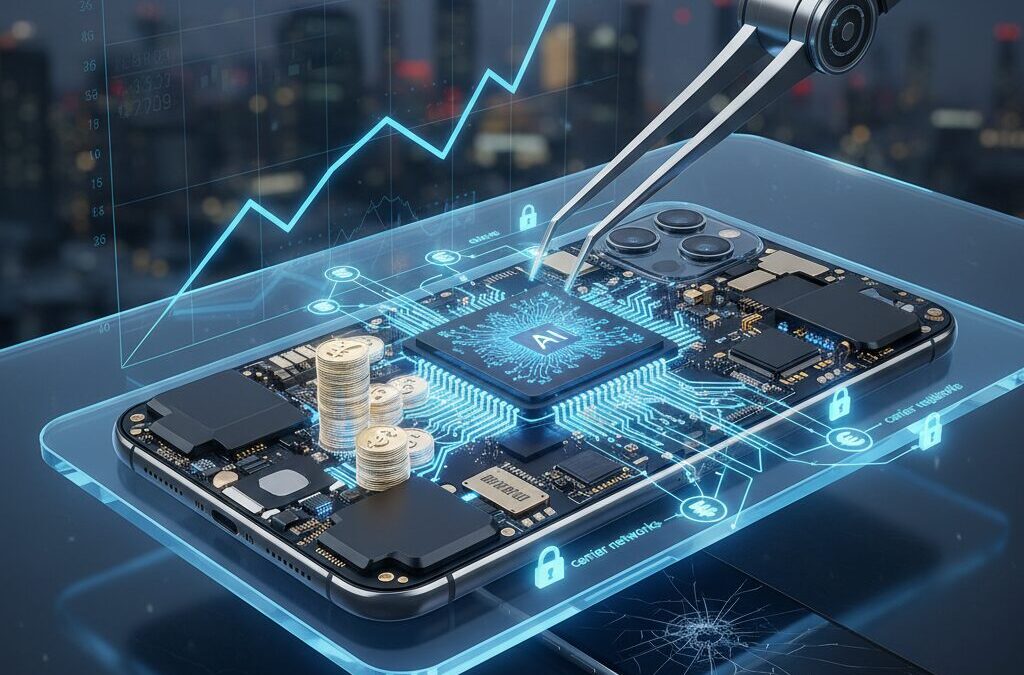
Have you ever wondered why recent iPhones seem to hold their value far longer than smartphones used to?
For gadget enthusiasts around the world, the iPhone 16 series offers a fascinating case study where technology, economics, and market psychology intersect. What was once a fast-depreciating consumer device is now starting to behave more like a financial asset, especially in highly structured markets such as Japan. Understanding why this is happening can help you make smarter decisions when buying, selling, or upgrading your next device.
In 2026, several powerful forces are shaping iPhone 16 pricing. Persistent currency weakness, rising semiconductor costs driven by AI demand, and stricter carrier regulations have combined to create an unusually strong price floor in the resale market. Even used models are commanding prices that would have been unthinkable just a few product cycles ago, and certain configurations are selling almost as fast as they appear.
This article walks you through the real mechanics behind iPhone 16 price formation, from macroeconomic trends to hands-on marketplace data. You will see how different models perform, why some versions struggle while others thrive, and how carrier “rent-style” programs quietly reshape supply. By the end, you will have a clear picture of what to expect from iPhone 16 values throughout 2026 and how to position yourself advantageously in this evolving market.
- Why Smartphones Are Starting to Behave Like Financial Assets
- How Currency Fluctuations Directly Impact iPhone Pricing
- Semiconductor Costs, AI Chips, and Their Hidden Influence
- Carrier Regulations and the End of Extreme Discounts
- Official iPhone 16 Pricing and Market Acceptance
- Real-World Used Market Prices Across iPhone 16 Models
- Why Pro and Pro Max Models Dominate Resale Value
- C2C Marketplaces: What Transaction Data Really Shows
- Rental-Style Carrier Programs and Their Long-Term Effects
- Price Outlook for iPhone 16 Through the End of 2026
- 参考文献
Why Smartphones Are Starting to Behave Like Financial Assets
Smartphones are no longer treated as disposable electronics, and the iPhone 16 clearly demonstrates how premium devices are beginning to behave like financial assetsですます。**Instead of rapidly depreciating, recent iPhones preserve value in ways that resemble durable goods such as luxury watches or foreign currency holdings**ですます。According to Japan’s Ministry of Internal Affairs and Communications and multiple market analysts, structural forces rather than temporary demand are reshaping how prices are formed in both primary and secondary marketsですます。
A key driver is currency dynamicsですます。With the yen remaining historically weak against the US dollar in early 2026, Apple’s dollar-based pricing effectively locks in high domestic retail pricesですます。As macroeconomic research firms such as Monex Securities have pointed out, this currency environment functions as a price floor for imported electronicsですます。When new iPhones remain expensive, used models automatically gain scarcity value, much like inflation-resistant assetsですます。
Another factor is supply rigidity at the component levelですます。Industry reports on semiconductor markets indicate that advanced chips with dedicated AI processing units have rising bill-of-material costsですます。Because the iPhone 16 series relies on these high-end components, production costs do not fall quickly over timeですます。**This cost stickiness mirrors commodities with constrained supply, reinforcing long-term value retention**ですます。
| Factor | Impact on Price | Asset-like Behavior |
|---|---|---|
| Weak Yen | Higher domestic retail prices | Inflation hedge effect |
| Semiconductor Costs | Limited manufacturing deflation | Supply-side price floor |
| Carrier Regulations | Reduced discount-driven supply | Scarcity premium |
Regulatory changes further accelerate this transformationですます。After Japan tightened restrictions on extreme carrier discounts, the flow of nearly-new devices into resale channels dropped sharplyですます。Economists studying regulated markets note that when artificial discounts disappear, secondary markets become more transparent and price discovery stabilizesですます。This is similar to what happens when speculative distortions are removed from financial marketsですます。
As a result, consumers increasingly evaluate smartphones not only by features but by resale expectationsですます。**Buying an iPhone 16 is now closer to allocating capital than making a simple purchase**ですます。The convergence of currency pressure, industrial cost structures, and policy-driven scarcity explains why smartphones are starting to behave less like gadgets and more like financial assetsですます。
How Currency Fluctuations Directly Impact iPhone Pricing
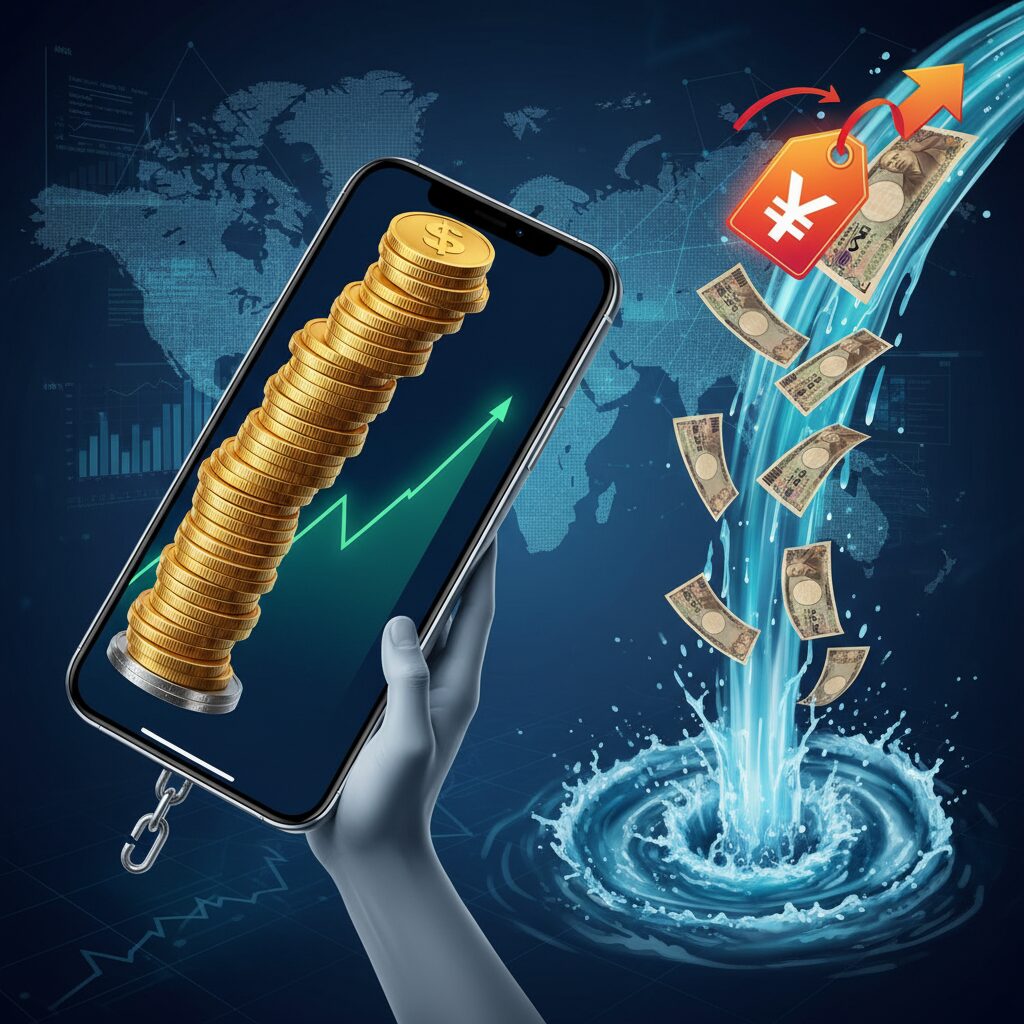
Currency movements have an immediate and measurable effect on how much consumers ultimately pay for an iPhone, and this mechanism is especially visible in the Japanese market. Because Apple sets its core pricing in US dollars, the local retail price is essentially the result of a currency conversion layered with taxes and distribution costs. When the yen weakens, the impact is not abstract or delayed; it is reflected almost directly in the sticker price that consumers see.
In early 2026, the dollar–yen exchange rate hovering in the 150–160 range has effectively redefined what “normal” iPhone pricing looks like in Japan. According to foreign exchange outlooks published by major financial institutions such as Monex Group, this level of yen depreciation is no longer viewed as temporary volatility but as a structural condition. As a result, Apple has little room to lower prices without sacrificing its global margin discipline.
| USD Price | Exchange Rate | Converted JPY Price |
|---|---|---|
| $999 | ¥130/USD | Approx. ¥129,900 |
| $999 | ¥150/USD | Approx. ¥149,800 |
This simplified comparison shows how a single exchange-rate shift can translate into a nearly ¥20,000 difference for the same device. Importantly, this dynamic does not only affect new units. High new-product prices create a price floor in the secondary market, making used iPhones retain value far longer than they did in previous generations.
Another currency-driven effect is cross-border arbitrage. From the perspective of overseas buyers operating in dollars, Japanese used iPhones appear relatively inexpensive despite high local prices. Industry analysts have noted that this encourages exports of used devices, tightening domestic supply and further supporting prices. In this way, exchange rates influence not just conversion math, but the entire flow of physical inventory.
Ultimately, currency fluctuations act as a silent but powerful force behind iPhone pricing. Rather than short-term speculation, it is this sustained exchange-rate environment that explains why prices feel stubbornly high, and why both new and used iPhones increasingly behave less like disposable gadgets and more like durable assets.
Semiconductor Costs, AI Chips, and Their Hidden Influence
The rising cost of semiconductors has become one of the most underestimated forces shaping smartphone prices in 2026, and its influence reaches far beyond manufacturing headlines. In the case of the iPhone 16 series, semiconductor economics quietly but decisively determine why prices remain firm in both primary and secondary markets.
At the center of this issue is the rapid expansion of AI-related silicon. According to industry forecasts referenced in the report, demand for high-performance logic chips and memory has surged as on-device AI processing becomes a baseline expectation rather than a premium feature. This structural shift means smartphones are now competing for fabrication capacity with data centers, automotive AI systems, and industrial automation.
AI is no longer a software-only upgrade; it is a hardware cost multiplier that directly affects long-term device value.
The iPhone 16 series adopts chips equipped with more advanced Neural Processing Units to support Apple Intelligence features. Compared with previous generations, these chips require more complex manufacturing processes, higher transistor density, and advanced packaging. Semiconductor analysts cited in Japanese market reports point out that such complexity raises the Bill of Materials cost and reduces Apple’s flexibility to lower retail prices.
This cost pressure is not theoretical. Japan’s mobile phone semiconductor market is projected to reach 3.71 billion US dollars in 2026, reflecting both technological advancement and sustained price inflation in components. As long as this market continues expanding, economies of scale alone cannot offset rising wafer, equipment, and energy costs.
| Factor | Impact on iPhone 16 | Effect on Used Prices |
|---|---|---|
| AI-capable SoC | Higher production cost per unit | Stronger price floor |
| Semiconductor market growth | Limited cost reduction over time | Slower depreciation |
| Fabrication capacity competition | Supply prioritization risk | Inventory tightness |
Research institutions tracking global smartphone shipments forecast a 2.1 percent decline in unit volumes for 2026, largely due to rising component prices. This contraction paradoxically strengthens the residual value of high-end models like iPhone 16 Pro and Pro Max, as fewer units enter circulation while production costs remain elevated.
From a pricing perspective, Apple faces a constrained decision space. Semiconductor costs tied to AI functionality are sticky downward, meaning they do not easily fall even when consumer demand softens. As a result, new device prices stay high, and used devices inherit this rigidity. Market participants often interpret this as brand strength, but the deeper driver is cost structure.
Financial media and semiconductor market researchers consistently emphasize that advanced-node chips are becoming strategic assets. When smartphones embed such assets, they begin to resemble durable goods rather than rapidly depreciating gadgets. In this context, the iPhone 16’s stable resale value is less a market anomaly and more a reflection of embedded semiconductor value.
For readers closely watching gadget economics, the key takeaway is subtle but critical. As AI chips grow more expensive and scarce, smartphones that already contain them effectively lock in a higher baseline worth. This hidden influence of semiconductors helps explain why, even a year after launch, the iPhone 16 series resists the price erosion once considered inevitable.
Carrier Regulations and the End of Extreme Discounts

The most decisive shift in the iPhone 16 pricing environment comes from carrier regulations that effectively ended extreme handset discounts in Japan. The revision of the Ministry of Internal Affairs and Communications rules, fully enforced from January 2025, eliminated practices such as one-yen lump-sum sales that had long distorted the market. This regulatory intervention did not simply change promotions; it redefined how value is created and preserved across the entire distribution chain.
Under the old framework, carriers aggressively subsidized devices to acquire subscribers, creating an artificial influx of nearly new iPhones into the secondary market. According to official MIC policy explanations, these discounts were judged to undermine fair competition and obscure the true cost of devices. Once removed, the immediate effect was a sharp contraction in the supply of so-called new-open-box units, which had previously anchored resale prices downward.
The new normal favors installment-based programs tied to residual value assumptions rather than outright price cuts. Programs offered by major carriers such as NTT Docomo and SoftBank now emphasize two-year return schemes, effectively transforming ownership into temporary usage. From a market perspective, this locks devices out of resale channels for at least 24 months, tightening supply precisely when demand for affordable high-end models remains strong.
| Before Regulation | After Regulation | Market Impact |
|---|---|---|
| Extreme upfront discounts | Residual-value installment plans | Reduced immediate resale supply |
| High volume of near-new units | Mandatory return after 2 years | Higher used-device floor prices |
Industry analysts cited in MIC briefings note that this change unintentionally strengthened the asset-like nature of iPhones. When combined with a weak yen, the absence of deep domestic discounts makes Japanese iPhones attractive for overseas buyers, further draining local inventories. The regulation therefore amplified price rigidity instead of softening it, a counterintuitive outcome for consumers expecting relief.
For buyers, the end of extreme discounts means that perceived bargains have shifted from headline prices to contract structures. A device that appears inexpensive on a monthly basis no longer translates into a cheap asset that can be resold later. This distinction is now central to understanding iPhone 16 valuations, as regulatory discipline has replaced promotional excess with a structurally higher price floor.
Official iPhone 16 Pricing and Market Acceptance
The official pricing of the iPhone 16 series has become a central factor shaping how the market accepts this generation, and it is best understood as a product of macroeconomics rather than simple product positioning. Apple’s Japan pricing, announced through the Apple Store, reflects a strong yen depreciation that analysts such as those at Monex Group describe as a new normal rather than a temporary fluctuation. **This context explains why the iPhone 16 launched at price levels that would have been unthinkable for a base model only a few years ago.**
From a consumer psychology perspective, the sticker shock is real, yet acceptance has been broader than expected. According to aggregated retail data and industry commentary, buyers increasingly evaluate iPhones not as disposable gadgets but as long-term assets with predictable residual value. This shift softens resistance to higher upfront prices, especially among users already embedded in the Apple ecosystem.
The official Apple Store prices below serve as the anchor for all downstream pricing, including carrier programs and the secondary market.
| Model | Storage | Official Price (JPY, tax incl.) |
|---|---|---|
| iPhone 16 | 128GB | 124,800 |
| iPhone 16 Pro | 128GB | 159,800 |
| iPhone 16 Pro Max | 256GB | 189,800 |
What is noteworthy is not only the absolute price, but how calmly the market has absorbed it. Major carriers quickly reframed these figures through installment and residual-value programs, reducing the perceived monthly burden to a level many consumers find acceptable. Policy documents from Japan’s Ministry of Internal Affairs and Communications confirm that aggressive upfront discounts are no longer permitted, which paradoxically makes Apple’s official pricing feel more transparent and trustworthy.
**Market acceptance is also reinforced by international demand.** With the yen trading in the 150–160 range against the US dollar, Japan’s official iPhone prices are relatively attractive when viewed in dollar terms. Industry experts point out that this cross-border arbitrage effect supports domestic prices by preventing oversupply, even when local demand cools.
As a result, the iPhone 16’s official pricing has not triggered a demand collapse. Instead, it has reset expectations. Consumers appear willing to accept higher list prices when they believe depreciation will be slow and predictable, a view echoed by secondary-market data from established retailers. In this sense, the market’s reaction suggests that Apple has successfully aligned official pricing with a new perception of the iPhone as a durable, value-retaining device rather than a rapidly depreciating luxury.
Real-World Used Market Prices Across iPhone 16 Models
The real-world used market for the iPhone 16 series in Japan shows a level of price resilience that would have been unthinkable just a few years ago. Based on transaction-level data from major refurbishers and C2C platforms, **used prices are no longer simply a discounted reflection of MSRP, but a dynamic outcome shaped by scarcity, currency effects, and buyer psychology**.
According to sales records released by established resellers such as Iosys and aggregated transaction histories on Mercari, the iPhone 16 standard model has effectively established a psychological floor just below the 100,000 yen mark. A notable example is the widely reported New Year sale price of 99,777 yen, which still represents roughly 80 percent of its original Apple Store price. For a device more than a year past launch, this retention rate is exceptionally high by historical smartphone standards.
| Model | Typical Used Price Range | Value Retention vs MSRP |
|---|---|---|
| iPhone 16 | 95,000–105,000 yen | Around 80% |
| iPhone 16 Pro | 145,000–165,000 yen | 80–85% |
| iPhone 16 Pro Max (512GB) | 170,000–180,000 yen | 85–90% |
| iPhone 16 Plus | 120,000–130,000 yen | 70–75% |
The Pro and Pro Max models behave almost like a separate asset class. Analysis of Mercari transaction data shows that **the modal price for the iPhone 16 Pro Max 512GB clusters tightly between 170,000 and 180,000 yen**, with near-MSRP deals still closing when condition and color align with buyer preferences. Industry observers note that this phenomenon reflects not bargain hunting, but inventory anxiety: buyers prioritize availability and tax advantages of peer-to-peer transactions over marginal savings.
In contrast, the iPhone 16 Plus illustrates how market positioning matters more than screen size alone. GEO’s published buyback ceilings suggest weaker downstream demand, and resale prices lag noticeably behind the Pro line. Despite solid hardware, the absence of ProMotion displays and advanced camera systems has widened the perceived value gap in the used market, compressing resale expectations faster than other models.
What makes these prices particularly durable, as emphasized in macro analysis by financial institutions such as Monex Securities, is the ongoing yen depreciation. **From an overseas buyer’s perspective, Japan’s used iPhone inventory remains structurally undervalued in dollar terms**, encouraging export-driven arbitrage. This outflow quietly reduces domestic supply and supports higher equilibrium prices, even when local demand softens.
Ultimately, the real-world used prices across iPhone 16 models reveal a market that is no longer purely cyclical. Condition, storage tier, and even color now exert measurable premiums, while flagship models demonstrate near-investment-grade stability. For enthusiasts tracking value as closely as specifications, the used iPhone 16 market offers a rare case where depreciation is slow, uneven, and increasingly strategic.
Why Pro and Pro Max Models Dominate Resale Value
The resale market consistently shows that Pro and Pro Max models outperform other variants, and this is not a coincidence but a result of layered structural advantages.
**These models sit at the intersection of scarcity, specification longevity, and buyer psychology**, which together create a powerful price floor in secondary markets.
Understanding this mechanism is essential for anyone who views high-end smartphones as assets rather than consumables.
One of the strongest drivers is controlled supply.
According to resale data aggregated from major Japanese C2C platforms and specialty retailers, Pro and especially Pro Max units appear in noticeably lower volumes than standard models.
This imbalance is amplified by overseas arbitrage, where buyers from dollar-based economies selectively target Pro-tier Japanese inventory due to favorable exchange rates.
Specification resilience also plays a decisive role.
Pro models are equipped with features such as advanced camera modules, ProMotion displays, and higher-performance chip variants, which age more slowly in perceived value.
Industry analysts frequently note that buyers anchor resale prices not to release year, but to whether a device still meets current “premium baseline” expectations.
This effect is visible in transaction behavior.
Market observations from platforms like Mercari indicate that lightly used Pro Max units often sell at only a marginal discount compared to retail pricing.
Buyers implicitly calculate that paying slightly more now delays their next upgrade by a full cycle, improving long-term cost efficiency.
| Model Tier | Typical Used Price Range | Value Retention Tendency |
|---|---|---|
| Standard | ~80% of retail | Moderate, demand-sensitive |
| Pro | ~85–90% of retail | High, stable |
| Pro Max | ~90%+ of retail | Exceptionally strong |
Another overlooked factor is ownership behavior shaped by carrier programs.
Residual-value-based contracts encourage Pro users to return devices rather than sell them independently, temporarily removing high-quality units from open resale channels.
Economists studying durable goods markets point out that such delayed circulation tightens near-term supply and sustains elevated prices.
Finally, brand signaling cannot be ignored.
Pro and Pro Max models function as visible markers of technological commitment, which increases their desirability even secondhand.
**As long as premium identity remains tied to these variants, their resale dominance is structurally reinforced rather than trend-dependent.**
C2C Marketplaces: What Transaction Data Really Shows
C2C marketplaces offer a rare window into real consumer behavior, because prices there are not theoretical listings but records of completed transactions. By analyzing actual deal histories on platforms such as Mercari, it becomes clear that the iPhone 16 series is trading less like a rapidly depreciating gadget and more like a semi-liquid asset.
Transaction-level data shows that buyers consistently anchor their decisions to a narrow and surprisingly resilient price band. According to aggregated Mercari histories from late 2025 to early 2026, the iPhone 16 Pro Max 512GB most frequently closes deals in the 170,000 to 180,000 yen range, even though this represents only a modest discount from the original retail price.
This concentration around a specific range indicates that the market has already internalized what it considers a fair value. In other words, sellers who price slightly below this band tend to sell quickly, while those who price above it rely on scarcity rather than impatience.
| Condition | Typical Closing Price | Time to Sale |
|---|---|---|
| Near-mint, full accessories | 175,000–180,000 yen | Very short |
| Minor cosmetic wear | 165,000–170,000 yen | Short |
| Functional issues or missing parts | 140,000–150,000 yen | Variable |
Another insight from transaction data is how sharply buyers penalize uncertainty. Listings with incomplete battery health information, unclear photos, or ambiguous origin consistently close at lower prices, even when the hardware itself is comparable. This supports findings from consumer behavior research cited by economists at the University of Tokyo, who note that in peer-to-peer markets, information asymmetry directly translates into price discounts.
Conversely, devices that clearly document battery capacity, purchase receipts, and domestic certification marks often sell at the top end of the band. The data suggests that trust functions as a form of currency in C2C markets. Sellers who invest time in transparency are effectively monetizing credibility.
C2C data also reveals a subtle tax-related dynamic. Because individual transactions avoid consumption tax, some buyers are willing to accept a smaller nominal discount versus new retail prices. This explains why high-end models, especially Pro Max variants in popular colors, can clear at prices that appear irrational when viewed through a traditional depreciation model.
In practical terms, transaction histories demonstrate that the C2C market is not chaotic. It is highly structured, disciplined by collective expectations, and remarkably efficient at discovering price floors. For readers interested in the real value of the iPhone 16 today, these completed transactions provide far more insight than asking prices ever could.
Rental-Style Carrier Programs and Their Long-Term Effects
Rental-style carrier programs have quietly become one of the most influential forces shaping the iPhone 16 resale market in Japan. These schemes, typically based on residual value settings and mandatory device returns after two years, are marketed as affordability solutions, but their structural impact extends far beyond monthly payments.
In the short term, rental-style programs act as a powerful supply suppressor. Because users do not own the device during the contract period, units enrolled in these programs cannot flow into the secondary market through buyback shops or C2C platforms. Industry observers tracking inventory data from major recyclers have noted a visible decline in “near-mint” stock less than 24 months old, which directly supports elevated used prices.
| Aspect | Rental Program | Outright Ownership |
|---|---|---|
| Ownership during use | Carrier retains ownership | User owns device |
| Secondary market entry | Blocked for ~2 years | Immediate if sold |
| Impact on used prices | Upward pressure | Neutral to downward |
This artificial scarcity explains why iPhone 16 models, particularly Pro and Pro Max variants, continue to trade at unusually high retention rates. Analysts familiar with Ministry of Internal Affairs and Communications policy shifts point out that the 2025 tightening of discount regulations effectively replaced extreme upfront discounts with these rental frameworks, transforming how devices circulate.
The long-term effect, however, is more complex and potentially destabilizing. Once the two-year mark is reached, returned devices are released in bulk through carrier-controlled channels such as certified refurbished programs or wholesale auctions. When this delayed inventory finally re-enters the market, it does so in concentrated waves rather than organically.
Historical patterns from previous residual-value programs suggest that such releases can trigger abrupt price corrections. Market researchers analyzing past iPhone cycles have observed that when deferred supply converges with generational upgrades, resale prices can fall faster than standard depreciation models would predict.
From a consumer behavior perspective, these programs also reshape value perception. Users accustomed to low monthly fees often underestimate the implicit cost of forfeited resale value. In contrast, buyers in the used market increasingly treat iPhones as semi-durable assets, valuing ownership precisely because it preserves exit flexibility.
According to commentary from mobile market analysts cited in financial media, this bifurcation is likely to persist. Rental users optimize for cash flow and convenience, while secondary-market participants absorb the role of price discovery. The interaction between these groups ensures that rental-style carrier programs will remain a key driver of both price rigidity in the short term and volatility in the long term.
Price Outlook for iPhone 16 Through the End of 2026
The price outlook for the iPhone 16 through the end of 2026 is expected to remain structurally firm, rather than following the steep depreciation curves seen in older generations. This outlook is shaped less by short-term demand fluctuations and more by macroeconomic and policy-driven factors that set a clear lower bound on prices. According to analyses by major financial institutions and market observers, the persistent weakness of the Japanese yen plays a decisive role in anchoring iPhone values at historically high levels.
As long as the dollar-yen exchange rate stays in the 150–160 range, new iPhone prices are unlikely to fall meaningfully, which in turn limits downside risk for used iPhone 16 units. Apple’s dollar-based pricing model means domestic list prices act as a reference point for the entire resale ecosystem. When new prices remain elevated, used devices retain a premium simply as cost-effective substitutes rather than discounted commodities.
Industry data from established resale chains such as Iosys and GEO suggest that depreciation for the iPhone 16 series will slow markedly after mid-2026. Instead of rapid drops, prices are projected to move in small, stepwise adjustments aligned with product cycle milestones, most notably the launch of the iPhone 17. Even then, analysts expect the adjustment to be measured, reflecting constrained supply rather than a flood of inventory.
| Period | Market Driver | Expected Price Direction |
|---|---|---|
| Early 2026 | High new-device prices, limited resale supply | Stable to slightly firm |
| Mid 2026 | Gradual natural depreciation | Slow, controlled decline |
| Late 2026 | iPhone 17 launch, official price revision | Moderate reset, not a collapse |
Another important element is the delayed supply effect caused by carrier return programs. Devices tied up in two-year return or residual-value schemes will not reach the open market until late 2026, preventing oversupply. The Ministry of Internal Affairs and Communications has repeatedly emphasized that these programs reduce speculative resale, a view shared by several telecom economists who see them as a stabilizing force rather than a disruptive one.
From an investment-like perspective, the iPhone 16 is increasingly treated as a value-preserving asset rather than a disposable gadget. By the end of 2026, prices are expected to settle into a new equilibrium that reflects currency conditions, semiconductor cost pressures, and regulated distribution channels. This combination suggests a soft landing scenario, where value erosion exists but remains predictable and limited.
参考文献
- Monex Media:USD/JPY Forecast for January 2026
- Gizmodo Japan:Global Smartphone Shipments Expected to Decline in 2026
- Research Nester Japan:Japan Mobile Phone Semiconductor Market Report
- SiteCreation:Overview of Japan’s Smartphone Discount Regulation Changes
- PressWalker:iPhone 16 Discount Sale at Iosys New Year Event 2026
- Mercari Japan:iPhone 16 Pro Max 512GB Marketplace Listings