Are you wondering why your iPhone 16 does not last as long as it did on day one, even though it is powered by Apple’s most advanced chip yet?
Many tech‑savvy users are starting to realize that raw performance, AI features, and battery longevity are now deeply connected.
Understanding when to replace a battery is no longer just about a percentage number in Settings.
In 2026, the iPhone 16 series sits at the intersection of high‑performance silicon, always‑on AI workloads, and increasingly demanding user behavior.
As a result, battery degradation is influenced by heat, charging habits, network conditions, and even resale market dynamics.
This article helps you see battery health not as a problem, but as a strategic decision.
By reading this guide, you will learn how lithium‑ion chemistry actually ages, how Apple’s software controls help or fail, and how real user data compares with Apple’s official claims.
You will also understand the financial side, including repair costs, resale value, and warranty trade‑offs.
If you want to maximize both daily usability and long‑term value from your iPhone 16, this article is designed for you.
- Why Battery Longevity Became a Critical Issue with iPhone 16
- Lithium‑Ion Battery Cycle Counts and What 1,000 Cycles Really Mean
- How Heat, Voltage, and Charging Behavior Accelerate Battery Aging
- Real‑World User Patterns That Cause Faster Battery Degradation
- A18 and A18 Pro Chips: Power Efficiency Versus Thermal Reality
- The Role of iOS Battery Management and the 80% Charge Limit
- MagSafe Charging Convenience Versus Long‑Term Battery Health
- Repair Costs, AppleCare+, and the Economics of Battery Replacement
- Resale Value, Trade‑In Programs, and Why Battery Health Affects Price
- Future Outlook: AI‑Driven Battery Management and What Comes Next
- 参考文献
Why Battery Longevity Became a Critical Issue with iPhone 16
With the iPhone 16, battery longevity has become a critical issue not because Apple suddenly failed at efficiency, but because the definition of everyday smartphone use has fundamentally changed. The introduction of the A18 and A18 Pro chips, combined with Apple Intelligence features that rely on on-device generative AI, has pushed sustained power demand to a level where battery behavior directly shapes the user experience. **Performance is no longer limited by raw silicon, but by how long that silicon can be fed stable power without thermal or chemical penalties.**
Apple’s own technical documentation explains that the iPhone 16 battery is designed to retain 80% capacity after 1,000 full charge cycles under ideal conditions, doubling the historical 500-cycle benchmark seen before iPhone 14. However, battery researchers cited by Apple Support emphasize that “ideal conditions” rarely exist outside laboratories. Real-world usage introduces heat, high voltage dwell time, and fluctuating discharge rates, all of which accelerate chemical aging even when cycle counts remain low.
This gap between specification and reality is especially visible when advanced workloads are considered. Tasks such as AI photo processing, on-device transcription, console-class gaming, and prolonged 5G usage generate continuous heat rather than short performance bursts. According to semiconductor efficiency analyses published by NotebookCheck and Apple’s own performance briefings, the A18 Pro is more efficient per task, yet it is also used more aggressively and more often. **Higher efficiency does not automatically translate into longer battery lifespan when total energy throughput increases.**
| Factor | Previous iPhones | iPhone 16 Reality |
|---|---|---|
| Typical workload pattern | Short bursts | Sustained high load |
| Main battery stressor | Cycle count | Heat and voltage |
| User perception | Daily runtime | Long-term degradation |
Another reason battery longevity moved to the foreground is that Apple’s performance management is now tightly coupled to battery health. Since iOS dynamically adjusts peak performance based on internal resistance, even a battery at 85–90% health can trigger subtle throttling under load. Apple engineers have publicly stated that this is not about slowing devices, but about maintaining system stability. From the user’s perspective, however, it means battery aging now affects speed, camera responsiveness, and gaming consistency, not just screen-on time.
In this context, battery longevity is no longer a background maintenance concern. It has become a core performance variable that defines how long the iPhone 16 can deliver its promised capabilities at full strength. **Understanding battery degradation is therefore essential to understanding the true lifespan of the device itself**, not merely how often it needs to be charged.
Lithium‑Ion Battery Cycle Counts and What 1,000 Cycles Really Mean
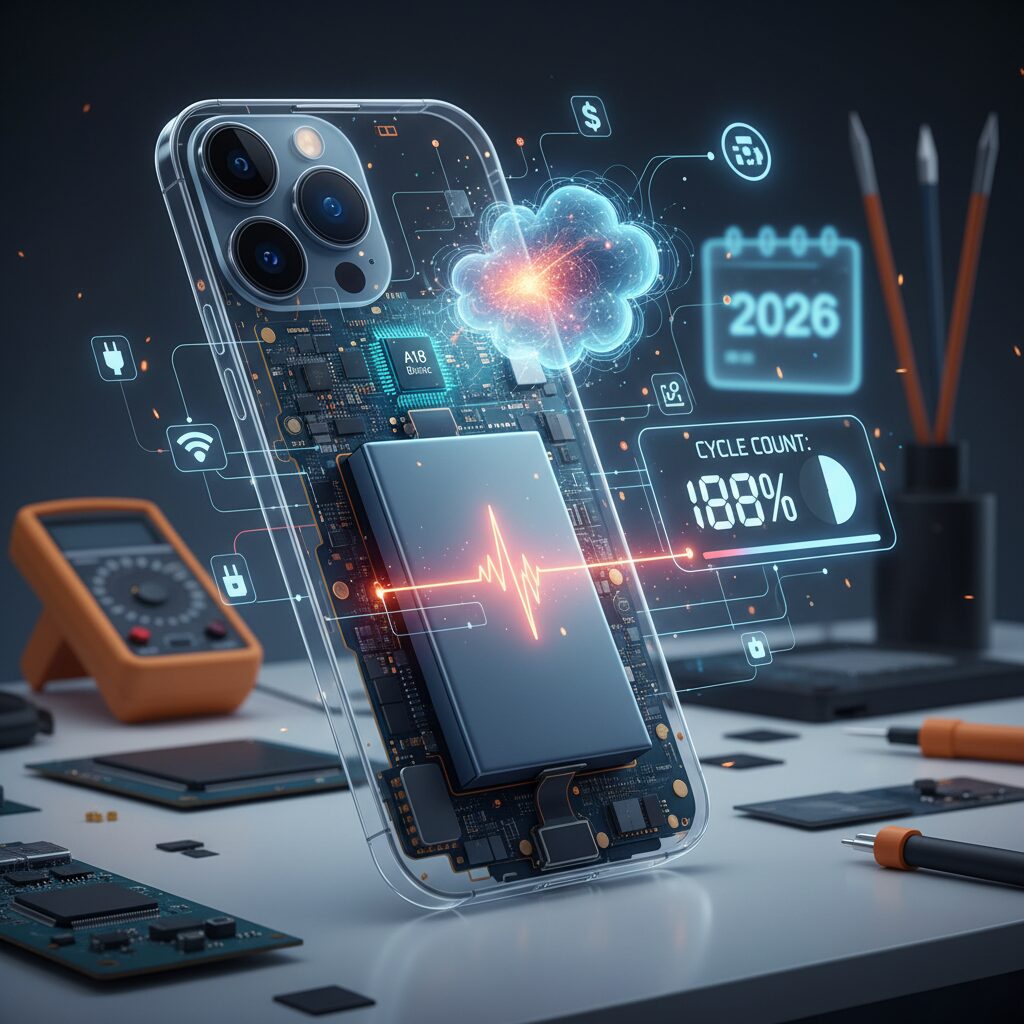
When Apple states that the iPhone 16 battery is designed to retain 80 percent of its original capacity after 1,000 full charge cycles, this figure often sounds abstract. Many users intuitively assume that one cycle equals one day of use, but that assumption is inaccurate. A cycle is defined as a cumulative 100 percent discharge, meaning that using 50 percent one day and recharging, then another 50 percent the next day, counts as a single cycle.
This definition is consistent with standards referenced by Apple and organizations such as the IEC, and it fundamentally changes how longevity should be interpreted. For light to moderate users who typically consume 30 to 60 percent per day, reaching 1,000 cycles can realistically take four to five years. Heavy users, on the other hand, may approach that threshold much faster, even if the calendar age of the device is still relatively young.
| Daily Usage Pattern | Cycles per Year | Years to Reach 1,000 Cycles |
|---|---|---|
| 30% per day | ~110 | ~9 years |
| 50% per day | ~180 | ~5.5 years |
| 100% per day | ~365 | ~2.7 years |
However, the phrase “under ideal conditions” is critical. Apple’s own technical documentation makes clear that cycle-life testing is performed in tightly controlled environments, typically around room temperature with stable charge rates. Real-world usage introduces heat, rapid discharge, and prolonged high-voltage states, all of which accelerate chemical aging even if the cycle count itself remains modest.
From an electrochemical perspective, each cycle slightly thickens the SEI layer on the anode, increasing internal resistance. Research frequently cited in academic journals and battery conferences shows that capacity fade is not linear: degradation is relatively slow early on, then accelerates once impedance crosses certain thresholds. This explains why some users report stable battery health for months, followed by a seemingly sudden drop.
The jump from the previous 500-cycle benchmark to 1,000 cycles is therefore not just a marketing number. It reflects incremental but meaningful improvements in electrode materials, electrolyte stability, and battery management algorithms. According to Apple’s published specifications, this effectively doubles the engineered lifespan compared with iPhone models prior to the iPhone 15 generation. It does not mean the battery will feel “like new” for twice as long, but it does mean usable capacity remains within an acceptable range for a much longer period.
User data shared through Apple Support Communities and long-term reviews supports this interpretation. Optimized users who avoid excessive heat and extreme charging habits often report 99 to 100 percent health after several hundred cycles. Conversely, gaming-heavy users who combine high discharge rates with charging frequently see noticeable degradation well before reaching even half of the theoretical cycle limit.
Ultimately, 1,000 cycles should be understood as a durability ceiling, not a promise of uniform performance. The practical takeaway is that cycle count interacts with how those cycles are accumulated. Slow, cool, partial cycles are far gentler than fast, hot, full-depth ones. For readers who closely monitor battery health, this perspective clarifies why two iPhone 16 devices with similar cycle counts can exhibit very different real-world endurance.
How Heat, Voltage, and Charging Behavior Accelerate Battery Aging
Battery aging is not driven by time alone but by a continuous interaction between heat, voltage, and charging behavior. In modern smartphones like the iPhone 16 series, this interaction becomes more intense because higher performance demands place the battery under frequent electrical and thermal stress. **Understanding how these three factors reinforce each other is essential to grasp why real-world battery aging often diverges from laboratory expectations.**
Heat is the most aggressive accelerator of lithium-ion battery degradation. Apple’s own technical documentation, consistent with findings from electrochemical research institutions, explains that operating or charging above roughly 35°C increases irreversible chemical reactions inside the cell. Elevated temperature speeds up electrolyte decomposition and thickens the SEI layer on the electrodes, which permanently raises internal resistance. **This means that even short but repeated exposure to high temperatures can reduce peak power delivery long before maximum capacity visibly declines.**
Voltage stress works more quietly but is just as damaging. When a battery remains near full charge, typically close to 100%, the internal cell voltage stays high, placing sustained strain on the cathode structure. Research cited by Apple Support indicates that prolonged high-voltage states accelerate crystal lattice damage in the positive electrode. In practical terms, a phone left fully charged overnight every day experiences more chemical stress than one that cycles between moderate charge levels, even if total usage time is identical.
| Stress Factor | Primary Trigger | Long-Term Effect on Battery |
|---|---|---|
| Heat | High ambient temperature or charging while hot | Electrolyte breakdown and rising internal resistance |
| High Voltage | Staying near 100% charge for long periods | Structural damage to cathode materials |
| Aggressive Charging | Fast or wireless charging under load | Combined thermal and electrical stress |
Charging behavior ties heat and voltage together. Fast charging and wireless charging both introduce additional energy losses that manifest as heat. Independent testing referenced by accessory manufacturers and Apple-focused media has shown that MagSafe charging can raise device temperature by several degrees compared with wired charging under similar conditions. **This temperature increase occurs precisely when the battery is already under high-voltage stress, creating a compounding aging effect.**
User behavior further amplifies these mechanisms. Playing graphically intensive games or editing video while charging forces the battery to accept charge and deliver power simultaneously. According to user reports analyzed by Apple Communities and MacRumors, devices used this way often show faster capacity decline within the first year. The reason is not excessive cycle count alone but repeated exposure to high internal temperatures during charging, a condition that laboratory cycle-life ratings explicitly avoid.
Academic battery researchers frequently emphasize that lithium-ion aging follows an exponential relationship with temperature rather than a linear one. This aligns with Apple’s warning that damage from heat is cumulative and non-recoverable. **A phone that is only slightly too warm, but frequently so, may age faster than one that occasionally experiences deeper discharge cycles at cooler temperatures.** This insight explains why seemingly minor habits can have outsized long-term consequences.
In short, battery aging accelerates when heat, high voltage, and charging habits overlap. Each factor alone is manageable, but together they form a feedback loop that erodes battery health faster than cycle counts suggest. For high-performance devices like the iPhone 16, managing these stresses is less about avoiding use and more about minimizing the moments when all three converge.
Real‑World User Patterns That Cause Faster Battery Degradation
In real-world use, battery degradation is rarely driven by a single dramatic mistake. It is usually the accumulation of everyday habits that users consider harmless. These patterns often diverge sharply from Apple’s “ideal conditions” assumptions, which is why two iPhone 16 units purchased on the same day can show very different battery health after one year.
Apple’s own battery documentation and electrochemical research cited by institutions such as IEEE make it clear that heat, charge level, and current draw interact in non‑linear ways. When users unknowingly combine these stressors, degradation accelerates even if total charge cycles remain moderate.
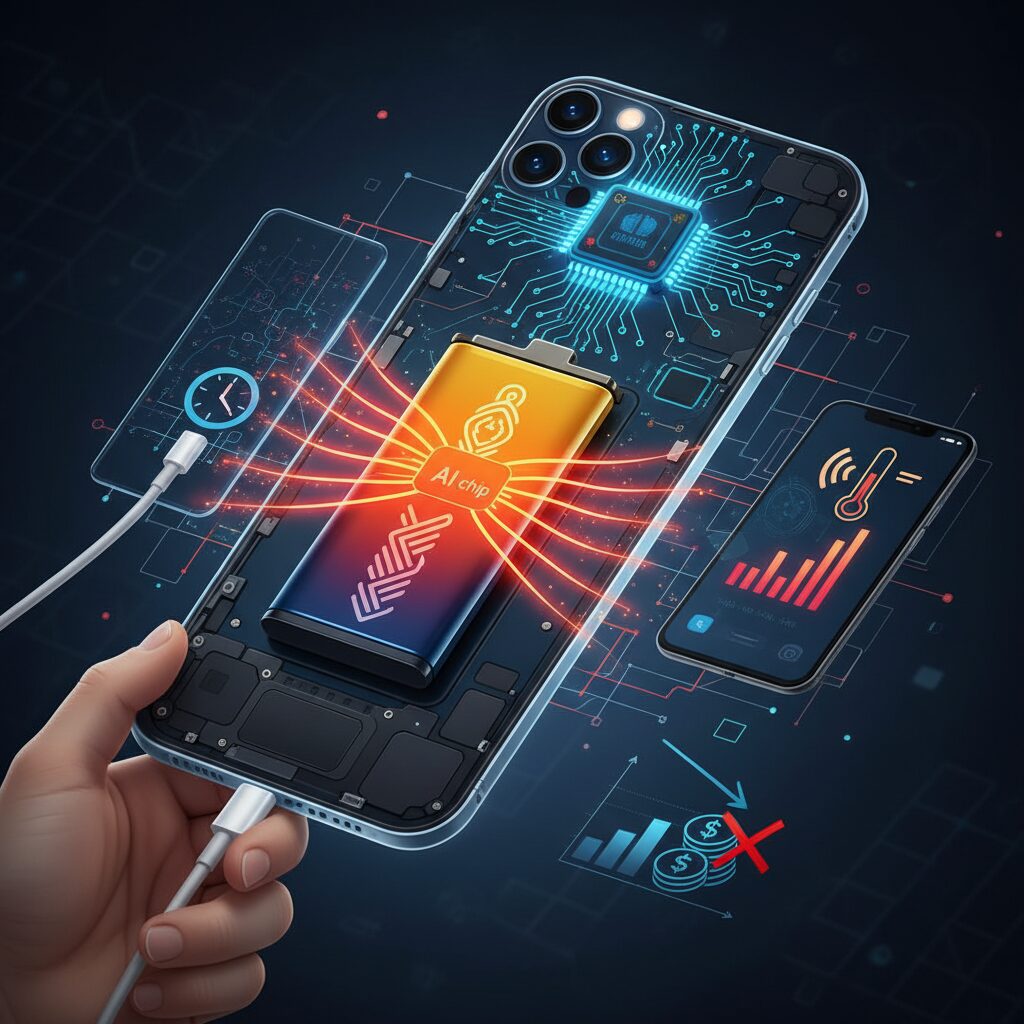
One common pattern is prolonged high-load usage while the device is connected to power. Mobile gaming, extended video capture, or on-device AI processing with Apple Intelligence can push the A18 or A18 Pro chip into sustained high wattage states. When this occurs during charging, internal temperatures rise faster than iOS can effectively dissipate them.
According to user diagnostics shared in Apple Support Communities and corroborated by long-term reviewers, devices frequently used this way have shown battery health dropping below 90 percent in under a year. The underlying mechanism is well understood in battery science: elevated temperature accelerates electrolyte breakdown and thickens the SEI layer, increasing internal resistance.
| User behavior pattern | Primary stress factor | Observed long-term impact |
|---|---|---|
| Gaming or video editing while charging | Heat plus high current | Faster capacity loss, reduced peak performance |
| MagSafe charging in warm rooms | Sustained elevated temperature | Gradual but irreversible chemical aging |
| Weak-signal 5G commuting | Modem power spikes | Higher baseline drain and thermal stress |
Another overlooked pattern is environmental rather than behavioral. In urban Japan, commuting through areas with unstable 5G coverage forces the modem to repeatedly boost transmission power. Even with the screen off, the phone generates heat internally. Apple engineers have acknowledged that radio subsystems can become a significant energy sink under poor signal conditions.
Over months, this creates what battery researchers call a thermal history problem. Each individual episode seems minor, but the cumulative exposure shortens the effective lifespan. Users often misattribute the resulting capacity drop to “bad luck,” when it is actually the logical outcome of repeated micro-stress events.
A final pattern worth noting is overnight charging in warm, enclosed spaces. Placing the iPhone under a pillow or on a heat-retaining surface keeps the battery near 100 percent state of charge while limiting heat dissipation. Apple Support explicitly warns that maintaining a high charge level at elevated temperature is one of the fastest paths to chemical aging.
Seen together, these patterns explain why software features like optimized charging or an 80 percent limit sometimes fail to deliver consistent results. User context can easily overwhelm software safeguards. Understanding these real-world behaviors allows users to adjust habits where they matter most, rather than relying solely on settings toggles.
A18 and A18 Pro Chips: Power Efficiency Versus Thermal Reality
The A18 and A18 Pro chips represent Apple’s most aggressive push toward power efficiency to date, yet they also expose a fundamental tension between silicon progress and thermal reality in a thin smartphone chassis.
Built on TSMC’s second-generation 3nm process, both chips reduce switching power and leakage compared with A17 Pro, which Apple and independent analysts note translates into lower energy use during everyday tasks such as messaging, browsing, and media playback.
In light workloads, efficiency cores dominate, allowing the iPhone 16 series to feel fast while sipping power.
However, efficiency gains at the transistor level do not eliminate heat; they merely change when and how it appears.
According to benchmark analysis published by NotebookCheck and PhoneArena, the A18 Pro achieves industry-leading Geekbench 6 CPU scores, but sustained GPU stress tests reveal a familiar pattern of thermal throttling after several minutes.
This behavior illustrates that peak efficiency and sustained efficiency are not the same metric in real-world use.
| Scenario | Observed Behavior | User Impact |
|---|---|---|
| Light daily tasks | High efficiency-core usage, low heat | Stable battery life, cool operation |
| Short burst workloads | High peak performance, brief heat spike | Excellent responsiveness |
| Sustained gaming or AI tasks | Thermal throttling after minutes | Gradual performance drop, battery warming |
Apple emphasizes its revised thermal architecture, including improved graphite layering and an aluminum substructure, claiming up to a 30 percent gain in sustained gaming performance.
These changes do spread heat more evenly, yet they also mean that thermal energy is conducted closer to the battery cell itself.
From a battery health perspective, this is the hidden trade-off of higher sustained performance.
Experts in semiconductor thermodynamics often point out that every watt not turned into useful computation becomes heat, regardless of process node.
In practical terms, the A18 Pro’s superior efficiency delays throttling rather than preventing it, especially in compact enclosures with limited surface area.
As a result, users who frequently engage in extended gaming, 4K video capture, or on-device AI processing may still experience elevated battery temperatures.
This thermal reality does not negate the achievements of A18 and A18 Pro, but it reframes them.
They excel at doing more work per joule, yet they cannot escape the physics of heat dissipation.
Understanding this balance helps users interpret why battery life feels excellent on some days and merely adequate on others, even with the same chip and the same device.
The Role of iOS Battery Management and the 80% Charge Limit
iOS plays a far more active role in battery longevity than many users realize, and the 80% Charge Limit introduced in recent iPhone generations is a clear example of software directly shaping hardware lifespan. This feature is not a simple cap, but a dynamic control rooted in lithium-ion chemistry, where prolonged high-voltage states accelerate irreversible degradation.
Apple’s own battery documentation explains that stress is highest near full charge, as electrode materials experience structural strain at elevated voltages. By stopping charging around 80%, iOS keeps the cell in a chemically calmer zone, roughly equivalent to 3.9–4.0V, where oxidation reactions slow measurably.
| Charge Behavior | Chemical Stress | Long-Term Impact |
|---|---|---|
| 80% Charge Limit | Low to moderate | Slower capacity loss |
| Optimized Charging | Variable | Balanced convenience |
| Always 100% | High | Faster degradation |
Real-world data reflects this theory, but not uniformly. Long-term user reports aggregated by MacRumors show some devices maintaining 99–100% health after a year with the 80% limit enabled, while others still decline into the low 90s. This gap underscores an important reality: iOS can reduce one major risk factor, but it cannot override heat, workload, or charging habits.
The true value of the 80% limit lies in predictability. For users with consistent daily routines and access to charging, iOS battery management acts like an insurance policy, quietly trading peak capacity for stability. It is most effective when paired with low-temperature charging and moderate usage, conditions Apple’s engineers explicitly emphasize in official support guidance.
MagSafe Charging Convenience Versus Long‑Term Battery Health
MagSafe charging offers a level of everyday convenience that wired charging cannot easily match, especially for users who place their iPhone on and off a charger multiple times a day. The magnetic alignment reduces port wear and lowers the friction of frequent top‑ups, which in turn can help avoid deep discharge cycles.
However, from a long‑term battery health perspective, this convenience comes with a technical trade‑off. Wireless charging inherently generates more heat due to electromagnetic induction losses, and Apple’s own support documentation explains that heat is one of the primary accelerators of lithium‑ion battery aging.
Independent measurements and teardown analyses cited by major tech publications indicate that iPhones can run several degrees Celsius warmer during MagSafe charging than during comparable wired charging sessions. Even when Apple’s thermal safeguards pause charging or cap it at 80%, the battery may already have spent extended time in a high‑temperature state.
| Charging Method | User Convenience | Thermal Impact |
|---|---|---|
| MagSafe (15–25W) | Very high | Moderate to high |
| Wired (5–12W) | Moderate | Low |
Battery researchers frequently cited by outlets such as MacRumors emphasize that repeated exposure to elevated temperatures, even below critical thresholds, contributes to gradual capacity loss. For users in warmer climates or poorly ventilated rooms, this effect becomes more pronounced.
In practical terms, MagSafe is best viewed as a lifestyle enhancer rather than a default charging strategy. **Using it selectively, while relying on cooler wired charging for overnight or extended sessions, offers a balanced approach** that preserves both daily comfort and long‑term battery health.
Repair Costs, AppleCare+, and the Economics of Battery Replacement
When battery health becomes a real-world problem, repair costs and warranty coverage suddenly matter more than chemistry or benchmarks. For the iPhone 16 series, Apple’s official battery replacement pricing in Japan has settled into a clear tier structure, reflecting both hardware size and ongoing yen depreciation. **For many users, the decision to replace a battery is less about percentage numbers and more about whether the economics make sense at that moment.**
According to Apple’s official repair pricing and carrier disclosures, out-of-warranty battery replacement now approaches what some users once paid for midrange Android phones. This price pressure has changed user behavior, especially among power users who rely on their device daily and cannot tolerate unpredictable shutdowns or aggressive performance throttling.
| Model | Official Battery Replacement Cost (JPY) | Economic Impression |
|---|---|---|
| iPhone 16 Pro Max | 19,400 | High upfront cost, strong performance recovery |
| iPhone 16 Pro | 19,400 | Same cost as Max despite smaller battery |
| iPhone 16 / Plus | 15,800 | More balanced cost-to-benefit ratio |
AppleCare+ complicates this calculation in an interesting way. Apple’s support documentation clearly states that battery replacement becomes free once maximum capacity drops below 80 percent during coverage. However, when analysts compare the two-year AppleCare+ fee with a single paid battery replacement, **AppleCare+ rarely pays for itself if battery service is the only expected issue.** This aligns with consumer cost-benefit analyses frequently cited by Japanese tech media and repair industry observers.
The value of AppleCare+ emerges instead from risk pooling. Display damage, accidental drops, and liquid exposure are statistically far more expensive than a battery alone. Battery replacement should be seen as a bonus feature rather than the primary justification. Apple’s own framing of AppleCare+ as comprehensive protection, rather than a maintenance plan, supports this interpretation.
Third-party repair options often appear attractive due to lower prices, but the hidden costs are substantial. Apple’s parts authentication system flags non-genuine batteries, permanently displaying component warnings and often disabling accurate health metrics. According to established resale platforms in Japan, devices with such warnings can lose tens of percent in resale value, easily exceeding the initial savings from unofficial repairs.
In short, battery replacement for the iPhone 16 is no longer a simple maintenance decision. It is an economic judgment shaped by repair pricing, warranty structure, resale implications, and how intensely the device is used. **Understanding these trade-offs allows users to spend money where it actually improves daily experience, rather than reacting reflexively to a declining percentage.**
Resale Value, Trade‑In Programs, and Why Battery Health Affects Price
When evaluating the resale value of the iPhone 16 series, battery health functions as a financial signal rather than a purely technical metric. In the Japanese secondary market, buyers and professional resellers consistently treat maximum battery capacity as a proxy for overall device care. **A difference of just a few percentage points in battery health can translate directly into a noticeable price gap**, even when the exterior condition is identical.
According to established buyback operators such as Sofmap and major reuse chains, devices showing battery health below 80% are automatically classified as degraded, triggering systematic deductions. This is not a subjective judgment. It is a standardized rule designed to anticipate user dissatisfaction and future repair costs. Apple’s own documentation reinforces this logic by defining sub‑80% batteries as candidates for service, which indirectly legitimizes resale penalties.
| Battery Health Status | Typical Market Treatment | Price Impact Trend |
|---|---|---|
| 80% or higher | Normal resale condition | Minimal or no deduction |
| Below 80% | Degraded battery | Roughly 20–30% reduction |
| Unknown part detected | Non‑genuine repair history | Severe reduction or rejection |
Trade‑in programs offered by Japanese carriers operate under a different economic logic. With two‑year return schemes, battery degradation is generally not treated as functional damage. This means users gain no financial advantage by replacing a battery before returning the device. **From a value‑maximization standpoint, paying for a replacement shortly before trade‑in is almost always irrational.**
Battery health also influences price indirectly through trust. Devices showing “unknown part” warnings after non‑authorized repairs suffer disproportionate losses, even if real‑world performance is unaffected. This aligns with Apple’s system‑level authentication design and has been repeatedly confirmed by resale professionals. In practical terms, maintaining official battery integrity preserves not only runtime, but also credibility in the resale ecosystem.
Ultimately, battery health affects resale price because it compresses future risk into a single number. For buyers, it predicts longevity. For sellers, it defines negotiating power. Treating battery management as an asset strategy rather than mere maintenance is therefore essential.
Future Outlook: AI‑Driven Battery Management and What Comes Next
The future of battery management is shifting from static rules to predictive, AI‑driven control, and Apple is clearly signaling that direction. According to reporting by MacRumors citing iOS 19 development builds, Apple is experimenting with machine‑learning models that analyze individual usage patterns to adjust charging behavior, background activity, and performance states in real time.
Instead of treating battery health as a fixed percentage, the system aims to treat it as a dynamic resource. This means the device may temporarily limit peak CPU or GPU power before heat builds up, or delay background tasks when it predicts intensive use later in the day, such as gaming or video recording.
| Aspect | Current Approach | AI‑Driven Direction |
|---|---|---|
| Charging | Rule‑based limits | Context‑aware timing |
| Performance | Reactive throttling | Predictive scaling |
| Thermal control | Threshold‑based | Pattern‑based prevention |
Apple’s own research on optimized charging already shows that learning sleep and usage cycles can reduce high‑voltage stress on lithium‑ion cells. Extending this logic with on‑device AI could further reduce time spent at damaging temperature and charge states, effectively slowing chemical aging without user intervention.
What matters most is that these optimizations are expected to run entirely on‑device. Apple has repeatedly emphasized privacy‑preserving machine learning, and experts from semiconductor research communities note that localized inference minimizes latency while avoiding cloud dependency.
Looking ahead, AI‑driven battery management may not dramatically increase physical capacity, but it can stretch perceived longevity. For users, this means fewer sudden drops in endurance, more stable performance over years, and a battery that ages quietly in the background rather than demanding constant attention.
参考文献
- Apple Support:About Charge Limit and Optimized Battery Charging on iPhone
- MacRumors:iPhone 16 Pro Max 80% Charge Limit: One Year Later, Was It Worth It?
- NotebookCheck.net:A18 Pro claims the top spot in smartphone SoC ranking
- PhoneArena:iPhone 16 Pro performance tested: How much faster is the new A18 Pro processor?
- Apple Support:iPhone Battery Replacement
- Counterpoint Research:Japan Smartphone Market: Replacement Demand May Strengthen in 2026