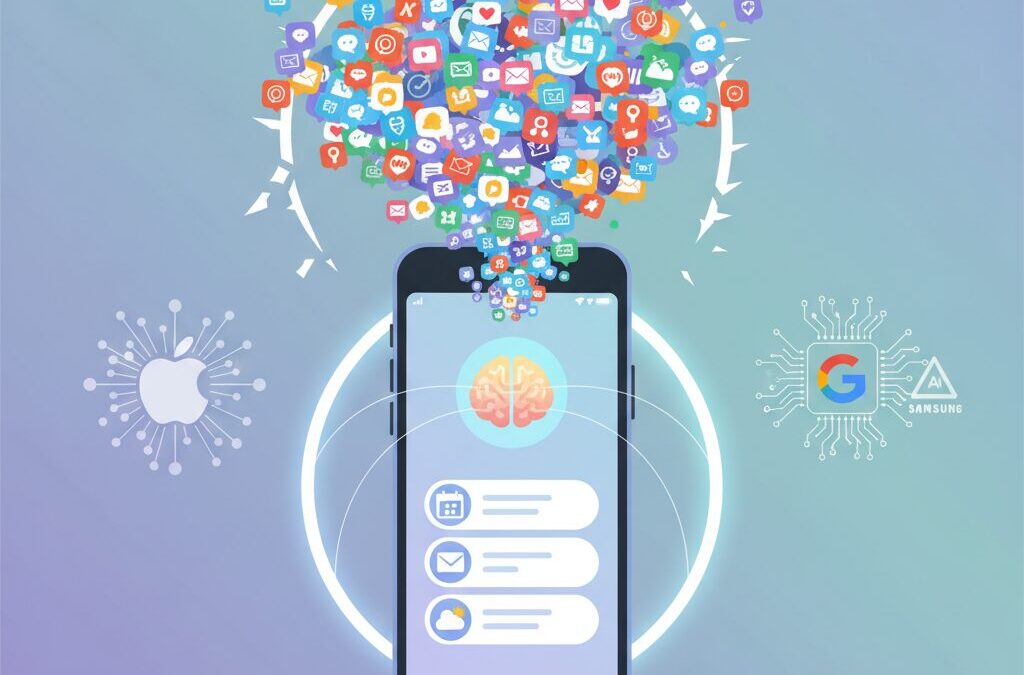
Have you ever felt that your smartphone is no longer helping you, but constantly interrupting you?
Notifications were originally designed to keep us informed in real time, yet today they often feel like endless noise that steals our focus and peace of mind.
Many gadget enthusiasts around the world share this frustration, wondering whether technology has crossed a point of no return.
In recent years, the overload of alerts, messages, and app updates has led to what experts describe as notification fatigue, affecting productivity, mental health, and even sleep quality.
At the same time, smartphone makers are quietly introducing a new solution that could redefine how we interact with our devices.
AI-powered notification summaries aim to deliver only what truly matters, exactly when it matters.
This article explores how AI notification summarization is changing the post-smartphone experience.
By looking at concrete data, real-world examples, and the latest implementations from Apple, Google, and Samsung, you will understand why this technology is more than a convenience feature.
It represents a fundamental shift in the attention economy and offers a glimpse into a calmer, more human-centered future of gadgets.
- The Breaking Point of Digital Attention and the Rise of Silence
- Notification Fatigue Explained Through Data and Human Limits
- Productivity Loss, Economic Impact, and Why Businesses Care
- How AI Understands Context Instead of Keywords
- On-Device AI and Small Language Models as a Privacy Solution
- Apple Intelligence and the Hybrid Approach to Notification Summaries
- Google, Android, and Gemini Nano’s System-Level AI Strategy
- Samsung Galaxy AI and Cross-Device Notification Intelligence
- Apps, Wearables, and Smart Glasses in the AI Summary Era
- Hallucination Risks and Real-World Misread Notifications
- From Notifications to Ambient Computing
- 参考文献
The Breaking Point of Digital Attention and the Rise of Silence
The digital attention economy is reaching a clear breaking point, and this shift is no longer anecdotal but structurally observable. Since the rise of smartphones, notifications have been designed as a constant call for immediate reaction, promising efficiency and real-time connection. However, by the mid-2020s, this promise has inverted, and notifications are increasingly experienced as cognitive noise rather than value.
Large-scale surveys conducted by Amazon indicate that the average smartphone user now receives around 40 notifications per day, while users in their twenties often exceed 50. This means attention is forcibly interrupted every 20 to 30 minutes during waking hours. According to the same research, nearly 60 percent of users report that most notifications they receive are unnecessary. **Human cognitive capacity has not expanded, yet the demand placed upon it has multiplied**, creating a systemic mismatch.
Research in cognitive psychology and human–computer interaction has long warned about this phenomenon. Medical studies cited by the U.S. National Institutes of Health describe “alert fatigue,” where excessive warnings reduce sensitivity to genuinely critical signals. Similar patterns are now visible in everyday digital life, where users unconsciously ignore or mute alerts, even those that may matter.
| Aspect | Early Smartphone Era | Mid-2020s Reality |
|---|---|---|
| Notification Role | Helpful prompt | Cognitive interruption |
| User Perception | Convenience | Stress and fatigue |
| Behavioral Response | Immediate checking | Silencing or ignoring |
The psychological cost is particularly visible during moments meant for rest. Amazon’s data shows that roughly 40 percent of younger users experience increased stress when notifications interrupt leisure activities such as video streaming or reading. Sleep research published in JMIR Formative Research further connects nighttime notifications to reduced sleep quality and higher stress levels the following day. **Silence, once an absence of information, is now being redefined as a premium resource.**
This is why the current shift toward notification control and reduction is not a design trend but a necessity. As scholars of digital well-being and organizations like the World Health Organization have emphasized, sustained cognitive overload leads to disengagement, not productivity. The rise of silence reflects a collective demand to restore mental bandwidth and to rebuild digital systems that respect human limits rather than exploit them.
Notification Fatigue Explained Through Data and Human Limits
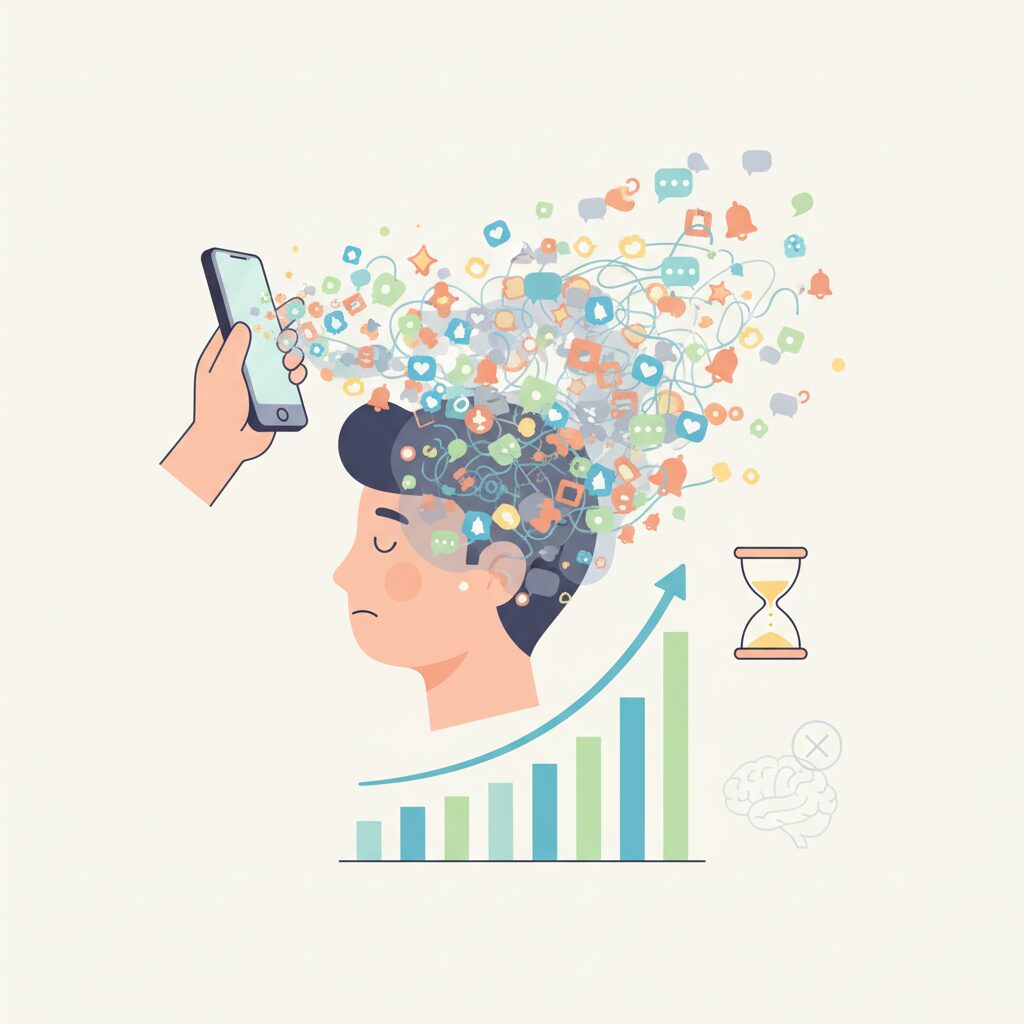
Notification fatigue is not a vague feeling but a measurable collision between human cognitive limits and the modern attention economy. Multiple large-scale studies show that the average smartphone user now receives around 40 notifications per day, and for users in their twenties this number often exceeds 50. This means attention is forcibly interrupted every 20 to 30 minutes during waking hours, a rhythm fundamentally misaligned with how the human brain sustains focus.
What makes this overload dangerous is not just volume, but irrelevance. According to a large survey conducted by Amazon, nearly 60 percent of users report that most notifications they receive are unnecessary or not useful. From a cognitive psychology perspective, this implies that more than half of our limited attentional resources are consumed by low-value signals, leaving less capacity for meaningful tasks, reflection, or rest.
| Metric | General Users | Users in Their 20s |
|---|---|---|
| Average notifications per day | ~40 | 50+ |
| Perceived unnecessary notifications | ~60% | ~60% |
| Reported stress increase during leisure time | — | ~40% |
The human cost of this constant interruption mirrors what medicine has long described as alert fatigue. Research published via the U.S. National Institutes of Health shows that when clinicians are exposed to too many alerts, they begin to ignore even critical warnings. The same mechanism applies to everyday users: when every message feels urgent, nothing truly is. Important signals are cognitively flattened into background noise.
Stress and recovery cycles are also directly affected. Japanese studies conducted during the COVID-19 pandemic demonstrated that repeated, high-frequency alerts reduced compliance and psychological resilience over time, a phenomenon labeled pandemic fatigue. Parallel findings from wearable-based sleep research in Japan indicate that disrupted sleep amplifies stress levels the following day, creating a feedback loop in which night-time notifications degrade both rest and next-day cognitive performance.
From a productivity standpoint, the limits are equally clear. Asana’s Anatomy of Work report shows that constant context switching, often triggered by notifications across an average of nine work apps, significantly lowers efficiency and contributes to burnout. Notification fatigue is therefore not a personal weakness but a systemic mismatch between digital systems and human attention bandwidth. Understanding this data-driven reality is essential before discussing any technological solution, because it clarifies one hard truth: humans cannot be optimized to handle infinite alerts, so the system itself must change.
Productivity Loss, Economic Impact, and Why Businesses Care
When notification overload is discussed, it is often framed as a personal inconvenience, but from a business perspective, the consequences are far more severe. Constant interruptions directly translate into measurable productivity loss, and this loss compounds across teams and entire organizations. In knowledge work, attention is not a soft concept; it is a core economic resource.
According to Asana’s Anatomy of Work Report, employees use an average of nine different apps per day, frequently switching contexts in response to pings and alerts. This behavior fragments focus, and more than one in five workers explicitly report reduced efficiency due to this constant app switching. Cognitive science research, frequently cited by institutions such as the American Psychological Association, shows that regaining deep focus after an interruption can take over 20 minutes, even if the interruption itself lasts only seconds.
| Factor | Observed Impact | Business Implication |
|---|---|---|
| Frequent notifications | Increased context switching | Lower task completion speed |
| Always-on responsiveness | Mental fatigue and stress | Higher burnout risk |
| Poor focus quality | More errors | Rework and hidden costs |
The economic impact becomes clearer when scaled. Analysts and workflow experts cited by enterprise productivity studies estimate that AI-powered summarization can save professionals up to four hours per week in the short term, with long-term potential reaching double-digit weekly hours. This reclaimed time does not merely reduce workload; it shifts labor toward higher-value, creative tasks, which is why businesses increasingly view attention management as a strategic investment rather than a UX detail.
In this context, notification management is no longer optional hygiene. It is an operational concern tied to revenue, retention, and sustainable performance, explaining why enterprises are now paying close attention to how intelligently attention itself is handled.
How AI Understands Context Instead of Keywords
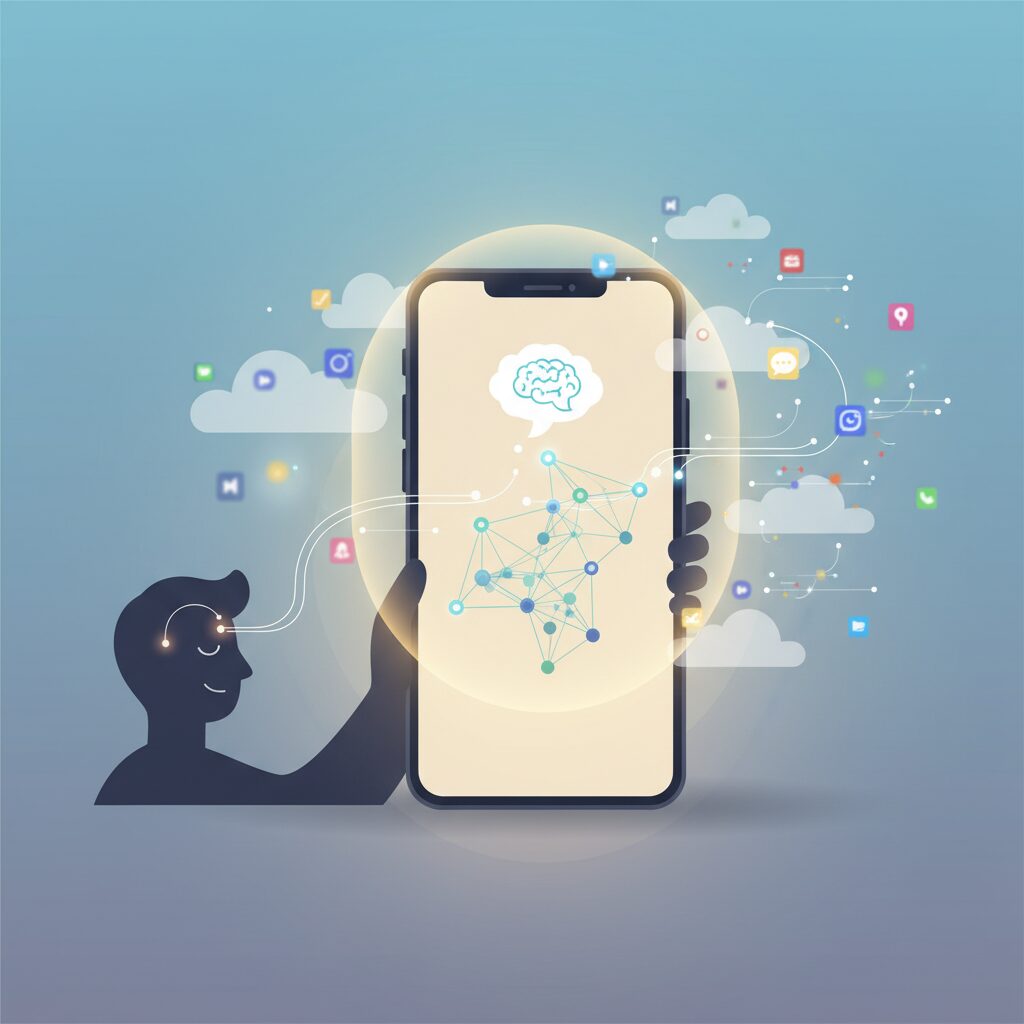
Traditional notification systems have relied on keyword matching, but modern AI approaches understand context in a fundamentally different way. Instead of reacting to isolated words like “urgent” or “meeting,” AI models analyze relationships between messages, timing, senders, and prior interactions to infer intent. **This shift allows notifications to be evaluated based on meaning rather than surface-level triggers**, which directly addresses notification fatigue.
Research summarized by Apple and Google shows that small language models running on devices can preserve semantic structure even with limited context windows. By processing entire conversation threads, AI can recognize whether a message is a casual update or a decision that requires action. For example, a group chat mentioning “tomorrow” and “airport” is interpreted as travel coordination, not just a generic date reference.
| Approach | What It Detects | User Impact |
|---|---|---|
| Keyword-based | Exact words or rules | High false alerts |
| Context-aware AI | Intent, urgency, relationships | Reduced interruptions |
According to studies cited by Frontiers in Artificial Intelligence, context-aware summarization reduces information loss caused by fragmented alerts. **AI evaluates who is speaking, what has already been decided, and what remains unresolved**, which is why summaries feel closer to human judgment. This capability is especially important on smartphones, where attention is scarce and every interruption carries cognitive cost.
By moving beyond keywords, AI transforms notifications from noise into signals. The technology does not simply filter information; it interprets it, allowing users to stay informed without being overwhelmed.
On-Device AI and Small Language Models as a Privacy Solution
As AI-driven notification summaries become more deeply embedded in smartphones, privacy has emerged as the defining concern for power users and gadget enthusiasts. Notifications often contain fragments of personal conversations, financial alerts, location data, and work-related intelligence, making them one of the most sensitive data streams on any device. This is precisely why **on-device AI and small language models are increasingly positioned as a practical privacy solution rather than a technical compromise**.
The core idea is simple but powerful. Instead of sending raw notification content to distant cloud servers, modern smartphones process and summarize information locally, inside the device. According to Apple and Google’s official technical disclosures, this approach dramatically reduces the attack surface for data leaks, because the information never leaves the user’s physical possession. For users who already distrust always-on cloud analytics, this architectural shift is not cosmetic; it fundamentally changes the privacy equation.
Small Language Models, or SLMs, are the enablers of this shift. Unlike large cloud-based models with hundreds of billions of parameters, SLMs operate with far fewer parameters and are optimized for Neural Processing Units inside modern chipsets. Research published in peer-reviewed AI journals shows that, for narrow tasks such as summarization or classification, carefully tuned SLMs can reach accuracy levels close to larger models while consuming a fraction of the energy. This efficiency makes local processing viable even on battery-powered devices.
The privacy implications become clearer when comparing processing models.
| Processing Model | Data Location | Privacy Exposure |
|---|---|---|
| Cloud-based LLM | Remote servers | Dependent on provider policies and network security |
| Hybrid (Selective Cloud) | Device + secure servers | Reduced but still conditional |
| On-device SLM | User’s device only | Structurally minimized |
Apple’s documentation on Apple Intelligence emphasizes that routine notification summaries are handled entirely on-device, with no logging or retention. Google has made similar statements regarding Gemini Nano on Pixel devices, noting that summaries generated by Android System Intelligence do not require network access. Independent security researchers have long argued, including those cited by academic institutions such as MIT and Stanford, that **data which is never transmitted is data that cannot be intercepted**. In this sense, on-device AI aligns with the long-standing principle of data minimization in privacy engineering.
There is also a less obvious benefit: latency and contextual integrity. Because summaries are generated instantly and offline, the system does not need to batch or delay notifications for server-side processing. This allows the AI to respect local context, such as Focus modes or time-of-day rules, without exposing behavioral metadata to third parties. From a privacy perspective, metadata leakage can be just as revealing as message content, and on-device models significantly reduce this risk.
Of course, on-device AI is not without trade-offs. SLMs have narrower context windows and less world knowledge than their cloud counterparts. However, studies on divide-and-summarize techniques demonstrate that breaking notifications into smaller semantic units largely mitigates this limitation. Importantly, these techniques operate entirely within the device, preserving privacy while maintaining acceptable summary quality for everyday use.
For gadget-focused users, the broader implication is clear. **Privacy is no longer achieved solely through settings menus and legal terms, but through silicon, model size, and execution locality**. Choosing a device with strong on-device AI capabilities is effectively choosing a privacy posture. As regulatory scrutiny around data usage increases globally, on-device AI and SLMs may well become the default expectation rather than a premium feature, redefining what users consider a trustworthy smart device.
Apple Intelligence and the Hybrid Approach to Notification Summaries
Apple Intelligence approaches notification summaries with what can be described as a carefully engineered hybrid model, designed to balance immediacy, accuracy, and privacy. Rather than relying exclusively on either on-device processing or cloud-based AI, Apple dynamically selects where computation should occur, depending on the complexity and sensitivity of the notification context.
This hybrid design is not a marketing abstraction but a concrete architectural choice. **Routine notification summaries, such as group chat previews or stacked alerts, are processed entirely on the device**, using Apple’s on-device language models optimized for the Neural Engine. According to Apple’s own technical documentation, these models are intentionally smaller and context-limited, which reduces latency and prevents personal notification data from leaving the user’s iPhone.
At the same time, Apple acknowledges that some summarization tasks exceed the practical limits of on-device models. In those cases, Apple Intelligence escalates processing to Private Cloud Compute, a purpose-built cloud environment running on Apple silicon. **What makes this notable is that user data is not stored, logged, or reused**, and the software stack is designed to be auditable by independent security researchers, a point Apple has emphasized in its privacy whitepapers.
| Processing Layer | Primary Use | Privacy Characteristics |
|---|---|---|
| On-device AI | Everyday notification summaries | Data never leaves the iPhone |
| Private Cloud Compute | Complex, multi-context summaries | No data retention, verifiable code |
This dual-layer strategy directly addresses a long-standing concern in the attention economy. Research cited by Amazon and academic institutions has shown that users already perceive most notifications as low-value noise, yet they remain highly sensitive to privacy risks. Apple’s hybrid approach attempts to resolve this contradiction by ensuring that the most frequent interruptions are handled locally, while still allowing for deeper semantic understanding when needed.
In practical terms, this means that a flood of messages from a family group chat can be summarized instantly on the lock screen, while a more nuanced notification, such as overlapping travel updates and calendar changes, may briefly leverage cloud intelligence without exposing raw content. **The user experiences a single, seamless summary, while the system quietly optimizes where intelligence lives.**
Industry analysts often contrast this with purely cloud-driven AI systems, which may achieve stronger raw language performance but introduce latency and trust issues. By comparison, Apple’s design reflects a philosophy closer to what security researchers advocate: minimizing data movement by default. This aligns with guidance from organizations such as the Electronic Frontier Foundation, which has repeatedly highlighted data minimization as a core principle of responsible AI deployment.
As notification summaries become a standard feature rather than a novelty, Apple Intelligence’s hybrid approach signals an important shift. **AI is no longer just about being smarter; it is about being selectively intelligent, context-aware, and restrained.** In that sense, Apple’s notification strategy is less about showing everything AI can do, and more about deciding when it should quietly step back.
Google, Android, and Gemini Nano’s System-Level AI Strategy
Google’s approach to AI notification summarization is fundamentally different from vendor-specific feature add-ons, because it is designed as a system-level capability embedded deep inside Android itself. By integrating Gemini Nano into Android System Intelligence, Google is not merely adding an AI feature, but redefining how the operating system mediates attention between users and applications. This architectural choice signals a long-term strategy in which AI becomes a default layer of interaction rather than an optional enhancement.
At the core of this strategy is Gemini Nano, a small language model optimized to run directly on-device using the phone’s NPU. According to Google’s official Pixel documentation and coverage by outlets such as 9to5Google, Gemini Nano processes notification content locally, without sending raw message data to Google’s servers unless users explicitly opt into cloud-based features. This on-device-first stance is critical for notifications, which often contain highly sensitive personal and professional information.
What makes Google’s implementation distinctive is its position at the system layer. Because notification summarization operates through Android System Intelligence, it can analyze and summarize alerts from third-party apps such as WhatsApp or messaging clients without requiring developers to rewrite their apps. From a platform economics perspective, this dramatically lowers adoption friction and accelerates ecosystem-wide impact.
| Aspect | System-Level AI (Android) | App-Level AI |
|---|---|---|
| Integration depth | OS-wide via System Intelligence | Limited to individual apps |
| Developer effort | None required | Feature-by-feature implementation |
| User experience | Consistent across apps | Fragmented and uneven |
This system-level design also allows Google to combine AI summarization with non-AI mechanisms such as Notification Cooldown in Android 15. While Gemini Nano handles semantic compression of information, the OS simultaneously applies physical dampening by reducing sound and vibration intensity during notification bursts. The result is a hybrid strategy that addresses both cognitive overload and sensory stress.
From a research and policy standpoint, this aligns with broader findings in human-computer interaction. Studies cited by the Android Developers documentation emphasize that excessive alerts reduce user responsiveness to genuinely important messages, a phenomenon long known in medical informatics as alert fatigue. By centralizing prioritization logic at the OS level, Google can apply consistent heuristics informed by large-scale behavioral data while still preserving user privacy through on-device inference.
For gadget enthusiasts, the strategic implication is clear. Android devices equipped with capable NPUs are no longer just faster phones; they are attention-management tools. Gemini Nano’s role inside Android marks a shift from notification delivery to notification mediation, suggesting a future where the operating system actively negotiates when, how, and whether information should reach the user at all.
Samsung Galaxy AI and Cross-Device Notification Intelligence
Samsung Galaxy AI approaches notification intelligence from a uniquely ecosystem-driven perspective, and this strategy becomes especially powerful when notifications are no longer confined to a single smartphone screen. In One UI 7, Samsung is preparing AI-powered notification summaries that are designed to travel seamlessly across Galaxy devices, creating what can be described as a cross-device attention layer rather than a phone-only feature.
This design philosophy reflects Samsung’s long-standing strength in multi-device ownership. According to IDC and Counterpoint Research analyses on Android ecosystems, Galaxy users are more likely than average Android users to own multiple connected devices such as tablets, smartwatches, and earbuds. Galaxy AI leverages this reality by ensuring that notification summaries remain consistent, context-aware, and synchronized across devices.
At the core of this experience is Samsung’s on-device AI processing, complemented by tightly integrated cloud assistance where necessary. Reports from outlets such as 9to5Google indicate that Galaxy notification summaries will be generated with lock-screen readability in mind, but the real innovation lies in how these summaries persist and adapt when viewed on different form factors.
For example, a summarized group chat notification first appears on a Galaxy smartphone as a concise, AI-generated overview. When the same user checks a Galaxy Watch, the system does not simply mirror the raw notification but presents an even more condensed version optimized for glanceability. On a Galaxy Tab, that summary can expand again, preserving context without overwhelming the user.
| Galaxy Device | Notification Role | AI Optimization Focus |
|---|---|---|
| Galaxy Smartphone | Primary context hub | Balanced detail and urgency detection |
| Galaxy Watch | Glance-based alerts | Extreme brevity and priority filtering |
| Galaxy Tablet | Extended review | Context expansion and follow-up actions |
This cross-device consistency directly addresses notification fatigue. Cognitive science research referenced by academic publishers such as MDPI shows that repeated exposure to the same alert in different formats increases stress unless the information density is intelligently adjusted. Galaxy AI’s adaptive summaries attempt to solve this by changing how much information is shown, not what information is shown.
Another notable aspect is Samsung’s integration with existing Galaxy AI features such as call transcription, real-time translation, and voice memo summarization. When these features generate insights, they can be surfaced as summarized notifications across devices. A missed call with a transcribed voicemail summary, for instance, can appear as a short actionable insight on a watch and a fuller summary on a tablet.
Samsung executives have repeatedly emphasized “AI that fits into daily life” rather than AI that demands attention, a stance echoed in official Galaxy AI briefings. By distributing notification intelligence across devices instead of stacking alerts on a single screen, Galaxy AI quietly shifts the power balance back to the user.
The result is not fewer notifications, but fewer interruptions. For Galaxy users invested in the broader ecosystem, cross-device notification intelligence represents one of the most practical and human-centered applications of AI available today.
Apps, Wearables, and Smart Glasses in the AI Summary Era
In the AI summary era, apps, wearables, and smart glasses are quietly redefining how people interact with information, and the shift is more profound than it first appears. Instead of competing for attention with raw notifications, these interfaces increasingly act as filters that decide what deserves to reach the user at all. **The value is no longer in showing more, but in showing less with better judgment**, and this principle is becoming a design baseline rather than a premium feature.
At the application layer, messaging and collaboration tools illustrate this change clearly. Slack’s AI-powered channel recaps and LINE’s message summaries are not simply conveniences; they reshape behavior by reducing the psychological cost of rejoining conversations. According to Slack’s public briefings and coverage by Business Insider Japan, users report faster context recovery after absences, which directly translates into lower cognitive load during work hours. The app becomes an intermediary that absorbs noise before it reaches the human.
| Device Category | AI Summary Role | User Impact |
|---|---|---|
| Smartwatch | Condensed notification delivery | Fewer phone pickups, faster decisions |
| Smartphone App | Thread and conversation abstraction | Reduced catch-up stress |
| Smart Glasses | Audio-first contextual summaries | Hands-free awareness |
Wearables amplify this effect because of their physical constraints. Apple Watch and Pixel Watch do not attempt to display everything; instead, they benefit most from AI summaries generated upstream on the phone. Apple’s own documentation emphasizes that summarized notifications mirror iPhone intelligence rather than duplicating processing on the watch itself. This design choice keeps power consumption low while ensuring that a glance at the wrist delivers meaning, not fragments.
Smart glasses represent the most radical endpoint of this trajectory. Meta’s Ray-Ban smart glasses, as noted by Meta and discussed in international user communities, rely heavily on voice-based summaries, reading notifications aloud and condensing them into spoken highlights. Although availability in Japan remains limited, the concept is significant. **When displays disappear, summaries become the interface itself**, forcing AI to prioritize clarity and context over completeness. In this sense, apps, wearables, and smart glasses are not accessories to AI summaries; they are the environments that make selective silence possible.
Hallucination Risks and Real-World Misread Notifications
AI-powered notification summaries promise calm, but they also introduce a new class of risk that gadget enthusiasts should not underestimate. When a system compresses multiple messages into a single sentence, it is no longer just filtering information but actively interpreting reality. **This interpretive layer is where hallucination and misreading can quietly emerge**, especially under real-world conditions that differ from lab benchmarks.
Early user reports in English-speaking markets illustrate how these risks surface. According to discussions aggregated by major Apple and Android communities and reported by technology journalists, mis-summaries often occur when notifications arrive from unrelated apps within a short time window. The AI attempts to create coherence where none exists, blending contexts into a single narrative. Cognitive scientists at institutions such as Stanford have long warned that generative models are biased toward narrative completion rather than factual restraint, a tendency that becomes visible in notification streams.
| Risk Pattern | Trigger Condition | Potential Impact |
|---|---|---|
| Context Fusion | Simultaneous alerts from different apps | False sense of urgency or threat |
| Emotional Flattening | Personal or sensitive messages | Misjudgment of interpersonal intent |
| Fabricated Details | Incomplete or ambiguous text | Belief in events that never occurred |
One widely cited anecdote involved a home security alert and a food delivery update being summarized together as an apparent police visit. While anecdotal, these cases matter because they reveal a structural weakness: **on-device SLMs optimize for speed and brevity, not epistemic certainty**. Research published in peer-reviewed AI journals shows that smaller language models are more prone to confident errors when forced to infer missing context, a trade-off accepted to preserve privacy and battery life.
Misread notifications also intersect with human psychology. Studies in human-computer interaction indicate that users quickly develop automation bias, trusting concise system-generated text more than raw data. When a summary appears on a lock screen with system-level design cues, it inherits the credibility of the OS itself. **This can delay critical actions**, such as checking an original message about schedule changes, medical updates, or emotionally charged conversations.
Platform vendors acknowledge this implicitly. Apple and Google documentation emphasize that summaries are informational aids, not substitutes for original content, and they visually mark them as AI-generated. This mirrors recommendations from organizations like the IEEE, which advocate for clear provenance labeling in AI-mediated communication. The responsibility, however, remains shared: users must recalibrate their trust, and designers must continue refining safeguards that reduce hallucination without reintroducing notification overload.
From Notifications to Ambient Computing
The shift from notifications to ambient computing represents a fundamental redesign of how people relate to technology, and it is not merely an incremental UX improvement. Instead of demanding attention through constant alerts, devices are beginning to operate quietly in the background, surfacing information only when context truly requires it. This change is strongly driven by AI notification summarization, which acts as a gatekeeper between raw digital noise and human awareness.
According to cognitive science research frequently cited by institutions such as Stanford University, human attention is a limited resource that degrades rapidly under frequent interruptions. Smartphones, built around push notifications, have unintentionally trained users into reactive behavior. Ambient computing inverts this relationship. **The system observes context, predicts relevance, and waits**, rather than interrupting by default.
This evolution becomes clearer when comparing classic notification models with ambient ones.
| Dimension | Notification-Centric | Ambient Computing |
|---|---|---|
| User role | Reactive receiver | Implicit collaborator |
| Timing | Immediate, indiscriminate | Context-aware, delayed |
| Cognitive load | High and fragmented | Reduced and consolidated |
What makes this transition feasible today is on-device AI. Apple, Google, and Samsung all emphasize local processing so that devices can infer intent from signals such as time, location, activity state, and historical behavior. Researchers at MIT Media Lab have long described ambient systems as technology that “fades into the periphery,” and modern AI finally allows that vision to be implemented at consumer scale.
For example, instead of notifying every incoming message during a meeting, an ambient system may remain silent, later presenting a single summary that states what changed, what requires action, and what can wait. **The absence of interruption becomes a feature, not a failure.** This aligns closely with findings from digital well-being studies showing lower stress and higher task completion when interruptions are minimized.
Importantly, ambient computing does not mean less information, but better timing and framing. By transforming dozens of micro-interruptions into a single, meaningful interaction, AI-driven devices support sustained focus while preserving situational awareness. This marks a decisive step away from the attention economy toward a calmer, more humane computing paradigm.
参考文献
- PR TIMES:Amazon conducts a survey on device notifications
- NIH:Physicians’ Perspectives on Prescription Alerts: A Journey Towards Reducing Fatigue
- HR Dive:Notification fatigue is tanking productivity, report says
- Apple:Summarize notifications and reduce interruptions with Apple Intelligence on iPhone
- 9to5Google:Pixel AI Notification Summaries start rolling out: How to enable
- Google Blog:Android 15: New updates for foldables, tablets, phones and more