
Many smartphone users outside Japan have noticed a quiet but important change in recent years: flagship phones are dropping the microSD card slot, while storage prices keep climbing. You may be wondering whether expandable storage still makes sense in 2026, or if it has finally been replaced by ultra-fast internal memory and cloud services.
At the same time, mobile technology is evolving faster than ever. On-device AI, 8K video recording, console-class mobile games, and massive creative workloads are turning smartphones into powerful production tools. These new use cases are not only about speed, but also about where your data lives, how much control you have over it, and how safely you can store it offline.
This article explores whether microSD cards still matter in 2026 by looking at cutting-edge storage standards like UFS 5.0 and microSD Express, real-world device strategies, and the growing conversation around data ownership. By the end, you will clearly understand who still benefits from microSD, who does not, and how to choose the right storage strategy for your digital life.
- Why the microSD Question Matters Again in 2026
- UFS 5.0 and the Rise of AI-Centric Internal Storage
- The Cost and Physical Limits of Ultra-Fast Built-In Memory
- microSD Express: How Removable Storage Reached SSD-Class Speeds
- SDUC and the Era of Multi-Terabyte microSD Cards
- Real Devices, Real Choices: Different Approaches in the Smartphone Market
- Exploding Content Sizes: Games, 8K Video, and AI Data Logs
- Cloud Storage vs Physical Media: The Return of Data Ownership
- Portable SSDs over USB4: The Strongest Alternative to microSD
- Security, Encryption, and Trust in Removable Storage
- 参考文献
Why the microSD Question Matters Again in 2026
In 2026, the question of whether smartphones still need a microSD card has resurfaced with renewed urgency, and it is no longer a nostalgic debate about expandable storage. It matters again because the very structure of mobile computing has changed. **Smartphones are now primary tools for AI processing, high-resolution content creation, and long-term personal data retention**, and these roles expose tensions that internal storage alone cannot fully resolve.
On the surface, the return of this question may seem counterintuitive. Internal storage has never been faster. According to JEDEC, the official standardization of UFS 5.0 has pushed theoretical sequential read speeds beyond 10 GB/s, a level designed to support on-device generative AI and real-time inference. Many flagship devices now rely on this speed to deliver instant translation, advanced computational photography, and AI assistants that operate entirely offline.
However, this performance leap has also narrowed the design philosophy of smartphones. Ultra-fast internal storage is expensive, power-sensitive, and physically complex to integrate. As a result, manufacturers increasingly reserve large internal capacities for premium tiers, while removing external storage slots altogether. This has reintroduced a practical dilemma for users who generate large volumes of data but do not want to pay a steep premium for built-in terabytes.
At the same time, external storage is no longer technologically stagnant. The SD Association reports that SD Express, which integrates PCIe and NVMe technologies, has become commercially viable by 2026, delivering read speeds close to 1 GB/s. While still slower than UFS 5.0, this performance is sufficient for continuous 4K video recording, high-bitrate audio libraries, and rapid offloading of large media files. The long-held assumption that microSD cards are inherently slow is no longer accurate.
The relevance of microSD cards is further amplified by the sheer scale of modern content. Mobile games frequently exceed 30 GB per title, 8K video consumes several gigabytes per minute, and AI-driven applications continuously generate local logs and personalized datasets. Keeping all of this on internal storage forces users into constant trade-offs. Many now prefer a tiered approach, reserving internal storage for performance-critical applications while offloading bulk data to removable media.
| Storage Type | Typical Speed (2026) | Primary Role |
|---|---|---|
| Internal UFS 5.0 | Up to ~10.8 GB/s | AI inference, system apps |
| microSD Express | ~800–900 MB/s | Media, archives, backups |
Another reason this issue has returned to the spotlight is data ownership. Analysts and industry groups increasingly emphasize data sovereignty, the idea that users should physically control their own data rather than merely renting cloud space. Large-scale cloud outages and rising subscription costs have made this concern tangible. A removable microSD card offers a simple but powerful guarantee: data remains accessible even without a network, an account, or a monthly fee.
For privacy-conscious users, this matters more than ever. On-device AI systems continuously learn from personal behavior, producing datasets that many users are reluctant to upload. Keeping such information on a physically removable, locally encrypted medium provides reassurance that purely cloud-based solutions cannot easily match.
Ultimately, the microSD question matters again in 2026 because the mobile ecosystem has become polarized. Internal storage has reached extraordinary speeds, but at the cost of flexibility and affordability. External storage, once dismissed as outdated, has evolved just enough to fill the widening gap between performance, price, and personal control. This renewed tension is why the debate has returned, not as a relic of the past, but as a reflection of how smartphones are truly used today.
UFS 5.0 and the Rise of AI-Centric Internal Storage

UFS 5.0 represents a decisive turning point in how internal storage is positioned inside smartphones, especially in devices designed around on-device AI. According to JEDEC, which standardized UFS 5.0 in late 2025, the specification was explicitly engineered to remove storage latency as a bottleneck for real-time AI inference, not merely to accelerate file transfers. This shift reflects the reality that modern smartphones are no longer passive endpoints, but autonomous computing nodes.
With a theoretical sequential read speed of up to 10.8 GB/s, UFS 5.0 nearly doubles the bandwidth of UFS 4.0. This leap allows large language models with hundreds of millions to several billion parameters to be loaded into memory almost instantaneously. In practical terms, AI-driven features such as real-time translation, advanced computational photography, and continuous voice recognition become perceptibly more responsive because data can be streamed from storage without stalling the neural processing units.
| Storage Standard | Max Theoretical Speed | Primary Role in 2026 Smartphones |
|---|---|---|
| UFS 3.1 | ~2.1 GB/s | Legacy flagships, cost-focused models |
| UFS 4.0 / 4.1 | ~5.8 GB/s | Mainstream premium devices |
| UFS 5.0 | ~10.8 GB/s | AI-centric flagship smartphones |
This performance is made possible by adopting MIPI M-PHY v6.0 and UniPro v3.0, including the new High-Speed Gear 6 mode that supports 46.6 Gb/s per lane. When configured with dual lanes, smartphones effectively approach PCIe 4.0 SSD-class bandwidth. Tech analysts at outlets such as TechRadar have pointed out that this level of throughput fundamentally changes how much computation can stay on-device instead of being offloaded to the cloud.
At the same time, UFS 5.0 introduces architectural refinements such as inline hashing and enhanced link equalization. These features improve data integrity and security while keeping power efficiency under control, a concern often raised with ultra-high-speed storage. JEDEC has emphasized that these mechanisms are essential for AI workloads, where corrupted or delayed data can directly degrade inference accuracy.
However, this AI-first internal storage strategy comes with trade-offs. High manufacturing costs, increased controller complexity, and significant PCB area consumption mean that UFS 5.0 is realistically confined to top-tier devices. As seen in 2026 flagships like the Galaxy S26 Ultra, manufacturers prioritize sealed, high-speed internal storage over expandability, reinforcing a design philosophy where internal storage becomes the cognitive core of the smartphone.
In this context, UFS 5.0 is not simply “faster storage.” It is an enabling layer for always-on, privacy-aware, low-latency AI experiences that define the upper end of the smartphone market in 2026. The rise of AI-centric internal storage marks a clear architectural commitment: intelligence now lives inside the device, and storage performance is what allows that intelligence to feel instantaneous.
The Cost and Physical Limits of Ultra-Fast Built-In Memory
Ultra-fast built-in memory such as UFS 5.0 delivers astonishing performance, but that speed comes with clear economic and physical trade-offs that are often invisible to users. According to JEDEC documentation and analysis cited by PCMag and TechRadar, UFS 5.0 nearly doubles throughput over UFS 4.0 by using more advanced controllers, denser NAND, and stricter signal integrity requirements. **Each of these improvements directly raises manufacturing cost per gigabyte**, especially at higher capacities.
This cost pressure is evident in real products. Flagship smartphones in 2026 typically offer 256GB as a base configuration, while 1TB variants command a substantial price premium. Industry observers note that the price gap between 512GB and 1TB models is not linear, because yields for high-density, high-speed NAND remain lower. **In other words, ultra-fast memory scales poorly in terms of cost**, even as consumer data demands continue to rise.
Physical constraints further complicate the situation. UFS 5.0 requires more sophisticated power management and signal conditioning to sustain transfer rates approaching 10.8GB/s. JEDEC explains that features such as link equalization and inline hashing improve reliability, but they also increase controller complexity and board-level footprint. **Inside a smartphone, millimeters matter**, and allocating space to storage competes directly with battery capacity, camera modules, and thermal solutions.
| Factor | UFS 4.0 | UFS 5.0 |
|---|---|---|
| Theoretical bandwidth | ~5.8 GB/s | ~10.8 GB/s |
| Controller complexity | High | Very high |
| Cost per GB | Lower | Significantly higher |
Power consumption is another hard limit. While efficiency has improved generation by generation, sustained ultra-high-speed access still draws more power and generates more heat. Analysts quoted by TechRadar point out that peak storage performance is often throttled in real-world use to protect battery health and device longevity. **This means users pay for peak speed that cannot always be used continuously**.
As a result, ultra-fast built-in memory represents a classic case of diminishing returns. It is indispensable for AI inference and latency-sensitive tasks, yet expensive, space-hungry, and thermally constrained. These limits explain why manufacturers remain conservative with internal capacity tiers, even in premium devices, and why storage strategy in 2026 is shaped as much by physical reality as by raw performance metrics.
microSD Express: How Removable Storage Reached SSD-Class Speeds
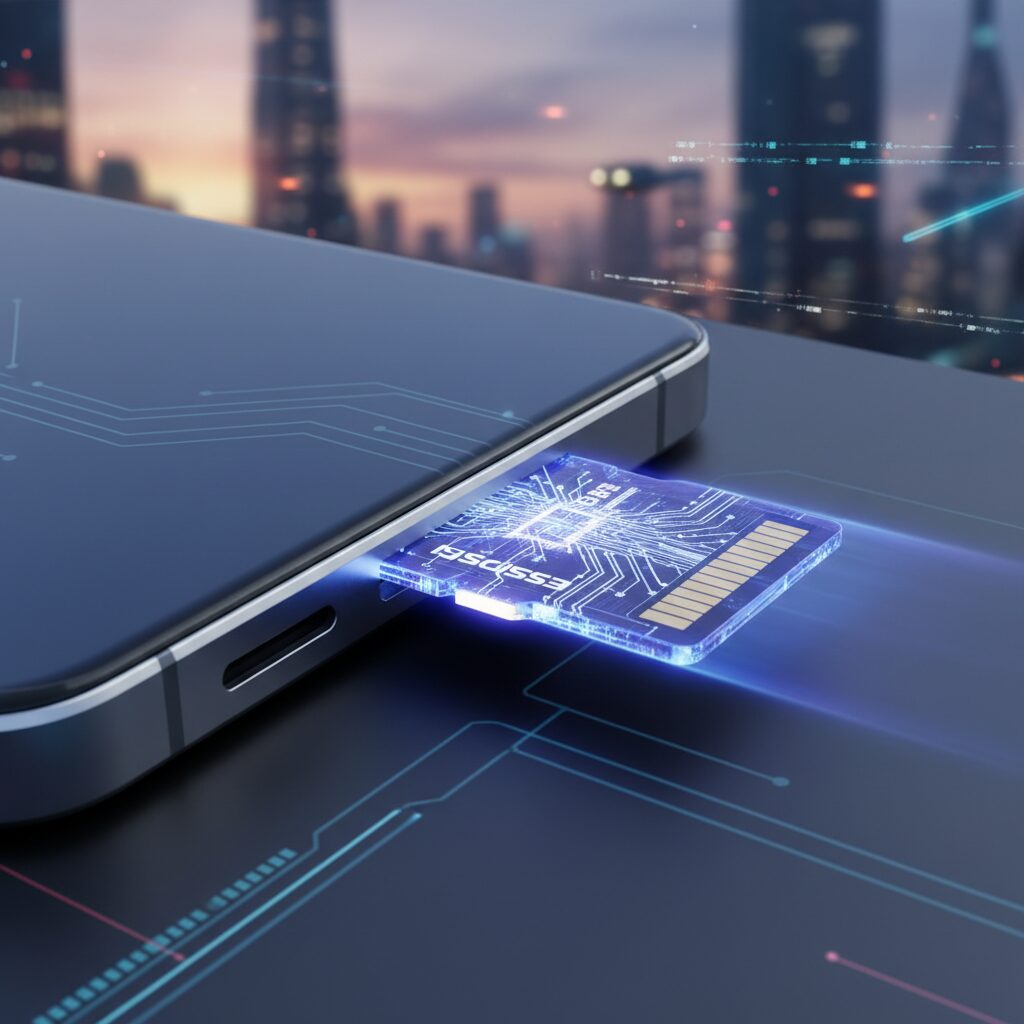
microSD Express represents a turning point where removable storage finally escapes the legacy bottlenecks of the SD interface and steps into SSD-class territory. The key breakthrough is architectural rather than incremental. By integrating PCIe and NVMe directly into the microSD form factor, the SD Association fundamentally changed how data moves between card and device.
According to the SD Association’s 2026 technology outlook, mainstream microSD Express cards now deliver sustained read speeds in the 800 to 900 MB/s range. This is nearly an order of magnitude faster than UHS‑I and places microSD Express closer to entry-level NVMe SSDs than to traditional memory cards.
This shift matters because PCIe 3.0 x1 provides close to 1 GB/s of usable bandwidth, while NVMe minimizes command latency. In practical terms, this means large assets such as 4K and 8K video streams, high‑bit‑rate RAW photo bursts, or game textures can be accessed without the stutter once associated with removable media.
| Interface | Typical Max Read | Protocol |
|---|---|---|
| microSD UHS‑I | ~104 MB/s | SD |
| microSD UHS‑II | ~312 MB/s | SD |
| microSD Express | 800–900 MB/s | PCIe 3.0 / NVMe |
Real-world adoption accelerated once devices could actually exploit this bandwidth. The inclusion of microSD Express support in next-generation handheld consoles such as Nintendo Switch 2 demonstrated that removable storage could meaningfully reduce load times for multi‑gigabyte games, a use case traditionally reserved for internal SSDs.
From a system design perspective, microSD Express also benefits from NVMe’s parallel command queues. Multiple read and write requests can be handled simultaneously, which is especially valuable for creator workflows where video recording, thumbnail generation, and background transfers occur at the same time.
Importantly, this performance leap does not come from speculative benchmarks. Commercial products from vendors such as Samsung, BUFFALO, and Nextorage consistently reach these speeds under standardized tests reported by industry reviewers and confirmed by SD Association compliance programs.
The result is a redefinition of what “removable” means in 2026. microSD Express is no longer a slow fallback for overflow data, but a high-speed extension of the storage hierarchy that narrows the experiential gap between internal flash and external media.
SDUC and the Era of Multi-Terabyte microSD Cards
The arrival of SDUC marks a decisive turning point for removable storage, and it deserves attention not as a distant specification but as a technology already reshaping real-world usage in 2026.
SDUC, or SD Ultra Capacity, extends the addressable limit of SD cards to a theoretical 128TB, a figure defined by the SD Association’s roadmap. While consumer products naturally lag behind theory, **2TB microSD cards have already entered mainstream distribution**, signaling that the multi-terabyte era is no longer speculative.
This capacity leap fundamentally changes how microSD cards are positioned within mobile ecosystems.
According to the SD Association’s 2026 outlook, the primary driver behind SDUC is not casual media consumption but sustained data generation at the edge. AI-assisted video capture, spatial computing, and sensor-rich devices now produce data continuously, not episodically.
In these scenarios, storage is less about peak throughput and more about how much data can be retained locally without network dependency.
SDUC directly addresses this requirement.
| Use Case | Typical Data Volume | Why SDUC Fits |
|---|---|---|
| 8K HDR video capture | Several GB per minute | Multi-hour recording without offloading |
| Autonomous drones | Hundreds of GB per mission | Offline storage in bandwidth-limited zones |
| VR/AR local content | 1–2TB libraries | Low-latency playback without streaming |
What makes SDUC especially compelling is its physical advantage. A microSD card weighing less than a gram can now store datasets that previously required external SSDs or persistent cloud connections.
For creators and engineers, this enables a workflow where data is generated, stored, transported, and archived entirely offline.
In disaster recovery, field research, or secure environments, this characteristic is not a convenience but a requirement.
Industry analysts frequently emphasize that cloud infrastructure continues to grow, yet the same reports acknowledge structural constraints. Bandwidth costs, latency, and availability during outages remain unsolved problems.
By contrast, **SDUC offers a deterministic storage model**: capacity is fixed, access is immediate, and ownership is unambiguous.
This aligns closely with the growing emphasis on data sovereignty discussed by organizations such as the SD Association and major semiconductor vendors.
Another overlooked aspect is endurance economics.
Large-capacity SDUC cards distribute write cycles across significantly more NAND cells, which can extend usable lifespan for workloads such as continuous video logging or AI sensor recording.
This characteristic has been highlighted in technical briefings related to edge AI deployments, where predictable failure models are valued over raw speed.
In practical terms, SDUC enables a new storage hierarchy on mobile devices.
High-speed internal storage remains responsible for active computation, while SDUC-backed microSD cards act as vast, persistent reservoirs.
Rather than competing, these layers complement each other.
Seen from this perspective, the era of multi-terabyte microSD cards is not an anomaly surviving against technological trends.
It is a direct response to how data is created and controlled in 2026.
SDUC succeeds precisely because it addresses what high-speed internal storage and cloud platforms cannot fully solve: scale without surrendering physical control.
Real Devices, Real Choices: Different Approaches in the Smartphone Market
The smartphone market in 2026 no longer moves in a single direction, and this is especially clear when we look at real devices and the choices manufacturers make. Rather than asking which approach is technically superior, it is more useful to examine how different storage strategies reflect fundamentally different ideas about what a smartphone should be.
At one end of the spectrum, flagship models emphasize sealed designs and ultra-fast internal storage. Devices such as Samsung’s Galaxy S26 Ultra prioritize UFS 5.0, which JEDEC explains was designed to remove storage latency as a bottleneck for on-device AI. In this approach, the smartphone is treated as a self-contained computing unit, where **speed, security, and tight system integration are valued over expandability**.
At the other end, there are devices that deliberately preserve external storage as part of their identity. Sony’s Xperia 1 VII is a representative example, continuing to support microSD cards up to 2TB while also competing at the very top of performance charts. According to reviews by TechRadar and GSMArena, this is not a technical compromise but a strategic decision aimed at professional creators who value physical media workflows.
| Design Philosophy | Typical Storage Choice | User Value Emphasis |
|---|---|---|
| Sealed flagship | Large-capacity UFS 5.0 only | AI speed, simplicity, security |
| Creator-oriented flagship | UFS + microSD Express | Flexibility, data mobility |
| Mainstream mid-range | Moderate UFS + microSD | Cost efficiency, peace of mind |
Mid-range smartphones make the contrast even clearer. In Japan, models such as the AQUOS sense10 continue to include a microSD slot despite relatively modest internal storage options. Market analyses cited by domestic reviewers point out that many users treat the microSD card as a physical backup and a migration tool when changing devices. **This reflects a cultural preference for ownership and reassurance rather than maximum throughput**.
What is important here is that these differences are not temporary. Content size keeps growing, but so does user awareness of trade-offs. Mobile games exceeding 30GB, 8K video clips consuming several gigabytes per minute, and locally stored AI interaction logs all put pressure on internal storage. Flagship users are often willing to pay for 1TB of UFS memory, while others prefer to externalize photos and videos to removable media.
Industry commentary from the SD Association frequently stresses that removable storage is about choice rather than nostalgia. Meanwhile, silicon roadmaps discussed by JEDEC underline that UFS development is accelerating precisely because many flagship vendors assume users will not rely on external cards. These two narratives coexist, and neither invalidates the other.
As a result, the smartphone market now offers genuinely different answers to the same problem. Some devices ask users to trust integrated hardware and cloud-linked ecosystems, while others invite them to manage data physically and independently. **This diversity of real devices and real choices is what defines the smartphone landscape in 2026**, and it allows users to select a philosophy, not just a phone.
Exploding Content Sizes: Games, 8K Video, and AI Data Logs
Mobile storage pressure in 2026 is no longer driven by casual photo libraries but by exploding content sizes created and consumed directly on smartphones. Games now rival PC titles, 8K video turns every minute into gigabytes, and on-device AI continuously generates data logs that quietly accumulate in the background.
This convergence fundamentally changes how storage is used. Internal flash is optimized for speed, while sheer volume increasingly spills beyond what even 256GB or 512GB devices can comfortably sustain over time.
| Content Type | Typical Size in 2026 | Storage Impact |
|---|---|---|
| Mobile AAA games | 30–40GB per title | Consumes internal storage rapidly |
| 8K HDR video | Several GB per minute | Short sessions fill devices |
| AI interaction logs | GBs accumulated monthly | Hidden long-term growth |
The clearest example is mobile gaming. According to capacity analyses around HoYoverse titles, the mobile build of Genshin Impact surpassed 30GB by early 2026, and optional high-resolution assets push it closer to 40GB. With operating systems and system partitions already occupying tens of gigabytes, a single flagship game can render 64GB devices impractical and severely constrain 128GB models.
Because game engines require ultra-low latency access, these assets must reside on internal UFS storage. As a result, users increasingly offload everything else, media libraries, screen recordings, downloaded video, to removable storage in order to preserve performance.
Video capture is even more punishing. Modern smartphones routinely record 8K at 60fps with 10-bit HDR, formats once reserved for professional cinema cameras. Industry estimates cited by the SD Association indicate that such footage consumes multiple gigabytes per minute, meaning a short travel vlog or family event can exhaust hundreds of gigabytes in a single afternoon.
This transforms storage from a static specification into an operational constraint. Users must decide in real time whether to stop recording, delete memories, or physically swap storage.
Less visible but equally significant is the rise of AI data logs. On-device assistants store voice interactions, personalized language models, sensor histories, and contextual metadata locally for privacy and latency reasons. While each log entry is small, researchers note that these datasets grow continuously, forming what can be described as personal big data.
For privacy-conscious users, uploading such data to the cloud is not always acceptable. Physical storage therefore becomes the default sink for information that users want to keep offline yet accessible.
Games, video, and AI together ensure that content growth outpaces internal storage upgrades. This imbalance explains why removable, high-capacity storage remains strategically relevant even as internal flash reaches unprecedented speeds.
Cloud Storage vs Physical Media: The Return of Data Ownership
In 2026, the debate between cloud storage and physical media is no longer about convenience alone, but about who truly owns the data. Cloud services continue to grow rapidly, with market analysts noting steady expansion driven by AI-powered search, automated backups, and cross-device synchronization. However, **a growing segment of users now questions the long-term cost and control trade-offs embedded in subscription-based storage**.
Major cloud providers emphasize resilience and intelligence. According to industry analyses cited by organizations such as IMARC Group, modern cloud platforms use machine learning to optimize data placement, predict capacity needs, and detect threats in real time. For enterprises, this is transformative. For individual users, however, these benefits are often offset by recurring fees, bandwidth consumption, and reliance on always-on connectivity.
| Aspect | Cloud Storage | Physical Media |
|---|---|---|
| Access | Network-dependent | Offline, instant |
| Cost Model | Ongoing subscription | One-time purchase |
| Data Control | Provider-managed | User-owned |
Physical media such as microSD cards re-enter this discussion as symbols of data sovereignty. The SD Association has repeatedly stressed the idea of “owning your data,” highlighting that removable storage enables complete user control without intermediaries. **In an era where personal AI agents log conversations, preferences, and behavioral data, the ability to keep sensitive information entirely offline has renewed appeal**.
Outages among hyperscale cloud providers, documented by academic and industry researchers alike, further reinforce this mindset. Even short disruptions can temporarily lock users out of critical files. Physical media avoids this single point of failure and eliminates exposure to changing terms of service or regional data regulations imposed by platforms.
Ultimately, cloud storage remains indispensable for collaboration and redundancy, but its dominance is no longer absolute. The renewed interest in physical media reflects a broader cultural shift: users are no longer satisfied with renting digital space indefinitely. **They increasingly value tangible ownership, predictable costs, and the psychological assurance that their data remains firmly under their own control**.
Portable SSDs over USB4: The Strongest Alternative to microSD
For users questioning whether microSD still makes sense in 2026, portable SSDs over USB4 have emerged as the most powerful and realistic alternative. This shift is not driven by marketing alone but by concrete architectural changes in smartphones, tablets, and handheld gaming devices that now natively support USB4 with bandwidths previously reserved for PCs.
USB4 builds on the Thunderbolt 3 specification and enables a maximum theoretical throughput of 40Gbps. In real-world consumer products, this translates to sustained transfer speeds of around 3,000 to 4,000MB/s when paired with modern NVMe-based portable SSDs. According to performance analyses cited by PCMag and TechRadar, this places USB4 storage far beyond the reach of microSD Express, which typically tops out just under 1,000MB/s.
This performance difference becomes tangible in professional workflows. Recording 8K video at high bitrates, for example, can easily exceed 1GB per second. While SD Express cards were designed to finally address this ceiling, USB4 SSDs offer several times the headroom, eliminating dropped frames and buffer overruns even in sustained recording sessions. Camera and storage engineers referenced by the SD Association have acknowledged that PCIe-based external drives currently offer the safest margin for next-generation capture formats.
| Storage Option | Typical Speed | Practical Role in 2026 |
|---|---|---|
| microSD Express | 800–900MB/s | Always-on expansion inside the device |
| USB4 Portable SSD | 3,000–4,000MB/s | High-speed capture, editing, bulk transfer |
Another factor accelerating adoption is physical design. In 2026, portable SSDs from brands such as Samsung, SanDisk, and Elecom weigh as little as 5 to 10 grams and are scarcely larger than a USB-C plug itself. Industry testing reported by SAKIDORI and Kakaku.com shows that many models meet IP65 water and dust resistance and survive drops of up to three meters, addressing long-standing durability concerns associated with external storage.
The rise of magnetic mounting systems compatible with Qi2 and MagSafe has further reduced friction. Users can attach an SSD directly to the back of a smartphone and treat it as semi-permanent storage during a shoot or gaming session. This has changed user behavior: instead of constantly managing internal capacity, creators increasingly offload raw footage or AI-generated assets directly to an external drive in real time.
However, this power comes with trade-offs. USB4 SSDs monopolize the USB-C port, preventing simultaneous charging or wired accessories unless hubs are introduced. There is also the mechanical risk of accidental disconnection, something internal microSD slots inherently avoid. Storage reliability studies referenced by TechRadar note that connector wear and sudden power loss remain the most common failure points for external drives used on mobile devices.
From a data ownership perspective, USB4 SSDs strongly align with the growing emphasis on local control. Like microSD cards, they enable complete offline storage, but at multi-terabyte capacities that are already affordable in 2026. This makes them particularly attractive for users who reject recurring cloud fees or who operate in bandwidth-constrained environments, a concern repeatedly highlighted in SD Association thought leadership.
Ultimately, portable SSDs over USB4 do not merely replace microSD cards; they redefine what external storage can do. They excel when speed, capacity, and immediate access outweigh convenience. For many power users, USB4 SSDs have become the default answer when microSD feels technically insufficient, even if they have not yet matched the elegance of storage that disappears entirely inside the device.
Security, Encryption, and Trust in Removable Storage
When discussing removable storage in 2026, security and trust have become more important than raw speed or capacity. Many users still associate microSD cards with a higher risk of data leakage, yet this perception is increasingly outdated. **Modern removable storage is now designed around zero-trust assumptions**, meaning that physical possession alone no longer equals data access.
According to guidance from the SD Association and security frameworks referenced by organizations such as NIST, encryption must be applied at the data’s point of creation, not after the fact. In practical terms, smartphones now generate encryption keys within secure enclaves, and data written to a microSD card is automatically protected using AES-256. Even if the card is removed and inserted into another device, the contents remain unreadable without device-level authentication.
Another important shift is integrity verification. Inspired by inline hashing techniques introduced in advanced internal storage standards, removable media increasingly supports real-time hash validation. This allows the system to detect silent corruption or tampering, a concern highlighted in academic storage reliability studies published by IEEE. For creators and professionals, this means recorded video or sensor data can be verified as authentic long after capture.
| Security Aspect | Traditional microSD | 2026 microSD Environment |
|---|---|---|
| Data confidentiality | Optional or manual | Automatic AES-256 encryption |
| Integrity checking | Limited | Inline hashing and verification |
| Access control | Card-level only | Device-bound authentication |
Trust is also reinforced by enterprise-grade controls. Cybersecurity research cited by major consultancies notes the rise of AI-based guardrails that monitor what data is written to removable storage in real time. If sensitive information is detected, encryption is enforced or the write operation is blocked entirely. As a result, microSD cards are no longer weak points but deliberate offline security tools.
For privacy-conscious users, this evolution restores confidence. **Removable storage now represents not a compromise, but a controlled, auditable extension of personal data sovereignty**, balancing physical ownership with cryptographic assurance.
参考文献
- PCMag:UFS 5.0 Storage Is Official, and It’s Almost Twice as Fast to Help Power AI
- TechRadar:Smartphone storage just hit warp speed as UFS 5.0 aims to supercharge AI performance
- SD Association:State of Memory Technology and Trends to Watch in 2026
- TechRadar:Sony Xperia 1 VII review
- Gadgets 360:Sony Xperia 1 VII With Snapdragon 8 Elite Chipset Launched: Specifications
- SAKIDORI:Best Portable SSDs in 2026