
Your smartphone in 2026 is no longer just a communication device. It is your biometric ID, your financial wallet, your AI assistant, and in many ways, a living map of your daily behavior. As AI moves deep into Android 16, iOS 19, and next-generation chipsets, privacy permissions are no longer static settings you toggle once and forget.
Today’s operating systems use on-device AI to predict threats, mute malicious notifications, hide one-time passwords on the lock screen, and dynamically adjust app permissions in the background. At the same time, hardware-level security such as Samsung Knox KEEP and secure AI processing units are designed to ensure that your most sensitive data never leaves your device.
However, major ransomware attacks, OAuth token abuses, and AI-related data leaks in 2024–2025 have shown that excessive permissions and weak access controls remain critical risks. With stronger legal frameworks emerging and biometric technologies projected to expand rapidly toward 2030, understanding how privacy is being redesigned is no longer optional. In this article, you will learn how mobile AI, security architecture, regulation, and real-world breach cases are reshaping smartphone privacy—and how you can stay ahead.
- From Manual Permissions to Ambient Security: The Shift Driven by AI
- Android 16 Deep Dive: Privacy Sandbox, Dynamic Permissions, and Notification Cooldown
- iOS 19 and Apple Intelligence: Cross-Device Privacy Dashboards and Advanced Fingerprinting Protection
- On-Device AI vs Cloud Processing: Why NPUs Are the New Privacy Battleground
- Samsung Knox KEEP and Hardware-Level Isolation: Securing Data at the Silicon Layer
- Biometrics in 2026: Multi-Modal Authentication and Deepfake-Resistant AI
- Lessons from 2024–2025 Breaches: Ransomware, OAuth Token Abuse, and Shadow AI
- The Hidden Danger of Excessive Permissions and Over-Privileged Identities
- Global Regulatory Momentum: Stronger Data Protection and User Sovereignty
- 2026 Smartphone Privacy Audit Checklist: Practical Steps for Power Users
- Beyond Smartphones: Wearables, Screenless AI Devices, and the Future of Ambient Data
- 参考文献
From Manual Permissions to Ambient Security: The Shift Driven by AI
For years, smartphone privacy was defined by a simple ritual: an app asked, and you decided. Allow location, deny microphone, approve contacts. This manual, app-by-app model placed responsibility squarely on the user, but it also assumed that users could accurately predict risk in complex digital environments.
In 2026, that assumption no longer holds. With AI embedded deep inside operating systems such as Android 16 and iOS 19, privacy control is shifting toward what can be described as ambient security—a model in which the system continuously evaluates context, behavior, and threat signals in the background and adjusts permissions dynamically.
Ambient security means your smartphone no longer waits for instructions; it anticipates risk and intervenes before you even notice.
This shift is powered by on-device AI processing. Rather than sending raw data to the cloud, modern devices rely on dedicated NPUs to analyze patterns locally. As industry coverage from sources such as Google’s security blog and Samsung’s mobile press materials explains, this architectural change reduces structural exposure by keeping sensitive data within the hardware boundary of the device.
The contrast between the old and new models is stark.
| Aspect | Manual Permission Era | Ambient Security Era (2026) |
|---|---|---|
| Decision Timing | User grants once at install | AI re-evaluates continuously |
| Risk Detection | Reactive to visible prompts | Predictive, behavior-based analysis |
| Data Processing | Often cloud-dependent | Primarily on-device AI |
Android 16’s dynamic permission adjustments and notification cooldown feature illustrate this transformation. If an app begins sending excessive notifications—behavior sometimes associated with phishing attempts—the system can automatically mute or limit interruptions. The user is protected not by a new setting, but by AI inference operating silently in the background.
Similarly, enhanced protections around one-time passwords ensure that sensitive codes are hidden on the lock screen by default. Instead of asking users to manually configure every scenario, the OS anticipates common attack vectors such as shoulder surfing and adapts automatically.
Apple’s expanded cross-device privacy dashboard in iOS 19 reflects the same philosophy from a transparency angle. By visualizing sensor usage across iPhone, iPad, Apple Watch, and other devices, the system contextualizes access patterns, allowing AI-driven alerts to be understood within a broader ecosystem view.
Crucially, this transition is not only technical but behavioral. Surveys by JIPDEC in 2025–2026 show that a large majority of Japanese users feel strong resistance to providing personal data. When trust declines, friction increases. Ambient security reduces that friction by embedding safeguards into design rather than relying on user vigilance alone.
Security researchers have repeatedly demonstrated the dangers of excessive permissions, particularly in OAuth token abuse and over-privileged cloud identities. By shifting toward dynamic, context-aware controls, mobile platforms are responding to these lessons. Permission is no longer a static checkbox; it is a living contract constantly renegotiated by AI.
The result is a redefinition of privacy itself. Instead of being a moment of consent at installation, privacy becomes an ongoing process—adaptive, predictive, and increasingly invisible. For gadget enthusiasts and power users alike, understanding this shift is essential, because the true innovation of 2026 is not just smarter AI, but smarter protection woven into the air around every tap, swipe, and command.
Android 16 Deep Dive: Privacy Sandbox, Dynamic Permissions, and Notification Cooldown
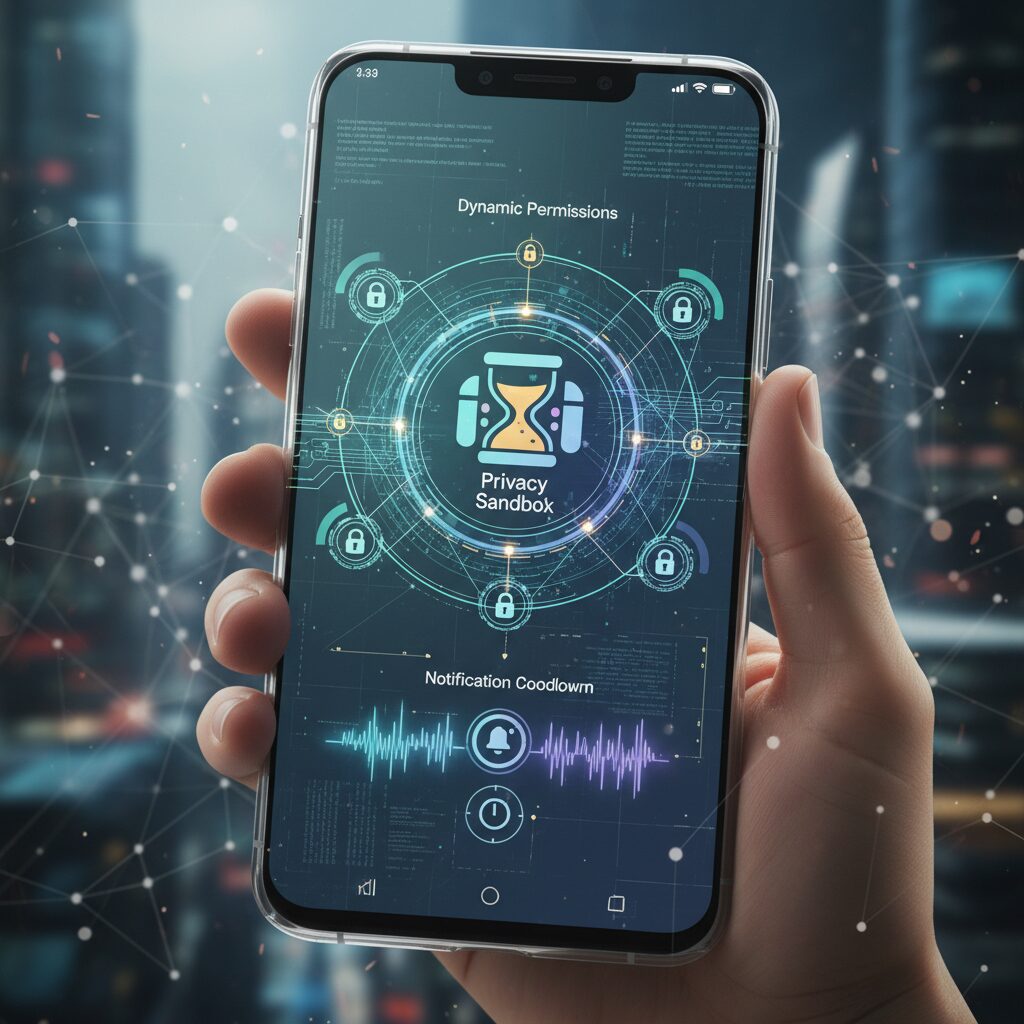
Android 16 marks a structural shift in how privacy is enforced on smartphones. Instead of relying solely on static, user-granted permissions, the OS advances Google’s Privacy Sandbox initiative and introduces AI-assisted, context-aware controls that operate continuously in the background.
Released in June 2026 under the codename Baklava, Android 16 standardizes a post-ADID advertising framework. According to industry analysis cited by Braze, the move reduces dependency on persistent cross-app identifiers and pushes ad measurement into anonymized, on-device or sandboxed environments.
This is not just a feature update. It is a redesign of the mobile trust model.
| Area | Android 16 Approach | User Impact |
|---|---|---|
| Ad Tracking | Privacy Sandbox (SDK Runtime) | Reduced cross-app profiling |
| Permissions | Dynamic, risk-aware adjustment | Context-based access control |
| Notifications | Notification Cooldown | Lower spam & phishing exposure |
The Privacy Sandbox in Android 16 isolates advertising SDKs from the core app environment. By running them in a dedicated runtime, the system prevents unnecessary data leakage between advertising components and sensitive user data. This design directly addresses long-standing concerns raised by security researchers about excessive third-party SDK privileges.
At the same time, Android 16 deepens dynamic permission control. Rather than treating permissions as permanent switches, the OS evaluates behavioral signals and contextual risk. For example, enhanced safeguards now monitor accessibility service abuse, an attack vector previously exploited to hijack banking sessions. When sensitive apps are active during screen sharing, the system can automatically warn users and allow one-tap termination.
This evolution reflects a broader industry lesson: over-privileged access is the root cause of many modern breaches. Security analyses such as ReliaQuest’s research on over-privileged cloud identities show how excessive rights become escalation pathways. Android’s mobile-layer response mirrors that insight by tightening runtime boundaries.
One of the most user-visible changes is Notification Cooldown. When an app sends multiple alerts in a short period, Android 16 automatically suppresses sound and minimizes intrusive visual interruptions. While it appears to be a convenience feature, its security implications are significant.
Phishing campaigns increasingly rely on notification flooding to create urgency. By dampening repetitive alerts, Android reduces psychological pressure and limits real-time manipulation vectors. Google’s security communications in 2025 emphasized lowering exposure surfaces, and Notification Cooldown operationalizes that principle at scale.
Another subtle but critical improvement involves one-time password protection. OTP messages are hidden from the lock screen by default when the device is secured. This mitigates shoulder-surfing and physical theft scenarios, which remain common in urban environments.
Android 16’s privacy architecture works as a layered defense system: sandboxed advertising, adaptive permissions, and behavioral notification controls combine to form ambient security rather than reactive toggles.
For gadget enthusiasts and power users, the takeaway is clear. Android 16 is less about adding more switches and more about embedding intelligence into the permission lifecycle itself. The OS increasingly acts as a silent risk manager, continuously recalibrating access in response to context, behavior, and threat patterns.
In an era where AI permeates the operating system core, privacy is no longer a static consent screen. It becomes a dynamic negotiation between user intent, app behavior, and system-level intelligence—and Android 16 places that negotiation directly inside the runtime engine.
iOS 19 and Apple Intelligence: Cross-Device Privacy Dashboards and Advanced Fingerprinting Protection
iOS 19 marks a decisive shift from app-level permission management to ecosystem-level intelligence. At the center of this evolution is Apple Intelligence, designed with an on-device processing priority that minimizes unnecessary data transfer to external servers.
Instead of treating privacy as a static settings page, iOS 19 reframes it as a living, cross-device system. This approach aligns with broader 2026 trends in ambient security, where AI predicts and mitigates risks in real time.
According to industry analyses such as MacRumors and GoTrust, Apple’s latest strategy focuses on transparency at scale—extending visibility beyond a single iPhone to the entire Apple ecosystem.
Cross-Device Privacy Dashboard
The enhanced App Privacy Report in iOS 19 evolves into a unified dashboard that aggregates data access activity across iPhone, iPad, Apple Watch, Mac, and Vision Pro. This consolidation responds directly to growing consumer anxiety around fragmented data oversight.
Instead of checking permissions device by device, users can now review which apps accessed microphones, cameras, location data, or sensitive system APIs across all linked hardware.
This cross-device visibility reduces blind spots that previously existed between platforms.
| Feature | Before iOS 19 | iOS 19 Enhancement |
|---|---|---|
| App Privacy Report | Single-device view | Unified cross-device dashboard |
| Sensor Activity Indicators | Basic visual alerts | Liquid Glass UI emphasis |
| Data Processing | Mixed cloud reliance | On-device AI prioritization |
The introduction of the Liquid Glass design language further reinforces transparency. Semi-translucent UI layers make active sensor usage visually prominent, ensuring users immediately recognize when microphones or cameras are engaged.
This design choice is not merely aesthetic. It acts as behavioral nudging, subtly encouraging users to question unexpected sensor activation.
In a climate where JIPDEC surveys show roughly 70 percent of Japanese consumers feel resistance to providing personal data, such clarity directly addresses trust deficits.
Advanced Fingerprinting Protection in Safari
Beyond app permissions, iOS 19 tackles one of the web’s most opaque tracking techniques: device fingerprinting. Unlike cookies, fingerprinting identifies users through subtle combinations of fonts, hardware configurations, and system characteristics.
Safari in iOS 19 enables Advanced Fingerprinting Protection by default, blocking attempts to uniquely identify devices based on these signals.
This default activation is significant because fingerprinting often operates invisibly, without explicit consent prompts.
Security researchers and privacy advocates have long warned that fingerprinting undermines user choice. By standardizing browser-exposed attributes and limiting entropy, Safari reduces the uniqueness of each device’s digital profile.
The shift mirrors Apple’s broader philosophy: prevent tracking structurally rather than relying solely on user vigilance.
In practical terms, websites attempting to differentiate users via subtle configuration mismatches encounter normalized outputs instead of distinct identifiers.
This architectural stance gains importance in light of recent security incidents involving over-privileged integrations and OAuth token abuse, as reported in 2025 breach analyses. When excessive access persists across interconnected systems, the attack surface multiplies.
By limiting fingerprint-based identification and centralizing permission oversight, Apple narrows both tracking vectors and lateral visibility gaps.
The result is not just cleaner dashboards, but a measurable reduction in silent data exposure pathways.
Apple Intelligence complements this framework by processing personalization tasks locally whenever possible. On-device AI handling of contextual suggestions or summarization reduces metadata leakage to cloud endpoints.
As University of California experts note in broader 2026 AI trend discussions, edge-based intelligence increasingly defines trustworthy AI deployment.
Keeping inference local transforms privacy from a policy promise into a hardware-backed guarantee.
For power users deeply invested in the Apple ecosystem, the cross-device dashboard becomes a command center rather than a diagnostic afterthought. It enables pattern recognition—spotting anomalies such as unexpected background microphone access on a secondary device.
Meanwhile, default fingerprinting protection ensures that even sophisticated web tracking methods face systemic resistance.
Together, these mechanisms redefine smartphone privacy in 2026: not as a series of permissions to grant, but as an intelligently guarded digital perimeter spanning every connected Apple device.
On-Device AI vs Cloud Processing: Why NPUs Are the New Privacy Battleground

In 2026, the privacy debate no longer centers on app permissions alone. It centers on where AI computation happens. The rise of the NPU has turned every flagship smartphone into a privacy decision engine, forcing a clear contrast between on-device AI and cloud-based processing.
On-device AI processes data locally within the smartphone’s Neural Processing Unit (NPU), while cloud processing sends user data to remote servers for inference. This architectural difference directly determines who can access raw data, how long it is stored, and what attack surface exists.
| Aspect | On-Device AI (NPU) | Cloud Processing |
|---|---|---|
| Data Flow | Stays on device | Transmitted to servers |
| Latency | Real-time, offline capable | Network dependent |
| Breach Surface | Physical device | Server + API + token layers |
| Regulatory Exposure | Local jurisdiction | Cross-border data issues |
Google’s Android 16 and Apple’s iOS 19 both prioritize on-device inference for sensitive tasks such as voice recognition, biometric authentication, and scam detection. According to Google’s security blog, newer Android builds increasingly isolate AI-driven security features within protected system layers, reducing dependency on cloud calls for core protections.
Apple similarly emphasizes on-device processing in Apple Intelligence, reserving cloud expansion only for complex queries through controlled environments such as Private Cloud Compute. This hybrid model acknowledges a practical limit: some generative tasks still exceed mobile silicon constraints.
The risk difference becomes clearer when examining real-world breaches. The 2025 Salesforce-related OAuth token compromises demonstrated how cloud-connected ecosystems amplify lateral movement once credentials are stolen. When data and inference both reside in the cloud, privilege escalation scales instantly. In contrast, exploiting an on-device model typically requires physical compromise or advanced malware deployment.
IBM’s 2025 AI security reporting noted that many AI-related breaches stemmed from weak access controls in cloud-connected systems. That insight reinforces why hardware-level isolation, such as Samsung’s Knox Vault combined with on-device AI engines, represents more than performance optimization. It represents structural risk reduction.
NPUs also enable fully offline features that were previously cloud-bound. Real-time translation, call-based scam detection, and deepfake-resistant biometric checks now execute locally on Snapdragon 8 Elite or Tensor-class chips. Eliminating continuous server communication reduces interception risk and metadata exposure.
The privacy battleground is shifting from permission pop-ups to silicon architecture. Whoever controls the inference location controls the exposure surface.
However, on-device AI is not automatically safer. Malicious apps granted excessive accessibility permissions can still observe outputs or screen content. Security depends on OS-level sandboxing and hardware-backed isolation working together.
For privacy-conscious users and enterprises alike, the strategic question is no longer whether AI runs, but where it runs. In 2026, choosing a smartphone increasingly means choosing a privacy architecture, and the NPU sits at the center of that decision.
Samsung Knox KEEP and Hardware-Level Isolation: Securing Data at the Silicon Layer
As AI becomes deeply embedded in mobile operating systems, the real battleground for privacy shifts from software permissions to the silicon itself. Samsung’s Knox KEEP architecture represents this transition by redesigning how data is isolated at the hardware level, not just managed at the app layer.
Announced alongside One UI 8, Knox Enhanced Encrypted Protection (KEEP) creates encrypted storage environments for each application within the device’s secure storage domain. According to Samsung Mobile Press, this approach is engineered to prevent lateral data access even if the operating system is compromised.
This is not merely sandboxing at the software level—it is structural isolation enforced by hardware-backed security.
| Component | Role | Security Impact |
|---|---|---|
| Knox KEEP | App-specific encrypted storage containers | Prevents cross-app data exposure |
| Knox Vault | Tamper-resistant hardware module | Protects credentials and cryptographic keys |
| Personal Data Engine | On-device behavioral analysis | Processes sensitive insights locally |
The most strategic element is the Personal Data Engine (PDE). Instead of sending behavioral patterns, routines, or preference data to cloud servers, PDE analyzes them inside Knox Vault, a physically isolated, tamper-resistant hardware enclave. Samsung explains that even biometric credentials and encryption keys remain inside this protected boundary.
This architecture directly addresses a risk highlighted in recent cybersecurity reports: excessive permissions and token abuse often allow attackers to pivot laterally once initial access is gained. By fragmenting storage at the silicon layer, KEEP reduces the blast radius of any single compromise.
Hardware-level isolation also strengthens AI personalization. Real-time translation, contextual recommendations, and adaptive battery optimization can operate on intimate behavioral datasets without exposing them externally. In an era where AI models increasingly rely on personal context, KEEP enables personalization without surrendering sovereignty over raw data.
Importantly, this design aligns with tightening regulatory expectations around biometric and sensitive data handling. When analysis occurs inside a hardware-secured enclave, the data never leaves the device boundary, structurally minimizing third-party exposure risk.
For gadget enthusiasts evaluating flagship devices in 2026, silicon-level isolation is no longer a niche enterprise feature. It is becoming a core differentiator. Security is shifting from reactive software patches to proactive architectural containment—and Knox KEEP demonstrates how deeply privacy can be embedded when protection starts at the chip itself.
Biometrics in 2026: Multi-Modal Authentication and Deepfake-Resistant AI
By 2026, biometric authentication is no longer limited to a single fingerprint or face scan. It is evolving into a layered, AI-driven defense system designed to withstand synthetic media, deepfakes, and identity replay attacks.
The rapid expansion of the biometrics market—projected to reach approximately $46.6 billion by 2030 according to industry forecasts cited by a&s Middle East—reflects how central digital identity has become to everyday mobile security. Smartphones now function as vaults for financial assets, health data, and behavioral patterns.
The key shift in 2026 is from single-factor biometrics to multi-modal authentication enhanced by on-device AI.
| Authentication Mode | Primary Use | Risk Mitigation Advantage |
|---|---|---|
| Facial Recognition | Device unlock, payments | Convenience with AI-based liveness detection |
| Fingerprint | Secure app access | Hardware-isolated verification |
| Iris / Eye Scan | High-security environments | Harder to replicate remotely |
| Voice Authentication | AI assistant control | Behavioral pattern analysis |
Instead of relying on one biometric signal, flagship devices such as the Galaxy S26 Ultra or Pixel 10 Pro combine two or more modalities. If facial recognition confidence drops—due to unusual lighting or detected anomalies—the system can silently request fingerprint confirmation.
This layered model significantly reduces the risk that a single compromised biometric trait leads to full account takeover.
Deepfake-resistant AI plays a critical role in this architecture. As generative AI tools improve, attackers can fabricate realistic facial videos or cloned voices. According to security analyses referenced in 2026 AI feature reports, modern smartphones now perform real-time liveness detection directly on the device’s NPU.
These systems analyze micro-expressions, blink dynamics, skin reflectivity, and depth mapping inconsistencies that synthetic content often fails to reproduce convincingly.
The decisive advantage is that verification happens on-device, not in the cloud.
Samsung’s Knox Vault and KEEP architecture illustrate this hardware-software fusion. Biometric templates are encrypted and isolated within tamper-resistant hardware. Even if the operating system were compromised, cross-app extraction of biometric credentials would remain technically constrained.
Similarly, Apple’s emphasis on on-device processing under Apple Intelligence reinforces a privacy-first approach. Biometric comparisons occur locally, while any cloud-based processing leverages privacy-preserving frameworks.
Another emerging defense layer in 2026 is behavioral biometrics. Beyond physical traits, smartphones analyze typing cadence, gesture speed, and device-handling patterns. These signals create a continuous authentication model, quietly verifying that the current user behaves like the enrolled identity.
This approach addresses a growing risk highlighted in cloud security reviews: over-privileged access combined with stolen credentials. Even if attackers bypass initial login checks, behavioral anomalies can trigger step-up authentication.
Voice authentication faces particular scrutiny due to AI voice cloning. Security feature updates in 2026 emphasize anti-spoofing detection, analyzing spectral artifacts and latency inconsistencies common in synthesized audio.
Rather than treating biometrics as static identifiers, systems now treat them as dynamic probability models.
Regulatory developments reinforce this shift. Japan’s 2026 amendments to the Act on the Protection of Personal Information classify biometric identifiers such as facial feature data as high-risk information requiring stricter governance. This legal pressure incentivizes device makers to adopt privacy-preserving biometric storage and explicit consent mechanisms.
Meanwhile, consumer sentiment data from JIPDEC indicates that nearly 70% of users feel resistance toward providing personal data. In this climate, biometric systems must not only be secure but also transparent and controllable.
Trust in biometrics now depends on three pillars: multi-modality, deepfake detection, and legal accountability.
Looking ahead, the integration of wearable sensors may further diversify biometric signals—heart rhythm patterns or gait recognition could complement facial scans. However, the guiding principle remains minimization: collect only what is necessary, process locally, and encrypt by default.
In 2026, biometric authentication is no longer just about unlocking a phone. It is about defending a living, AI-mediated digital identity against increasingly synthetic threats.
Lessons from 2024–2025 Breaches: Ransomware, OAuth Token Abuse, and Shadow AI
The breaches of 2024–2025 revealed a hard truth: sophisticated AI-powered devices mean little if identity and access controls remain fragile.
Ransomware, OAuth token abuse, and the rise of Shadow AI exposed how “over-permissioned” environments quietly accumulate systemic risk.
The common denominator was not zero-day exploits, but excessive trust.
Major Incidents and Structural Weaknesses
| Incident | Attack Vector | Core Lesson |
|---|---|---|
| KADOKAWA (2024) | Ransomware | Business continuity collapses when lateral movement is unchecked |
| Salesforce/Drift (2025) | OAuth token abuse | Third-party integrations expand invisible attack surfaces |
| Japanese hospitals (2025) | Ransomware | High-value medical data + weak segmentation = large-scale leakage |
In June 2024, KADOKAWA suffered a ransomware attack attributed to a Russia-linked group, disrupting operations for weeks and leaking tens of thousands of records. The case demonstrated how attackers exploit privilege escalation once inside a network.
Healthcare institutions in Japan faced similar ransomware campaigns in 2025, with reports indicating that up to 300,000 patient records were exposed in some incidents. Medical systems, heavily digitized yet often underfunded in security, became prime targets.
Ransomware is no longer just encryption for ransom; it is data exfiltration plus operational paralysis.
The 2025 Salesforce-related breaches marked a different turning point. According to analyses summarized by Symmetry Systems, attackers abused OAuth tokens issued to third-party apps, gaining access to more than 700 organizations without traditional phishing payloads.
No malware was required. Valid tokens acted as master keys.
This reflects what ReliaQuest and Horizon3.ai have repeatedly warned: cloud identities with excessive permissions create “silent backdoors.” Once granted write or admin scope, tokens often persist far longer than intended.
Penetration testing data cited by Horizon3.ai in 2025 indicates that misconfigured privileges remain among the most frequently discovered critical weaknesses in enterprise environments.
Then came Shadow AI. As generative AI tools proliferated in 2025, employees began inputting confidential documents into unapproved platforms.
Reco AI’s 2025 review reports that a significant portion of AI-related breaches involved insufficient access controls and governance gaps. Organizations deployed AI faster than they deployed policy.
Shadow AI is not malicious by design; it is risky by convenience. When productivity incentives outpace security oversight, data inevitably drifts beyond approved boundaries.
Across these cases, three patterns stand out: identity tokens are the new perimeter, permissions expand silently over time, and AI accelerates both innovation and leakage.
For gadget enthusiasts and tech-forward professionals, the implication is clear. Every app integration, every “Sign in with” shortcut, and every AI plugin represents delegated authority.
The lesson from 2024–2025 is simple but unforgiving: minimize trust, segment aggressively, and audit continuously.
The Hidden Danger of Excessive Permissions and Over-Privileged Identities
Even in 2026, the most sophisticated AI-driven privacy controls cannot protect you from one fundamental mistake: granting excessive permissions. When an app or cloud identity holds more access rights than it truly needs, it becomes a high-value target and a powerful launchpad for attackers.
Over-privileged identities turn convenience into systemic risk. What looks like a harmless “Allow all” tap can silently expand an app’s reach across contacts, storage, location history, and even connected SaaS environments.
According to ReliaQuest’s analysis on over-privileged cloud identities, attackers increasingly exploit misconfigured roles rather than sophisticated zero-day vulnerabilities. In many cases, once initial access is obtained, excessive permissions allow lateral movement without triggering traditional alarms.
| Risk Factor | What Happens | Impact |
|---|---|---|
| Unnecessary admin roles | Broad data export rights | Mass data exfiltration |
| Persistent OAuth tokens | Silent API access | Cross-account compromise |
| Excessive accessibility access | Screen and input control | Credential theft |
The 2025 Salesforce-related breaches demonstrated how stolen OAuth tokens enabled access to hundreds of organizations without phishing individual users again. The weakness was not password hygiene but overly broad delegated permissions that remained valid for long periods.
NodeZero’s large-scale penetration testing, covering tens of thousands of engagements, similarly found that misconfigured privileges and role assignments were a recurring root cause in successful compromises. This pattern shows that identity mismanagement, not just malware, drives modern breaches.
On smartphones, the same principle applies. Accessibility permissions, originally designed for assistive technologies, have been abused in past banking malware campaigns to capture screen content and simulate user input. That is precisely why Android 16 introduced stronger safeguards around sensitive app interactions.
AI integration adds another layer of complexity. IBM’s 2025 security reporting noted that a significant share of AI-related incidents involved inadequate access controls. When AI assistants are granted blanket access to email, cloud storage, and messaging, they effectively aggregate sensitive data into a single decision engine.
Shadow AI further amplifies this exposure. Employees who paste confidential documents into unauthorized generative AI tools may unintentionally expand the data’s visibility beyond corporate boundaries. Without strict identity governance, these actions bypass traditional perimeter defenses.
Excessive permissions create three compounding effects: expanded attack surface, accelerated privilege escalation, and invisible persistence. Once attackers inherit an over-privileged identity, they often operate within “legitimate” boundaries, making detection far more difficult.
In an era where on-device AI, cross-device dashboards, and seamless SaaS integrations define user experience, disciplined permission minimization becomes a strategic necessity. The principle of least privilege is no longer an abstract security doctrine; it is the only reliable countermeasure against cascading identity compromise.
If every permission is a potential attack path, then every unnecessary permission is an avoidable risk.
Global Regulatory Momentum: Stronger Data Protection and User Sovereignty
Regulatory frameworks around the world are accelerating in response to AI-driven mobile ecosystems. As smartphones evolve into autonomous data processors, lawmakers are redefining the balance between innovation and individual control. The core shift is from passive consent to enforceable user sovereignty.
In Japan, the Personal Information Protection Commission (PPC) published its 2026 policy revision under the triennial review of the Act on the Protection of Personal Information. The reform introduces administrative surcharges for fraudulent data acquisition and unlawful third-party transfers, strengthening deterrence against exploitative data practices.
This marks a structural transition: privacy violations are no longer treated merely as compliance failures but as financial risks tied directly to corporate revenue.
| Regulatory Focus (2026 Japan) | Practical Impact on Mobile Ecosystems |
|---|---|
| Administrative surcharge system | Stronger penalties for unlawful data resale and deceptive consent flows |
| Child data protection (under 16) | Mandatory parental consent and prioritization of minors’ best interests |
| Stricter biometric governance | Heightened safeguards for facial and other biometric identifiers |
| Conditional consent exemptions for AI/statistics | Encourages innovation while requiring clear usage boundaries |
Particularly notable is the tighter regulation of biometric identifiers such as facial feature data. As biometric authentication expands across smartphones and wearables, regulators now classify these identifiers as high-risk data categories requiring enhanced safeguards.
At the same time, the 2026 reform introduces conditional flexibility for AI development. Where data usage is demonstrably limited to statistical or AI training purposes under strict conditions, explicit consent may not always be required. This nuanced approach avoids a blanket “consent-only” model while preserving accountability.
Consumer sentiment reinforces this regulatory momentum. According to JIPDEC’s 2025–2026 consumer awareness survey, roughly 70% of Japanese respondents report psychological resistance to providing personal information. This indicates that privacy anxiety is not abstract—it directly influences service adoption and conversion behavior.
Globally, high-profile breaches between 2024 and 2025—including ransomware attacks on healthcare institutions and token abuse in SaaS integrations—have further legitimized stricter oversight. Security analyses from firms such as ReliaQuest and Horizon3.ai highlight over-privileged identities and misconfigured access controls as systemic vulnerabilities.
Regulators are responding by emphasizing proportionality, transparency, and traceability in data handling. User sovereignty in 2026 increasingly means verifiable audit trails, clear purpose limitation, and enforceable rights rather than symbolic privacy policies.
For mobile platforms, this regulatory climate creates competitive differentiation. Devices and OS vendors that embed privacy dashboards, on-device processing, and granular permission controls are not merely adding features—they are aligning with an emerging global compliance baseline.
The trajectory is clear: AI autonomy must coexist with legally codified human authority. Smartphones may act intelligently in the background, but regulatory momentum ensures that the ultimate decision-making power remains structurally anchored to the user.
2026 Smartphone Privacy Audit Checklist: Practical Steps for Power Users
In 2026, privacy is no longer a static setting but a living system powered by on-device AI. That is why a structured privacy audit is essential for power users. By reviewing permissions, AI processing paths, and cross-device data flows every quarter, you can reduce silent exposure risks that ambient security alone cannot fully eliminate.
The goal of this checklist is minimization, visibility, and containment. Minimization reduces attack surface, visibility reveals hidden data flows, and containment limits damage if a breach occurs.
1. App and Permission Minimization
| Audit Item | What to Check | Recommended Action |
|---|---|---|
| Unused apps | No launch in 3 months | Delete permanently |
| Location access | “Always” enabled | Switch to “While Using” |
| Unrelated permissions | Contacts, mic, camera | Deny by default |
Security researchers consistently warn that excessive permissions become privilege-escalation footholds. According to ReliaQuest’s 2024 threat analysis, over-privileged identities were a root cause in many compromised environments. The same logic applies to smartphones. If a calculator requests contacts access, treat it as a red flag.
Modern Android and iOS versions are designed to function even when nonessential permissions are denied. Power users should assume refusal as the baseline, not acceptance.
2. Deep OS Configuration Review
Next, review system-level privacy controls rather than individual apps. Disable system-wide tracking requests, restrict lock screen notification previews, and turn off unnecessary analytics sharing. Media reports and independent audits in 2026 show that limiting diagnostic uploads also reduces background network chatter, indirectly shrinking metadata exposure.
On iOS 19, check the cross-device Privacy Dashboard to confirm which sensors were accessed across your Apple ecosystem. On Android 16, review the Privacy Sandbox and risk scoring indicators for unusual SDK behavior.
If you cannot explain why a feature needs continuous access to a sensor, revoke it and observe whether functionality actually breaks.
3. AI and On-Device Processing Controls
AI assistants now access emails, files, and messages to generate context-aware responses. IBM’s 2025 security review noted that many AI-related incidents involved insufficient access controls. For that reason, explicitly limit which data sources your AI agent can read.
Whenever possible, prioritize on-device processing options. Samsung’s Personal Data Engine and similar architectures process behavioral insights inside secure hardware zones, reducing external transmission risk. Confirm that cloud processing toggles are disabled unless absolutely necessary.
Finally, simulate a breach scenario once per year. Review which apps hold administrator-like privileges, which accounts are linked via OAuth, and which services retain long-term tokens. The Salesforce-related OAuth incidents in 2025 demonstrated how persistent authorization can become an invisible backdoor.
A privacy audit is not paranoia; it is lifecycle management for your digital identity. In an era where AI acts autonomously in the background, disciplined review is what separates convenience from silent compromise.
Beyond Smartphones: Wearables, Screenless AI Devices, and the Future of Ambient Data
The center of gravity is shifting beyond the smartphone. Wearables and screenless AI devices are redefining how data flows around us, moving from app-centric interaction to always-on, context-aware assistance.
Instead of tapping icons, users increasingly rely on voice, gestures, and ambient sensors. This transition accelerates the rise of what many experts call ambient data environments.
In this model, data is not something we actively input; it is continuously sensed, interpreted, and acted upon in the background.
| Device Category | Primary Interface | Privacy Challenge |
|---|---|---|
| Smartwatches | Biometric + touch | Continuous health data capture |
| AI wearables (clip/pendant) | Voice + sensors | Always-on listening |
| Screenless AI hubs | Contextual automation | Invisible data processing |
Projects such as the “io” initiative led by Jony Ive and Sam Altman explore screenless AI companions that rely heavily on microphones and environmental sensing. According to industry analyses, the central design question is no longer performance but consent: how to signal recording, how to pause collection in private spaces, and how to process data locally.
In response, manufacturers are embedding visible and audible indicators when recording is active, along with geofencing that disables capture in predefined private zones. These mechanisms echo the broader shift toward on-device AI processing seen in smartphones, where data is handled within dedicated hardware enclaves.
Biometrics is expanding even faster. Market forecasts cited by security industry reports project the global biometrics sector to approach 46.6 billion dollars by 2030, nearly tripling within the decade. Multi-modal authentication combining face, fingerprint, and iris recognition is becoming standard.
This layered identity model reduces dependency on a single credential and strengthens resilience against spoofing and deepfake attacks.
However, ambient data raises a paradox. The more invisible the interface becomes, the less visible the data transaction feels to users. Research from AI policy observers, including commentary from the University of California’s expert panels, emphasizes that transparency must scale with autonomy.
Another emerging countertrend is the revival of hardware-level control. Privacy-focused devices now integrate physical kill switches for microphones and cameras, or modular communication components that can be removed entirely. These solutions reflect a demand for tangible assurance in an increasingly intangible ecosystem.
Looking ahead, the future of ambient data will likely blend three pillars: pervasive sensing, on-device intelligence, and explicit user sovereignty. Wearables and screenless AI systems will not replace smartphones overnight, but they will reshape how identity, consent, and security are experienced in daily life.
For gadget enthusiasts, the real frontier is not just smarter devices, but smarter boundaries—where convenience and control evolve together rather than in conflict.
参考文献
- Cashify:Android 16 Vs iOS 19: The 2026 Winner Isn’t Who You Think …
- Google Security Blog:What’s New in Android Security and Privacy in 2025
- MacRumors:iOS 26: Everything We Know
- Samsung Mobile Press:Samsung Introduces Future-Ready Mobile Security for Personalized AI Experiences
- ReliaQuest:Too Much Trust: The Danger of Over-Privileged Cloud Identities
- Reco AI:AI & Cloud Security Breaches: 2025 Year in Review
- HastingsNow:The “io” Initiative: Jony Ive & Sam Altman’s New AI Device (Comprehensive Report)