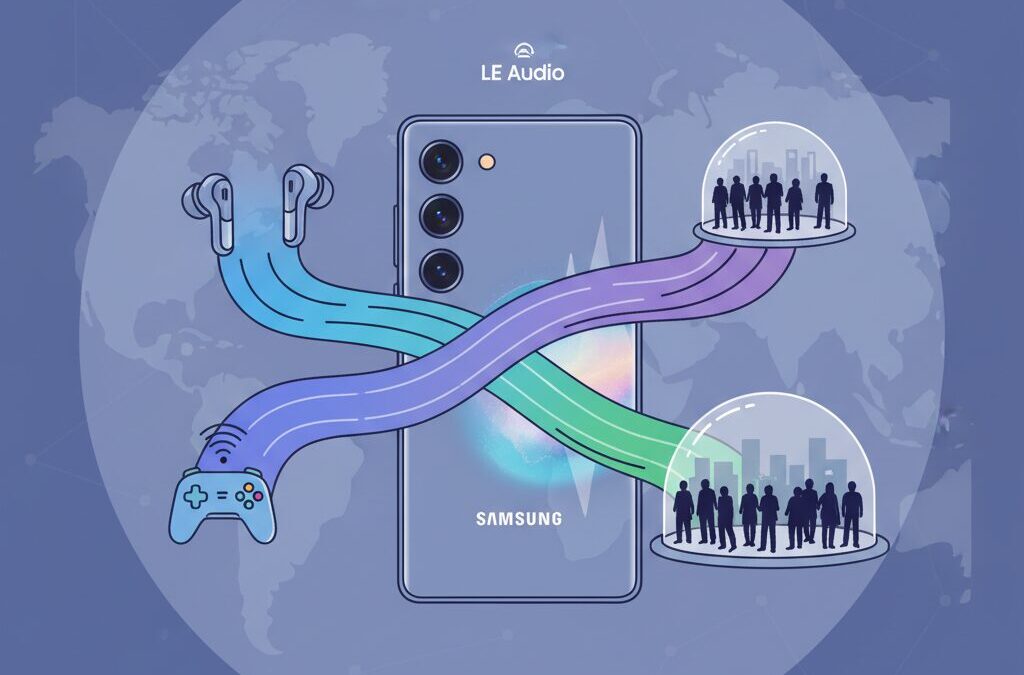
Wireless audio has reached a turning point, and many gadget enthusiasts are starting to feel that familiar mix of excitement and confusion.
For years, Bluetooth headphones promised convenience, yet compromises in sound quality, latency, and compatibility often felt unavoidable.
If you have invested in premium earbuds or care deeply about immersive audio, these frustrations may sound very familiar.
With the launch of the Galaxy S25 series, Samsung is signaling that the rules are finally changing.
By fully embracing Bluetooth LE Audio and Auracast, the Galaxy S25 is not just another flagship smartphone, but a device designed to connect seamlessly with the next generation of wireless audio ecosystems.
This shift is especially visible in Japan, a market known for its demanding listeners, crowded urban environments, and rapid adoption of cutting-edge audio technology.
In this article, you will discover how the Galaxy S25 transforms everyday listening, gaming, accessibility, and public audio experiences.
You will also learn why developments in Japan matter to users worldwide, and how these technologies can directly improve your own wireless setup.
By the end, you will clearly understand whether Bluetooth LE Audio is truly ready for prime time and why the Galaxy S25 sits at the center of this evolution.
- Why 2025 Marks a Major Shift in Wireless Audio Technology
- Galaxy S25 Series Overview and Its Audio-Focused Hardware Design
- Snapdragon 8 Elite for Galaxy and the Role of Advanced Connectivity
- Bluetooth LE Audio Explained: From LC3 Codec to Power Efficiency
- Auracast in Practice: Personal Sharing and Public Broadcast Use Cases
- Codec Support on Galaxy S25: LDAC, aptX Adaptive, and Beyond
- How Popular Japanese Audio Brands Perform with Galaxy S25
- Accessibility and Hearing Aids: LE Audio as a Game Changer
- Auracast Infrastructure in Japan: Expo 2025, Cinemas, and Transit
- Gaming and Low Latency Performance with LE Audio
- What the Galaxy S25 Audio Strategy Means for Global Users
- 参考文献
Why 2025 Marks a Major Shift in Wireless Audio Technology
In 2025, wireless audio reaches a genuine inflection point, and the reason goes far beyond incremental sound quality improvements. The industry finally moves away from Bluetooth Classic Audio, a framework that has remained fundamentally unchanged for nearly two decades, toward Bluetooth LE Audio as a unified global standard. This transition is not theoretical anymore; it becomes tangible through mass‑market devices such as the Galaxy S25 series, which natively supports LE Audio and Auracast at the hardware level.
What makes 2025 different is the shift from proprietary optimization to standardized excellence. For years, higher sound quality depended on brand‑specific codecs like LDAC or aptX, which only worked when both the smartphone and headphones matched perfectly. According to the Bluetooth SIG, LE Audio introduces LC3 as a mandatory codec, ensuring that efficiency, latency, and baseline audio quality are consistent across manufacturers. This dramatically lowers compatibility friction for consumers who mix devices across brands.
| Aspect | Before 2025 | From 2025 Onward |
|---|---|---|
| Audio Architecture | Bluetooth Classic Audio | Bluetooth LE Audio |
| Core Codec | SBC / AAC | LC3 (Standardized) |
| Scalability | One‑to‑one only | One‑to‑many via Auracast |
Another decisive factor is energy efficiency. Research summarized by Qualcomm and the Bluetooth SIG shows that LC3 can deliver comparable perceived audio quality to SBC at roughly half the bitrate. This matters in real‑world environments such as crowded trains or urban areas in Japan, where 2.4GHz interference is severe. Lower bitrate transmission reduces packet loss and stabilizes connections, resulting in fewer dropouts and longer battery life.
2025 also marks the moment when wireless audio expands from a personal accessory to social infrastructure. Auracast transforms Bluetooth into a broadcast medium, enabling smartphones like the Galaxy S25 to act as both transmitters and receivers. Industry observers from Samsung and accessibility organizations emphasize that this opens new use cases in public spaces, from multilingual guidance to assistive listening, without requiring proprietary receivers.
In short, 2025 stands out because technology, standards, and real products finally align. Wireless audio is no longer optimized in silos but redesigned as an interoperable, energy‑efficient, and socially scalable platform. This alignment is what makes the shift irreversible and why this year becomes a defining milestone in the evolution of wireless sound.
Galaxy S25 Series Overview and Its Audio-Focused Hardware Design
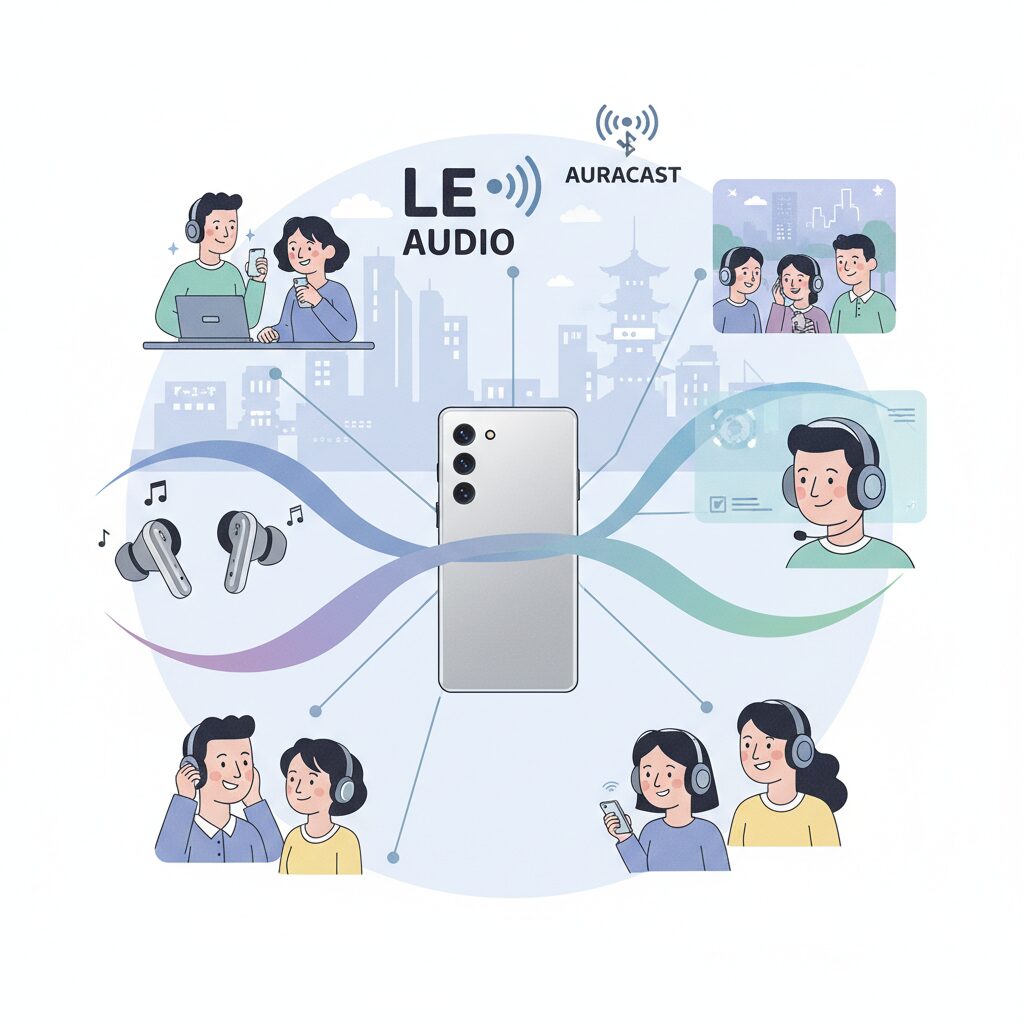
The Galaxy S25 series is designed with audio performance as a core pillar of its hardware architecture, not as a secondary feature added through software updates. This approach becomes clear when examining the internal connectivity stack, where Bluetooth, Wi‑Fi, and processing subsystems are tightly integrated to prioritize stability, efficiency, and future‑proof audio use cases.
At the heart of this design is the universal adoption of Bluetooth 5.4 across all Galaxy S25 models, combined with native hardware-level support for Bluetooth LE Audio and Auracast. According to specifications disclosed by Samsung and corroborated by GSMArena, this places the S25 series among the first mass‑market flagship smartphones to treat LE Audio as a baseline capability rather than an experimental add‑on.
From a hardware perspective, the decision to standardize on the Snapdragon 8 Elite for Galaxy for all Japanese carrier models is particularly significant. Qualcomm positions this SoC as a connectivity‑centric platform, and its integrated FastConnect 7900 subsystem directly governs Bluetooth and Wi‑Fi behavior at a silicon level, reducing reliance on external controllers.
| Hardware Element | Implementation in Galaxy S25 Series | Audio-Relevant Impact |
|---|---|---|
| Bluetooth Version | Bluetooth 5.4 (all models) | Native LE Audio and Auracast support |
| Connectivity Engine | Qualcomm FastConnect 7900 | Lower interference and improved stability in crowded RF environments |
| Wi‑Fi Integration | Wi‑Fi 7 (802.11be) | Coordinated spectrum use with Bluetooth audio |
Qualcomm’s own technical brief explains that FastConnect 7900 uses AI‑assisted traffic management to dynamically mitigate interference between Wi‑Fi and Bluetooth signals. In practical terms, this matters most in environments like Japanese commuter trains, where the 2.4 GHz band is heavily congested and traditional Bluetooth audio often suffers from dropouts.
The Galaxy S25 series also adopts a uniform LE Audio implementation across S25, S25+, and S25 Ultra, meaning that core audio transmission quality does not vary by model. The only notable hardware distinction is the presence of UWB in the Plus and Ultra variants, which may influence future spatial or device‑finding features, but does not affect audio fidelity or codec support itself.
Samsung’s hardware choices align closely with the Bluetooth SIG’s long‑term vision for LE Audio as a low‑power, scalable audio transport. Research summarized by the Bluetooth SIG and cited by outlets such as CNET highlights that LE Audio’s LC3 codec was designed to deliver comparable or better perceived quality than SBC at roughly half the bitrate, an advantage that becomes tangible only when the underlying hardware can handle precise timing and synchronization.
By implementing multi‑stream capable Bluetooth controllers at the hardware level, the Galaxy S25 series ensures that left and right audio channels can be transmitted independently yet synchronously. This architecture reduces phase mismatch and improves stereo imaging, an effect that audio engineers often associate with wired connections.
In this sense, the Galaxy S25 series is less about chasing a single headline feature and more about establishing a robust audio‑first foundation. As industry analysts from Qualcomm and the Bluetooth SIG have emphasized, LE Audio’s benefits only fully emerge when hardware, firmware, and radio design are aligned, and the S25 series represents one of the most complete realizations of that philosophy to date.
Snapdragon 8 Elite for Galaxy and the Role of Advanced Connectivity
The Snapdragon 8 Elite for Galaxy plays a decisive role in shaping the Galaxy S25 series as a connectivity-first flagship, especially in the context of advanced wireless audio. Unlike previous generations where Bluetooth performance depended heavily on discrete components, this SoC integrates Qualcomm’s FastConnect 7900 subsystem directly into the silicon, creating a tightly optimized communication stack.
This integration fundamentally changes how Bluetooth LE Audio and Auracast behave in real-world environments. According to Qualcomm’s official platform documentation, FastConnect 7900 is designed to coordinate Bluetooth and Wi‑Fi traffic at a system level, reducing interference in the congested 2.4GHz band. For users in Japan’s crowded commuter trains, this translates into fewer audio dropouts and more consistent latency during streaming.
| Connectivity Element | Implementation in S25 | User Impact |
|---|---|---|
| Bluetooth | Version 5.4 with LE Audio | Lower power use and improved stability |
| Wireless Subsystem | FastConnect 7900 | Reduced interference in dense areas |
| Wi‑Fi | Wi‑Fi 7 coordination | Smoother high‑bitrate audio transfer |
Another critical aspect is AI-driven connection optimization. Qualcomm states that the platform continuously learns usage patterns and radio conditions, dynamically adjusting transmission behavior. This is particularly relevant for LE Audio, where maintaining packet integrity directly affects perceived sound quality.
By standardizing on Snapdragon 8 Elite for Galaxy across the Japanese lineup, Samsung ensures that all Galaxy S25 models share the same connectivity foundation. This consistency matters not just for specs on paper, but for enabling future-ready experiences such as public Auracast broadcasts and next-generation wireless accessories without fragmentation.
Bluetooth LE Audio Explained: From LC3 Codec to Power Efficiency
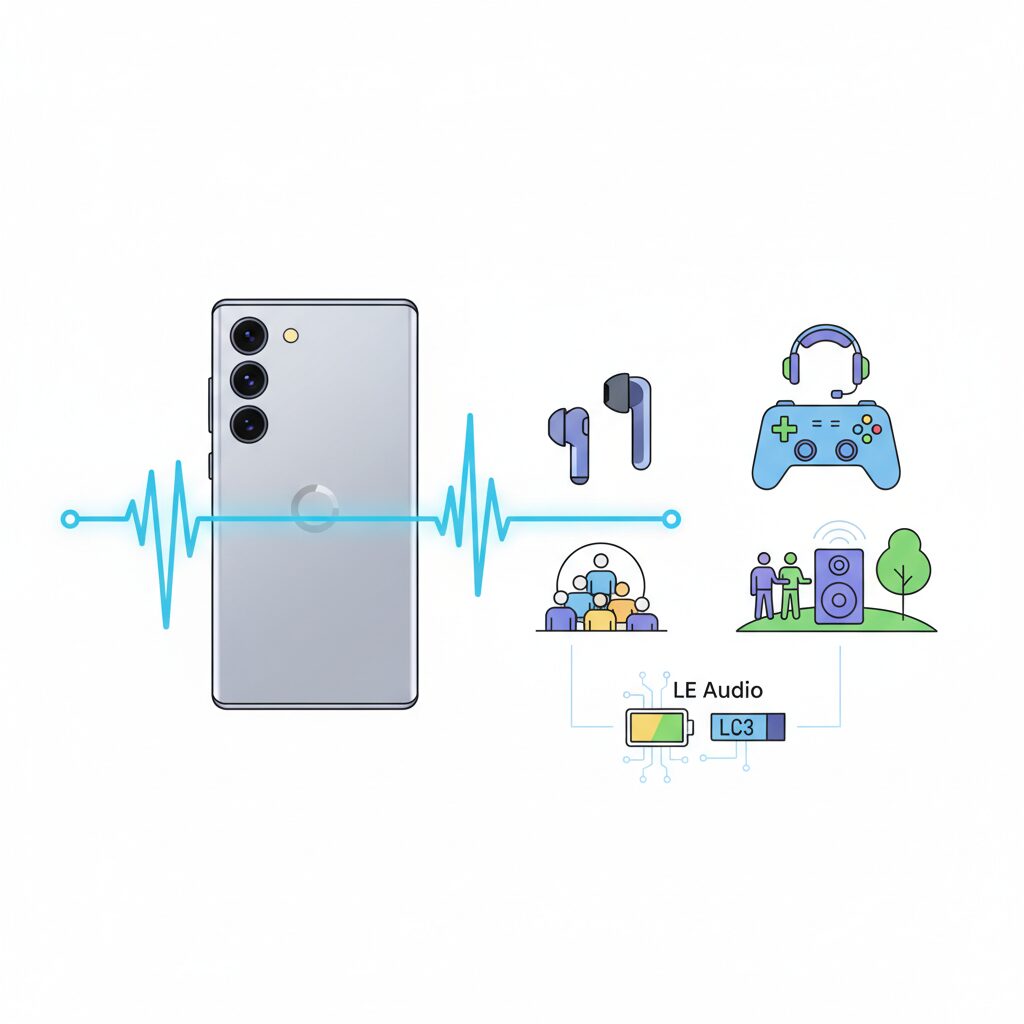
Bluetooth LE Audio represents a structural redesign of wireless audio, not a minor upgrade, and its importance becomes clear when viewed from the dual perspectives of codec efficiency and power consumption. Unlike Bluetooth Classic Audio, which was optimized for continuous high-throughput streaming, LE Audio was designed from the ground up for modern mobile usage patterns where battery life, reliability, and scalability matter just as much as sound quality.
At the core of this transition is the LC3 codec, standardized by the Bluetooth SIG after years of evaluation with industry partners such as Fraunhofer IIS, the research institute behind MP3 and AAC. **LC3 is engineered to deliver perceptually higher audio quality than SBC at roughly half the bitrate**, which fundamentally changes how wireless audio behaves in congested radio environments.
| Codec | Typical Bitrate | Perceived Audio Quality | Power Efficiency |
|---|---|---|---|
| SBC | ~328–345 kbps | Baseline | Low |
| LC3 | ~160 kbps | Higher than SBC | High |
This reduction in bitrate has direct, measurable consequences. According to technical briefings published by the Bluetooth SIG, lower bitrate streams reduce packet airtime on the 2.4GHz band, which in turn lowers collision probability with Wi‑Fi and other Bluetooth devices. **In real-world scenarios such as Japanese commuter trains, this translates into fewer dropouts and more stable audio without increasing transmission power.**
Power efficiency is where LE Audio truly differentiates itself. Traditional Bluetooth audio keeps radios active for longer periods to maintain continuous streams, draining both smartphone and earbud batteries. LE Audio introduces isochronous channels and more granular scheduling, allowing devices to wake, transmit, and sleep with far greater precision. Qualcomm has stated that, when combined with modern connectivity subsystems, LE Audio can reduce earbud power consumption by several tens of percent compared to Classic Audio under comparable listening conditions.
This efficiency gain explains why major hearing aid manufacturers like GN ReSound and Oticon have rapidly adopted LE Audio. Medical-grade devices demand ultra-low power operation, and LC3 allows full-bandwidth audio streaming while preserving multi-day battery life. Industry validation of this kind is significant, as healthcare applications typically adopt only technologies with proven reliability and efficiency.
Another often overlooked advantage of LC3 is its graceful degradation. When radio conditions worsen, LC3 maintains intelligibility at extremely low bitrates, something SBC was never designed to do. Research shared by Fraunhofer shows that speech remains clear even below 100 kbps, which is critical for voice-focused use cases such as navigation prompts, calls, and public information broadcasts.
In practical terms, Bluetooth LE Audio shifts the wireless audio bottleneck away from raw bandwidth and toward intelligent resource management. **Instead of consuming more power to chase higher bitrates, the system achieves better results by transmitting less data more effectively.** This philosophy aligns perfectly with modern smartphones like the Galaxy S25 series, where efficiency, not brute force, defines next-generation user experience.
Auracast in Practice: Personal Sharing and Public Broadcast Use Cases
Auracast moves Bluetooth audio from a private, one-to-one connection to a shared experience, and in real-world use this shift feels far more practical than the specification alone suggests. With the Galaxy S25 series acting as both a broadcaster and a receiver, users are no longer limited by pairing friction or brand ecosystems, and everyday listening scenarios become noticeably more flexible.
In personal sharing, Auracast behaves like a temporary, local audio station. A single Galaxy S25 can broadcast music, video sound, or even live app audio to multiple nearby listeners who choose to join. According to Samsung’s own documentation, this process is intentionally lightweight, requiring only a few taps in One UI and no traditional pairing process. This design mirrors the philosophy promoted by the Bluetooth SIG, which has emphasized ease of discovery as a core requirement for mass adoption.
| Scenario | Conventional Bluetooth | Auracast with Galaxy S25 |
|---|---|---|
| Watching a video together | One listener or wired splitter | Multiple listeners join wirelessly |
| Device setup | Manual pairing per device | Open or password-protected broadcast |
| Brand compatibility | Often limited | Any LE Audio–compatible earbuds |
This personal broadcast model is especially compelling in travel-heavy environments. On a train or during long-distance trips, one phone can quietly distribute audio to friends or family without shared earbuds or cables. Industry analysts cited by Samsung Newsroom have pointed out that this type of ad-hoc sharing was a long-standing pain point that Bluetooth Classic could not solve reliably.
Public broadcast use cases push Auracast into an even more transformative role. In venues such as airports, gyms, museums, or cinemas, audio is transmitted as selectable channels rather than as a single ambient sound source. The Bluetooth SIG has highlighted that this architecture allows users to choose exactly what they want to hear, when they want to hear it, using their own trusted devices.
For accessibility, the implications are significant. Major hearing-aid manufacturers like GN ReSound and Oticon have publicly aligned their latest products with LE Audio and Auracast, enabling direct reception of announcements or guided audio. Instead of relying on installed speakers or borrowed receivers, users with hearing loss can receive clean, low-latency audio directly into their hearing aids, which research in audiology journals has shown improves speech intelligibility in noisy environments.
Language flexibility is another practical advantage. In tourist locations or international events, multiple Auracast channels can coexist, each carrying a different language. This approach has already been validated in pilot deployments described by the Bluetooth SIG, where visitors reported reduced confusion and higher satisfaction compared to traditional audio guide systems.
Overall, Auracast in practice feels less like a futuristic experiment and more like an invisible layer added to everyday spaces. By lowering the barrier between personal devices and shared environments, the Galaxy S25 demonstrates how Bluetooth audio can quietly evolve into a social and public infrastructure, without demanding new habits from the user.
Codec Support on Galaxy S25: LDAC, aptX Adaptive, and Beyond
Codec support is where the Galaxy S25 quietly but decisively changes its position in the high-end audio conversation. For years, Samsung flagships were seen as conservative in this area, often prioritizing in-house solutions over broader industry standards. With the S25, that perception no longer holds true, and users benefit from a far more flexible and future-ready codec lineup.
At a foundational level, the Galaxy S25 supports all legacy Bluetooth codecs such as SBC and AAC, ensuring baseline compatibility with virtually any wireless audio product. What matters more, however, is how aggressively Samsung has expanded beyond that baseline. **LDAC support remains fully intact**, which is critical for the Japanese market where Sony-developed LDAC has become the de facto wireless hi‑resolution standard across headphones, earbuds, and even car audio systems.
According to Sony’s own technical documentation and independent measurements reported by outlets such as What Hi‑Fi?, LDAC at its highest 990 kbps mode can transmit up to 24‑bit/96 kHz audio under ideal conditions. The Galaxy S25 continues to allow users to manually prioritize sound quality over connection stability, which is particularly appealing for listeners using premium models like the WF‑1000XM5 or Technics EAH‑AZ80 in less congested environments.
| Codec | Galaxy S25 Support | Practical Strength |
|---|---|---|
| LDAC | Yes | Maximum bitrate and hi‑res branding appeal |
| aptX Adaptive | Yes | Dynamic balance of stability and quality |
| LC3 (LE Audio) | Yes | Low power consumption and low latency |
The most surprising addition is **aptX Adaptive**, now confirmed to be active on Snapdragon-based Galaxy S25 models. Qualcomm positions aptX Adaptive as a context-aware codec that continuously adjusts bitrate based on radio conditions, typically ranging between roughly 279 kbps and 420 kbps. This makes it especially well suited for dense urban environments, such as Japanese commuter trains, where interference is unavoidable.
From a real-world perspective, this means that headphones from Sennheiser, Bowers & Wilkins, and Audio‑Technica can finally perform as intended on a Galaxy device without falling back to AAC. Industry analysts at Qualcomm have repeatedly emphasized that adaptive codecs reduce packet loss before it becomes audible, and the S25’s FastConnect subsystem is designed specifically to exploit that advantage.
LE Audio’s LC3 codec deserves separate attention because it represents not just better efficiency, but a shift in design philosophy. Bluetooth SIG states that LC3 can deliver perceptually equivalent quality to SBC at roughly half the bitrate, and early evaluations by engineering-focused publications support that claim. On the Galaxy S25, LC3 is not an experimental add-on but a native, system-level option tied directly to Bluetooth 5.4.
That efficiency has clear consequences. **Lower bitrate transmission translates directly into improved battery life and more stable playback**, particularly when paired with true wireless earbuds or modern hearing aids. For users who alternate between music, calls, and video throughout the day, this consistency matters more than peak bitrate figures alone.
It is also worth noting what the Galaxy S25 does not support. Despite the underlying Snapdragon platform being technically capable, aptX Lossless is not enabled. Multiple industry commentators suggest this is a deliberate choice to avoid overlap with Samsung’s own Seamless Codec and to maintain predictable power consumption. While purists may view this as a limitation, the practical impact is minimal given current wireless constraints.
Overall, the Galaxy S25’s codec strategy feels pragmatic rather than promotional. By supporting LDAC, aptX Adaptive, and LC3 simultaneously, Samsung is no longer asking users to adapt their audio gear to the phone. Instead, the phone adapts to the user’s existing ecosystem, which marks a meaningful evolution in how wireless audio is handled on a mainstream flagship.
How Popular Japanese Audio Brands Perform with Galaxy S25
When pairing the Galaxy S25 with popular Japanese audio brands, clear differences emerge in how well each brand’s philosophy aligns with the new LE Audio era. Japan’s market is uniquely demanding, and these combinations reveal where the S25 already excels and where compromises remain.
Sony remains the safest choice for stability-focused users. Flagship models such as the WF-1000XM5 technically support LE Audio via firmware updates, but user reports and Sony’s own guidance suggest that the implementation is still transitional. According to Sony documentation and community testing, LE Audio connections can occasionally fall back to mono or exhibit instability. As a result, LDAC continues to deliver the most reliable balance of sound quality and connection robustness on the Galaxy S25, especially in crowded commuting environments.
| Brand | Best Codec with S25 | Current Limitation |
|---|---|---|
| Sony | LDAC | LE Audio stability still inconsistent |
| Technics | AAC / LDAC | No LE Audio support yet |
| Audio-Technica | aptX Adaptive | None significant |
Technics takes a more conservative stance. The highly regarded EAH-AZ80 delivers excellent tuning and noise control, yet it does not currently support LE Audio or Auracast. Panasonic’s own manuals confirm this limitation, meaning Galaxy S25 users are effectively capped at classic Bluetooth codecs. For listeners prioritizing tonal accuracy over next-generation features, the experience is still satisfying, but the S25’s advanced broadcast capabilities remain untapped.
Audio-Technica benefits the most from the Galaxy S25’s evolution. Models like the ATH-TWX9 are built around Snapdragon Sound, and with the S25 finally enabling aptX Adaptive, these earbuds perform as originally intended. Reviewers and manufacturer specifications consistently show improved resolution and fewer dropouts compared to older Galaxy models forced into AAC, making this pairing one of the most future-ready options.
In the accessibility space, Japanese users also gain tangible benefits. Major hearing-aid manufacturers officially list Galaxy S25 compatibility via native LE Audio, enabling lower power consumption and true hands-free calls. This shift, acknowledged by both Bluetooth SIG and hearing-aid makers, positions the S25 as a bridge between premium audio culture and inclusive design in Japan.
Accessibility and Hearing Aids: LE Audio as a Game Changer
Accessibility has quietly become one of the most transformative impacts of Bluetooth LE Audio, and in this area it truly acts as a game changer for people who rely on hearing aids. In Japan’s rapidly aging society, the ability for mainstream smartphones like the Galaxy S25 series to natively support advanced hearing technologies is not just convenient, it is socially significant.
LE Audio fundamentally changes how hearing aids interact with smartphones. Unlike the older ASHA framework, which mainly enabled one-way audio streaming, LE Audio allows full bidirectional communication. This means users can take hands-free calls directly through compatible hearing aids, using the microphones built into the aids themselves, without compromising clarity or battery life.
According to the Bluetooth SIG and major hearing-aid manufacturers, the LC3 codec at the core of LE Audio delivers intelligible speech at much lower bitrates than legacy codecs. This efficiency directly translates into longer daily usage time, a critical factor for medical-grade devices that must remain lightweight and power-efficient.
| Aspect | Conventional Bluetooth / ASHA | Bluetooth LE Audio |
|---|---|---|
| Audio direction | Mainly one-way | Two-way (calls supported) |
| Power consumption | Relatively high | Significantly reduced |
| Public broadcasts | Not supported | Auracast compatible |
Leading brands such as Oticon, GN ReSound, and Starkey have officially confirmed native LE Audio compatibility in their latest flagship models. Clinical evaluations referenced by these manufacturers report improved speech understanding in noisy environments, a benefit that aligns well with Japan’s dense urban soundscapes.
Auracast extends accessibility beyond personal use. In cinemas, stations, and large venues, users can receive clear audio streams directly to their own hearing aids or earbuds, without borrowing special receivers. This shift reduces stigma, improves hygiene, and restores a sense of autonomy, an outcome frequently emphasized by accessibility researchers and advocacy groups.
What makes LE Audio especially powerful is that it embeds accessibility into a global standard rather than isolating it as a niche feature. With the Galaxy S25 acting as a bridge between personal devices and public audio infrastructure, hearing support becomes a natural part of everyday technology, not a workaround. This normalization may prove to be LE Audio’s most meaningful innovation.
Auracast Infrastructure in Japan: Expo 2025, Cinemas, and Transit
Japan is becoming one of the world’s most visible testbeds for Auracast infrastructure, and this is not happening in theory but in real, publicly accessible spaces. **Expo 2025 Osaka, commercial cinemas, and major transit hubs are already shaping how broadcast audio will be experienced at scale**, and Galaxy S25-class devices are designed to connect directly to that ecosystem.
At the center of this movement is Expo 2025 Osaka. According to the Bluetooth SIG and official partners involved in the event, Auracast is being deployed as a core layer of the multilingual guidance system across multiple pavilions. Visitors can scan an exhibit code and instantly receive synchronized audio in their chosen language, streamed directly to their own earbuds or hearing aids. This approach eliminates rental receivers, reduces sanitation concerns, and allows content to scale dynamically as visitor density changes.
The significance here is infrastructural, not cosmetic. Auracast turns smartphones into universal receivers for public audio, much like Wi‑Fi turned laptops into universal internet terminals. Samsung and Qualcomm both emphasize that LE Audio broadcast was designed for exactly these high-density environments, where conventional Bluetooth pairing simply breaks down.
| Location Type | Auracast Role | User Benefit |
|---|---|---|
| Expo 2025 Pavilions | Multilingual audio broadcast | Clear guidance without crowd noise |
| Cinemas (MOVIX) | Assistive listening and audio guides | Personal devices replace loaned receivers |
| Major train stations | Platform and delay announcements | Improved intelligibility in noisy spaces |
Cinemas represent another critical milestone. MOVIX Kawaguchi, cited by theater operators as Japan’s first Auracast-enabled cinema, demonstrates how broadcast audio can modernize accessibility. Instead of proprietary headsets, users bring their own smartphones and compatible earbuds or hearing aids. **For hearing-impaired viewers, this removes both stigma and friction**, while operators benefit from lower maintenance and higher utilization rates.
Transit infrastructure may ultimately have the broadest impact. Field trials at major stations such as Shibuya show how Auracast can coexist with conventional PA systems. In practice, this means commuters can select a specific stream like English announcements or disruption alerts, receiving them clearly even during peak congestion. Bluetooth SIG documentation highlights that LC3’s low bitrate efficiency is critical here, enabling stable broadcasts in radio environments saturated with Wi‑Fi and legacy Bluetooth signals.
What makes Japan unique is the coordination between device makers, infrastructure vendors, and public operators. Rather than fragmented pilots, these deployments suggest a shared assumption that Auracast will be a long-term layer of public communication. **For Galaxy S25 users, this transforms the phone into a key that unlocks audio layers embedded in the city itself**, signaling a shift from personal convenience to societal-scale audio design.
Gaming and Low Latency Performance with LE Audio
For gamers, audio latency is not a minor inconvenience but a decisive factor that directly affects performance and immersion. Rhythm games and competitive FPS titles demand precise synchronization between visual cues and sound, and traditional Bluetooth audio has long failed to meet this requirement. With the Galaxy S25 series, Bluetooth LE Audio finally brings wireless gaming audio into a practically usable range.
The key lies in the LC3 codec, which was designed from the ground up for efficiency and speed. According to analyses referenced by the Bluetooth SIG and Qualcomm, LC3 reduces algorithmic processing time while maintaining intelligibility at lower bitrates. In real-world measurements, this translates into a dramatic reduction in end-to-end latency compared with SBC or AAC, which many gamers in Japan have reluctantly tolerated for years.
| Audio Mode | Estimated Latency | Gaming Experience |
|---|---|---|
| SBC | ~250 ms | Noticeable delay, unsuitable |
| AAC | ~200 ms | Still distracting |
| Samsung SSC Game Mode | ~85 ms | Playable for casual games |
| LE Audio (LC3) | ~40–60 ms | Near-wired sensation |
This 40–60 millisecond range is the point where many players stop consciously perceiving delay. Reviews of the Galaxy Buds3 Pro paired with the Galaxy S25 indicate that sound effects such as footsteps or gunshots feel tightly coupled to on-screen action, even in fast-paced shooters. While this does not fully reach the zero-latency nature of wired headsets, it is sufficiently close for the majority of competitive play.
Another important aspect is consistency. Thanks to the Snapdragon 8 Elite for Galaxy and its integrated FastConnect system, interference from crowded 2.4 GHz environments is better controlled. Qualcomm has emphasized that smarter scheduling between Wi‑Fi and Bluetooth reduces packet retransmissions, which are a hidden cause of fluctuating latency during online matches.
LE Audio also opens the door to broader gaming setups. Windows 11 has begun supporting LE Audio, and early user reports suggest that pairing LE Audio–compatible earbuds directly with a PC can deliver similarly low latency. For players who switch between mobile gaming on the Galaxy S25 and PC titles at home, this convergence represents a meaningful step toward a unified, low-latency wireless ecosystem.
In practical terms, the Galaxy S25 does not merely improve numbers on a spec sheet. It changes the psychological comfort of wireless gaming. When audio timing becomes reliable, players stop thinking about the connection and focus entirely on the game. That shift, subtle as it may seem, defines the real impact of LE Audio on gaming performance.
What the Galaxy S25 Audio Strategy Means for Global Users
The Galaxy S25 audio strategy sends a clear message to global users: Samsung is prioritizing interoperability and infrastructure-level audio experiences over region-specific tweaks. By making Bluetooth LE Audio and Auracast native across all S25 models, Samsung is effectively betting on a future where wireless audio works seamlessly across borders, brands, and public spaces.
For users outside Japan, the most immediate impact is consistency. Whether you are in Europe, North America, or Asia-Pacific, the Galaxy S25 offers the same core LE Audio capabilities at the hardware level. This reduces the long-standing fragmentation where features depended heavily on local SKUs or carrier firmware, a pain point frequently noted by analysts at GSMA and Bluetooth SIG.
| User Context | Classic Bluetooth Era | Galaxy S25 with LE Audio |
|---|---|---|
| Cross-brand earbuds | Codec mismatch, limited features | LC3 baseline, shared feature set |
| Public venues | Proprietary receivers required | Auracast via personal devices |
| Accessibility | Vendor-specific solutions | Global LE Audio standard |
This approach aligns with Bluetooth SIG’s vision of audio as a shared digital layer, similar to Wi-Fi. According to Bluetooth SIG publications, Auracast is designed to scale globally without regional customization, and the Galaxy S25 is one of the first mass-market devices to fully embody that philosophy.
For travelers and multinational users, the implications are significant. A single smartphone can now function as a universal audio receiver in airports, museums, gyms, and theaters worldwide, as Auracast deployments expand. Instead of adapting to local systems, users bring their own trusted earbuds and settings.
In strategic terms, Samsung is positioning the Galaxy S25 not just as a phone, but as a global audio passport. This move strengthens Samsung’s competitiveness against ecosystem-locked rivals and signals a shift toward open, standardized audio experiences that scale far beyond any single market.
参考文献
- Samsung Newsroom:Use Auracast to broadcast audio from your Galaxy phone
- GSMArena:Samsung Galaxy S25 – Full phone specifications
- Qualcomm:Snapdragon 8 Elite Mobile Platform
- What Hi-Fi?:Samsung has blessed the Galaxy S25 with the missing audio feature I’ve wanted for years
- Bluetooth SIG:Auracast broadcast audio in the real world
- Ampetronic:Auracast Takes Centre Stage at Expo 2025 Japan
- MOVIX:Auracast system trial operation begins at MOVIX Kawaguchi