Your smartphone in 2026 is no longer just a communication device. It is your digital identity, your banking terminal, your remote office, and your entertainment hub all in one. As our lives become fully mobile, the value of the data stored and transmitted through our phones continues to rise dramatically.
At the same time, cyberattacks have evolved. AI-powered phishing, automated vulnerability scanning, data‑theft‑focused ransomware, and attacks hidden inside encrypted traffic are no longer theoretical risks. They are measurable, rapidly growing threats affecting millions of users worldwide.
Globally, around 33% of internet users—approximately 1.8 billion people—use a VPN each month, and the market continues to expand toward 2035. As 5G Advanced rolls out and remote work becomes standard, the traditional security perimeter disappears, placing your smartphone directly on the front line.
In this article, you will discover why mobile VPNs are shifting from optional tools to essential personal infrastructure. We will examine real market data, emerging AI-driven attack models, public Wi‑Fi risks, ISP tracking practices, and the truth behind “VPN is dead” narratives in the zero‑trust era. By the end, you will clearly understand whether a VPN is a luxury—or a necessity—for your digital life in 2026.
- The Smartphone as a Digital Hub in 2026: Why the Security Perimeter Has Disappeared
- Global VPN Adoption by the Numbers: 1.8 Billion Users and Accelerating Market Growth
- AI-Driven Cyberattacks: How Automation Is Reshaping the Threat Landscape
- Ransomware’s Shift to Data Extortion and What It Means for Mobile Users
- Public Wi‑Fi in 2026: Evil Twin Attacks and Modern Man-in-the-Middle Techniques
- Encrypted Traffic Is Not Enough: Malware Hidden Inside TLS and QUIC
- ISP Data Collection, Metadata Monetization, and Bandwidth Throttling
- Zero Trust vs Traditional VPN: Why Enterprises Are Changing Strategy
- Why Personal VPNs Still Matter in the Zero‑Trust Era
- How Mobile VPN Technology Has Improved: WireGuard, Lightway, and Performance Optimization
- Free VPN Apps: The Economics Behind “Free” and the Hidden Security Risks
- Choosing a Trustworthy VPN Provider in 2026: Audits, RAM-Only Servers, and Transparency
- 5G Advanced, 6G on the Horizon, and Protecting an Always‑Connected IoT Ecosystem
- Who Actually Needs a Smartphone VPN in 2026? Clear User Profiles and Use Cases
- 参考文献
The Smartphone as a Digital Hub in 2026: Why the Security Perimeter Has Disappeared
In 2026, the smartphone is no longer just a communication device. It functions as a digital hub that integrates identity, finance, work, and entertainment into a single always-connected interface.
Bank transfers, biometric authentication, cloud documents, AI assistants, and smart home controls all converge in one palm-sized device. As digital society matures, the value concentrated inside smartphones has dramatically increased.
At the same time, the traditional idea of a “security perimeter” has effectively disappeared.
From Perimeter Defense to Boundaryless Connectivity
In the past, cybersecurity relied on a clear boundary: inside the company network was trusted, outside was not. However, with cloud adoption, remote work normalization, and the expansion of 5G Advanced, this boundary has dissolved.
According to domestic market analyses, Japan’s VPN market reached 120 billion yen in 2025, growing 14.3% year over year, and is projected to continue double-digit growth toward 2030. This expansion reflects structural demand rather than temporary trend.
The shift signals a deeper reality: protection is moving from centralized infrastructure to individual endpoints—especially smartphones.
| Then | Now (2026) | Security Impact |
|---|---|---|
| Office-based work | Remote & hybrid work | Data accessed from anywhere |
| On-premise servers | Cloud-first systems | No fixed network boundary |
| PC-centric access | Mobile-first access | Smartphone as primary endpoint |
Globally, an estimated 1.8 billion people—around 33% of internet users—were using VPN services monthly as of 2024, according to market research reports. Adoption is accelerating particularly in mobile-first regions, reinforcing the smartphone’s central role.
What this tells us is clear: individuals are no longer shielded by institutional firewalls. They stand directly exposed to global networks.
Every app installed, every public Wi-Fi connection joined, and every API call made by AI assistants extends the device’s exposure surface. The perimeter used to sit at the corporate gateway. In 2026, it sits nowhere—and everywhere.
Cybersecurity experts, including analysts cited in Japan Security Summit reports, emphasize that AI-driven automation is accelerating threat discovery and exploitation cycles. When attack tools can scan and adapt in real time, static boundaries lose meaning.
In this boundaryless environment, protection must follow the user, not the network. The disappearance of the perimeter does not mean security is obsolete. It means security has become personal, continuous, and device-centric.
Global VPN Adoption by the Numbers: 1.8 Billion Users and Accelerating Market Growth
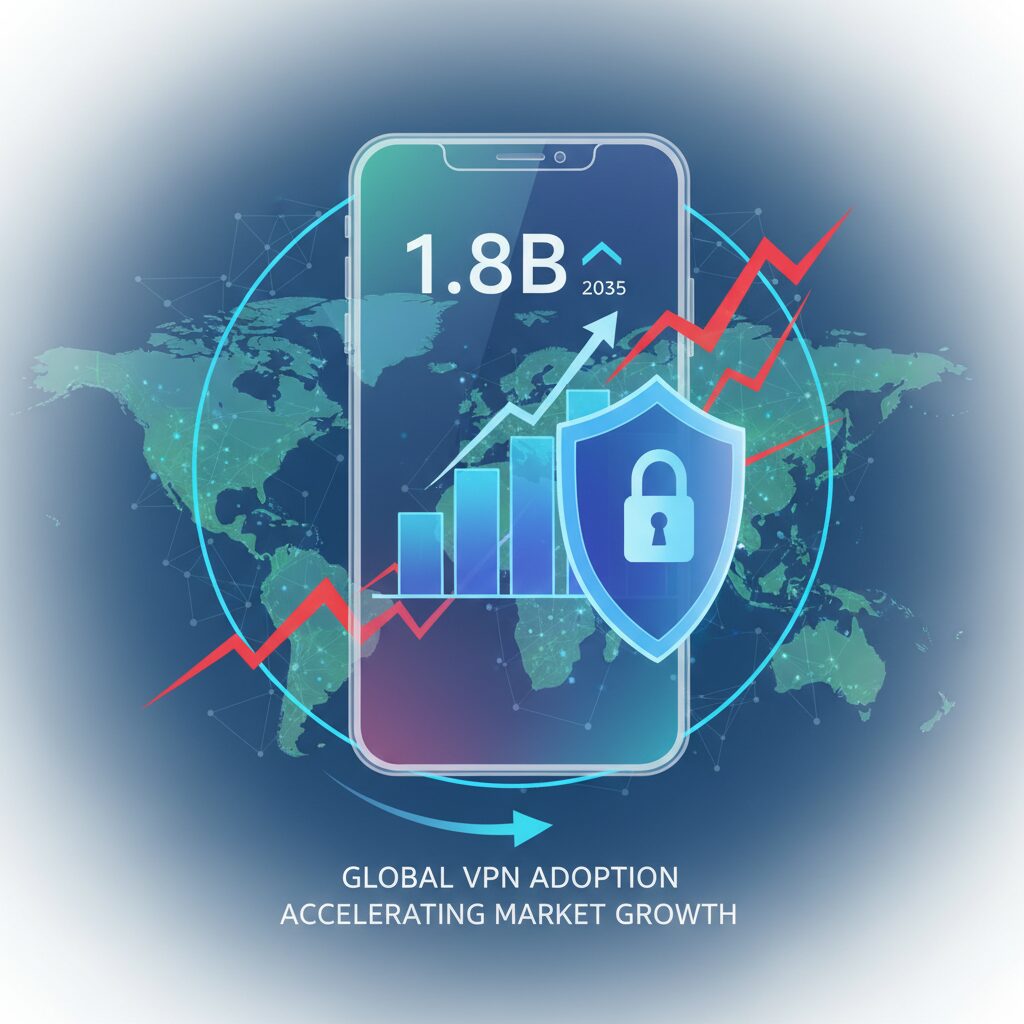
VPN adoption is no longer a niche behavior limited to privacy enthusiasts or frequent travelers. As of 2024, approximately 1.8 billion people—about 33% of global internet users—use a VPN every month, according to Market Growth Reports. This figure rose sharply from 1.4 billion in 2023, signaling not incremental growth but structural acceleration.
Behind this surge is a fundamental shift in how individuals perceive digital risk. Smartphones now function as financial wallets, identity vaults, and remote work terminals. As their role expands, so does the incentive to encrypt traffic, mask IP addresses, and bypass surveillance-driven tracking ecosystems.
The global market trajectory reflects this behavioral change. Industry estimates project the worldwide VPN market to reach 368.78 million USD in 2026 and expand to 805.44 million USD by 2035, indicating sustained long-term demand rather than a temporary spike.
| Metric | 2023 | 2024 | Outlook |
|---|---|---|---|
| Monthly VPN Users | 1.4 Billion | 1.8 Billion | Growing |
| Global Market Size | – | – | 368.78M USD (2026) |
| Long-Term Projection | – | – | 805.44M USD (2035) |
Regionally, North America currently leads with 37% market share, but Asia-Pacific follows closely at 31%. The mobile-first culture in Asian markets is particularly influential, with mobile VPN downloads increasing by 21% year over year. This trend underscores that growth is being driven not by desktop enterprise deployments alone, but by individual smartphone users.
Perhaps most revealing is that 54% of VPN connections now originate from individual consumers rather than corporate mandates. This bottom-up adoption pattern indicates a cultural shift: users are proactively choosing encryption as a personal safeguard, not merely complying with workplace policy.
For gadget-savvy readers, the takeaway is clear. Market expansion at this magnitude typically accompanies deeper ecosystem integration: optimized mobile protocols, lighter encryption overhead for 5G environments, and stronger competition among providers. Accelerating adoption is not just a statistic; it is a signal that encrypted connectivity is becoming a default expectation in the modern internet stack.
When one in three internet users actively tunnels their traffic, the conversation shifts from “Who needs a VPN?” to “Who can afford to operate without one?”
AI-Driven Cyberattacks: How Automation Is Reshaping the Threat Landscape
In 2026, cyberattacks are no longer primarily manual operations carried out by small groups of skilled hackers. They are increasingly automated, adaptive, and powered by artificial intelligence. According to Trend Micro’s 2026 threat outlook, attackers are leveraging generative AI and autonomous agents to execute large parts of the attack lifecycle without continuous human control. This shift is fundamentally reshaping the threat landscape.
Automation has reduced the cost, time, and technical barrier required to launch sophisticated attacks. What once required weeks of reconnaissance and customization can now be performed in minutes by AI-driven scanning tools that identify vulnerabilities, craft tailored phishing messages, and adjust tactics in real time.
| Threat Type | AI-Driven Evolution in 2026 | User Impact |
|---|---|---|
| Phishing | Context-aware, flawless language generation | Higher click-through and credential theft rates |
| Ransomware | Automated data exfiltration before encryption | Extortion based on stolen personal data |
| AI Agent Attacks | API and agent-to-agent manipulation | Unauthorized actions and silent data leakage |
One of the most alarming developments is AI-enhanced phishing. Security researchers cited by JAPANSecuritySummit Update note that generative AI can now replicate natural Japanese business communication with near-perfect fluency. This dramatically increases the credibility of fraudulent emails and SMS messages targeting smartphone users, especially those handling financial or work-related accounts on mobile devices.
Ransomware has also evolved structurally. Recent threat analyses show a clear shift from simple file encryption to data theft and extortion models. Attackers automatically extract sensitive data before locking systems, then threaten public exposure. This dual-pressure tactic is often orchestrated by automated scripts that scan for valuable files, compress them, and transfer them to remote servers without manual intervention.
Encryption itself has become a double-edged sword. As encrypted traffic now accounts for the vast majority of internet communications, attackers increasingly hide malware inside TLS 1.3 and QUIC sessions. Automated tools probe endpoints continuously, searching for misconfigurations or outdated software that can be exploited at scale.
Another emerging battleground is identity. Zscaler’s 2026 cybersecurity predictions emphasize that AI agents are being used to test stolen credentials across multiple services automatically, adapting login attempts to bypass behavioral detection systems. Combined with deepfake audio or video used to defeat verification checks, identity compromise has become faster and more convincing than ever.
For smartphone users, this means that exposure is constant and borderless. There is no longer a clear “safe zone” behind a corporate firewall. Automated attacks scan global IP ranges indiscriminately, and mobile devices—frequently switching between Wi-Fi and cellular networks—are part of that surface.
The defining feature of AI-driven cyberattacks in 2026 is scalability with intelligence. Attackers are not just operating at higher volume; they are operating with adaptive logic. Defenses that rely solely on static rules or manual response struggle to keep pace with adversaries that learn and iterate automatically.
Understanding this automation-first threat model is essential. It reframes cybersecurity from a question of isolated incidents to one of continuous, machine-speed confrontation—where every connected smartphone participates in a dynamic, AI-shaped battlefield.
Ransomware’s Shift to Data Extortion and What It Means for Mobile Users
Ransomware in 2026 no longer revolves solely around locking files. It increasingly centers on stealing data first and threatening to expose it later. According to the latest cyber threat forecasts published by Japan Security Summit Update and multiple security vendors, attacks have structurally shifted from “encryption for ransom” to “data extortion as leverage.”
Between 2024 and 2025, ransomware attempts surged by approximately 146% year over year, while data-leak extortion rose by around 70% and direct data theft increased by more than 90%. This means the true target is no longer your device’s usability, but your information itself.
For mobile users, this evolution changes the risk model entirely. Smartphones store cloud access tokens, private photos, financial app credentials, business chat logs, and authentication codes. Even if attackers never encrypt the device, exfiltrating this data is often enough to launch long-term blackmail or identity fraud.
Security analyses indicate that modern ransomware groups increasingly prioritize stealthy data extraction before triggering any visible disruption. This approach allows attackers to monetize victims without immediately alerting them. On smartphones, where background data flows constantly, unnoticed exfiltration becomes especially dangerous.
| Phase | Traditional Ransomware | Data-Extortion Model (2026) |
|---|---|---|
| Initial Goal | Encrypt files | Steal sensitive data |
| Pressure Tactic | System lockout | Public leak threats |
| Impact on Mobile Users | Device unusable | Identity, privacy, financial exposure |
Another structural shift is the use of AI-driven reconnaissance. As reported in 2026 threat outlooks by Trend Micro and other industry analysts, attackers automate vulnerability scanning and credential harvesting. When smartphones connect to unsecured Wi-Fi or outdated network devices, they can become entry points for data theft operations.
Unlike corporate networks, personal mobile environments lack centralized monitoring. There is no SOC team watching anomalous outbound traffic. If a malicious app or compromised connection siphons encrypted backups, contact lists, or stored documents, users may only realize it when extortion messages arrive.
This is particularly alarming because modern ransomware groups often operate leak sites on the dark web. Stolen data is categorized, previewed, and sometimes auctioned. Even individuals can be targeted if their data contains high-value elements such as cryptocurrency keys, business contracts, or sensitive personal content.
For mobile users, the implication is clear: ransomware defense is no longer about restoring files from backup. It is about preventing data exfiltration in the first place. Encrypted communication channels, secure authentication, and strict app hygiene become critical layers of defense in an ecosystem where information itself is the ransom currency.
In this new paradigm, smartphones are not peripheral devices. They are primary repositories of identity. Protecting the data flowing in and out of them is no longer optional but foundational to personal cyber resilience.
Public Wi‑Fi in 2026: Evil Twin Attacks and Modern Man-in-the-Middle Techniques
Public Wi‑Fi remains one of the most convenient yet dangerous connectivity options in 2026. Cafés, airports, hotels, and even convenience stores offer free access, but security researchers consistently warn that these networks are prime hunting grounds for attackers.
According to analyses referenced by ExpressVPN and multiple 2026 security reports, open Wi‑Fi environments significantly increase exposure to interception and credential theft. The structural issue is simple: users share the same broadcast domain, and trust is largely implicit.
In high-traffic public hotspots, you should assume that someone nearby is actively scanning the network.
Evil Twin Attacks: The Most Effective Trap
An Evil Twin attack occurs when a malicious actor sets up a fake access point using the same SSID as a legitimate network. Because smartphones prioritize previously connected names, devices often auto-connect without user awareness.
Once connected, all traffic flows through the attacker’s device. Login credentials, email sessions, cloud dashboards, and even two-factor authentication tokens can be intercepted if additional protections are absent.
| Attack Type | How It Works | User Impact |
|---|---|---|
| Evil Twin | Fake SSID mimics real hotspot | Credential theft, session hijacking |
| ARP Spoofing | Redirects traffic inside LAN | Data interception, manipulation |
| SSL Stripping | Forces downgrade from HTTPS | Exposes login data in plain text |
What makes Evil Twin attacks especially dangerous in 2026 is automation. AI-assisted tools can clone captive portals, replicate branding, and even simulate realistic connection error messages to keep victims connected longer.
The attack no longer requires advanced expertise; downloadable toolkits reduce the barrier dramatically.
Modern Man-in-the-Middle Techniques
Traditional Man-in-the-Middle attacks relied on simple packet sniffing. Today, attackers combine ARP poisoning, DNS spoofing, and rogue gateway injection to manipulate traffic in real time.
Even encrypted traffic is not immune to exploitation. As noted in 2026 threat forecasts from Trend Micro and other security researchers, more than 80% of global web traffic is encrypted, which paradoxically helps attackers conceal malicious payloads inside TLS sessions.
This means users may see the HTTPS padlock while malware or phishing redirections operate beneath the surface.
Because VPN tunneling encrypts all outgoing packets before they touch the public router, Evil Twin operators only see unreadable ciphertext. Even if DNS responses are manipulated locally, secure VPN DNS handling mitigates redirection attempts.
In 2026, the threat is not theoretical. Public Wi‑Fi remains a low-cost, high-return vector for cybercriminals. If you frequently connect outside your home or office, treating every hotspot as hostile is no longer paranoia—it is practical digital hygiene.
Encrypted Traffic Is Not Enough: Malware Hidden Inside TLS and QUIC
Many users assume that once traffic is encrypted, it is automatically safe. However, in 2026, that assumption no longer holds true.
Encrypted traffic can protect confidentiality, but it can also conceal malicious activity. Threat actors are increasingly abusing TLS 1.3 and QUIC to hide malware, command-and-control (C2) communications, and data exfiltration inside seemingly legitimate encrypted sessions.
According to Trend Micro’s 2026 threat outlook, attackers are leveraging AI to automate the delivery of malware through encrypted channels, making detection significantly more difficult at both network and endpoint levels.
| Protocol | Legitimate Purpose | Abuse Pattern in 2026 |
|---|---|---|
| TLS 1.3 | Secure HTTPS communication | Encrypted C2 traffic and payload delivery |
| QUIC (HTTP/3) | Faster web transport over UDP | Low-latency exfiltration hidden in web sessions |
The structural issue is visibility. As noted in recent cybersecurity analyses from Japan Security Summit Update, more than 80% of internet traffic is now encrypted. While this protects users from eavesdropping, it also creates blind spots for traditional security appliances that rely on packet inspection.
Attackers exploit this asymmetry. Malware embedded in encrypted sessions blends into normal HTTPS traffic, especially when delivered through compromised but legitimate cloud services. QUIC, designed for performance and reduced latency, further complicates monitoring because it operates over UDP and encrypts more metadata than older protocols.
Encryption does not validate intent; it only obscures content. A malicious payload wrapped in TLS is still malicious.
For smartphone users, this risk is amplified. Mobile devices frequently connect to public Wi-Fi and rapidly switch between networks. If an infected application establishes outbound encrypted connections, those sessions may appear indistinguishable from ordinary app traffic.
Security researchers have observed that modern ransomware campaigns prioritize data theft before encryption. Encrypted outbound channels are used to quietly exfiltrate sensitive files, authentication tokens, or personal data before victims even realize they are compromised.
This is why relying solely on HTTPS indicators or encrypted connections is insufficient. Defensive strategies must include behavior-based detection, strict app permission control, and network-level protection such as secure tunneling that enforces consistent traffic policies.
In the era of AI-driven attacks, encrypted traffic has become a double-edged sword. It safeguards privacy, yet simultaneously provides cover for increasingly automated and adaptive threats. Understanding this paradox is essential for anyone serious about mobile cybersecurity in 2026.
ISP Data Collection, Metadata Monetization, and Bandwidth Throttling
Most smartphone users assume their biggest privacy risk comes from hackers, but in reality their Internet Service Provider (ISP) sits in the most powerful observational position. Every website request, DNS query, and app connection flows through the ISP’s infrastructure. Even when content is encrypted, the metadata—such as timestamps, destination domains, and traffic volume—remains visible at the network level. According to industry analyses referenced by major VPN providers like ExpressVPN, ISPs can theoretically log when, where, and how long you connect to specific services, even if they cannot read the encrypted content itself.
This distinction between content and metadata is critical. Content may be protected by HTTPS, but metadata forms a detailed behavioral blueprint. Over time, patterns reveal work schedules, streaming habits, financial activity, and even health-related browsing. Cybersecurity experts have long emphasized that metadata can be as revealing as message content because it maps relationships and intent rather than just text.
| Data Type | Visible to ISP Without VPN | Hidden With VPN |
|---|---|---|
| Website Domain Accessed | Yes | No (Only VPN Server Visible) |
| Exact Page Content | No (If HTTPS) | No |
| App Usage Patterns | Yes (Traffic Analysis) | Obfuscated |
| Connection Duration & Timing | Yes | Partially Masked |
In many countries, anonymized user data has become part of a broader data brokerage ecosystem. While regulations differ, aggregated browsing trends and usage statistics are often leveraged for advertising optimization. Even where direct sale of identifiable browsing histories is restricted, traffic analysis feeds into behavioral profiling systems that influence targeted ads and dynamic pricing. Your connection history becomes a commercial asset, even if you never explicitly consent to selling your digital footprint.
A VPN fundamentally alters this visibility model. Instead of seeing every destination you access, the ISP sees only an encrypted tunnel to a single VPN server. From that point onward, traffic exits through the VPN provider’s infrastructure. This architectural shift does not eliminate all tracking on the internet, but it removes the ISP from the granular observation layer. In practical terms, your provider can no longer map your daily browsing behavior or app usage patterns with precision.
Another underappreciated issue is bandwidth throttling. ISPs manage network congestion by prioritizing or limiting specific types of traffic. Streaming video, cloud gaming, and large file downloads are common targets because they consume substantial bandwidth. Multiple consumer reports and technical analyses cited in VPN industry publications have documented cases where video quality drops or gaming latency increases during peak hours due to protocol-based traffic shaping.
When traffic is unencrypted and identifiable, throttling policies can be selectively applied. For example, an ISP may detect high-volume video streams and reduce speeds to preserve overall network stability. However, when a VPN encrypts traffic, the ISP cannot easily distinguish whether the data packets correspond to streaming, gaming, or simple browsing. Encryption neutralizes application-specific throttling by masking protocol signatures.
This does not mean a VPN increases your base internet speed. Physical infrastructure limits still apply. However, it can prevent artificial slowdowns triggered by traffic categorization. For mobile users on 5G networks—where high-bandwidth services like 4K streaming and cloud-based productivity apps are common—avoiding selective throttling can translate into noticeably smoother performance during peak hours.
There is also a competitive dimension to consider. Some ISPs bundle their own streaming or content services. In such ecosystems, traffic shaping may indirectly favor affiliated platforms. While regulatory frameworks aim to prevent discriminatory practices, technical enforcement varies. Encrypting traffic ensures that service preference cannot be inferred from packet inspection at the ISP layer.
Ultimately, ISP data collection and bandwidth management are structural characteristics of modern internet architecture. They are not inherently malicious, but they create asymmetry: one side sees everything, the other sees almost nothing. A smartphone VPN rebalances this relationship by encrypting outbound traffic at the device level. In a data-driven economy where metadata carries strategic value, controlling who can observe your connection patterns is no longer optional for privacy-conscious users.
Zero Trust vs Traditional VPN: Why Enterprises Are Changing Strategy
In 2026, many enterprises are rethinking their remote access architecture. According to reports from Japan Security Summit and Zscaler, a growing number of large organizations in Japan are either phasing out traditional VPNs or limiting their usage due to security concerns.
The main reason is structural. Traditional VPNs were designed for a time when the corporate network had a clear perimeter. Once authenticated, users were often granted broad access to internal resources. In today’s AI-driven threat landscape, this model creates unnecessary exposure.
Trend Micro’s 2026 threat outlook highlights how AI-powered attacks now automate credential theft and vulnerability scanning at scale. When attackers obtain VPN credentials or exploit an unpatched VPN appliance, they can move laterally inside the network with limited resistance.
This architectural weakness has pushed enterprises toward Zero Trust Network Access, or ZTNA. Instead of trusting users once they are “inside,” Zero Trust verifies identity, device posture, and contextual risk continuously.
| Aspect | Traditional VPN | Zero Trust (ZTNA) |
|---|---|---|
| Trust Model | Trust after login | Always verify |
| Access Scope | Network-level access | Application-level access |
| Risk Exposure | Lateral movement possible | Segmented and restricted |
| Primary Target | VPN appliances & credentials | Identity and device integrity |
Another driving factor is the documented exploitation of VPN devices themselves. Domestic security analyses in 2025 showed that vulnerabilities in VPN equipment remained a major initial access vector for ransomware incidents. This reality forced CISOs to reconsider whether perimeter-based tunnels are sustainable long term.
Zero Trust reduces the blast radius. Even if credentials are compromised, attackers cannot automatically access the entire internal network. Each application requires separate authorization, and risk is reassessed dynamically based on behavior and device condition.
Importantly, this transition does not mean encryption tunnels are obsolete. It means enterprises are prioritizing identity-centric security over network-centric security. As Zscaler and other industry leaders emphasize, location is no longer a reliable indicator of trust.
For enterprises operating in hybrid and cloud-native environments, this strategy aligns with how infrastructure is actually deployed today. Applications are distributed across SaaS, IaaS, and on-premise systems. A flat VPN tunnel cannot provide the granularity required to protect such environments effectively.
The shift from traditional VPN to Zero Trust is therefore not a trend but a response to measurable risk evolution. As AI accelerates attack automation and credential abuse, enterprises are redesigning access control around continuous verification rather than assumed safety.
Why Personal VPNs Still Matter in the Zero‑Trust Era
In recent years, many enterprises have announced a shift away from traditional VPNs in favor of Zero‑Trust Network Access. At first glance, this has led some to assume that personal VPNs are becoming obsolete. However, this interpretation overlooks a critical distinction between enterprise network architecture and individual risk exposure.
Zero‑trust does not eliminate the need for encryption on untrusted networks. It changes how organizations manage access, but it does not secure your personal traffic on public infrastructure.
According to security forecasts published by Trend Micro and Zscaler, identity‑centric attacks and AI‑driven automation are accelerating in 2026. Zero‑trust frameworks focus on verifying users and devices continuously, yet they assume that communication still travels across potentially hostile networks.
Enterprise Zero‑Trust vs Personal VPN
| Aspect | Zero‑Trust (Enterprise) | Personal VPN |
|---|---|---|
| Primary Goal | Granular access control to apps | Encrypt all device traffic |
| Trust Model | Always verify identity | Secure tunnel over public networks |
| Scope | Corporate resources | Any network, any app |
Zero‑trust solutions protect corporate systems from lateral movement and credential abuse. They do not prevent your ISP from analyzing metadata, nor do they shield you from man‑in‑the‑middle attacks on public Wi‑Fi. ExpressVPN’s 2026 technical guidance emphasizes that a VPN operates at the OS level, encrypting all outgoing traffic before it reaches the access point. That function remains structurally relevant.
Another overlooked factor is the decentralization of work. As organizations reduce reliance on perimeter VPN appliances—often targeted through unpatched vulnerabilities, as reported in Japanese ransomware trend analyses—employees increasingly rely on personal networks and devices. This effectively shifts part of the security boundary to the individual.
In a zero‑trust era, the “perimeter” has dissolved. Your smartphone itself becomes the perimeter.
Global VPN adoption data reinforces this reality. Market analyses indicate that roughly one‑third of the world’s internet users—about 1.8 billion people—use VPNs monthly as of 2024, with continued growth projected through 2030. Importantly, over half of VPN connections are driven by individuals rather than corporate mandates. This bottom‑up adoption suggests that users recognize risks that enterprise architecture alone does not mitigate.
Zero‑trust is about identity verification and contextual access control. A personal VPN is about transport security and privacy insulation. These are complementary, not contradictory, layers.
In practice, a remote worker accessing SaaS applications through zero‑trust still transmits data over café Wi‑Fi, hotel networks, or mobile carriers that may log metadata. Without a VPN, DNS requests, connection timing, and destination IP information remain visible to intermediaries. With a VPN, that visibility collapses to a single encrypted tunnel endpoint.
The zero‑trust model assumes compromise is possible and limits blast radius. A personal VPN reduces exposure surface before compromise occurs. That preventative layer is precisely why personal VPNs continue to matter in 2026.
How Mobile VPN Technology Has Improved: WireGuard, Lightway, and Performance Optimization
Mobile VPN technology in 2026 looks dramatically different from what many users experienced just a few years ago. Slow connections, unstable tunnels, and heavy battery drain used to be common complaints. Today, thanks to next-generation protocols such as WireGuard and Lightway, those trade-offs are being systematically eliminated.
The shift is not cosmetic but architectural. Modern mobile VPNs are built for a world dominated by 5G Advanced networks, encrypted-by-default traffic, and always-on connectivity. As ExpressVPN explains in its 2026 technical overview, protocol efficiency and lightweight cryptography have become central design priorities rather than afterthoughts.
Protocol Evolution: From Legacy Overhead to Lean Architecture
| Protocol | Design Focus | Mobile Impact |
|---|---|---|
| OpenVPN (legacy) | Robust, flexible | Higher CPU load, slower reconnection |
| WireGuard | Minimal codebase, modern cryptography | Faster speeds, lower battery usage |
| Lightway | Lightweight, rapid network switching | Stable on Wi‑Fi/5G transitions |
WireGuard represents a fundamental redesign of VPN protocol structure. With a significantly smaller codebase compared to legacy protocols, it reduces attack surface and computational overhead. On smartphones, this translates into faster connection times and more efficient CPU usage, which directly improves battery life.
Lightway, developed specifically for modern mobility scenarios, focuses on rapid session resumption and seamless network transitions. When your smartphone switches from public Wi‑Fi to 5G while you are on the move, Lightway can maintain the encrypted tunnel with minimal interruption. This is critical in 2026, where constant connectivity is the norm rather than the exception.
Performance Optimization in the 5G Advanced Era
High-speed mobile networks introduce a paradox. While 5G Advanced enables multi-gigabit throughput, inefficient encryption layers can become bottlenecks. Modern VPN protocols address this by streamlining handshake processes and using optimized cryptographic primitives designed for contemporary processors.
According to industry analyses referenced by VPN providers in 2026 comparisons, users increasingly expect negligible speed loss when VPN is enabled. Premium services now engineer their infrastructure with high-capacity servers and RAM-only architectures to ensure that encryption does not meaningfully degrade streaming, gaming, or cloud workloads.
Another key improvement lies in connection stability. Earlier VPN apps often dropped connections during brief signal fluctuations. Modern clients implement intelligent auto-reconnect logic and adaptive tunneling, allowing encrypted sessions to persist even in unstable network environments such as trains or crowded urban hubs.
Performance optimization is also tied to security resilience. Lightweight protocols make it feasible to keep VPN protection enabled at all times, rather than toggling it on only for sensitive tasks. In an era defined by AI-driven scanning and automated exploitation, continuous protection is not merely convenient; it is strategically necessary.
The evolution of WireGuard, Lightway, and mobile-centric optimization demonstrates a broader industry shift: VPN technology is no longer compensating for limitations. It is being engineered natively for smartphones, high-speed networks, and a threat landscape that demands both speed and cryptographic strength.
Free VPN Apps: The Economics Behind “Free” and the Hidden Security Risks
At first glance, free VPN apps look like a perfect deal. You download an app, tap one button, and your traffic appears to be protected without paying a cent. However, when you look at the economics behind “free,” a more complex reality emerges.
Running a VPN service is capital-intensive. Providers must maintain global server networks, invest in bandwidth, implement strong encryption protocols, and ensure 24/7 monitoring. According to industry comparisons and provider disclosures, infrastructure and bandwidth costs scale directly with user traffic, meaning millions of active users translate into substantial recurring expenses.
If users are not paying with money, they are often paying with data.
Security experts and multiple VPN analyses consistently warn that some free VPN services log connection timestamps, device identifiers, and browsing destinations. Even when content is encrypted, metadata such as accessed domains and session duration can be commercially valuable. In data-driven advertising markets, anonymized browsing profiles are routinely monetized.
This creates a structural conflict of interest. A paid VPN’s business model is aligned with protecting user privacy to maintain reputation and renew subscriptions. A free VPN may be incentivized to collect and analyze user activity to sustain operations.
| Aspect | Paid VPN | Free VPN |
|---|---|---|
| Primary revenue source | Subscriptions | Ads / Data monetization |
| Server investment | Large-scale, optimized networks | Limited capacity, congestion common |
| Incentive structure | User trust retention | Traffic volume & data value |
Beyond privacy concerns, technical risks are equally serious. Some free VPN apps impose strict data caps and overcrowded servers, which increases the likelihood of dropped connections. Without a reliable kill switch, a momentary disconnect can expose real IP addresses and ongoing sessions.
More concerning are documented cases where poorly maintained VPN applications contained security flaws or excessive permission requests. In corporate environments, reports in Japan have highlighted incidents where insecure personal apps on employee smartphones became entry points for broader security issues, including malware propagation.
There is also the issue of encryption integrity. Reputable providers publish information about their protocols and undergo third-party audits. In contrast, some free apps provide little transparency about their encryption standards or logging policies, making independent verification nearly impossible.
In a cybersecurity landscape shaped by AI-driven attacks and large-scale data harvesting, opacity itself becomes a risk factor.
Ultimately, the question is not whether a free VPN can function, but whether its economic incentives align with your security goals. When your smartphone holds financial credentials, biometric identifiers, and professional communications, the hidden trade-offs behind “free” may outweigh the apparent savings.
Choosing a Trustworthy VPN Provider in 2026: Audits, RAM-Only Servers, and Transparency
By 2026, choosing a VPN is no longer about speed alone. It is about whether you can verify the provider’s trustworthiness through evidence, not marketing claims. As VPN adoption continues to grow across Japan and globally, the real differentiator has become transparency.
According to industry comparisons and provider disclosures referenced in 2026 reviews, three elements consistently separate trustworthy services from risky ones: independent audits, RAM-only infrastructure, and clear operational transparency.
Key Trust Signals in 2026
| Criterion | What It Means | Why It Matters |
|---|---|---|
| Independent Audit | Third-party verification of no-logs claims and infrastructure | Reduces reliance on self-reported policies |
| RAM-Only Servers | Servers run without physical hard drives | Data is wiped on reboot |
| Transparency Reports | Disclosure of legal requests and responses | Shows accountability and governance |
Independent audits are particularly critical. Many providers claim “no logs,” but without third-party verification, that statement remains unverifiable. Leading services publicly commission security firms to audit their server configurations and privacy policies. This practice aligns with broader cybersecurity trends noted in 2026 threat outlooks, where transparency and continuous validation are considered core risk mitigation strategies.
RAM-only server architecture is another major shift. Instead of storing data on hard drives, these servers operate entirely in volatile memory. When rebooted, all data disappears automatically. Providers such as those highlighted in 2026 VPN evaluations emphasize this design to minimize the impact of physical seizure or external intrusion.
Transparency extends beyond infrastructure. Reputable VPN companies publish regular transparency reports detailing government data requests and how they responded. Even if requests are denied due to a no-logs architecture, the act of disclosure builds credibility. In contrast, providers that reveal little about ownership, jurisdiction, or security processes introduce unnecessary uncertainty.
Jurisdiction also deserves scrutiny. While no country guarantees absolute privacy, understanding where a company is legally based helps you assess regulatory exposure. Clear corporate structure, named leadership, and documented privacy policies are signs of operational maturity.
Finally, examine how a provider handles vulnerabilities. Do they maintain a public bug bounty program? Do they disclose past incidents? In 2026’s AI-accelerated threat landscape, rapid patching and open communication are essential. Silence is rarely a good sign.
For gadget enthusiasts and security-conscious users alike, the takeaway is simple: trust must be engineered, audited, and demonstrated. A fast connection is convenient, but a verifiable privacy architecture is what truly protects your digital life.
5G Advanced, 6G on the Horizon, and Protecting an Always‑Connected IoT Ecosystem
As 5G Advanced rolls out commercially in 2026 and early 6G research accelerates toward the 2030s, the structure of mobile connectivity is fundamentally changing. Smartphones are no longer just endpoints; they function as real-time control hubs for wearables, AR devices, cloud gaming, remote work platforms, and financial services.
According to industry analyses referenced in domestic market reports, market expansion drivers toward 2027 explicitly include the spread of 5G Advanced and preparation for 6G. This signals that ultra‑high bandwidth and ultra‑low latency are not simply performance upgrades, but catalysts for a denser, always‑connected ecosystem.
When connectivity becomes continuous and invisible, security must become continuous and invisible as well.
5G Advanced enhances network slicing, edge computing integration, and multi‑gigabit throughput. While these technologies reduce latency for applications such as XR streaming and AI inference at the edge, they also expand the attack surface. Every slice, API, and edge node introduces additional identity and traffic validation requirements.
Trend Micro and other security analysts note that AI‑driven attacks are increasingly automated and adaptive. In a high‑speed mobile environment, threat actors can scan, exploit, and exfiltrate data faster than traditional reactive defenses can respond.
| Generation | Performance Focus | Security Implication |
|---|---|---|
| 5G | High speed, low latency | Encrypted traffic surge, harder inspection |
| 5G Advanced | Edge integration, network slicing | Expanded API and slice-level attack surface |
| 6G (concept phase) | Ultra-low latency, AI-native networks | Identity-centric, machine-to-machine trust risks |
In an always‑connected IoT environment, the smartphone often acts as the authentication anchor. Smartwatches, AR glasses, connected vehicles, and home IoT sensors frequently depend on it for configuration, control, or data relay. If the smartphone’s traffic is intercepted, the broader ecosystem becomes indirectly exposed.
VPN technology evolves in response to this shift. Modern protocols such as WireGuard and proprietary lightweight designs are optimized to minimize cryptographic overhead, allowing users to maintain multi‑gigabit performance without noticeable degradation. This balance between speed and encryption is essential in 5G Advanced environments.
In the 6G horizon, where networks are expected to be AI‑native, identity validation will become more critical than perimeter defense. Zero‑trust principles are already influencing mobile security design, and personal VPN usage aligns with this philosophy by encrypting traffic at the device level, independent of carrier infrastructure.
Moreover, as encrypted traffic already represents the vast majority of internet communications, malicious payloads increasingly hide within secure channels. A device‑level encrypted tunnel ensures that even when connected to heterogeneous networks—public Wi‑Fi, private 5G slices, or edge nodes—data confidentiality remains consistent.
The transition to 5G Advanced and the anticipation of 6G do not reduce the need for VPNs. Instead, they redefine their role. VPNs shift from being optional privacy tools to becoming foundational components of a resilient, always‑connected IoT ecosystem—protecting not just a smartphone, but the expanding digital sphere orbiting around it.
Who Actually Needs a Smartphone VPN in 2026? Clear User Profiles and Use Cases
In 2026, not everyone needs a smartphone VPN in the same way. However, specific user profiles face structurally higher risks due to how they connect, work, and consume content. According to multiple security reports and market analyses, VPN usage has expanded to nearly one in three global internet users, reflecting a shift from optional tool to personal security infrastructure.
The question is no longer “Is VPN useful?” but rather “Does my digital behavior expose me to avoidable risk?”
| User Profile | Primary Risk | Why VPN Matters |
|---|---|---|
| Frequent Public Wi-Fi Users | MITM / Evil Twin attacks | Encrypts all mobile traffic at OS level |
| Mobile Finance Users | Credential theft, phishing | Adds encrypted tunnel beyond HTTPS |
| Remote & Hybrid Workers | Data leakage from personal devices | Creates personal secure boundary |
| Privacy-Conscious Individuals | ISP tracking, metadata collection | Masks browsing activity from providers |
Frequent public Wi-Fi users are the clearest candidates. Cafés, airports, and hotels remain prime environments for Man-in-the-Middle attacks. Security research highlighted by ExpressVPN and other industry analysts shows that encrypted HTTPS alone does not eliminate risks such as rogue access points or SSL stripping attempts. If you routinely check email, upload documents, or stream over open networks, a VPN functions as a constant encrypted tunnel rather than relying on app-level protections.
Users who manage money on their smartphones also fall into a high-necessity category. Mobile banking, crypto wallets, and QR-based payments concentrate financial identity into a single device. With AI-generated phishing becoming more linguistically convincing, as Trend Micro’s 2026 threat outlook notes, reducing network-level exposure adds an additional defensive layer. A VPN does not stop phishing itself, but it reduces interception risk in compromised networks.
Remote workers and side-business operators represent another critical group. As enterprises move toward zero-trust architectures, personal devices are no longer implicitly shielded by corporate perimeter defenses. If you access cloud dashboards, client databases, or internal collaboration tools from cafés or co-working spaces, you effectively become your own network administrator. A VPN establishes what can be described as a “personal encrypted perimeter.”
Privacy-focused users should also consider VPN essential rather than optional. ISPs can see metadata about domains visited and traffic patterns. Industry commentary consistently notes that VPN usage limits visibility to a single encrypted connection to the VPN server. If you prefer minimizing behavioral profiling or reducing ISP-level tracking, this use case is directly aligned.
Finally, there is a lifestyle-driven segment: globally minded content consumers. While not a security emergency, users who frequently travel or access international services benefit from IP flexibility and consistent connection security across regions.
If your smartphone acts as your bank, office, and identity vault, you are not a casual user—you are a high-value target. In 2026’s AI-accelerated threat landscape, VPN necessity correlates less with technical knowledge and more with exposure patterns. The more mobile, financial, or public your usage is, the stronger the case becomes.
参考文献
- Realnet Engineering:Is a VPN Really Necessary? VPN Necessity, Use Cases, and Who Needs It
- Omake Co., Ltd.:Current State and Future Forecast of the VPN Market Size Through 2030
- Market Growth Reports:Virtual Private Network (VPN) Market Size, Share, Forecast Report 2035
- Trend Micro:Overview of the 2026 Corporate Security Threat Forecast Report
- Japan Security Summit Update:Latest 2026 Cyber Threat Forecast
- ExpressVPN:Is a VPN Necessary? Key Reasons and Daily Use Cases (2026)
- Fujisoft:What Is Ransomware? Latest 2025 Cases, Attack Methods, and Cost-Effective Countermeasures