Smartphone cameras have never been more powerful, yet many creators feel that software alone is no longer enough. As 1-inch sensors become common in flagship devices, the physical limits of light control are becoming impossible to ignore.
In 2026, the global lens filter market is accelerating at an extraordinary pace, with projections pointing to a 25.6% CAGR through 2035. At the same time, 61% of YouTube creators prioritize visual aesthetics, driving demand for tools that deliver cinematic quality directly at the moment of capture.
From ND filters that enable proper 180-degree shutter motion blur, to CPL filters that eliminate reflections beyond the reach of computational photography, physical optics are reclaiming center stage. In this article, you will discover why lens filters are no longer optional accessories, how major brands are building magnetic and modular ecosystems, and what this shift means for serious creators worldwide.
- The Turning Point of Smartphone Imaging in 2026
- Market Expansion and the 25.6% CAGR: Why Optical Accessories Are Surging
- Creator Economy Data: 61% of YouTube Channels Prioritize Visual Aesthetics
- Why Computational Photography Cannot Replace Physical Light Control
- ND Filters, the 180-Degree Shutter Rule, and Motion Blur in Mobile Video
- CPL Filters, Malus’s Law, and the Physics of Reflection Control
- Diffusion and Black Mist: Achieving Filmic Texture with High-Resolution Sensors
- Magnetic Mounts, Modular Systems, and the 38% Shift Toward Faster Workflows
- Brand Ecosystems Compared: Kenko-Tokina, NiSi, Marumi, and Moment
- Psychological Protection: High-End Smartphones and the Rise of Premium Protectors
- User Pitfalls and Real-World Cases: Ghosting, Drop Risks, and Best Practices
- Smart Optics and App-Controlled Filters: The Next Phase of Hybrid Imaging
- Sustainability, Aluminum Systems, and Long-Term Compatibility Trends
- 参考文献
The Turning Point of Smartphone Imaging in 2026
In 2026, smartphone imaging stands at a genuine inflection point. As flagship models increasingly adopt 1-inch-class sensors, the industry is confronting a physical reality: software alone can no longer compensate for the limits of light entering the lens. Computational photography has matured, but the optical “front door” of the camera is now the decisive battleground.
According to market analyses referenced in 2026 industry reports, Japan’s smart optical accessory market is projected to reach approximately USD 300 million by the end of the year, with the lens filter segment expected to grow at a CAGR of 25.6% through 2035. This is not incremental growth; it signals structural change in how users perceive smartphone cameras.
Behind this shift lies a macro trend: creators are prioritizing aesthetics over mere resolution. Research cited in market surveys shows that about 61% of YouTube channels identify visual beauty as their top priority. In a landscape saturated with ultra-sharp 4K and 8K footage, differentiation increasingly depends on optical character rather than pixel count.
| Trend | Adoption / Focus Ratio |
|---|---|
| Magnetic mount systems | 38% |
| Eco-friendly packaging | 32% |
| App-controlled optical products | 29% |
| Mist and tone effect variations | 24% |
The 38% emphasis on magnetic mounting reflects a deeper behavioral change. In fast-paced shooting environments, especially for vloggers and short-form creators, time lost attaching a screw-in filter can mean missing the moment. Convenience has become a core optical requirement, not an afterthought.
At the same time, physics is reasserting its authority. The 180-degree shutter rule in video production requires shutter speed to remain roughly double the frame rate to preserve natural motion blur. Because most smartphones still use fixed apertures, bright daylight forces excessively fast shutter speeds, producing unnatural, jittery motion. Only a physical ND filter can reduce incoming light before it hits the sensor, something no post-processing algorithm can truly replicate.
Polarization offers another example. Circular polarizers manipulate the vibration direction of light according to Malus’s law, physically suppressing reflections from water and glass. Even advanced computational photography struggles to reconstruct information hidden by glare. User reports on major Japanese platforms such as Kakaku.com consistently highlight clearer visibility of underwater details and reduced reflections when CPL filters are used.
There is also an emotional dimension. High-resolution sensors in 2026 often render skin texture and night highlights with clinical precision. Diffusion filters such as black mist introduce controlled halation by scattering highlights before they reach the sensor. Because the diffusion occurs optically rather than digitally, highlight gradation is preserved in a way post-production glow effects cannot fully emulate.
The turning point of 2026 is therefore not about abandoning computation, but about rebalancing it with optics. Hardware and software are no longer substitutes; they are co-equal partners. As smartphones evolve from communication tools into primary creative instruments, the control of light at the physical level has become the new frontier of competitive advantage.
This convergence of larger sensors, creator-driven aesthetics, and rapidly expanding accessory ecosystems defines 2026 as the year smartphone imaging moves decisively beyond pure software magic and returns, strategically and inevitably, to the physics of light.
Market Expansion and the 25.6% CAGR: Why Optical Accessories Are Surging
The optical accessories market is entering a decisive growth phase, fueled by structural shifts in how smartphones are used as primary creative tools.
According to market data cited by Global Growth Insights, the camera lens filter segment is projected to expand at a remarkable 25.6% compound annual growth rate (CAGR) between 2026 and 2035. In Japan alone, the broader smart optical accessories market is forecast to reach approximately 300 million USD by the end of 2026.
This acceleration is not a short-term spike. It reflects a deeper redefinition of smartphones—from communication devices to full-fledged imaging platforms.
| Indicator | Outlook | Implication |
|---|---|---|
| Japan smart optical market size (2026) | ~300 million USD | Strong domestic demand |
| Lens filter CAGR (2026–2035) | 25.6% | High-growth niche within optics |
| Content creators prioritizing aesthetics | 61% | Visual differentiation drives purchases |
The 61% figure, representing YouTube channels that prioritize visual aesthetics, signals a cultural shift. Visual quality is no longer optional; it is competitive leverage. As more creators monetize their content, marginal gains in image character translate directly into audience retention and brand value.
Another structural driver is hardware evolution. Flagship smartphones now commonly integrate 1-inch-class sensors, pushing image fidelity to levels where optical imperfections and lighting control become more visible. As sensor performance increases, so does the demand for precision light management at the lens entry point.
Growth is therefore technologically inevitable rather than trend-driven.
Convenience innovation also plays a central role. Market analysis shows that 38% of new product focus centers on magnetic mounting systems, reflecting the need for rapid attachment in fast-paced shooting environments. Meanwhile, 29% of development attention is directed toward app-controlled optical products, indicating convergence between analog glass and digital ecosystems.
This hybridization lowers the skill barrier. Features such as adjustable ND density synchronized with smartphone exposure systems transform previously complex workflows into accessible tools for advanced amateurs.
Regional dynamics amplify the expansion. Asia-Pacific, particularly Japan, maintains high literacy in optical quality due to a strong camera culture. As reported in industry coverage, enthusiast users represent the fastest-growing segment, motivated by the desire to approach professional-grade output without investing in dedicated camera bodies.
Importantly, pricing psychology reinforces demand. With flagship smartphones often exceeding 150,000 to 200,000 yen, users increasingly perceive optical accessories not as optional add-ons but as protective and performance-enhancing investments.
When a device becomes both expensive and creatively central, accessory ecosystems naturally scale around it.
The 25.6% CAGR is therefore a reflection of converging forces: sensor advancement, creator economy monetization, workflow innovation, and premium device ownership. Optical accessories are not merely riding smartphone growth—they are becoming an essential layer in its next stage of evolution.
Creator Economy Data: 61% of YouTube Channels Prioritize Visual Aesthetics
In 2026, creator behavior is increasingly data-driven, and one statistic stands out: 61% of YouTube channels prioritize visual aesthetics as their top production focus. This shift signals that image quality is no longer a secondary consideration but a strategic differentiator in an oversaturated content ecosystem.
As competition intensifies, creators recognize that audience retention is closely tied to first impressions. Thumbnail clarity, cinematic lighting, highlight roll-off, and overall tonal consistency directly influence click-through rates and watch time. In other words, aesthetics have become performance metrics.
According to market analyses of the camera lens filter sector, this emphasis on visual refinement aligns with rapid growth in optical accessories, with the segment projected to expand at a CAGR of 25.6% from 2026 onward. The data suggests that creators are investing not only in cameras but also in tools that shape light before it reaches the sensor.
| Priority Area | Adoption / Focus Rate | Strategic Implication |
|---|---|---|
| Video Aesthetics | 61% of YouTube channels | Competitive differentiation through visual quality |
| Magnetic Mount Systems | 38% | Faster workflow in dynamic shooting environments |
| App-Controlled Optical Products | 29% | Hybridization of hardware and software control |
The prioritization of aesthetics is not purely artistic. It is economic. Platforms such as YouTube reward higher engagement with broader distribution. Subtle improvements in highlight softness, glare control, or color depth can translate into measurable gains in viewer retention.
Creators operating in fast-paced environments especially value tools that preserve aesthetic consistency without slowing production. The growing 38% adoption rate of magnetic mounting systems reflects a desire for immediacy. Swapping a diffusion or ND filter in seconds allows creators to maintain cinematic standards even under time constraints.
Moreover, the rise of app-connected optical tools, now drawing attention from 29% of the market, illustrates how aesthetics are becoming programmable. Exposure-linked variable ND systems, for example, help maintain motion blur consistency while protecting visual tone. This directly supports the aesthetic goals prioritized by the majority of YouTube channels.
Industry observers note that as sensors become sharper and more unforgiving, creators increasingly seek optical methods to shape mood at the capture stage rather than relying solely on post-production. Diffusion filters, polarization control, and precise exposure management enable intentional visual storytelling that algorithms alone cannot replicate.
The 61% figure ultimately reflects a broader transformation within the creator economy. Visual sophistication has become the baseline expectation, not the premium tier. Channels that fail to control light, texture, and reflection risk appearing amateurish in comparison.
For gadget-savvy creators, this data point confirms a clear direction: investing in visual tools is not about gear enthusiasm alone. It is about sustaining relevance in an environment where aesthetics directly influence visibility, engagement, and monetization.
Why Computational Photography Cannot Replace Physical Light Control
Computational photography has dramatically expanded what smartphones can achieve, but it does not change the fundamental fact that photography begins with light entering a lens. In 2026, even flagship devices equipped with 1-inch sensors still rely on fixed apertures and ultra-compact optical paths. Software can reinterpret captured data, yet it cannot modify the physical properties of light before it reaches the sensor.
This distinction—before capture versus after capture—is precisely why physical light control remains indispensable. Algorithms operate on recorded pixels. Filters operate on photons. That difference defines the boundary of computational replacement.
Exposure Control and the 180-Degree Shutter Constraint
For video creators, especially YouTubers who prioritize aesthetics—around 61% according to industry surveys—natural motion blur is essential. The widely accepted 180-degree shutter rule requires shutter speed to remain approximately double the frame rate. Under bright daylight, smartphones with fixed apertures are forced into excessively fast shutter speeds, producing unnatural, jittery motion.
| Condition | Without ND Filter | With ND Filter |
|---|---|---|
| Bright daylight video | Shutter speed increases excessively | Shutter speed remains cinematic |
| Motion rendering | Choppy, sharp frames | Smooth natural blur |
Software cannot “add” authentic motion blur that results from correct exposure timing at capture. While artificial blur can be simulated, it lacks the physically accurate integration of light over time. Neutral Density filters reduce incoming light itself, enabling correct shutter behavior in ways no post-processing stack can replicate.
Polarization Is a Physical Phenomenon
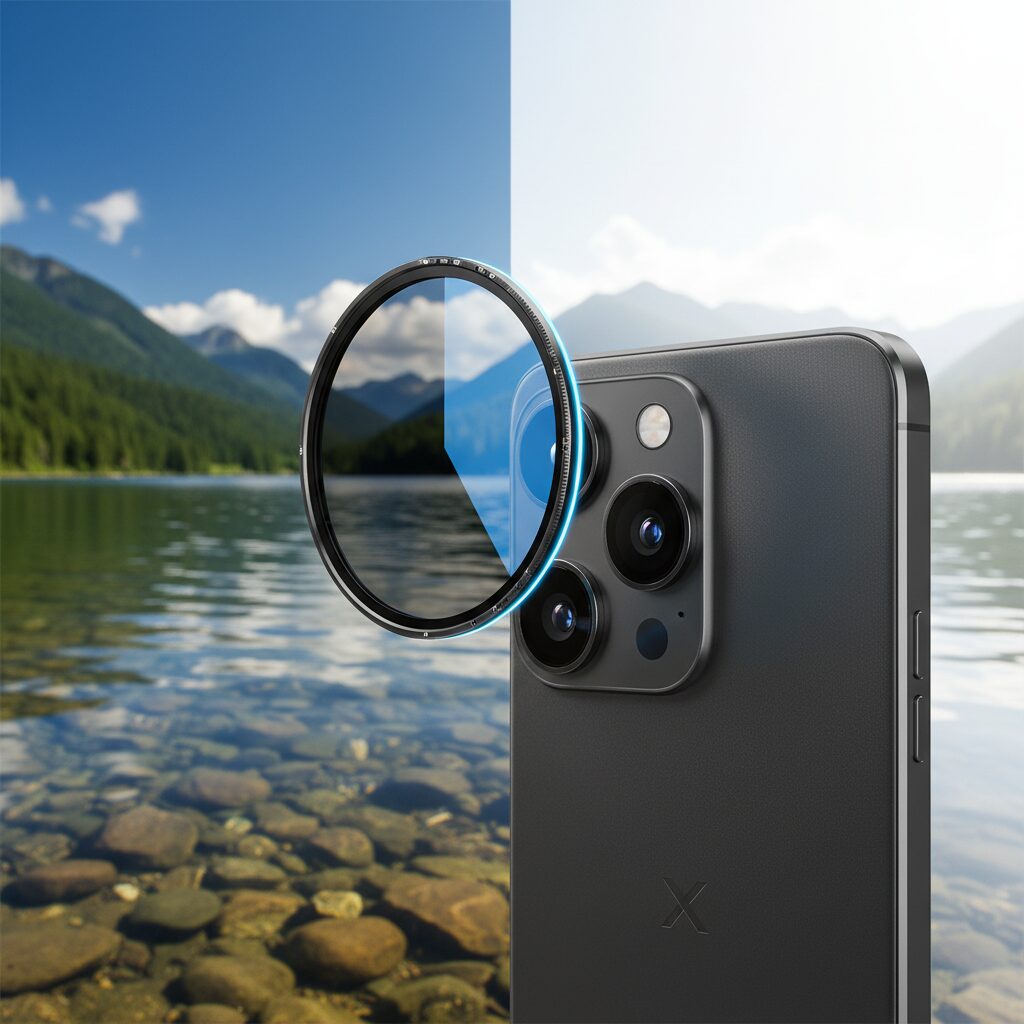
Circular polarizers demonstrate an even clearer limitation. Reflections on water or glass are governed by the physics of polarized light. According to Malus’ Law, reflected light intensity varies with the angle between polarization axes. A CPL filter physically rotates to attenuate specific vibration directions of light before capture.
Once glare is recorded and highlights are clipped, no computational method can fully reconstruct the obscured detail beneath the reflection. User reports on major Japanese platforms such as Kakaku.com consistently describe improved visibility of underwater textures when CPL filters are used. The key is not enhancement—it is selective exclusion of unwanted light at the source.
Optical Diffusion and Highlight Roll-Off
High-resolution sensors in 2026 often render scenes with clinical sharpness. Diffusion filters such as black mist physically scatter highlights through microscopic particles embedded in glass. This modifies the light’s spatial distribution before it is digitized, producing smoother highlight roll-off and preserved tonal gradation.
Simulated glow effects applied afterward operate on already clipped or contrast-compressed data. In contrast, optical diffusion reshapes the photon distribution itself. Manufacturers like Kenko-Tokina emphasize this distinction in their smartphone-oriented EXAPRO lineup, framing filters not as corrections but as creative optical tools.
The broader market trajectory—forecasted at a 25.6% CAGR in the lens filter segment—suggests that advanced users increasingly recognize this boundary. Computational photography enhances interpretation, but physical light control defines the raw material. As long as imaging depends on photons passing through glass, computation alone cannot replace optical intervention.
ND Filters, the 180-Degree Shutter Rule, and Motion Blur in Mobile Video
When shooting mobile video in 2026, controlling light is no longer optional. If you want cinematic motion, you need to respect the 180-degree shutter rule, a principle long used in film production. This rule states that your shutter speed should be set to roughly double your frame rate to create natural-looking motion blur.
For example, if you record at 24fps, your shutter speed should be around 1/48s. At 30fps, it should be close to 1/60s. This balance creates motion blur that feels organic to the human eye, something the American Society of Cinematographers has consistently emphasized in discussions of cinematic motion rendering.
| Frame Rate | Recommended Shutter Speed |
|---|---|
| 24fps | 1/48s (approx. 1/50s) |
| 30fps | 1/60s |
| 60fps | 1/120s |
The problem is that most smartphones have fixed apertures. Under bright daylight, your phone automatically increases shutter speed to prevent overexposure. The result is extremely fast shutter values such as 1/1000s, which eliminate motion blur and produce harsh, jittery footage often described as “video-like” or unnatural.
This is exactly where ND filters become essential. A Neutral Density filter physically reduces the amount of light entering the lens without altering color balance. By lowering incoming light, you can keep shutter speed locked at 1/50s or 1/60s even under direct sunlight.
According to market analyses in 2026, variable ND (VND) filters have become especially popular among mobile creators because they allow dynamic exposure adjustment during shooting. Some systems offer a wide range equivalent to ND2.5 through ND1000, enabling smooth control from cloudy conditions to bright noon light without changing filters.
This matters more than ever because over 61% of YouTube creators now prioritize visual aesthetics as a core production value. Natural motion blur directly contributes to perceived production quality. Viewers may not consciously identify shutter speed, but they immediately sense when motion feels cinematic versus harsh.
There is also a technical nuance worth understanding. Motion blur is not just an artistic choice; it helps the compression algorithms used by social platforms. When motion transitions smoothly between frames, encoding artifacts are often less noticeable compared to sharp, staccato frames with no blur.
ND filters therefore solve a physical limitation that computational photography cannot fully replace. While software can simulate blur in post-processing, it cannot recreate the authentic integration of light over time that occurs when shutter speed is physically controlled at capture.
For mobile videographers using gimbals or handheld rigs outdoors, locking exposure with an ND filter transforms workflow. Instead of fighting auto-exposure shifts and unnatural sharpness, you maintain consistent motion cadence across scenes. The result is footage that aligns with cinematic standards rather than default smartphone behavior.
In practical terms, if you are shooting travel vlogs at 24fps on a sunny beach, attaching an ND filter is not a luxury accessory. It is the only reliable way to preserve the 180-degree shutter relationship and achieve motion blur that feels intentional, immersive, and professionally crafted.
CPL Filters, Malus’s Law, and the Physics of Reflection Control
Circular Polarizing (CPL) filters are not mere accessories but precise optical control devices grounded in electromagnetic theory. When light reflects off non-metallic surfaces such as water or glass, it becomes partially polarized. This means the light waves begin oscillating predominantly in a specific direction. A CPL filter selectively blocks that orientation, allowing photographers to suppress glare physically rather than digitally.
The governing principle is Malus’s Law, formulated in 1809 by Étienne-Louis Malus. The law states that transmitted light intensity follows the equation I = I0 cos²θ, where θ is the angle between the incoming polarized light and the filter’s transmission axis. By rotating the CPL, you are literally adjusting θ, and therefore controlling how much reflected light reaches the sensor.
| Angle (θ) | cos²θ | Relative Light Transmission |
|---|---|---|
| 0° | 1 | 100% |
| 45° | 0.5 | 50% |
| 90° | 0 | 0% |
This predictable mathematical relationship explains why rotating a CPL dramatically alters reflections in real time. When aligned at 90 degrees to the reflected polarization, glare can be nearly eliminated. According to standard optics textbooks used in university physics courses, this extinction behavior is a direct consequence of wave interference, not a software effect.
No computational photography pipeline can recreate information that never reached the sensor. If glare obscures underwater textures or saturates highlights on glass, those photons are already lost. A CPL works upstream of the sensor, filtering unwanted polarization before image capture.
The physics becomes especially relevant at Brewster’s angle, where reflected light from dielectric surfaces is maximally polarized. At this specific incidence angle, defined by tanθB = n2/n1, reflections are almost entirely linearly polarized. In practical shooting, this is why lakes, storefront windows, and wet asphalt respond so strongly to CPL rotation under certain sun positions.
Modern smartphone sensors, particularly 1-inch class sensors, are highly sensitive to micro-contrast variations. Reflections reduce perceived contrast and color saturation because they introduce broadband specular highlights. By suppressing polarized reflections, a CPL effectively increases color depth and surface detail without altering white balance or dynamic range algorithms.
Importantly, a circular polarizer differs from a linear polarizer by including a quarter-wave plate. This converts linearly polarized light into circularly polarized light after filtration, ensuring compatibility with autofocus and metering systems. Even though smartphones rely heavily on phase detection and computational exposure, this optical compatibility remains essential for stable performance.
Reflection control is therefore not aesthetic trickery but controlled wave selection. When you rotate a CPL, you are adjusting electromagnetic vector alignment with mathematical precision. The result is clearer skies, deeper foliage tones, and transparent water surfaces—not because of software interpretation, but because physics allows selective transmission of light itself.
Diffusion and Black Mist: Achieving Filmic Texture with High-Resolution Sensors
As smartphone sensors have grown to 1-inch class and beyond, image sharpness has reached a point where it can feel almost clinical. Fine skin texture, micro-contrast in night scenes, and specular highlights are rendered with relentless precision. While this technical clarity is impressive, many creators now seek a softer, more cinematic rendering that resembles analog film rather than computational perfection.
Diffusion and Black Mist filters respond directly to this demand. By embedding ultra-fine black particles within optical glass, these filters gently scatter highlight information before it reaches the sensor. According to Kenko-Tokina’s product documentation for its EXAPRO line, this optical diffusion reduces harsh contrast while preserving overall detail, enabling what users often describe as a “filmic” look straight out of camera.
The distinction is critical. Computational filters typically soften edges uniformly or apply glow algorithms to bright areas. In contrast, physical diffusion interacts with real optical phenomena such as halation and highlight blooming. Because the light is scattered prior to sensor capture, tonal transitions—especially in bright regions—retain richer gradation and avoid the artificial clipping sometimes seen in post-processing.
| Aspect | Diffusion / Black Mist | Software Effect |
|---|---|---|
| Timing | Before light hits sensor | After image capture |
| Highlight Rendering | Natural bloom with gradation | Algorithmic glow |
| Texture Control | Optical micro-scatter | Edge softening |
The surge in aesthetic-focused video production reinforces this shift. Market analysis indicates that 61% of YouTube channels prioritize visual aesthetics as a top production value. As competition intensifies, subtle optical character becomes a differentiator. A mild Black Mist strength can tame overly sharp 4K or UHD smartphone footage, particularly when shooting portraits under LED lighting where specular highlights tend to look brittle.
NiSi and other manufacturers emphasize the use of lens-grade optical glass and precise surface polishing to maintain base sharpness even when diffusion is introduced. This is crucial for high-resolution sensors, which can easily reveal low-quality filter artifacts. Properly engineered diffusion allows creators to soften highlight edges without sacrificing overall clarity.
In practical scenarios, the benefits are immediately visible. Night street lamps gain a gentle halo reminiscent of cinema lenses. Skin tones appear smoother without losing pore-level realism. Backlit scenes gain atmosphere, as contrast rolls off more gradually. These qualities are difficult to replicate convincingly through editing alone.
High-resolution sensors capture everything; diffusion filters help you decide what should feel sharp and what should feel cinematic. In an era where smartphones risk over-defining reality, controlled optical imperfection has become a deliberate creative choice.
Magnetic Mounts, Modular Systems, and the 38% Shift Toward Faster Workflows
The rapid adoption of magnetic mounts and modular filter systems is not a passing trend but a structural response to how creators actually work in 2026. According to Global Growth Insights, 38% of new product development in the lens filter market is focused on magnetic mounting mechanisms, the highest single category among recent innovations. This shift clearly signals that workflow speed has become as critical as optical quality.
For smartphone shooters, especially vloggers and short-form video creators, seconds matter. Swapping from ND to CPL or adding a mist filter during a live shooting session used to require screwing and unscrewing threaded filters, increasing the risk of cross-threading or dropping glass. Magnetic systems eliminate that friction. The result is not only faster setup, but fewer interruptions in creative flow.
| Mount Type | Attachment Speed | Workflow Impact |
|---|---|---|
| Threaded | Manual rotation required | Higher time cost, stable once fixed |
| Magnetic | Snap-on / snap-off | Minimal downtime, rapid scene adaptation |
| Bayonet / Modular | Quarter-turn lock | Balanced speed and structural security |
Manufacturers are building entire ecosystems around this demand for speed. Marumi’s MAGNETIC SLIM and M100 systems, for example, allow filters to be attached even while wearing gloves or shooting in low light, dramatically improving usability in field conditions. NiSi’s IP-A holder employs a bayonet-style mechanism capable of stacking up to three filters without vignetting, which directly addresses the needs of hybrid shooters switching between stills and video.
Moment takes a different approach by leveraging Apple’s MagSafe standard. By integrating magnets directly into the mounting architecture, creators can attach filters without clamps, maintaining gimbal balance and reducing recalibration time. In fast-paced shooting environments, this translates into measurable productivity gains.
The 38% shift toward magnetic systems reflects a deeper transformation: optical accessories are now judged by how much friction they remove from the creative process.
This workflow acceleration also aligns with broader creator behavior. As noted in market analyses, over 60% of video-focused channels prioritize aesthetics, which often requires switching filters mid-shoot. A modular magnetic system enables dynamic adjustments—adding ND to preserve the 180-degree shutter rule outdoors, then snapping on a mist filter for cinematic indoor scenes—without dismantling the rig.
Equally important is long-term adaptability. Modular systems extend product lifespan by allowing users to replace only specific components instead of entire kits when upgrading smartphones. In a market increasingly sensitive to sustainability and cost efficiency, this modularity enhances both economic and environmental value.
In practical terms, magnetic and modular mounts redefine the relationship between hardware and creativity. They turn filters from deliberate, pre-planned tools into agile, real-time instruments. For creators who operate at the intersection of speed and expression, that difference is transformative.
Brand Ecosystems Compared: Kenko-Tokina, NiSi, Marumi, and Moment
As the Japanese smart optical accessories market is projected to reach USD 300 million by the end of 2026, with a remarkable CAGR of 25.6% in the lens filter segment, brand ecosystems have become a decisive factor for serious creators. According to Global Growth Insights, user demand is no longer limited to image quality alone but extends to usability, modularity, and emotional expression. In this landscape, Kenko-Tokina, NiSi, Marumi, and Moment each build distinct strategic ecosystems rather than merely selling filters.
The real competition in 2026 is not glass versus glass, but ecosystem versus ecosystem.
| Brand | Core Mount System | Strategic Focus |
|---|---|---|
| Kenko-Tokina | 49mm universal clip (EXAPRO) | System expansion & creative effects |
| NiSi | IP-A / P2 holder systems | Cinematic precision & optical quality |
| Marumi | Magnetic Slim / M100 | Speed & specialized shooting tools |
| Moment | MagSafe-based (M)Force | Seamless mobile workflow |
Kenko-Tokina positions EXAPRO as a bridge between traditional camera culture and smartphones. By adopting a 49mm filter standard with a screw-stopper clip design, it absorbs differences in multi-lens layouts while preserving compatibility with existing filters. As highlighted in its official product communications, the brand emphasizes evolving smartphones from tools for “taking” into tools for “creating.” Peripheral releases in 2026, including lighting diffusers and Arca-Swiss–compatible quick shoes, reinforce a holistic shooting environment rather than a single-product solution.
NiSi, by contrast, scales down professional cinema filter philosophy. Its aluminum IP-A holder supports stacking up to three filters without vignetting even with 0.5x ultra-wide lenses, according to NiSi Optics. The P2 square system allows 360-degree rotation, enabling precise graduated ND alignment. The ecosystem appeals to videographers who demand UHD-level sharpness and consistent color neutrality, reflecting NiSi’s heritage in high-precision optical glass manufacturing.
Marumi differentiates itself through magnetic efficiency and niche innovation. The Magnetic Slim system reduces attachment time dramatically—an advantage in fast-paced environments where, as market data shows, 38% of product development focus centers on magnetic adoption. Its Focus Aid Filter, applying the Bahtinov mask principle for astrophotography, illustrates how Marumi integrates scientific optical concepts into smartphone workflows. This specialization strengthens loyalty among advanced hobbyists seeking technical advantages.
Moment leverages Apple’s MagSafe ecosystem, creating perhaps the fastest attachment experience in the market. By eliminating clamp-based mounting, it improves gimbal balance and on-the-go shooting fluidity. The integration with cases, mounts, and accessories forms a cohesive mobile production system, aligning with the 29% market emphasis on app-linked and digitally integrated products.
Choosing among these brands ultimately means choosing a philosophy: universality, cinematic rigor, magnetic agility, or platform-native integration. For creators deeply invested in smartphone optics, understanding these ecosystem architectures is more critical than comparing filter specifications alone.
Psychological Protection: High-End Smartphones and the Rise of Premium Protectors
As flagship smartphones surpass 150,000 to 200,000 yen in Japan, the way users think about protection is fundamentally changing.
It is no longer just about avoiding scratches. It is about protecting an investment that functions as both a creative tool and a status symbol.
The rise of premium protectors reflects a deeper psychological need: safeguarding performance without compromising image quality.
According to user reviews aggregated on major Japanese e-commerce platforms in early 2026, high-end protectors such as Kenko’s ZX II series are evaluated not merely on durability, but on optical neutrality.
Users repeatedly emphasize that they “cannot tell whether the filter is attached,” highlighting ultra-high transmittance and low-reflection coatings.
This perception of invisibility becomes central to trust.
Psychologically, this aligns with loss aversion theory described in behavioral economics. When consumers invest heavily in a device, the fear of irreversible damage outweighs the marginal cost of additional protection.
However, unlike screen protectors, lens protectors directly influence captured data.
Therefore, the protective layer must not introduce flare, ghosting, or contrast degradation.
| Factor | Standard Protector | Premium Optical Protector |
|---|---|---|
| Primary Value | Scratch prevention | Optical fidelity + protection |
| Coating | Basic anti-scratch | Multi-layer low-reflection nano coating |
| User Motivation | Cost saving | Performance preservation |
Community discussions on platforms such as Kakaku.com reveal a nuanced understanding among advanced users.
Some report that poorly mounted filters can detach and cause peripheral damage, while others note that minor frame scratches do not affect actual image output.
This shared knowledge base elevates the conversation from simple protection to risk management strategy.
At the same time, experienced photographers acknowledge a trade-off.
In night scenes with strong point light sources, even high-quality protective filters can introduce ghosting.
As a result, sophisticated users remove protectors selectively depending on shooting conditions, treating them as dynamic tools rather than permanent fixtures.
This behavior signals a maturation of the market.
Protection is no longer binary—on or off—but situational and intentional.
The protector becomes part of workflow optimization.
Manufacturers respond by emphasizing advanced coatings, hardened glass surfaces, and slim frames designed to minimize vignetting on ultra-wide smartphone lenses.
Some brands integrate magnetic mounting systems, allowing rapid attachment and removal without disrupting gimbal balance or multi-lens alignment.
Convenience reduces friction, which in turn reinforces psychological comfort.
Another layer of psychological value lies in concentration.
When users feel confident that their expensive lens module is shielded, cognitive load decreases during shooting.
They can focus on composition and timing instead of worrying about accidental contact or dust.
In 2026, as smartphone cameras rival dedicated compact systems, the protector evolves into a symbolic boundary between vulnerability and control.
It reassures users that technological sophistication does not equate to fragility.
The premium protector market grows not because glass breaks easily, but because peace of mind has measurable value.
This fusion of optics and psychology explains why high-end protectors are no longer optional accessories.
They represent a convergence of financial prudence, performance integrity, and emotional security in an era of ultra-expensive mobile imaging systems.
Protection, in this context, becomes part of the creative ecosystem itself.
User Pitfalls and Real-World Cases: Ghosting, Drop Risks, and Best Practices
As smartphone optics become more advanced, user-related issues are also becoming more visible. In 2026, discussions on platforms such as Kakaku.com frequently highlight real-world problems including ghosting, unexpected filter drops, and improper mounting. These are not theoretical risks. They directly affect image quality and device safety.
Understanding these pitfalls is now part of being a serious mobile creator. Even premium filters can introduce artifacts or mechanical risks if used incorrectly.
Ghosting and Flare: When Protection Backfires
High-quality protective filters such as Kenko’s ZX II series are praised for high transmittance and low reflection coatings. However, user reports in early 2026 show that even well-coated glass can introduce ghosting under strong backlight conditions.
Ghosting occurs when light reflects between the smartphone lens and the added filter surface. With today’s large 1-inch-class sensors and powerful light sources in night scenes, internal reflections become more pronounced.
According to user discussions on Kakaku.com, some photographers remove protective filters during night cityscape shoots to avoid secondary light artifacts. This reflects an important reality: there is no universally “safe” setup for every lighting condition.
| Situation | Risk | Recommended Action |
|---|---|---|
| Night city with strong point lights | Ghosting and flare | Temporarily remove protective filter |
| Bright outdoor vlog | Overexposure without ND | Use ND or VND securely mounted |
| Waterfront landscape | Excess reflection | Adjust CPL angle carefully |
Drop Risks and Mounting Failures
Magnetic systems now account for 38% of product development focus in the filter market, reflecting demand for speed and convenience. While magnetic mounts from brands like Marumi and Moment significantly improve workflow, improper attachment can lead to detachment.
User anecdotes describe filters falling when magnets were misaligned or when the device experienced sudden motion. In some cases, only the filter frame was scratched, while the glass remained intact. In others, surrounding surfaces were damaged.
The risk is rarely the magnet itself, but user handling under time pressure. Fast-paced shooting environments, especially for vloggers, increase the chance of incomplete attachment.
Best Practices from Field Experience
Real-world cases show that advanced users treat filters as situational tools, not permanent fixtures. Professionals often remove CPL filters indoors, detach protective glass for critical night shots, and double-check magnetic alignment before mounting a smartphone on a gimbal.
NiSi’s bayonet-style holders and Kenko’s screw-stopper clip systems exist precisely to reduce alignment errors. These design philosophies acknowledge that modern smartphones have multi-lens arrays with tight tolerances. Even slight misplacement can cause vignetting or edge softness.
Industry analysis in 2026 emphasizes usability and system integration as core market drivers. That shift reflects a broader truth: optical accessories are no longer passive add-ons, but active components of a precision imaging system.
Ultimately, avoiding pitfalls requires understanding both physics and mechanics. Light can reflect unpredictably, and magnets cannot compensate for careless mounting. The creators who achieve consistent results are those who adapt their setup to the scene, verify attachment stability, and remove filters when optical purity matters most.
Smart Optics and App-Controlled Filters: The Next Phase of Hybrid Imaging
Smart optics are rapidly redefining what a smartphone camera can achieve in 2026. As 1-inch sensors become common in flagship models, the optical “entry point” can no longer remain passive. Software alone cannot fully compensate for excessive light, unwanted reflections, or highlight roll-off. This is where app-controlled filters and intelligent optical systems step in as the next logical phase of hybrid imaging.
According to market data, approximately 29% of product development focus in the lens filter sector is now directed toward application-controlled optical products. This shift reflects a clear industry recognition that the future lies in synchronizing physical light control with computational photography rather than treating them as separate domains.
| Technology | Control Method | Primary Benefit |
|---|---|---|
| Variable ND (App-linked) | Bluetooth + Exposure Meter Sync | Automatic shutter consistency |
| Magnetic Mount System | Physical snap-on design | Rapid filter switching |
| Smart Diffusion Filters | Hybrid optical + software tuning | Balanced highlight control |
The most compelling innovation is the app-synchronized variable ND filter. By communicating with the smartphone’s internal exposure meter, the filter can dynamically adjust density to maintain a fixed shutter speed, supporting the 180-degree shutter principle in video without manual intervention. This effectively removes one of the last technical barriers between mobile creators and cinema-grade motion rendering.
NiSi and other manufacturers already demonstrate how modular systems can support multi-layer stacking without vignetting, even on ultra-wide lenses. When such hardware is paired with real-time exposure data from the phone, the workflow becomes seamless. Creators no longer need to interrupt shooting to compensate for changing light conditions during outdoor filming.
Moment’s MagSafe-based ecosystem further illustrates how magnetic interfaces reduce friction in the creative process. When filter attachment becomes as intuitive as snapping on a charger, the psychological resistance to using physical optics disappears. This usability leap is not trivial. In fast-paced environments such as street videography or travel vlogging, seconds determine whether a moment is captured or lost.
Academic discussions on computational photography have long emphasized sensor data optimization, yet physical light modulation occurs before photons reach the sensor. By controlling light at the source and refining it algorithmically afterward, creators gain a dual-layer advantage. Optical filtration shapes the character of light, while AI refines exposure, color science, and dynamic range.
Another notable trend is intelligent diffusion management. Rather than applying a purely fixed-strength mist, future smart filters are expected to integrate selectable diffusion levels coordinated through companion apps. This would allow highlight bloom to adapt depending on scene contrast, preserving cinematic softness without sacrificing perceived sharpness.
As smartphone prices continue to rise into the ¥150,000–¥200,000 range in Japan, investment in intelligent optical accessories becomes rational rather than niche. Users increasingly view filters not as add-ons, but as modular upgrades that extend the creative lifespan of their devices.
The next phase of hybrid imaging is defined by responsiveness. Light conditions change instantly, and smart optics that communicate with mobile processors in real time ensure that exposure, motion cadence, and aesthetic tone remain consistent. In this convergence of glass and code, smartphones evolve from powerful cameras into adaptive imaging systems capable of professional-grade control.
Sustainability, Aluminum Systems, and Long-Term Compatibility Trends
As the smartphone optical accessory market expands toward a projected 300 million USD scale in Japan by the end of 2026, sustainability is no longer a peripheral concern but a structural driver of product design. According to market analyses cited earlier, 32% of new product initiatives emphasize eco-friendly packaging and sustainable materials. This shift reflects a broader consumer awareness that extends beyond image quality to environmental responsibility.
The material choice of filter systems has become a visible indicator of brand credibility. Plastic clip systems, once dominant for their low cost and light weight, are increasingly being replaced or reinforced with aluminum frameworks. Aluminum offers a rare combination of durability, corrosion resistance, and high recyclability, aligning with circular economy principles highlighted by international sustainability frameworks.
| Material | Durability | Environmental Profile |
|---|---|---|
| Plastic (Conventional) | Moderate, prone to wear | Limited recyclability, higher long-term waste |
| Aluminum Alloy | High structural rigidity | Widely recyclable, longer lifecycle |
Manufacturers such as NiSi employ aluminum in bayonet-style holders designed for repeated attachment cycles without mechanical degradation. This engineering approach reduces replacement frequency, indirectly lowering material consumption over time. In practical terms, a robust aluminum mount that survives multiple smartphone upgrade cycles prevents the accessory from becoming disposable after a single device change.
Long-term compatibility has therefore become a decisive design philosophy. As smartphone bodies evolve annually, users face the risk of accessory obsolescence. Universal clip systems, such as those developed by Japanese manufacturers like Kenko-Tokina under the EXAPRO concept, intentionally decouple the filter diameter from the phone model. By standardizing around common filter sizes like 49mm, these systems extend usability across multiple generations.
This modular architecture transforms a filter from a short-term gadget into a semi-permanent optical asset. The environmental implication is significant: fewer redundant purchases, reduced packaging waste, and a lower cumulative carbon footprint associated with logistics and manufacturing.
Magnetic mounting systems further contribute to sustainability in less obvious ways. While their primary appeal lies in speed and usability—an attribute noted in market data where magnetic adoption reaches 38%—they also minimize mechanical abrasion. Reduced thread wear and fewer forced attachments mean less structural damage, extending product lifespan. Marumi’s magnetic square systems illustrate how operational convenience can coexist with material longevity.
Packaging strategy is another measurable dimension. The transition toward eco-packaging, cited as a 32% priority in market development trends, often involves reduced plastic blister packs and increased use of recyclable paper-based materials. Although packaging accounts for a smaller fraction of total lifecycle emissions compared to metal production, visible sustainability efforts influence purchasing psychology. In high-price segments where smartphones exceed 150,000 to 200,000 yen, buyers increasingly expect accessories to reflect comparable ethical standards.
Aluminum systems also offer thermal stability advantages. As 1-inch sensors generate more heat during 4K and 8K video capture, filter mounts must maintain dimensional accuracy. Aluminum’s lower deformation under moderate temperature changes preserves optical alignment, ensuring that stacking systems—such as those allowing up to three filters—remain precisely seated. This stability supports long-term optical consistency, especially critical for UHD-level resolution.
From a lifecycle perspective, recyclability distinguishes aluminum most clearly. Global recycling infrastructures for aluminum are well established, and reprocessing requires significantly less energy than primary extraction. While precise energy ratios vary by region, industry consensus acknowledges secondary aluminum production as substantially less energy-intensive. Choosing such materials aligns accessory ecosystems with broader decarbonization goals.
Compatibility trends also intersect with platform ecosystems like magnetic alignment standards. Systems leveraging widely adopted attachment standards reduce proprietary lock-in, which in turn decreases forced upgrades. When an attachment framework persists across device generations, consumers retain functional components rather than discarding them.
Sustainability in smartphone optics is no longer limited to packaging claims; it is engineered into materials, mounting geometry, and cross-generational compatibility.
Looking ahead, the convergence of durable aluminum structures, modular filter sizing, and recyclable packaging forms a coherent strategy. Instead of treating accessories as consumables, leading manufacturers are repositioning them as long-term creative infrastructure. For serious creators who invest in ND, CPL, or diffusion filters as expressive tools, this durability ensures that their optical palette evolves without unnecessary environmental cost.
In this context, aluminum systems are not merely premium upgrades. They represent a structural response to both market growth and ecological accountability, reinforcing the idea that high-performance mobile imaging can coexist with responsible design.
参考文献
- Global Growth Insights:Camera Lens Filter Market Size & Statistics 2026
- Moment:MagSafe® Cases, Mounts, Chargers, and More
- NiSi Optics:NiSi Filters for iPhone®, Kits and Accessories
- Kenko-Tokina:From ‘Taking’ to ‘Creating’ – Smartphone Filtration with EXAPRO
- AstroArts:Magnetic Slim Focus Aid Filter by Marumi
- DC Watch (Impress):Upgrading Landscape Photography with Marumi Magnetic Holder M100