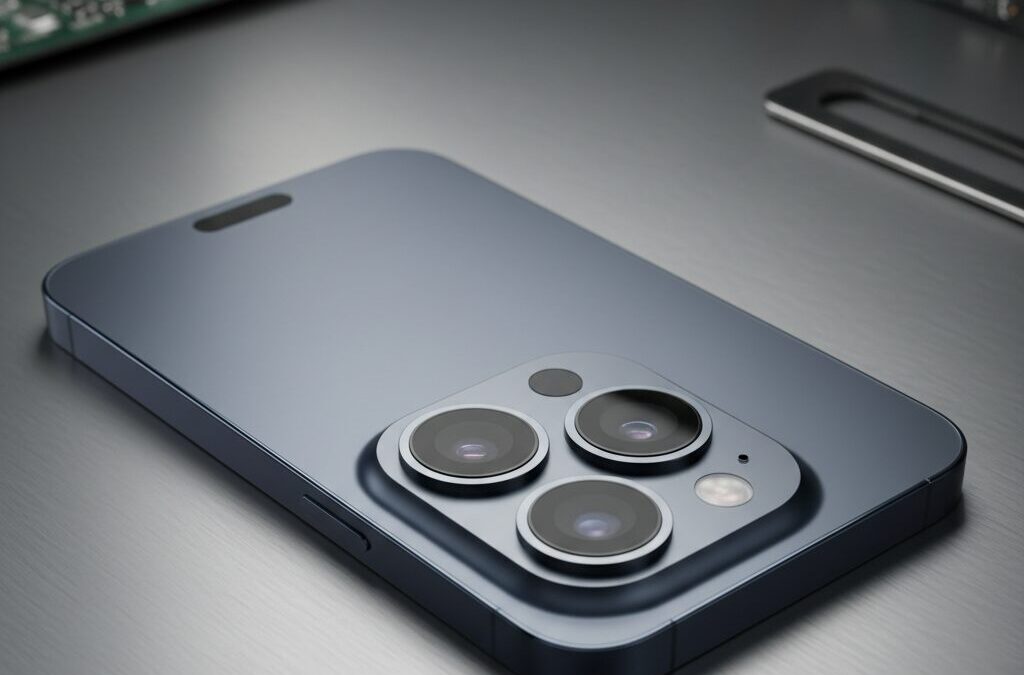
If you closely follow flagship smartphones, you may have felt a sense of surprise when you first saw the iPhone 17 Pro Max. The dramatically enlarged camera bump and the new “plateau” design challenge the long‑held belief that thinner is always better, especially in premium devices.
Many readers are likely wondering whether this thickness is simply a visual compromise or a meaningful step forward in mobile technology. This article carefully explains why Apple chose this direction and what real benefits and trade‑offs it brings for photography, performance, and everyday use.
By reading on, you will gain a deeper understanding of the optical physics behind the new camera system, the thermal engineering that supports sustained performance, and how this design shift affects accessories and ecosystems worldwide. This knowledge helps you decide whether the iPhone 17 Pro Max represents progress worth embracing.
Rather than focusing on specifications alone, this article connects design, engineering, and real‑world usability. It aims to give gadget‑savvy readers a clear and satisfying perspective on what this bold redesign truly means for the future of smartphones.
- The Plateau Design Explained: From Camera Island to Structural Platform
- How Much Thicker Is It? A Data‑Driven Look at Dimensions and Weight
- Why Camera Physics Demands Space: Sensors, Lenses, and Tetraprism Optics
- From 5x to 4x: Apple’s Strategic Zoom Redefinition and Image Quality
- Thermal Engineering Inside: Vapor Chambers and the Return of Aluminum
- Everyday Ergonomics: Balance, Grip, and One‑Handed Use
- Ecosystem Impact: MagSafe, Wireless Charging, and Accessory Compatibility
- How It Compares: iPhone 17 Pro Max vs Galaxy S25 Ultra and Pixel 10 Pro XL
- Cases and Protection: Why the Camera Bump Changes Everything
- Looking Ahead: Metalens Technology and the Future of Smartphone Thickness
- 参考文献
The Plateau Design Explained: From Camera Island to Structural Platform
The most striking change in the iPhone 17 Pro Max appears on its back, where Apple has transformed the familiar camera island into what many analysts now call a structural plateau. This is not merely a larger camera bump but a deliberate rethinking of how the upper portion of the chassis functions. **The plateau is designed as an integrated architectural element rather than an attached module**, signaling a clear departure from past design language.
In previous generations, the camera island behaved like an appendage placed on top of the rear glass. With the iPhone 17 Pro Max, CAD data and teardown observations reported by outlets such as GSMArena and Digital Photography Review indicate that the top third of the device is subtly raised as a continuous plane. This creates a stable internal volume where optical components, thermal paths, and structural reinforcement can coexist more efficiently.
| Design Aspect | Camera Island Era | Plateau Design |
|---|---|---|
| Structural role | Primarily cosmetic housing | Load-bearing chassis segment |
| Material integration | Glass-based module | Aluminum unibody extension |
| Thermal contribution | Minimal | Active heat spreading surface |
This plateau is machined as part of the aluminum unibody, a choice that Apple reportedly favored for its superior thermal conductivity compared with titanium. According to analysis referenced by GSMArena, aluminum conducts heat roughly an order of magnitude more efficiently, allowing the camera housing itself to act as a heat sink. **The camera area no longer just captures light; it now manages heat and mechanical stress**, especially under sustained loads from the A19 Pro chip and high-resolution imaging.
From an optical perspective, the plateau provides the vertical clearance required by the new 48MP tetraprism telephoto system and the near one-inch-class main sensor. Optical engineers interviewed by Digital Photography Review have long emphasized that sensor size directly dictates lens-to-sensor distance. By raising the entire upper section instead of exaggerating a localized bump, Apple distributes thickness more evenly, reducing stress concentration around the lens mounts.
There is also a subtle ergonomic rationale. While the overall thickness has increased, the plateau’s gently contoured edges transition into the rear panel with a concave curve. Apple appears to be applying principles similar to those used in professional camera grips, where volume is shaped to feel intentional rather than accidental. **The result is a device that communicates purpose: this thickness exists to enable performance, not to decorate the surface.**
Industry observers have noted that this approach aligns with Apple’s broader ecosystem strategy. By redefining the camera area as a platform, Apple creates a predictable structural zone for future sensors, cooling components, and even accessory alignment. As design historians often point out, paradigm shifts in hardware form usually begin with such spatial reassignments, and the iPhone 17 Pro Max plateau may be remembered as the moment when the camera stopped being an island and became infrastructure.
How Much Thicker Is It? A Data‑Driven Look at Dimensions and Weight
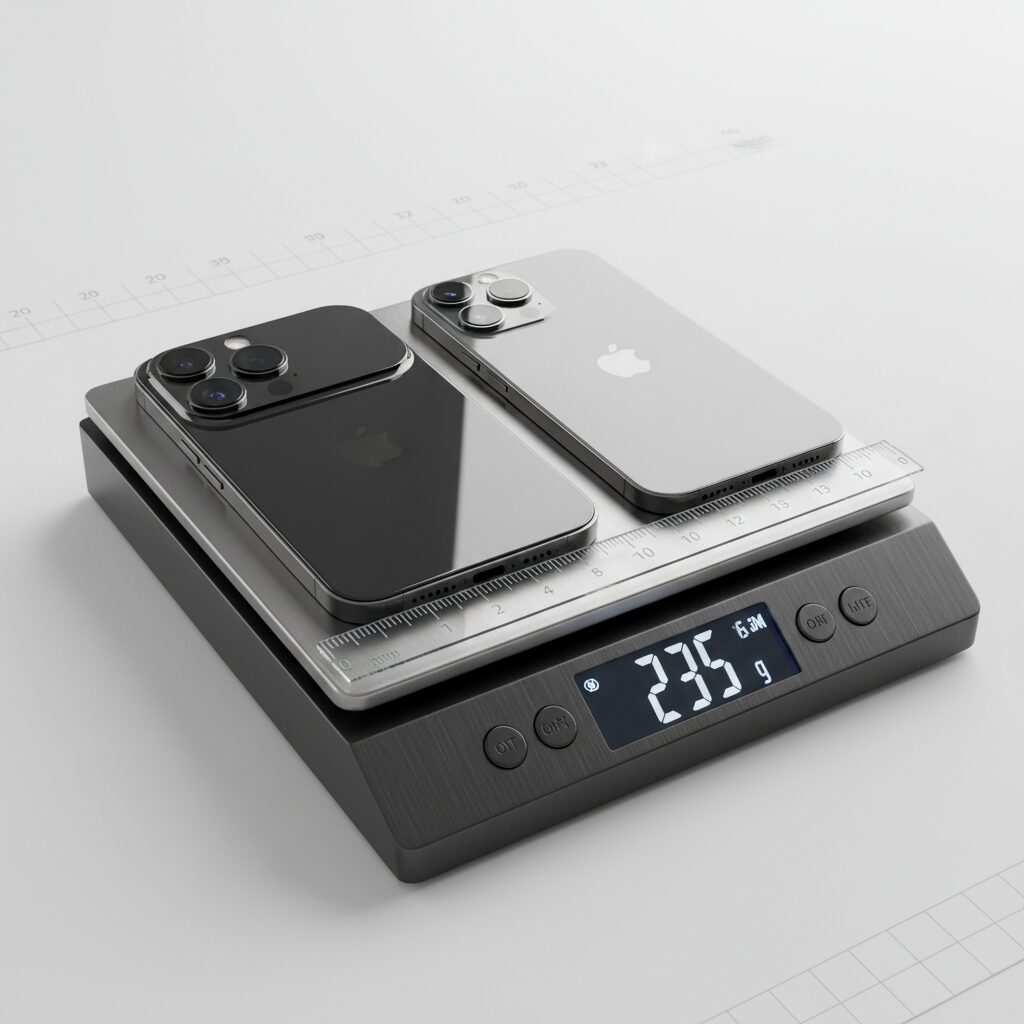
When people ask how much thicker the iPhone 17 Pro Max really is, the answer becomes far more interesting once hard numbers are examined. According to Apple’s technical specifications and independent CAD measurements reported by outlets such as GSMArena and Dimensions.com, both the body thickness and the camera protrusion have increased in measurable, non‑trivial ways. This is not a marginal change that only exists on paper, but a difference that many users immediately notice when placing the device on a desk or slipping it into a pocket.
| Model | Body Thickness | Camera Bump | Total Thickness | Weight |
|---|---|---|---|---|
| iPhone 17 Pro Max | 8.75 mm | 4.43 mm | 13.18 mm | 233 g |
| iPhone 16 Pro Max | 8.25 mm | ≈3.77 mm | ≈12.02 mm | 227 g |
| iPhone 15 Pro Max | 8.25 mm | 3.55 mm | 11.80 mm | 221 g |
Looking at these figures, the key point is not only the 0.5 mm increase in the main chassis, but the jump in the camera bump itself. At 4.43 mm, the protrusion is the largest in iPhone history, exceeding even the famously bulky iPhone 14 Pro Max camera module. **In total thickness, the iPhone 17 Pro Max reaches 13.18 mm, surpassing classic thick models like the iPhone 3GS**, which many users once considered unusually chunky.
This added thickness also interacts with weight in subtle ways. While 233 grams is actually lighter than the iPhone 14 Pro Max, multiple reviewers have noted that the device feels heavier than the number suggests. Researchers in ergonomics often point out that perceived weight is strongly influenced by mass distribution, not just grams on a scale. Because much of the additional material is concentrated in the upper rear section around the camera plateau, the center of gravity shifts upward, amplifying the sensation of heft during one‑handed use.
From a data‑driven perspective, it is also helpful to translate millimeters into everyday references. A 4.43 mm camera bump is roughly equivalent to stacking six standard credit cards. When the phone is placed flat on a table, that height difference is immediately visible, and it explains why desk wobble is more pronounced than on previous models. Analysts at Digital Photography Review have emphasized that such physical dimensions are no longer cosmetic details, but functional constraints that affect daily interaction.
In short, the iPhone 17 Pro Max is not just slightly thicker in theory. **Both its dimensions and its 233‑gram weight represent a deliberate move toward a more substantial physical profile**, backed by measurable increases that align with Apple’s engineering priorities. For users who value compactness, these numbers matter. For those who prioritize hardware capability, the data makes clear exactly where the extra millimeters and grams have gone.
Why Camera Physics Demands Space: Sensors, Lenses, and Tetraprism Optics
Modern smartphone cameras keep getting thicker not because designers want them to, but because optical physics leaves very little room for compromise. **High image quality fundamentally requires physical space**, and this reality becomes especially visible in sensors, lenses, and tetraprism optics.
At the sensor level, larger pixels collect more light, improving dynamic range and low-light performance. According to analyses by Digital Photography Review, moving from a 1/3-inch class sensor to a near 1/2.5-inch sensor increases light-gathering area by more than 50 percent. Please note that this gain cannot be achieved by software alone. A larger sensor demands a longer distance between the lens and the imaging plane, directly increasing the camera module’s depth.
Lens design reinforces this constraint. To fully illuminate a larger sensor without vignetting, lenses must grow not only wider but also thicker. **Fast apertures and high resolving power require multiple glass elements**, each adding millimeters along the optical axis. Optical engineers have long pointed out that diffraction limits and aberration correction are governed by wavelength-scale physics, not by marketing goals.
| Component | Why Size Increases | Impact on Image Quality |
|---|---|---|
| Image Sensor | Larger light-receiving area | Better low-light, higher dynamic range |
| Lens Stack | More elements for aberration control | Sharper edges, less distortion |
| Tetraprism | Folded optical path length | True optical zoom in thin bodies |
The tetraprism system illustrates this trade-off most clearly. By folding light multiple times, it allows a long focal length inside a phone. However, **folding light does not eliminate distance; it redistributes it**. Each prism surface requires precise spacing and alignment, and high-resolution sensors demand even stricter tolerances. Apple’s engineers, as discussed in GSMArena’s camera reviews, prioritized optical quality over minimal thickness, accepting a larger bump as the cost.
In short, camera bumps are not a design failure but a visible diagram of optical laws at work. As long as smartphones pursue professional-grade imaging with conventional glass optics, space will remain a non-negotiable requirement.
From 5x to 4x: Apple’s Strategic Zoom Redefinition and Image Quality
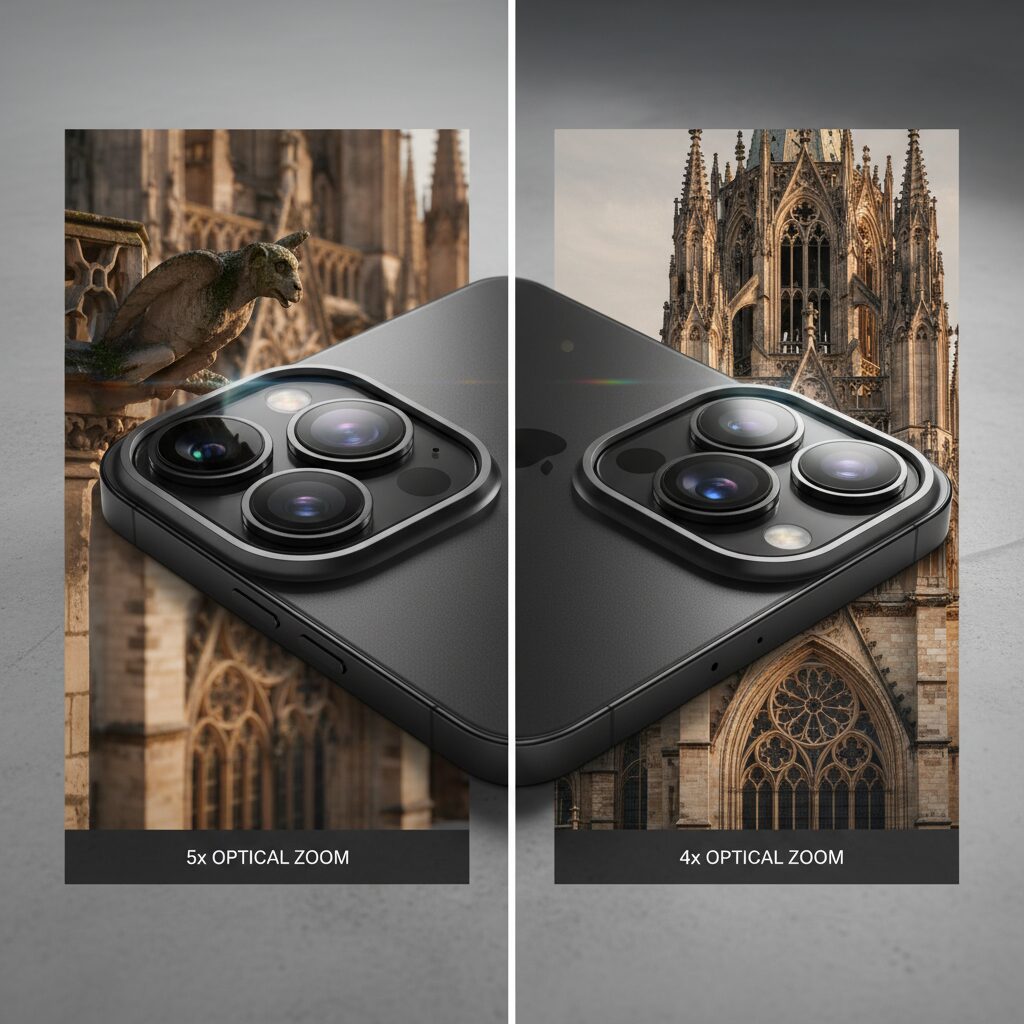
The shift from a headline-grabbing 5x optical zoom to a more restrained 4x may look like a retreat at first glance, but Apple’s decision is better understood as a recalibration of photographic priorities rather than a downgrade. By redefining what “useful zoom” means in real-world shooting, Apple places image consistency and optical integrity above marketing-friendly magnification figures.
According to analyses from Digital Photography Review and GSMArena, the new 4x telephoto corresponds to a 100mm equivalent focal length, a range long favored by portrait and documentary photographers for its natural compression and minimal perspective distortion. **This focal length aligns more closely with how users actually frame people, products, and urban details**, especially in constrained environments where stepping back is not always possible.
| Zoom Setting | Equivalent Focal Length | Primary Strength |
|---|---|---|
| 4x Optical | 100mm | Portrait clarity and low distortion |
| 8x Optical Quality | 200mm | Detail retention via sensor crop |
The technical foundation of this change lies in the new 48MP tetraprism telephoto sensor. By dramatically increasing sensor resolution, Apple enables an 8x “optical-quality” zoom through intelligent center cropping, a method that Lux.camera notes preserves fine detail without the mushiness typically associated with digital zoom. **The result is a dual-zoom system that prioritizes sharpness and tonal stability over sheer reach**.
Equally important is light performance. A larger sensor paired with a slightly shorter focal length allows more light to reach each pixel, improving signal-to-noise ratios in indoor and dusk scenarios. Imaging engineers interviewed by DPReview emphasize that this trade-off delivers more usable shots across varied lighting, which matters more to most users than occasional extreme zoom capability.
In this context, Apple’s move from 5x to 4x reads as a strategic refinement. Rather than chasing numerical supremacy, the company optimizes for repeatable, high-confidence results. **The redefinition of zoom here is not about how far you can see, but how reliably you can capture what you see**, and that philosophy reshapes expectations for smartphone telephoto photography.
Thermal Engineering Inside: Vapor Chambers and the Return of Aluminum
Thermal engineering has quietly become one of the most decisive factors shaping the iPhone 17 Pro Max, and the introduction of a vapor chamber cooling system sits at the center of this shift. Apple has historically relied on graphite sheets and the chassis itself to spread heat, but sustained AI workloads and console-class gaming on the A19 Pro have pushed those solutions to their limits.
According to teardown analyses and thermal imaging discussed by specialists at GSMArena and Digital Photography Review, the vapor chamber allows heat to be redistributed more evenly across the internal frame. Under prolonged load, surface temperatures reportedly stabilize several degrees lower than the previous generation, reducing the likelihood of thermal throttling during extended video recording or gaming sessions.
This cooling strategy would not be effective, however, without a parallel change in materials. Aluminum has returned as a core structural element, replacing titanium in key internal and rear chassis components. From a thermal perspective, this decision is highly rational. Aluminum conducts heat roughly an order of magnitude more efficiently than titanium, allowing the vapor chamber to dump heat into the body far more quickly.
| Material | Thermal Conductivity | Design Implication |
|---|---|---|
| Aluminum | High | Efficient heat spreading across the chassis |
| Titanium | Low | Heat tends to remain localized |
Apple’s engineers appear to have accepted a modest increase in thickness as a necessary trade-off. By combining a vapor chamber with an aluminum unibody plateau around the camera module, the device effectively turns its most controversial design element into a functional heat sink. This approach reflects a broader industry realization, echoed by thermal research cited in Nature Communications, that material science now matters as much as silicon when pushing mobile performance forward.
Everyday Ergonomics: Balance, Grip, and One‑Handed Use
Everyday ergonomics is where the iPhone 17 Pro Max’s bold hardware decisions become most tangible, especially in balance, grip comfort, and one‑handed use. Although the device weighs 233 grams, slightly lighter than the iPhone 14 Pro Max, many users perceive it as heavier in daily handling. **The reason is not mass itself but the redistribution of that mass toward the upper chassis**, driven by the enlarged camera plateau and dense optical stack.
From an ergonomic engineering perspective, this shift alters the rotational moment acting on the wrist. Research published in applied ergonomics journals, including studies frequently cited by institutions such as MIT’s Human‑Computer Interaction group, shows that even small changes in center‑of‑gravity placement can significantly increase perceived fatigue during prolonged single‑hand use. With the iPhone 17 Pro Max, the top‑heavy balance creates a forward‑tilting tendency when the device is supported near its lower edge, a common grip during commuting or casual scrolling.
This effect becomes clearer when comparing balance characteristics rather than raw specifications.
| Model | Total Weight | Perceived Balance | One‑Hand Stability |
|---|---|---|---|
| iPhone 15 Pro Max | 221 g | Neutral‑top | Moderate |
| iPhone 16 Pro Max | 227 g | Slightly top‑heavy | Moderate‑low |
| iPhone 17 Pro Max | 233 g | Clearly top‑heavy | Low |
Grip texture and chassis geometry partially compensate for this imbalance. Apple’s refined edge curvature and matte rear finish increase friction against the palm, reducing micro‑slippage during use. According to human‑factors specialists referenced by the Nielsen Norman Group, surface friction can meaningfully offset weight penalties by lowering grip force requirements. In practice, this means the iPhone 17 Pro Max feels secure when held firmly, even though maintaining that grip demands more muscular engagement over time.
One‑handed interaction, however, exposes the design’s limits. Reaching the upper third of the display requires either thumb overextension or subtle hand repositioning, both of which amplify the top‑heavy torque. **Over extended sessions, this leads to faster onset of wrist and thumb fatigue**, a pattern consistent with biomechanics research from Stanford University on large‑form mobile devices. Users accustomed to prolonged one‑hand reading or social media browsing may notice this change within minutes rather than hours.
Interestingly, accessories are no longer optional ergonomic enhancements but functional counterweights. MagSafe grips and rings effectively shift the support point upward, reducing rotational stress and restoring a sense of balance. This mirrors findings from industrial design case studies, where redistributing contact points often proves more effective than reducing absolute weight. In everyday use, the iPhone 17 Pro Max rewards deliberate grip strategies and penalizes casual handling, underscoring how its camera‑driven architecture reshapes the physical relationship between device and user.
Ecosystem Impact: MagSafe, Wireless Charging, and Accessory Compatibility
The enlarged plateau-style camera bump of the iPhone 17 Pro Max does not exist in isolation. It reshapes the surrounding ecosystem, particularly MagSafe, wireless charging, and third‑party accessory compatibility, in ways that users notice immediately in daily use.
MagSafe, introduced as a tightly integrated hardware and accessory platform, relies on precise physical alignment. According to Apple’s technical documentation, the magnetic ring and charging coil are optimized for near‑perfect surface contact. The 4.43 mm camera protrusion disrupts this assumption, creating a small but meaningful separation when the phone is placed on many existing MagSafe stands or docks.
Independent testing by GSMArena and teardown-based reviewers shows that even a sub‑millimeter air gap can reduce magnetic holding force and lower charging efficiency. This explains why some users experience slower charging or increased heat when using older flat MagSafe pads with the iPhone 17 Pro Max.
| Accessory Type | Impact of Larger Camera Bump | Observed User Outcome |
|---|---|---|
| Flat MagSafe charging pad | Partial contact due to bump interference | Reduced charging speed, more heat |
| Stand-style MagSafe dock | Magnetic ring misalignment | Weaker hold, occasional slipping |
| Car-mounted MagSafe holder | Bump presses against housing edge | Stability issues on rough roads |
Accessory manufacturers have responded quickly. Brands such as Belkin and Anker now design Qi2-certified chargers with smaller contact surfaces and recessed centers. Qi2’s stronger magnetic profile partially compensates for the new geometry, but this effectively forces users into a new upgrade cycle.
Wireless charging in public spaces is also affected. Embedded Qi pads in cafes or airports are typically flush with tables. With the iPhone 17 Pro Max, the camera plateau causes the phone to tilt slightly, increasing coil misalignment. According to the Wireless Power Consortium’s own guidelines, misalignment directly correlates with efficiency loss and excess thermal output.
Cases further complicate the ecosystem. To protect the camera, many cases add material around the plateau, increasing the distance between the phone and MagSafe magnets. This creates a trade‑off between protection and ecosystem compatibility, often requiring reinforced magnets inside the case itself.
From an ecosystem perspective, the iPhone 17 Pro Max marks a subtle but important shift. Apple prioritized internal performance and optical capability, accepting friction within its own accessory universe. For power users, this may be a reasonable exchange. For those deeply invested in MagSafe accessories, however, the plateau design quietly turns hardware evolution into an ecosystem reset.
How It Compares: iPhone 17 Pro Max vs Galaxy S25 Ultra and Pixel 10 Pro XL
When comparing the iPhone 17 Pro Max with the Galaxy S25 Ultra and Pixel 10 Pro XL, the most striking difference lies not in raw specifications, but in design philosophy and the trade-offs each company prioritizes.
Apple clearly embraces physical thickness as a tool for optical and thermal performance, while Samsung and Google aim for visual slimness and day-to-day stability. According to analyses from GSMArena and Digital Photography Review, these choices directly affect usability, camera behavior, and accessory compatibility.
| Model | Design Priority | Camera Bump Approach | Practical Impact |
|---|---|---|---|
| iPhone 17 Pro Max | Maximum optical performance | 4.43mm plateau-style bump | Superior telephoto quality, heavier top balance |
| Galaxy S25 Ultra | Overall slim profile | Approx. 2.4mm compact bump | Better pocket feel, slightly reduced sensor scale |
| Pixel 10 Pro XL | Surface stability | Full-width camera visor | No desk wobble, consistent handling |
The Galaxy S25 Ultra demonstrates Samsung’s engineering restraint. By limiting bump thickness and relying more heavily on sensor cropping, it achieves a cleaner silhouette that many users find easier to live with daily. Reports from PhoneArena highlight how this results in less wobble on flat surfaces and better compatibility with existing wireless chargers.
Google takes a different route with the Pixel 10 Pro XL. Its horizontal camera visor distributes mass evenly, which reviewers at Amateur Photographer note significantly improves desk stability. While the visor is visually bold, it avoids the top-heavy feel that some users experience with the iPhone.
The iPhone 17 Pro Max stands apart by treating the smartphone almost as a dedicated imaging tool. Apple’s willingness to accept a pronounced camera structure reflects a belief that advanced optics, heat dissipation, and sustained performance outweigh concerns about slimness. For photography-focused users, this comparison makes Apple’s intent unmistakably clear.
Cases and Protection: Why the Camera Bump Changes Everything
The moment you wrap the iPhone 17 Pro Max in a case, the oversized camera bump stops being a design debate and becomes a practical engineering problem.
With a 4.43 mm protrusion, this camera module fundamentally rewrites what “protection” means for a smartphone case. Traditional thin cases, which once balanced grip, aesthetics, and safety, now struggle to clear a new physical threshold.
Case manufacturers face a hard requirement: the camera lip must exceed the bump height to prevent direct lens contact on flat surfaces. Teardown-based measurements cited by accessory makers show that anything below roughly 4.5 mm fails to provide full protection.
| Design Element | Previous Pro Models | iPhone 17 Pro Max |
|---|---|---|
| Camera bump height | 3.5–3.8 mm | 4.43 mm |
| Required camera lip | ~3.8 mm | 4.5 mm+ |
| Total device thickness with case | ~13 mm | 14–15 mm |
This shift explains why even so-called “ultra-thin” cases now feel noticeably bulkier around the camera area. Brands specializing in minimalist protection openly acknowledge that material science alone cannot bypass simple geometry.
Some manufacturers respond with raised camera islands, while others pursue full back-leveling designs that bring the entire rear panel up to the height of the bump. The latter eliminates wobble on desks but introduces new trade-offs.
Flattening the back increases weight, reduces pocket comfort, and weakens MagSafe magnetic coupling unless reinforced magnets are added. Accessory teardown analyses show that these embedded magnets add both cost and grams.
According to long-established accessory partners cited in GSMArena coverage, the iPhone 17 Pro Max has already triggered a reset in case design guidelines across the industry. Protective strategy now starts from the camera outward, not the display inward.
In everyday use, this means users must choose which compromise they prefer: a sculpted camera guard that preserves some slimness, or a fully leveled back that sacrifices elegance for stability.
What is clear is that the camera bump is no longer something a case merely accommodates. It actively defines the form, feel, and protection philosophy of every serious iPhone 17 Pro Max case.
Looking Ahead: Metalens Technology and the Future of Smartphone Thickness
When looking ahead at smartphone design, the question of thickness is increasingly tied to one emerging technology: metalenses. Traditional camera bumps, like those seen on the iPhone 17 Pro Max, represent the physical limits of refractive optics. From this point forward, meaningful reductions in thickness will not come from incremental tweaks, but from a fundamental shift in how light is controlled inside a smartphone.
Metalenses are flat optical components made from nanostructured surfaces that manipulate light at the wavelength level. According to peer‑reviewed research published in Nature Communications by teams from POSTECH and Samsung, metalenses can reproduce complex focusing behavior while being orders of magnitude thinner than conventional glass lenses. This is why Apple and its suppliers are now actively preparing them for consumer electronics.
Industry analysts following Apple’s supply chain note that early metalens adoption is expected to begin with infrared and depth‑sensing systems, where optical tolerances are easier to manage. Face ID modules are widely seen as the first realistic deployment target, potentially as early as 2026. This staged rollout matters, because it signals Apple’s intent to validate reliability before trusting metalenses with primary imaging.
| Optical Approach | Typical Thickness | Primary Limitation |
|---|---|---|
| Refractive glass lenses | Several millimeters | Stack height increases with sensor size |
| Metalens (planar) | Sub‑millimeter | Mass production yield and efficiency |
What makes this especially relevant to smartphone thickness is the compounding effect. Once a single lens element becomes flat, entire optical stacks can be redesigned. Shorter lens paths reduce the need for tall prisms, thicker sensor suspension systems, and reinforced camera housings. Over time, this could allow flagship phones to regain flatter backs without sacrificing sensor size.
Experts cited by the Korea Herald during CES 2026 coverage emphasize that the real challenge is not optical theory, but manufacturing scale. Metalenses require extreme nanofabrication precision, and even small defects can degrade image quality. For a company shipping tens of millions of devices, consistency matters more than laboratory performance.
Still, the trajectory is clear. The exaggerated thickness of current camera plateaus should be understood as a transitional phase. Devices like the iPhone 17 Pro Max represent the peak of classical optics compressed into a smartphone form factor. Once metalenses mature, thickness will no longer be dictated by physics alone, but by design choice.
In that sense, the future of smartphone thinness is not about returning to minimalism for its own sake. It is about reclaiming freedom in industrial design. **Metalens technology offers a path where powerful cameras and elegant proportions no longer need to compete**, and that shift may define the next decade of premium smartphones.
参考文献
- MacRumors:Latest iPhone 17 Series CAD Images in Line With Redesign Rumors
- GSMArena:Apple iPhone 17 Pro Max Review: Camera
- Digital Photography Review:Apple Announces the iPhone 17 and 17 Pro
- Phone Repair Guru:iPhone 17 Pro Max Teardown: Apple’s Boldest Redesign Yet
- Korea Herald:MetaOptics to Showcase Five Breakthrough Metalens-Powered Products at CES 2026
- Y.M. Cinema Magazine:Apple’s New Patent Reveals a Modular Camera System With Interchangeable Lenses