If your wireless earbuds, keyboard, or car audio system suddenly disconnect in 2026, you are not alone. Many users across the globe are experiencing unstable Bluetooth connections even with the latest flagship devices.
What used to be a simple issue of distance or interference has evolved into something far more complex. Bluetooth 6.0, Wi‑Fi 7, advanced audio codecs, and new auto‑pairing features are pushing wireless technology to its limits, sometimes exposing weaknesses in operating systems, drivers, and even security design.
In this article, you will discover why Bluetooth instability is increasing in 2026, how next‑generation standards like Channel Sounding and Multi‑Link Operation interact behind the scenes, what recent vulnerabilities mean for your privacy, and what practical steps you can take to regain a stable, secure connection.
- The 2026 Wireless Turning Point: Bluetooth 6.0 Meets Wi‑Fi 7
- Why 2.4GHz Is More Crowded Than Ever: Spectrum Saturation and Urban Device Density
- Adaptive Frequency Hopping vs. Wi‑Fi 7 MLO: When Coexistence Breaks Down
- Bluetooth 6.0 Channel Sounding: Precision Ranging and Unexpected Instability
- ISOAL, LE Audio, and the Fragility of Low‑Latency Streaming
- Android 16 and iOS 26.1: OS-Level Bluetooth Stack Failures in the Real World
- WhisperPair and Fast Pair Exploits: When Disconnections Signal a Security Attack
- Airoha Chipset Vulnerabilities: How Firmware Flaws Can Force Dropouts
- High-Bitrate Codecs Like LDAC and HDT: The Stability vs. Sound Quality Trade-Off
- Professional Environments and Live Events: Why Experts Still Distrust Bluetooth
- X-Cast and Cross-Technology Coordination: A Glimpse of a More Stable Future
- Advanced Troubleshooting Strategies for 2026 Devices
- 参考文献
The 2026 Wireless Turning Point: Bluetooth 6.0 Meets Wi‑Fi 7
2026 marks a structural turning point in wireless connectivity. With Bluetooth 6.0 entering flagship devices and Wi‑Fi 7 becoming mainstream in homes and enterprises, users are experiencing a new reality: cutting-edge speed and precision on one hand, and unexpected instability on the other.
The coexistence model that worked in the Wi‑Fi 5/6 era is now under visible strain. Bluetooth still operates primarily in the 2.4GHz band, transmitting at very low power levels typically between 1 and 10mW. In contrast, Wi‑Fi 7 introduces Multi‑Link Operation (MLO), which can simultaneously utilize 2.4GHz, 5GHz, and 6GHz bands for aggregated throughput, as explained by Qualcomm.
This asymmetry in power and bandwidth allocation is redefining how interference behaves in real environments.
| Technology | Primary Bands | Key 2026 Feature | Impact on Coexistence |
|---|---|---|---|
| Bluetooth 6.0 | 2.4GHz | Channel Sounding (±20cm ranging) | Higher timing sensitivity |
| Wi‑Fi 7 | 2.4/5/6GHz | Multi‑Link Operation | Longer 2.4GHz airtime occupancy |
Bluetooth 6.0’s flagship innovation, Channel Sounding, combines phase-based ranging and round-trip time measurements to achieve distance accuracy of approximately ±20cm, according to Embedded and Novel Bits. While this enables secure fine-ranging for smart locks, asset tracking, and spatial computing, it also makes connections more timing‑critical. Even minor multipath reflections or processing delays inside low-cost devices can introduce ranging errors, which may translate into stricter link termination when distance thresholds are exceeded.
At the same time, Wi‑Fi 7’s MLO increases packet density in 2.4GHz environments. When Wi‑Fi traffic remains active longer in this shared band, Bluetooth’s Adaptive Frequency Hopping has fewer clean channels to escape to. Reports in dense urban deployments indicate that Bluetooth backoff times can grow long enough to hit protocol timeouts.
Security dynamics also shift at this turning point. Research highlighted by major technology media outlets shows vulnerabilities such as WhisperPair affecting Fast Pair implementations, allowing attackers within roughly 14 meters to disrupt and hijack connections. What appears to users as a random disconnect may in fact be an intentional interference exploiting pairing logic.
Industry analysts cited in 2026 Wi‑Fi market forecasts describe this phase as a transitional coexistence crisis. Performance ceilings are rising dramatically, yet cross‑technology coordination mechanisms remain immature outside research prototypes like IEEE’s X‑Cast.
The convergence of Bluetooth 6.0 precision and Wi‑Fi 7 throughput creates extraordinary potential. However, it also exposes how fragile shared spectrum becomes when every millisecond and every megahertz are contested.
Why 2.4GHz Is More Crowded Than Ever: Spectrum Saturation and Urban Device Density

The 2.4GHz band has become the most contested airspace in modern cities. Bluetooth, Wi-Fi, smart home hubs, game controllers, wearables, and industrial IoT sensors all compete within the same narrow spectrum. As device density accelerates in 2026, spectrum saturation is no longer theoretical—it is measurable in everyday packet collisions and latency spikes.
Bluetooth operates at extremely low transmission power, typically around 1–10mW. According to industry technical guidance, this design preserves battery life but makes signals highly sensitive to environmental congestion. In dense urban apartments where dozens of routers and hundreds of personal devices coexist, the probability that multiple devices attempt transmission simultaneously rises dramatically.
| Interference Source | Mechanism | Urban Impact |
|---|---|---|
| Wi-Fi 7 (2.4GHz) | Wide-channel occupancy | Bluetooth backoff delays |
| Smart Home Devices | Persistent beaconing | Channel crowding |
| Human Body (Water) | Signal absorption | RSSI fluctuation |
| Metal Structures | Reflection / multipath | Packet error bursts |
Qualcomm’s documentation on Wi-Fi 7 explains that Multi-Link Operation can actively utilize the 2.4GHz band alongside 5GHz and 6GHz. While this improves throughput, it increases airtime occupancy. Bluetooth’s Adaptive Frequency Hopping attempts to avoid busy channels, but in high-density buildings there are fewer “clean” channels available. When every channel appears busy, hopping becomes less effective.
Urban device density compounds the issue. A single residential tower may contain thousands of active radios. Each router emits periodic beacons, IoT sensors transmit telemetry, and smartphones constantly scan for connections. Research into cross-technology coexistence, such as the IEEE-proposed X-Cast framework, demonstrates that lack of coordination between protocols directly reduces packet reception rates under congestion.
Physical barriers further intensify instability. The 2.4GHz frequency is particularly susceptible to absorption by water—meaning the human body itself attenuates signals. When a smartphone is placed in a back pocket and earbuds are used outdoors, subtle body shielding can reduce received signal strength below stable thresholds. In crowded commuter trains, the effect multiplies due to surrounding bodies and metallic structures.
Electronic appliances add episodic noise. Microwave ovens emit broadband interference when active, sometimes overwhelming low-power Bluetooth transmissions entirely. In small apartments, this can momentarily resemble a complete connection failure.
The result is a structural imbalance: Bluetooth was engineered for low-power, short-range reliability in moderately shared environments, yet it now operates inside hyper-dense radio ecosystems. As spectrum demand grows faster than new frequency allocations, the 2.4GHz band becomes a bottleneck rather than a convenience layer. For gadget enthusiasts in metropolitan areas, understanding this saturation is essential to diagnosing why connections feel less stable than ever.
Adaptive Frequency Hopping vs. Wi‑Fi 7 MLO: When Coexistence Breaks Down
Adaptive Frequency Hopping(AFH)は、Bluetoothが2.4GHz帯で生き残るための中核技術です。79チャネルを高速に切り替えながら、干渉の強い周波数を自動的に回避します。しかし、Wi‑Fi 7のMulti‑Link Operation(MLO)が本格普及した2026年、この前提が揺らぎ始めています。
AFHは「空いている隙間がある」ことを前提に最適化されています。一方でMLOは、2.4GHz・5GHz・6GHzを束ねて同時通信し、トラフィックを動的に振り分けます。問題は、2.4GHz帯が補助リンクとして常時アクティブ化されるケースが増えている点です。
AFHは回避型、MLOは同時占有型です。この設計思想の違いが、共存の限界を生み出します。
QualcommのWi‑Fi 7技術解説によれば、MLOはリンク間での低遅延切り替えとスループット最大化を目的としています。その結果、2.4GHz帯でもWi‑Fiフレームの滞留時間が長くなる傾向があります。Bluetooth側は送信前にチャネル使用状況を監視しますが、利用可能と判断できる時間窓が極端に短くなると、バックオフが連続します。
| Technology | Spectrum Strategy | Impact on 2.4GHz |
|---|---|---|
| Bluetooth (AFH) | Interference-aware channel hopping | Relies on idle micro-slots |
| Wi‑Fi 7 (MLO) | Simultaneous multi-band aggregation | Keeps auxiliary links active |
このとき、Bluetoothのタイムアウト値を超えるとリンクは再確立プロセスに入ります。ユーザーからは「一瞬の無音」や「接続が切れた」と認識されますが、実際には送信機会の枯渇が原因です。
さらに厄介なのが、Preamble Puncturingの実装差です。理論上は干渉帯域を避けられますが、低価格ルーターではBluetoothのホッピングを広帯域ノイズと誤検知し、出力を強める挙動が報告されています。これによりAFHが選べるチャネルが実質的に圧縮されます。
IEEEで報告されたX‑Cast研究では、異種無線間で使用チャネル情報を共有することでBluetoothのパケット受信率が最大18%改善しました。裏を返せば、情報共有がない現行環境では、その分の損失が起き得ることを示唆しています。
特にLDACやHDTのような高ビットレート通信では、再送余地が小さくなります。AFHが数チャネルしか使えない状態では、わずかな衝突が致命的になります。MLO環境下では、高音質設定ほど切断リスクが上がるという逆説が生じます。
結局のところ、共存が破綻する瞬間は「干渉が強いとき」ではありません。2.4GHz帯が断続的ではなく、ほぼ常時占有状態になったときです。そのときAFHは逃げ場を失い、設計上想定された柔軟性を発揮できなくなります。
Wi‑Fiを5GHzや6GHz中心に固定し、2.4GHzリンクを無効化できる環境では状況は改善します。しかし、デフォルト設定のままでは、AFHとMLOは理論上共存可能でも、実装次第でバランスが崩れやすいのが2026年の現実です。
Bluetooth 6.0 Channel Sounding: Precision Ranging and Unexpected Instability
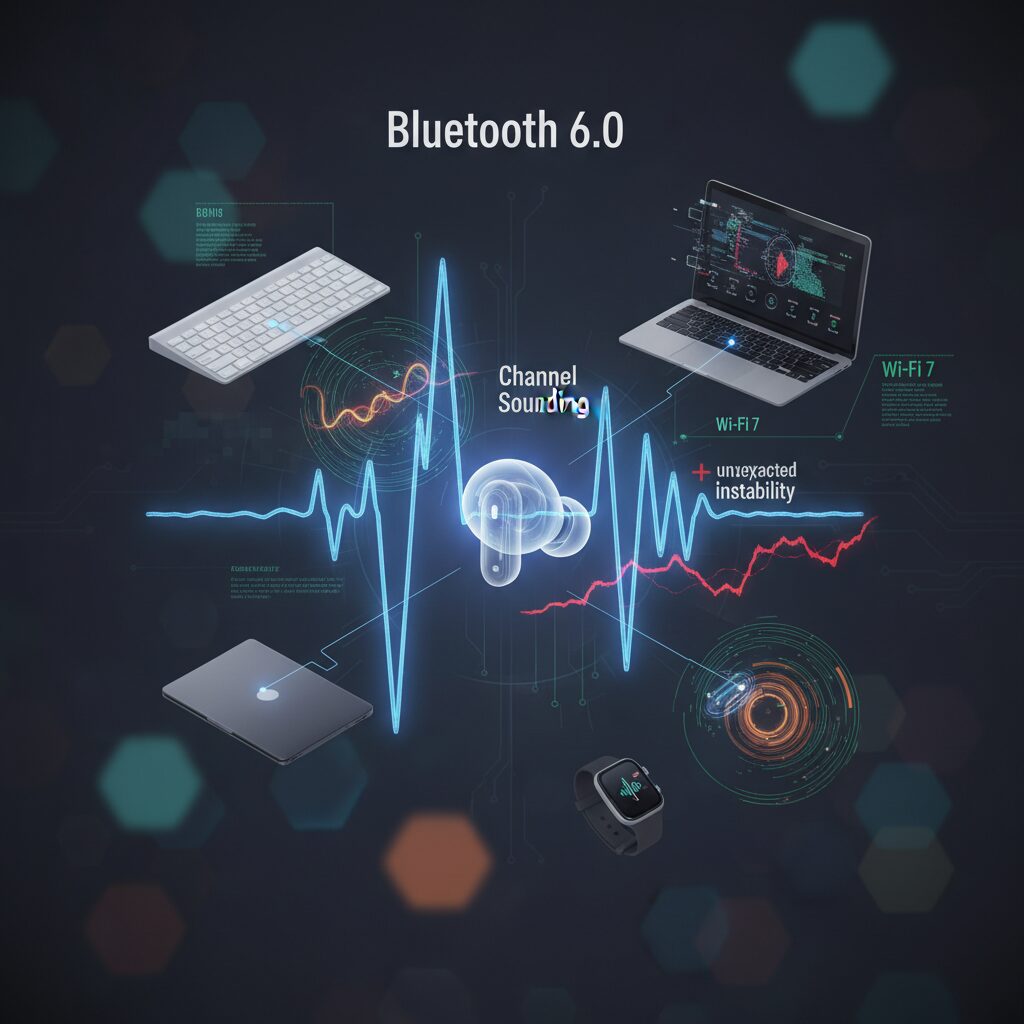
Bluetooth 6.0 introduces Channel Sounding as its flagship capability, promising centimeter-level ranging accuracy that fundamentally changes how devices understand spatial relationships.
By combining Phase-Based Ranging (PBR) and Round-Trip Time (RTT) measurements, the standard targets accuracy of approximately ±20 cm under ideal conditions, as outlined by industry analyses such as Embedded and Novel Bits.
For gadget enthusiasts, this means earbuds that know exactly which phone is closest, smart locks that verify proximity, and trackers that respond with unprecedented precision.
At its core, RTT relies on the physics of signal propagation.
Because radio waves travel at the speed of light, distance can be estimated by measuring the time difference between transmission and reception across devices.
However, real-world silicon rarely behaves like textbook equations.
| Measurement Method | Principle | Main Error Source |
|---|---|---|
| RTT | Time-of-flight calculation | Clock offset, processing delay |
| PBR | Phase difference across channels | Multipath, antenna orientation |
According to technical commentary from Silicon Labs and Qiita engineering analyses, group delay variations inside RF front-ends introduce subtle but cumulative timing offsets.
Even nanosecond-level discrepancies can translate into tens of centimeters of ranging error.
When ranging accuracy degrades, connection logic built on strict distance thresholds can trigger unexpected disconnections.
This is where precision turns paradoxical.
Earlier Bluetooth versions tolerated ambiguous proximity because they relied primarily on RSSI, a relatively coarse signal strength indicator.
Bluetooth 6.0, in contrast, makes binary decisions based on calculated spatial certainty.
If a device determines that its peer has crossed a predefined boundary, pairing maintenance policies may respond aggressively.
In dense indoor spaces filled with reflections from metal surfaces, multipath propagation rotates signal phase unpredictably.
The result is distance “jitter” even when devices are physically stationary.
Single-antenna budget devices are especially vulnerable.
As noted in developer kit evaluations from Silicon Labs, antenna null points can form depending on orientation.
In such cases, phase measurements fluctuate dramatically, producing ranging spikes at close range.
Users may perceive this as random dropouts while holding two devices only centimeters apart.
In reality, destructive interference is distorting the phase model that Channel Sounding depends on.
The algorithm interprets corrupted phase data as spatial inconsistency rather than mere interference.
Another structural factor is coexistence with Wi-Fi 7.
Qualcomm’s documentation on Multi-Link Operation explains how extended occupancy in the 2.4 GHz band can increase Bluetooth backoff time.
When Channel Sounding sequences require tightly timed exchanges, prolonged channel contention undermines synchronization.
Missed timing windows force retries.
Retries increase latency.
Excessive latency can cause higher-layer supervision timeouts.
Thus, instability is not always a raw RF failure but a cascading protocol effect.
LitePoint’s industry outlook highlights that advanced features such as Channel Sounding and High Data Throughput push the BLE stack closer to its timing margins.
The more deterministic the ranging logic becomes, the less tolerant the system is to environmental randomness.
Security layers add further complexity.
Secure fine-ranging procedures require cryptographic exchanges intertwined with measurement packets.
If packet integrity checks fail due to phase distortion or timing drift, the session may be invalidated.
From a user’s perspective, this manifests as “Bluetooth keeps disconnecting.”
From a systems perspective, it is a failed secure ranging handshake triggered by borderline RF conditions.
This distinction matters when diagnosing 2026-era devices.
In controlled lab environments with calibrated antennas and minimal multipath, Channel Sounding performs remarkably well.
But in apartments crowded with routers, metal furniture, and human bodies that absorb 2.4 GHz energy, phase coherence becomes fragile.
The promise of centimeter precision collides with the entropy of everyday physics.
For power users, practical mitigation includes maintaining line-of-sight positioning and minimizing body obstruction between devices.
Small orientation adjustments can stabilize phase readings significantly.
In a technology designed to measure space precisely, spatial awareness from the user side suddenly becomes part of the stability equation.
ISOAL, LE Audio, and the Fragility of Low‑Latency Streaming
Low‑latency wireless audio in 2026 is built on two pillars: ISOAL and LE Audio. Both promise tighter synchronization and lower delay, but in real‑world environments they also expose how fragile modern streaming stacks have become.
ISOAL, the Isochronous Adaptation Layer introduced and expanded with Bluetooth 6.0, sits between the upper audio layers and the controller. Its job is to fragment large audio frames into isochronous packets and reassemble them on the receiving side with strict timing guarantees.
According to technical analyses by Argenox and LitePoint, ISOAL enables more deterministic transport for time‑sensitive data such as voice and multistream audio. However, this comes at the cost of increased dependency on precise scheduling, buffer management, and clock accuracy.
When network jitter exceeds the tolerated window, reassembly fails to complete in time. Instead of gradual degradation, users experience abrupt dropouts or full disconnections because isochronous streams are not designed for indefinite retransmission.
| Layer | Role in LE Audio | Failure Impact |
|---|---|---|
| ISOAL | Fragment/reassemble isochronous PDUs | Buffer underrun, stream drop |
| Controller | Schedule isochronous events | Missed time slot, timeout |
| LC3 Codec | Efficient audio compression | Audio artifact before mute |
LE Audio, powered by the LC3 codec, was designed to be more efficient than classic SBC while maintaining quality at lower bitrates. The Bluetooth SIG and industry testing bodies have emphasized its robustness under constrained bandwidth.
Yet efficiency does not mean immunity. LC3’s resilience relies on timely packet delivery. In dense 2.4GHz environments or under Wi‑Fi 7 Multi‑Link Operation pressure, even small scheduling delays can cascade into audible glitches.
The paradox is clear: the lower the latency target, the smaller the tolerance for instability. Traditional buffering strategies that masked interference in legacy A2DP are less effective in tightly synchronized LE Audio broadcasts.
This fragility becomes even more visible in Auracast and multistream scenarios. When a single source transmits synchronized audio to multiple receivers, clock drift or packet loss affecting one branch can force resynchronization events that momentarily interrupt playback.
Engineers note that OS‑level power management also interacts with ISOAL timing. Aggressive sleep states or delayed interrupt handling can shift isochronous event timing just enough to trigger controller‑level timeouts.
In practice, low‑latency streaming today depends not only on codec choice but on end‑to‑end timing integrity: RF coexistence, firmware scheduler precision, and driver stability. As LE Audio adoption accelerates, users gain impressive responsiveness—but they also operate closer to the physical and architectural limits of Bluetooth.
Android 16 and iOS 26.1: OS-Level Bluetooth Stack Failures in the Real World
By early 2026, Bluetooth instability has increasingly shifted from radio interference to OS-level stack failures. Android 16 and iOS 26.1 illustrate how deeply integrated wireless subsystems can fail when driver layers, power management, and coexistence logic fall out of sync.
What makes this wave of issues different is that users report failures even in low-interference environments. The root cause is not always spectrum congestion, but breakdowns inside the operating system’s Bluetooth framework, hardware abstraction layer, and firmware coordination.
Android 16: Driver Deadlocks and Radio Collapse
| Symptom | Suspected Layer | Reported Devices |
|---|---|---|
| Bluetooth/Wi-Fi toggle loop | Driver-level deadlock | Pixel 8 Pro, Pixel Fold |
| 30-second BLE drops | Doze power policy conflict | Xiaomi 14, Huawei models |
| Settings app blackout | System UI stack crash | Multiple Android 16 builds |
According to user reports on Google’s official support forums and developer discussions, certain Android 16 builds triggered a “Critical Failure” where both Wi-Fi and Bluetooth radios became non-functional. The issue appears tied to resource contention in the driver layer, causing the radio firmware to enter a non-recoverable state.
In practical terms, users attempting to enable Bluetooth encounter a looping animation followed by a settings crash. Because the fault occurs below the application layer, resetting network settings often does not resolve the issue. Only a full device reboot temporarily restores radio functionality, suggesting a lower-level stack lock rather than an application bug.
Developers have experimented with disabling A2DP hardware offload or downgrading AVRCP versions via developer options. These workarounds sometimes stabilize audio connections, but they do not eliminate the systemic driver instability introduced in specific Android 16 updates.
iOS 26.1: CarPlay and Multi-Radio Handoff Failures
Apple’s ecosystem has not been immune. After the iOS 26.1 update, numerous users reported repeated Bluetooth disconnections, particularly with wireless CarPlay. Posts on Apple’s community forums indicate that connections drop roughly 10 minutes into a session.
The likely trigger involves coordination failures between Bluetooth and Wi-Fi during CarPlay’s wireless session management. Because wireless CarPlay relies on both protocols, any misalignment in handoff timing or VPN-level packet inspection can destabilize the link. The failure is not a simple pairing issue but a cross-stack synchronization problem.
Unlike classic interference, these issues occur even in controlled in-car environments. This reinforces that modern Bluetooth reliability increasingly depends on how the OS orchestrates coexistence logic, security policies, and background network services.
As wireless subsystems grow more integrated, a minor regression in driver scheduling or radio arbitration can cascade into total connectivity loss. For advanced users and developers, monitoring OS build notes and firmware revisions has become just as important as checking signal bars.
Android 16 and iOS 26.1 demonstrate that the next frontier of Bluetooth reliability is not only hardware or spectrum management, but robust, fail-safe OS stack design.
WhisperPair and Fast Pair Exploits: When Disconnections Signal a Security Attack
When your earbuds suddenly disconnect, it is easy to blame interference or low battery. However, in 2026, repeated and unexplained disconnections can signal something far more serious: an active security attack exploiting auto‑pairing mechanisms.
In particular, vulnerabilities known as WhisperPair have exposed structural weaknesses in Google’s Fast Pair ecosystem. Designed for frictionless onboarding, Fast Pair prioritizes speed and convenience. That very design choice has created an unexpected attack surface.
If your audio cuts out without moving, without low battery, and without visible interference, you should consider the possibility of a hijack attempt rather than a simple glitch.
According to reporting by The Indian Express and security analyses cited by CNET, researchers demonstrated that an attacker within approximately 46 feet, or 14 meters, could interfere with a legitimate Fast Pair session in as little as 15 seconds. The technique involves disrupting the authentic connection and inserting a malicious device in its place.
From the user’s perspective, the symptoms look deceptively ordinary. Music stops. The device shows “disconnected.” A reconnection prompt appears. Behind the scenes, however, the attacker may have already established a rogue pairing channel.
| Stage | What the User Sees | What May Be Happening |
|---|---|---|
| Signal Disruption | Sudden audio drop | Legitimate session forcibly interrupted |
| Reconnection Prompt | Fast Pair pop-up | Malicious device advertises itself |
| Repaired State | Audio resumes | Traffic potentially routed via attacker |
The risk is not theoretical. Security researchers have shown that compromised sessions may allow microphone eavesdropping or location tracking if permissions are abused. Because Fast Pair relies on streamlined authentication flows, users often approve reconnection prompts without scrutiny.
A parallel concern involves Airoha chipsets used in millions of earbuds. As reported by cybersecurity outlets covering CVE-2025-20700 through 20702, an exposed RACE debug protocol allowed nearby attackers to access sensitive functions without proper authentication. In practice, this can mean forced disconnection followed by device impersonation.
What makes these exploits particularly dangerous is their subtlety. Unlike ransomware or visible malware, WhisperPair-style attacks mimic everyday instability. In dense public spaces such as airports or cafés, a targeted disruption blends seamlessly into normal wireless chaos.
For security-conscious users, behavioral awareness is critical. Repeated disconnects in the same physical location, unexpected pairing requests, or device name changes should be treated as red flags. Keeping firmware updated is essential, as several vendors, including Google and JBL, have already distributed patches.
Ultimately, in the Fast Pair era, convenience and exposure scale together. When disconnections become patterned rather than random, they may not be noise in the spectrum. They may be someone knocking on your wireless door.
Airoha Chipset Vulnerabilities: How Firmware Flaws Can Force Dropouts
Airoha chipsets power tens of millions of true wireless earbuds, making them a silent backbone of the 2026 audio market. However, vulnerabilities discovered in the RACE debugging protocol (CVE-2025-20700 to CVE-2025-20702) have revealed how firmware-level flaws can directly trigger forced Bluetooth dropouts rather than mere data leaks.
Unlike conventional interference, these flaws operate inside the device’s control plane. Security researchers reported that the RACE protocol interface was accessible without proper authentication, allowing nearby attackers to interact with internal commands that were originally intended for factory diagnostics.
When firmware debug channels remain exposed in production devices, attackers can forcibly terminate active sessions, extract encryption keys, and reinitiate connections under false identities.
The attack chain is structurally simple but technically severe. An adversary within Bluetooth range can first disrupt the legitimate connection, then extract pairing material, and finally impersonate the earbuds to the smartphone. From the user’s perspective, this appears as a sudden audio stop or repeated reconnection loop.
| Stage | Technical Action | User-Visible Effect |
|---|---|---|
| 1. Injection | Unauthorized RACE command access | Momentary audio glitch |
| 2. Key Extraction | Retrieval of stored encryption material | Connection drop |
| 3. Impersonation | Device spoofing and reconnection | Unexpected pairing behavior |
According to cybersecurity reporting in early 2026, affected brands include products built on Airoha reference designs across multiple global audio manufacturers. Because the chipset is embedded at the silicon level, remediation depends heavily on firmware updates distributed by each vendor.
What makes this particularly damaging is the relationship between forced dropouts and Bluetooth security logic. Modern stacks interpret abrupt link termination as interference or low RSSI. As a result, devices automatically retry pairing, which ironically provides additional handshake opportunities for attackers exploiting exposed firmware endpoints.
In dense urban environments already saturated with 2.4 GHz traffic, these malicious disconnects can be indistinguishable from environmental instability. This ambiguity delays detection and allows repeated session hijacking attempts without raising immediate suspicion.
The core issue is not radio weakness but firmware trust boundaries that were never meant to be reachable in consumer deployments. Debug interfaces left open for manufacturing efficiency have become operational liabilities at scale.
For advanced users, ensuring earbuds receive the latest firmware patches is essential. Vendors that have closed RACE access channels through signed firmware updates significantly reduce exploitability. Without those patches, however, dropouts may not be random glitches but symptoms of structural security exposure inside the chipset itself.
High-Bitrate Codecs Like LDAC and HDT: The Stability vs. Sound Quality Trade-Off
High-bitrate Bluetooth codecs such as LDAC and the emerging High Data Throughput (HDT) profile promise near-wired audio quality, but they also expose the fragile side of wireless communication. As throughput increases, tolerance for interference decreases. In dense 2.4GHz environments shaped by Wi-Fi 7 and Bluetooth 6.0 coexistence challenges, this trade-off becomes impossible to ignore.
According to LitePoint’s analysis of next-generation Bluetooth evolution, higher data throughput modes significantly tighten packet timing requirements. This means retransmission windows shrink, and even micro-level interference can cascade into audible dropouts. What sounds like “better audio” on paper often translates into “less stability” in real-world conditions.
| Codec | Max Bitrate (Approx.) | Stability Tolerance | Typical Failure Pattern |
|---|---|---|---|
| SBC | ~328 kbps | High | Gradual quality loss before disconnect |
| LDAC (Quality Mode) | ~990 kbps | Low | Frequent stutter, sudden silence |
| LC3 (LE Audio) | ~400 kbps | Medium–High | Efficient recovery via retransmission |
| HDT | Up to ~4 Mbps | Very Low | Strict RF conditions required |
The core issue is spectral pressure. In 2026, Wi-Fi 7’s Multi-Link Operation frequently occupies 2.4GHz alongside 5GHz and 6GHz bands. Qualcomm’s technical documentation on Wi-Fi 7 explains how wider channel utilization increases airtime competition. When LDAC runs at 990 kbps in “sound quality priority” mode, it consumes far more airtime than SBC, leaving minimal margin for collision recovery.
Higher bitrate means larger payloads per unit time, which directly increases the probability that interference results in unrecoverable packet loss. Unlike SBC, which degrades more gracefully, LDAC often collapses abruptly because buffering thresholds are exceeded.
HDT amplifies this structural tension. Designed to push throughput toward multi-megabit territory, HDT assumes extremely clean RF environments. In controlled lab conditions, this works. In urban apartments saturated with IoT devices, it does not. Even minor body absorption—human tissue significantly attenuates 2.4GHz signals—can shift RSSI just enough to destabilize a high-bitrate stream.
Interestingly, LC3 under LE Audio demonstrates a different philosophy. Rather than maximizing raw bitrate, it emphasizes coding efficiency and robust retransmission. This reflects a broader industry shift: sustainable audio quality may depend more on resilience than on peak throughput.
For enthusiasts, the practical takeaway is clear. Use LDAC or HDT in low-interference scenarios such as desk listening with line-of-sight device placement. In crowded transport hubs or Wi-Fi-dense offices, switching to adaptive bitrate or LC3-based modes often produces a subjectively better experience despite lower nominal resolution.
The stability versus sound quality trade-off is not a flaw of Bluetooth—it is a mathematical reality of shared spectrum physics. As bandwidth ambitions grow, so does fragility. Understanding this relationship allows you to choose intentionally, rather than blaming random dropouts on “bad luck.”
Professional Environments and Live Events: Why Experts Still Distrust Bluetooth
In professional environments and live events, reliability is not a preference but a contractual obligation. A single audio dropout during a keynote, broadcast, or concert can translate directly into financial loss and reputational damage. That is why many engineers still hesitate to rely on Bluetooth, even in 2026 when Bluetooth 6.0 promises higher precision and throughput.
In large venues, the 2.4GHz spectrum becomes a battlefield. Bluetooth operates at low power, typically 1–10mW, and must compete with thousands of smartphones, Wi‑Fi 7 access points, and IoT devices. As discussed in professional audio communities such as r/livesound, engineers often describe Bluetooth in crowded halls as “a gamble” because spectrum congestion is unpredictable and uncontrollable from the stage side.
| Environment | Primary Risk | Impact on Bluetooth |
|---|---|---|
| Concert hall (2,000+ attendees) | Dense 2.4GHz traffic | Packet collisions, audio dropouts |
| Trade show floor | Multiple Wi‑Fi 7 MLO links | Backoff delays, timeout disconnects |
| Broadcast studio | Metal structures, RF reflections | Multipath fading, unstable RSSI |
For in‑ear monitoring (IEM) systems used by performers, latency and stability are critical. Even tens of milliseconds of unexpected delay or a brief mute can disrupt timing. While Bluetooth LE Audio and ISOAL improvements aim to stabilize isochronous streams, they still depend on shared spectrum conditions. In contrast, professional RF systems often use dedicated frequency coordination and higher transmission power, reducing exposure to consumer device interference.
Security concerns further deepen distrust. Research reported by major media outlets highlighted vulnerabilities such as WhisperPair, where attackers within roughly 14 meters could hijack Fast Pair connections. In a live production setting, the mere possibility of unauthorized audio interception or forced disconnection is unacceptable. Security uncertainty becomes an operational risk, not just a technical flaw.
Wi‑Fi 7 adds another layer of complexity. Qualcomm explains that Multi‑Link Operation can aggregate multiple bands simultaneously. When 2.4GHz is actively used for throughput optimization, Bluetooth devices may experience extended backoff periods. In a controlled office this might mean a brief glitch. On a live stage, it can mean silence in front of thousands.
Emerging coexistence research such as IEEE’s X‑Cast demonstrates measurable improvements in packet reception and latency by enabling cross‑technology coordination. However, such mechanisms are not yet standard in most deployed consumer hardware. Until cross‑protocol awareness becomes universal, event engineers prefer deterministic systems over adaptive ones.
For gadget enthusiasts, this distinction is important. Bluetooth may perform flawlessly at home, yet under professional RF density and zero‑tolerance conditions, its probabilistic nature still prevents full trust. That gap between consumer expectation and professional requirement explains why skepticism persists in 2026.
X-Cast and Cross-Technology Coordination: A Glimpse of a More Stable Future
As wireless environments grow denser in 2026, the idea that each protocol can independently fight for spectrum is reaching its limit. This is where X-Cast and cross-technology coordination enter the conversation, offering a structural solution rather than another patch on top of congestion.
According to an IEEE conference publication on X-Cast, the core concept is simple yet transformative: different low-power technologies broadcast their channel usage information to one another, enabling dynamic and cooperative spectrum allocation instead of blind competition.
Traditionally, Bluetooth relies on Adaptive Frequency Hopping (AFH) to avoid busy channels, while Wi-Fi 7 leverages mechanisms such as Multi-Link Operation (MLO) and Preamble Puncturing. However, these mechanisms operate within their own standards silos. They detect interference, but they do not understand its intent.
X-Cast introduces cross-technology broadcasts that allow Wi-Fi, Bluetooth, and ZigBee-class devices to share minimal coordination data. This enables each system to anticipate congestion patterns instead of merely reacting to collisions after packet loss occurs.
| Aspect | Traditional Coexistence | X-Cast Approach |
|---|---|---|
| Channel Awareness | Local sensing only | Cross-technology broadcast sharing |
| Interference Handling | Reactive hopping/backoff | Proactive channel reassignment |
| Packet Reliability | Collision-dependent | Coordination-driven optimization |
Experimental results presented in 2025 show that implementing X-Cast improved Bluetooth packet reception rates by up to 18% and reduced latency to roughly one-third under dense spectrum conditions. For users streaming high-bitrate audio or relying on Bluetooth 6.0 Channel Sounding, this reduction in contention directly translates into fewer sudden disconnects.
What makes this particularly relevant in the Wi-Fi 7 era is the aggressive use of 2.4GHz alongside 5GHz and 6GHz bands through MLO. When Wi-Fi traffic dynamically expands into 2.4GHz, Bluetooth’s hopping space shrinks. With coordination, that expansion can be scheduled rather than chaotic.
In practical terms, this means a future router could signal its temporary spectrum needs, allowing nearby Bluetooth devices to shift hopping patterns before interference peaks. The result is not just higher throughput, but a measurable increase in stability.
It is important to note that large-scale commercial deployment remains limited as of early 2026. Most consumer routers and smartphones do not yet implement cross-technology broadcast frameworks. However, the architectural direction is clear.
Cross-technology coordination reframes wireless instability as a systems-level problem rather than a single-device flaw. Instead of blaming firmware, antennas, or user positioning alone, the industry begins to address coexistence at the protocol ecosystem level.
For gadget enthusiasts and early adopters, this shift signals a more stable wireless future. As coordination frameworks like X-Cast mature and integrate into mainstream chipsets, the chaotic “airspace battle” of 2.4GHz could gradually evolve into a managed and predictable environment.
In a world where every wearable, router, and IoT sensor competes for milliseconds of airtime, cooperation is no longer optional. It is becoming the defining requirement for next-generation wireless reliability.
Advanced Troubleshooting Strategies for 2026 Devices
When troubleshooting Bluetooth instability on 2026 devices, you need to go beyond basic resets and pairing retries. The interaction between Bluetooth 6.0, Wi-Fi 7, modern OS stacks, and newly discovered security flaws requires a layered diagnostic approach.
The key is to isolate whether the root cause lies in radio coexistence, protocol stack failure, or security-level disruption. Each layer leaves different technical fingerprints, and recognizing them dramatically shortens resolution time.
Step 1: Identify Radio-Level Congestion vs. Stack Failure
Wi-Fi 7’s Multi-Link Operation actively uses the 2.4GHz band in dense environments. According to Qualcomm’s Wi-Fi 7 technical documentation, simultaneous multi-band aggregation can increase airtime occupancy, forcing Bluetooth into repeated backoff states.
If your device disconnects only under heavy Wi-Fi traffic, spectrum congestion is likely the trigger. If both Wi-Fi and Bluetooth fail simultaneously, as reported in Android 16 cases affecting Pixel 8 Pro, driver-level deadlock becomes the primary suspect.
| Symptom Pattern | Most Likely Layer | Recommended Action |
|---|---|---|
| Audio stutter under heavy Wi-Fi load | 2.4GHz congestion | Force router to 5GHz/6GHz |
| Bluetooth toggle stuck or crashing | OS driver deadlock | Full device reboot |
| Disconnect every ~30 seconds | Power management conflict | Disable aggressive battery optimization |
| Sudden cut during CarPlay | Wi-Fi handoff failure | Temporarily disable VPN |
Step 2: Validate Channel Sounding Stability
Bluetooth 6.0’s Channel Sounding relies on phase-based ranging and RTT timing. As explained by Embedded and Novel Bits, even minor group delay variation inside chipsets can distort distance estimation.
If disconnections happen when devices are close but not in direct line-of-sight, antenna null points may be the cause. Repositioning a device from a pocket to open air can significantly reduce phase rotation errors.
Maintaining line-of-sight is no longer just about signal strength—it directly affects ranging stability.
Step 3: Rule Out Security Interference
Security vulnerabilities such as WhisperPair demonstrate that forced disconnections may not always be environmental. Researchers reported that attackers within roughly 14 meters could interrupt Fast Pair sessions and insert malicious devices.
If you experience unexplained pairing resets in public spaces, delete all bonded devices and re-pair after firmware updates. CNET and other security outlets confirm that patches have been deployed for major brands, but unpatched earbuds remain exposed.
Step 4: Evaluate Codec Load vs. RF Conditions
High-bitrate codecs like LDAC at 990 kbps or upcoming HDT modes dramatically increase throughput requirements. LitePoint notes that higher PHY demand reduces tolerance to packet loss.
If stability improves immediately after switching to SBC or LC3, your environment cannot sustain high data rate streaming. In dense RF conditions, lowering bitrate often restores connection continuity without further changes.
By approaching instability scientifically and observing when, where, and under what network load failures occur, you transform Bluetooth troubleshooting from guesswork into controlled diagnostics.
参考文献
- Qualcomm:Wi‑Fi 7 Chips & Tech | Next-Generation WiFi
- Embedded:Bluetooth Channel Sounding: The Next Leap in Bluetooth Innovation
- LitePoint:Bluetooth Grows Up: What to Expect Next
- Google Pixel Phone Help Community:[Critical Failure] Pixel 8 Pro / Android 16: Wi-Fi & Bluetooth Totally Dead (Drivers Failed)
- The Indian Express:This is how hackers can hijack your earbuds to spy on you
- IEEE Xplore:X-Cast: Cross-Technology Broadcasts for Enhanced Spectrum Utilization in Low-Power Networks