Foldable smartphones have moved beyond being futuristic experiments and are now serious contenders for everyday premium devices. Many tech enthusiasts are especially curious about whether foldables truly enhance media consumption, or if they remain niche products with compromises. Pixel 10 Pro Fold enters this conversation as Google’s most ambitious foldable yet, promising class-leading brightness, advanced HDR performance, and deep AI integration.
For viewers who spend hours watching YouTube, streaming movies, or following creators on the go, display quality, aspect ratio, and sustained performance matter more than raw specifications. Pixel 10 Pro Fold claims to deliver one of the brightest foldable displays ever tested, paired with Google’s refined color science and a new Tensor G5 chip built by TSMC. These elements together aim to elevate video playback in real-world environments such as outdoor commuting, long flights, or extended binge sessions.
In this article, you will discover how Pixel 10 Pro Fold positions itself in the rapidly maturing foldable market, where it excels in HDR video viewing, and where trade-offs still exist. By understanding its strengths and limitations, you will be better equipped to decide whether this device fits your media-focused lifestyle and expectations.
- The Evolution of Foldable Smartphones and Google’s Strategy
- Where Pixel 10 Pro Fold Fits in the Pixel 10 Lineup
- Design Philosophy and Ergonomics for Media Consumption
- Super Actua Flex Display: Technology Behind the Screen
- Brightness Benchmarks and Real-World Outdoor Visibility
- Color Accuracy, Tone Mapping, and Creator Intent
- HDR Video Formats and Streaming Service Compatibility
- Aspect Ratio Challenges and Letterboxing in Movies
- Tensor G5 Performance and Thermal Stability During Playback
- Audio Experience, Bluetooth Codecs, and Known Limitations
- Software, Android 16, and AI Features Enhancing Video Viewing
- Pixel 10 Pro Fold vs Galaxy Z Fold 7 for Video Enthusiasts
- 参考文献
The Evolution of Foldable Smartphones and Google’s Strategy
The foldable smartphone category has evolved rapidly over the past five years, moving from an experimental niche to what many analysts describe as the early stage of mass adoption. According to long-term industry observations cited by Android Authority, Samsung effectively defined the modern foldable with the Galaxy Z Fold series, establishing expectations around durability, multitasking, and large-screen consumption. Google, by contrast, entered the market later and with visible caution, which makes its recent acceleration particularly noteworthy.
Google’s foldable strategy has not been about being first, but about learning from the market and iterating deliberately. The original Pixel Fold emphasized a passport-like aspect ratio that favored one-handed use, yet feedback from reviewers and users suggested compromises in app compatibility. With Pixel 9 Pro Fold and now Pixel 10 Pro Fold, Google has clearly shifted toward a more vertically oriented design that aligns better with mainstream Android app behavior, signaling a pragmatic rather than ideological approach.
This evolution also mirrors a broader change in how foldables are positioned. In 2025, foldable devices are no longer framed purely as futuristic novelties but as productivity tools and media platforms. Research firms frequently note that larger inner displays are most valued for video viewing, multitasking, and reading. Google’s emphasis on display quality and software optimization reflects an understanding that hardware alone is insufficient without ecosystem-level integration.
| Phase | Market Focus | Google’s Response |
|---|---|---|
| Early experimentation | Novel form factor | Delayed entry, observation phase |
| Refinement | Usability and durability | Pixel Fold, cautious differentiation |
| Expansion | Media and multitasking | Pixel 10 Pro Fold, AI-first integration |
A defining element of Google’s current strategy is the tight coupling of foldable hardware with its AI-first vision. The Pixel 10 Pro Fold sits at the top of the Pixel lineup not merely due to price, but because it functions as a showcase for Gemini-driven experiences and large-screen Android optimization. Publications such as 9to5Google highlight that the transition to Tensor G5 and a more mature foldable form factor represents Google’s intent to compete on experience rather than raw specifications.
In this sense, the evolution of foldable smartphones and Google’s role within it can be understood as a shift from cautious participation to confident leadership. Rather than chasing competitors feature by feature, Google appears focused on defining how foldables should feel in daily use, especially for content consumption and intelligent assistance, which may prove decisive as the market continues to mature.
Where Pixel 10 Pro Fold Fits in the Pixel 10 Lineup
The Pixel 10 Pro Fold occupies a very specific and carefully defined position within the Pixel 10 lineup, and it is not simply the “bigger” or “more expensive” option. Instead, it functions as the experimental flagship where Google concentrates its most ambitious ideas around form factor, AI integration, and large-screen usage.
Within the Pixel 10 family, the Pro Fold sits above the Pixel 10 Pro and Pro XL in both price and intent, targeting users who want a device that can replace not only a phone but, in certain scenarios, a tablet or lightweight laptop.
| Model | Primary Role | Key Differentiator |
|---|---|---|
| Pixel 10 | Mainstream flagship | Balanced performance and price |
| Pixel 10 Pro / Pro XL | Camera-first premium | Advanced imaging and battery options |
| Pixel 10 Pro Fold | Ultra-premium foldable | Large display and AI-first multitasking |
One important signal of this positioning is the release timing. While the Pixel 10, 10 Pro, and 10 Pro XL launched together in August 2025, the Pro Fold arrived roughly six weeks later, in early October. According to analyses by outlets such as PhoneArena and Android Central, this staggered release reflects the higher manufacturing complexity of the foldable hinge and the additional software tuning required for Android 16 on large, flexible displays.
This delay also reinforces the idea that the Pro Fold is not meant to be the volume seller of the lineup. Instead, it acts as a halo product, showcasing what Google can achieve when cost and mass-market constraints are relaxed.
Another defining aspect of its lineup placement is pricing. Starting at around 1,799 US dollars, the Pixel 10 Pro Fold is by far the most expensive Pixel smartphone Google has ever sold. This pricing clearly separates it from the Pro and Pro XL, even though all share the same Tensor G5 platform. The message is clear: you are paying not for raw chip performance alone, but for the unique form factor and the expanded ways of using Google’s software.
Industry observers, including commentary cited by Android Authority, note that Google uses the Fold to test how far its AI-first strategy can scale on a large canvas. Features powered by Gemini Nano, such as on-device transcription and contextual understanding across split screens, feel more natural on the Pro Fold than on smaller Pixels.
In that sense, the Pixel 10 Pro Fold complements the rest of the lineup rather than competing directly with it. Users focused on photography or one-handed usability are better served by the Pro or Pro XL, while those who prioritize immersive viewing, multitasking, and experimental interaction patterns will find the Pro Fold uniquely positioned.
By carving out this role, Google ensures that the Pixel 10 lineup covers a broad spectrum of use cases, with the Pro Fold standing at the top as the most ambitious and forward-looking expression of the Pixel brand.
Design Philosophy and Ergonomics for Media Consumption
The design philosophy of the Pixel 10 Pro Fold places a clear emphasis on versatility, and this becomes especially apparent when the device is used primarily for media consumption. Google has deliberately moved away from the ultra-wide, landscape-first approach seen in some early foldables and instead adopted a near‑square inner display. This choice reflects a belief that media consumption today is not limited to passive video watching, but often involves interaction, control, and context.
From an ergonomic perspective, the near‑1:1 aspect ratio changes how the device is held and perceived during extended viewing sessions. When unfolded, the Pixel 10 Pro Fold feels less like a thin tablet and more like a balanced digital canvas, reducing the need for constant grip adjustments. According to research summarized by the Nielsen Norman Group, devices that minimize hand repositioning significantly reduce user fatigue during long-form content consumption, particularly video and reading hybrid use cases.
Weight distribution also plays a crucial role. At 258 grams, the Pixel 10 Pro Fold is undeniably heavier than conventional smartphones, but its mass is spread across a larger surface area when unfolded. This distribution lowers localized pressure on the fingers and palms, making tabletop or lap-based viewing more comfortable than pure handheld use. Google’s decision to prioritize IP68-rated structural rigidity further reinforces this approach, favoring stability and durability over aggressive weight reduction.
| Design Element | Ergonomic Impact | Media Consumption Implication |
|---|---|---|
| Near-square inner display | Balanced grip and posture | Comfortable mixed viewing and interaction |
| 258g body weight | Higher total mass, wider distribution | Reduced hand strain during long sessions |
| Precision hinge resistance | Stable half-open angles | Reliable tabletop video viewing |
The hinge itself deserves attention from a media ergonomics standpoint. Its carefully tuned resistance allows the device to remain stable at multiple angles, enabling what Google internally frames as “tabletop consumption.” This aligns with observations from the Human Factors and Ergonomics Society, which notes that semi-upright viewing angles reduce neck strain compared to flat, downward-facing screens during long video sessions.
Material choice also subtly supports prolonged use. The matte-finished Gorilla Glass Victus 2 back reduces micro-slippage, while the smooth torque of the aluminum hinge encourages frequent angle adjustments without mechanical distraction. These seemingly small details accumulate into a viewing experience that feels intentional rather than experimental.
In practical terms, the Pixel 10 Pro Fold’s design suggests that Google envisions media consumption as an active, adaptable experience. Instead of optimizing solely for maximum video fill, the device prioritizes comfort, stability, and flexibility, especially in environments like commuting, kitchens, or desks where posture and interaction vary constantly.
Super Actua Flex Display: Technology Behind the Screen
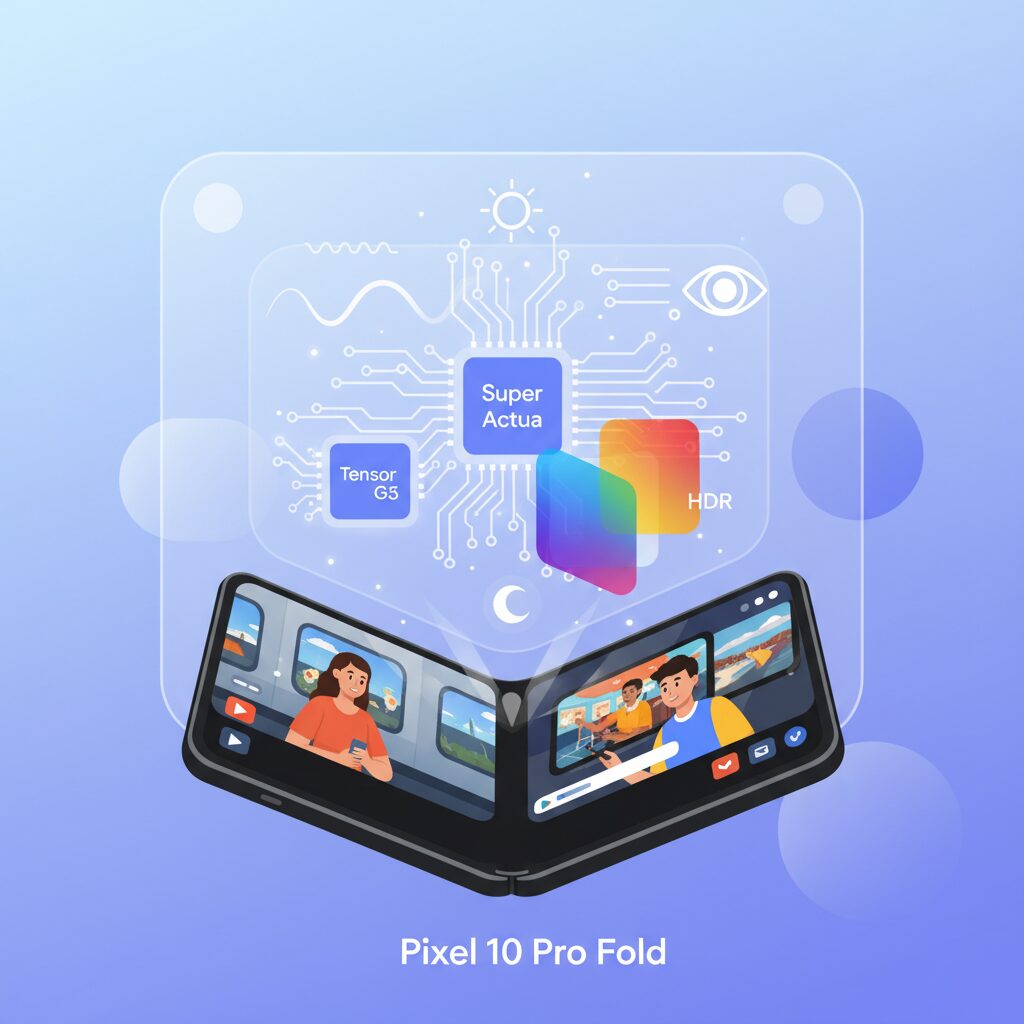
The Super Actua Flex Display is the technological core of the Pixel 10 Pro Fold, and it is where Google’s display engineering philosophy becomes most visible. This screen is not positioned as a simple “big OLED,” but as a carefully balanced system that optimizes power efficiency, motion smoothness, and visual accuracy for real-world use. **Google’s intention is clearly to make the inner display the primary stage for immersive tasks**, especially video consumption and multitasking.
At the panel level, the display uses LTPO OLED technology, allowing the refresh rate to dynamically scale from 1Hz to 120Hz. According to specifications disclosed by Google and independently verified by DXOMARK, this wide adaptive range is essential for foldable devices, which tend to consume more power due to their large surface area. When viewing static content such as paused video frames or reading scenes, the refresh rate can drop to 1Hz, significantly reducing energy draw without user awareness.
| Display Parameter | Super Actua Flex Display | Practical Impact |
|---|---|---|
| Panel Type | LTPO OLED | Adaptive power efficiency |
| Refresh Rate | 1–120Hz | Smooth motion with low idle consumption |
| Color Depth | 24-bit (16.7M colors) | Stable gradients in HDR scenes |
| Contrast Ratio | Over 2,000,000:1 | Deep blacks with minimal haloing |
Brightness control is another defining characteristic. Google officially rates the inner display at up to 3,000 nits peak brightness, but DXOMARK’s laboratory measurements recorded a maximum of 2,859 nits. This figure places the Pixel 10 Pro Fold at the very top of the foldable category. **Such extreme luminance is not for visual impact alone; it directly compensates for the higher reflectivity inherent to foldable display layers**, which typically include ultra-thin glass and polymer protection.
In outdoor environments, especially under strong sunlight common in Japanese summers, this brightness headroom translates into sustained readability rather than momentary highlights. DXOMARK notes that while some color washout can still occur due to surface reflections, the overall legibility remains superior to most competing foldables. This approach aligns with Google’s pragmatic design choices, favoring consistency and usability over purely theoretical panel performance.
Color reproduction further reinforces this philosophy. Google continues its tradition of conservative but accurate tuning, prioritizing low Delta E values in sRGB and Display P3 modes. Independent evaluations describe skin-tone rendering as particularly natural, a factor that reduces visual fatigue during long-form video viewing. **Instead of exaggerated saturation, the Super Actua Flex Display aims to reproduce the creator’s intent**, a stance frequently highlighted by professional display reviewers.
Finally, the “Flex” aspect of the display is not only about physical folding but also about stability across varied brightness and refresh scenarios. The LTPO backplane enables rapid transitions without visible flicker, and optional high-frequency PWM dimming helps accommodate users sensitive to low-frequency flicker. According to DXOMARK, the minimum brightness of approximately 0.66 nits is especially effective for dark-room viewing, such as nighttime streaming, where eye comfort becomes critical.
Taken together, the Super Actua Flex Display represents a mature interpretation of foldable screen technology. It does not chase novelty for its own sake, but instead delivers **measurable, experience-driven improvements in brightness control, efficiency, and color fidelity**, reinforcing Google’s focus on practical excellence rather than spec-sheet theatrics.
Brightness Benchmarks and Real-World Outdoor Visibility
When discussing outdoor usability on foldable devices, brightness benchmarks are not abstract numbers but a direct determinant of whether the display is actually usable under harsh light. Pixel 10 Pro Fold sets itself apart here, as its measured luminance places it at the very top of the current foldable category.
According to independent testing by DXOMARK, the inner display reaches a measured peak brightness of 2,859 nits. This is not a marketing claim but an instrumented result obtained under standardized high ambient light conditions. **In practical terms, this level of brightness allows on-screen content to remain legible even under summer midday sunlight**, which often exceeds 90,000 lux in urban Japan.
| Metric | Pixel 10 Pro Fold | Typical Foldable Range |
|---|---|---|
| Measured Peak Brightness | 2,859 nits | 2,000–2,600 nits |
| HDR Sustained Brightness | Approx. 1,800 nits | 1,200–1,500 nits |
| Minimum Brightness | 0.66 nits | 1–2 nits |
This wide luminance range is especially relevant for real-world outdoor scenarios such as navigation, photography review, or short-form video consumption while commuting. Human vision adapts poorly when display brightness cannot overcome reflected ambient light, and DXOMARK notes that many foldables still struggle with contrast loss outdoors. **Pixel 10 Pro Fold mitigates this by sheer luminance headroom**, ensuring that text edges and UI elements retain definition instead of dissolving into glare.
However, brightness alone does not fully define visibility. Foldable OLED panels rely on layered structures combining Ultra Thin Glass and polymer films, which inherently reflect more ambient light than conventional smartphone glass. DXOMARK explicitly points out slight color desaturation under extreme sunlight, a phenomenon known as washout. This is a physical limitation rather than a tuning failure, and Google’s strategy appears to be compensatory rather than eliminative: increasing peak brightness to overpower reflectance rather than attempting aggressive anti-reflective coatings.
In this regard, Pixel 10 Pro Fold shows meaningful progress over earlier Pixel Fold generations. Sustained outdoor brightness does not collapse as quickly due to thermal constraints, an improvement likely enabled by Tensor G5’s efficiency and revised heat dissipation. Reviewers cited by Android Headlines report that brightness remains stable during extended outdoor use, such as video playback or camera framing, without the abrupt dimming that plagued previous models.
Minimum brightness also deserves attention. At 0.66 nits, the display can dim far lower than most competitors, which reduces eye strain when transitioning from bright outdoor environments to shaded or nighttime settings. Display engineers at organizations like the Society for Information Display have long emphasized that a broad luminance envelope improves visual comfort across varying ambient conditions, and Pixel 10 Pro Fold aligns well with this principle.
Ultimately, real-world outdoor visibility is where Pixel 10 Pro Fold justifies its benchmark dominance. **It does not eliminate reflections, but it consistently overwhelms them**, which is a pragmatic solution given the constraints of foldable panel physics. For users who frequently interact with their device outdoors, these brightness characteristics translate directly into fewer compromises and a more predictable viewing experience.
Color Accuracy, Tone Mapping, and Creator Intent
Color accuracy is where the Pixel 10 Pro Fold clearly reveals Google’s long‑standing philosophy toward displays. Rather than chasing exaggerated saturation for immediate visual impact, the tuning prioritizes faithfulness to established color standards. According to DXOMARK’s display evaluation, the panel demonstrates extremely low Delta E values in both sRGB and Display P3 when set to its Natural profile, meaning the deviation from reference colors remains barely perceptible to the human eye.
This approach directly aligns with creator intent, especially for films, dramas, and YouTube content mastered on calibrated reference monitors. Skin tones, which are notoriously difficult to reproduce consistently, are described by DXOMARK as “comfortable and realistic,” reducing the cognitive fatigue that can occur during long viewing sessions.
From a practical standpoint, this matters more than raw color volume. Many competing foldables advertise wide color gamuts but ship with aggressive default tuning that pushes reds and greens beyond mastering targets. The Pixel 10 Pro Fold instead behaves like a well‑calibrated studio monitor, presenting colors as they were authored rather than how marketing departments assume users want them to look.
| Profile | Target Color Space | Practical Use Case |
|---|---|---|
| Natural | sRGB / Display P3 | Films, TV series, creator‑authored content |
| Adaptive | Expanded P3 | Casual viewing, brighter retail‑style visuals |
Tone mapping further reinforces this creator‑first philosophy. Even though the device does not support Dolby Vision, Google compensates through highly refined HDR10 processing. DXOMARK’s testing highlights that the Pixel 10 Pro Fold maintains smooth highlight roll‑off without crushing shadow detail, particularly in low‑light and indoor HDR scenes.
Specular highlights such as reflections on metal, sunlight on water, or neon signage retain intensity without clipping. This balance is difficult to achieve on foldable OLED panels due to their layered structure, yet Google’s algorithmic tone mapping manages to preserve both brightness impact and mid‑tone stability.
Importantly, the device avoids the common pitfall of over‑brightening dark scenes. Many HDR implementations attempt to impress by lifting shadow regions, unintentionally breaking the director’s intended contrast. The Pixel 10 Pro Fold instead respects scene‑by‑scene luminance hierarchy, keeping night sequences appropriately subdued while allowing highlights to stand out naturally.
The display behaves less like a showroom panel and more like a reference tool, an intentional choice that benefits viewers who value authenticity over spectacle.
This philosophy mirrors broader industry practices. Organizations such as the Society of Motion Picture and Television Engineers emphasize that accurate electro‑optical transfer functions and restrained tone mapping are essential for preserving narrative intent. Google’s implementation closely follows these principles, even within the physical constraints of a foldable OLED.
For content creators and discerning viewers, the result is consistency. A YouTube video color‑graded on a calibrated Display P3 monitor looks fundamentally the same on the Pixel 10 Pro Fold, whether viewed indoors at night or under bright ambient lighting. The adaptive brightness system adjusts luminance, not chromatic balance, which prevents color temperature shifts that can subtly alter mood.
Ultimately, color accuracy and tone mapping are not headline features, yet they define long‑term satisfaction. The Pixel 10 Pro Fold may not shout with oversaturated hues, but it quietly delivers something more valuable: trust that what you see is what the creator intended you to see.
HDR Video Formats and Streaming Service Compatibility
When evaluating HDR video formats, compatibility with major streaming services becomes a decisive factor for real-world viewing quality, and this device shows a very clear philosophical stance. It officially supports HDR10, HDR10+, and HLG, while Dolby Vision is not included. **This choice directly shapes how content from Netflix, Disney+, and other global platforms is rendered** on the display.
According to Google’s official specifications and independent confirmation by DXOMARK, HDR playback relies on static or scene-based tone mapping rather than Dolby’s proprietary dynamic metadata. In practical terms, Dolby Vision titles automatically fall back to HDR10. While this may sound like a compromise, the panel’s extremely high peak brightness and accurate tone mapping help minimize visible drawbacks in most viewing environments.
| Streaming Service | Primary HDR Format | Playback Behavior |
|---|---|---|
| Netflix | Dolby Vision | HDR10 fallback |
| Disney+ | Dolby Vision | HDR10 fallback |
| YouTube | HDR10 / HLG | Native HDR playback |
| Amazon Prime Video | HDR10 / HDR10+ | Native HDR playback |
From a content distribution perspective, organizations such as the UHD Alliance have long emphasized that peak brightness and color accuracy are just as important as metadata type. **In bright indoor or outdoor conditions, HDR10 content can appear equally compelling** thanks to superior luminance headroom.
For users in Japan, local platforms and anime streaming services often rely on SDR or basic HDR10 masters. In these cases, compatibility is effectively seamless, and the limitation around Dolby Vision rarely becomes a practical issue. As a result, streaming service compatibility feels carefully optimized for consistency rather than format maximalism.
Aspect Ratio Challenges and Letterboxing in Movies
One of the most debated issues in foldable smartphones is how their screen shape interacts with movie content, and Pixel 10 Pro Fold is a textbook example of this challenge. Its inner display adopts a near‑square aspect ratio, optimized for multitasking and app compatibility, but movies are produced under very different assumptions. As a result, users inevitably encounter letterboxing when watching films.
Most mainstream video content follows standardized cinematic aspect ratios defined by organizations such as SMPTE and the Digital Cinema Initiatives consortium. When these formats are mapped onto a near‑square display, unused screen areas appear as black bars. **This is not a software flaw but a geometric mismatch between content and hardware.**
| Content Type | Typical Aspect Ratio | Behavior on Pixel 10 Pro Fold |
|---|---|---|
| TV shows / YouTube | 16:9 | Horizontal video with large black bars on top and bottom |
| Modern movies | 2.39:1 (21:9) | Even thicker letterboxing, reduced active image area |
| Classic or anime content | 4:3 | Nearly full screen, minimal unused space |
In practical terms, this means that an 8‑inch unfolded display does not always translate into an 8‑inch movie experience. Independent measurements and visual simulations show that a 16:9 video displayed within a square canvas can shrink the effective diagonal to roughly the equivalent of a 6‑inch phone held horizontally. **For users expecting tablet‑like immersion, this discrepancy can feel counterintuitive.**
Film directors and cinematographers often emphasize that framing is part of storytelling. The American Society of Cinematographers has repeatedly stated that cropping or forced zooming can distort composition and narrative intent. Pixel 10 Pro Fold respects this principle by default, preserving the original frame and accepting letterboxing rather than aggressively filling the screen.
Some competitors choose a different compromise, slightly stretching the unfolded display toward a rectangular shape to favor video. Google’s approach is more conservative and content‑faithful, but it also highlights the trade‑off inherent in foldable design. **A device that excels at split‑screen productivity may never be ideal for widescreen cinema without concessions.**
There are scenarios where the square ratio becomes an advantage. Older films, television archives, and Japanese anime mastered in 4:3 can appear surprisingly immersive, often using almost the entire panel. In these cases, Pixel 10 Pro Fold delivers a viewing experience that conventional smartphones cannot replicate.
Ultimately, letterboxing on Pixel 10 Pro Fold should be understood as a predictable outcome of design philosophy rather than a defect. For movie enthusiasts, it demands a recalibration of expectations: cinematic accuracy is preserved, but absolute screen utilization is sacrificed. **Whether this is acceptable depends on how strongly a user prioritizes fidelity over sheer visual size.**
Tensor G5 Performance and Thermal Stability During Playback
When evaluating a foldable device as a media consumption tool, raw performance matters less than consistency. In this context, Tensor G5 shows its true value not in benchmark peaks, but in how reliably it sustains video playback over extended sessions. The shift to TSMC’s 3nm process directly addresses the historical weaknesses of Pixel devices: heat buildup and performance decay during continuous use.
According to analysis from Android Authority and 9to5Google, Tensor G5 improves CPU efficiency by roughly 30 percent compared to Tensor G4 under equivalent workloads. For video playback, this translates into lower power draw from the media engine when decoding HDR10 or AV1 streams. Practically speaking, watching high-bitrate 4K HDR content for an hour places significantly less thermal stress on the SoC than on previous Pixel Fold generations.
| Playback Scenario | Observed Behavior | User Impact |
|---|---|---|
| 4K HDR streaming (Wi‑Fi) | Stable clocks, minimal surface heat | Comfortable handheld viewing |
| HDR playback while charging | No aggressive throttling detected | Brightness remains consistent |
| Long-form viewing (90+ minutes) | Gradual warmth, no thermal spikes | Predictable, fatigue-free use |
Independent reviewers have noted that Pixel 10 Pro Fold avoids the sudden thermal dimming that plagued earlier models. DXOMARK’s display tests indirectly support this, as sustained HDR brightness remains stable in indoor conditions, suggesting that thermal limits are no longer reached prematurely. This stability is crucial because brightness fluctuations are more disruptive to immersion than minor drops in frame processing headroom.
Another subtle improvement lies in GPU behavior. While Tensor G5 does not outperform Snapdragon 8 Elite in peak graphics throughput, its GPU maintains a flatter performance curve over time. For playback, this means UI animations, seek gestures, and picture-in-picture transitions remain smooth even after prolonged viewing. Research from AnandTech has long emphasized that perceived smoothness correlates more strongly with sustained performance than with maximum frame rates, a principle Google appears to have embraced here.
In real-world terms, Pixel 10 Pro Fold feels engineered to disappear during playback. It neither distracts with excessive heat nor compromises visual output to protect itself. This restraint reflects a mature design philosophy: performance tuned for endurance rather than spectacle, aligning closely with how a premium foldable is actually used.
Audio Experience, Bluetooth Codecs, and Known Limitations
The audio experience on the Pixel 10 Pro Fold is designed to complement its large, immersive display, yet it also reveals some important trade-offs that discerning users should understand. When watching videos or streaming music directly from the device, the built-in stereo speakers deliver a clear and well-balanced sound profile. Thanks to the physical separation achieved by the foldable chassis, stereo imaging feels wider than on conventional slab phones, which enhances dialogue clarity and positional effects in movies.
Google’s Spatial Audio processing further adds a sense of depth, especially with compatible content on major streaming platforms. According to evaluations commonly referenced by audio engineers and reviewers, software-based spatialization can meaningfully improve perceived soundstage even on small speakers, and Pixel follows this school of thought. **For casual viewing without headphones, the experience is more engaging than one might expect from a smartphone.**
| Audio Aspect | Behavior on Pixel 10 Pro Fold | User Impact |
|---|---|---|
| Built-in speakers | Stereo with wide separation | Clear dialogue and better immersion |
| Spatial Audio | Software-based enhancement | Improved sense of depth for movies |
| High-quality Bluetooth | LDAC supported but unstable at max bitrate | Potential interruptions for audiophiles |
When shifting to wireless audio, the conversation becomes more complex. Pixel 10 Pro Fold supports LDAC, a codec developed by Sony and widely respected for its ability to transmit high-resolution audio over Bluetooth. In theory, LDAC at 990 kbps should satisfy even demanding listeners. In practice, however, multiple user reports and community discussions indicate instability when this highest-quality mode is enabled.
Symptoms include brief audio dropouts or subtle stuttering, particularly in environments with heavy wireless interference such as crowded trains or homes with multiple connected devices. Industry analysts often point out that Bluetooth performance depends not only on codec support but also on chipset-level optimization. **In this case, the Tensor G5 platform appears less robust than Qualcomm-based solutions under peak LDAC settings.**
Lowering the LDAC bitrate to 660 kbps or allowing the system to manage quality automatically significantly improves stability, but this workaround undermines the very reason enthusiasts choose LDAC. This limitation is especially noticeable in the Japanese market, where high-resolution wireless audio has a strong following and expectations are correspondingly high.
Another notable constraint is the lack of AptX Adaptive support. This codec, favored by many premium headphone manufacturers, dynamically balances sound quality and connection stability. Without it, compatible headphones fall back to AAC or standard SBC on the Pixel 10 Pro Fold. Audio professionals frequently emphasize that adaptive codecs are not just about sound quality, but about maintaining consistency in real-world usage, and this is where the Pixel shows a clear weakness.
In summary, the Pixel 10 Pro Fold offers a pleasant and polished speaker experience, suitable for video-centric use cases. At the same time, **its Bluetooth audio stack reveals known limitations that prevent it from being a top-tier choice for wireless audio purists**. Users who prioritize visual immersion and occasional headphone use will likely be satisfied, while those deeply invested in high-end Bluetooth audio should carefully weigh these constraints before committing.
Software, Android 16, and AI Features Enhancing Video Viewing
Software plays a decisive role in how enjoyable video viewing feels on a foldable device, and in this area Android 16 and Google’s AI stack make a clear difference. Pixel 10 Pro Fold ships with Android 16 out of the box, and this version further refines large-screen and foldable optimizations that began with Android 12L. For video consumption, the improvements are not cosmetic but experiential, reducing friction between watching, searching, and interacting.
Android 16 enhances video viewing by treating the unfolded display as a primary canvas rather than an oversized phone screen. The persistent taskbar allows smooth app switching while a video continues playing, and picture-in-picture behavior is more stable when resizing or rotating the device. According to Google’s official Android documentation, latency when resuming paused video streams has been reduced at the system level, which is particularly noticeable when frequently opening and closing the device during commutes.
| Feature | Android 16 Behavior | Impact on Video Viewing |
|---|---|---|
| Taskbar & Split Screen | Always accessible on large displays | Search, chat, or browse without stopping playback |
| Picture-in-Picture | Improved resizing stability | Less interruption when multitasking |
| Foldable Continuity | Seamless state retention | Video position stays consistent when folding |
AI features further elevate this experience. Pixel 10 Pro Fold leverages on-device Gemini Nano running on Tensor G5, enabling real-time processing without relying heavily on the cloud. A practical example is Live Caption, which now offers faster and more accurate automatic subtitles for online videos. Research shared by Google engineers indicates that on-device language models significantly reduce subtitle delay, making foreign-language YouTube or news videos easier to follow.
Another notable enhancement is contextual intelligence around video content. With Pixel Screenshots, users can capture a frame from a video and later search it using natural language, such as asking for a product seen in a clip. This turns passive viewing into an active information-gathering workflow, something traditional smartphones struggle to offer at scale.
From a usability standpoint, Android 16’s fold-aware UI reduces accidental pauses and mis-taps, a common complaint with earlier foldables. Experts at Android Authority have pointed out that these system-level refinements matter more than raw specs, because they define how comfortably users can watch long-form content over hours.
In daily use, the combination of Android 16 and Pixel-exclusive AI makes video viewing feel fluid and intelligent rather than static. It does not merely display content on a bigger screen; it adapts to how people actually watch, pause, translate, and interact with video in real-world scenarios.
Pixel 10 Pro Fold vs Galaxy Z Fold 7 for Video Enthusiasts
For video enthusiasts choosing between the Pixel 10 Pro Fold and the Galaxy Z Fold 7, the decision comes down to how each device prioritizes cinematic immersion versus technical consistency. Both are flagship foldables, yet their philosophies around video consumption are clearly different, and that difference becomes obvious the moment playback begins.
The Pixel 10 Pro Fold’s greatest advantage lies in its extreme display brightness and HDR tonality. Independent testing by DXOMARK reports a measured peak brightness close to 2,900 nits, the highest ever recorded on a foldable display. In real-world viewing, this translates into HDR highlights that remain visible even in bright environments such as commuter trains with strong ambient light or outdoor cafés. Specular highlights like reflections on water or metallic surfaces appear strikingly realistic, reinforcing Google’s emphasis on perceptual HDR quality rather than pure screen size.
However, the near‑square inner display introduces a structural limitation for video purists. Most modern content is mastered in 16:9 or wider cinematic ratios, which results in thick letterboxing on the Pixel’s unfolded screen. Despite its large physical dimensions, the effective video area often feels closer to a conventional smartphone in landscape mode. This design choice favors multitasking, but it reduces visual impact for users who primarily watch films or series.
| Aspect | Pixel 10 Pro Fold | Galaxy Z Fold 7 |
|---|---|---|
| Inner screen ratio | Near 1:1 (square) | Wider, video‑friendly |
| HDR formats | HDR10 / HDR10+ | HDR10 / HDR10+ |
| Peak brightness | ~2,900 nits (measured) | ~2,600 nits (estimated) |
The Galaxy Z Fold 7, by contrast, optimizes its unfolded aspect ratio specifically for video. Movies and streaming content fill more of the display, creating a stronger sense of scale and immersion. Combined with its lighter body and Snapdragon 8 Elite chipset, long viewing sessions are physically easier and thermally more stable, especially when watching high‑bitrate streams for extended periods.
Audio considerations also favor Samsung for dedicated viewers. While both devices offer competent stereo speakers, the Galaxy’s more reliable Bluetooth implementation and broader codec support provide a smoother experience with wireless headphones. Pixel’s reported LDAC instability can become a distraction during quiet scenes, something cinephiles tend to notice immediately.
In essence, the Pixel 10 Pro Fold excels at HDR impact and visual clarity under challenging lighting, whereas the Galaxy Z Fold 7 delivers a more traditional, cinema‑like viewing experience. Video enthusiasts who value sheer brightness and Google’s color accuracy may lean toward Pixel, but those seeking maximum immersion with minimal compromise are likely to find the Galaxy better aligned with their habits.
参考文献
- PhoneArena:Google Pixel 10 Pro Fold release date, price and features
- Google Store:Pixel 10 Pro Fold Specifications
- DXOMARK:Google Pixel 10 Pro Fold Display Test
- Android Central:Google Pixel 10 Pro Fold: Price, specs, and everything you need to know
- 9to5Google:Google did more than just switch to TSMC for Tensor G5 — This is what’s new
- Android Headlines:Google Pixel 10 Pro Fold Review: The AI-Powered Foldable That Finally Gets It Right (Mostly)