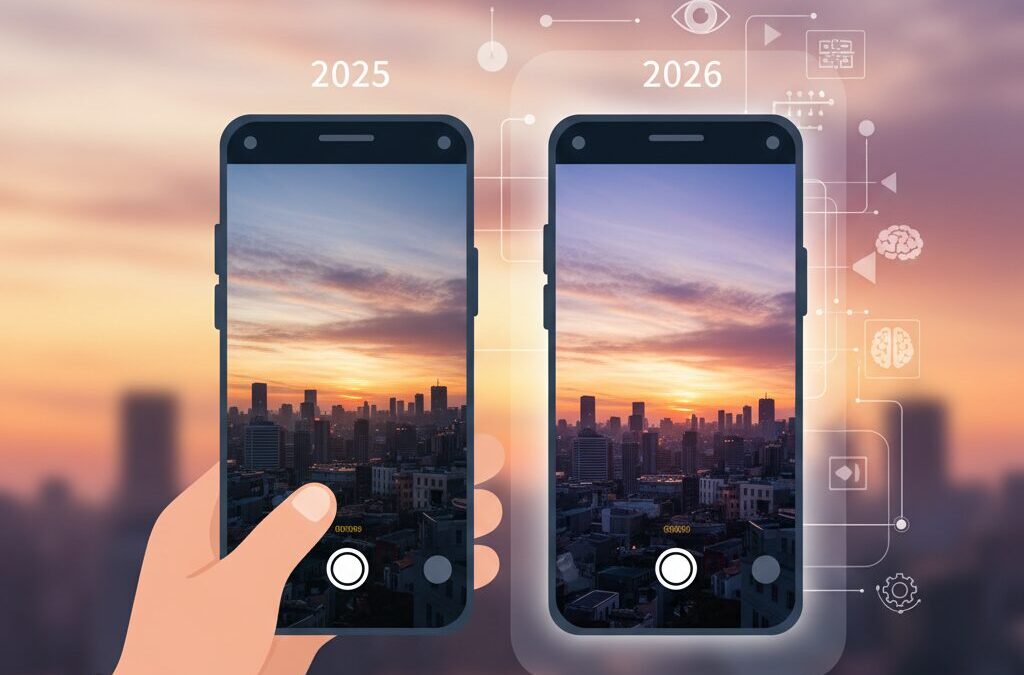
Have you ever looked at a smartphone photo and felt that something was slightly off, even though it looked technically perfect? Many gadget enthusiasts have noticed that modern phone cameras no longer simply record what is in front of them, but actively interpret the scene for us.
Between 2025 and 2026, smartphone HDR has evolved into a complex mix of advanced sensors, AI-driven tone mapping, and brand-specific philosophies. As a result, photos from different phones can feel dramatically different, even when taken in the same place at the same moment.
This article explores why those differences exist and how computational photography, large sensors, and semantic AI processing shape the final image. By understanding these trends, you will be better equipped to choose a smartphone camera that truly matches your visual taste and shooting style.
- From Recording Light to Interpreting Scenes in Mobile Photography
- How HDR Has Changed: Dynamic Range Meets AI Understanding
- Why Sensor Size Matters Again in 2025 and 2026
- Sony LYT-901 and the Push Toward Extreme Dynamic Range
- Samsung’s 200MP Strategy and the Philosophy Behind ISOCELL
- Semantic Tone Mapping and the Birth of Brand-Specific ‘Looks’
- iPhone, Pixel, Galaxy: Three Very Different HDR Personalities
- The Rise of Large-Sensor Chinese Flagships
- AI, Authenticity, and the Debate Over Photographic Truth
- What the Future Holds for Ultra HDR and Generative Imaging
- 参考文献
From Recording Light to Interpreting Scenes in Mobile Photography
Mobile photography has quietly crossed a line. Smartphones no longer function as devices that simply record incoming light; they now actively interpret scenes before you ever see the final image. This shift has accelerated between 2025 and 2026, driven by advances in computational photography and AI-driven HDR pipelines, and it fundamentally changes what it means to “take a photo” with a phone.
Traditionally, HDR was a defensive technology. Its goal was modest: combine multiple exposures to avoid blown highlights and crushed shadows. According to long‑standing definitions used in imaging research, HDR existed to preserve information that optics and sensors could not capture in a single shot. That assumption no longer holds true. **Modern HDR has become an interpretive process, not a corrective one**, redefining the camera from a passive recorder into an active decision‑maker.
In current flagship smartphones, HDR means AI‑driven scene understanding that reconstructs what the system believes the scene should look like, not merely what the sensor measured.
Research shared by Adobe and Qualcomm shows that contemporary imaging pipelines rely heavily on semantic segmentation. Instead of applying one tone curve to the entire frame, the AI identifies skies, skin, foliage, buildings, and artificial light sources as distinct regions. Each region is then processed independently, with different exposure compensation, contrast, saturation, and noise reduction strategies applied simultaneously.
This is why two phones using sensors of similar size can produce radically different images. One device may preserve dramatic shadows to emphasize depth, while another lifts dark areas to maximize visibility. Neither result is technically incorrect. They reflect different interpretations encoded into the algorithm, often informed by user preference data and regional market expectations.
| HDR Approach | Primary Decision Maker | Resulting Image Character |
|---|---|---|
| Conventional Multi‑Exposure HDR | Exposure fusion rules | Balanced but uniform tonality |
| AI Semantic HDR | Scene recognition models | Context‑aware, stylistically distinct output |
The implications are profound. A sunset is no longer evaluated purely by luminance values; the system “knows” it is a sunset and enhances warm gradients accordingly. Faces are detected and prioritized, often brightened even when backlit, because decades of perceptual psychology show that viewers judge photo quality largely by facial clarity. These findings align with academic work on memory color, which demonstrates that people prefer images that match remembered colors rather than spectrally accurate ones.
At the same time, this interpretive power introduces what enthusiasts increasingly describe as a camera’s “personality.” **The subtle biases in HDR processing become visible patterns**, repeated across thousands of images, and experienced users quickly learn to recognize them. This is why some photos feel cinematic, others feel flat but reliable, and others feel vivid to the point of exaggeration.
Importantly, this transformation is not speculative. Industry documentation from Android’s Ultra HDR initiative and Adobe’s computational camera research confirms that HDR metadata, semantic masks, and tone‑mapping decisions are now embedded as first‑class elements in the image pipeline. The photo you see is the output of layered interpretations happening in milliseconds.
Understanding this shift is essential for anyone serious about mobile photography. When you tap the shutter today, you are not just capturing photons. You are engaging a system that interprets context, predicts viewer preference, and renders a version of reality shaped by algorithms as much as by light itself.
How HDR Has Changed: Dynamic Range Meets AI Understanding
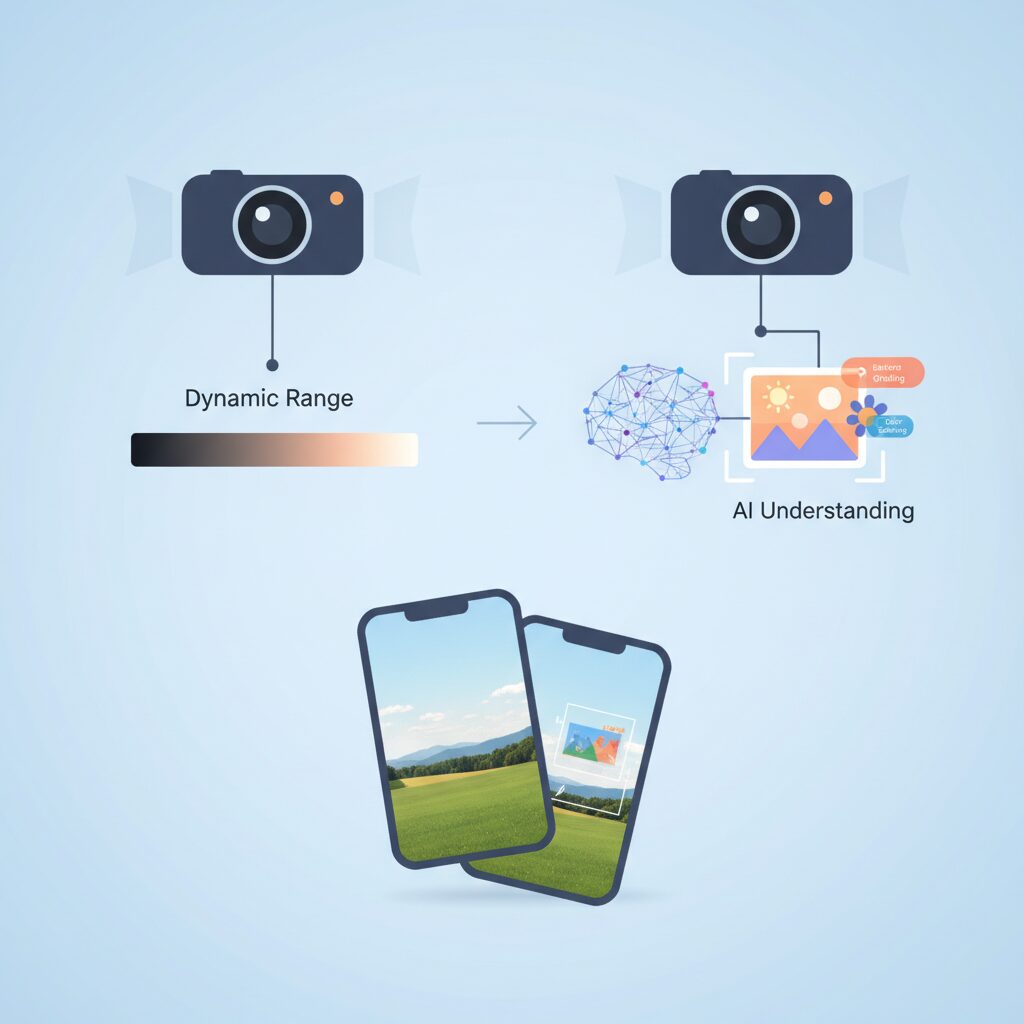
HDR in smartphone cameras has quietly but fundamentally changed its role over the past few years. What was once a safety net to avoid blown highlights and crushed shadows has evolved into an intelligent system that actively interprets what a scene means. Modern HDR no longer asks how bright something is, but what it represents, and this shift has reshaped how images look, feel, and are judged by enthusiasts.
According to research published by Adobe and Qualcomm, current HDR pipelines rely heavily on semantic segmentation powered by AI. The image is divided into regions such as sky, skin, foliage, and architecture, and each is processed with different priorities. This allows a sunset sky to preserve dramatic gradients while a face in the foreground is lifted just enough to remain expressive, even if that balance never existed optically in a single exposure.
This transformation means HDR has moved from a global correction tool to a localized decision-making engine. In practice, the camera is making aesthetic choices on behalf of the user. Google’s Pixel series, for example, is known to aggressively protect shadow detail in people’s faces, while Apple tends to preserve contrast by letting darker areas remain dark. These differences are not sensor limitations but intentional interpretations embedded in AI models.
| HDR Era | Primary Goal | Decision Logic |
|---|---|---|
| Conventional HDR | Avoid clipping | Histogram-based |
| AI-driven HDR | Scene understanding | Semantic segmentation |
One striking implication of this change is consistency. AI-driven HDR dramatically reduces failed shots in difficult lighting. Sony Semiconductor has shown that pairing wide dynamic range sensors with intelligent tone mapping lowers exposure errors in backlit scenes involving motion, such as children or pets. HDR is now as much about reliability as it is about beauty, which explains why many users perceive newer phones as more dependable cameras.
However, this reliability comes at a philosophical cost. When HDR decides that the sky should always look blue or that skin should always look healthy, the resulting image may drift away from physical reality. Imaging researchers often describe this as a transition from recording light to reconstructing a plausible scene. The photo becomes a visual answer to what the AI believes you wanted to remember, not strictly what was there.
For gadget enthusiasts, this evolution explains why HDR now has a recognizable “character” per brand. The dynamic range itself is no longer the bottleneck; understanding and intent are. As HDR meets AI understanding, the debate has shifted from how much detail a camera can capture to whether we agree with the story that its algorithms choose to tell.
Why Sensor Size Matters Again in 2025 and 2026
In 2025 and 2026, sensor size matters again not because software has stalled, but because it has finally exposed its own limits. Computational photography has become extraordinarily capable, yet its results are still constrained by the quality of the raw light captured at the very beginning. When the base signal is weak, even the most advanced AI can only guess.
This is why larger sensors are returning to the center of discussion among serious gadget enthusiasts. A bigger sensor collects more photons per frame, which directly improves the signal-to-noise ratio before any HDR merging or AI tone mapping takes place. According to Sony Semiconductor Solutions and independent analyses by imaging researchers, this upstream advantage reduces the need for aggressive multi-frame synthesis that often causes texture loss or unnatural contrast.
| Sensor Class | Typical Size | Practical HDR Impact |
|---|---|---|
| Conventional flagship | 1/1.3 inch | Heavy AI tone lifting required |
| Large mobile sensor | 1/1.12 inch | Cleaner shadows, fewer artifacts |
| 1-inch class | Approx. 1 inch | Near single-shot HDR latitude |
What changes in 2025–2026 is that HDR itself has become semantic and selective. Adobe Research and Qualcomm both describe modern pipelines as meaning-aware rather than histogram-driven. However, semantic tone mapping amplifies sensor differences instead of hiding them. Skin regions, skies, and foliage all respond more naturally when the underlying data is rich and low in noise.
Large sensors also reduce temporal dependency. Technologies such as Sony’s Hybrid Frame-HDR rely less on long exposure gaps, which means moving subjects produce fewer ghosts. For everyday users, this translates into children, pets, or street scenes being captured with higher reliability, not just better lab scores.
Another overlooked factor is color stability. Bigger photosites maintain more consistent color information across brightness levels, which helps AI avoid overcorrecting white balance or saturation. Imaging engineers often point out that memory color tuning works best when the sensor does not collapse chroma in the shadows.
In short, sensor size matters again because AI has matured. Once algorithms became good enough, the industry rediscovered a simple truth: optical reality still defines the ceiling of computational photography. In 2025 and 2026, larger sensors are no longer brute-force solutions, but precision tools that allow software to act with restraint rather than excess.
Sony LYT-901 and the Push Toward Extreme Dynamic Range
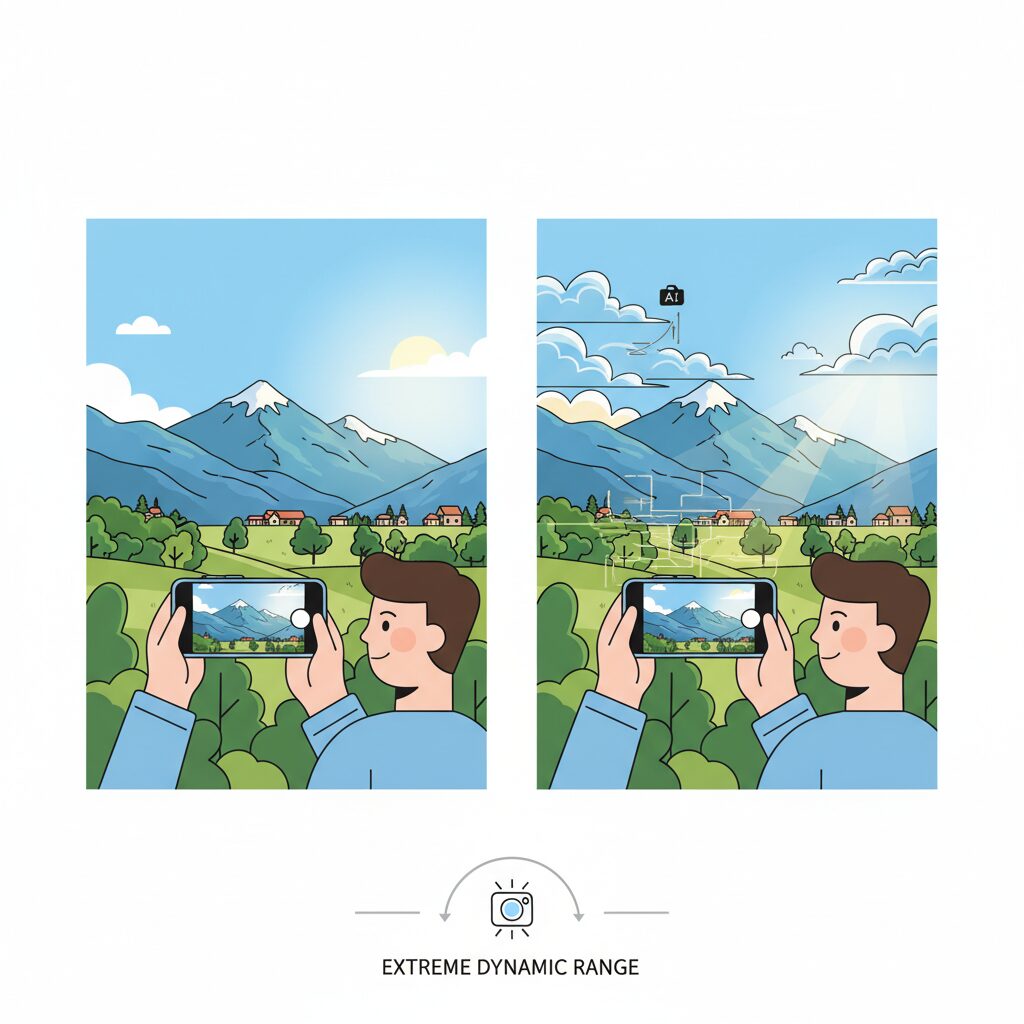
The Sony LYT-901 represents a decisive push toward extreme dynamic range in smartphone photography, and its importance goes beyond headline numbers. Sony is not merely chasing higher megapixels here; it is redefining how much light information a mobile sensor can reliably capture before computational processing even begins.
At the core of this shift is the promise of nearly 17 stops of dynamic range, or roughly 100dB, a figure that approaches what dedicated cinema cameras achieved only a few years ago. According to Sony Semiconductor Solutions and subsequent technical analysis by imaging specialists such as PetaPixel, this is made possible by combining sensor-level innovations rather than relying solely on aggressive multi-frame HDR.
| Feature | LYT-901 Implementation | Practical Impact |
|---|---|---|
| Sensor size | 1/1.12-inch | Higher photon capture, cleaner shadows |
| Pixel structure | Quad-Quad Bayer (16-in-1) | Stable HDR with low noise |
| HDR method | Hybrid Frame-HDR | Reduced ghosting in motion |
The most meaningful breakthrough is Hybrid Frame-HDR. Traditional staggered HDR captures multiple exposures over time, which often leads to ghosting when subjects move. LYT-901 instead combines Dual Conversion Gain data from a single exposure with an additional ultra-short exposure frame. This hybrid approach preserves highlight detail while dramatically reducing temporal artifacts.
In real-world terms, this means backlit children, pets, or street scenes are rendered with both sky detail and readable faces, without the smeared edges that many users have learned to tolerate. Imaging engineers interviewed by Digital Camera World point out that this shifts HDR from a “fix it later” process to a sensor-native capability.
Another subtle but critical advantage lies in tonal continuity. Sony’s 12-bit ADC pipeline allows smoother gradation from highlights into midtones, which reduces the harsh, over-processed look often associated with smartphone HDR. This aligns with Sony’s long-standing philosophy of preserving optical truth first, then letting AI interpret gently rather than overwrite.
As a result, LYT-901 does not just enable brighter photos. It enables more believable contrast under extreme lighting, creating a foundation where computational photography can enhance rather than rescue the image. For enthusiasts who value dynamic range as photographic latitude, this sensor marks a genuine inflection point in mobile imaging.
Samsung’s 200MP Strategy and the Philosophy Behind ISOCELL
Samsung’s commitment to 200‑megapixel sensors is often misunderstood as a simple numbers game, but in reality it reflects a very deliberate imaging philosophy. With the ISOCELL HP2 and its successors, Samsung positions ultra‑high resolution not as an end goal, but as a flexible foundation for computational photography that prioritizes consistency, speed, and visual impact. This approach aligns closely with how most users actually consume photos today: on bright smartphone displays, in social feeds, and often at a glance.
At the core of ISOCELL’s design is the idea that more pixels equal more optionality. A 200MP sensor captures an enormous amount of raw spatial information, which can then be reshaped by algorithms depending on the scene. In bright daylight, the sensor can preserve fine textures and edges that survive aggressive sharpening and tone mapping. In low light, those same pixels are combined through 16‑to‑1 binning to form large virtual pixels, improving signal‑to‑noise while keeping autofocus fast and reliable.
| Design Focus | ISOCELL HP2 Approach | User Benefit |
|---|---|---|
| Resolution | 200MP native capture | High cropping and zoom flexibility |
| Low‑light strategy | 16‑pixel binning (Tetra2pixel) | Cleaner night shots with minimal delay |
| Autofocus | Super Quad Phase Detection | Reliable focus on moving subjects |
Samsung Semiconductor has repeatedly emphasized that ISOCELL sensors are designed as “data‑rich sources” for AI pipelines, rather than as purist imaging devices. According to analyses published by TechInsights and commentary echoed in specialized media like PetaPixel, this philosophy explains why Samsung invests heavily in fast readout and dense phase‑detection coverage, even when pixel size is relatively small. The sensor is optimized to feed the ISP and NPU with as much structured information as possible, as quickly as possible.
This design choice has visible consequences in real‑world images. **Galaxy photos tend to look vivid, sharp, and immediately eye‑catching**, even before any manual editing. High resolution allows Samsung’s algorithms to apply strong local contrast and edge enhancement without the image collapsing into mush. In marketing terms, this supports the company’s long‑standing preference for “wow factor” imagery that performs well in blind tests and retail demos.
Another often overlooked aspect of the 200MP strategy is zoom. Instead of relying solely on optics, Samsung treats the main sensor as a multi‑purpose zoom module. By cropping into the 200MP frame and combining it with AI super‑resolution, Galaxy devices can deliver usable intermediate zoom levels with less processing delay than traditional multi‑camera switching. Reviewers at outlets such as TechRadar have noted that this contributes to Samsung’s reputation for versatile travel and everyday photography.
Ultimately, the ISOCELL philosophy accepts that modern smartphone photos are interpretations, not neutral records. Samsung chooses to maximize controllable data at capture time, then sculpt the final image through computation. **The 200MP sensor is therefore less about realism and more about creative and algorithmic headroom**, a strategy that fits perfectly with Samsung’s broader vision of AI‑driven imaging in the 2025–2026 era.
Semantic Tone Mapping and the Birth of Brand-Specific ‘Looks’
Semantic Tone Mapping has quietly become the most powerful creative tool in smartphone photography, and it is fundamentally reshaping how brand-specific visual identities are formed. Rather than applying a single global HDR curve, modern pipelines now interpret scenes at a semantic level, adjusting tone, contrast, and color based on what the AI believes each region represents. According to Adobe Research, this shift marks a transition from exposure correction to perceptual optimization, where images are tuned to align with human expectations rather than optical measurements.
This semantic awareness is the birthplace of brand-specific “looks.” Sky, skin, foliage, food, and architecture are no longer treated equally, and the priority assigned to each category differs by manufacturer. These priorities are embedded deep within training datasets and tuning parameters, making them consistent across generations and instantly recognizable to experienced users.
| Semantic Priority | Typical Adjustment | Brand-Level Outcome |
|---|---|---|
| Human skin | Local exposure lift and smoothing | Trustworthy portraits, social-media readiness |
| Sky and clouds | Highlight compression, saturation boost | Dramatic landscapes with visual impact |
| Food and objects | White balance correction, midtone contrast | Perceived realism and appetizing color |
What is notable here is that these decisions are not made at capture time by the user, but in milliseconds by trained models. Qualcomm’s CVPR 2025 disclosures indicate that many flagship devices now execute region-specific tone mapping on the NPU, allowing different semantic layers to receive distinct HDR curves within a single frame. This computational freedom makes visual consistency a deliberate design choice, not an accidental byproduct.
As a result, HDR “personality” becomes a branding asset. Some brands favor conservative highlight roll-off to preserve a cinematic feel, while others aggressively lift shadows to avoid information loss. Neither approach is objectively correct. Instead, each reflects assumptions about what users value most when they review photos on a small, bright display.
Research in visual perception supports this divergence. Studies referenced by Adobe note that viewers rarely evaluate photographs holistically; attention is drawn first to faces, then to high-contrast regions such as skies. Semantic Tone Mapping exploits this bias, ensuring that priority areas align with brand philosophy even if global tonal balance is sacrificed.
Importantly, this also explains why cross-brand comparisons often feel emotionally inconsistent despite similar hardware. Two phones may share comparable sensors and dynamic range, yet their outputs feel fundamentally different because the semantic hierarchy encoded in their HDR pipelines is different. Users are not choosing better or worse HDR anymore; they are choosing an interpretation style.
In this sense, brand-specific “looks” are no longer marketing veneers layered on top of neutral images. They are the emergent result of semantic decision-making systems that continuously answer one question on behalf of the user: which parts of reality deserve to be seen first, and which can quietly fade into the background.
iPhone, Pixel, Galaxy: Three Very Different HDR Personalities
When comparing HDR behavior across today’s flagship phones, it becomes clear that iPhone, Pixel, and Galaxy are not simply tuning the same algorithm differently. They are pursuing fundamentally different interpretations of what HDR photography should be, and those choices shape every photo you take.
Apple’s iPhone treats HDR as a tool for storytelling rather than maximum visibility. Recent iPhone generations deliberately preserve deep shadows and strong contrast, even when more information could be lifted out of the dark areas. According to comparative analyses by TechRadar and professional photographers such as Austin Mann, this approach aligns closely with cinematic color grading, where blacks are allowed to remain black to maintain depth and mood.
This is why iPhone photos are often described as “darker” in side-by-side tests. It is not a sensor limitation, but a conscious tone-mapping decision that favors three-dimensionality over uniform brightness. Apple assumes users value realism and post-editing latitude more than instant visual impact.
| Brand | HDR Priority | Typical Visual Impression |
|---|---|---|
| iPhone | Contrast and shadow control | Moody, cinematic, deep blacks |
| Pixel | Information preservation | Flat but highly readable |
| Galaxy | Impact and vividness | Bright, colorful, eye-catching |
Google Pixel takes the opposite stance, treating HDR as an information-equalizer. Pixel’s computational pipeline aggressively lifts shadows and suppresses blown highlights, ensuring that no part of the scene is lost. Google’s Ultra HDR format, documented by the Android Open Source Project, even stores extended brightness metadata so highlights can appear more lifelike on compatible displays.
The result is reliability. Faces remain bright against harsh backlight, and detail is visible almost everywhere. However, this can also produce images that feel visually flat, as local contrast is sacrificed for completeness. Pixel assumes that a photo’s primary job is to show everything clearly, even if it looks less dramatic.
Samsung Galaxy sits at a third point, prioritizing emotional memory over optical truth. Galaxy HDR strongly enhances saturation and micro-contrast, producing skies that look bluer and foliage that looks richer than reality. Tech reviewers consistently note that this tuning maximizes immediate appeal on a smartphone display, especially in travel and social media contexts.
In essence, iPhone asks you to feel the light, Pixel asks you to see everything, and Galaxy asks you to remember the moment as brighter and bolder than it truly was. Understanding these three HDR personalities helps explain why debates over “the best camera” never really end.
The Rise of Large-Sensor Chinese Flagships
Over the past two years, Chinese flagship smartphones have accelerated a clear and deliberate shift toward large-sensor camera design, fundamentally changing how HDR is achieved on mobile devices. Brands such as Xiaomi and Vivo have embraced one-inch–class sensors not as a marketing gimmick, but as a strategic rejection of excessive computational correction. **Their core belief is simple: richer optical input reduces the need for aggressive HDR manipulation.**
This movement gained global attention with models like the Xiaomi 15 Ultra and Vivo X200 Pro, both of which rely on physically larger sensors to capture broader dynamic range in a single exposure. According to analyses from Digital Camera World and TechRadar, these devices often preserve highlight roll-off and shadow texture without resorting to heavy multi-frame fusion, resulting in images that feel less processed and more tonally continuous.
From a technical standpoint, a one-inch sensor offers a decisive advantage in signal-to-noise ratio. Larger photosites collect more photons, which directly translates into cleaner shadows and smoother gradients. **This allows HDR to function as a safety net rather than a visual effect**, minimizing artifacts such as haloing or local contrast pumping that are common in smaller-sensor phones.
| Model | Main Sensor Size | HDR Approach |
|---|---|---|
| Xiaomi 15 Ultra | 1-inch | Single-frame priority with light HDR |
| Vivo X200 Pro | 1-inch | Optical DR first, selective multi-frame |
| Typical flagship | ~1/1.3-inch | Aggressive multi-frame HDR |
Blind camera tests conducted in 2025 further validated this approach. In evaluations where brand names were hidden, Vivo’s large-sensor output consistently ranked highest in low-light and high-contrast scenes, outperforming rivals that leaned more heavily on computational HDR. Reviewers noted that motion handling was also superior, as fewer stacked frames meant fewer ghosting artifacts.
Industry observers, including imaging analysts cited by PetaPixel, argue that this trend represents a partial return to photographic fundamentals. Rather than asking AI to reconstruct missing data, Chinese flagships increasingly focus on capturing it in the first place. **The rise of large-sensor Chinese flagships therefore signals not just better HDR, but a philosophical recalibration toward optical truth in mobile photography.**
AI, Authenticity, and the Debate Over Photographic Truth
As AI-driven computational photography matures, smartphones increasingly challenge the long-held assumption that photographs are objective records of reality. Modern HDR pipelines no longer simply recover highlights and shadows; they actively reinterpret scenes through semantic analysis. **This shift has ignited a serious debate over photographic truth**, especially among gadget enthusiasts who value both technical excellence and authenticity.
Research from Adobe and Qualcomm shows that current systems identify elements such as faces, skies, and buildings, then apply region-specific tone mapping and noise reduction. While this dramatically reduces failed shots, it also means that two phones can produce radically different “truths” from the same scene. The controversy around Samsung’s AI-enhanced moon photography, widely discussed by imaging researchers and major tech media, exemplifies how AI may cross the line from enhancement into fabrication.
| Approach | Strength | Authenticity Risk |
|---|---|---|
| Multi-frame HDR | High dynamic range | Motion artifacts |
| Semantic AI mapping | Consistent exposure | Algorithmic bias |
| Generative reconstruction | Detail recovery | Hallucinated content |
According to imaging scholars cited by PetaPixel and TechRadar, users are becoming more aware of this trade-off. **The question is no longer whether AI improves photos, but whether viewers can trust what they see.** As smartphones move closer to real-time image generation, authenticity becomes a design choice rather than a given, redefining what a “true” photograph means in the AI era.
What the Future Holds for Ultra HDR and Generative Imaging
The future of Ultra HDR and generative imaging is moving beyond incremental image quality improvements and toward a fundamental redefinition of what a photograph represents. Ultra HDR, as standardized in the Android ecosystem, already separates base image data from gain maps that describe how highlights should glow on compatible displays. According to the Android Open Source Project, this approach preserves backward compatibility while enabling peak brightness far beyond SDR limits. From 2026 onward, Ultra HDR is expected to evolve from a display feature into a creative and semantic layer of photography, where brightness itself becomes part of storytelling.
One concrete direction is the tighter coupling between capture-time HDR data and on-device generative models. Research trends discussed by Adobe and Qualcomm indicate that future pipelines will no longer treat HDR as a static merge of exposures. Instead, HDR data will act as structured input for generative models that understand scene intent. For example, a sunset image may preserve physically accurate luminance values, while a generative layer subtly reconstructs cloud textures or atmospheric haze that sensors partially lost. This is not random fabrication but probabilistic reconstruction constrained by captured light data.
To clarify how Ultra HDR and generative imaging are expected to interact, the following table outlines their evolving roles.
| Layer | Primary Role | Future Evolution |
|---|---|---|
| Ultra HDR | Preserve luminance and highlight detail | Semantic brightness control per scene element |
| Generative Imaging | Noise reduction and detail recovery | Context-aware texture and tone reconstruction |
Another important shift is user trust and transparency. After public debates around AI hallucination in smartphone cameras, industry experts argue that future generative HDR systems must expose intent rather than hide it. Adobe Research has emphasized the concept of content provenance, where generative contributions are constrained and traceable. In practical terms, future Ultra HDR photos may include metadata describing which regions were reconstructed versus directly captured, allowing advanced users to evaluate authenticity without sacrificing convenience.
Display technology also plays a decisive role. As OLED panels with higher sustained brightness become mainstream, Ultra HDR images will no longer look merely brighter but more spatially realistic. Highlights such as reflections or stage lights will occupy perceptual depth, closer to how the human visual system perceives contrast. Generative imaging will complement this by smoothing transitions between extreme highlights and shadows, reducing the unnatural halos that early HDR implementations suffered from.
Ultimately, what lies ahead is not a battle between optical truth and AI interpretation, but a negotiated balance. Ultra HDR provides a physically grounded framework anchored in real luminance, while generative imaging fills perceptual gaps left by sensor and lens limitations. The most successful systems in the late 2020s will be those that clearly respect captured light while using generation only where human perception expects continuity, ensuring that future smartphone photos feel both believable and emotionally compelling.
参考文献
- Digital Camera World:The 3 camera phone trends that defined 2025 – and what might happen next in 2026
- Sony Semiconductor Solutions:Sony Semiconductor Solutions to Release Approx. 200-Effective Megapixel Image Sensor for Mobile Applications
- PetaPixel:Sony’s New 200MP Sensor Promises Nearly 17 Stops of Dynamic Range
- Adobe Research:Project Indigo – A Computational Photography Camera App
- TechRadar:Clash of the camera phones 2025: iPhone 16 Pro vs Pixel 9 Pro vs Galaxy S25 Ultra
- Android Open Source Project:Ultra HDR