Have you ever wondered why your smartphone suddenly lowers the volume while you are listening to music or gaming? It may feel inconvenient at first, but in 2026 this behavior is no longer a random glitch. It is the result of global health standards, AI-driven sound management, and advanced hardware working together to protect your hearing.
With nearly 3 billion gamers worldwide and billions more consuming audio content daily, prolonged exposure to high decibel levels has become a serious public health concern. The World Health Organization estimates that unaddressed hearing loss costs the global economy close to one trillion US dollars each year. As a result, smartphone makers are no longer leaving volume control entirely in users’ hands.
In this article, you will discover how WHO and ITU standards such as H.870 and H.872 shape modern devices, how iOS 26 and Android’s One UI 7 use AI to adapt sound in real time, and how next-generation chips from companies like Qualcomm enable millisecond-level protection. By the end, you will understand not only why your phone lowers the volume automatically, but also how to optimize these features for a safer and smarter listening experience.
- The Global Hearing Crisis: Why Safe Listening Became a Mandatory Feature
- WHO/ITU H.870 and the Science of Sound Dose Management
- From Music to Esports: The Impact of the New H.872 Gaming Standard
- How iOS 26 Enforces Volume Limits with AI and Headphone Safety Controls
- AirPods 4 and Pro 2: Sleep Detection, AutoMix, and Intelligent Audio Balancing
- Android and Samsung One UI 7: Personalized Volume Control and Hearing Tests
- Adaptive Noise Control, Siren Detection, and Context-Aware Audio
- Inside the Chip: Qualcomm S5/S3 Gen 2 and Real-Time DSP Protection
- Japanese Audio Innovation: Yamaha Listening Care and Sony Adaptive Sound Control
- Why Your Volume Drops Unexpectedly: Bluetooth Misclassification and Hardware Limits
- Accessibility Breakthroughs: AdaptiveSound and AI for Deaf and Hard-of-Hearing Users
- The Future of Emotion-Aware Volume Control and Biometric Audio Optimization
- 参考文献
The Global Hearing Crisis: Why Safe Listening Became a Mandatory Feature
Hearing loss is no longer a distant medical issue. It is a fast‑growing global crisis directly linked to how we consume audio every day through smartphones, headphones, and games.
According to the World Health Organization, unsafe listening practices put more than one billion young people at risk of preventable hearing loss. The economic impact of unaddressed hearing loss is estimated at nearly one trillion US dollars annually. This is why safe listening has shifted from a recommendation to a mandatory design requirement.
The turning point came with the WHO/ITU H.870 global standard for safe listening devices and systems. This framework is built on the Equal Energy Principle, which evaluates hearing damage not by peak loudness alone, but by cumulative sound dose over time.
| User Mode | Reference Level | Weekly Exposure Limit |
|---|---|---|
| Adults | 80 dB | 40 hours |
| Children/Youth | 75 dB | 40 hours |
What makes this standard powerful is its energy-based logic. Every 3 dB increase doubles sound energy. That means 83 dB halves safe exposure time compared to 80 dB, and at 100 dB, safe listening shrinks to roughly 15 minutes. Smartphones in 2026 continuously calculate this accumulated dose in the background.
When users approach 100% of their weekly sound allowance, systems now trigger warnings and automatically reduce output to safer levels. In several regulated regions, these protections cannot be fully disabled. Safe listening is therefore embedded at the operating system level, not left to user discipline.
The urgency intensified in 2025 when WHO and ITU introduced H.872, a new standard targeting video games and eSports. With an estimated three billion gamers worldwide, long-duration headphone use became a measurable public health concern. Gaming is no longer exempt from health regulation.
Under H.872, platforms are expected to monitor in-game audio exposure, predict risk thresholds, and implement protective mechanisms such as automatic attenuation when switching to headphones. This represents a structural shift: entertainment ecosystems are now accountable for auditory safety.
From a policy perspective, safe listening has evolved into digital infrastructure. Smartphones are no longer passive audio players. They function as real-time health monitors that integrate acoustic measurement, regulatory compliance, and behavioral nudging.
For gadget enthusiasts, this transformation signals something profound. Audio performance is no longer judged solely by loudness or dynamic impact. In 2026, premium technology means delivering immersive sound while intelligently protecting the user’s biological limits. Safe listening has become a baseline expectation, not a premium feature.
WHO/ITU H.870 and the Science of Sound Dose Management
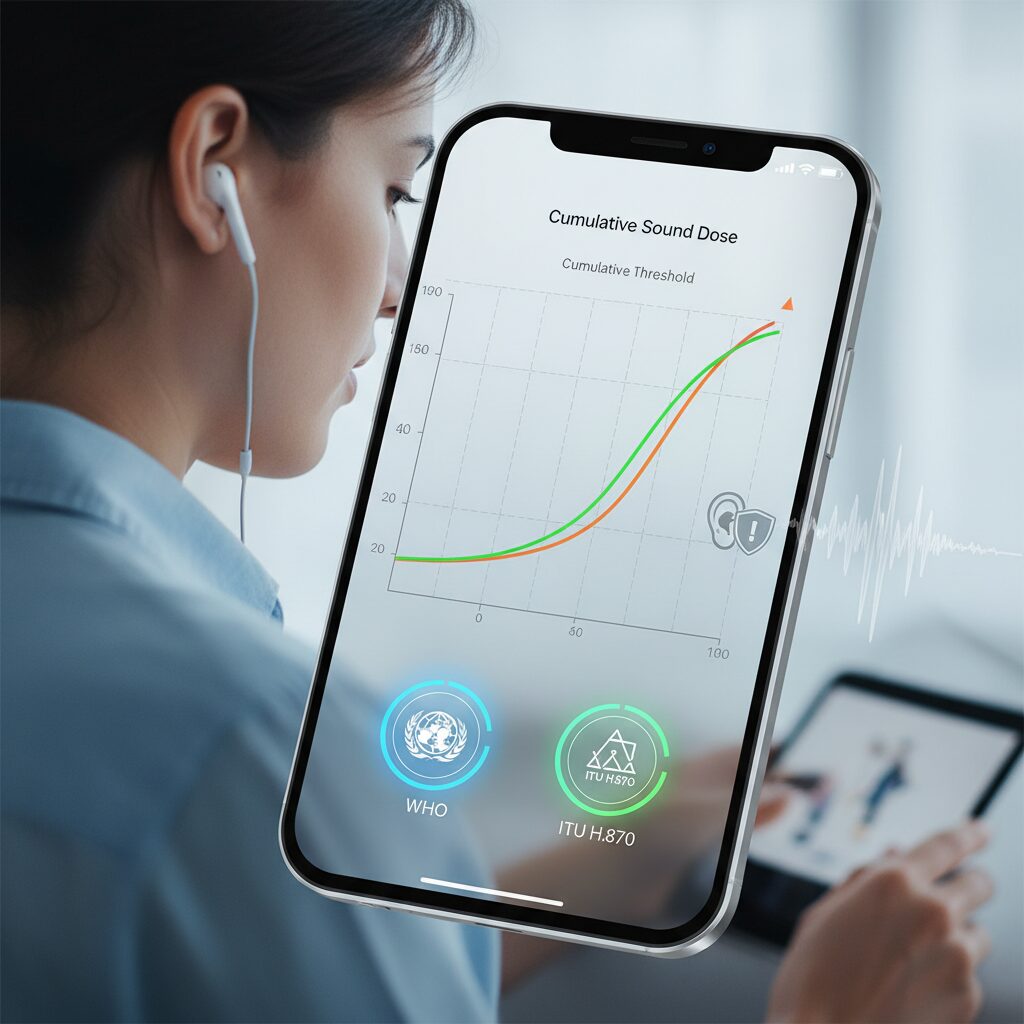
The foundation of modern automatic volume control lies in the WHO/ITU H.870 standard, a technical guideline that transforms public health theory into device-level engineering requirements. Rather than focusing on a single loud moment, H.870 is built on the Equal Energy Principle, which evaluates hearing risk based on cumulative sound exposure over time. This approach reflects decades of occupational health research showing that damage risk depends on total acoustic energy, not peak loudness alone.
In practical terms, smartphones continuously calculate what is known as “sound dose.” This metric multiplies sound pressure level by exposure duration and converts it into an energy-based value, typically expressed in pascal-squared hours (Pa²h). According to ITU-T H.870 and its 2024 compliance testing paper, manufacturers must ensure devices can monitor, log, and react when users approach recommended limits.
| User Mode | Reference Level | Weekly Exposure | Energy Limit (7 days) |
|---|---|---|---|
| Adult | 80 dB | 40 hours | 1.6 Pa²h |
| Children/Youth | 75 dB | 40 hours | 0.51 Pa²h |
These numbers are not arbitrary. As widely documented in audiology literature and reflected in WHO materials, every 3 dB increase represents a doubling of acoustic energy. That means safe exposure time halves with each 3 dB step upward. An adult who can tolerate 40 hours at 80 dB reaches the same energy dose in just 20 hours at 83 dB, and dramatically faster at higher levels.
This logarithmic relationship is the scientific core of sound dose management. It explains why devices must intervene proactively rather than wait for extreme peaks. Modern operating systems therefore track rolling seven-day exposure windows. When cumulative dose approaches 100 percent of the recommended threshold, the system issues a notification and may automatically reduce output to safer levels, typically around or below 80 dB.
Importantly, H.870 does not merely recommend warnings. It defines technical capabilities: real-time measurement, user feedback mechanisms, and configurable listening modes. Compliance testing procedures published by the ITU specify how personal audio systems should be evaluated to verify that dose calculations and limiting behaviors function as intended.
This framework represents a shift from reactive hearing care to preventive engineering. By embedding epidemiological risk models directly into firmware and DSP pipelines, smartphone makers operationalize public health guidance at global scale. In a world where billions rely on personal audio daily, sound dose management under H.870 turns abstract health recommendations into measurable, enforceable, and automated protection.
From Music to Esports: The Impact of the New H.872 Gaming Standard
The launch of the WHO/ITU H.872 standard in 2025 marks a turning point where safe listening moves beyond music streaming and becomes a core requirement for gaming and esports.
According to the World Health Organization, nearly 3 billion people worldwide play video games, many of them exposed to prolonged, high-intensity audio through headsets. Competitive titles amplify gunshots, explosions, and voice chat, often pushing sound pressure levels far above what is considered safe for extended sessions.
H.872 directly addresses this risk by embedding hearing protection into the gaming ecosystem itself.
| Area | H.870 (General Devices) | H.872 (Gaming & Esports) |
|---|---|---|
| Primary Focus | Personal audio systems | Video games & competitive play |
| Monitoring Method | Cumulative sound dose | Real-time gameplay-aware dose tracking |
| Intervention | OS-level volume limiting | In-game alerts & automatic attenuation |
Unlike traditional volume caps, H.872 requires game software to monitor output dynamically and predict when players are approaching unsafe exposure levels. When thresholds are near, the system must warn users or automatically reduce volume, especially when switching from speakers to headphones.
This is critical in esports, where players may practice for six to ten hours per day. Because every 3 dB increase doubles acoustic energy, as outlined in ITU-T H.870 technical documentation, even small volume increases dramatically shorten safe listening time.
For esports athletes, hearing protection becomes a performance issue, not just a health issue.
Major mobile platforms are integrating H.872 principles directly into gaming frameworks. Real-time DSP analysis measures peak transients common in shooter and action titles, preventing sudden spikes from exceeding safe limits. Qualcomm’s latest audio platforms, for example, enable millisecond-level response times, allowing attenuation before the ear fully registers the harmful peak.
This changes the design philosophy of competitive audio. Developers must now balance immersion, positional accuracy, and compliance. Sound cues remain precise, but excessive loudness no longer defines competitive advantage.
From a market perspective, this standard reshapes headset manufacturing as well. Esports-focused gear increasingly integrates on-device dose calculation and automatic gain control aligned with WHO guidance.
In practical terms, players experience:
Smarter alerts during marathon sessions
Automatic reduction when cumulative exposure exceeds weekly limits
Safer transitions between speakers and closed-back headsets
As WHO emphasized during World Hearing Day 2025, prevention must evolve alongside digital lifestyles. H.872 reflects that philosophy by embedding public health logic into one of the fastest-growing entertainment sectors.
The result is a structural shift: gaming audio is no longer just about intensity and immersion, but about sustainability and long-term cognitive and auditory performance.
For gadget enthusiasts and competitive players alike, this new standard signals that the future of esports will be defined not only by frame rates and latency, but by intelligent, health-aware sound engineering.
How iOS 26 Enforces Volume Limits with AI and Headphone Safety Controls
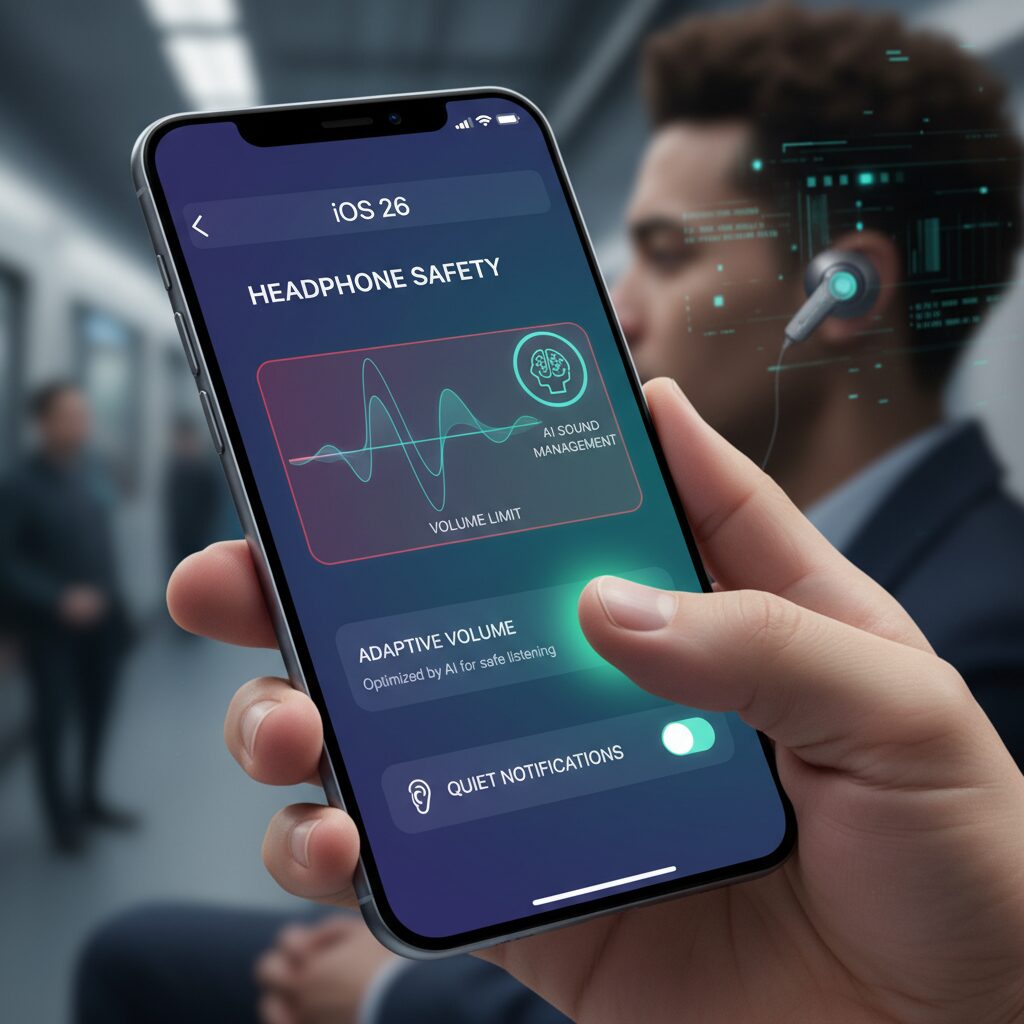
In iOS 26, volume control is no longer a simple slider but a continuously monitored health parameter. Apple integrates WHO/ITU H.870 safe listening guidelines directly into the operating system, meaning your iPhone constantly calculates cumulative sound exposure based on the equal energy principle.
This approach measures not just loudness, but loudness multiplied by time. According to WHO, 80 dB for 40 hours per week is the recommended upper limit for adults, while 75 dB applies to children and young users. Once exposure approaches these thresholds, iOS 26 intervenes automatically.
| Mode | Reference Level | Weekly Limit | System Action |
|---|---|---|---|
| Adult | 80 dB | 40 hours | Notification + auto reduction |
| Youth | 75 dB | 40 hours | Stricter cap + enforced limiter |
The enforcement mechanism operates in three AI-driven layers. First, the on-device DSP measures real-time output levels across music, video, and games. Second, if peaks exceed a user-defined ceiling such as 85 dB, the limiter compresses waveform spikes instantly. Third, when the seven-day sound dose exceeds 100 percent of WHO guidance, the system issues a headphone notification and can forcibly lower output to safer levels.
In certain regulated regions such as the EU, these limits cannot be fully disabled, reinforcing that this is a compliance feature rather than a convenience toggle. Apple Support discussions frequently show users surprised by sudden reductions, but these are typically triggered by accumulated exposure data rather than device malfunction.
iOS 26 deepens this framework through Apple Intelligence. Features such as AutoMix analyze track-to-track loudness differences and normalize transitions, preventing sudden jumps that can push exposure into risky territory. Pause for Sleep integrates motion data and Apple Watch biometrics to detect when a user falls asleep, then fades audio out to eliminate unnecessary overnight exposure.
AirPods 4 and AirPods Pro 2 extend enforcement beyond the phone itself. With 24-bit/96kHz playback and improved clarity, users perceive more detail at lower volumes, reducing the behavioral tendency to increase loudness. AI also balances translated speech and original voices during Live Translation, preventing one stream from overpowering the other.
The key shift in iOS 26 is predictive enforcement rather than reactive limitation. By forecasting when cumulative exposure will exceed safe thresholds, the system nudges users before damage risk escalates. This predictive model aligns with WHO’s broader public health strategy to prevent irreversible hearing loss, which the organization estimates contributes to massive global economic burden when unmanaged.
For power users, the Headphone Safety panel in Settings provides transparency through exposure history charts. Reviewing this data often reveals patterns such as extended high-volume gaming sessions or commuting habits that concentrate weekly sound dose. In that sense, iOS 26 functions as a personal hearing guardian, quietly recalibrating output in milliseconds while surfacing actionable insights in days.
The result is a tightly integrated AI and regulatory framework where hardware sensors, DSP computation, and global health standards converge. Volume limits are not arbitrary restrictions but dynamically enforced safety rails engineered to preserve long-term auditory health without sacrificing immersive audio quality.
AirPods 4 and Pro 2: Sleep Detection, AutoMix, and Intelligent Audio Balancing
AirPods 4 and AirPods Pro 2 are no longer just wireless earbuds. In 2026, they function as intelligent audio guardians that continuously optimize how, when, and how loudly you listen. By tightly integrating with iOS 26, these models combine sleep detection, AutoMix, and real-time audio balancing to deliver a listening experience that is both immersive and medically responsible.
What makes them stand out is not louder sound, but smarter control of sound exposure. This philosophy closely aligns with the WHO/ITU H.870 safe listening framework, which emphasizes cumulative sound dose rather than momentary volume peaks.
| Feature | Core Technology | User Benefit |
|---|---|---|
| Pause for Sleep | Biometric + motion detection | Stops playback when you fall asleep |
| AutoMix | AI-driven loudness normalization | Prevents sudden volume spikes |
| Intelligent Audio Balancing | Real-time DSP + context awareness | Optimized clarity at lower volumes |
Pause for Sleep is particularly impactful for heavy nighttime listeners. By combining motion data from iPhone sensors with health data from Apple Watch, the system detects when your breathing and movement patterns shift into sleep mode. At that moment, playback fades out automatically. This is more than convenience. According to WHO safe listening guidance, prolonged exposure even at moderate levels contributes to cumulative sound dose. Eliminating unconscious overnight playback meaningfully reduces that exposure.
AutoMix addresses another subtle but common risk: dynamic range inconsistency between tracks. Modern streaming platforms often host songs mastered at different loudness levels. Without normalization, switching from a quiet acoustic track to a heavily compressed pop song can produce abrupt spikes. AutoMix uses AI-driven loudness analysis and DSP limiting to smooth transitions in real time. The result is fewer impulsive volume adjustments and reduced risk of exceeding safe thresholds.
Intelligent Audio Balancing goes deeper than simple normalization. Leveraging on-device DSP similar in principle to Qualcomm’s next-generation sound platforms, AirPods continuously analyze output levels and environmental context. If you are in a quiet room, the system maintains clarity without encouraging higher gain. In noisier spaces, it balances transparency and playback levels so you do not compensate by pushing volume dangerously high.
Research summarized by the ITU on personal audio systems highlights that sound dose increases exponentially with decibel increments, with every 3 dB doubling acoustic energy exposure. By minimizing unnecessary peaks and flattening abrupt transitions, AirPods effectively reduce cumulative exposure without degrading perceived richness.
For audiophile-minded users, this might sound restrictive. In practice, it feels seamless. You still get detailed playback, spatial depth, and responsive dynamics. The difference is that the system works quietly in the background, preventing accidental overexposure during long listening sessions, gaming, or late-night streaming.
AirPods 4 and Pro 2 redefine premium audio not by amplifying sound, but by intelligently managing it. For gadget enthusiasts who demand both cutting-edge tech and long-term hearing sustainability, this combination of sleep detection, AutoMix, and intelligent balancing represents one of the most meaningful evolutions in personal audio to date.
Android and Samsung One UI 7: Personalized Volume Control and Hearing Tests
Android 16 and Samsung’s One UI 7 take a distinctly personalized approach to volume management. Rather than applying a uniform cap, the system adapts to the user’s hearing profile, listening habits, and real-time environment. This philosophy aligns with the WHO/ITU H.870 framework, which emphasizes cumulative sound dose rather than momentary loudness.
On Galaxy devices running One UI 7, volume control becomes contextual and individualized. The goal is not simply to reduce sound, but to deliver clarity at safer levels.
Personalized Volume Control with Sound Assistant
Samsung integrates advanced controls through Sound Assistant, now deeply embedded into One UI 7. According to Samsung’s Global Newsroom, this evolution reflects user demand for granular audio customization beyond standard 15-step sliders.
Users can fine-tune volume in up to 100 incremental steps, enabling subtle adjustments that reduce the temptation to overcompensate with excessive loudness. From a behavioral perspective, this micro-adjustment capability lowers the risk of abrupt volume spikes.
Another standout capability is per-app volume management. For example, navigation guidance can automatically duck music playback, while social media apps can be capped at predefined maximum levels. This directly addresses one of the most common complaints in user forums: sudden high-volume video playback.
| Feature | Function | User Benefit |
|---|---|---|
| Per-App Volume | Independent gain control by app | Prevents unexpected loud bursts |
| 100-Step Adjustment | Fine-grained volume increments | More precise safe listening levels |
| Automatic Ducking | Dynamic reduction during alerts | Maintains clarity without raising base volume |
Importantly, Android continues to track cumulative exposure in accordance with international safe listening recommendations. When thresholds approach WHO guidance—such as the 80 dB weekly exposure reference for adults—the system issues alerts and can automatically reduce output levels.
Advanced Hearing Test and Personalized Audio Mapping
Where One UI 7 truly differentiates itself is in its built-in hearing assessment tools. When paired with Galaxy Buds3 Pro, users can complete an on-device hearing test that measures sensitivity across frequency bands.
Research in audiology shows that age-related hearing loss often affects higher frequencies first. Instead of increasing overall volume to compensate, the system selectively boosts deficient frequency ranges through adaptive equalization. This approach preserves safe overall decibel levels while improving intelligibility.
This frequency-specific compensation reduces the need for risky global volume increases. It transforms volume control from a blunt instrument into a precision calibration tool.
The AI engine further adapts in real time. Galaxy Buds leverage environmental sensing and adaptive noise control to balance media playback against surrounding sound. In noisy transit settings, stronger ANC reduces background noise so users can maintain lower playback levels. In quieter environments, the system relaxes isolation and subtly reduces output.
Emergency and voice detection features add another safety layer. If sirens or nearby speech are detected, media volume is automatically attenuated. This protects situational awareness without requiring manual intervention.
Under the hood, these capabilities rely on advanced DSP and low-latency processing architectures, such as Qualcomm’s latest sound platforms described by industry engineers. MEMS microphones continuously sample ambient sound, while on-device machine learning models classify and respond within milliseconds.
For enthusiasts who demand control but also value long-term hearing health, Android and One UI 7 represent a balanced ecosystem. The system respects user autonomy while embedding evidence-based safeguards. Personalized volume control and integrated hearing tests do not restrict the experience—they refine it, ensuring that high-fidelity listening remains sustainable for years to come.
Adaptive Noise Control, Siren Detection, and Context-Aware Audio
Adaptive Noise Control in 2026 is no longer a simple on/off noise‑cancelling switch. It operates as a continuously learning system that analyzes ambient sound through MEMS microphones and on‑device DSP, then recalibrates both noise suppression strength and media volume in real time.
Qualcomm’s S5/S3 Gen 2 sound platforms, as highlighted in industry briefings, enable millisecond‑level processing, allowing earbuds and smartphones to respond to sudden environmental changes faster than human reflexes. This ultra‑low latency adaptation prevents users from instinctively raising volume in noisy spaces, directly supporting WHO/ITU safe listening principles.
In practice, adaptive control dynamically balances three variables: ambient noise level, playback loudness, and user context. Instead of maximizing cancellation, the system optimizes perceived clarity at the lowest safe output level.
| Scenario | System Response | User Benefit |
|---|---|---|
| Subway commute | Stronger ANC, moderated playback gain | Clear audio without volume spikes |
| Quiet office | Reduced ANC, lowered media level | Less ear fatigue |
| Outdoor walking | Ambient blend mode + safety monitoring | Situational awareness |
Siren Detection represents a critical safety layer on top of adaptive control. According to Samsung’s One UI 7 updates and Galaxy Buds integration reports, AI models are trained to identify high‑priority acoustic signatures such as emergency vehicle sirens. When detected, the system immediately attenuates media playback and amplifies external sound.
This is not a simple frequency trigger. Sirens vary by country and vehicle type, so machine learning classifiers evaluate modulation patterns and temporal signatures rather than relying solely on pitch. The result is fewer false positives and faster, context‑aware transitions.
Context‑Aware Audio expands this concept further by incorporating motion sensors, GPS data, and behavioral patterns. Sony’s Adaptive Sound Control demonstrates how movement states such as walking, commuting, or staying still automatically shift audio profiles. Volume, ANC intensity, and ambient pass‑through are adjusted as a unified preset rather than separate toggles.
Research such as the AdaptiveSound project presented at ASSETS 2023 shows how feedback‑loop systems can prioritize critical environmental cues for deaf and hard‑of‑hearing users. When specific sounds are recognized, media playback is reduced and alternative alerts are triggered. This approach reframes audio control from entertainment enhancement to information prioritization.
Ultimately, adaptive noise control, siren detection, and context‑aware audio form a layered safety architecture. The goal is not louder immersion but intelligent moderation, ensuring that users remain both protected and connected to their surroundings without consciously managing volume themselves.
Inside the Chip: Qualcomm S5/S3 Gen 2 and Real-Time DSP Protection
The intelligence behind automatic volume control in 2026 does not live in the user interface. It lives deep inside the chip. Qualcomm’s S5 and S3 Gen 2 Sound Platforms integrate dedicated DSP blocks that continuously calculate sound dose, environmental noise, and output levels in real time, aligning device behavior with WHO/ITU H.870 requirements.
According to ITU technical documentation on safe listening compliance, accurate dose estimation requires continuous monitoring of both amplitude and exposure time. The S5/S3 Gen 2 platforms handle this at the silicon level, offloading computation from the main CPU and enabling millisecond-level response to sudden peaks.
This hardware-level processing is what makes real-time protection actually reliable.
| Component | Role | User Impact |
|---|---|---|
| Integrated DSP | Real-time dB and dose calculation | Instant peak limiting |
| MEMS microphones | Ambient sound capture | Context-aware volume balancing |
| Bluetooth SoC | Low-latency signal transport | Seamless adaptive control |
The embedded DSP continuously analyzes waveform peaks before they reach the driver. If output approaches a predefined threshold, a limiter engages within milliseconds. Because this process occurs locally on the chip, it does not rely on cloud latency or app-level permissions.
Research highlighted by Mouser’s technical review of next-generation audio platforms explains that modern audio SoCs combine machine learning accelerators with classical signal processing. This hybrid architecture allows pattern recognition, such as identifying transient gunshots in games or sudden notification spikes, while still enforcing deterministic safety limits.
Protection is predictive, not reactive.
When paired with MEMS microphones embedded in earbuds, the S5/S3 Gen 2 platforms evaluate external noise floors. If ambient noise rises, the system can increase noise cancellation strength instead of simply boosting playback volume. This distinction is critical because raising output power directly increases cumulative Pa²h exposure under H.870 calculations.
Low-latency Bluetooth pipelines are another key factor. The Gen 2 architecture reduces processing delay to the point where environmental changes are reflected almost instantly. Users experience smooth transitions rather than abrupt drops, even though protective algorithms are actively running.
Some premium implementations also integrate biometric feedback modules, as industry analyses note. Heart rate variability or stress indicators can subtly influence equalization and loudness profiles. While still emerging, this creates a feedback loop in which the chip adapts not only to sound, but to the listener’s physiological state.
The result is a silicon-level guardian that operates continuously, invisibly, and independently of user awareness.
In practical terms, this means volume reduction in 2026 smartphones is rarely a blunt software cap. It is the outcome of coordinated DSP limiting, machine-learned context detection, and compliance-driven energy accounting executed directly within Qualcomm’s audio subsystem.
For gadget enthusiasts, understanding this internal architecture reveals why modern devices feel smarter. The protection is not just a setting. It is engineered into the chip itself.
Japanese Audio Innovation: Yamaha Listening Care and Sony Adaptive Sound Control
Japanese audio brands have taken a distinctive approach to automatic volume control in 2026. Rather than simply limiting decibels in line with WHO/ITU H.870 guidelines, they focus on making lower volumes feel subjectively richer and contextually smarter. Yamaha’s Listening Care and Sony’s Adaptive Sound Control represent two complementary philosophies: psychoacoustic compensation and situational intelligence.
Both technologies aim to reduce excessive sound exposure without sacrificing perceived quality. This is crucial because, as the WHO explains, cumulative sound dose—not momentary loudness—drives hearing risk. If users can enjoy clarity at lower levels, they are far less likely to exceed weekly exposure thresholds such as 80 dB for 40 hours in adult mode.
Yamaha Listening Care: Psychoacoustics in Action
Human hearing follows the so‑called loudness curve: when volume drops, bass and treble become harder to perceive. Yamaha addresses this with real‑time equalization that dynamically boosts frequency bands that would otherwise fade at low levels. According to Yamaha’s own technical explanation, this processing is continuously adjusted depending on playback intensity.
The result is subtle but powerful. Instead of turning the volume up to “feel” the music, listeners retain full‑range balance even at reduced output. In practical terms, this aligns with safe‑listening recommendations because satisfaction no longer depends on raw sound pressure.
| Aspect | Conventional Low Volume | Listening Care Enabled |
|---|---|---|
| Bass perception | Weaker, less immersive | Compensated and fuller |
| Treble clarity | Duller detail | Maintained articulation |
| User behavior | Tendency to increase volume | Comfortable at safer levels |
This approach is particularly relevant in mobile ecosystems where OS‑level limiters may intervene after cumulative exposure reaches 100 percent. By improving perceived richness beforehand, Yamaha reduces the likelihood of hitting that ceiling.
Sony Adaptive Sound Control: Context Is Everything
Sony’s strategy, widely implemented in its headphones and integrated with smartphones, relies on behavioral and environmental detection. Using GPS and motion sensors, the system distinguishes between states such as walking, commuting, or staying still, then automatically adjusts noise canceling and ambient sound intake.
For example, during a train commute, stronger noise canceling reduces the need to raise media volume to overcome background noise. When walking in urban areas, the system can shift to ambient mode, lowering playback while amplifying external sounds for safety. This dynamic balancing reduces both acoustic risk and situational danger.
Industry analyses of AI audio platforms, including reports referenced by semiconductor suppliers such as Qualcomm, highlight how MEMS microphones and low‑latency DSP enable these real‑time transitions. Sony leverages this hardware layer to ensure that adjustments occur within milliseconds, preventing sudden loud peaks or unsafe isolation.
In densely populated Japanese cities, where commuters frequently transition between quiet offices and noisy transport hubs, this location‑aware audio management feels particularly natural. Instead of reacting after exposure limits are exceeded, the system anticipates context and optimizes volume preemptively.
For gadget enthusiasts, these technologies demonstrate that the future of audio is not about louder hardware, but smarter listening ecosystems. Safe listening becomes seamless, embedded in psychoacoustics and AI rather than enforced as a blunt constraint.
Why Your Volume Drops Unexpectedly: Bluetooth Misclassification and Hardware Limits
Even when you are fully aware of WHO/ITU safe‑listening standards, sudden volume drops can still feel random. In reality, two highly technical factors often sit behind the behavior: Bluetooth device misclassification and hardware-level output limits.
Modern smartphones do not treat every connected audio device equally. They classify each Bluetooth accessory as headphones, speakers, car stereos, or hearing devices, and then apply different safety rules accordingly. If that classification is wrong, the volume logic changes instantly.
When your phone thinks a car stereo is a pair of headphones, it activates strict near‑ear protection. That is when unexpected attenuation happens.
| Actual Device | Detected As | System Reaction |
|---|---|---|
| Car audio system | Headphones | Applies WHO-based exposure limits |
| External speaker | Headphones | Triggers loud sound reduction |
| DAC adapter + wired headset | Unknown headset | Conservative output cap |
According to discussions in Apple Support Communities and user reports referenced in technical forums, this misclassification most commonly occurs with aftermarket car systems and certain Bluetooth receivers. The OS assumes the sound is delivered directly to the ear canal and enforces H.870 cumulative exposure rules.
Because the equal energy principle doubles acoustic energy with every 3 dB increase, the system reacts aggressively. If your listening history is already near the weekly threshold, the phone may immediately scale output down to approximately 80 dB or below.
Hardware constraints create a second layer of volume reduction that many users overlook. Smartphones continuously monitor temperature, amplifier load, and DAC behavior. Under high thermal stress—such as gaming while charging—power management circuits may lower output voltage to protect internal components.
In devices like Xperia models discussed in Japanese user communities, firmware updates that strengthen thermal control have coincided with perceived volume drops. This is not hearing protection but amplifier safeguarding.
Adapter impedance mismatch adds another complication. When using USB‑C or Lightning DAC adapters, the phone may not precisely identify output impedance or sensitivity. To avoid exceeding safe acoustic levels, the system applies a conservative gain ceiling.
From the phone’s perspective, uncertainty equals risk. If it cannot confirm the acoustic path, it chooses protection over loudness.
Qualcomm’s S5/S3 Gen 2 Sound platforms further tighten this loop by enabling millisecond-level DSP monitoring. That means output limiting can occur faster than human perception, which makes the drop feel abrupt rather than gradual.
If you experience repeated unexpected reductions, checking Bluetooth device type settings, verifying certified adapters, and avoiding high thermal load scenarios often resolves the issue. In most cases, the volume is not malfunctioning—it is responding to classification logic or hardware protection protocols working exactly as designed.
Accessibility Breakthroughs: AdaptiveSound and AI for Deaf and Hard-of-Hearing Users
Accessibility in 2026 is no longer limited to screen readers or captioning. It is deeply embedded in how smartphones manage sound itself.
For deaf and hard-of-hearing users, automatic volume control has evolved into an intelligent prioritization system. Instead of simply lowering audio for safety, devices now identify, classify, and elevate critical environmental sounds in real time.
This shift is driven by AI-powered frameworks such as AdaptiveSound, originally presented at ASSETS 2023, and now increasingly integrated into mainstream mobile operating systems.
How AdaptiveSound Redefines Audio Awareness
AdaptiveSound is built around an interactive feedback loop. Users first train the system by recording and labeling important environmental sounds—such as a baby crying, a fire alarm, or a doorbell.
The AI model then continuously monitors ambient audio through on-device microphones, distinguishing learned sounds from background noise. When a target sound is detected, the system automatically reduces media playback volume and delivers multimodal alerts.
According to the original research paper, this feedback-loop design significantly improves recognition accuracy over static classifiers because users can iteratively correct misclassifications and refine detection profiles.
| Function | Technology Layer | User Impact |
|---|---|---|
| Custom Sound Training | On-device machine learning | Personalized detection of meaningful sounds |
| Real-Time Classification | DSP + MEMS microphones | Instant identification of alarms or voices |
| Automatic Volume Reduction | System-level audio control | Prevents masking of critical cues |
| Multimodal Alerts | Visual + haptic feedback | Accessible notification beyond sound |
Importantly, this processing occurs on-device, minimizing latency and preserving privacy. As semiconductor platforms such as Qualcomm’s latest audio SoCs demonstrate, real-time inference can now be executed in milliseconds.
This matters because safety-critical sounds—like emergency sirens—require immediate response. Delayed recognition would defeat the purpose of accessibility enhancement.
The breakthrough is not louder sound, but smarter prioritization. Media audio becomes secondary when human safety or communication is at stake.
WHO’s broader framework on hearing health emphasizes safe listening thresholds, but accessibility extends that philosophy further. It ensures that users who rely less on auditory acuity are not excluded from environmental awareness.
Modern systems therefore integrate three simultaneous controls: cumulative sound dose management under ITU-T H.870 guidelines, adaptive noise control, and AI-driven environmental recognition.
For example, when media is playing through wireless earbuds, the device may reduce playback volume upon detecting a siren, while simultaneously amplifying external audio through transparency mode. This dynamic shift allows users to perceive urgency without manually adjusting settings.
Another powerful application is conversational detection. If someone speaks directly to the user, AI can identify speech patterns and lower background media automatically, making lip-reading or residual hearing more effective.
Research communities note that context-aware audio systems reduce cognitive load for deaf and hard-of-hearing individuals, who otherwise must constantly monitor their surroundings visually.
In practical terms, this means fewer missed alarms, improved responsiveness in public spaces, and greater independence at home.
The broader implication is profound. Smartphones are transitioning from passive media players to active environmental interpreters. For accessibility, that transformation is not incremental—it is foundational.
By combining AI classification, hardware-level audio control, and evidence-based health standards, 2026 smartphones are creating an ecosystem where sound is no longer a barrier but a bridge.
For gadget enthusiasts, this represents one of the most meaningful innovations in mobile technology: audio intelligence that protects, informs, and empowers simultaneously.
The Future of Emotion-Aware Volume Control and Biometric Audio Optimization
Emotion-aware volume control is emerging as the next logical step beyond rule-based safe listening. Instead of reacting only to decibel thresholds defined by WHO/ITU H.870 and H.872, next-generation systems analyze physiological signals to infer how a user feels in real time.
Qualcomm’s S5/S3 Gen 2 sound platforms already support on-device machine learning with low-latency DSP processing. When combined with biometric sensors in earbuds and smartwatches, smartphones can correlate heart rate variability (HRV), skin conductance (EDA), and motion data with audio behavior.
This shifts volume control from “how loud is the sound?” to “how is the user responding to the sound?”
Biometric Inputs and Audio Adaptation
| Biometric Signal | Detected State | Audio Optimization |
|---|---|---|
| HRV (Heart Rate Variability) | Stress or fatigue | Gradual volume reduction, softer EQ profile |
| EDA (Skin Conductance) | Heightened arousal | Limiter tightening, transient peak suppression |
| Sleep detection | Onset of sleep | Automatic fade-out and playback stop |
Research into adaptive auditory systems, including work presented in accessibility-focused studies such as AdaptiveSound, shows that feedback-loop models can dynamically prioritize relevant sounds while attenuating others. This principle is now being extended from environmental alerts to emotional regulation.
For example, if wearable sensors detect sustained sympathetic nervous system activation, the system can subtly lower high-frequency energy that is often associated with listening fatigue. Instead of a sudden volume drop, the algorithm applies micro-adjustments over several seconds to preserve immersion.
The goal is optimization, not restriction.
Biometric audio engines also address a long-standing issue in personal listening: users often increase volume during cognitive load. By monitoring physiological strain, AI can counteract this tendency before cumulative sound dose approaches WHO limits.
In gaming scenarios aligned with H.872 safety standards, emotion-aware systems may detect elevated stress during competitive play. Rather than interrupting gameplay with alerts, the device can rebalance dynamic range compression and limit peak explosions while preserving dialogue clarity.
Privacy remains central. Most implementations process biometric signals on-device through dedicated DSP cores, avoiding cloud transmission. According to semiconductor vendors, millisecond-level latency ensures that adjustments occur faster than conscious perception, maintaining natural sound continuity.
Looking ahead, emotion-aware volume control represents a convergence of digital health and high-fidelity audio. As biometric sensing becomes more precise, smartphones will not only protect hearing from excessive sound energy but also tune audio to stabilize mood, enhance focus, and reduce fatigue.
Volume will no longer be a static slider, but a living parameter synchronized with the listener’s body.
参考文献
- World Health Organization (WHO):New WHO and ITU standard aims to prevent hearing loss among gamers
- International Telecommunication Union (ITU):ITU-T H.870 (V2) Recommendation
- World Health Organization (WHO):WHO-ITU global standard for safe listening devices and systems
- MacRumors:iOS 26: Everything We Know
- Samsung Global Newsroom:One UI 7
- Mouser Electronics Blog:New Tech Tuesdays: The Sound of the Future Is Smarter
- ACM ASSETS Conference:AdaptiveSound: An Interactive Feedback-Loop System to Improve Sound Recognition for Deaf and Hard of Hearing Users