Have you ever wondered why some smartphone videos feel cinematic and emotional, while others look hyper‑real and incredibly smooth? In 2026, the choice between 24fps, 30fps, and 60fps is no longer a minor setting hidden in a menu. It has become one of the most strategic creative decisions for anyone serious about mobile video.
Today’s flagship smartphones can shoot 4K at 120fps, record in 10‑bit Log, and even synchronize multiple devices with professional workflows. At the same time, social media platforms quietly optimize your uploads, and AI systems dynamically adjust frame rates in real time. The result is a complex ecosystem where technology, psychology, and platform algorithms intersect.
In this article, you will discover how frame rate influences human perception, editing flexibility, battery life, heat management, and even viewer engagement on platforms like YouTube, Instagram, and TikTok. By the end, you will be able to choose the optimal frame rate for your creative goals in 2026 with confidence and technical clarity.
- Why Frame Rate Is the Most Underrated Creative Decision in 2026
- The Science of Time Resolution: What 24fps, 30fps, and 60fps Really Mean
- Debunking the 24fps Myth: What Human Vision Research Actually Shows
- 120fps and Beyond: What VR and Reaction-Time Studies Reveal About High Frame Rates
- Flagship Smartphone Video Capabilities in 2026: iPhone, Galaxy, Xperia, Pixel, and More
- AI ProVisual Engines and Intelligent Variable Frame Rate Recording
- 3nm Chips, ISP Evolution, and Vapor Chamber Cooling: The Hardware Behind 4K 120fps
- Silicon-Carbon Batteries and the Power Demands of High Frame Rate Video
- Social Media Algorithms and Frame Rate Optimization: YouTube, Instagram, TikTok, X, and LinkedIn
- Professional Workflows: Genlock, Direct-to-SSD Recording, and Mobile Cinema Rigs
- AI Video Agents, Character Consistency, and Real-Time Voice Cloning in 2026
- Choosing the Right Frame Rate for Cinematic Storytelling, Sports, Gaming, and Marketing
- 参考文献
Why Frame Rate Is the Most Underrated Creative Decision in 2026
In 2026, frame rate is no longer a technical afterthought. It is one of the most powerful creative decisions you can make.
With smartphones such as the iPhone 17 Pro Max and Xperia 1 VII offering 4K at 120fps across multiple lenses, and platforms like YouTube preserving original frame rates up to 60fps and beyond, the choice between 24, 30, and 60fps directly shapes how your audience feels, not just how your footage looks.
Frame rate now defines emotional tone, cognitive clarity, and even platform performance.
At its core, frame rate determines temporal resolution: how many visual slices of time you present every second. According to research on human visual perception, the long-standing belief that “the human eye can only see 24fps” has been scientifically debunked. Studies on flicker fusion thresholds show that under bright conditions, humans can detect changes well above 60Hz, meaning higher frame rates are perceptually meaningful.
This matters because perception shapes trust and immersion. A 24fps clip feels cinematic partly due to motion blur and historical conditioning. A 60fps clip feels immediate and real because it reduces temporal ambiguity.
| Frame Rate | Perceptual Effect | Best Used For |
|---|---|---|
| 24fps | Emotional, narrative weight | Storytelling, cinematic content |
| 30fps | Balanced clarity | Social media, interviews |
| 60fps+ | High realism, fluid motion | Sports, action, product demos |
In VR research published in Frontiers in Virtual Reality, 120fps has been identified as a critical threshold for reducing simulator sickness. Lower frame rates increase latency mismatches between visual and vestibular systems, which can cause discomfort. Even outside VR, smoother motion reduces cognitive load and improves perceived responsiveness.
Gaming studies measuring manual reaction time show performance improves as refresh rates increase from 30Hz to 60Hz and 120Hz. MEG-based neuroscience research estimates visual-to-motor processing delays around 150–200ms, and higher frame rates reduce uncertainty during this window.
Higher frame rates do not just look smoother. They change how quickly and confidently we react.
On the production side, 2026 hardware removes previous trade-offs. Thanks to 3nm chipsets and improved ISP pipelines, devices can maintain 10-bit HDR and high frame rates simultaneously. Vapor chamber cooling systems in flagship models prevent thermal throttling during extended 4K 120fps recording. Silicon-carbon batteries, now mainstream in models like the Oppo Find X9 Pro, provide the sustained power required for hours of high-frame-rate capture.
This technical foundation means frame rate is finally a creative choice, not a limitation.
Meanwhile, social platforms impose their own logic. Instagram and Facebook often standardize playback around 30fps, while YouTube preserves original frame rates. Choosing 60fps for action content destined for a 30fps feed can still be strategic if you plan slow-motion edits, because 4K 120fps footage can be conformed to 30fps for smooth 4× slow motion without resolution loss.
AI adds another layer. Intelligent variable frame rate systems can dynamically allocate higher frame rates to regions of interest, optimizing both storage and power. This signals a shift: frame rate is becoming adaptive, context-aware, and algorithmically guided.
In 2026, deciding between 24, 30, or 60fps is not about tradition. It is about designing perception. It is about aligning neuroscience, hardware capability, and platform behavior with your creative intent.
The most underrated creative decision is often the one that controls time itself.
The Science of Time Resolution: What 24fps, 30fps, and 60fps Really Mean
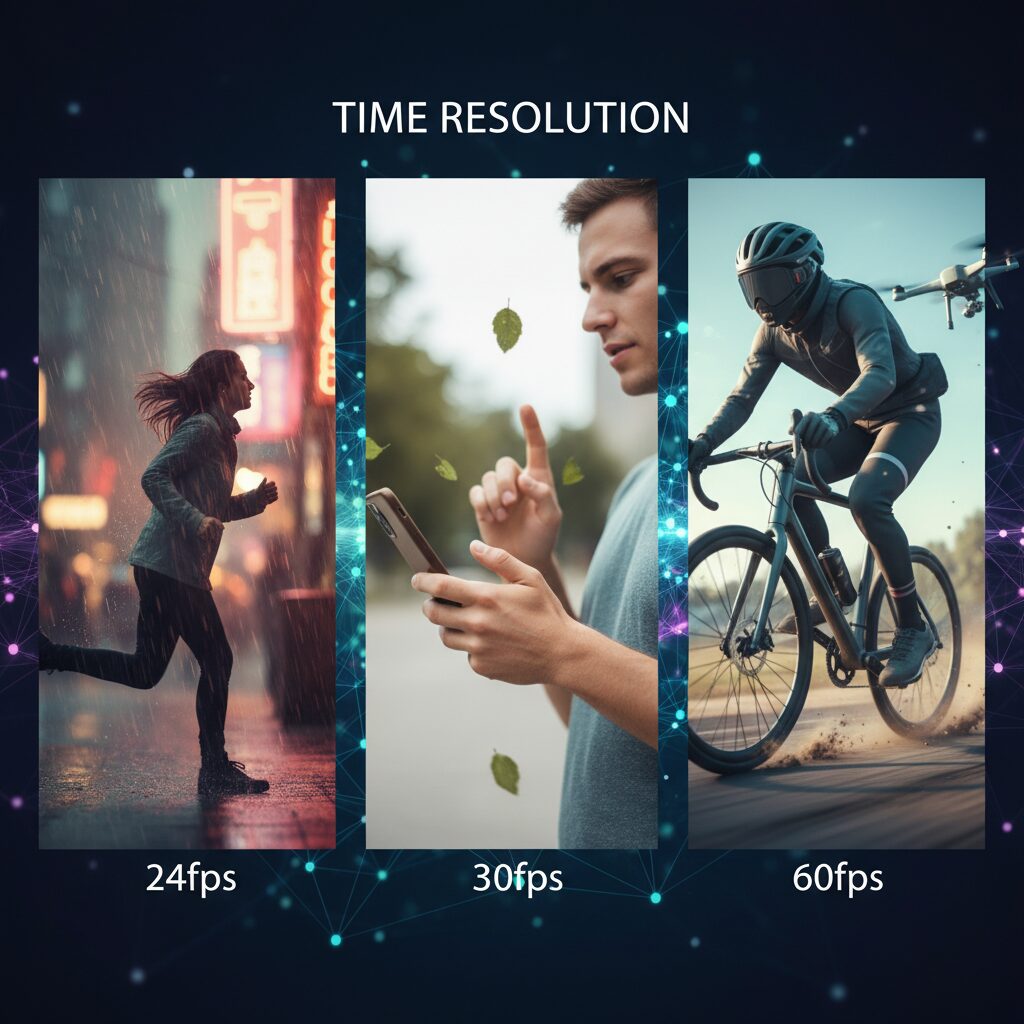
Frame rate is not just a number on a spec sheet. It defines the temporal resolution of a video—how finely time itself is sliced and presented to your eyes.
When you choose 24fps, 30fps, or 60fps, you are deciding how many still images are shown per second. That decision directly shapes motion clarity, blur characteristics, cognitive load, and even emotional tone.
In 2026’s mobile video ecosystem, understanding this scientific foundation is more important than ever.
How Time Is Quantized
| Frame Rate | Frames per Second | Time per Frame |
|---|---|---|
| 24fps | 24 images | ≈41.7ms |
| 30fps | 30 images | ≈33.3ms |
| 60fps | 60 images | ≈16.7ms |
The key difference lies in the duration of each frame. At 24fps, each image remains on screen for about 41.7 milliseconds. At 60fps, that window shrinks to 16.7 milliseconds.
Shorter frame duration means more frequent visual updates, which reduces motion judder and increases perceived smoothness.
This is not subjective preference alone; it is rooted in human visual processing.
The Human Visual System Is Not Limited to 24fps
The long-standing claim that “the human eye can only see 24fps” has been repeatedly challenged. Research on flicker fusion threshold shows that under bright conditions, humans can detect temporal changes well above 50–60Hz.
Studies cited in perceptual science and VR research, including work published in Frontiers in Virtual Reality, demonstrate that higher refresh rates significantly improve comfort and reduce simulator sickness.
In other words, our visual system processes continuous light changes, not discrete frames. Frame rate interacts with motion blur, display refresh rate, and latency.
Magnetoencephalography studies indicate that visual perception and motor response involve roughly 150–200ms of neural processing time. Increasing frame rate does not eliminate this delay, but it reduces uncertainty in motion sampling.
That reduction improves timing accuracy, especially in fast-moving scenes.
Motion Blur and Cognitive Interpretation
At 24fps, motion blur plays a structural role. With a traditional 180-degree shutter equivalent, each frame captures roughly half of its exposure interval as motion blur.
This blur helps the brain interpolate missing motion information. The result feels cohesive and “cinematic,” not because 24fps matches biology, but because blur masks temporal gaps.
At 60fps, motion is sampled more frequently, so less blur is required for continuity. Movement appears crisp, immediate, and highly responsive.
30fps sits between these extremes. It reduces judder compared to 24fps while maintaining moderate data efficiency and broadcast compatibility.
According to social video specification guides such as Wyzowl’s 2026 update, 30fps remains a dominant platform standard because it balances smoothness and bandwidth.
From a physics and perception standpoint, the difference between 24, 30, and 60fps is a difference in how finely reality is measured over time.
Higher frame rates capture more temporal detail. Lower frame rates rely more on blur and perceptual filling-in.
Once you understand that frame rate is fundamentally about how densely time is sampled, the creative and technical implications become much clearer.
Debunking the 24fps Myth: What Human Vision Research Actually Shows
For decades, a persistent claim has circulated in both filmmaking and tech communities: humans can only see up to 24 frames per second. It sounds scientific, but modern vision research tells a very different story.
The human visual system does not operate in discrete “frames.” It continuously processes changes in light intensity, contrast, and motion. Treating the eye like a 24fps camera oversimplifies a far more dynamic biological system.
According to research summarized in perceptual psychology and neuroscience literature, what matters is not a fixed frame limit but temporal sensitivity under specific conditions.
Flicker Fusion Threshold Is Not 24fps
The concept often confused with frame rate perception is the flicker fusion threshold (FFT). This refers to the frequency at which a flickering light appears steady to an observer.
Under laboratory conditions, studies show that FFT commonly falls between 48Hz and 60Hz, and can exceed that depending on brightness and retinal location. Cone cells in the fovea, responsible for high-acuity vision, demonstrate particularly high temporal resolution in bright environments.
| Condition | Observed Threshold | Key Factor |
|---|---|---|
| Low illumination | ~40–50Hz | Rod-dominant vision |
| High illumination | ~60Hz or higher | Cone activation |
| Peripheral vision | Often higher sensitivity | Motion detection bias |
This alone contradicts the idea that 24fps represents a biological ceiling. Instead, 24fps works because motion blur and persistence of vision mask discontinuities, not because the brain cannot detect higher temporal detail.
Reaction Time and Neural Processing
Magnetoencephalography research published in peer‑reviewed neuroscience journals shows that visual perception and motor response involve approximately 150–200 milliseconds of processing delay. However, this does not mean the brain samples the world slowly.
Higher frame rates reduce temporal ambiguity between successive visual states. In controlled gaming experiments cited in frame rate perception analyses, performance and manual reaction times improved as displays increased from 30Hz to 60Hz and beyond.
Evidence from Virtual Reality
Virtual reality research provides especially compelling evidence. Studies in immersive display environments report that frame rates around 120fps significantly reduce simulator sickness compared to lower rates.
When visual updates lag behind head movement, the brain detects a mismatch between vestibular and visual signals. Increasing frame rate and reducing latency measurably decreases nausea and discomfort, demonstrating that the visual system remains sensitive well beyond 24fps.
If humans were capped at 24fps perception, these differences would not produce statistically significant changes in user comfort and performance. Yet they do.
The enduring popularity of 24fps therefore stems from aesthetic convention and motion blur characteristics, not from biological limitation. Human vision is adaptive, context-dependent, and capable of resolving temporal changes far beyond the cinematic standard.
Understanding this distinction is crucial for modern creators. Frame rate is not constrained by the eye’s “maximum,” but by artistic intent, motion portrayal, and display technology.
120fps and Beyond: What VR and Reaction-Time Studies Reveal About High Frame Rates
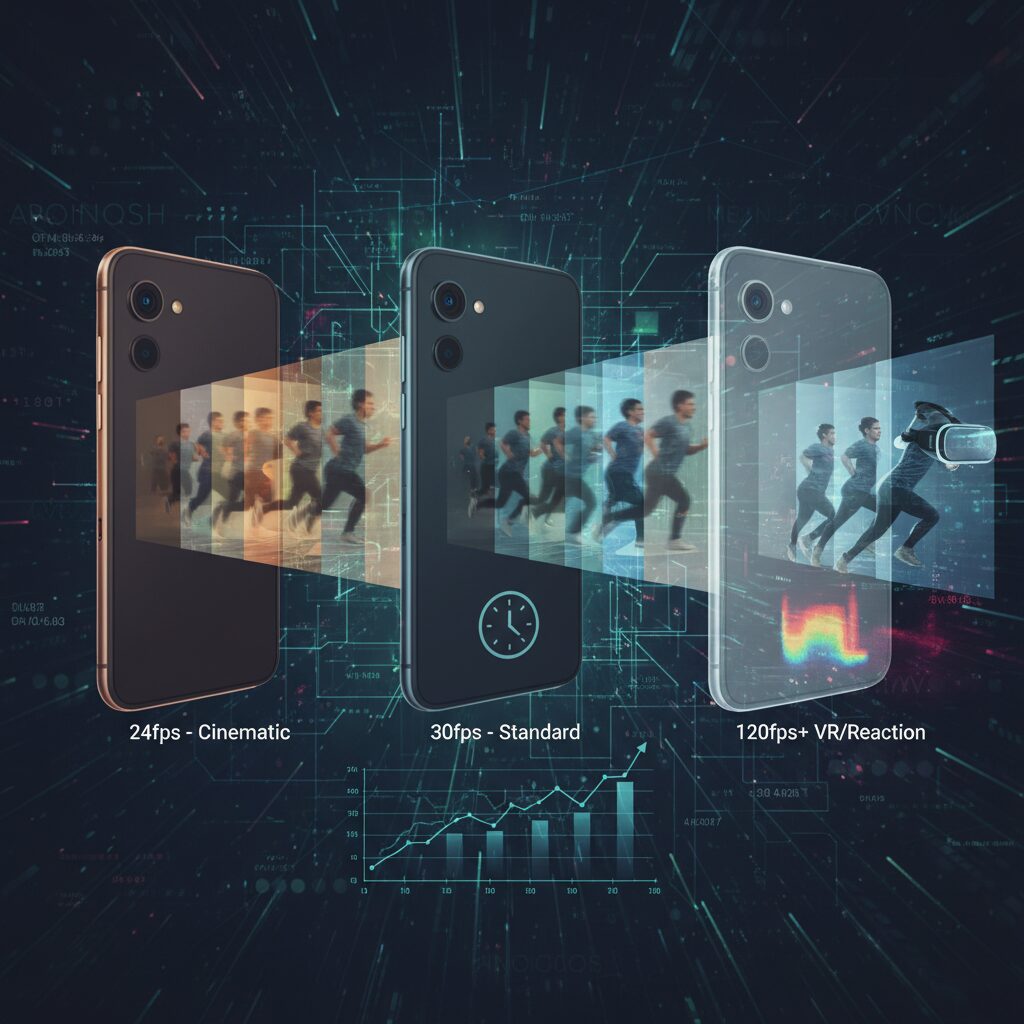
When frame rates move beyond 120fps, the discussion shifts from aesthetics to neuroscience and human limits.
In VR and high-speed interaction environments, frame rate is not simply about smoothness, but about how precisely the brain can align visual input with motor response.
This is where high frame rates become a performance variable, not a visual luxury.
Flicker Fusion and Temporal Sensitivity
For decades, the idea that “the human eye sees only 24fps” persisted. However, perceptual research shows that the human visual system does not operate in frames at all.
Studies on flicker fusion threshold demonstrate that under controlled laboratory conditions, humans can detect temporal changes well above 48–60Hz, depending on luminance and retinal position.
According to perceptual analyses cited in recent visual science discussions, cone cells in the central retina maintain particularly high temporal resolution under bright conditions.
| Condition | Temporal Sensitivity | Implication |
|---|---|---|
| Low luminance | Lower fusion threshold | Flicker more noticeable |
| High luminance | 60Hz+ | Smoother motion perceived |
| Peripheral vision | Higher motion sensitivity | Movement artifacts detected faster |
This variability explains why higher frame rates feel more stable, especially in immersive displays filling the visual field.
120fps as a VR Stability Threshold
Virtual reality research provides some of the clearest evidence. Studies published in Frontiers in Virtual Reality and related human–computer interaction research show that increasing frame rate significantly reduces simulator sickness symptoms.
When visual updates lag behind head movement, the brain detects a mismatch between visual input and vestibular feedback.
Maintaining 120fps or higher reduces this temporal discrepancy, lowering nausea and disorientation.
Experimental comparisons between lower frame rates and 120Hz conditions demonstrate measurable improvements in user comfort and task performance.
In high-immersion contexts, even small latency reductions can meaningfully affect subjective realism.
This is why many premium VR systems treat 120Hz as a baseline rather than a luxury specification.
Reaction Time and Competitive Performance
Frame rate also influences measurable reaction speed. Research using magnetoencephalography (MEG) indicates that visual perception and motor response involve a delay of roughly 150–200 milliseconds.
Higher refresh environments reduce uncertainty within that window by presenting more frequent motion updates.
More visual samples per second mean fewer gaps in motion prediction.
Gaming experiments comparing 30Hz, 60Hz, 120Hz, and 240Hz displays consistently show faster manual reaction times and improved performance as frame rate increases.
The improvement is not infinite, but the gains between 60Hz and 120Hz remain statistically meaningful in competitive contexts.
For esports-level responsiveness, frame rate becomes a cognitive amplifier.
Beyond 120fps, the advantages become increasingly situational, particularly in precision tracking, fast object discrimination, and immersive simulation.
In these domains, high frame rates enhance temporal fidelity—the brain’s confidence in what it sees.
Ultimately, ultra-high frame rates refine not just motion clarity, but human action itself.
Flagship Smartphone Video Capabilities in 2026: iPhone, Galaxy, Xperia, Pixel, and More
In 2026, flagship smartphones no longer compete only on megapixels. They compete on how intelligently they handle time. Frame rate strategy—24fps, 30fps, 60fps, and now 120fps in 4K—has become the defining factor in mobile video performance.
According to Digital Camera World and PhoneArena comparisons, this year’s leading models differentiate themselves not just by resolution, but by workflow integration, thermal stability, and AI-assisted processing. The result is a new tier of devices that operate closer to cinema tools than consumer gadgets.
| Model | Max Video Capability | Signature Strength |
|---|---|---|
| iPhone 17 Pro Max | 4K 120fps (ProRes/Log) | Genlock multi‑cam sync |
| Galaxy S25 Ultra | 8K 30fps / 4K 60fps Log | 200MP + AI ProVisual Engine |
| Xperia 1 VII | 4K 120fps (all lenses) | Full manual Video Pro control |
| Pixel 10 Pro | 8K 30fps (Video Boost) | Cloud AI processing |
The iPhone 17 Pro Max pushes synchronization to a professional level. With Genlock support, multiple devices can align frames at near‑nanosecond precision, enabling broadcast‑grade multi‑camera shooting. Combined with ProRes Log and consistent 4K 120fps across lenses, it minimizes timeline inconsistencies during editing.
Samsung’s Galaxy S25 Ultra takes a different route. Its 200MP sensor paired with the AI ProVisual Engine emphasizes spatial detail at 8K 30fps. By applying temporal noise reduction across frames, it compensates for the physical limits of small pixel pitch, particularly in low light.
Sony’s Xperia 1 VII remains the purist’s choice. Maintaining 4K 120fps on every lens and preserving deep manual controls through its Video Pro interface, it mirrors Sony Alpha ergonomics. The continued inclusion of microSD support addresses the massive data load high frame rates generate.
Google’s Pixel 10 Pro highlights computational video. Its Video Boost pipeline processes footage in the cloud, refining HDR tone mapping and noise reduction after capture. This shifts part of the performance burden away from on‑device thermals and into distributed AI infrastructure.
Thermal engineering is equally decisive. Vapor chamber cooling systems in premium models reduce throttling during extended 4K or 8K capture. As Android Headlines notes in chipset comparisons, 3nm processors such as A19 Pro and Tensor G5 deliver meaningful efficiency gains, sustaining higher frame rates with lower energy cost.
Battery innovation reinforces this shift. Silicon‑carbon batteries, highlighted by Tech Advisor’s 2026 testing, allow devices like the Oppo Find X9 Pro to reach 7500mAh capacities. This enables prolonged 4K 120fps recording sessions that would have triggered shutdowns only a few years ago.
The competitive landscape in 2026 therefore reflects three philosophies. Apple prioritizes synchronized professional workflows. Samsung maximizes resolution with AI correction. Sony emphasizes manual cinematic control. Google leans into cloud‑enhanced computation.
For creators who care deeply about motion rendering, the flagship market now offers distinct creative identities—not just incremental upgrades. Choosing between them means choosing how you want time itself to look and feel in your footage.
AI ProVisual Engines and Intelligent Variable Frame Rate Recording
In 2026, AI ProVisual Engines have transformed smartphones from reactive cameras into predictive imaging systems. Rather than simply recording at a fixed frame rate, these engines continuously analyze motion vectors, lighting conditions, and subject priority in real time. According to industry coverage by Digital Camera World and Android Headlines, flagship chipsets built on 3nm processes now integrate advanced ISPs capable of processing hundreds of millions of pixels per second while maintaining HDR and 10‑bit color.
This computational headroom enables Intelligent Variable Frame Rate (VFR) recording, a paradigm shift where frame rate is no longer a static user choice but a dynamic, scene-aware parameter. Instead of locking into 24fps or 60fps, the system adapts fluidly to what is happening in front of the lens.
| Scene Condition | AI Analysis | Frame Rate Strategy |
|---|---|---|
| Fast motion (sports, action) | High motion vector density | Shift toward 60–120fps |
| Static interview | Low motion, stable exposure | Optimize around 24–30fps |
| Low light | Noise risk detected | Lower fps to increase exposure time |
Samsung’s AI ProVisual Engine exemplifies this approach by combining high-resolution sensors with temporal noise reduction across frames. As reported in 2026 flagship comparisons, the engine evaluates inter-frame data to suppress noise in 8K and 4K capture, effectively using adjacent frames as reference points. This makes dynamic frame allocation viable even at extreme resolutions.
In parallel, surveillance-focused AI research from Hanwha Vision highlights ROI-based processing, where critical subjects receive prioritized encoding. Applied to consumer devices, this logic allows the camera to maintain higher frame consistency for a moving person while compressing background regions more aggressively. The result is smarter bandwidth allocation without perceptible quality loss.
Intelligent VFR also intersects with human perception science. Research published in Frontiers and ResearchGate demonstrates that higher frame rates reduce perceptual discomfort in immersive environments, particularly near or above 120Hz thresholds. By selectively increasing frame rate during rapid motion, AI systems align capture parameters with how the visual cortex processes temporal changes.
From a workflow perspective, adaptive frame rate recording reduces storage strain. Lowering fps during static segments cuts data generation significantly, which is critical when 4K 120fps can consume gigabytes per minute. Combined with UFS 4.0 storage and direct-to-SSD pipelines, the AI engine ensures performance stability without thermal throttling.
AI ProVisual Engines therefore redefine frame rate as a responsive variable rather than a fixed specification. For creators, this means fewer technical trade-offs and more consistent output across unpredictable environments. The camera does not merely capture reality anymore; it interprets context and optimizes time itself as a creative dimension.
3nm Chips, ISP Evolution, and Vapor Chamber Cooling: The Hardware Behind 4K 120fps
The leap to stable 4K 120fps recording in 2026 is not a marketing coincidence but a hardware inevitability. Behind the headline numbers sit three tightly integrated pillars: 3nm chipsets, next-generation ISPs, and advanced vapor chamber cooling systems. Together, they transform extreme frame rates from short bursts into sustainable workflows.
At 4K 120fps, a smartphone processes hundreds of millions of pixels per second. Without architectural breakthroughs, that data rate would immediately trigger thermal throttling or battery collapse. The newest flagships solve this at the silicon level.
3nm SoCs: Efficiency as the Enabler
| Chip Generation | Process Node | Efficiency Gain | Impact on 4K 120fps |
|---|---|---|---|
| Previous Gen | 4nm–5nm | Baseline | Limited sustained high-fps |
| 2026 Flagship | 3nm | ~15–20% improvement | Stable long-duration capture |
According to comparative analyses by Android Headlines and other industry reviewers, 3nm chipsets such as A19 Pro, Tensor G5, and Snapdragon 8 Elite deliver roughly 15–20% better power efficiency over prior nodes. That margin is decisive. It allows the CPU, GPU, and neural engines to remain active during 10-bit HDR and Log recording without crossing thermal thresholds within minutes.
This efficiency is not just about battery life. It directly determines whether 4K 120fps can be recorded continuously, especially when combined with ProRes or other high-bitrate codecs.
ISP Evolution: Real-Time Pixel Orchestration
The Image Signal Processor has evolved from a simple pipeline into a parallel computation hub. Modern ISPs process multi-frame HDR, temporal noise reduction, and color mapping while handling 120 discrete frames every second.
Each second of 4K 120fps requires synchronized exposure control, rolling shutter management, and 10-bit color processing. Digital Camera World notes that leading 2026 phones can now sustain this across multiple lenses, reflecting major bandwidth and memory controller upgrades.
Critically, ISP advancements reduce latency between sensor readout and encoding. That minimizes dropped frames and preserves motion integrity, which is essential when footage is later slowed down four times on a 30fps timeline.
Vapor Chamber Cooling: Thermal Physics in Action
Even the most efficient 3nm silicon generates significant heat under sustained load. High-bitrate 4K 120fps recording can push internal components toward throttling limits within minutes if unmanaged.
Flagship devices such as iPhone 17 Pro Max and Galaxy S25 Ultra integrate enlarged vapor chamber cooling systems. As reported by leading device comparisons, these chambers distribute heat across a broader internal surface area, reducing localized hotspots around the SoC.
The result is not just lower peak temperature, but slower thermal ramp-up. That difference determines whether recording stops after five minutes or continues through an entire event sequence.
In practical terms, 3nm efficiency lowers heat generation, advanced ISPs optimize computational load, and vapor chambers dissipate what remains. The synergy of these three technologies is what truly makes 4K 120fps a baseline feature in 2026 rather than a fragile demo mode.
For gadget enthusiasts, understanding this hardware stack reveals a simple truth: ultra-high frame rate video is no longer limited by ambition, but by engineering precision.
Silicon-Carbon Batteries and the Power Demands of High Frame Rate Video
High frame rate recording such as 4K at 120fps is not just a computational challenge. It is fundamentally an energy challenge. Every additional frame multiplies sensor readout, ISP processing, memory writes, and encoding workloads. As a result, sustained high frame rate capture places continuous peak demand on the battery subsystem.
In 2026, silicon-carbon batteries have emerged as a structural answer to this demand. By replacing conventional graphite anodes with silicon-infused carbon materials, manufacturers significantly increase energy density without proportionally increasing device thickness. According to Tech Advisor and other industry analyses, this shift enables capacities such as 7,500mAh in devices like the Oppo Find X9 Pro, while maintaining a flagship form factor.
The difference becomes clearer when comparing battery architectures under high frame rate load.
| Battery Type | Energy Density | High FPS Stability |
|---|---|---|
| Graphite Li-ion | Standard | Thermal throttling under prolonged 4K 120fps |
| Silicon-Carbon (Si-C) | Higher | Sustained output with reduced voltage drop |
High frame rate encoding demands rapid bursts of current as the ISP processes hundreds of millions of pixels per second. Conventional lithium-ion packs can experience voltage sag under such loads, triggering thermal management systems that reduce frame rate or halt recording. Silicon-carbon cells, by contrast, support higher discharge rates and improved low-temperature behavior, as noted in 2026 battery optimization research.
This has practical consequences for creators. Shooting 4K 120fps for slow-motion flexibility is only viable if the device can maintain peak throughput for extended sessions. A 7,500mAh Si-C battery allows hours of capture in controlled conditions, fundamentally changing on-location workflows. Outdoor sports, live events, and documentary shoots no longer require constant power bank swaps.
Another overlooked advantage is efficiency at the system level. When paired with 3nm chipsets such as A19 Pro or Tensor G5, which improve power efficiency by roughly 15–20 percent over prior generations, silicon-carbon batteries amplify the gains. The SoC consumes less per frame, while the battery delivers more per charge. The synergy directly supports stable 60fps and 120fps pipelines.
Thermal stability also improves creative confidence. High frame rate shooting often coincides with bright daylight, increasing ambient temperature. Because silicon-carbon chemistry tolerates stress and reduces performance degradation in colder or variable climates, power delivery remains consistent across environments.
In essence, silicon-carbon batteries transform high frame rate video from a short burst feature into a dependable production mode. The ability to sustain energy-intensive capture redefines what mobile creators can attempt, pushing smartphones closer to dedicated cinema systems in endurance as well as image quality.
Social Media Algorithms and Frame Rate Optimization: YouTube, Instagram, TikTok, X, and LinkedIn
In 2026, social media algorithms do not simply distribute videos; they reinterpret them. Frame rate is no longer a purely creative decision but a strategic variable that directly affects compression, playback consistency, and ultimately reach.
According to Wyzowl and Mavic AI’s 2026 video specification summaries, most major platforms still normalize playback to specific frame rate ceilings. This means that uploading 60fps does not automatically guarantee 60fps delivery.
If your frame rate exceeds a platform’s internal standard, the algorithm will downsample it—often without notifying you.
| Platform | Recommended FPS | Algorithm Behavior |
|---|---|---|
| YouTube | 24–60fps (native) | Maintains original frame rate if supported |
| Instagram Reels | 30–60fps | Often normalized to 30fps playback |
| TikTok | 23–60fps | 4K accepted, typically compressed to 1080p |
| X | Up to 40fps | Higher fps may be reduced automatically |
| 30fps preferred | Professional content optimized at 30fps |
YouTube remains the most creator-friendly environment. As documented in 2026 platform specs, it preserves the uploaded frame rate up to 60fps and beyond in supported formats. This makes it ideal for 24fps cinematic storytelling or 60fps gameplay and sports content.
Instagram and TikTok, however, prioritize feed fluidity and compression efficiency. Even when 60fps files are uploaded, playback frequently trends toward 30fps normalization, particularly under bandwidth constraints.
For marketers, this means that shooting in 60fps but delivering a carefully optimized 30fps export can produce more predictable engagement results.
X imposes a practical ceiling of around 40fps. Uploading 60fps content risks automatic reduction, which can introduce motion artifacts if not pre-optimized. Encoding natively at platform limits reduces algorithmic intervention.
LinkedIn’s ecosystem behaves differently. Corporate communication trends analyzed by movingimage indicate that clarity and perceived professionalism outperform hyper-smooth motion. As a result, 30fps remains the dominant standard for B2B authority.
In this context, frame rate influences brand perception as much as motion quality.
Another overlooked factor is watch-time retention. High-motion 60fps clips may perform better in sports or gaming niches, where reaction speed and visual precision matter. Research in visual perception and reaction timing suggests that higher temporal resolution improves perceived responsiveness, which aligns with audience expectations in these verticals.
Conversely, 24fps can differentiate cinematic content in YouTube’s long-form ecosystem, where emotional storytelling outweighs kinetic intensity.
Ultimately, optimization in 2026 is not about choosing the highest frame rate available. It is about aligning capture, export, and algorithmic normalization into a single coherent strategy that maximizes both technical integrity and platform-native performance.
Professional Workflows: Genlock, Direct-to-SSD Recording, and Mobile Cinema Rigs
In 2026, mobile devices are no longer secondary cameras on professional sets. With support for Genlock, direct-to-SSD recording, and fully modular cinema rigs, smartphones have become viable nodes inside broadcast-grade workflows.
According to Digital Camera World and PhoneArena, the iPhone 17 Pro Max supports Genlock synchronization, enabling multiple units to align their frame timing with nanosecond-level precision. This single feature fundamentally changes how multi-camera productions are executed on location.
Genlock eliminates frame drift between devices, allowing smartphones to function as synchronized A‑, B‑, and C‑cams in live or post-synced environments.
In practical terms, Genlock means that frame boundaries are shared across cameras. When shooting 4K 120fps ProRes across several units, editors no longer need to manually correct micro-offsets in motion or audio alignment. For live music sessions, interviews, or event coverage, this dramatically reduces post-production time while preserving cinematic motion cadence.
Storage throughput is the second pillar of professional viability. High-bitrate codecs such as ProRes 422 HQ or ProRes RAW generate several gigabytes per minute at 4K 120fps. Internal storage alone is insufficient for sustained capture, especially during long-form productions.
| Workflow Element | Technical Role | Production Impact |
|---|---|---|
| Genlock | Frame-level synchronization | Accurate multi-cam editing |
| Direct-to-SSD | 10Gbps+ external write speeds | Stable high-bitrate recording |
| Cinema Rig | Cooling, power, ND integration | Extended shooting reliability |
Direct recording via USB‑C to external SSDs such as Samsung’s T-series or SanDisk professional drives sustains 10Gbps-class transfer speeds. As reported by VIDEO SALON.web, this approach prevents dropped frames during long takes and allows immediate handoff to editors without media offloading delays.
Equally important is thermal management. 3nm SoCs such as A19 Pro or Snapdragon 8 Elite improve efficiency, yet sustained 4K 120fps capture still produces significant heat. Professional rigs like Tilta’s Khronos integrate active cooling and modular expansion, stabilizing performance under direct sunlight or extended interviews.
These rigs also introduce practical cinema tools: variable ND filters for maintaining the 180-degree shutter rule at 24fps, external power inputs for uninterrupted operation, and secure mounting points for wireless audio receivers. Smartphones are therefore no longer handheld compromises but structured components within a broader cinema ecosystem.
Battery innovation reinforces this shift. Silicon‑carbon batteries, highlighted by Tech Advisor in 2026 device testing, increase energy density while maintaining output stability. When combined with external power banks or rig-mounted V-mount adapters, mobile setups now sustain multi-hour shooting sessions once reserved for dedicated cinema cameras.
The convergence of synchronization, storage bandwidth, thermal engineering, and modular rigging marks a paradigm shift: smartphones are not replacing cinema cameras—they are integrating into professional pipelines as flexible, networked capture devices.
For creators who demand mobility without sacrificing workflow integrity, this evolution transforms the phone from a convenience tool into a legitimate production instrument.
AI Video Agents, Character Consistency, and Real-Time Voice Cloning in 2026
In 2026, AI video agents are no longer passive tools that simply enhance footage. They actively interpret scenes, make decisions, and execute creative or security-driven actions in real time.
According to Hanwha Vision’s 2026 outlook on trustworthy AI, next-generation systems can detect complex behaviors such as fighting or falling and autonomously trigger tracking, alerts, or recording priorities. This shift from automation to agency fundamentally changes how video is produced and managed.
AI is now a collaborative operator, not just a post-production assistant.
Core Capabilities of AI Video Agents in 2026
| Capability | Function | Impact |
|---|---|---|
| Scene Understanding | Real-time detection of actions and context | Automated tracking and alerts |
| ROI Optimization | Prioritized encoding for key subjects | Higher efficiency, lower bandwidth |
| Workflow Autonomy | Independent decision-making during capture | Reduced manual intervention |
One notable innovation is intelligent variable frame rate control. As reported by Mavic.ai in its 2026 platform analysis, AI can dynamically allocate bitrate and frame stability to regions of interest, such as a speaker’s face, while compressing non-essential background areas. This dramatically improves storage efficiency without sacrificing perceptual quality.
At the same time, character consistency has become a cornerstone of AI-driven production. LTX Studio’s 2026 AI video predictions highlight how generative systems now maintain facial features, wardrobe, and stylistic traits across scenes with different lighting, lenses, or frame rates.
Brand mascots, virtual influencers, and corporate spokespersons can now appear in multiple formats while remaining visually identical. What once required manual continuity supervision over weeks can now be executed in hours.
This consistency is especially powerful in global campaigns. A product ambassador generated or enhanced by AI can move seamlessly from cinematic 24fps storytelling to 60fps social media cuts without visual drift. The character becomes an anchored digital asset rather than a fragile editing construct.
Parallel to visual stability, real-time voice cloning has reached production-grade maturity. According to movingimage’s 2026 corporate communication trends, executives’ video messages can be translated into more than ten languages while preserving the speaker’s vocal timbre and emotional tone.
The result is not a dubbed approximation but a linguistically localized performance that still sounds authentically human. For multinational enterprises, this eliminates the friction between speed and authenticity.
Importantly, these technologies are converging. AI agents can now combine scene detection, character preservation, and voice cloning within a single workflow. A detected keynote speaker can be automatically isolated, stabilized, translated, and redistributed in localized formats—all with minimal human input.
This convergence represents a paradigm shift in mobile video ecosystems. Video is no longer a static file captured at a fixed frame rate and edited afterward. It is a living, adaptive system shaped in real time by intelligent agents that understand narrative, identity, and audience context.
For gadget enthusiasts and creators, this means creative leverage has expanded exponentially. The question in 2026 is no longer whether AI can assist video production. It is how strategically you deploy AI agents to preserve identity, amplify voice, and scale storytelling across platforms without losing coherence.
Choosing the Right Frame Rate for Cinematic Storytelling, Sports, Gaming, and Marketing
Frame rate is not just a technical setting. It is a strategic choice that shapes how your audience feels, reacts, and remembers your content.
In 2026, with smartphones capable of 4K at 120fps and platforms optimizing playback differently, choosing between 24fps, 30fps, and 60fps has become a deliberate storytelling decision rather than a default setting.
The right frame rate aligns emotion, clarity, and distribution strategy.
Cinematic Storytelling: Why 24fps Still Dominates
For narrative films, branded documentaries, and high-end YouTube productions, 24fps continues to define the cinematic look. Historically standardized in the early 20th century for sound synchronization, it now functions as a cultural signal for “film language.”
The moderate motion blur created by a 180-degree shutter equivalent encourages the brain to interpolate missing motion information. Research discussing human visual processing and flicker fusion thresholds shows that perception is continuous rather than frame-bound, which explains why 24fps feels cohesive rather than choppy under controlled motion.
On devices such as iPhone 17 Pro Max or Xperia 1 VII, combining 24fps with Log recording enables greater dynamic range and tonal control. This pairing is particularly effective for dramatic lighting, interviews, and emotionally driven campaigns.
Sports and Action: The Case for 60fps and Beyond
Fast motion demands temporal precision. In sports, dance, and outdoor action, 60fps significantly reduces motion blur and preserves detail during rapid subject movement.
Studies in VR environments published in Frontiers and related research platforms indicate that higher frame rates, including 120fps, reduce perceptual discomfort and improve motion clarity. While traditional video does not require VR-level refresh rates, the principle remains: increased temporal resolution enhances realism.
For creators, 60fps also provides flexibility. Footage captured at 60fps can be conformed to 30fps timelines for smooth half-speed slow motion without resolution loss, a practical advantage in highlight reels or product demos.
| Use Case | Recommended FPS | Primary Benefit |
|---|---|---|
| Short Film / Narrative | 24fps | Cinematic motion cadence |
| Sports / Action | 60fps | Sharper fast movement |
| Slow Motion Editing | 60fps or 120fps | Flexible post-production |
Gaming and Performance Content: Responsiveness Matters
Gaming content operates under different expectations. Competitive players and viewers are sensitive to responsiveness and timing.
Neuroscientific research using magnetoencephalography suggests that visual perception and motor response involve measurable latency in the 150–200ms range. Higher refresh rates reduce uncertainty in motion presentation, supporting faster reactions in interactive contexts.
For gameplay recording or esports highlights, 60fps is often the minimum. Where hardware permits, 120fps capture provides superior clarity for rapid camera pans and on-screen effects.
Marketing and Social Media: Optimize for Platform and Clarity
Marketing decisions must account for platform behavior. According to updated 2026 social media specifications reported by industry resources such as Wyzowl and Mavic AI, many feeds standardize playback around 30fps even when higher frame rates are uploaded.
This makes 30fps a pragmatic baseline for paid ads, product explainers, and corporate messaging. It balances smoothness with manageable file size and compression efficiency.
If your campaign prioritizes emotional storytelling, choose 24fps. If it prioritizes clarity and universality, choose 30fps. If it emphasizes energy and dynamism, choose 60fps.
Ultimately, frame rate is not about chasing the highest number. It is about matching temporal resolution to human perception, distribution mechanics, and brand intent.
In 2026’s mobile-first ecosystem, the creators who understand this alignment design experiences rather than simply record video.
参考文献
- Medium:Debunking the 24 FPS Myth: An Analysis of Human Visual Perception and Frame Rate Standards
- Digital Camera World:The best phone for video recording and vlogging in 2026
- VERTU:Best Phones for Video 2026: iPhone 17 Pro Max vs S25 Ultra | Ultimate Comparison
- Wyzowl:All Social Media Video Specs (2026)
- Mavic AI:2026 Video Sizes for Instagram, YouTube, Facebook & X
- Frontiers in Virtual Reality:Virtual reality as a tool for perceptual evaluation of display characteristics
- ResearchGate:Effect of Frame Rate on User Experience, Performance, and Simulator Sickness in Virtual Reality
- Hanwha Vision:Video Surveillance Trends 2026: Trustworthy AI and Sustainability