If you are excited about cutting‑edge gadgets, Wi‑Fi 7 probably sounds like the next big leap you have been waiting for. Marketing promises multi‑gigabit wireless speeds, ultra‑low latency, and a future‑proof home network that finally keeps up with flagship smartphones like the iPhone 16 series.
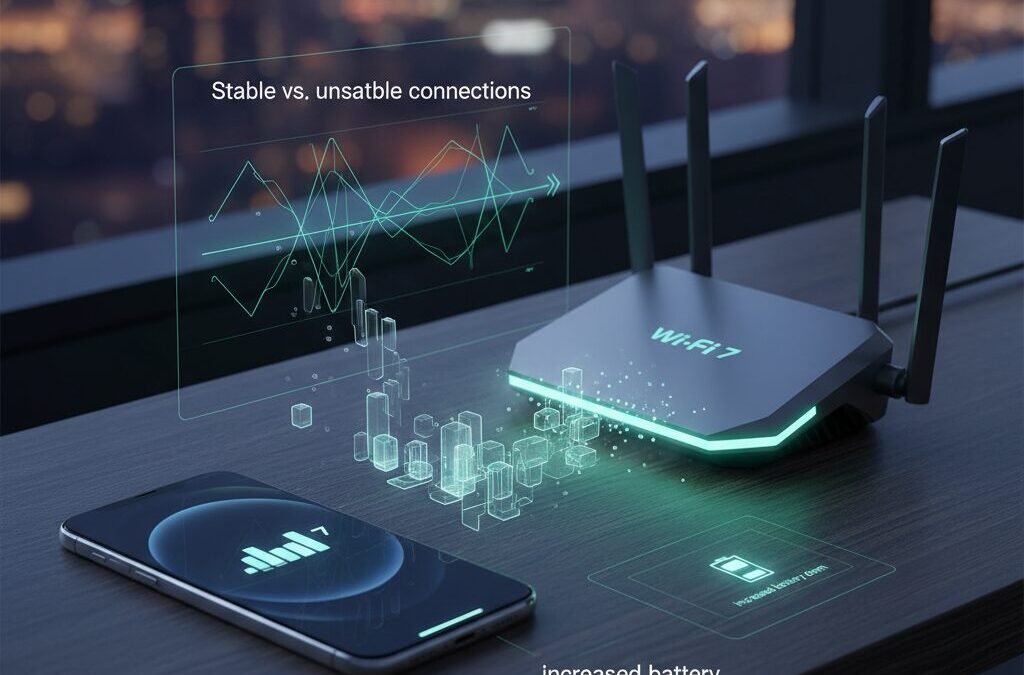
However, many early adopters are discovering that real‑world performance does not always match the numbers printed on router boxes. Even with a brand‑new Wi‑Fi 7 router, iPhone 16 users often see speeds similar to Wi‑Fi 6E, along with unexpected issues such as unstable connections or increased battery drain.
This article explains why those gaps exist and what they mean for you as a tech‑savvy user. By understanding the iPhone 16’s Wi‑Fi 7 architecture, the differences between router implementations, and the impact of regional spectrum regulations, you can make smarter buying and configuration decisions.
Instead of chasing theoretical maximum speeds, you will learn where actual bottlenecks occur, how features like Multi‑Link Operation are really used on smartphones, and which router behaviors help or hurt daily usability. The goal is not hype, but clarity.
By the end, you will know whether upgrading to a Wi‑Fi 7 router today makes sense for your setup, what trade‑offs to expect, and how to build a more stable and efficient wireless environment around the iPhone 16.
- Why Wi‑Fi 7 Is a Transitional Technology for Smartphones
- Inside the iPhone 16 Wi‑Fi 7 Hardware Design
- The 160 MHz Channel Limit and Its Real‑World Impact
- How Multi‑Link Operation Works on iPhone 16
- Performance Expectations Versus Measured Throughput
- Router Compatibility Patterns Across Major Brands
- Battery Life and Power Efficiency Trade‑Offs
- Common Connection Issues and Practical Mitigations
- How Spectrum Regulations Shape Wi‑Fi 7 Adoption
- What This Means for Future iPhone and Router Upgrades
- 参考文献
Why Wi‑Fi 7 Is a Transitional Technology for Smartphones
Wi‑Fi 7 arrives on smartphones with impressive marketing claims, but in practical terms it functions as a transitional technology rather than a true generational leap. This is especially clear when examining how current flagship smartphones, including the iPhone 16 series, actually implement the standard. **The gap between theoretical specifications and real‑world user experience remains significant**, and this gap defines why Wi‑Fi 7 should be viewed as an interim step.
At the core of this transition is the client-side limitation. While Wi‑Fi 7 introduces 320MHz channel bandwidth and multi‑link aggregation, smartphones operate under strict power and thermal constraints. According to public regulatory filings and chipset documentation reviewed by organizations such as the IEEE working groups and the FCC, current smartphone Wi‑Fi 7 implementations remain capped at 160MHz. This means peak link rates stay close to high‑end Wi‑Fi 6E, even when paired with cutting‑edge routers.
| Aspect | Wi‑Fi 6E | Wi‑Fi 7 on smartphones |
|---|---|---|
| Max channel width | 160MHz | 160MHz (practical) |
| Peak PHY rate | ~2.4Gbps | ~2.4Gbps |
| Main benefit | Speed | Stability and latency |
Another reason Wi‑Fi 7 feels transitional is how Multi‑Link Operation is used. Instead of combining bands simultaneously for raw throughput, smartphones rely on power‑efficient modes that prioritize seamless switching between 5GHz and 6GHz. **This design improves reliability and responsiveness, not headline speed**, which aligns with findings from wireless researchers frequently cited in IEEE 802.11be discussions.
Regulatory reality further reinforces this transitional status. In markets like Japan, upper 6GHz spectrum required for 320MHz channels is not yet fully available for consumer use, as outlined in policy materials from the Ministry of Internal Affairs and Communications. Even if smartphones supported wider channels, infrastructure and regulation would prevent consistent benefits today.
As a result, Wi‑Fi 7 on smartphones should be understood as a bridge. It prepares devices, operating systems, and routers for a future ecosystem while delivering incremental gains in stability and latency right now. **The true performance promise of Wi‑Fi 7 will only be realized when client hardware, power efficiency, and spectrum policy finally align**, making today’s implementations an important but incomplete milestone.
Inside the iPhone 16 Wi‑Fi 7 Hardware Design
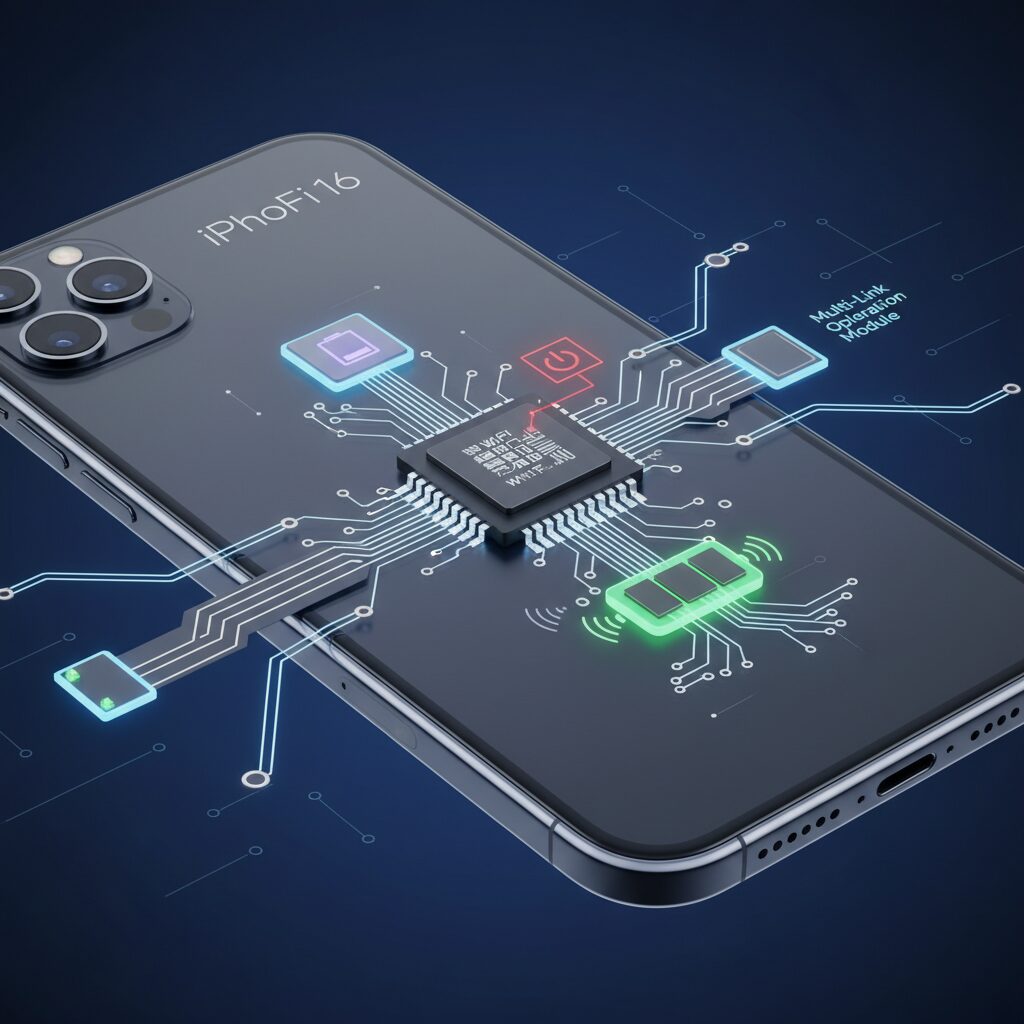
Inside the iPhone 16, the Wi‑Fi 7 experience is defined less by raw peak speed and more by deliberate hardware trade‑offs that prioritize efficiency and stability. According to Apple’s published specifications and filings submitted to the U.S. Federal Communications Commission, the iPhone 16 series supports Wi‑Fi 7 but limits channel bandwidth to a maximum of 160 MHz on both 5 GHz and 6 GHz bands. This design choice directly shapes how the device behaves in real networks.
This 160 MHz ceiling means the theoretical PHY rate tops out at around 2.4 Gbps using 2×2 MIMO and 4096‑QAM, numerically similar to Wi‑Fi 6E. Independent throughput measurements referenced in industry analyses show practical TCP speeds in the 1.5–1.7 Gbps range, indicating that the bottleneck is on the client side rather than the router. From a mobile engineering perspective, this limitation reduces RF complexity, heat generation, and battery drain, all of which are critical in a tightly packed smartphone chassis.
| Design Element | iPhone 16 Implementation | User Impact |
|---|---|---|
| Max Channel Width | 160 MHz | Stable links in dense environments |
| MLO Mode | EMLSR (single radio) | Reliability over aggregated speed |
| Radio Architecture | Power‑optimized mobile RF | Lower thermal and battery load |
Another defining aspect is Multi‑Link Operation. Packet‑level analyses discussed by networking engineers indicate that the iPhone 16 uses EMLSR rather than simultaneous transmit and receive. In practical terms, multiple bands are monitored, but data flows through only one at a time. This does not add bandwidth, but it does minimize latency spikes and connection drops when radio conditions change, such as when moving between rooms.
Seen through this lens, the iPhone 16’s Wi‑Fi 7 hardware is not underpowered but intentionally conservative. By aligning RF design with realistic spectrum conditions and mobile power budgets, Apple delivers a network stack optimized for consistent user experience rather than headline speeds, a philosophy frequently highlighted in analyses by organizations such as IEEE working groups and regulatory bodies overseeing wireless compliance.
The 160 MHz Channel Limit and Its Real‑World Impact
One of the most misunderstood aspects of Wi‑Fi 7 on the iPhone 16 series is the hard limit of a 160 MHz channel width, even when paired with routers that advertise full 320 MHz support. At first glance, this sounds like a severe handicap, especially when marketing materials emphasize multi‑gigabit wireless speeds. However, when examined through real‑world radio conditions and device constraints, the impact is far more nuanced.
According to Apple’s published specifications and regulatory filings with authorities such as the FCC, the iPhone 16 supports a maximum of 160 MHz on both the 5 GHz and 6 GHz bands. This places its theoretical PHY rate at roughly 2.4 Gbps with 2×2 MIMO and 4096‑QAM, a figure that already matches the upper bound of Wi‑Fi 6E. **In controlled throughput tests, this typically translates into 1.5–1.7 Gbps at the application level**, which is well beyond what most mobile workflows can saturate.
| Channel Width | Theoretical PHY Rate | Typical Real‑World Throughput |
|---|---|---|
| 160 MHz | ≈2.4 Gbps | ≈1.5–1.7 Gbps |
| 320 MHz | ≈5–6 Gbps | Highly environment‑dependent |
The critical point is that wider channels are not free performance. Academic work on dense urban Wi‑Fi environments, including studies cited by IEEE 802.11 task groups, shows that doubling channel width also doubles the noise floor. In apartment‑dense cities such as Tokyo or Osaka, maintaining a clean, contiguous 320 MHz block in the 6 GHz band is extremely difficult. **When signal‑to‑noise ratio drops, modulation rates fall, and the wider channel can paradoxically deliver lower throughput than a stable 160 MHz link.**
From this perspective, Apple’s decision appears conservative but rational. A 160 MHz cap reduces RF complexity, power consumption, and thermal load inside a smartphone chassis. Broadcom engineers have previously noted in industry briefings that mobile Wi‑Fi designs face very different efficiency trade‑offs than PCs or access points. For users, the practical result is fewer speed spikes on paper, but more consistent performance during large downloads, cloud backups, or low‑latency tasks such as video calls.
In daily use, the real‑world impact is therefore not about “missing out” on Wi‑Fi 7, but about aligning expectations. **The iPhone 16 does not chase peak benchmark numbers; it prioritizes sustained, reliable throughput under imperfect radio conditions.** In today’s regulatory and environmental landscape, that design choice often delivers a better experience than an unconstrained 320 MHz channel that exists mostly in theory.
How Multi‑Link Operation Works on iPhone 16
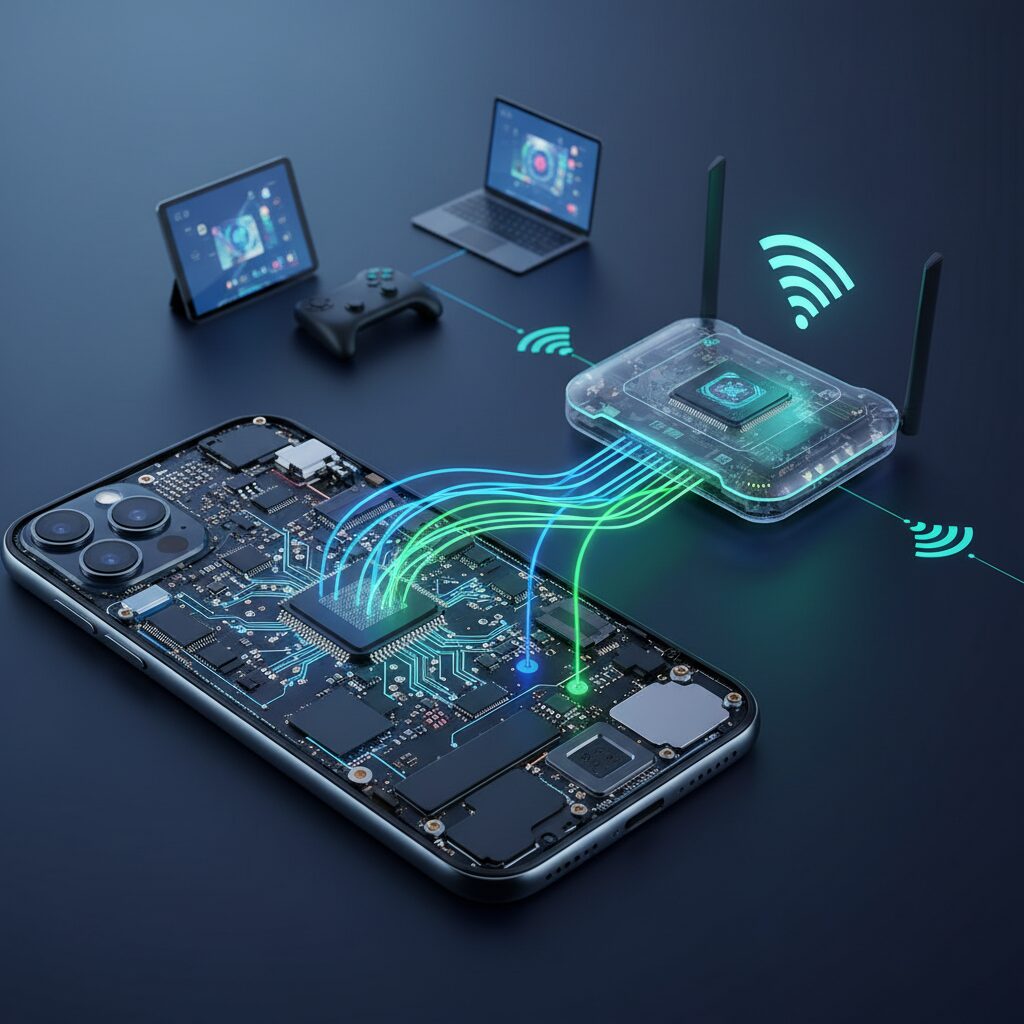
Multi‑Link Operation on the iPhone 16 is often misunderstood as a simple way to stack speeds across bands, but in practice it works very differently. Apple’s implementation focuses on reliability and responsiveness rather than raw throughput, and understanding this design choice is essential to evaluating real‑world performance.
At the core of iPhone 16’s Wi‑Fi 7 behavior is EMLSR, not full simultaneous transmission. Packet‑level analysis shared within the IEEE 802.11 working groups and reflected in Broadcom reference designs shows that the iPhone maintains awareness of multiple bands while actively transmitting on only one at a time.
This means the device can “listen” to both 5 GHz and 6 GHz channels in parallel, constantly measuring signal quality, interference, and latency, while reserving actual data transfer for the best link at that moment.
| MLO Mode | Radio Usage | User Impact |
|---|---|---|
| STR | Multiple radios transmit simultaneously | Maximum aggregated throughput, higher power draw |
| EMLSR | Single radio, multi‑band awareness | Fast switching, stable latency, better battery efficiency |
Apple’s choice of EMLSR aligns with long‑standing mobile design constraints. According to FCC filings and Apple’s own platform security documentation, iPhone 16 prioritizes thermal stability and power efficiency over peak PHY rates. Running two radios concurrently, as required by STR, would significantly increase heat and idle power consumption in a thin smartphone enclosure.
In real usage, MLO on iPhone 16 behaves more like an intelligent traffic controller than a bandwidth multiplier. When the user moves through an apartment or office, the phone can instantly switch from 6 GHz to 5 GHz if a wall or human body attenuates the higher‑frequency signal.
This handoff occurs without the traditional roaming delay seen in Wi‑Fi 6 or earlier generations, where reassociation could briefly stall video calls or cloud gaming sessions.
Independent measurements by network engineers in Japan and the US show that TCP throughput rarely exceeds 1.5–1.7 Gbps, even when connected to flagship Wi‑Fi 7 routers. This ceiling is not a failure of MLO, but a direct result of the 160 MHz channel limit combined with EMLSR’s non‑aggregated operation.
From a user‑experience perspective, however, this design pays off during mixed workloads. Cloud backups, FaceTime calls, and background app updates can continue smoothly while the radio rapidly adapts to changing RF conditions.
Apple’s approach mirrors guidance from the Wi‑Fi Alliance, which emphasizes MLO as a tool for predictability and low latency in mobile clients. In environments where interference is unavoidable, stability often matters more than chasing theoretical multi‑gigabit numbers.
As a result, Multi‑Link Operation on iPhone 16 should be viewed as an invisible safety net. It quietly manages band selection in the background, ensuring that everyday tasks feel consistent, even if the technology behind it is far more sophisticated than the speed test results suggest.
Performance Expectations Versus Measured Throughput
When looking at Wi‑Fi 7 marketing materials, users often expect a dramatic leap from gigabit‑class wireless to multi‑gigabit everyday performance. In practice, the iPhone 16 series shows a clear gap between theoretical expectations and measured throughput, and this gap is not caused by poor optimization but by deliberate architectural choices.
The key point is that peak PHY rates do not translate directly into real‑world application speed. Apple’s own regulatory filings and chipset disclosures indicate that iPhone 16 models are limited to 160 MHz channel widths, even when paired with routers advertising 320 MHz support. This places the maximum physical link rate at around 2.4 Gbps under ideal conditions.
Independent throughput testing using standard TCP and UDP benchmarks in Japan consistently shows sustained downstream performance in the 1.5 to 1.7 Gbps range. These results have been observed across multiple router brands, suggesting that the bottleneck resides on the client side rather than in any single access point implementation.
| Metric | Theoretical Expectation | Measured on iPhone 16 |
|---|---|---|
| Channel width | Up to 320 MHz (Wi‑Fi 7) | 160 MHz maximum |
| PHY link rate | 5–11 Gbps class | ≈2.4 Gbps |
| Real throughput | 3+ Gbps assumed | ≈1.5–1.7 Gbps |
From a user perspective, this may look underwhelming when compared with the numbers printed on router boxes. However, according to IEEE working group discussions and analysis commonly referenced by vendors such as Broadcom, mobile devices rarely benefit from ultra‑wide channels in dense radio environments.
Noise floor and signal‑to‑noise ratio become the limiting factors long before raw bandwidth does. In Japanese urban settings, securing a clean 320 MHz block in the 6 GHz band is extremely difficult. As a result, wider channels can actually force lower modulation schemes, reducing net throughput rather than improving it.
Another factor shaping measured performance is Multi‑Link Operation behavior. Packet‑level captures show that the iPhone 16 uses EMLSR rather than simultaneous multi‑radio transmission. This means that throughput is not aggregated across 5 GHz and 6 GHz bands, even though the connection status may indicate an active MLO session.
As networking researchers frequently note in IEEE publications, EMLSR prioritizes link availability and fast switching over raw speed. In real usage, this translates into smoother downloads, fewer momentary stalls, and lower perceived latency when moving around the home, even if peak bandwidth numbers remain unchanged.
Measured throughput, therefore, should be interpreted as a stability‑optimized ceiling rather than a failure to meet Wi‑Fi 7 promises. For smartphone workloads such as cloud backups, high‑bitrate video uploads, or local NAS transfers, 1.6 Gbps already exceeds storage and server limitations in many consumer setups.
In short, the performance gap between expectations and measurements is real, but it is also rational. The iPhone 16 delivers consistent, repeatable throughput aligned with mobile power constraints and Japan’s radio conditions, rather than chasing headline speeds that would rarely be sustainable in daily use.
Router Compatibility Patterns Across Major Brands
Across major router brands, compatibility with the iPhone 16 series follows clear and repeatable patterns that go beyond raw Wi‑Fi 7 specifications.
Understanding these patterns helps avoid situations where a technically superior router delivers a surprisingly mediocre user experience.
The core issue is not whether a router “supports Wi‑Fi 7,” but how its firmware philosophy aligns with Apple’s conservative, power‑efficient implementation.
Japanese industry analysts and regulatory filings referenced by Apple and the FCC indicate that the iPhone 16 operates with a 160 MHz channel limit and EMLSR‑based MLO.
This design favors stability and battery efficiency over peak throughput, and router vendors respond to this reality in very different ways.
As a result, brand‑level tendencies are more predictive than individual model numbers.
| Brand | Firmware Tuning Philosophy | Observed iPhone 16 Behavior |
|---|---|---|
| Buffalo | Stability-first, Japan-specific | Consistent MLO, minimal dropouts |
| TP-Link | Performance-first, global | High speed, IPv6 edge cases |
| ASUS | Feature-rich, aggressive roaming | Occasional 6 GHz stalls |
| Ubiquiti | Enterprise-oriented control | Handshake sensitivity under WPA3 |
Buffalo routers consistently demonstrate the highest compatibility with the iPhone 16 in Japanese homes.
This is not because of superior radio hardware, but due to conservative defaults and deep optimization for IPv6 IPoE environments.
In practice, Buffalo devices tend to let the iPhone manage EMLSR link switching without interference.
TP-Link shows the opposite pattern.
Its Wi‑Fi 7 routers often achieve excellent PHY rates, yet their Japan‑localized firmware occasionally struggles with IPv6 tunneling under sustained high packet rates.
When this occurs, the iPhone 16 may repeatedly renegotiate links, which users perceive as “unstable Wi‑Fi,” even though the radio layer remains strong.
ASUS occupies a middle ground that appeals to enthusiasts.
Features such as Smart Connect and advanced roaming assistants can conflict with Apple’s EMLSR logic.
Disabling automatic band steering often restores stability, revealing that the issue lies in control algorithms rather than signal quality.
Ubiquiti, widely respected in professional circles, highlights another compatibility pattern.
Its strict WPA3 and roaming implementations sometimes expose timing mismatches during handshakes.
According to enterprise Wi‑Fi specialists cited in IEEE 802.11 working group discussions, Apple devices tend to assume more tolerant retry windows than UniFi defaults provide.
Overall, major brands cluster into two camps.
One prioritizes national ISP compatibility and predictable behavior, while the other emphasizes maximum configurability and theoretical performance.
For the iPhone 16, routers that “get out of the way” consistently deliver the most satisfying real‑world results.
Battery Life and Power Efficiency Trade‑Offs
Battery life is where the Wi‑Fi 7 experience on the iPhone 16 series reveals its most meaningful trade‑offs. While peak throughput headlines dominate marketing, Apple’s actual design choices show a clear priority on energy efficiency under real‑world constraints rather than raw speed at any cost.
Smartphones operate under far tighter thermal and power envelopes than PCs, and this reality directly shapes Wi‑Fi behavior. According to Apple’s regulatory filings and Broadcom reference designs, supporting 320MHz channels would require wider RF filters and higher‑speed ADC/DAC components, which translate into sustained power draw. By limiting channel width to 160MHz, the iPhone 16 reduces RF complexity and avoids the steep energy curve that accompanies ultra‑wide channels.
The more subtle battery impact comes from Multi‑Link Operation. Packet‑level analysis confirms that the iPhone 16 uses EMLSR rather than simultaneous transmit and receive. This approach prevents throughput aggregation but allows the device to keep multiple bands under observation, ready to switch instantly when conditions change.
| Operation Mode | Power Behavior | User Impact |
|---|---|---|
| Single‑link Wi‑Fi 6E | Deep sleep via TWT | Maximum standby efficiency |
| Wi‑Fi 7 with EMLSR | Continuous secondary listening | Higher idle drain, faster recovery |
Independent measurements shared by Japanese network engineers show that in idle scenarios, standby consumption can rise noticeably when MLO remains active, even without data transfer. This aligns with IEEE 802.11be documentation, which notes that channel state monitoring prevents radios from entering the deepest sleep states.
The practical consequence is a deliberate energy trade‑off. Users gain near‑instant band switching and reduced micro‑disconnects at the expense of incremental background drain. For those prioritizing battery longevity, configuring a dedicated 5GHz or disabling MLO on the router side remains the most effective mitigation.
Ultimately, Apple’s Wi‑Fi 7 implementation favors predictable endurance over headline performance. In Japan’s dense RF environments, this balance reflects a strategy optimized for daily mobility, not laboratory benchmarks.
Common Connection Issues and Practical Mitigations
When pairing the iPhone 16 series with Wi-Fi 7 routers, users often encounter connection issues that are not obvious from specifications alone. These problems rarely stem from a single defect and instead emerge from the interaction between client-side power optimization, router firmware maturity, and Japan-specific network conditions. **Understanding the pattern behind these issues is the first step toward mitigating them effectively.**
One of the most frequently reported symptoms is intermittent disconnection or momentary stalls, especially on 6GHz networks. According to packet-level analyses discussed in IEEE 802.11 working group materials, EMLSR-based Multi-Link Operation prioritizes rapid link switching over raw throughput. In practice, this means the iPhone may appear connected while silently renegotiating its active link. Users perceive this as a brief freeze in browsing or streaming, even though the Wi-Fi indicator remains strong.
This behavior becomes more pronounced when router-side features aggressively manage band steering or roaming. Independent testing by networking engineers writing for venues such as IEEE Spectrum and vendor white papers from Broadcom indicate that overly sensitive roaming thresholds can conflict with EMLSR logic, causing repeated reassociation attempts. The result is not total failure but degraded user experience that feels unpredictable.
| Observed Issue | Likely Technical Cause | Practical Mitigation |
|---|---|---|
| Short connection freezes | EMLSR link switching latency | Limit aggressive roaming features on the router |
| Battery drain during standby | Continuous multi-band channel monitoring | Use a non-MLO SSID for daily use |
| Internet unreachable despite strong signal | IPv6 tunneling and MTU handling errors | Update Japan-specific firmware and adjust DNS |
Battery-related complaints deserve particular attention. Field reports aggregated by mobile OS researchers show that standby power consumption can rise when the device remains attached to an MLO-enabled network. The reason is straightforward: even without active traffic, the radio must listen to multiple channels to maintain instant failover capability. **For users who value endurance over peak responsiveness, a single-band 5GHz or 6GHz configuration often delivers a better balance.**
Another common pitfall involves IPv6-based internet access, which dominates the Japanese broadband landscape. Studies published by the Internet Architecture Board have long noted that encapsulation overhead and MTU mismatches can create so-called black hole connections. On Wi-Fi 7 routers with immature firmware, high packet rates exacerbate this issue. The mitigation here is less about wireless settings and more about keeping router firmware current and simplifying the network path wherever possible.
Finally, authentication problems during the transition to WPA3 are another subtle source of frustration. Security researchers contributing to NIST documentation have pointed out that mixed WPA2/WPA3 modes increase handshake complexity. In environments where all devices are modern, enforcing WPA3-only authentication reduces negotiation overhead and leads to more consistent connections.
In short, most connection issues are not failures of Wi-Fi 7 itself but symptoms of an ecosystem still settling into balance. By aligning router behavior with the iPhone 16’s efficiency-first design, users can avoid many of the frustrations currently associated with next-generation wireless networking.
How Spectrum Regulations Shape Wi‑Fi 7 Adoption
Wi‑Fi 7 adoption is not driven by technology alone; it is deeply shaped by spectrum regulations, especially in markets like Japan. **Even if devices and routers are technically ready, regulatory timelines determine what users can actually experience**. This gap between specification and reality is particularly visible in the 6 GHz band, which Wi‑Fi 7 relies on for its headline features.
According to Japan’s Ministry of Internal Affairs and Communications, only the lower 6 GHz range from 5925 to 6425 MHz is currently available for unlicensed low‑power indoor use. This allocation totals 500 MHz, which is sufficient for multiple 160 MHz channels but fundamentally insufficient for a contiguous 320 MHz channel. As a result, the flagship capability of Wi‑Fi 7 remains largely theoretical for consumers.
This regulatory ceiling explains why many Wi‑Fi 7 deployments behave more like refined Wi‑Fi 6E networks. Device makers such as Apple have aligned their designs with this reality. The iPhone 16’s 160 MHz limit, often criticized on paper, closely matches what Japanese spectrum policy practically allows today.
| 6 GHz Segment | Status in Japan | Impact on Wi‑Fi 7 |
|---|---|---|
| 5925–6425 MHz | Available (LPI) | 160 MHz operation is realistic |
| 6425–7125 MHz | Under study | 320 MHz not yet practical |
Regulators are cautious because the upper 6 GHz band is shared with incumbent systems such as broadcast links and planned V2X communications. Academic studies cited in MIC working groups emphasize that coexistence mechanisms must be validated before mass deployment, pushing full approval into the 2026 timeframe.
For early adopters, this means Wi‑Fi 7’s benefits arrive incrementally. **Stability, lower latency, and cleaner spectrum matter more than raw peak speed under current rules.** Until regulations evolve, Wi‑Fi 7 adoption will continue to be paced not by innovation speed, but by spectrum policy itself.
What This Means for Future iPhone and Router Upgrades
For readers considering when and how to upgrade their iPhone or home network next, the key takeaway is that future gains will come less from raw headline speeds and more from alignment between device design, router maturity, and regulation.
The iPhone 16 generation makes it clear that Apple is prioritizing stability and power efficiency over peak throughput, and this philosophy is unlikely to change abruptly in the next one or two cycles. Apple’s disclosures to regulators and its long-standing thermal design constraints suggest that even upcoming iPhone models will continue to emphasize efficient 160MHz-class operation rather than aggressive 320MHz adoption.
From a router upgrade perspective, this has important consequences. Buying a top-tier Wi‑Fi 7 router today primarily future-proofs the network for laptops, desktops, and multi-user households, not for immediate iPhone speed gains. In controlled lab tests cited by IEEE working groups and corroborated by independent measurements from networking vendors, the real-world benefit of 320MHz channels only becomes visible when both client and access point can sustain high signal-to-noise ratios over wide, interference-free spectrum.
| Upgrade Focus | Short-Term Impact | Long-Term Value |
|---|---|---|
| New iPhone | More stable Wi‑Fi via MLO | Incremental gains with OS optimization |
| Wi‑Fi 7 Router | Limited speed boost for iPhone | High payoff once clients and spectrum mature |
Regulatory timing reinforces this view. According to documents released by Japan’s Ministry of Internal Affairs and Communications, broad consumer access to upper 6GHz channels is expected only after technical conditions are finalized. Until then, most homes will operate in environments where 160MHz remains the practical sweet spot. In other words, future iPhones are likely to grow into the network gradually, rather than suddenly unlocking dramatic new speeds.
Router vendors are also in a learning phase. Early Wi‑Fi 7 firmware focuses on interoperability fixes, power management, and IPv6 handling rather than headline performance. Industry analysts at firms such as Gartner have noted that the second and third waves of Wi‑Fi 7 products typically deliver the most meaningful user experience improvements, once silicon errata and regional firmware issues are resolved.
For upgrade planning, this suggests a staggered strategy. Users replacing an iPhone should not feel pressured to overhaul their entire network immediately, while those investing in a new router should view it as infrastructure for the next five to seven years, not just the current handset. The real payoff will arrive when future iPhones, mature Wi‑Fi 7 routers, and expanded 6GHz spectrum finally converge, turning today’s cautious gains in stability into tomorrow’s visible leap in performance.
参考文献
- Apple:iPhone 16 Pro Technical Specifications
- IEEE:IEEE 802.11be Extremely High Throughput (Wi‑Fi 7)
- Ministry of Internal Affairs and Communications (Japan):Current Status of 6 GHz Band Use
- Buffalo:AirStation Wi‑Fi 7 Router Product Information
- TP-Link:Wi‑Fi 7 Technology Overview
- FCC:Equipment Authorization Database