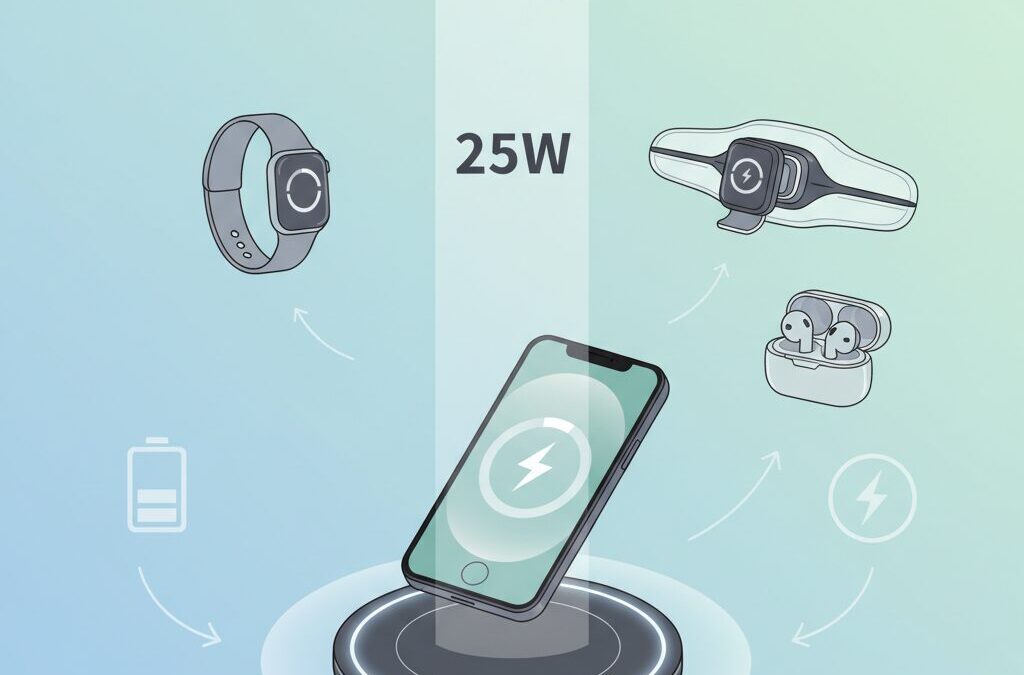
Wireless charging used to be about convenience rather than performance, and many gadget enthusiasts accepted slower speeds and unreliable alignment as unavoidable trade-offs. That assumption is now being challenged in a very real way. Qi2, the latest wireless charging standard, is quietly transforming how devices are charged, mounted, and integrated into daily life.
For users who care deeply about gadgets, Qi2 is not just another incremental upgrade. Magnetic alignment fundamentally changes charging reliability, while the jump from 15W to 25W finally places wireless charging in the same league as wired solutions for everyday use. This shift affects not only smartphones, but also wearables, cars, and even home appliances.
At the same time, the market is entering a confusing transition phase. Terms like “Qi2 Certified” and “Qi2 Ready” are used side by side, flagship phones take very different implementation paths, and older chargers may suddenly feel obsolete. By understanding what Qi2 really brings, which devices unlock its full potential, and how the ecosystem is evolving, you can make smarter decisions and fully enjoy the next generation of wireless power.
- Why 2025 Became the Turning Point for Wireless Charging
- Magnetic Power Profile (MPP): The Core Innovation Behind Qi2
- From 15W to 25W: How Qi2 Changes Everyday Charging Speeds
- Qi2 Certified vs Qi2 Ready: What the Labels Really Mean
- Google Pixel 10 Series and the Ideal Qi2 Implementation
- Galaxy S25 Ultra and the Trade-Offs of a Qi2 Ready Approach
- How Japanese Brands Are Shaping the Qi2 Accessory Ecosystem
- Beyond Phones: Wearables, Cars, and the Expansion of Qi2
- Heat, Safety, and Charger Selection: What Users Need to Know
- 参考文献
Why 2025 Became the Turning Point for Wireless Charging
2025 is widely regarded as the year when wireless charging stopped being a convenient extra and started to function as core infrastructure for everyday devices. This shift did not happen because of a single breakthrough, but because multiple long‑standing weaknesses were resolved at once. **Qi2 unified speed, reliability, and user trust in a way earlier wireless standards never managed**.
According to the Wireless Power Consortium, Qi2-compatible devices surpassed 1.5 billion units globally within a year of launch, with certified product lineups growing sixfold year over year. This adoption curve is unprecedented when compared with earlier Qi generations, which struggled for nearly a decade to overcome complaints about misalignment, heat, and unpredictable charging behavior.
The fundamental reason lies in Magnetic Power Profile. By enforcing magnetic alignment, Qi2 eliminated the guesswork that defined legacy pads. Energy transfer efficiency increased, heat generation became more predictable, and charging failures dropped sharply. Independent lab testing referenced by WPC shows that precise alignment alone accounts for a double‑digit percentage reduction in power loss during typical smartphone charging sessions.
| Aspect | Pre‑2025 Qi | Qi2 Era |
|---|---|---|
| Coil alignment | Manual, error‑prone | Magnetically enforced |
| User feedback | Visual or trial‑and‑error | Physical snap confirmation |
| Perceived reliability | Inconsistent | Predictable and repeatable |
Another decisive factor was output parity with wired charging. With the approval of Qi2 25W in 2025, wireless charging crossed a psychological threshold. WPC data indicates charging time reductions of roughly 40 to 50 percent versus 15W systems, enabling meaningful top‑ups during short daily routines. **Wireless charging no longer felt like a compromise**, which fundamentally changed consumer behavior.
Equally important was institutional alignment. Apple’s MagSafe technology became standardized rather than isolated, Google adopted native magnetic implementations, and accessory makers gained a clear certification path. Analysts at Granite River Labs note that this ecosystem clarity reduced both manufacturer risk and consumer confusion, accelerating market confidence.
In short, 2025 became the turning point because wireless charging finally delivered on its original promise: effortless placement, dependable performance, and speeds fast enough to matter in real life. Once those conditions were met simultaneously, adoption was no longer optional—it was inevitable.
Magnetic Power Profile (MPP): The Core Innovation Behind Qi2
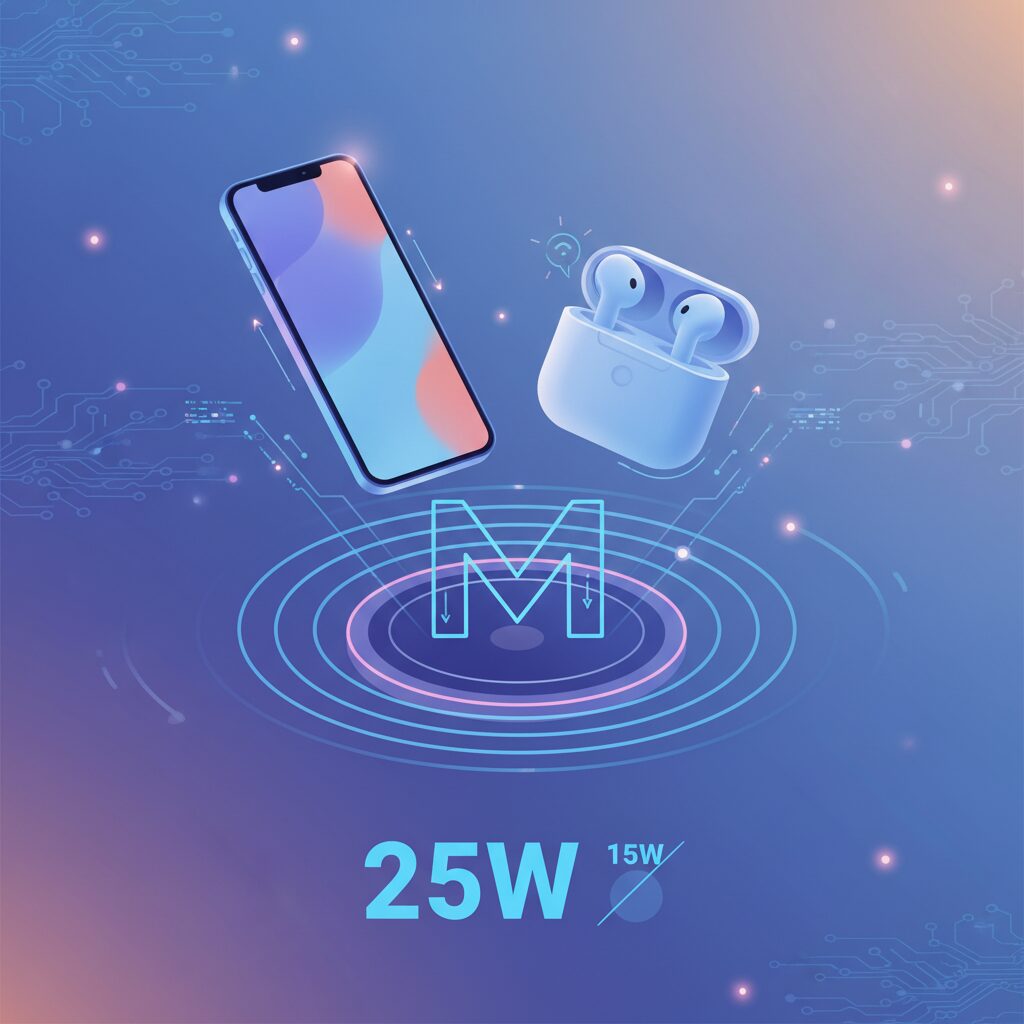
The true breakthrough of Qi2 lies in the Magnetic Power Profile, commonly referred to as MPP. This profile redefines wireless charging not by chasing raw wattage first, but by fundamentally fixing alignment, the long‑standing weakness of previous Qi generations. **MPP standardizes magnetic alignment as a core requirement, not an optional enhancement**, and this shift has cascading effects on efficiency, heat management, and user trust.
Under legacy Qi EPP systems, users were responsible for manually positioning devices on a charging pad. Even slight coil misalignment could reduce coupling efficiency, forcing the charger to compensate with higher power draw and generating excess heat. According to technical documentation published by the Wireless Power Consortium, imperfect alignment was one of the primary causes of unstable charging and premature thermal throttling in real‑world usage.
MPP solves this by integrating a precisely defined magnetic ring around the charging coil. When a Qi2 device approaches a compatible charger, magnetic attraction physically pulls the receiver coil into the optimal position. **This mechanical certainty replaces guesswork with determinism**, ensuring the electromagnetic field is used efficiently from the first second of charging.
| Aspect | Qi EPP | Qi2 MPP |
|---|---|---|
| Coil alignment | User‑dependent | Magnetically enforced |
| Energy loss | High variability | Consistently minimized |
| Thermal behavior | Unpredictable heat spikes | More stable temperature curve |
This alignment accuracy directly translates into measurable gains. WPC‑affiliated test labs such as Granite River Labs report that magnetically aligned systems achieve a higher coupling coefficient between coils, reducing resistive loss. In practical terms, that means **less wasted energy, lower surface temperatures, and fewer charging interruptions**, even before output power is increased beyond 15W.
Another subtle but important benefit of MPP is user feedback. The magnetic snap provides tactile confirmation that charging has begun correctly, eliminating the need to check screen indicators or LEDs. Human–computer interaction researchers have long noted that passive physical feedback improves perceived reliability, and Qi2 leverages this principle elegantly.
It is also worth noting that MPP is not merely inspired by Apple’s MagSafe but formalized through open standardization. By defining magnet strength, placement tolerances, and interoperability rules, the WPC ensures cross‑vendor compatibility. This is a critical distinction, as it allows Android, iOS, and accessory manufacturers to share a single magnetic ecosystem without proprietary lock‑in.
In essence, Magnetic Power Profile is not about magnets for convenience alone. **It is an engineering correction that stabilizes the entire wireless power stack**, enabling higher wattage, safer thermal envelopes, and a charging experience that users can finally trust to work every time they set their device down.
From 15W to 25W: How Qi2 Changes Everyday Charging Speeds
Moving from 15W to 25W may sound like a modest numerical upgrade, but in everyday use, the difference feels far more dramatic. **Qi2 fundamentally changes how wireless charging fits into short, real-life time windows**, such as getting ready in the morning or topping up between meetings. According to data released by the Wireless Power Consortium, Qi2 25W can reduce total charging time by roughly 40 to 50 percent compared to conventional 15W wireless charging, assuming proper magnetic alignment and thermal conditions.
What makes this speed increase meaningful is not peak wattage alone, but consistency. The Magnetic Power Profile ensures optimal coil alignment every time, which minimizes energy loss and wasted heat. As a result, more of the supplied power is converted into actual battery charge rather than being dissipated. Industry testing shared via Business Wire shows that many Qi2 25W devices can reach around 50 percent charge in approximately 30 minutes, a threshold that previously required wired fast charging.
| Charging Mode | Typical Power | 0–50% Time |
|---|---|---|
| Conventional Qi | 10–15W | 50–60 minutes |
| Qi2 (MPP) | 15W | 40–45 minutes |
| Qi2 25W | 25W | About 30 minutes |
From a user-experience perspective, this shift changes behavior. Wireless charging no longer feels like something reserved for overnight use. **A brief placement on a desk or stand now delivers a visibly meaningful battery gain**, which encourages more frequent, opportunistic charging throughout the day. Engineers involved in Qi2 certification have also noted that tighter power negotiation reduces the stop-and-start behavior common in older pads.
In daily life, Qi2 25W narrows the psychological gap between wired and wireless charging. While cables may still win on absolute speed, the convenience-to-speed ratio has finally tipped. For many users, wireless charging stops being a compromise and starts feeling like the default option, which is precisely the shift Qi2 was designed to enable.
Qi2 Certified vs Qi2 Ready: What the Labels Really Mean
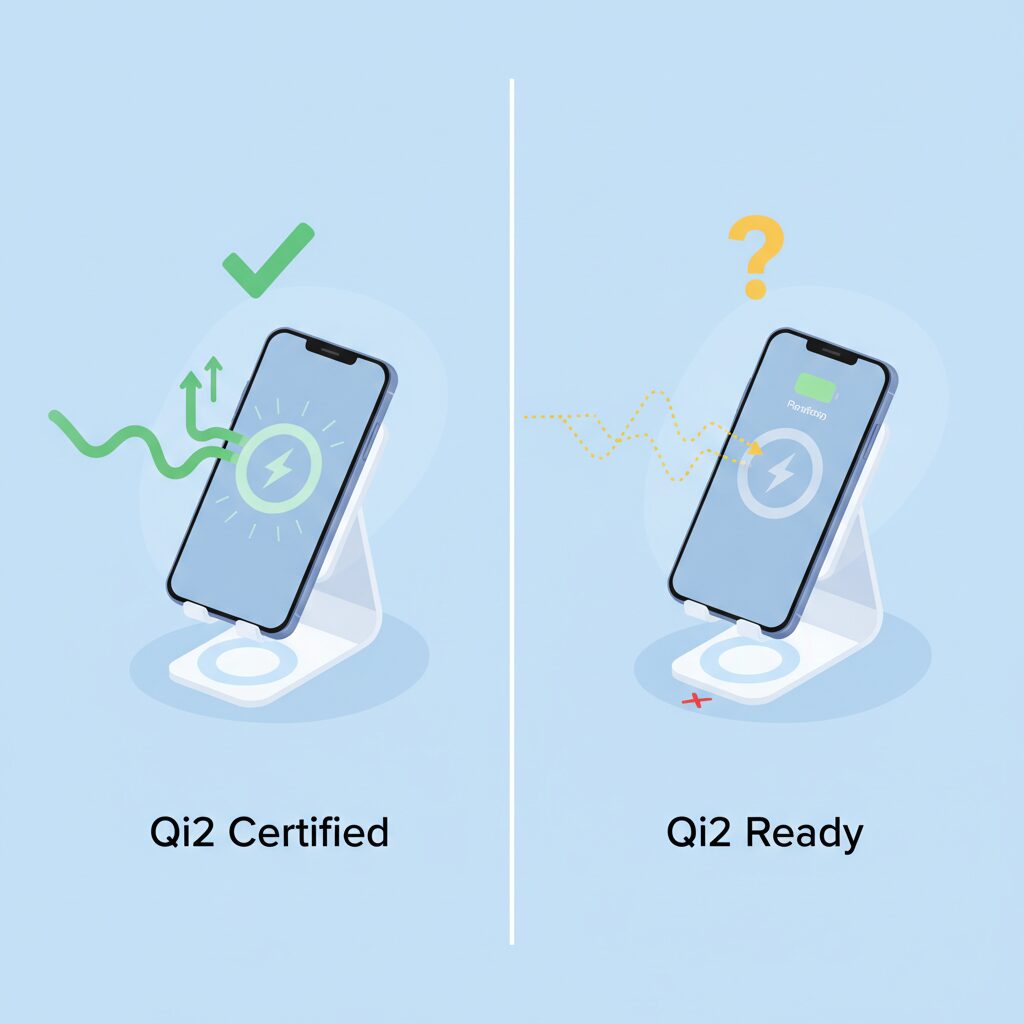
In the Qi2 era, few labels create as much confusion as Qi2 Certified and Qi2 Ready. At a glance, they look similar, but in practice they represent two fundamentally different hardware realities that directly affect daily charging behavior.
The difference is not cosmetic or marketing-driven; it is structural. According to the Wireless Power Consortium, Qi2 Certified products have passed full compliance testing and integrate the Magnetic Power Profile magnets directly into the device body. Qi2 Ready products, by contrast, only support the communication protocol and power negotiation.
| Label | Built-in magnets | User requirement | Real-world experience |
|---|---|---|---|
| Qi2 Certified | Yes | No accessories needed | Instant snap-on alignment |
| Qi2 Ready | No | Magnetic case required | Depends on case quality |
This distinction matters because Qi2’s core value lies in magnetic alignment. Without magnets inside the phone, coil positioning reverts to chance, recreating the inefficiencies Qi2 was designed to eliminate. Granite River Labs has repeatedly emphasized that MPP compliance assumes physical alignment, not just digital handshakes.
Qi2 Ready devices technically charge at up to 15W, but they do not guarantee the Qi2 experience. Users must rely on third-party magnetic cases with embedded rings, and even then, magnetic strength, alignment precision, and thermal behavior vary widely between manufacturers.
Industry analysts note that this has led to widespread consumer misinterpretation. The WPC itself has acknowledged confusion, which prompted the introduction of the Magnetic Case Profile to standardize magnet-equipped cases. However, MCP adoption is still uneven in early 2026.
From a UX perspective, Qi2 Certified devices behave predictably. You place the phone near the charger, feel the snap, and charging proceeds at optimal efficiency. With Qi2 Ready devices, the experience depends on case thickness, magnet placement, and even adhesive tolerances.
This is why reviewers consistently recommend checking for Qi2 certification logos rather than relying on the word Ready. As publications such as How-To Geek have pointed out, Ready without magnets is closer to a transitional compatibility mode than a full next-generation solution.
In short, Qi2 Certified means the hardware itself is designed around magnetic wireless power. Qi2 Ready means the responsibility shifts to the user. Understanding that difference prevents disappointment and ensures that the promise of Qi2 is actually delivered on the desk, not just on the box.
Google Pixel 10 Series and the Ideal Qi2 Implementation
The Google Pixel 10 series represents what many engineers and power-consortium members describe as the most faithful Qi2 implementation on Android so far. Rather than treating Qi2 as a marketing checkbox, Google appears to have designed the hardware, thermal logic, and accessory ecosystem as a single system, and this integrated approach fundamentally changes daily charging behavior.
At the core of this design is native magnetic alignment, branded by Google as PixelSnap. According to Google’s official documentation and independent teardown analyses, every Pixel 10 model embeds a circular magnet array directly around the wireless charging coil. This ensures consistent coil coupling without relying on cases or external rings, eliminating one of the most common failure points of legacy Qi charging.
| Pixel 10 Model | Magnet Integration | Max Qi2 Output |
|---|---|---|
| Pixel 10 / 10 Pro | Native (PixelSnap) | 15W |
| Pixel 10 Pro XL | Native (PixelSnap) | 25W |
Teardown reports published by established repair specialists show an additional orientation magnet below the main ring. This small detail prevents rotational drift when accessories such as stands or wallets are attached, a refinement previously associated almost exclusively with Apple’s MagSafe design philosophy. From a user perspective, the result is a tactile “snap” that confirms correct alignment without visual confirmation.
The Pixel 10 Pro XL further distinguishes itself by supporting Qi2 25W at the hardware level. Wireless Power Consortium data and Belkin’s certification tests indicate that, when paired with a certified Qi2 25W charger and a 30W or higher power adapter, the device can reach roughly 50 percent charge in about 30 minutes. This places wireless charging within practical reach of wired fast charging for short top-up scenarios.
Google’s decision to limit the smaller Pixel 10 and Pixel 10 Pro to 15W is not arbitrary. In interviews cited by Android-focused technical media, Google engineers point to heat density and long-term battery health. Smaller chassis designs concentrate thermal energy more aggressively, and sustained 25W inductive charging could accelerate cell degradation. From a battery science standpoint, this conservative cap aligns with research published by battery longevity experts, including IEEE-affiliated studies on thermal stress.
However, this ideal Qi2 vision comes with a trade-off that users immediately notice. Compatibility with older Qi chargers is significantly reduced. Multiple reviewers and user reports confirm that Pixel 10 devices often fall back to the Basic Power Profile, around 5W, when connected to pre-Qi2 chargers. Even first- and second-generation Pixel Stands have exhibited unstable charging behavior.
This behavior is widely attributed to stricter power negotiation rules introduced alongside Qi2’s Magnetic Power Profile. Google appears to prioritize electrical safety and alignment certainty over backward convenience. Industry analysts note that this mirrors Apple’s early MagSafe transition, where legacy accessories quickly felt obsolete.
In practical terms, the Pixel 10 series demonstrates what Qi2 was originally intended to be: a predictable, repeatable, and accessory-friendly wireless power platform. It rewards users who fully transition to certified Qi2 hardware, while quietly discouraging half-measures. For enthusiasts invested in a frictionless charging experience, this clarity may be frustrating at first, but it ultimately defines a cleaner and more reliable standard.
Galaxy S25 Ultra and the Trade-Offs of a Qi2 Ready Approach
The Galaxy S25 Ultra represents Samsung’s most cautious interpretation of the Qi2 transition, and that choice deserves careful attention. Rather than fully embracing the Magnetic Power Profile, the device is marketed as Qi2 Ready, a label that signals protocol compatibility without integrating magnets into the chassis. For enthusiasts expecting a seamless, MagSafe-like experience, this distinction has meaningful consequences.
The absence of built-in magnets fundamentally alters how Qi2 feels in daily use. According to analyses referenced by the Wireless Power Consortium and echoed by technical reviewers at outlets such as How-To Geek, Qi2’s core value lies not only in wattage but in guaranteed alignment. Without magnets, the S25 Ultra relies on user placement or third-party cases to achieve that alignment, reintroducing the very uncertainty Qi2 was designed to remove.
| Aspect | Qi2 Certified Device | Galaxy S25 Ultra |
|---|---|---|
| Built-in magnets | Yes | No |
| Out-of-box alignment | Automatic | Manual or case-dependent |
| Accessory ecosystem | Direct MagSafe/Qi2 | Requires magnetic case |
Samsung’s motivation is widely understood to be risk management. Teardown discussions and industry commentary suggest that magnetic arrays could interfere with the S Pen’s electromagnetic digitizer. From an engineering perspective, this is a defensible trade-off, as stylus accuracy is a defining feature of the Ultra line. However, this protection of one flagship feature comes at the expense of another emerging standard, leaving users to bridge the gap themselves.
Charging performance further illustrates the compromise. Independent tests shared by reviewers and early adopters indicate that, even when paired with Qi2 chargers, the S25 Ultra typically caps wireless charging at around 15W. This aligns with Samsung’s existing Fast Wireless Charging 2.0 rather than the 25W ceiling demonstrated by fully compliant Qi2 25W devices. Business Wire’s reporting on Qi2 emphasizes sustained higher power as a hallmark of the new era, making Samsung’s conservative limit feel intentionally restrained.
In practice, many owners will turn to magnetic cases from brands like Spigen or Torras. These accessories can restore magnetic alignment, but they add cost, thickness, and variability in thermal behavior. Research cited by Granite River Labs highlights how added layers between coils can exacerbate heat buildup, increasing the likelihood of thermal throttling during longer charging sessions.
The Galaxy S25 Ultra therefore embodies a strategic hesitation. It acknowledges Qi2 as inevitable while stopping short of full commitment. For users deeply invested in the S Pen ecosystem, this balance may feel acceptable. For gadget enthusiasts seeking the cleanest expression of Qi2’s promise, it reads as a reminder that standards adoption is as much about corporate priorities as it is about technology itself.
How Japanese Brands Are Shaping the Qi2 Accessory Ecosystem
The Qi2 accessory ecosystem in Japan is being shaped not by sheer volume, but by a distinctive philosophy that prioritizes reliability, safety, and real-world usability. Japanese brands are approaching Qi2 not as a race for headline-grabbing wattage, but as a long-term infrastructure play that must earn trust in everyday life. This mindset is already influencing how Qi2 products are designed, certified, and distributed.
Elecom’s entry into Qi2 25W charging is widely seen as a turning point. According to ITmedia Mobile and BCN+R, Elecom became the first Japanese manufacturer to obtain official Qi2 25W certification, a process that requires strict compliance testing defined by the Wireless Power Consortium. **This certification-first strategy reassures consumers who are wary of ambiguous labels such as “Qi2 Ready,” which often lack built-in magnets or consistent performance.**
What differentiates Japanese brands is the depth of their safety engineering. Elecom publicly emphasizes enhanced foreign object detection and multi-point thermal monitoring, features that align with guidelines frequently referenced by WPC and independent test labs such as Granite River Labs. These measures are not merely technical checkboxes; they reflect Japan’s long-standing consumer expectation that charging accessories should remain stable even in poorly ventilated rooms or during extended overnight use.
| Design Focus | Typical Japanese Brands | Common Overseas Approach |
|---|---|---|
| Certification priority | Full Qi2 or Qi2 25W certification before launch | Early release with partial compliance |
| Thermal management | Conservative output with strict heat control | Maximum output emphasized |
| Retail strategy | Physical stores and carrier shops | Online-first distribution |
Another important influence is distribution. Japanese brands have strong ties with electronics retailers and mobile carriers, which means Qi2 accessories are explained by staff and physically demonstrated. **This reduces user error, such as pairing a Qi2 smartphone with an incompatible legacy charger, a problem highlighted by Android Police in its analysis of Pixel 10 charging behavior.** The ecosystem therefore evolves with fewer negative first impressions.
Japanese accessory makers are also quietly shaping expectations around form factor. Rather than aggressively adding fans or bulky heatsinks, many designs favor desk-friendly angles, subdued LEDs, and materials chosen to blend into home interiors. This approach resonates with the broader Japanese concept of daily tools rather than gadgets, and it encourages Qi2 charging to become a habitual behavior.
As noted by Business Wire’s coverage of Qi2 adoption, standards only succeed when supported by credible local ecosystems. **Japanese brands are playing that stabilizing role, translating a global specification into products that feel dependable and approachable.** In doing so, they are not only expanding Qi2 adoption domestically, but also setting a benchmark that global accessory makers increasingly must match.
Beyond Phones: Wearables, Cars, and the Expansion of Qi2
Qi2 is no longer confined to smartphones, and this expansion is quietly reshaping how people interact with everyday devices. In wearables, automotive environments, and even emerging appliance categories, the core promise of Qi2—magnetically aligned, predictable wireless power—is solving long-standing usability problems that earlier Qi generations could not address. According to the Wireless Power Consortium, these adjacent categories are now a primary driver of Qi2 certification growth heading into 2026.
In wearables, the impact is especially tangible. True wireless earbuds and smart accessories suffer disproportionately from coil misalignment because of their compact size. Industry analysts at Granite River Labs point out that even a few millimeters of offset can drop efficiency by more than 30 percent in small charging cases. Qi2’s Magnetic Power Profile removes this margin of error entirely, ensuring that compact devices charge reliably every time they are placed on a pad. Sony’s next-generation WF-1000XM6 charging case, which has passed certification processes discussed within the WPC ecosystem, is widely viewed as a bellwether for how premium audio brands are adopting magnetic alignment as a baseline user experience.
The automotive sector represents an even more demanding environment. Heat, vibration, and constant micro-movements have historically made in-car wireless charging unreliable. To address this, the WPC has introduced the Qi v2.1 Active Alignment Power Profile, designed specifically for vehicles. Rather than relying solely on static magnets, this profile allows the transmitter system to actively track the receiver coil position. This approach stabilizes charging output while reducing thermal spikes during navigation or long drives, a concern repeatedly raised by automakers during standardization discussions.
| Use Case | Primary Challenge | Qi2 Solution |
|---|---|---|
| Wearables | Severe coil misalignment | Magnetic Power Profile |
| Automotive | Vibration and heat buildup | Active Alignment Power Profile |
| Accessories | Inconsistent placement | Magnetic attachment feedback |
Accessory ecosystems are also evolving alongside these changes. Magnetic power banks, dashboard mounts, and modular stands are increasingly designed with cross-device compatibility in mind. Belkin and Anker have both emphasized, in their public briefings, that Qi2 allows them to design a single magnetic platform that serves phones, earbuds, and car mounts without compromising safety thresholds. This convergence reduces accessory redundancy for users, an underappreciated benefit as device counts per household continue to rise.
Perhaps most importantly, Qi2’s expansion signals a philosophical shift. Wireless charging is no longer treated as a convenience feature but as infrastructure that must function across contexts. By extending consistent magnetic alignment beyond phones and into wearables and cars, Qi2 establishes a unified expectation: wireless power should be effortless, reliable, and predictable wherever it is used. This expectation is now shaping product roadmaps well beyond the smartphone category.
Heat, Safety, and Charger Selection: What Users Need to Know
As Qi2 and especially Qi2 25W become mainstream, heat management and safety move from secondary concerns to daily user issues. Wireless charging is inherently less efficient than wired charging, and the jump from 15W to 25W magnifies even small alignment or thermal problems. According to the Wireless Power Consortium, Magnetic Power Profile alignment is designed specifically to reduce wasted energy that would otherwise turn into heat, but this benefit only appears when certified chargers and proper power adapters are used.
Heat is not just about comfort; it directly affects battery longevity. Multiple battery studies cited by IEEE publications show that sustained charging above 40°C accelerates lithium-ion degradation. This is why Google limits 25W Qi2 charging to the Pixel 10 Pro XL, explicitly citing heat management constraints for smaller models, and why some devices aggressively throttle power even when a 25W charger is attached.
In real-world testing reported by Belkin and Anker, surface temperatures during Qi2 25W charging typically stabilize 3–5°C lower than older 15W Qi pads, provided magnetic alignment is correct. When alignment is poor or when thick cases trap heat, temperatures rise quickly and trigger thermal throttling, resulting in slower charging than expected.
| Factor | Lower Heat Risk | Higher Heat Risk |
|---|---|---|
| Charger certification | Qi2 Certified with MPP | Qi or “Qi2 Ready” only |
| Cooling design | Active or reinforced passive cooling | Ultra-thin, no heat dissipation |
| Phone case | Thin, heat-aware materials | Thick TPU or layered cases |
Safety mechanisms are another differentiator. High-quality Qi2 chargers from brands like Elecom, Anker, and Belkin integrate advanced Foreign Object Detection and continuous temperature monitoring. Anker’s ActiveShield system, for example, reportedly samples temperature millions of times per day, a figure highlighted in company technical briefings and echoed by independent reviewers. These systems are critical at 25W, where even a misplaced coin or metal ring can cause rapid heat spikes.
Charger selection also depends heavily on the power adapter behind it. A Qi2 25W pad connected to an 18W USB-C adapter will silently fall back to lower output, often creating longer charging sessions and prolonged heat exposure. WPC guidelines and manufacturer documentation consistently recommend 30W or higher USB Power Delivery adapters to maintain stable, efficient wireless output.
Finally, user behavior matters. Charging in a warm car, stacking accessories, or covering the phone during charging can negate Qi2’s thermal advantages. Qi2 is safer and more predictable than previous standards, but only when the entire charging chain is treated as a system rather than a single accessory choice.
参考文献
- Wireless Power Consortium:Qi2
- Business Wire:Qi2’s Rapid Adoption Highlights Its Redefinition of Wireless Charging
- Google Blog:Take a look at the new Qi2 PixelSnap accessories
- Android Police:Google’s Qi2 implementation is a disaster for anyone who owns an old charger
- ITmedia Mobile:Elecom launches Japan’s first Qi2 25W wireless charger
- Granite River Labs:How to be “Qi2 Ready” for the 2025 Wireless Charging Market