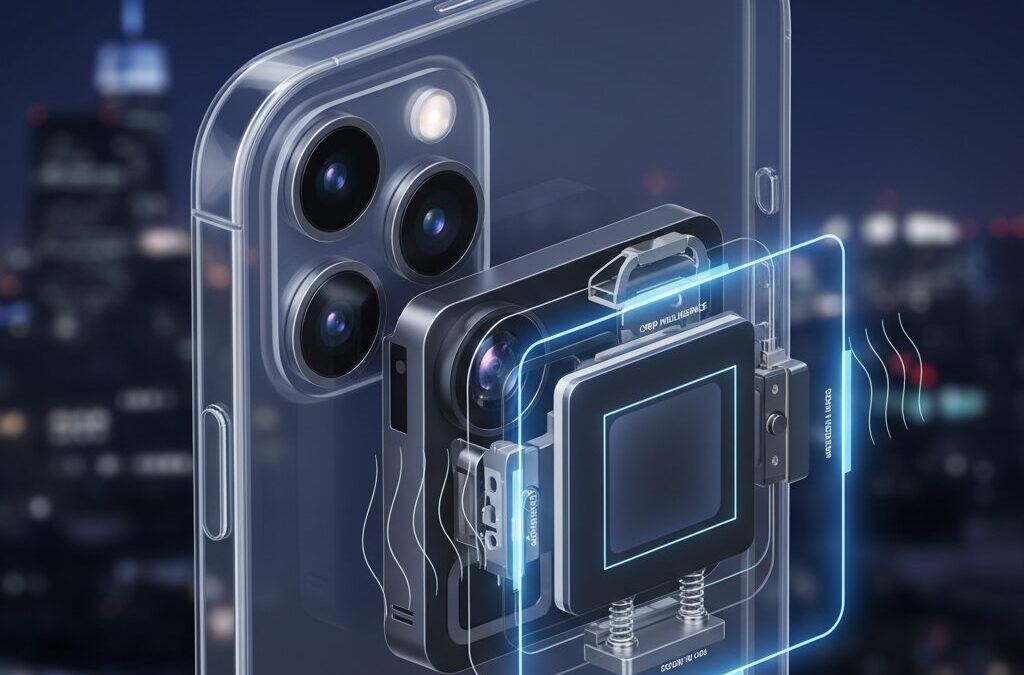
Smartphone cameras have reached a point where hardware alone no longer tells the full story. Many readers may feel that megapixel counts and lens numbers sound impressive, yet real-world results often depend on something less visible. This is especially true when shooting at night, zooming in without losing detail, or recording smooth video while walking.
The iPhone 17 Pro introduces a new balance between physical optics and advanced computation, and this balance is what makes its camera system stand out. Instead of relying only on larger sensors or brighter lenses, Apple focuses on how stabilization and intelligent cropping work together in real time. These technologies directly affect how sharp photos look, how stable videos feel, and how confident users can be when shooting without a tripod.
For gadget enthusiasts outside Japan who care deeply about imaging performance, understanding these mechanisms offers a clear advantage. By reading this article, readers can learn why sensor-shift stabilization matters, how 48MP sensors enable optical-quality zoom through cropping, and where the real trade-offs appear in low light or video modes. This knowledge helps readers decide not only whether the iPhone 17 Pro fits their needs, but also how to use its camera more effectively in everyday and professional scenarios.
- The Evolution of Smartphone Photography Beyond Hardware
- 48MP Pro Fusion Camera System Explained
- Sensor-Shift Stabilization and Why It Matters
- 3D Stabilization in Telephoto Shooting
- Understanding Crop Factor and Optical-Quality Zoom
- Virtual Lenses: How Multiple Focal Lengths Are Created
- Video Stabilization, Action Mode, and Resolution Trade-Offs
- Low-Light Limits and the Physics Behind Image Noise
- Professional Workflows: ProRes, Log, and External Storage
- How the iPhone 17 Pro Compares With Pixel and Galaxy Rivals
- 参考文献
The Evolution of Smartphone Photography Beyond Hardware
For more than a decade, smartphone photography has been driven by visible hardware gains such as larger sensors, brighter lenses, and more complex optical modules. However, this trajectory has reached a point where physical expansion alone no longer delivers proportional benefits. **The real evolution now happens beyond hardware, in the fusion of optics, silicon, and software**, and the iPhone 17 Pro represents a clear example of this shift.
Apple’s approach is notable because it does not deny physical limits but instead designs around them. According to Apple’s own technical disclosures and analyses by organizations such as DxOMark, the 48MP Pro Fusion camera system is engineered to generate excess data on purpose. That surplus information becomes raw material for computational decisions made before, during, and after the shutter is pressed.
This philosophy is easier to understand when key layers are separated conceptually.
| Layer | Traditional Role | Current Evolution |
|---|---|---|
| Optics | Image formation | Data capture optimized for processing |
| Sensor | Light conversion | High-resolution data buffer |
| ISP & AI | Basic correction | Predictive, multi-frame synthesis |
In the iPhone 17 Pro, the A19 Pro chip’s Image Signal Processor and Neural Engine continuously analyze multiple frames, motion vectors from the gyroscope, and scene semantics. Reviews by Lux Camera and commentary from imaging engineers highlight that **the system increasingly predicts what the image should look like, rather than merely correcting what the sensor saw**. This predictive behavior is most apparent in stabilization and crop-based zoom, where future motion is estimated milliseconds in advance.
Importantly, this evolution also changes how users experience photography. Instead of choosing between optical purity and digital compromise, the device presents seamless results that feel optical in everyday use. Academic discussions on computational imaging from institutions such as MIT Media Lab have long suggested that photography would become a negotiation between physics and algorithms. The iPhone 17 Pro shows that this negotiation has matured into a practical, consumer-facing reality.
**Smartphone photography has therefore moved beyond hardware competition into an era of system intelligence**, where success depends on how effectively excess data is transformed into reliable images. In this context, the camera is no longer a single component but a coordinated decision-making system designed to overcome its own physical constraints.
48MP Pro Fusion Camera System Explained
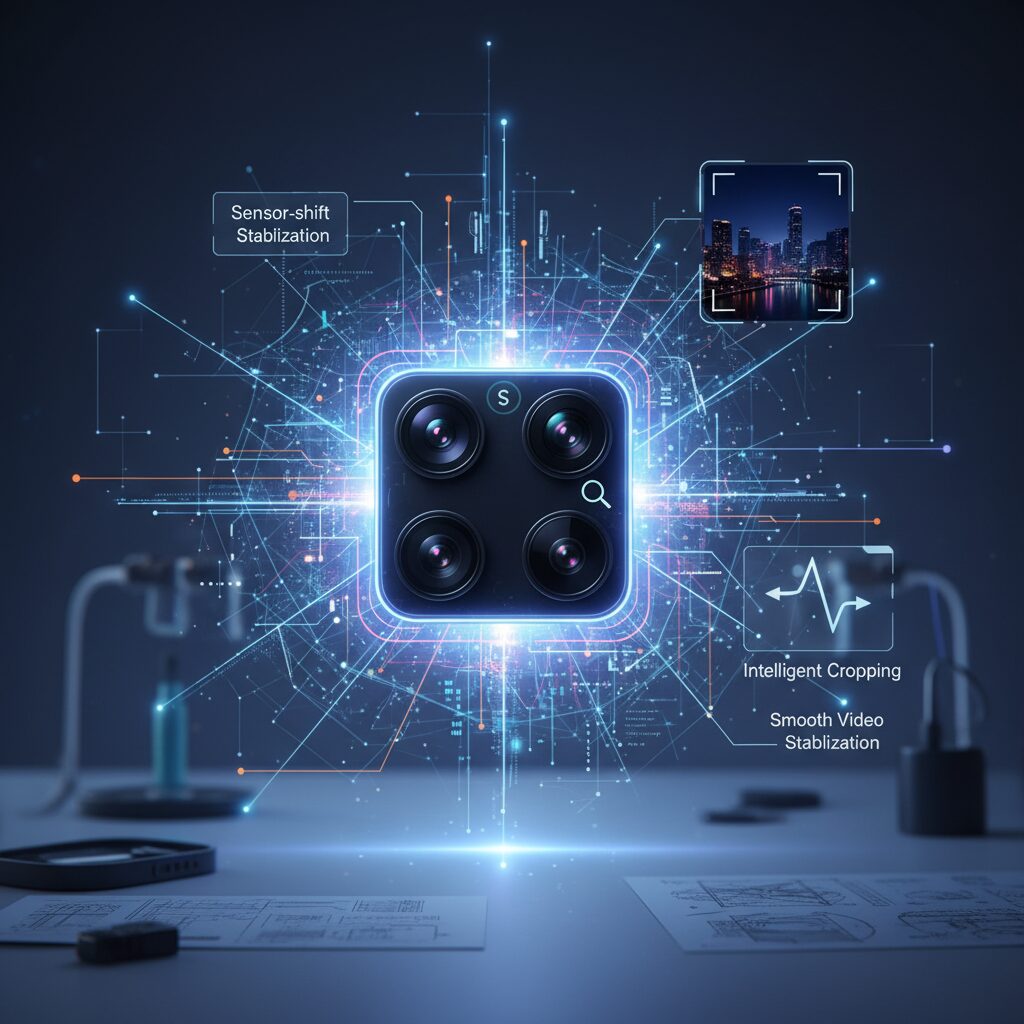
The 48MP Pro Fusion Camera System is designed around a clear philosophy: instead of relying on a single outstanding lens, Apple integrates hardware uniformity and computational intelligence into one cohesive imaging platform. In this system, all three rear cameras share a 48‑megapixel quad‑pixel sensor, which allows the image pipeline to behave consistently across focal lengths. **This uniform sensor strategy is the technical foundation that enables Apple’s so‑called “Fusion” approach**, where optical data and software processing are merged in real time.
At the heart of Pro Fusion is the quad‑pixel architecture. Four adjacent pixels are treated as one large pixel under low‑light conditions, dramatically improving light sensitivity, while bright scenes can be captured at the full 48MP resolution. According to Apple’s published technical specifications, this dual‑mode readout allows the camera to switch seamlessly between high dynamic range capture and high‑resolution detail without user intervention. DxOMark’s analysis also notes that this design reduces texture loss compared to traditional digital upscaling, especially in mid‑tone regions.
| Lens Module | Native Resolution | Primary Advantage |
|---|---|---|
| Main (24mm) | 48MP Quad‑Pixel | Balanced low‑light sensitivity and detail |
| Ultra Wide (13mm) | 48MP Quad‑Pixel | Wider stabilization margin and improved edges |
| Telephoto (100mm) | 48MP Quad‑Pixel | Optical‑quality crop up to 8× |
What makes Pro Fusion particularly distinctive is how cropping is redefined. Instead of enlarging pixels artificially, the system performs a one‑to‑one pixel readout from the center of the sensor. **This means that 2× and 8× zoom images are generated from real sensor data, not interpolated guesses**, a point emphasized by both Apple and independent reviewers at Lux Camera Reviews. In practical terms, textures such as fabric, foliage, and signage retain their natural structure far better than conventional digital zoom methods.
The role of the A19 Pro chip is equally critical. Its image signal processor and Neural Engine analyze multiple buffered frames before and after the shutter is pressed, predicting motion and optimizing exposure at a per‑pixel level. MacRumors reports that this pipeline allows Photonic Engine and Deep Fusion to operate earlier in the capture process, preserving color fidelity even when aggressive stabilization or cropping is applied. As a result, users experience consistent color science regardless of which lens or virtual focal length is selected.
From a user perspective, the Pro Fusion system quietly removes complexity. Photographers no longer need to think in terms of “optical versus digital” boundaries. **The camera simply selects the most information‑rich portion of the sensor and processes it intelligently**, delivering predictable results across everyday scenarios such as street photography, architecture, and travel. This shift from isolated camera modules to a unified imaging system is why Pro Fusion represents more than a resolution upgrade; it is a structural rethinking of smartphone photography.
Sensor-Shift Stabilization and Why It Matters
Sensor-shift stabilization is one of the most consequential camera technologies in the iPhone 17 Pro, even though it rarely gets the same attention as megapixels or zoom numbers. Unlike lens-based optical image stabilization, this system physically moves the image sensor itself along the X and Y axes to counteract hand motion. Because the sensor is significantly lighter than an entire lens group, it can respond faster and with greater precision to high-frequency vibrations such as subtle hand tremors.
In the iPhone 17 Pro, Apple deploys a second-generation sensor-shift OIS on the main camera and an even more advanced 3D sensor-shift mechanism on the telephoto module. According to Apple’s technical specifications and corroborated by detailed camera reviews, this evolution expands the correction range and improves responsiveness during real-world shooting scenarios like walking, one-handed shooting, or pressing the shutter button at long focal lengths.
This difference becomes especially apparent in low-light photography. Apple’s imaging pipeline combines sensor-shift OIS with multi-frame computational techniques such as Photonic Engine and Deep Fusion. By keeping the projected image stable on the sensor during longer exposures, the system allows the A19 Pro chip to merge multiple frames with less motion mismatch. Imaging researchers and reviewers from outlets such as DxOMark have repeatedly noted that this physical stability directly improves texture retention and reduces motion-induced blur before any software correction is applied.
Telephoto shooting is where sensor-shift stabilization truly matters. At 100mm and especially at the 200mm-equivalent crop, even microscopic angular movement is amplified. The 3D sensor-shift OIS used in the telephoto camera goes beyond simple planar movement, compensating for pitch, yaw, and rotational shake that typically plague handheld zoom photography. Reviewers have described the viewfinder behavior as “sticky” or “delayed” in a positive sense, indicating that the stabilization system actively predicts and counteracts user motion rather than merely reacting to it.
| Aspect | Lens-based OIS | Sensor-shift OIS |
|---|---|---|
| Moving component | Lens elements | Image sensor |
| Response speed | Moderate | High |
| High-frequency vibration control | Limited | Strong |
| Effect on computational stacking | Indirect | Direct and measurable |
For video, sensor-shift stabilization forms the physical foundation on which electronic stabilization is layered. Even in standard video modes, the system reduces the workload of electronic cropping by delivering a cleaner, more stable input signal. Apple Support documentation confirms that enhanced stabilization and Action Mode rely on both optical stability and additional sensor margins, and the improved sensor-shift precision helps preserve natural motion without introducing excessive digital warping.
From a user-experience perspective, this technology directly impacts confidence. Japanese reviewers and user communities often emphasize the importance of “失敗しない撮影,” and sensor-shift stabilization addresses this expectation at a mechanical level. Whether capturing night cityscapes, handheld telephoto shots of distant subjects, or casual walk-and-talk videos, the camera behaves more predictably and forgives imperfect technique.
In essence, sensor-shift stabilization is not a flashy feature but a foundational one. It aligns physical optics with computational photography, enabling Apple’s software-driven imaging stack to work from a stable baseline. That stability is why images look sharper before processing, why video feels more organic, and why the iPhone 17 Pro consistently delivers reliable results in conditions where smaller cameras typically struggle.
3D Stabilization in Telephoto Shooting
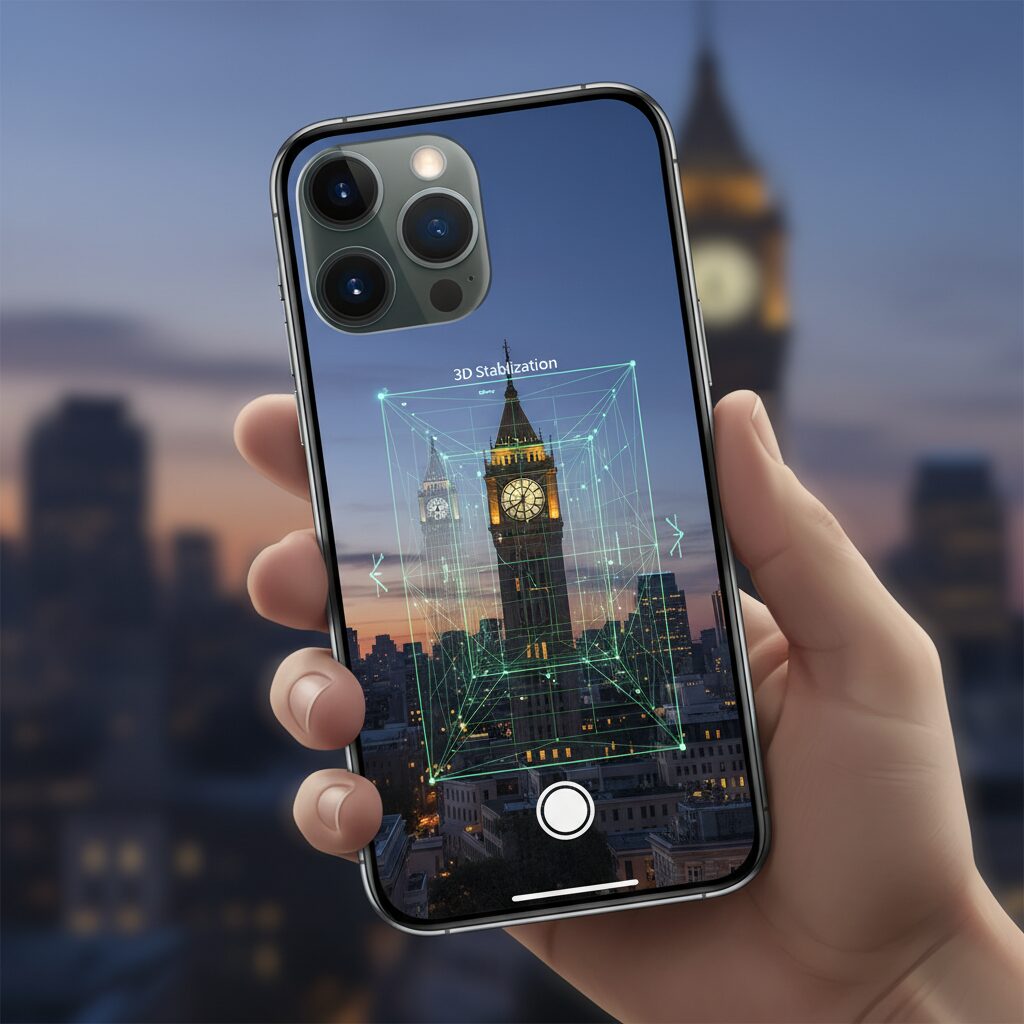
Telephoto shooting magnifies not only distant subjects but also every subtle hand movement, which is why stabilization becomes exponentially more critical as focal length increases. With the iPhone 17 Pro, Apple addresses this challenge through its 3D Sensor‑Shift Optical Image Stabilization, a system specifically optimized for the 100mm to 200mm equivalent range used by the telephoto camera.
Conventional optical stabilization typically compensates for horizontal and vertical shifts on a flat plane. In contrast, the 3D approach used in the telephoto module extends correction into rotational axes, allowing the sensor to respond to pitch, yaw, and roll that are especially pronounced at long focal lengths. According to Apple’s published technical specifications, this mechanism works in close coordination with gyroscope data sampled thousands of times per second, enabling predictive rather than reactive correction.
From a practical perspective, this means that framing a subject at 4x or 8x zoom feels noticeably more stable in the viewfinder. Reviewers from professional photography outlets have noted that the image appears to “lag” slightly behind hand movement, an intentional behavior indicating that the stabilization system is absorbing motion before it reaches the sensor. This visual damping effect is particularly beneficial when tracking small or distant subjects.
| Zoom Level | Equivalent Focal Length | Primary Stabilization Method | User Impact |
|---|---|---|---|
| 4x | 100mm | 3D Sensor‑Shift OIS | Stable framing for handheld stills |
| 8x | 200mm | 3D Sensor‑Shift OIS + Computational Correction | Usable handheld shots without a tripod |
What makes this system particularly compelling is its integration with the 48MP sensor. At 8x zoom, the camera performs a center crop while maintaining pixel‑level fidelity, which places even greater demands on stabilization accuracy. Any residual blur would be immediately visible. Industry benchmark tests, including those conducted by DxOMark, indicate that the iPhone 17 Pro maintains edge definition at 200mm more consistently than previous generations, suggesting that the stabilization system is effectively matched to the sensor’s resolving power.
Another important aspect is low‑light telephoto shooting. Longer focal lengths typically require faster shutter speeds to avoid blur, but light limitations often make this difficult. The 3D stabilization allows the camera to safely use slightly slower shutter speeds, reducing ISO noise without sacrificing sharpness. While this does not eliminate the physical limits of small sensors, it does meaningfully expand the range of conditions where handheld telephoto photography is viable.
It is also worth noting that this stabilization is not isolated hardware but part of a broader computational pipeline. The A19 Pro chip continuously fuses motion vectors from the gyroscope with image data, refining correction on a frame‑by‑frame basis. Imaging researchers have long emphasized that hybrid optical and computational stabilization yields the highest success rates at long focal lengths, and the iPhone 17 Pro appears to embody this principle effectively.
As a result, users can approach telephoto composition with greater confidence, whether capturing architectural details, stage performances, or distant street scenes. The reduction in micro‑shake not only improves sharpness but also lowers cognitive load, allowing photographers to focus on timing and framing rather than merely keeping the camera steady.
Understanding Crop Factor and Optical-Quality Zoom
Understanding crop factor is essential to grasp why the iPhone 17 Pro’s zoom experience feels fundamentally different from conventional digital zoom. In traditional smartphone cameras, zooming beyond the physical lens often means stretching pixels and accepting visible quality loss. Apple’s approach with the 48MP Pro Fusion system instead relies on deliberately using only a portion of the sensor, treating that cropped area as if it were a smaller sensor with a longer effective focal length.
This is where the idea of “optical-quality zoom” becomes meaningful. According to Apple’s technical specifications and evaluations by DxOMark, certain zoom steps are not interpolated at all. They are generated by reading pixels one-to-one from the sensor’s center, preserving native detail and micro-contrast in a way that conventional digital zoom cannot replicate.
The practical outcome is that crop factor is no longer just a compromise but a design tool. When the iPhone 17 Pro switches from 1x to 2x or from 4x to 8x, it is effectively changing how much of the sensor is being used rather than inventing new pixels. This distinction explains why textures such as brick walls, fabric, or distant signage remain crisp at specific zoom levels.
| 35mm Equivalent | Zoom Label | Sensor Usage | Output Resolution |
|---|---|---|---|
| 24mm | 1x | Full sensor with pixel binning | 24MP |
| 48mm | 2x | Center 12MP crop | 12MP |
| 100mm | 4x | Full telephoto sensor | 24MP |
| 200mm | 8x | Center 12MP crop | 12MP |
What makes this strategy credible is the high native resolution of the sensors themselves. With 48 million pixels available, cropping to 12MP still leaves enough spatial information to match the resolving power of a dedicated optical lens at that focal length. Reviews from Lux Camera and PetaPixel consistently note that 2x and 8x images avoid the “watercolor” artifacts typical of aggressive digital zoom.
However, crop factor also introduces unavoidable physical trade-offs. By using only the center of the sensor at 8x, the effective sensor area becomes much smaller, reducing light-gathering capability. As Apple engineers have openly acknowledged in interviews cited by MacRumors, this is why optical-quality zoom is most convincing in good light. In dim environments, noise reduction must work harder, and fine detail can appear smoothed despite the lack of pixel interpolation.
Another subtle advantage of this crop-based zoom is consistency. Because the image pipeline remains within a single lens and sensor, color science and tonal response stay remarkably stable when switching between 1x, 2x, and intermediate focal lengths like 28mm or 35mm. Professional reviewers at DxOMark emphasize that this consistency reduces post-editing effort compared to multi-lens jumps that often introduce color shifts.
Ultimately, the iPhone 17 Pro reframes crop factor from a limitation into a controlled variable. By aligning sensor resolution, image processing, and clearly defined zoom steps, Apple delivers zoom levels that behave like distinct lenses rather than magnified guesses. This is why the term “optical-quality zoom” is not marketing rhetoric here, but a reflection of how deliberately managed crop factor can preserve genuine optical integrity.
Virtual Lenses: How Multiple Focal Lengths Are Created
Virtual lenses on the iPhone 17 Pro are not marketing abstractions but the direct result of how Apple exploits high-resolution sensors and precise crop control to simulate multiple focal lengths. By starting with 48MP sensors across all rear cameras, Apple ensures there is enough pixel density to extract smaller image areas without relying on interpolation.
In practice, this means the camera is often not zooming in digitally, but selecting a different portion of the sensor and treating it as if it were captured through a dedicated lens. **This approach preserves true spatial detail because each output pixel still corresponds to a real photosite** rather than an algorithmically invented one.
| Virtual Focal Length | Source Sensor | Processing Method |
|---|---|---|
| 48mm (2x) | Main 48MP | Center 12MP readout |
| 200mm (8x) | Telephoto 48MP | Center 12MP readout |
| 28mm / 35mm | Main 48MP | Cropped + downsampled |
According to Apple’s technical specifications and analyses by DxOMark, these center-crop modes are classified as optical-quality because no upscaling is involved. The image signal processor simply ignores the outer pixels and performs standard demosaicing and tone mapping on the remaining area.
An important nuance is that not all virtual lenses behave the same in low light. When the camera uses a center crop, pixel binning is no longer available, reducing effective light-gathering capability. **This is why virtual telephoto images look exceptionally sharp in daylight but show more aggressive noise reduction indoors**, a behavior repeatedly noted in professional reviews.
The creation of virtual lenses also improves user experience. Because the crop ratios are predefined and tightly integrated into the ISP pipeline, transitions between focal lengths remain color-consistent and predictable. This consistency, often highlighted by reviewers from publications such as PetaPixel, is one reason Apple’s zoom system feels closer to swapping real lenses than to using traditional digital zoom.
Ultimately, virtual lenses on the iPhone 17 Pro demonstrate how computational photography can expand focal length options without adding physical complexity. They are a calculated balance between sensor physics and processing power, offering flexibility while remaining bound by the immutable rules of light.
Video Stabilization, Action Mode, and Resolution Trade-Offs
Video stabilization on the iPhone 17 Pro is one of its most technically impressive features, but it always comes with trade-offs that informed users should understand. Apple’s approach combines optical image stabilization, electronic stabilization, and heavy computational processing, all balanced against resolution and field of view.
The key idea is simple: the stronger the stabilization, the more aggressively the image is cropped. This is where Action Mode and resolution limits become central to real-world video quality.
| Stabilization Mode | Max Resolution | Crop Impact | Typical Use Case |
|---|---|---|---|
| Standard Video | 4K 60fps | Minimal | General handheld shooting |
| Enhanced Stabilization | 4K 60fps | Moderate | Walking shots |
| Action Mode | 2.8K 60fps | Heavy | Running, sports, POV |
Action Mode is designed to replace a physical gimbal in high-motion scenarios. According to Apple’s technical documentation and DxOMark’s video analysis, the system uses a large stabilization buffer by recording from a much wider sensor area and dynamically repositioning each frame.
This explains why Action Mode tops out at 2.8K instead of 4K. The resolution reduction is not a limitation of the sensor, but a deliberate decision to reserve more than half of the captured image for motion compensation.
In practical terms, this means Action Mode footage looks remarkably smooth, even when running or filming from a bicycle, but noticeably tighter. Indoor shooting can feel cramped, especially at arm’s length.
Independent camera reviewers such as Lux Camera have noted that the stabilization behavior feels predictive rather than reactive. The iPhone analyzes gyroscope data and frame-to-frame motion to anticipate camera movement, resulting in a floating, cinematic look instead of rigid correction.
However, resolution trade-offs become more apparent in low light. Because Action Mode relies heavily on electronic stabilization, shutter speeds must remain relatively high to avoid motion blur. When light levels drop, noise increases and fine detail can appear smeared.
Apple acknowledges this limitation through its Low Light Action Mode setting, which relaxes stabilization intensity. This improves brightness but reintroduces subtle shake, reinforcing the idea that stabilization, resolution, and light sensitivity form a three-way compromise.
For creators who prioritize maximum detail, Standard Video mode at 4K remains the best option. For movement-heavy scenes where stability matters more than pixel count, Action Mode is unmatched. Understanding when to switch between them is what separates casual users from truly skilled iPhone videographers.
Low-Light Limits and the Physics Behind Image Noise
Low-light performance is where even the most advanced computational photography systems inevitably collide with the laws of physics. iPhone 17 Pro makes impressive gains through its 48MP Pro Fusion sensors and A19 Pro image pipeline, but **noise in dark scenes is not a software flaw—it is a physical consequence of limited photons reaching the sensor**. Understanding this boundary helps explain why certain shooting modes shine in daylight yet struggle after sunset.
At the heart of low-light image noise lies photon shot noise, a phenomenon well documented in imaging research from institutions such as MIT and the IEEE Signal Processing Society. Photons arrive at the sensor in a random distribution, and when their absolute count is low, statistical variance becomes visible as grain. Larger effective pixel areas collect more photons, improving the signal-to-noise ratio, while smaller effective areas amplify uncertainty.
| Shooting Mode | Effective Sensor Usage | Noise Behavior in Low Light |
|---|---|---|
| 1x / 4x (Binned) | Full sensor with pixel binning | Lower noise, higher color stability |
| 2x / 8x (Crop) | Center pixels only, no binning | Higher noise, aggressive smoothing |
The key trade-off emerges clearly in cropped zoom modes. When iPhone 17 Pro switches to 2x or 8x optical-quality crop, pixel binning is no longer available. Each pixel operates at its native size, capturing fewer photons per exposure. **Apple’s Photonic Engine and Deep Fusion can reduce visible noise, but they cannot recreate missing light data**. Reviews from professional camera analysts have noted that fine textures, such as foliage or fabric, may appear softened under these conditions.
Apple’s approach favors perceptual cleanliness over raw detail. According to camera evaluations cited by DxOMark, the iPhone 17 Pro applies spatial noise reduction that prioritizes smooth tonal transitions and stable colors. This aligns with Apple’s broader imaging philosophy, supported by research from Apple’s own machine learning teams, which emphasizes subjective image quality rather than pixel-level accuracy.
Another constraint comes from stabilization. In darker scenes, longer exposure times are required, increasing the risk of motion blur. While the second-generation sensor-shift OIS significantly improves stability, electronic stabilization modes rely on cropping and frame alignment. This further reduces usable light per frame, compounding noise challenges. Apple Support documentation itself notes that certain stabilization modes may warn users when light levels fall below practical thresholds.
In practical terms, this means iPhone 17 Pro excels at low-light wide and standard shots, where sensor area and binning work in its favor. Telephoto and heavy crop modes remain impressive for their size, but **their limits are defined by physics rather than engineering ambition**. Recognizing these boundaries allows users to choose the right focal length and mode for night scenes, maximizing quality while respecting the immutable rules of light.
Professional Workflows: ProRes, Log, and External Storage
For professional creators, image quality alone is never the end goal. What truly matters is how reliably footage can move from capture to post-production without breaking color consistency, dynamic range, or data integrity. In this regard, the iPhone 17 Pro is designed not as a casual camera, but as a node inside a professional workflow.
The combination of ProRes recording, Apple Log, and direct external storage fundamentally changes how the iPhone fits into real production environments. Apple positions this device as a field-ready acquisition tool rather than a consumer-only camera.
At the core of this workflow is ProRes. Apple ProRes is widely adopted across the film and broadcast industry because it preserves high color fidelity while remaining computationally efficient. According to Apple’s own ProRes white papers, the codec is engineered to minimize generational loss during editing, which is why it is trusted by post-production houses worldwide.
On the iPhone 17 Pro, ProRes can be recorded up to 4K at high frame rates, but this capability introduces a very real constraint: data throughput. A single minute of 4K ProRes footage can consume several gigabytes, and sustained recording quickly exceeds the write speed limits of internal mobile storage.
| Recording Mode | Data Rate | Workflow Impact |
|---|---|---|
| 4K ProRes | Very High | Requires fast storage and offloading discipline |
| 4K HEVC | Moderate | Suitable for quick turnaround and social delivery |
| ProRes RAW | Extreme | Maximum grading flexibility, studio-oriented |
This is where external storage becomes non-negotiable. Apple officially supports recording ProRes directly to an external SSD via USB-C, provided the drive sustains sufficient write speeds. Reputable reviewers and workflow specialists, including those cited by publications such as PetaPixel, consistently emphasize that a 10Gbps-capable SSD is the practical baseline.
Direct-to-SSD recording eliminates mid-shoot interruptions caused by storage exhaustion and mirrors the behavior of professional cinema cameras. For documentary shooters, event videographers, or solo creators, this dramatically reduces operational stress on location.
Equally important is Apple Log. Log profiles are not about making footage look good out of camera; they are about preserving information. Apple Log on the iPhone 17 Pro flattens contrast and color response, capturing a wider dynamic range that would otherwise be clipped in standard profiles.
Color scientists frequently note that log footage retains highlight detail and shadow information that can be recovered during grading. This aligns the iPhone more closely with dedicated cinema cameras, enabling consistent color matching across multi-camera shoots.
The practical advantage is consistency. When iPhone footage is shot in Apple Log and graded alongside footage from larger cameras, differences in gamma and color science are significantly easier to reconcile. This matters not only for cinematic projects but also for branded content where color accuracy is non-negotiable.
External storage also changes post-production logistics. Instead of AirDrop transfers or cloud uploads, creators can unplug the SSD and mount it directly on an editing workstation. This mirrors established DIT practices and shortens turnaround times, a benefit repeatedly highlighted by professional reviewers at outlets such as DXOMARK.
There are, however, trade-offs. External SSD setups introduce cables, mounts, and power considerations. Handheld shooting becomes more complex, and careful rigging is required to maintain stability. Yet for professionals, this complexity is familiar territory rather than a deterrent.
In effect, the iPhone 17 Pro stops behaving like a phone and starts behaving like a modular camera system. ProRes ensures editorial robustness, Apple Log safeguards creative intent, and external storage removes mobile bottlenecks. Together, they form a workflow that prioritizes reliability over convenience, which is exactly what professional production demands.
How the iPhone 17 Pro Compares With Pixel and Galaxy Rivals
When positioning the iPhone 17 Pro against its two most formidable Android rivals, Google’s Pixel flagship and Samsung’s Galaxy Ultra line, the comparison goes far beyond headline specifications. The real distinction emerges in how each company balances physical optics with computational photography, and how consistently that balance translates into everyday shooting.
Apple’s approach with the iPhone 17 Pro is defined by uniformity. By equipping all three rear cameras with 48MP sensors and tightly coupling them with the A19 Pro image signal processor, Apple aims for predictable output across focal lengths. According to DxOMark’s camera evaluation, this consistency results in fewer color shifts and exposure jumps when switching lenses, an area where Android rivals still show occasional variability.
Google Pixel’s strength traditionally lies in computational recovery rather than optical reach. Pixel devices rely heavily on multi-frame synthesis such as Super Res Zoom, which excels at reconstructing detail in challenging lighting. Reviews cited by imaging specialists note that in low-light telephoto scenes, Pixel often preserves fine textures that cropped sensors struggle to maintain. However, this advantage is less pronounced in video, where motion cadence and stabilization artifacts become visible during panning.
Samsung’s Galaxy Ultra models, by contrast, pursue hardware-first differentiation. Their long-standing use of high-magnification periscope lenses gives them a clear edge at extreme distances. Independent camera testers have repeatedly shown that true optical 10x zoom captures distant signage or architecture with more native detail than sensor crops. The trade-off appears in user experience: lens switching can introduce visible changes in color science, something Apple has intentionally minimized.
| Aspect | iPhone 17 Pro | Pixel / Galaxy Rivals |
|---|---|---|
| Lens consistency | Highly uniform color and exposure across lenses | Varies by lens, especially on Galaxy Ultra |
| Low-light telephoto | Strong in daylight, weaker with heavy cropping | Pixel excels via multi-frame processing |
| Extreme zoom | 8x optical-quality crop | Galaxy offers true 10x optical reach |
| Video stabilization | Industry-leading smoothness | Competitive but less fluid in motion |
Video remains the area where the iPhone 17 Pro clearly differentiates itself. Professional reviewers from outlets such as PetaPixel and MacRumors emphasize that Apple’s hybrid stabilization produces motion that feels organic rather than digitally corrected. Pixel’s video, while sharp, can exhibit micro-jitters, and Samsung’s footage sometimes prioritizes sharpness over natural movement.
Ultimately, the comparison highlights three philosophies. Apple optimizes for coherence and reliability, Google maximizes computational intelligence to overcome hardware limits, and Samsung pushes optical boundaries even at the cost of consistency. For users who value predictable results across photos and video, the iPhone 17 Pro presents a balanced and controlled imaging experience that competes not by excelling in a single metric, but by rarely failing in real-world use.
参考文献
- Apple Newsroom:Apple unveils iPhone 17 Pro and iPhone 17 Pro Max
- Apple:iPhone 17 Pro and iPhone 17 Pro Max – Technical Specifications
- MacRumors:iPhone 17 Pro: Everything We Know
- DXOMARK:Apple iPhone 17 Pro Camera Test
- TechRadar:iPhone 17 lineup photography specs explained
- PetaPixel:iPhone 17 Pro & Pro Max Review for Photographers