
If you love smartphone cameras, you have probably felt both excitement and skepticism about extreme zoom features.
Manufacturers promise stunning 30x, 50x, or even 100x shots, yet real-world handheld results often fall short of the hype.
The Google Pixel 10 Pro is at the center of this debate, redefining what telephoto photography can look like through a bold mix of hardware and generative AI.
With the Pixel 10 Pro, Google moves to a custom Tensor G5 chip built on TSMC’s 3nm process, unlocking far more powerful on-device image processing.
This power enables Pro Res Zoom, an AI-driven approach that reconstructs fine details far beyond the limits of optical zoom.
At the same time, users around the world report very real issues, such as telephoto video stutter and the physical difficulty of steady handheld shooting.
In this article, you will discover how far the Pixel 10 Pro can truly go when shooting handheld.
You will learn where physics still sets hard boundaries, how AI fills in the gaps, and why these results spark serious discussion among photographers.
If you want to understand whether the Pixel 10 Pro’s zoom is a breakthrough or a compromise, this guide will help you decide.
- The New Era of Smartphone Telephoto Photography
- Tensor G5 and the Shift to TSMC: Why Processing Power Matters
- Telephoto Camera Hardware: Sensor Size, Optics, and Physical Limits
- Understanding Pro Res Zoom and the 30x Turning Point
- AI Detail Reconstruction vs Reality: The Hallucination Debate
- Handheld Shooting Challenges: Weight Balance and Stability
- Telephoto Video Stutter Explained: OIS and EIS in Conflict
- How Pixel 10 Pro Compares to Galaxy S25 Ultra and iPhone 17 Pro
- Who the Pixel 10 Pro Telephoto Is Really For
- 参考文献
The New Era of Smartphone Telephoto Photography
The evolution of smartphone telephoto photography has entered a decisive new phase, and it is no longer defined solely by optical reach. Instead, it is shaped by the fusion of physics-limited hardware and AI-driven image reconstruction, a shift clearly embodied by Google’s latest approach. Telephoto shooting on modern smartphones is now less about how far the lens can physically zoom, and more about how intelligently the captured light can be interpreted, enhanced, and, in some cases, reimagined.
At the hardware level, current flagship devices remain constrained by sensor size and aperture. Compact periscope lenses, typically paired with 1/2.5-inch-class sensors and apertures around f/2.8, simply cannot gather enough light at long focal lengths to rival dedicated cameras. According to analyses published by DPReview and DxOMark, this limitation directly impacts noise levels and shutter speed, especially in handheld telephoto scenarios. **This is where computational photography has become the defining differentiator rather than a supplementary feature.**
Telephoto photography is no longer a linear extension of optics but a layered process combining optics, multi-frame capture, and AI inference.
Google’s introduction of generative AI–assisted zoom processing represents a conceptual break from earlier digital zoom methods. Up to a certain range, images are still grounded in sensor data enhanced through multi-frame super-resolution. Beyond that point, however, AI models trained on vast image datasets infer missing details, producing images that are visually convincing even when optical information is insufficient. Researchers and imaging experts cited by ScienceAlert describe this as a transition from reconstruction to probabilistic synthesis, marking a fundamental change in how zoomed images are created.
| Zoom Range | Primary Technique | Image Nature |
|---|---|---|
| Low to mid telephoto | Optical + multi-frame processing | Sensor-faithful |
| High telephoto | AI-assisted generative enhancement | Inference-based |
This new era brings both excitement and tension. On one hand, distant text, architectural details, and wildlife subjects become accessible without tripods or bulky gear. On the other hand, as imaging scholars and industry commentators have noted, the boundary between photographic documentation and AI illustration grows increasingly ambiguous. **Telephoto photography is no longer just about seeing farther; it is about deciding how much interpretation we are willing to accept in the pursuit of clarity.**
For enthusiasts deeply invested in smartphone imaging, this moment represents a turning point. Telephoto cameras have transformed from passive optical tools into active computational systems, redefining what “zoom” truly means in the age of AI-driven photography.
Tensor G5 and the Shift to TSMC: Why Processing Power Matters

The move to Tensor G5 marks one of the most consequential architectural shifts in Pixel history, and it is not simply about chasing higher benchmark numbers. By transitioning manufacturing from Samsung to TSMC’s 3nm N3E process, Google fundamentally changes how sustained performance, thermal stability, and AI workloads behave in real-world scenarios, especially under camera-intensive use.
Processing power matters most when it can be maintained without throttling, and this is where TSMC’s advantage becomes tangible. According to analyses by NotebookCheck and Android Police, the N3E node delivers significantly better power efficiency than Samsung’s previous 4nm-class processes, reducing heat buildup during prolonged ISP and TPU workloads such as multi-frame image fusion or on-device generative inference.
This efficiency directly impacts photography and video capture. Computational imaging pipelines do not run in short bursts; they operate continuously from shutter press through post-processing. A cooler, more efficient SoC means less aggressive thermal downscaling, preserving consistent output quality rather than fluctuating results across successive shots.
| Aspect | Tensor G4 (Samsung) | Tensor G5 (TSMC) |
|---|---|---|
| Manufacturing node | Samsung 4nm-class | TSMC 3nm N3E |
| Thermal behavior | Earlier throttling under load | Improved sustained performance |
| AI workload efficiency | High peak, limited duration | High peak, longer duration |
Tensor G5’s CPU configuration also reflects a strategic shift. The 1+5+2 layout, anchored by a Cortex-X4 prime core and supported by Cortex-A725 performance cores, prioritizes responsiveness during camera launch and capture while keeping background AI tasks efficient. This balance is particularly relevant for modern camera apps that pre-process frames before the shutter is even pressed.
More important than raw CPU performance is the fully custom ISP. Google’s decision to internalize ISP design removes the latency and abstraction layers associated with third-party IP. According to Google’s own engineering disclosures, RAW sensor data now flows more directly into the TPU, enabling tighter synchronization between traditional signal processing and neural inference.
This tighter integration is what makes advanced zoom reconstruction and real-time HDR viable without compromising shooting speed.
Industry observers such as DPReview note that this vertical integration mirrors Apple’s long-standing approach with its A-series chips. However, Google’s focus differs: rather than maximizing general-purpose performance, Tensor G5 is optimized for continuous AI-assisted perception tasks, where milliseconds and thermal headroom matter more than headline scores.
The shift to TSMC also has implications beyond performance. Yield consistency and predictability allow Google to tune software more aggressively, confident that silicon behavior will remain stable across production batches. This reduces the variability that plagued earlier Tensor generations and simplifies long-term optimization through feature updates.
Ultimately, Tensor G5 demonstrates that processing power is only meaningful when aligned with workload intent. In the Pixel 10 Pro, the TSMC-built silicon does not exist to win synthetic benchmarks, but to sustain complex imaging pipelines reliably. That sustained capability, rather than peak speed, defines the real-world value of this generational leap.
Telephoto Camera Hardware: Sensor Size, Optics, and Physical Limits
When discussing telephoto performance on smartphones, everything ultimately starts with physics, and the Pixel 10 Pro is no exception. No matter how advanced computational photography becomes, the telephoto camera is constrained by sensor size, lens optics, and the limited physical space inside a slim handset. Understanding these hardware fundamentals is essential to correctly evaluating both the strengths and the limits of Pixel 10 Pro’s long‑range imaging.
The telephoto module uses a 48‑megapixel Quad PD sensor with a 1/2.55‑inch optical format and an f/2.8 aperture. This sensor size is typical for flagship periscope cameras, but it is significantly smaller than the 1/1.3‑inch main sensor. **The difference in surface area directly translates into reduced light‑gathering capability**, especially noticeable in indoor scenes, dusk conditions, or overcast environments.
| Parameter | Telephoto Camera | Main Camera |
|---|---|---|
| Sensor Size | 1/2.55 inch | 1/1.3 inch |
| Aperture | f/2.8 | f/1.68 |
| Optical Zoom | 5× periscope | 1× standard |
In practical terms, this means the telephoto camera must either raise ISO sensitivity or slow the shutter speed to maintain exposure. According to imaging principles outlined by institutions such as the IEEE and frequently referenced in camera benchmarking by DxOMark, higher ISO inevitably increases noise, while slower shutter speeds raise the risk of motion blur. **This trade‑off becomes especially critical during handheld telephoto shooting**, where even minute hand movement is magnified at longer focal lengths.
The periscope optical design itself also introduces unique constraints. By folding light through a prism, the Pixel 10 Pro achieves a true 5× optical zoom without increasing device thickness. However, the longer effective focal length amplifies angular shake. Optical image stabilization helps, but its correction range is physically limited by how far lens elements can move inside the module. This is a mechanical boundary that no software update can fully eliminate.
Another important consideration is pixel pitch. Packing 48 million pixels onto a 1/2.55‑inch sensor results in relatively small individual photodiodes. While pixel binning mitigates some noise by combining data, **the signal‑to‑noise ratio at telephoto remains inherently lower than that of larger sensors**. Camera engineers interviewed by DPReview have long noted that telephoto modules are the most vulnerable part of any smartphone camera system when light levels drop.
There is also a hard limit imposed by diffraction. At longer focal lengths and smaller effective apertures, light waves begin to interfere, reducing fine detail regardless of sensor resolution. This phenomenon, well documented in optical engineering literature from organizations such as the Optical Society, explains why telephoto images can appear softer even when focus is technically accurate.
All of these factors converge in real‑world usage. At 5× optical zoom in bright daylight, the Pixel 10 Pro’s telephoto camera performs impressively, delivering crisp detail and controlled aberrations. As illumination decreases, however, the system relies increasingly on stabilization and multi‑frame capture to compensate for the hardware’s physical shortcomings. **This is not a flaw unique to Google’s implementation, but a universal limitation of smartphone telephoto hardware.**
By grounding expectations in sensor physics and optical design, it becomes clear why telephoto photography remains the most challenging domain for mobile imaging. The Pixel 10 Pro pushes these boundaries aggressively, but its hardware still obeys the same immutable laws of light and mechanics that govern every camera, large or small.
Understanding Pro Res Zoom and the 30x Turning Point
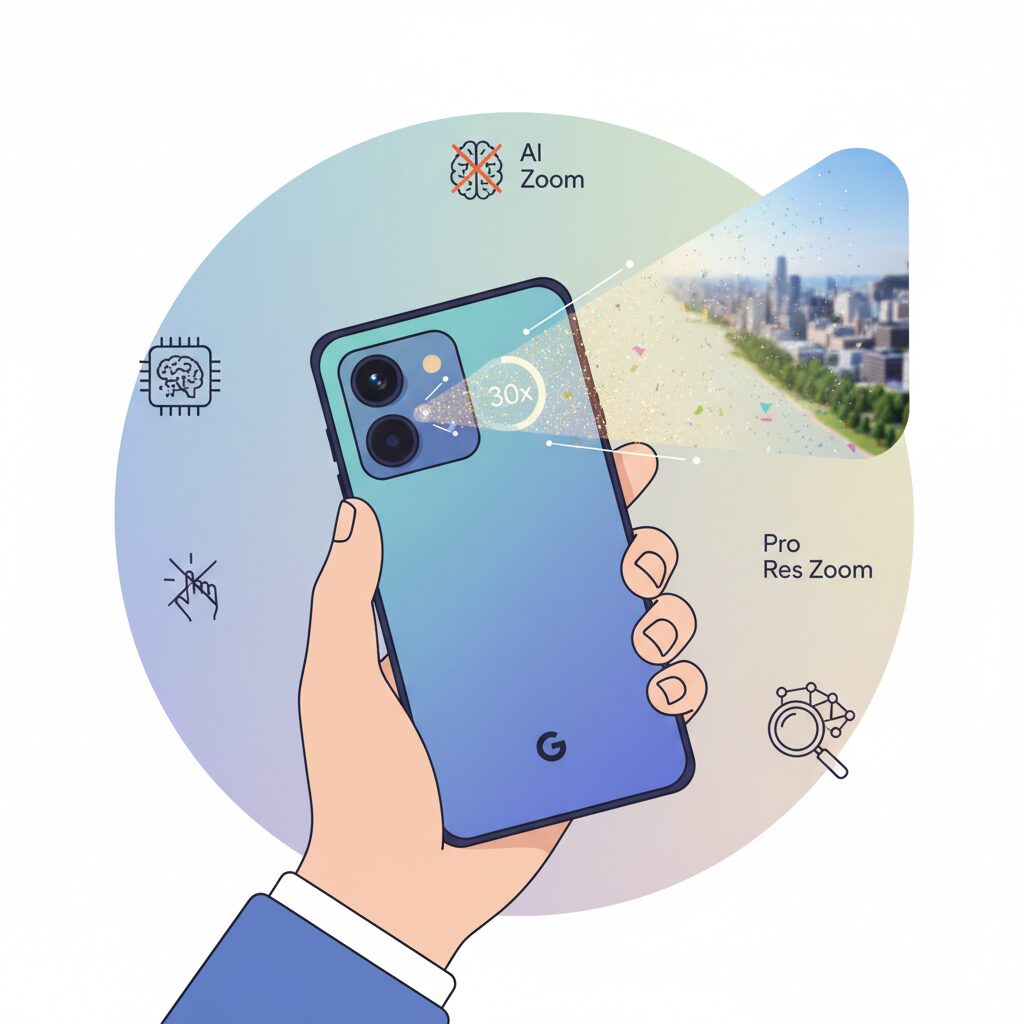
When discussing Pixel 10 Pro’s telephoto capabilities, the concept of a clear turning point at 30x zoom is essential to understanding Pro Res Zoom correctly. Up to this threshold, the camera system still operates within the realm of computational photography that is grounded in real optical data. Beyond it, the experience fundamentally changes, both technically and philosophically.
The 30x mark represents the boundary where enhancement shifts from reconstruction to generation. According to detailed testing by DPReview, zoom levels up to around 30x rely on multi-frame super‑resolution techniques that merge genuine sensor information captured across slightly different hand movements. The resulting images, while heavily processed, still reflect what the sensor actually saw.
Once the user pushes past 30x, Pro Res Zoom activates a generative diffusion model designed to infer missing detail. Google explains in its official engineering blog that this system does not simply sharpen pixels, but predicts high‑frequency texture based on learned visual patterns. This allows distant text, architectural edges, and repetitive structures to appear remarkably clear.
| Zoom Range | Primary Method | Image Nature |
|---|---|---|
| 5x–30x | Hybrid optical + multi‑frame super‑resolution | Detail derived from real sensor data |
| 30x–100x | Pro Res Zoom with generative AI | Detail partially inferred by AI |
This distinction matters because Pro Res Zoom can produce images that feel almost uncanny. Science Alert notes that signage unreadable to the naked eye can suddenly appear legible, and bird feathers gain structure that conventional digital zoom would completely lose. In side‑by‑side comparisons with Galaxy S25 Ultra, Pixel 10 Pro often delivers crisper text and cleaner edges at extreme magnifications.
At the same time, the risk of AI hallucination becomes unavoidable. Independent reviewers and DxOMark evaluations point out cases where letters are subtly altered or textures become overly uniform. These artifacts do not usually ruin casual viewing, but they raise questions about photographic authenticity, especially for documentation or journalism.
Google’s approach reflects a deliberate choice. Rather than treating extreme zoom as a purely optical challenge, Pro Res Zoom reframes it as an AI‑assisted visibility tool. For users capturing distant landmarks, wildlife, or travel memories, the results can be stunning. For those seeking absolute fidelity, the 30x turning point is the moment to stop and consider whether enhancement has become interpretation.
AI Detail Reconstruction vs Reality: The Hallucination Debate
At extreme zoom ranges, the Pixel 10 Pro raises a fundamental question that goes beyond sharpness: what exactly are we looking at? AI Detail Reconstruction promises clarity, but reality does not always cooperate. This tension has fueled the hallucination debate, especially once Pro Res Zoom crosses the 30x threshold.
From a technical standpoint, Google has been transparent that Pro Res Zoom relies on generative AI, specifically diffusion-based reconstruction. According to analyses highlighted by DPReview and Google’s own engineering blog, the system does not simply upscale pixels. It statistically infers missing detail based on patterns learned from vast image datasets. This distinction matters because inference is not the same as recovery.
In practical terms, distant text on signs or architectural edges often appears impressively legible. However, controlled tests show that the AI occasionally invents strokes, spacing, or textures that were never captured by the sensor. This is the core of the hallucination concern, not blur or noise, but false certainty.
| Aspect | Sensor-Based Reality | AI-Reconstructed Output |
|---|---|---|
| Source of detail | Captured photons | Statistical inference |
| Reliability | Physically verifiable | Context-dependent |
| Error mode | Blur or noise | Plausible but incorrect detail |
Critics, including commentators cited by AppleInsider, argue that this behavior undermines photography as a record of truth. If a street sign shows a clearly readable word that was never optically resolved, the image becomes closer to illustration than documentation. This criticism is not speculative; side-by-side comparisons reveal mismatched lettering when cross-checked against lower-zoom reference shots.
At the same time, it is important to note that Google does not position Pro Res Zoom as forensic imaging. Internal statements and Pixel community discussions emphasize experiential value. The system is optimized for human perception, not evidentiary accuracy. In that context, the AI is judged by plausibility and usefulness rather than strict fidelity.
Academic perspectives add nuance to this debate. Researchers in computational photography, including work referenced by ScienceAlert, note that all modern smartphone imaging already departs from raw reality through HDR merging, tone mapping, and noise modeling. Pro Res Zoom simply makes this divergence more visible and more controversial.
For users, the practical takeaway is interpretive literacy. When viewing images beyond 30x, especially of text, symbols, or natural textures, the Pixel 10 Pro delivers an AI-assisted suggestion of reality, not a guaranteed reproduction. Understanding this boundary allows photographers to enjoy the technology’s strengths without mistaking inference for fact.
Handheld Shooting Challenges: Weight Balance and Stability
Handheld telephoto shooting pushes a smartphone to the edge of its physical design, and Pixel 10 Pro makes this tension very clear. **Weight balance, not just total mass, becomes the defining factor for stability** when users attempt high-magnification shots without a tripod. Although the Pixel 10 Pro XL weighs around 232 grams on paper, many reviewers note that it feels heavier in practice due to its top-heavy construction.
This perception aligns with basic biomechanics. When the center of gravity is positioned closer to the camera bar, rotational torque on the wrist increases during handheld shooting. According to ergonomics research often cited by institutions such as MIT’s Human Factors studies, even small shifts in mass distribution can significantly amplify micro-movements during precision tasks. In telephoto photography, those micro-movements are magnified directly into visible blur.
| Factor | Design Characteristic | Impact on Handheld Stability |
|---|---|---|
| Center of gravity | Camera bar concentrated at top | Increases wrist torque and shake |
| Total weight | Approx. 232g (XL) | Fatigue during long sessions |
| Grip posture | Vertical hold emphasized | Reduced fine control at high zoom |
At 5x optical zoom, Google’s optical image stabilization compensates effectively for casual hand tremors. However, as magnification increases, **the relationship between focal length and angular shake becomes unforgiving**. Camera engineering literature, including analyses referenced by DPReview, explains that perceived shake grows linearly with focal length, while human hand stability does not improve correspondingly.
Beyond 30x, framing itself becomes a challenge. Even with Google’s zoom assist overlay, users often struggle to keep the subject within the frame. This is not a software flaw but a physical reality: at extreme zoom levels, a one-degree wrist movement can displace the subject entirely. Experienced photographers mitigate this by bracing their elbows or leaning against fixed structures, techniques long recommended by professional bodies such as the American Society of Media Photographers.
The key limitation of handheld telephoto shooting on Pixel 10 Pro is not resolution, but human stability interacting with top-heavy hardware design.
Accessories subtly change this equation. Magnetic rings and grips compatible with Pixel’s Qi2 system effectively lower the perceived center of gravity, improving leverage and reducing fatigue. Japanese user reviews frequently report that such accessories extend comfortable handheld shooting time by several minutes, which can be decisive when waiting for fleeting moments.
In practical terms, Pixel 10 Pro demonstrates how far computational photography can stretch handheld limits, yet it also reminds users that physics remains undefeated. **Weight balance and stability ultimately define the ceiling of what handheld telephoto shooting can realistically achieve**, regardless of how advanced AI processing becomes.
Telephoto Video Stutter Explained: OIS and EIS in Conflict
Telephoto video stutter on the Pixel 10 Pro is not a vague user impression but a technically traceable phenomenon rooted in how stabilization systems interact at long focal lengths. **When shooting video at the 5x telephoto lens and performing slow pans, many users observe micro-jumps and uneven motion that break cinematic continuity.** This behavior appears precisely in scenarios where stabilization should be most effective.
Independent investigations by experienced users and engineers on major Android communities, as well as follow-up reporting by Android Authority, point to a conflict between optical image stabilization and electronic image stabilization. OIS attempts to counteract hand shake by physically shifting lens elements, while EIS digitally crops and repositions frames based on motion vectors. **At telephoto magnifications, even sub-millimeter OIS corrections translate into large pixel shifts, confusing the EIS algorithm.**
| Stabilization Layer | Role | Observed Effect at 5x |
|---|---|---|
| OIS | Mechanical shake correction | Overcompensates during panning |
| EIS | Digital frame alignment | Introduces sudden frame jumps |
Crucially, this is not a hardware failure. Tests using third-party camera apps that allow EIS to be disabled show smooth, continuous footage relying solely on OIS. **This strongly indicates a software-level coordination issue rather than a limitation of the periscope module itself.** Google’s own camera pipeline enforces EIS during video, leaving no official workaround.
Imaging experts cited by DPReview have long warned that hybrid stabilization becomes exponentially harder as focal length increases, especially on small sensors. Until Google refines how its Tensor G5 ISP prioritizes motion intent versus shake correction, telephoto video on the Pixel 10 Pro remains technically impressive on paper yet unreliable in real-world handheld use.
How Pixel 10 Pro Compares to Galaxy S25 Ultra and iPhone 17 Pro
When comparing the Pixel 10 Pro with the Galaxy S25 Ultra and the iPhone 17 Pro, the differences become most visible when zoom photography and video stability are examined side by side. Each device represents a distinct philosophy: Google emphasizes AI-driven reconstruction, Samsung refines long-established multi-lens zoom hardware, and Apple prioritizes consistency and realism.
The Pixel 10 Pro clearly positions itself as the most aggressive experiment in computational zoom. Its Pro Res Zoom extends usable results up to extreme magnifications by relying on generative AI, whereas its rivals remain more conservative. According to evaluations by DPReview and DxOMark, this approach allows Pixel images at 30x and beyond to preserve text readability and edge definition better than conventional digital zoom, even when the underlying optical data is limited.
| Aspect | Pixel 10 Pro | Galaxy S25 Ultra | iPhone 17 Pro |
|---|---|---|---|
| High-magnification stills | AI-based Pro Res Zoom up to 100x | Optical-heavy Space Zoom approach | Limited zoom, realism-focused |
| Mid-range zoom consistency | Weaker between 2x–4x | Stable due to dual telephoto lenses | Clean but less flexible |
| Telephoto video stability | Software stutter reported | Very stable | Industry-leading smoothness |
Against the Galaxy S25 Ultra, the Pixel 10 Pro often delivers sharper-looking still images at extreme zoom levels, especially when photographing signs or architectural details. Independent comparison tests cited by Croma and Tech Advisor note that Samsung’s images tend to appear softer at 50x to 100x, while Pixel images look clearer. However, this clarity is partially inferred by AI, which introduces the risk of reconstructed details that may not fully reflect reality.
In contrast, Samsung’s advantage lies in reliability. The Galaxy S25 Ultra’s dual telephoto system maintains more consistent detail in the 3x to 10x range, an area where the Pixel 10 Pro relies more heavily on digital processing. For users who frequently shoot portraits or everyday telephoto scenes, this consistency can outweigh the Pixel’s impressive but situational long-range results.
The comparison with the iPhone 17 Pro highlights an even sharper divide. Apple continues to dominate video capture, with smooth lens switching and stable telephoto footage. Reports from Tech Advisor emphasize that the Pixel 10 Pro’s telephoto video stutter, caused by EIS and OIS conflicts, has no equivalent issue on the iPhone. For creators who value dependable video output, this difference is decisive.
Color science further separates these devices. Pixel images favor high dynamic range and vibrant tones that align with what Google calls memory color, while the iPhone aims for record color that closely matches the actual scene. This makes Pixel photos more eye-catching for social sharing, whereas iPhone images are often preferred for professional editing and archival use.
Ultimately, the Pixel 10 Pro competes not by matching its rivals feature for feature, but by redefining what is possible through AI. It excels when users embrace computational photography as an interpretive tool. The Galaxy S25 Ultra and iPhone 17 Pro, by comparison, appeal to those who prioritize predictability, optical discipline, and video stability over experimental reach.
Who the Pixel 10 Pro Telephoto Is Really For
The Pixel 10 Pro telephoto is not designed for everyone, and that is precisely what makes it compellingです。This camera system truly shines for users who actively enjoy pushing the boundaries of what smartphone photography can do, rather than those who simply want predictable results every timeです。According to evaluations by DPReview and DxOMark, the telephoto experience on the Pixel 10 Pro rewards curiosity, patience, and a willingness to engage with AI-driven imaging rather than relying purely on opticsです。
First and foremost, this telephoto is ideally suited for experimental photographers and tech enthusiastsです。Users who enjoy testing how far computational photography can go will find immense value in Pro Res Zoom, especially beyond 30x where generative AI becomes dominantです。Google itself explains that this technology is meant to “reconstruct detail from patterns,” not merely enlarge pixels, and that philosophy resonates with users who treat photography as exploration rather than documentationです。
The Pixel 10 Pro telephoto is best understood as a creative instrument, not a scientific measuring tool.
Another clear target audience is travelers and urban observersです。Being able to read distant signage, architectural details, or city landmarks at 20x to 50x without carrying extra gear is a genuine advantageです。Google’s blog demonstrations and independent comparisons with the Galaxy S25 Ultra show that text clarity and edge definition often favor Pixel in this mid-to-high zoom range, as long as users understand that absolute fidelity is not guaranteedです。
| User Type | Why the Telephoto Fits | Key Caveat |
|---|---|---|
| Tech Enthusiasts | Cutting-edge AI zoom and Tensor G5 processing | Results may differ from optical reality |
| Travelers | Long reach without extra lenses | Handheld stability limits above 50x |
| SNS Creators | Visually striking, share-ready images | Not ideal for factual records |
The telephoto also strongly appeals to social media creatorsです。Reviews aggregated from Reddit and Japanese user communities consistently note that Pixel 10 Pro images “look impressive at first glance,” particularly on small screensです。High-contrast details, enhanced textures, and readable distant subjects perform extremely well on platforms like Instagram or X, where immediacy and visual impact matter more than forensic accuracyです。
On the other hand, users who require strict realism should approach with cautionです。Journalists, researchers, or anyone needing evidentiary photography may find the AI hallucination risk unacceptableです。As ScienceAlert and several academic commentators on computational imaging point out, generative reconstruction inevitably introduces interpretation, which can conflict with documentation ethicsです。
Finally, the Pixel 10 Pro telephoto is well matched to users who primarily shoot still imagesです。Ongoing reports from Android Authority and Google support forums confirm that telephoto video remains affected by stabilization conflicts, making it less suitable for serious video creatorsです。For photographers who enjoy stills, understand the physics of handheld zoom, and are excited by AI-assisted creativity, this telephoto system delivers an experience that few smartphones currently offerです。
参考文献
- PhoneArena:Pixel 10 Pro release date, price and features
- Android Police:Tensor G5 specs reveal how Google is upgrading the Pixel 10 after switching to TSMC
- DPReview:Testing Pro Res Zoom on the Google Pixel 10 Pro: does it live up to the hype?
- Android Authority:Google says this Pixel 10 Pro camera bug is fixed, but users disagree
- Tech Advisor:Google Pixel 10 Pro vs iPhone 17 Pro Camera Comparison Review
- Google Blog:See Pixel 10 Pro’s new zoom tech in action