
Have you ever trusted your smartphone’s silent mode, only to be betrayed at the worst possible moment?
In 2026, this frustration is no longer anecdotal but increasingly systematic across modern mobile platforms.
Even the most advanced operating systems now struggle to do one simple thing reliably: stay quiet when you ask them to.
Android 16 and iOS 26 represent the peak of AI-driven mobile intelligence, promising smarter notifications and context-aware behavior.
However, as these systems grow more autonomous, users around the world are experiencing silent mode failures, missing alerts, or sudden loud sounds in public spaces.
This gap between user intent and OS behavior is creating not only technical inconvenience but also social tension.
In this article, you will learn why silent mode is breaking down, how AI-driven notification logic contributes to the problem, and what real-world data reveals about its impact.
By understanding the mechanisms behind these failures, you can better protect yourself from missed emergencies and unwanted disruptions.
If you care about mobile technology and reliability, this insight will be invaluable.
- The Evolution of Silent Mode and Why It Matters More Than Ever
- Android 16 Notification Architecture and the Silent Notification Bug
- Auto-Grouping Errors and How AI Mislabels Critical Alerts
- iOS 26 and the Loss of Physical Silence Controls
- Focus Modes, Automation, and the Risk of Over-Intelligent Systems
- Wearables Out of Sync: Galaxy Watch and Cross-Device Failures
- Human Factors: Attention Limits and Inattentional Deafness
- Public Spaces, Social Friction, and the Cost of Notification Noise
- Practical Defensive Strategies for Users in 2026
- What Developers and OS Vendors Must Fix Next
- 参考文献
The Evolution of Silent Mode and Why It Matters More Than Ever
Silent mode was once a simple, mechanical promise. You flipped a switch, and your phone stayed quiet. That clarity mattered because it put humans firmly in control. Over the last decade, however, silent mode has evolved from a binary hardware function into a software-driven, AI-mediated system that constantly interprets context, priority, and intent. In 2026, this evolution has reached a breaking point, and its importance has never been higher.
Modern mobile operating systems no longer treat silence as absolute. Android 16 and iOS 26 both embed silent behavior deep inside notification architectures, focus modes, and adaptive AI logic. According to analyses published by Google’s Android Issue Tracker and Apple’s own support communities, silent mode is now the result of layered decisions rather than a single user command. This means silence can be overridden, delayed, or accidentally enforced without the user realizing it.
| Era | Silent Mode Control | Main Risk |
|---|---|---|
| Pre-2018 | Physical switch or toggle | Mechanical wear |
| 2019–2024 | Software + basic automation | Misconfigured settings |
| 2025–2026 | AI-driven contextual inference | Loss of user intent |
This shift matters because smartphones are no longer occasional devices. Research by Japan’s Mobile Society Research Institute shows smartphone ownership at 97.2%, with average daily use exceeding 165 minutes. In such an environment, silent mode is not a convenience feature but social infrastructure. A single unintended notification sound can disrupt hospitals, trains, or meetings where silence is culturally expected.
Human factors research adds another layer. Studies on inattentional deafness published in peer-reviewed ergonomics journals indicate that people under cognitive load may not perceive alerts even when they sound correctly. When AI simultaneously decides to suppress or bypass sound, the margin for error widens. Silent mode has therefore evolved into a trust mechanism: users trust that silence means silence, and sound means urgency.
In 2026, the evolution of silent mode exposes a paradox. The smarter phones become, the more fragile this trust can be. That is why silent mode now matters more than ever: it sits at the intersection of technology, human cognition, and social responsibility.
Android 16 Notification Architecture and the Silent Notification Bug
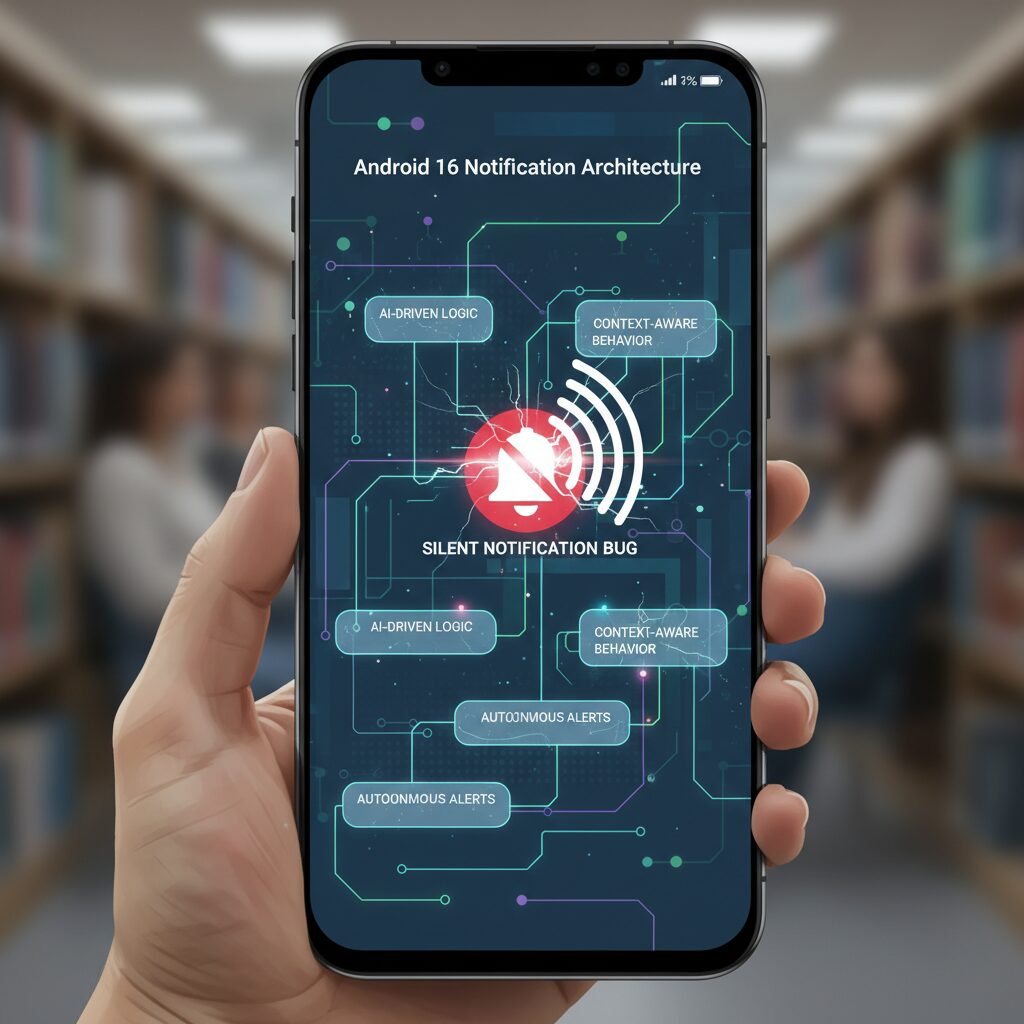
Android 16 introduces a fundamentally redesigned notification architecture that aims to balance performance, contextual intelligence, and user attention, but this shift has also exposed a critical flaw widely referred to as the Silent Notification Bug. This issue is not a superficial glitch but a structural regression rooted in how the system now groups and prioritizes alerts. According to Google’s own issue tracker and multiple developer analyses, the problem emerges precisely because the notification layer has become more autonomous and opaque to users.
At the core of Android 16’s design is automatic notification grouping, which consolidates incoming alerts under system-defined group keys. While this reduces visual clutter, **it also changes how sound and vibration states propagate across subsequent notifications**. Once an initial notification remains uncleared in the shade, later alerts can be forcibly marked as silent, regardless of individual app settings. Engineers examining the behavior have traced this to an erroneous SILENT flag assignment during the auto-grouping process.
| Aspect | Behavior in Android 16 | User Impact |
|---|---|---|
| Notification grouping | System-level auto-grouping | Loss of per-app sound control |
| Sound handling | SILENT flag applied to grouped alerts | Subsequent notifications muted |
| Scope of issue | OS-level regression | No app-side workaround |
This behavior has been most consistently reported on Pixel devices from the Pixel 6 through Pixel 10 series, indicating tight coupling between Android 16 and Google’s reference hardware. Media outlets specializing in Android internals have noted that even mission-critical alerts, such as health monitoring or security notifications, can be affected. **The risk is not merely inconvenience but a breakdown in trust toward the notification system itself**.
Google acknowledged the defect in mid-2025 and announced that fixes would be delivered through quarterly platform releases. However, staged rollouts mean that in 2026 some users still experience inconsistent behavior. This gap highlights a deeper architectural tension: as Android delegates more decision-making to automated systems, failures become harder for users to diagnose or override. From a user-experience perspective, the Silent Notification Bug illustrates how a single misjudged abstraction can undermine one of the smartphone’s most essential functions.
Auto-Grouping Errors and How AI Mislabels Critical Alerts
Auto-grouping is designed to reduce notification overload, but in Android 16 and iOS 26 it increasingly becomes a source of critical mislabeling that users cannot easily detect. **When AI-driven grouping logic fails, the system does not merely reorganize alerts, it actively changes their priority and audibility**. This shift transforms what should be a convenience feature into a silent risk layer embedded deep inside the operating system.
On Android 16, the core issue lies in the automatic aggregation of notifications under a shared group key. According to analyses discussed in Google’s own Issue Tracker and developer investigations on GitHub, once a notification remains in the shade, subsequent alerts are folded into the same group and inherit an unintended SILENT flag. The AI logic assumes semantic similarity and reduced urgency, even when the content is fundamentally different, such as a security camera alert following a chat message.
This behavior illustrates a structural limitation of machine-driven context inference. The system evaluates metadata, timing, and perceived redundancy, but it does not truly understand consequence. **As a result, alerts that are temporally close are treated as informationally equivalent**, despite radically different risk profiles.
| Scenario | AI grouping assumption | Actual user risk |
|---|---|---|
| Chat message followed by medical alert | Same conversational context | Delayed health intervention |
| Delivery update followed by intrusion alert | Routine transactional noise | Missed security incident |
| Calendar reminder followed by bank warning | Low urgency sequence | Financial loss escalation |
Research on human attention supports why this mislabeling is so dangerous. Studies published by MDPI on inattentional deafness show that users under cognitive load already struggle to perceive alerts. When the OS additionally suppresses sound or vibration based on flawed grouping, the probability of missing a critical event compounds sharply. The AI is not compensating for human limits; it is amplifying them.
Apple’s iOS 26 approaches the problem differently but reaches a similar outcome. Focus Modes and time-sensitive classifications rely on AI judgments about urgency. Reports from Apple Support Communities indicate that repeated or contextually ambiguous alerts are sometimes downgraded, while less important notifications bypass silence due to heuristic rules. **The mislabeling here is not silence alone, but false confidence**, where users believe critical channels remain protected.
Experts in mobile human–computer interaction have warned that adaptive notification systems require explicit fail-safe hierarchies. Google and Apple documentation both emphasize developer-set critical flags, yet field reports in 2026 show that OS-level automation can override or misinterpret these signals. In healthcare monitoring research cited on ResearchGate, even a single suppressed alert was identified as a meaningful escalation risk rather than a minor UX flaw.
For users, the danger is subtle because nothing appears broken. The screen still lights up, the badge still increments, and the AI confidently manages the flow. However, **the absence of sound or vibration is itself the error**, hidden behind an assumption that machines can reliably rank human urgency. Until AI systems can explain and justify why an alert is grouped and muted, auto-grouping remains a fragile layer where critical warnings are most likely to disappear.
iOS 26 and the Loss of Physical Silence Controls

With iOS 26, Apple has taken a decisive step away from dedicated physical silence controls, and this shift is beginning to reveal structural weaknesses. The traditional mute switch once offered a **binary, glance-free guarantee of silence**, especially valued in meetings, trains, and medical settings. In its place, iOS 26 relies on a layered interaction between the Action Button, on-screen indicators, and software logic, which introduces ambiguity at the exact moment certainty is required.
User reports analyzed in Apple Support Communities indicate that after updating to iOS 26, some iPhone 16 Pro models no longer display “Silent Mode” as an assignable Action Button option when specific status bar settings are disabled. This tight coupling between UI visibility and hardware behavior reflects a design philosophy where software state silently overrides physical intent. According to usability principles long advocated by the Nielsen Norman Group, such hidden dependencies significantly increase user error in high-stakes environments.
| Aspect | Before (Mute Switch) | iOS 26 Action Button |
|---|---|---|
| Feedback clarity | Physical position | Context-dependent UI |
| Error risk | Low | Moderate to high |
| Learning cost | Minimal | Cumulative |
The issue deepens when Focus Mode automation enters the equation. Time-sensitive notifications and repeated call bypass rules can override silence even when users believe the device is muted. Apple documentation frames this as a safety feature, yet human–computer interaction research published by MDPI shows that **unexpected audio feedback under cognitive load sharply increases stress and perceived loss of control**.
What is lost, then, is not merely a switch, but a trust contract. Physical controls acted as a final authority, immune to context inference and AI misjudgment. By dissolving that authority into software layers, iOS 26 exposes a fundamental dilemma: intelligence without transparency feels less like assistance and more like intrusion.
Focus Modes, Automation, and the Risk of Over-Intelligent Systems
Focus Modes were originally designed to give users intentional control over attention, but in 2026 they increasingly behave like autonomous systems that negotiate silence on the user’s behalf. On iOS 26 in particular, Focus Modes rely on location, time, app state, and inferred urgency, creating a layered automation stack that is difficult for even advanced users to fully predict.
This shift from explicit control to inferred intent introduces a new category of risk: over‑intelligent silence. When the system believes it understands context better than the user, silence becomes conditional rather than absolute, and that condition can fail in subtle but socially costly ways.
| Automation Trigger | Intended Benefit | Observed Risk |
|---|---|---|
| Time‑based Focus | Consistent quiet during meetings or sleep | Failure during irregular schedules or overtime |
| App‑triggered Focus | Silence during media consumption | Premature deactivation when apps background |
| Time‑Sensitive bypass | Delivery of critical information | False positives breaking silence in public |
Apple documents Focus as a user‑centric feature, yet multiple reports show that app lifecycle misinterpretation can collapse this promise. When an audiobook or navigation app briefly moves to the background, the system may conclude that the triggering condition has ended, immediately lifting silence. In a train car or theater, this millisecond‑level misjudgment becomes an audible violation.
Research in human‑computer interaction, including studies cited by MDPI on inattentional deafness, suggests that humans already struggle to perceive alerts under cognitive load. Adding opaque automation increases the mismatch between what users think their device will do and what it actually does. This gap erodes trust faster than a simple, reproducible bug.
Android’s approach differs architecturally, but the risk pattern is similar. As notification systems adopt adaptive logic driven by behavioral models, silence is no longer a binary state. According to recent adaptive notification research, delaying or suppressing alerts improves well‑being on average, yet the cost of a single misclassified urgent event can be disproportionately high, especially in health or security contexts.
Experts in safety‑critical system design, including those studying aviation alerts, emphasize that automation must remain explainable. When a phone exits silent mode without a clear, visible rationale, users cannot recalibrate their behavior. Over‑intelligence without transparency turns convenience into fragility.
The deeper issue is philosophical as much as technical. Focus Modes assume that context is computable and urgency is inferable. In reality, social norms, cultural expectations, and situational etiquette resist formal modeling. Until mobile OS platforms reintroduce stronger, hardware‑level or absolute overrides, Focus automation will remain powerful but brittle, optimized for averages rather than accountability.
Wearables Out of Sync: Galaxy Watch and Cross-Device Failures
Wearable devices are supposed to extend the smartphone experience seamlessly, but in 2026 this promise often breaks down in practice, especially with the Galaxy Watch series. Users increasingly report that notification states, particularly Do Not Disturb, fail to stay synchronized across devices, creating confusion rather than convenience. This issue feels minor at first, yet it directly undermines the core value proposition of wearables.
The most disruptive problem is an automatic DND解除ループ on Galaxy Watch models from Watch 4 through Watch 8. After the One UI 8 Watch update, DND enabled on the watch frequently turns itself off within seconds. Android Central has confirmed that this behavior stems from a circular logic error in cross-device state management, where the phone and watch continuously overwrite each other’s settings.
| Aspect | Observed Behavior | User Impact |
|---|---|---|
| DND control | Auto-disabled within ~5 seconds | Unexpected sounds in quiet spaces |
| Sync logic | Phone overrides watch state | Loss of on-wrist autonomy |
| Workaround | Phone app only | Reduced usability |
Samsung acknowledges the bug and promises a future patch, but the interim guidance is telling: users are advised to control DND exclusively from the connected smartphone app. This effectively turns the watch into a passive display, contradicting Samsung’s own marketing around independent wearable interactions.
From a human factors perspective, this desynchronization is not trivial. According to studies cited by MDPI on attention under high cognitive load, inconsistent alerts increase user stress and error rates. When a watch vibrates while the phone rings, or vice versa, users hesitate, check both devices, and lose trust in automation.
The broader implication is clear. As ecosystems grow more complex, cross-device reliability matters more than feature richness. Until synchronization logic is simplified and made transparent, even advanced wearables risk becoming noisy liabilities rather than silent assistants.
Human Factors: Attention Limits and Inattentional Deafness
When discussing silent mode failures in modern mobile operating systems, it is essential to look beyond software bugs and examine the human factors that shape how notifications are actually perceived. Even when a device behaves exactly as designed, users may still miss critical alerts due to fundamental limits of human attention. This phenomenon becomes especially visible in 2026, as smartphones attempt to manage ever-growing volumes of information through AI-driven notification control.
One key concept is inattentional deafness, a well-documented cognitive effect in which people fail to perceive audible signals while their attention is heavily occupied elsewhere. According to peer-reviewed human factors research published by MDPI in studies of air traffic controllers, participants frequently missed alarm sounds that were objectively loud and distinct when they were under high visual or cognitive load. The sound reached their ears, but the brain filtered it out.
This has direct implications for mobile notifications. Users often assume that a missed alert must be caused by silent mode, a system bug, or hardware failure. However, in many cases the notification was delivered correctly, yet cognitively ignored. In daily life, this occurs while reading dense text, navigating crowded stations, or completing biometric authentication on a smartphone. The brain prioritizes the primary task and suppresses secondary auditory input, even when that input is personally relevant.
| Condition | User State | Likelihood of Missing Sound |
|---|---|---|
| High visual load | Focused on screen content | Very high |
| Multitasking | Switching between apps | High |
| Notification overload | Repeated alerts in short time | Moderate to high |
The problem intensifies when OS-level behavior is unstable. In environments where Android or iOS inconsistently plays sounds, users cannot build reliable mental models of how their device behaves. Cognitive psychology shows that humans quickly reduce trust in signals that feel unpredictable. As a result, even correctly delivered alerts may be subconsciously discounted as noise, further amplifying inattentional deafness.
Research into adaptive notification systems using large language models has shown promising reductions in notification fatigue. A 2026 academic study on notification timing preferences demonstrated that deferring non-urgent alerts significantly improved user well-being. However, these systems rely on probabilistic inference. When AI misjudges urgency, the cost is not just technical but cognitive, as users may already be operating near their attentional limits.
For gadget enthusiasts, this highlights an uncomfortable truth. Silent mode is no longer a simple on-off switch, and hearing a notification is no longer guaranteed by sound alone. In a world of dense interfaces and constant engagement, attention itself has become the scarcest resource. Designing and configuring devices without acknowledging this human constraint inevitably leads to missed signals, social friction, and misplaced blame on technology that may, paradoxically, be working as intended.
Public Spaces, Social Friction, and the Cost of Notification Noise
In 2026, the failure of silent modes is no longer a private inconvenience but a public problem that plays out in trains, hospitals, and other shared environments. **When a device unexpectedly makes sound in a space designed for quiet, the cost is social friction rather than mere annoyance**. In Japan, where smartphones are owned by more than 97% of the population and are used continuously throughout the day, even a single notification chime can disrupt carefully maintained norms of silence.
This issue becomes sharper when operating systems behave unpredictably. Reports around Android 16’s silent notification bug and iOS 26’s unintended silent-mode bypass show that users are often blamed for sounds they did not choose to allow. According to mobile usage surveys by domestic research institutes, smartphones are now frequently used during commuting, medical check-ins, and work-related procedures. In such contexts, **the social penalty of notification noise falls on the user, even when the root cause lies in the OS or AI-driven automation**.
Public transportation offers a clear illustration. Rail operators such as JR East are introducing AI-based monitoring systems that demand high levels of concentration from staff. While notification sounds do not technically interfere with sensors, transport experts have noted that unexpected audio cues increase cognitive load for both operators and passengers. A single ringtone in a quiet carriage can escalate stress, attract disapproving looks, and create a perception of rule-breaking, even when the user believed the device was muted.
| Public Space | Expected Norm | Impact of Notification Noise |
|---|---|---|
| Commuter trains | Complete silence | Heightened stress and peer pressure |
| Hospitals | Minimal disturbance | Interruption of care environments |
| Cinemas | Total audio control | Collective frustration and complaints |
Human factors research provides further context. Studies on inattentional deafness, cited in peer-reviewed ergonomics journals, suggest that people in cognitively demanding situations may fail to notice sounds or, conversely, perceive sudden audio cues as disproportionately intrusive. **This mismatch between human perception and AI-driven notification logic amplifies the sense of intrusion in public spaces**, turning technical glitches into social incidents.
What makes the situation particularly fragile is the erosion of trust. Silent mode once represented a clear social contract: flip a switch, and the device would respect the environment. As AI-driven context awareness increasingly overrides explicit user intent, that contract weakens. In public spaces, the true cost perceived by others is not the decibel level itself, but the uncertainty of whether technology can still be relied upon to stay quiet when silence matters most.
Practical Defensive Strategies for Users in 2026
In 2026, users can no longer assume that silent mode behaves predictably, so practical defensive strategies have become a form of digital self‑defense. **The most important mindset shift is to treat silence as a state that must be actively verified, not passively trusted**. Research and incident analyses published by Google’s Android Issue Tracker and Apple user forums indicate that many failures occur after updates, context changes, or cross‑device synchronization, rather than during steady daily use.
One effective strategy is building a habit of redundancy. On Android 16, enabling notification history is strongly recommended, because it preserves evidence of alerts that may have arrived without sound due to the auto‑grouping bug documented by independent developers and acknowledged by Google. On iOS 26, users are advised to rely on at least two independent cues, such as haptic feedback combined with a visible status indicator, instead of trusting sound alone. **This mirrors human‑factors guidance from cognitive ergonomics, which emphasizes multimodal confirmation in high‑risk environments**.
Environmental context also matters. Japanese public spaces demand silence, yet they are increasingly saturated with AI systems and QR‑based interactions. Experts in mobile UX note that location‑based automation should be configured conservatively. Enlarging geofence boundaries and disabling Wi‑Fi–triggered automations reduces the risk of sudden mode changes when moving through stations or hospitals. According to usability studies referenced by MDPI, fewer automated triggers correlate with lower rates of inattentional errors under cognitive load.
| Platform | Common Failure Pattern | User‑Level Defensive Action |
|---|---|---|
| Android 16 | Subsequent notifications go silent | Clear the entire notification shade and keep history enabled |
| iOS 26 | Silent mode disengages unexpectedly | Verify Action Button mapping and status bar indicators |
| Wearables | DND sync loops | Control modes from the phone, not the watch |
Hardware awareness is another overlooked defense. Repair data summarized by mobile service professionals show that dust and mechanical wear can destabilize physical switches. Users are encouraged to periodically inspect and gently clean switches with dry air, while also setting up on‑screen accessibility toggles as a backup. **This layered approach aligns with the “defense in depth” principle widely used in safety‑critical system design**.
Finally, users should consciously rehearse critical scenarios. Before entering meetings, theaters, or medical facilities, briefly toggling silent mode off and on helps surface hidden misconfigurations caused by recent updates or AI‑driven adjustments. Behavioral scientists studying notification fatigue argue that such micro‑checks reduce anxiety and restore a sense of control. In an era where operating systems act autonomously, these small, intentional practices are what allow users to remain the final authority over when their devices speak and when they stay silent.
What Developers and OS Vendors Must Fix Next
From a developer and platform perspective, the silent mode failures seen in Android 16 and iOS 26 reveal structural weaknesses that can no longer be treated as edge cases.
The first issue that must be fixed is priority integrity. OS-level AI systems currently override explicit user intent, even when users have deliberately set devices to silent.
According to analyses published by Google engineers and Apple developer discussions, notification pipelines now apply inferred urgency after user-defined rules, not before them.
| Layer | Current Behavior | Required Fix |
|---|---|---|
| User Intent | Overridden by AI inference | Absolute priority lock |
| OS Automation | Opaque decision logic | Explainable triggers |
| App Signals | Collapsed by grouping | Isolated critical paths |
Second, notification state must be auditable. Both Android and iOS lack a system-level log that explains why a sound was suppressed or allowed.
Human factors research cited by MDPI shows that users under cognitive load cannot reliably infer system behavior, making transparency a safety requirement.
OS vendors should expose real-time reasoning, similar to permission indicators, so users and developers can verify why silence was broken.
Third, developers need guaranteed escape hatches. Google’s own Issue Tracker confirms that auto-grouping can silently force the SILENT flag, even for health or security alerts.
Apple’s Focus Mode similarly allows multiple bypass paths that interact unpredictably.
Both platforms must provide a narrowly scoped, non-AI-critical channel that is immune to grouping, automation, and wearable sync conflicts.
Until silent mode is treated as a safety boundary rather than a suggestion, these failures will continue to surface not as bugs, but as social and operational risks.
参考文献
- Android Headlines:Android 16 Has a Silent Notification Bug, But a Fix Is Coming
- Medium:Android 16 Bug: Why Your Notifications Go Silent (and What Devs Can Do)
- Apple Support Communities:iOS 26 update removes silent mode option from Action button
- Android Central:Yep, there’s a ‘Do Not Disturb’ problem with Galaxy Watches, but Samsung’s on it
- MDPI:Degraded States of Engagement in Air Traffic Control
- Japan Station:JR East Rolls Out New AI System to Detect Passengers Approaching Closing Doors