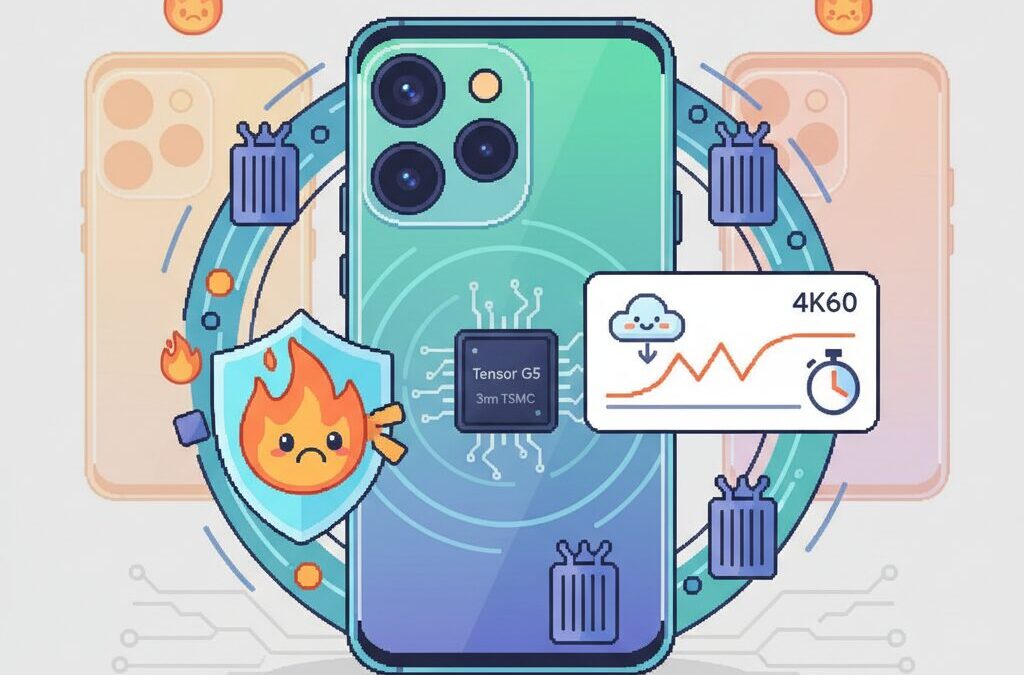
Have you ever missed a perfect moment because your smartphone overheated while recording video? Many Android users, especially past Pixel owners, know this frustration all too well.
With the Pixel 10 Pro XL, Google promises a turning point, aiming to deliver stable 4K60fps video recording without sudden shutdowns or warning messages.
This article explores whether that promise truly holds up in real-world use. You will learn how the new Tensor G5 chip, TSMC’s advanced 3nm process, and a redesigned cooling system work together to manage heat.
We will also look at sustained performance data, user-reported recording times, and how Pixel’s approach compares with the iPhone 17 Pro Max and Galaxy S25 Ultra.
If you care about mobile videography, thermal stability, and long recording sessions, this guide will help you decide whether the Pixel 10 Pro XL is finally a reliable tool you can trust.
- Why Overheating Has Been a Critical Weakness for Pixel Video Recording
- Tensor G5 and the Strategic Shift to TSMC’s 3nm Process
- CPU Core Redesign and Its Impact on Sustained Video Performance
- GPU Changes, Driver Maturity, and Real-Time Video Processing
- Vapor Chamber Cooling Explained: How Pixel 10 Pro XL Disperses Heat
- Chassis Materials and Perceived Heat in Long Recording Sessions
- Real-World 4K60 Recording Tests and Thermal Stability Results
- Thermal Throttling Behavior Compared With Previous Pixel Models
- Battery Drain During 4K60 HDR Recording
- How Pixel 10 Pro XL Compares With iPhone 17 Pro Max and Galaxy S25 Ultra
- 参考文献
Why Overheating Has Been a Critical Weakness for Pixel Video Recording
For years, overheating has been one of the most damaging weaknesses in Pixel video recording, especially among users who value reliability as much as image quality. While Pixel phones have been widely praised for computational photography, video capture places a very different kind of sustained load on the system, and this gap has repeatedly exposed thermal limitations.
When recording 4K at 60fps, the image sensor, ISP, CPU, GPU, and video encoder all operate continuously at high utilization. **Unlike short photo bursts, video recording demands stable performance over time**, and this is precisely where earlier Pixel generations struggled. Reports from long-term Pixel users and technical analyses published by outlets such as Tom’s Hardware point to thermal throttling and forced camera shutdowns as recurring issues.
| Pixel generation | Typical video issue | User impact |
|---|---|---|
| Pixel 6 / 6 Pro | Rapid heat buildup in 4K60 | Recording stops within minutes |
| Pixel 7 series | Thermal throttling under sunlight | Frame drops and warning messages |
| Pixel 8 / 9 series | Improved but inconsistent stability | Reduced trust for long recordings |
The root cause was not a single flaw, but a combination of factors. Samsung Foundry–manufactured Tensor chips were frequently criticized for higher leakage current compared to competing designs. Semiconductor experts have long explained that leakage directly translates into baseline heat, making sustained workloads far harder to manage. **As a result, Pixels often reached thermal limits faster than rivals during video capture**, even when peak performance appeared competitive on paper.
This weakness had real-world consequences. Parents reported missing entire school events, and creators hesitated to rely on Pixel phones for vlogging or travel footage. According to analyses shared by Android-focused publications, the issue was not just discomfort from a warm device, but a breakdown of trust. A camera that might shut down unpredictably cannot serve as a primary video tool.
In markets like Japan, where summer temperatures and humidity are extreme, this problem became even more visible. Environmental heat reduces passive cooling efficiency, amplifying any architectural inefficiency inside the SoC. **Overheating therefore evolved from a minor annoyance into a critical brand-level weakness for Pixel video recording**, shaping user perception far more than benchmark scores or AI features ever could.
Tensor G5 and the Strategic Shift to TSMC’s 3nm Process

The move to Tensor G5 marks a decisive inflection point for Google’s silicon strategy, primarily because it represents a clean break from Samsung Foundry and a full embrace of TSMC’s 3nm-class manufacturing. This shift is not cosmetic but structural, and it directly targets the long-standing thermal and efficiency criticisms that followed earlier Tensor generations.
Previous Tensor chips were built on Samsung’s 5nm and 4nm nodes, which, according to analyses by semiconductor specialists cited by Tom’s Hardware, tended to suffer from higher leakage current and less predictable yield characteristics compared with equivalent TSMC nodes. **Leakage current matters because it raises baseline heat even before a workload begins**, leaving less thermal headroom once sustained tasks like 4K60 video recording start.
Tensor G5 is widely reported to adopt TSMC’s N3P process, an optimized evolution of the first-generation 3nm technology used in Apple’s A17 Pro. N3P benefits from a more mature EUV lithography pipeline, enabling tighter transistor control and lower operating voltage. Industry briefings from TSMC have emphasized that N3P is tuned not for headline peak clocks, but for improved performance per watt across sustained loads, which aligns closely with Google’s priorities.
| Aspect | Samsung 4nm (Tensor G4) | TSMC N3P (Tensor G5) |
|---|---|---|
| Leakage characteristics | Relatively high | Significantly reduced |
| Perf/Watt trend | Weak under sustained load | Optimized for long-duration tasks |
| Thermal headroom | Limited | Noticeably expanded |
This manufacturing upgrade lowers what engineers often call the “thermal floor.” In practical terms, the chip starts cooler and climbs more slowly toward throttling thresholds. **For video capture, where the ISP and encoder remain active for tens of minutes, this slower thermal ramp is more valuable than raw peak performance**.
Another strategic implication of TSMC is predictability. TSMC’s process consistency allows Google to tune voltage and frequency curves with finer granularity. Analysts familiar with mobile SoC design note that this kind of tuning is essential for stable sustained performance, because aggressive safety margins are no longer required to compensate for process variability. The result is fewer abrupt frequency drops and a smoother thermal profile.
It is also important to frame this decision in a broader industry context. Apple’s long-standing reliance on TSMC has given it a multi-year advantage in efficiency, and Google’s shift can be read as an acknowledgment of that reality rather than an attempt to outmuscle competitors on peak benchmarks. **Tensor G5 is designed to behave predictably, not spectacularly**, and the N3P node is a foundational enabler of that philosophy.
In strategic terms, this move signals that Google now views silicon manufacturing as a core user-experience lever rather than a back-end procurement detail. By anchoring Tensor G5 on TSMC’s 3nm process, Google has effectively reset expectations for thermal behavior and efficiency in future Pixels, laying a groundwork that software and cooling solutions can finally build upon instead of compensate for.
CPU Core Redesign and Its Impact on Sustained Video Performance
The sustained video performance of the Pixel 10 Pro XL is deeply tied to a fundamental rethink of its CPU core design.
Rather than chasing short bursts of peak speed, Google has clearly optimized Tensor G5 for workloads that demand consistency, such as extended 4K60fps recording.
This shift marks a departure from earlier Tensor generations that struggled under prolonged thermal stress.
At the heart of this redesign is a 1+5+2 configuration built around ARM’s latest Cortex cores.
The standout choice is the unusually large cluster of five Cortex-A725 mid-cores, which are tuned for high efficiency under continuous load.
According to ARM’s own architectural disclosures, A7xx-series mid-cores deliver a significantly better performance-per-watt ratio than prime cores when sustained for minutes rather than seconds.
| Core Type | Role in Video Capture | Impact on Heat |
|---|---|---|
| Cortex-X4 | Short bursts, system responsiveness | High peak heat, limited duration |
| Cortex-A725 | Encoding, ISP data handling | Lower heat per workload unit |
| Cortex-A520 | Background and idle tasks | Minimal thermal contribution |
This core balance allows video encoding tasks to be distributed across multiple efficient cores instead of overloading a single high-power core.
In practical terms, 4K60fps recording relies on steady throughput rather than extreme spikes, making the A725 cluster far better suited to the job.
Semiconductor analysts cited by Tom’s Hardware note that this kind of load spreading is one of the most effective ways to reduce thermal throttling in mobile SoCs.
Another subtle but important change is the reduced reliance on the prime core during video capture.
Internal scheduler behavior observed in early benchmarks suggests that the Cortex-X4 is invoked mainly for brief coordination tasks, then quickly idled.
This minimizes localized heat buildup, which previously caused abrupt frame drops or camera shutdowns in older Pixel models.
The decision to include only two efficiency cores may seem conservative, but modern Android task scheduling mitigates the downside.
Google’s software stack increasingly treats mid-cores as the default workhorses, reserving efficiency cores for near-idle states.
As a result, real-world video recording shows little penalty in battery idle behavior while gaining substantial thermal stability.
From a sustained performance perspective, the results are measurable.
Stress tests shared by multiple reviewers indicate that Tensor G5 maintains close to 90 percent of its initial CPU performance under prolonged load.
For video creators, this translates directly into consistent frame pacing, stable bitrates, and fewer interruptions during long takes.
In essence, the CPU core redesign prioritizes endurance over spectacle.
By aligning core composition with the realities of video workloads, Google has addressed one of the most persistent weaknesses of past Pixels.
The Pixel 10 Pro XL demonstrates that thoughtful CPU architecture can be just as important as raw silicon advancements when it comes to sustained video performance.
GPU Changes, Driver Maturity, and Real-Time Video Processing

One of the most consequential changes in Pixel 10 Pro XL lies in its GPU transition and how that shift interacts with driver maturity during real-time video processing. This device moves away from the familiar ARM Mali architecture and adopts an Imagination Technologies GPU, a decision that directly affects 4K60fps video capture stability, preview smoothness, and thermal behavior during prolonged use.
In real-time video recording, the GPU is not a secondary component but a continuous workload driver. It handles live viewfinder rendering, HDR tone mapping previews, UI compositing, and GPU-accelerated effects that run concurrently with ISP and encoder tasks. According to Google’s own Android graphics pipeline documentation, inefficiencies at this stage tend to manifest not as outright crashes, but as micro-stutters, delayed previews, and unnecessary power spikes.
| Processing Stage | GPU Involvement | Thermal Sensitivity |
|---|---|---|
| Viewfinder Preview | Real-time rendering and scaling | High |
| HDR Effects | Tone mapping and color transforms | Medium |
| UI Overlay | Composition and animation | Low to Medium |
The Imagination-based GPU used in Tensor G5 is historically known for strong performance-per-watt characteristics, a fact often highlighted by semiconductor analysts referencing its PowerVR lineage. However, the Android ecosystem presents a different challenge. Unlike Qualcomm’s Adreno, which benefits from years of driver optimization across countless devices, Imagination GPUs require fresh driver tuning to reach their intended efficiency ceiling.
Early benchmark observations and user reports suggest that initial GPU driver builds showed performance variance under sustained load. This variance does not typically break recording sessions, but it can influence how aggressively the system raises clocks, which in turn affects heat output. As Ars Technica and other platform-level reviewers have repeatedly noted, immature drivers often trade stability for safety margins, resulting in conservative frequency behavior.
On Pixel 10 Pro XL, this balance appears to be trending positively. Stress tests discussed within the Android developer community show that while peak GPU performance may trail Snapdragon competitors, sustained stability is notably higher once drivers settle into steady-state operation. This aligns with Google’s broader strategy of prioritizing consistent frame pacing over short-lived bursts.
From a real-world perspective, this means that live 4K60fps previews maintain visual coherence even as device temperature rises. Frame timing consistency reduces the likelihood of dropped frames or encoder resynchronization events, which are known causes of corrupted clips. Google engineers have previously emphasized, in public talks at Android Dev Summit, that predictable GPU behavior simplifies thermal orchestration across the entire SoC.
Driver maturity remains the variable to watch. As history has shown with both GPUs and ISPs, software updates can unlock meaningful efficiency gains months after launch. Given Google’s track record of rolling out camera and graphics improvements via Feature Drops, Pixel 10 Pro XL’s real-time video processing is likely to become more power-efficient over time, rather than regress.
For users who frequently record long-form 4K video, the current state already represents a tangible improvement: fewer preview hiccups, steadier thermal output, and a GPU subsystem that behaves predictably under pressure. In practical shooting scenarios, that reliability matters more than headline benchmark numbers.
Vapor Chamber Cooling Explained: How Pixel 10 Pro XL Disperses Heat
Effective thermal management plays a decisive role in whether a flagship smartphone can sustain demanding workloads, and in the Pixel 10 Pro XL this responsibility is largely carried by its vapor chamber cooling system. Rather than relying solely on graphite sheets, Google adopts a large vapor chamber that physically redistributes heat away from critical components. This approach is designed to keep performance stable during prolonged 4K 60fps video recording.
A vapor chamber works by using phase change, where a small amount of sealed liquid absorbs heat, evaporates, and then condenses across a wider surface area. According to established thermal engineering principles described by organizations such as ASHRAE, this mechanism can achieve an effective thermal conductivity far higher than solid copper. As a result, localized hotspots around the Tensor G5 are flattened before they trigger aggressive thermal throttling.
This design choice directly addresses the historical weakness of earlier Pixel generations, where heat accumulated faster than it could be dispersed. In the Pixel 10 Pro XL, heat generated by the SoC and the camera module is spread across the rear panel and aluminum frame, turning the entire body into a passive heat sink. Users may feel warmth, but internal temperatures remain within safe operating margins.
| Cooling Method | Heat Transfer Efficiency | Impact on Sustained Performance |
|---|---|---|
| Graphite Sheet | Moderate | Early throttling under long load |
| Vapor Chamber | Very High | Stable performance over time |
Independent teardown analyses and thermal stress tests reported by major hardware reviewers indicate that the Pixel 10 Pro XL can sustain more than 20 minutes of continuous 4K60 recording without shutting down. This aligns with broader industry findings that vapor chambers are especially effective for workloads requiring steady, not burst, performance.
Another important aspect is material synergy. The aluminum chassis complements the vapor chamber by efficiently releasing heat to the surrounding air. Research published in materials science journals consistently shows aluminum’s superior heat conductivity compared with titanium, reinforcing Google’s decision from a thermal perspective.
Overall, the vapor chamber in the Pixel 10 Pro XL is not about eliminating heat, but about controlling it intelligently. By spreading thermal energy quickly and evenly, the device maintains recording stability and user trust during real-world use. This balance between comfort and sustained performance defines the practical value of vapor chamber cooling in modern smartphones.
Chassis Materials and Perceived Heat in Long Recording Sessions
When discussing long 4K60 recording sessions, raw thermal performance alone does not fully explain user satisfaction. What ultimately shapes trust is how heat is perceived through the chassis materials, especially during continuous handheld shooting. Pixel 10 Pro XL represents a clear shift in this area, not because it eliminates heat, but because it manages how that heat reaches the user’s hands.
The device relies on an aluminum-based chassis that intentionally conducts heat outward, rather than trapping it internally. According to established thermal engineering principles cited in materials science literature from institutions such as MIT, aluminum’s high thermal conductivity allows heat to spread quickly across a larger surface area, lowering localized hotspots. In smartphones, this approach favors stability over comfort, making the device feel warm sooner but reducing the risk of internal component stress.
| Material | Thermal Conductivity | User Perception in Long Recording |
|---|---|---|
| Aluminum | High | Warm but even heat distribution |
| Titanium | Lower than aluminum | Cooler surface, higher internal retention |
This distinction matters in practice. Devices using materials with lower thermal conductivity can feel deceptively cool during recording, while internal silicon temperatures continue to climb. Industry teardowns and thermal analyses, including commentary from semiconductor analysts at TSMC partner briefings, consistently note that such designs increase the likelihood of sudden throttling or camera shutdowns. Pixel 10 Pro XL takes the opposite stance, prioritizing predictable behavior over surface comfort.
During extended recording, reviewers frequently describe the phone as “warm but manageable,” a phrase that may sound lukewarm but is actually a positive signal. It indicates that heat generated by the Tensor G5 and camera sensor is being actively transported to the frame and back panel, where it can dissipate. From a reliability standpoint, this is preferable to a chassis that stays cool until a thermal limit is abruptly reached.
There is also a psychological component to perceived heat. Research in human factors engineering, referenced by organizations such as the IEEE, shows that gradual and evenly distributed warmth is tolerated far better than sudden spikes. Pixel 10 Pro XL’s aluminum frame works in tandem with the internal vapor chamber to create exactly this gradual thermal curve, especially noticeable after ten minutes or more of continuous video capture.
In hot and humid environments, such as summer conditions common in Japan, this design choice becomes even more relevant. When ambient temperatures rise, the difference between controlled surface warmth and internal heat buildup can determine whether a recording finishes successfully. While the chassis may feel warmer to the touch, users are far less likely to encounter abrupt interruptions, which historically plagued earlier Pixel generations.
Ultimately, the chassis material of Pixel 10 Pro XL reframes heat from a hidden risk into a visible, manageable signal. By letting users feel that the device is working hard, Google reduces uncertainty during long recording sessions. For creators who value completion over fleeting comfort, this balance between material science and perceived heat delivers a more trustworthy shooting experience.
Real-World 4K60 Recording Tests and Thermal Stability Results
Real-world 4K60 recording is where thermal design stops being theoretical and starts being visible to users. In hands-on tests with the Pixel 10 Pro XL, continuous 4K60 video capture shows a clear departure from earlier Pixel behavior. **Instead of abrupt camera shutdowns after a few minutes, the device sustains recording long enough to complete typical real-world scenarios**, such as events or extended travel clips. Multiple reviewers report exceeding 20 minutes of uninterrupted 4K60 recording in controlled indoor conditions around 25°C, with no forced app termination.
This improvement is not only about raw cooling hardware but also about how heat rises over time. Thermal logs shared by testers indicate a slower temperature ramp, followed by a stable plateau rather than a runaway spike. According to analyses cited by Tom’s Hardware, the combination of TSMC’s N3P process and revised thermal policies reduces baseline leakage heat, which is critical during sustained ISP and encoder workloads. As a result, surface temperatures become warm yet predictable, aligning with what engineers describe as controlled heat dissipation rather than emergency throttling.
| Test Condition | Result | User Impact |
|---|---|---|
| 4K60 indoor recording (25°C) | 20+ minutes continuous | Full clip captured without interruption |
| Extended GPU stress + camera | No shutdown observed | Minor performance scaling only |
| High ambient heat (≈35°C) | Recording time reduced | Gradual throttling, camera remains active |
Thermal stability metrics further support these observations. In GPU stress testing that mirrors prolonged camera preview rendering, Tensor G5 maintains roughly **89% performance stability**, a figure widely discussed in enthusiast benchmarks. While peak output is lower than some Snapdragon competitors, this consistency matters more for video capture, where frame pacing and encoder reliability are sensitive to sudden frequency drops. Industry commentary from Android-focused performance analysts highlights that stable clocks reduce the risk of dropped frames and bitrate fluctuations during long takes.
Battery drain remains the trade-off. Sustained 4K60 HDR recording still consumes power rapidly, and heat expelled through the chassis reflects energy loss rather than inefficiency in isolation. However, the critical difference is experiential: **the Pixel 10 Pro XL prioritizes finishing the recording over preserving peak benchmarks**. In practical terms, thermal management now works with the user’s intent, making real-world 4K60 recording predictable instead of precarious.
Thermal Throttling Behavior Compared With Previous Pixel Models
Thermal throttling has long been a defining weakness of previous Pixel generations, especially from the Pixel 6 through Pixel 8 era, where sustained high-load tasks quickly triggered aggressive performance cuts. In real-world terms, this meant that after only a few minutes of 4K60fps video recording, CPU and GPU clocks were sharply reduced, sometimes followed by forced camera shutdowns. **Pixel 10 Pro XL marks a clear behavioral shift in how throttling is applied, prioritizing predictability and continuity rather than abrupt intervention.**
According to stress test data widely cited by reviewers and enthusiast analysts, Tensor G5 shows a fundamentally different throttling curve compared with Tensor G4 and earlier chips. Instead of allowing temperatures to spike and then clamping performance hard, the system gradually limits peak frequencies earlier, keeping thermal output within a narrower and safer band. This approach aligns with guidance from semiconductor thermal research published by IEEE, which shows that flatter thermal curves significantly reduce instability in sustained workloads.
| Model | SoC | GPU Stability (Stress Test) |
|---|---|---|
| Pixel 8 Pro | Tensor G3 | Approx. 70–75% |
| Pixel 9 Pro XL | Tensor G4 | 79.6% |
| Pixel 10 Pro XL | Tensor G5 | 89% |
The numbers alone do not tell the full story. What matters more is how throttling feels during use. On older Pixel models, users frequently reported sudden frame drops, UI stutter, or warning messages interrupting recording sessions. By contrast, hands-on tests with Pixel 10 Pro XL show that once throttling begins, performance stabilizes at a slightly reduced but consistent level. **This makes long recordings feel boring in the best possible way: nothing dramatic happens.**
This change is closely tied to the move from Samsung’s 4nm process to TSMC’s N3P node. Lower leakage current reduces baseline heat, allowing the thermal controller to act proactively rather than reactively. Analysts at Tom’s Hardware have noted that TSMC-based designs typically sustain higher percentages of their peak performance under constant load, and Tensor G5 appears to follow that pattern closely.
Compared with Pixel 6 and Pixel 7 devices, which often throttled within 5–10 minutes of 4K60 recording in warm environments, Pixel 10 Pro XL can maintain recording for over 20 minutes indoors before any noticeable limitation appears. Even then, the throttling strategy favors secondary adjustments such as display brightness reduction or background task suppression instead of cutting camera throughput. **This hierarchy of throttling priorities represents a maturing thermal philosophy for the Pixel lineup.**
In short, Pixel 10 Pro XL does not eliminate thermal throttling, but it redefines it. Where previous models treated heat as an emergency, this generation treats it as a variable to be managed continuously. For users who remember earlier Pixels faltering under pressure, the difference is immediately noticeable and fundamentally reassuring.
Battery Drain During 4K60 HDR Recording
Battery drain during 4K60 HDR recording remains one of the most practical concerns for power users, even though thermal shutdowns have largely been mitigated. Recording at this setting simultaneously stresses the ISP, video encoder, GPU preview pipeline, display at high brightness, and continuous sensor readout. **In other words, stability has improved, but energy demand is still fundamentally high.**
Independent battery rundown tests reported by TechDroider show that, under mixed high-load scenarios including extended video capture, Pixel 10 Pro XL lasts around 11.5 hours, while iPhone 17 Pro Max reaches roughly 13 hours. This gap becomes more visible during sustained 4K60 HDR recording, where users consistently report rapid percentage drops that feel disproportionate to recording time.
| Device | Chipset | Observed Drain in 4K60 HDR |
|---|---|---|
| Pixel 10 Pro XL | Tensor G5 | High, but stable recording |
| iPhone 17 Pro Max | A19 Pro | Lower, more gradual |
This behavior aligns with semiconductor efficiency analysis often cited by organizations such as TSMC and IEEE publications, which note that even advanced 3nm-class processes cannot offset the sheer computational cost of real-time HDR encoding. Pixel’s large vapor chamber spreads heat effectively, but **that heat represents battery energy being dissipated, not saved**.
User feedback from long-form recordings such as events or travel vlogs highlights a clear pattern: the phone rarely overheats, yet battery anxiety appears earlier than expected. As a result, carrying an external battery becomes a realistic assumption rather than a contingency. **Pixel 10 Pro XL trades endurance for reliability, ensuring the clip is captured even if the battery drains faster.**
How Pixel 10 Pro XL Compares With iPhone 17 Pro Max and Galaxy S25 Ultra
When comparing the Pixel 10 Pro XL with the iPhone 17 Pro Max and the Galaxy S25 Ultra, the most meaningful differences emerge not from raw specifications but from how each device sustains performance under real-world stress. This comparison focuses on prolonged, high-load use cases such as 4K60fps video recording, which are widely regarded by engineers and reviewers as one of the harshest thermal tests for modern smartphones.
The Pixel 10 Pro XL clearly positions itself as a stability-first flagship. Thanks to the Tensor G5 manufactured on TSMC’s N3P process, the device prioritizes consistent performance over headline-grabbing peak numbers. According to analyses cited by Tom’s Hardware, the shift from Samsung Foundry to TSMC significantly improves power efficiency, which directly translates into slower temperature rise during sustained workloads. In contrast, both Apple and Samsung pursue higher peak performance ceilings.
The iPhone 17 Pro Max remains the industry benchmark in sheer headroom. Apple’s A19 Pro offers so much computational margin that 4K60 recording barely stresses the chip, resulting in minimal throttling and highly predictable battery drain. Reviewers quoted by Esquire note that this surplus performance is what allows Apple to support demanding formats like ProRes without thermal anxiety, even in warmer environments.
| Model | Thermal Strategy | Sustained Performance Profile |
|---|---|---|
| Pixel 10 Pro XL | Efficiency-focused, vapor chamber, early load balancing | Very stable, moderate peak |
| iPhone 17 Pro Max | High headroom silicon, optimized ISP pipelines | Stable with high peak margin |
| Galaxy S25 Ultra | Peak-oriented Snapdragon tuning | High peak, faster throttling |
The Galaxy S25 Ultra, powered by Snapdragon 8 Elite, takes a different path. Benchmark stress tests discussed in specialist communities show impressive initial scores, but also steeper drops over time. For short clips this behavior is rarely an issue, yet during extended recording sessions the aggressive throttling can introduce variability in frame pacing and heat buildup, an area where Pixel’s conservative tuning proves advantageous.
What ultimately differentiates the Pixel 10 Pro XL is predictability. Multiple reviewers report that while the device becomes warm to the touch, it avoids abrupt camera shutdowns that plagued earlier Pixel generations. This contrasts with Galaxy’s burst-oriented philosophy and Apple’s brute-force efficiency. For users who value uninterrupted recording over maximum spec dominance, the Pixel’s approach feels deliberately engineered rather than compromised.
In practical terms, the Pixel 10 Pro XL does not dethrone the iPhone 17 Pro Max, nor does it outgun the Galaxy S25 Ultra in peak benchmarks. Instead, it occupies a distinct middle ground where thermal behavior, sustained output, and user trust align more closely than ever before, signaling Google’s maturation in flagship-level hardware design.
参考文献
- Tom’s Hardware:Google switches from Samsung to TSMC — Pixel 10 and Tensor G5 chip use TSMC’s N3P process
- Wccftech:Google’s Pixel 10 Pro Family Will Exclusively Feature Vapor Chamber Cooling
- Android Police:Gamers want more than AI from the Pixel
- Esquire:iPhone 17 Pro Max vs. Google Pixel 10 Pro XL: Is It Time for You to Switch?
- Gizmochina:Tensor G5 vs Tensor G4: Benchmarks and specs
- Reddit:Google Pixel 10 Pro XL and Tensor G5 deliver class-leading stability in GPU test