Have you ever felt that traditional note-taking on smartphones just cannot keep up with the way you actually think and work? Many tech enthusiasts struggle with constant app switching, cramped screens, and the cognitive fatigue that comes from trying to process information on the go.
The Pixel 10 Pro Fold approaches this problem from a completely different angle. Instead of focusing on stylus input or handwritten notes, it combines a near-square foldable display, Android 16 multitasking, and deep Gemini AI integration to support a smarter, more efficient split-screen workflow.
In this article, you will discover how split-screen usage can reduce cognitive load, why Google intentionally prioritized AI-driven information structuring over pen input, and how real-world research on multitasking and dual displays supports this approach. By understanding these ideas, you can decide whether the Pixel 10 Pro Fold is the right device to transform your learning, research, and everyday mobile productivity.
- The Shift from Specs to Experience in Foldable Smartphones
- Pixel 10 Pro Fold Hardware Design and Its Impact on Multitasking
- Why the Lack of Stylus Support Changes Note-Taking Philosophy
- Split-Screen Productivity Through the Lens of Cognitive Load Theory
- Android 16 Multitasking Features Built for Large Foldable Displays
- Gemini AI as a Core Tool for Non-Handwritten Note-Taking
- Real-World Split-Screen Workflows for Learning and Research
- App Optimization: What Works Best on Pixel 10 Pro Fold
- Pixel 10 Pro Fold vs Galaxy Z Fold Series for Knowledge Workers
- 参考文献
The Shift from Specs to Experience in Foldable Smartphones
For much of the past decade, smartphones have been evaluated through an almost obsessive focus on specifications. Processor scores, camera megapixels, and display refresh rates dominated conversations, reviews, and purchasing decisions. However, in the foldable smartphone category, this mindset is rapidly losing relevance. What now defines value is not what a device can theoretically do, but how naturally it fits into daily workflows and cognitive habits.
This transition from specs to experience is especially visible in foldable devices, where raw numbers fail to explain why some products feel transformative while others remain novelties. An 8-inch display or a 120Hz panel means little on its own. The real question is whether those elements reduce friction in real-world use, particularly in information-heavy tasks such as reading, comparing, learning, and synthesizing content.
Industry analysts and human–computer interaction researchers have increasingly pointed out that user satisfaction correlates more strongly with task efficiency and mental comfort than with peak performance metrics. According to research synthesized by the U.S. National Institutes of Health, reducing unnecessary context switching directly improves comprehension and retention in knowledge work. Foldable smartphones, when designed around experience rather than spectacle, directly address this issue.
The key experiential advantage of foldables lies in their ability to externalize cognition. By displaying multiple sources of information simultaneously, they reduce the burden placed on working memory. Cognitive Load Theory, widely referenced in educational psychology, explains that humans perform best when extraneous cognitive load is minimized. A foldable device that allows reference material and output space to coexist on one screen achieves exactly that.
Traditional spec-driven comparisons struggle to capture this benefit. Clock speeds and benchmark scores cannot express how it feels to read a document, cross-check a source, and draft notes without constantly switching apps. The experience is one of continuity rather than interruption, and this continuity is increasingly what users are willing to pay for in premium devices.
| Evaluation Axis | Spec-Centric View | Experience-Centric View |
|---|---|---|
| Display | Size, resolution, refresh rate | How content is compared and referenced |
| Performance | Benchmark scores | Perceived smoothness in multitasking |
| AI Features | Model size, TOPS | Speed and relevance of assistance |
Another sign of this shift is the growing importance of software intelligence over hardware completeness. Some foldables lack features that would traditionally be considered essential, such as active stylus support. Yet for many users, this omission is outweighed by AI-driven capabilities like real-time transcription, summarization, and on-device language processing. These functions replace manual input with automated understanding, fundamentally changing how notes and ideas are captured.
Google has been particularly explicit about this direction. Its public statements around on-device AI emphasize immediacy and privacy rather than raw computational power. By prioritizing low-latency inference and deep OS integration, the company signals that the goal is not to impress with numbers, but to disappear into the background of the user’s thinking process.
Market data also reflects this evolution. Reports from firms such as IDC and Counterpoint Research show that while overall foldable shipments grow modestly, user satisfaction scores increase sharply when devices are used for productivity and learning rather than entertainment alone. This suggests that experiential value, once discovered, has a stronger impact on long-term adoption than initial excitement.
In this context, foldable smartphones are no longer experimental hardware showcases. They are becoming cognitive tools, designed to extend attention, reduce mental overhead, and support complex thought in mobile environments. The shift away from specs is not a rejection of technological progress, but a maturation of priorities. What matters now is not how powerful the device is in isolation, but how effectively it collaborates with the human mind.
Pixel 10 Pro Fold Hardware Design and Its Impact on Multitasking
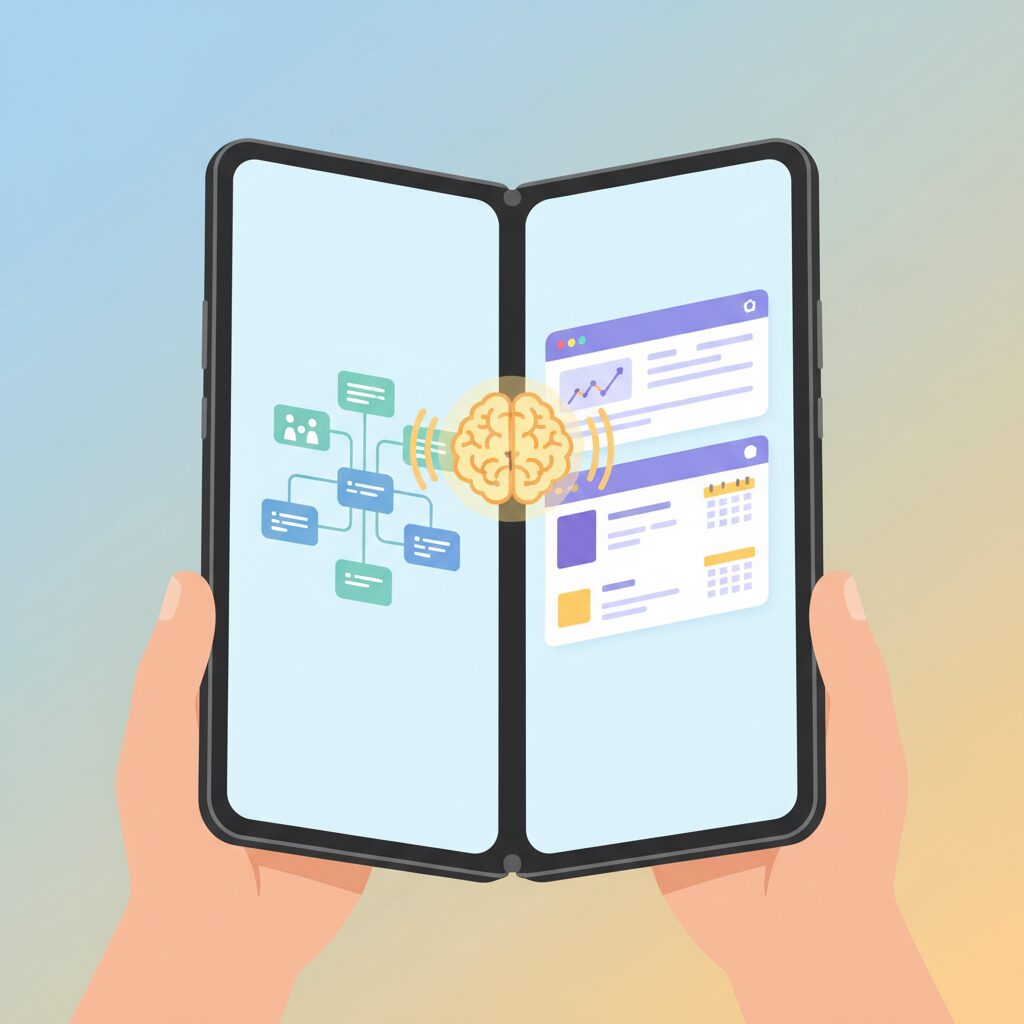
The hardware design of the Pixel 10 Pro Fold plays a decisive role in how effectively users can multitask, especially in split-screen scenarios that demand sustained attention and visual clarity.
At the center of this experience is the nearly square 8-inch Super Actua Flex inner display, which departs from the elongated form factors of earlier foldables.
This aspect ratio fundamentally changes how two apps coexist on screen, allowing each pane to retain a phone-like vertical balance instead of becoming narrow and compromised.
| Hardware Element | Specification | Multitasking Impact |
|---|---|---|
| Inner Display | 8-inch, 2076 x 2152, ~1:1 ratio | Balanced split views with minimal scrolling |
| Refresh Rate | LTPO 1–120Hz | Smooth interaction with lower battery drain |
| Peak Brightness | Up to 3,000 nits | Clear readability in bright environments |
| Memory | 16GB RAM | Stable performance with multiple heavy apps |
According to specifications published by Google, the combination of high pixel density and adaptive refresh rate ensures that text-heavy apps such as browsers, PDFs, and document editors remain crisp even when two windows are active simultaneously.
This matters because multitasking efficiency is often limited not by raw performance, but by visual fatigue and micro-delays that break concentration.
Brightness is another underestimated factor. With peak levels reaching 3,000 nits, the display maintains legibility in outdoor or café settings, a point frequently emphasized in professional display evaluations by organizations such as GSMArena.
For users who multitask on the move, this means fewer adjustments, less squinting, and more consistent focus across environments.
Under the hood, Tensor G5 reinforces this hardware-first multitasking philosophy. While early benchmarks suggest its GPU is not aimed at high-end gaming, Google’s own technical brief highlights a significant uplift in CPU efficiency and on-device AI throughput.
In practical multitasking, this translates to smoother app retention in memory, faster context switching, and reduced reloads when juggling browsers, note apps, and AI assistants.
The 16GB RAM configuration further supports this behavior, allowing large applications to remain resident without aggressive background eviction, a common pain point on foldables with lower memory ceilings.
Battery capacity and charging design also shape multitasking habits. With a 5,015mAh battery and Qi2 wireless charging support, the device encourages desk-based split-screen workflows where the phone can remain open and charging without cable clutter.
Industry analyses of mobile productivity consistently show that stability and endurance matter more than peak speed, and the Pixel 10 Pro Fold’s hardware reflects that priority.
Rather than chasing extreme thinness or stylus-centric design, Google has optimized the physical platform for sustained, visually comfortable parallel work.
This design choice positions the Pixel 10 Pro Fold not as a novelty foldable, but as a compact workstation where hardware geometry actively supports multitasking rather than merely allowing it.
Why the Lack of Stylus Support Changes Note-Taking Philosophy
The absence of active stylus support fundamentally reshapes how note-taking should be approached on this device, and it is important to recognize that this is not merely a missing feature but a deliberate philosophical shift. When handwriting is removed from the equation, note-taking moves away from manual inscription and toward cognitive organization, selection, and synthesis. This change aligns closely with how Google has positioned its recent hardware and software as tools for thinking with information rather than reproducing it by hand.
Educational psychology offers a useful lens here. According to cognitive load theory, articulated by researchers such as John Sweller, learning efficiency improves when extraneous actions are minimized and mental resources are directed toward understanding and structuring information. Handwriting can be powerful, but it also introduces motor and spatial demands. On a device without a digitizer, those demands are intentionally replaced by typing, selection, and AI-assisted transformation of content.
| Aspect | Handwritten Notes | Stylus-Free Notes |
|---|---|---|
| Primary action | Manual writing | Typing and structuring |
| Cognitive focus | Motor memory | Conceptual organization |
| Searchability | Limited | Immediate |
This shift also reflects findings from studies on digital note-taking. Research summarized by institutions such as the NIH suggests that when learners actively reorganize information, summarize key points, and connect ideas, retention can rival or exceed that of handwritten notes. **Typing becomes effective when it is paired with intentional processing rather than verbatim transcription**, and a stylus-free environment nudges users toward exactly that behavior.
In practical terms, the lack of stylus support encourages a workflow where notes are modular, searchable, and constantly revised. Instead of drawing arrows or marginal sketches, users are more likely to split the screen, compare sources side by side, and refine their notes in real time. This mirrors professional knowledge work, where value comes not from how notes look, but from how quickly insights can be retrieved and recombined.
From a marketing and product-strategy perspective, this approach differentiates the device from pen-centric competitors. It appeals to users who prioritize speed, clarity, and integration with AI-driven tools over the tactile satisfaction of writing. Rather than being a compromise, the lack of stylus support reframes note-taking as an editorial act, one that treats information as something to be shaped, not sketched.
Split-Screen Productivity Through the Lens of Cognitive Load Theory
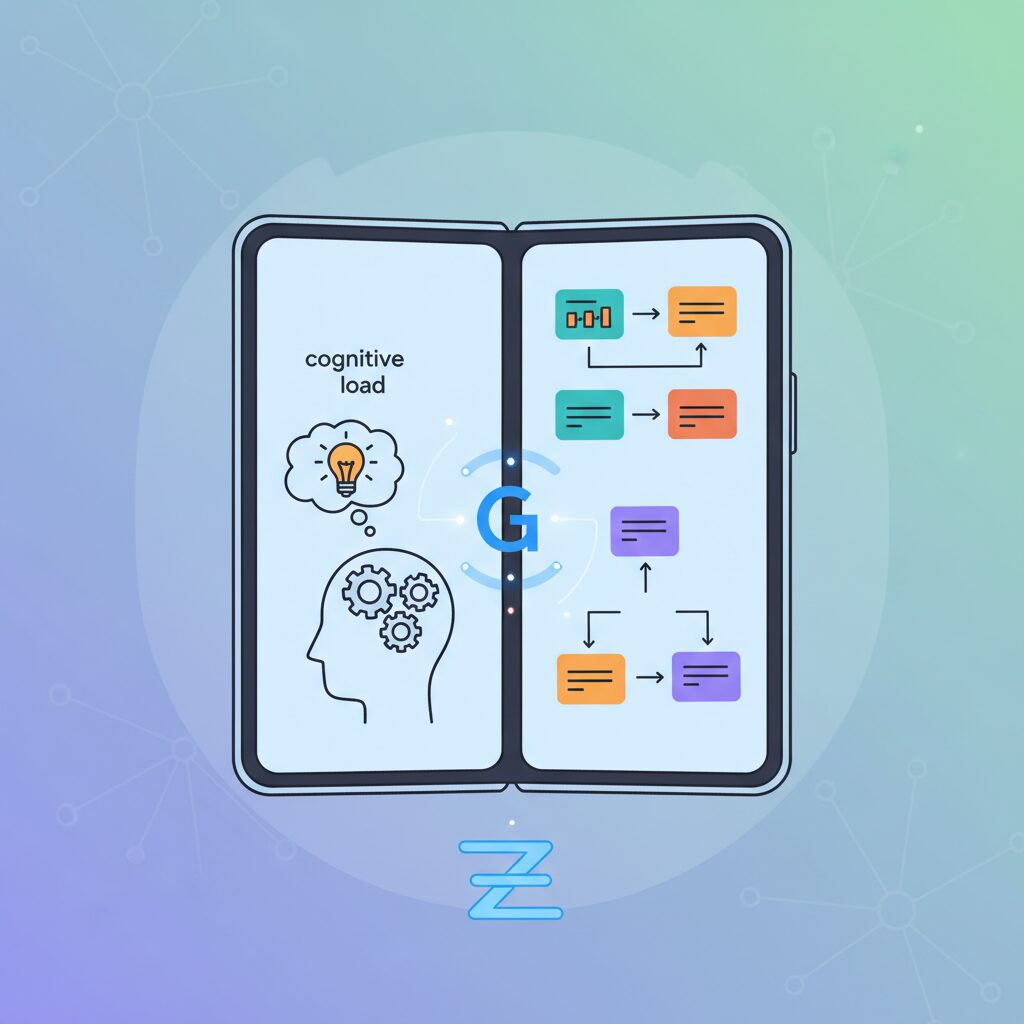
When evaluating split-screen productivity on the Pixel 10 Pro Fold, the most useful analytical lens is Cognitive Load Theory, originally proposed by educational psychologist John Sweller. This theory explains how human working memory has strict capacity limits, and how poorly designed interfaces can consume mental resources that should be reserved for thinking, learning, and decision-making. **Split-screen workflows matter not because they feel powerful, but because they reshape how cognitive load is distributed.**
In a traditional single-screen mobile workflow, users constantly switch between apps to compare information, take notes, or verify details. Each app switch forces the brain to reconstruct context: what was I reading, what detail was important, and how does it relate to what I am writing now. Research in human-computer interaction consistently refers to this as switching cost, and studies summarized by the U.S. National Institutes of Health show that even short task switches measurably degrade accuracy and increase mental fatigue.
From a cognitive load perspective, this friction is classified as extraneous cognitive load. It does not contribute to understanding or problem-solving, yet it consumes working memory. **The Pixel 10 Pro Fold’s split-screen layout directly attacks this inefficiency by keeping both information sources visible at all times.** Instead of memory-based reconstruction, users rely on perception-based confirmation, which is far less demanding for the brain.
| Workflow Pattern | Primary Cognitive Cost | Impact on Focus |
|---|---|---|
| Single-screen app switching | High extraneous load from context rebuilding | Frequent attention breaks |
| Split-screen reference and note-taking | Lower extraneous load, higher germane load | Sustained focus and continuity |
Educational research published by the New South Wales Department of Education further distinguishes germane cognitive load, which supports learning and schema construction. In split-screen use, the brain allocates more resources to integrating ideas rather than remembering where information came from. For example, reading a research article on the left and drafting a structured summary on the right encourages active comparison and synthesis, which are precisely the processes germane load is meant to support.
The form factor of the Pixel 10 Pro Fold is particularly relevant here. Its near-square 8-inch inner display ensures that each split window remains readable without aggressive zooming or vertical scrolling. **This reduces visual search time**, another hidden contributor to cognitive strain identified in ergonomics research. When text lines are too narrow or interfaces feel cramped, comprehension slows and error rates increase.
Evidence from dual-monitor studies in desktop environments reinforces this argument. A well-cited Dell-sponsored productivity white paper reports productivity gains of up to 42 percent when users work with two displays instead of one. While mobile and desktop contexts differ, the underlying mechanism is the same: spatially stable information reduces memory dependence. The Pixel 10 Pro Fold effectively translates this dual-monitor effect into a mobile, pocketable form.
Importantly, split-screen productivity is not about multitasking in the popular sense. Cognitive scientists caution that true multitasking is largely a myth. Instead, the benefit lies in parallel visibility with sequential attention. **The user still focuses on one task at a time, but without paying the mental tax of interface navigation.** This distinction explains why split-screen workflows feel calmer rather than more chaotic when designed correctly.
For knowledge workers, students, and researchers, this means that the Pixel 10 Pro Fold is best understood as a cognitive optimization tool. By minimizing extraneous load and amplifying germane load, split-screen usage aligns the device with how the brain naturally prefers to process complex information. Productivity gains, in this context, are not about speed alone, but about preserving mental energy across long sessions of thinking and learning.
Android 16 Multitasking Features Built for Large Foldable Displays
Android 16 brings a clear shift in how multitasking is designed for large foldable displays, and this change becomes especially meaningful on devices with near-square inner screens. Instead of treating foldables as oversized phones, the OS now assumes that users will actively manage multiple contexts at once, closer to a desktop workflow. This philosophy is visible in how window management, app persistence, and AI assistance are tightly integrated.
At the core of this experience is the system-level enhancement of split screen behavior. Android 16 improves how apps remember their size, position, and state when used side by side, reducing friction when reopening complex layouts. According to Google’s developer documentation and early hands-on reports from Android Authority and Tom’s Guide, this persistence directly targets the cognitive cost of repeatedly rebuilding workspaces on large screens.
| Multitasking Element | Android 15 and Earlier | Android 16 on Foldables |
|---|---|---|
| Split screen recall | Often resets layout | Layout and ratio are preserved |
| Floating windows | Limited to messaging bubbles | Any app can become a bubble |
| Drag and drop | App-dependent | System-level, AI-aware |
The most visible innovation is the Bubble Bar. Android 16 revives floating windows not as a novelty, but as a functional third layer of multitasking. Any compatible app can be minimized into a persistent bubble anchored to the edge of the display, allowing quick access without collapsing the main split screen. This effectively creates a three-tier workspace: two fixed panels and one transient tool layer.
For large foldable displays, this matters because screen real estate is no longer binary. Users are not forced to choose between focus and flexibility. A calculator, dictionary, or AI assistant can appear temporarily, then disappear without breaking visual continuity. Coverage by PhoneArena and Android Police highlights that this behavior mirrors desktop taskbars more than traditional mobile UI, signaling Google’s long-term intent.
Another key pillar is App Pairs. Android 16 formalizes the ability to save two apps as a single launchable context, optimized for foldable dimensions. When activated, both apps open simultaneously in a predefined split configuration. This reduces startup friction and makes short work sessions genuinely productive. Research on dual-screen productivity cited by Dell and PubMed shows that minimizing setup time is as important as screen size itself.
Drag and drop has also evolved from a convenience feature into a primary interaction model. On large foldables, users can physically move text snippets, images, or files across apps with a single gesture. Android 16 extends this by allowing AI tools like Gemini to accept dragged content directly for summarization or analysis. Google’s own product blog frames this as a lower-cognitive-load alternative to copy-and-paste menus.
This design aligns closely with findings in cognitive load theory. Educational research summarized by the NSW Department of Education and NIH suggests that keeping reference material and output space visible simultaneously reduces extraneous cognitive load. On a large foldable display, Android 16’s multitasking features operationalize this theory at the OS level rather than leaving it to individual apps.
Importantly, these improvements are not about raw performance. They are about predictability and reduced mental overhead. By ensuring that apps behave consistently when resized, floated, or paired, Android 16 allows users to build muscle memory. For power users, this consistency is what turns a foldable device into a reliable work tool rather than an experimental gadget.
In practice, Android 16 makes large foldable displays feel purpose-built for sustained multitasking. The OS no longer asks users to adapt their behavior to mobile limitations. Instead, it adapts itself to how people naturally organize information when given space, continuity, and intelligent assistance.
Gemini AI as a Core Tool for Non-Handwritten Note-Taking
In the absence of handwritten input, Gemini functions as the intellectual core of non-handwritten note-taking on the Pixel 10 Pro Fold, and this role is far more strategic than it may initially appear. Rather than replicating the cognitive act of writing, Gemini is designed to mediate, compress, and restructure information, which aligns closely with how modern knowledge workers actually process content.
Research in cognitive science, including work referenced by the U.S. National Institutes of Health, suggests that summarization and reorganization of information contribute more to long-term understanding than verbatim transcription. Gemini operationalizes this insight by acting as a real-time editor that reduces extraneous cognitive load, especially in split-screen environments where input and output coexist.
When Gemini is placed alongside a reference source, such as a browser or PDF viewer, it enables a workflow in which users no longer translate information manually. Instead, content is passed through an AI layer that extracts meaning first. This shift is subtle but important, as it reframes note-taking from capture to curation.
| Task Type | Manual Typing | Gemini-Assisted |
|---|---|---|
| Lecture Notes | Sequential transcription | Conceptual summarization |
| Research Reading | Highlight and copy | Thematic extraction |
| Meeting Records | Selective typing | Context-aware synthesis |
According to Google’s own documentation, Gemini on Pixel devices is optimized for on-device and hybrid processing, which minimizes latency and preserves conversational flow. This responsiveness is crucial because interruption has been shown to degrade working memory performance. By keeping interaction lightweight, Gemini supports continuous attention rather than fragmenting it.
Another defining strength is Gemini’s ability to work with partial or ambiguous input. Users are not required to issue perfectly structured prompts. Simple directives such as explaining, condensing, or rephrasing on-screen content are sufficient. This lowers the activation energy of note-taking and encourages frequent engagement, which educational researchers consistently associate with better learning outcomes.
Importantly, Gemini does not replace human judgment. Instead, it positions the user as an editor-in-chief who evaluates, rearranges, and refines AI-generated material. Studies on AI-assisted writing from institutions like Stanford University emphasize that this collaborative dynamic enhances productivity without diminishing critical thinking, provided the user remains actively involved.
On the Pixel 10 Pro Fold, the large inner display amplifies this effect. Gemini’s responses can be reviewed side-by-side with source material, allowing immediate verification. This visual proximity reduces error propagation, a known risk in AI-supported workflows, and reinforces trust through transparency.
Ultimately, Gemini as a core tool for non-handwritten note-taking represents a deliberate move away from emulating analog habits. It embraces a model in which notes are living structures, continuously refined through AI-supported interpretation. For users who prioritize clarity, retrieval, and synthesis over penmanship, this approach offers a rigorously modern alternative that feels both efficient and cognitively sound.
Real-World Split-Screen Workflows for Learning and Research
In real learning and research environments, split-screen workflows are most effective when they reduce friction between input, interpretation, and synthesis. On the Pixel 10 Pro Fold, the nearly square inner display allows two information streams to remain visible without constant context switching, which is critical for maintaining cognitive continuity during study sessions. **This persistent visibility directly supports deeper comprehension rather than superficial note-taking**, especially in self-directed learning.
One representative workflow involves academic reading and structured summarization. When a PDF viewer or browser is fixed on the left and a text-based note tool on the right, learners can translate complex arguments into their own words while keeping figures, citations, and definitions in view. Research on cognitive load theory, as summarized by educational studies from institutions such as the NSW Department of Education, indicates that minimizing task switching lowers extraneous cognitive load and preserves working memory for meaning-making. In practice, this means fewer rereads and more accurate paraphrasing.
Another common scenario is language learning and humanities research. For example, a primary text in a foreign language can remain open on one side, while a translation aid or AI-assisted explanation runs on the other. **Instead of copying translations verbatim, users can interrogate meaning line by line**, which aligns with findings from learning science literature showing that active comparison improves long-term retention. The foldable form factor makes this viable even during short sessions, such as commuting or waiting periods.
| Learning Task | Left Screen Role | Right Screen Role |
|---|---|---|
| Academic Reading | PDF or journal article | Structured text notes |
| Language Study | Original text or video | Translation or explanation |
| Literature Review | Search results and sources | Key point synthesis |
In scientific and technical research, split-screen workflows shine during literature reviews. Keeping search results or reference managers visible while drafting summaries helps prevent citation errors and selective reading. Studies indexed on PubMed regarding dual-monitor use in systematic reviews suggest measurable gains in efficiency and accuracy when source material and extraction fields are displayed simultaneously. The Pixel 10 Pro Fold brings a comparable effect to mobile contexts, where laptops are impractical.
AI integration further extends these workflows. When an on-device assistant can summarize a passage or clarify a diagram without replacing the source view, learners remain anchored to the original material. **This supports a shift from passive transcription to evaluative editing**, where AI output is treated as a draft rather than a final answer. Such an approach is consistent with recommendations from higher-education research that emphasize learner control over automated assistance.
Field research and qualitative studies also benefit from this setup. Interview transcripts or observational notes can be reviewed on one side while thematic coding or memo writing occurs on the other. Because both artifacts remain visible, researchers can iteratively refine categories without losing narrative context. This mirrors desktop-based qualitative analysis methods but adapts them to mobile conditions, expanding where and when analytical work can occur.
Across these examples, the defining advantage is not multitasking for its own sake but **parallel cognition**: seeing, questioning, and structuring information at the same time. Real-world learning rarely happens in isolation, and the split-screen workflows enabled by the Pixel 10 Pro Fold reflect how experts actually think—by comparing sources, testing interpretations, and gradually building understanding rather than switching endlessly between apps.
App Optimization: What Works Best on Pixel 10 Pro Fold
App optimization is where the Pixel 10 Pro Fold quietly distinguishes itself from earlier foldables. Thanks to Android 16’s large-screen guidelines and Google’s direct control over the OS, many core apps behave less like stretched phone apps and more like purpose-built workspace tools. This matters because, as usability research from Google’s Android team has repeatedly shown, inconsistent layouts on large displays increase cognitive friction and reduce task completion speed.
On the Pixel 10 Pro Fold, well-optimized apps consistently adopt dual-pane or responsive layouts that align with the device’s near‑square inner display. Google Keep, Gmail, and Google Docs dynamically switch between single-column and two-pane views depending on window width, allowing users to scan context on the left while editing content on the right without manual adjustments.
| App Category | Optimization Behavior | Practical Impact |
|---|---|---|
| Google Workspace | Adaptive dual-pane layouts | Faster reference and editing |
| Reading & PDFs | True split-page rendering | Reduced scrolling and eye movement |
| Productivity Tools | Resizable, multi-instance support | Smoother parallel workflows |
One subtle but important factor is multi‑instance support. Apps like Google Keep and Chrome can be opened twice in split screen, each instance maintaining its own state. According to Android documentation and developer talks from Google I/O, this capability is intentionally encouraged for foldables because it mirrors desktop-style workflows. On the Pixel 10 Pro Fold, this translates into tangible gains when comparing notes, dragging text between windows, or managing multiple accounts.
Not all third-party apps are equally optimized, but the Pixel benefits from Android’s automatic window size classes. When an app lacks a tablet-specific UI, Android 16 enforces minimum layout rules that prevent extreme stretching or unusable toolbars. This system-level safety net is less visible than flashy features, yet it ensures baseline usability across most apps.
From a performance standpoint, Tensor G5 plays a supporting role rather than a starring one. App optimization here is less about raw speed and more about consistency. Smooth animations when resizing windows, stable background processes, and reliable state retention all contribute to what UX researchers describe as perceived performance. Studies published through the Android Open Source Project community indicate that users rate devices as “faster” when UI states persist predictably, even if benchmark numbers are similar.
In daily use, this means the Pixel 10 Pro Fold rewards apps that respect Android’s large-screen design language and gently disciplines those that do not. The result is an ecosystem experience that feels coherent rather than experimental, making the device far more dependable for sustained, app-heavy workflows.
Pixel 10 Pro Fold vs Galaxy Z Fold Series for Knowledge Workers
For knowledge workers who spend their days reading, synthesizing, and producing information, the choice between the Pixel 10 Pro Fold and the Galaxy Z Fold series is not about novelty but about cognitive efficiency and workflow design. Both devices aim to replace moments traditionally reserved for laptops, yet they approach intellectual labor from fundamentally different philosophies.
The Galaxy Z Fold series prioritizes manual input. With its Wacom-based S Pen digitizer, it excels in handwritten annotations, freeform sketches, and diagram-centric thinking. Academic users who rely on writing equations, marking up PDFs by hand, or brainstorming visually often find that this tactile feedback aligns well with their established habits. Samsung’s One UI further amplifies this by offering deep pen shortcuts and system-wide handwriting recognition.
The Pixel 10 Pro Fold, by contrast, optimizes for information orchestration. Google’s design assumes that modern knowledge work involves collecting fragmented inputs and restructuring them quickly. The near-square 8-inch inner display enables balanced split-screen layouts, while Android 16 and Gemini reduce the mental overhead of switching contexts. Research cited by the NSW Department of Education on cognitive load theory suggests that minimizing extraneous load directly improves comprehension and output quality, and Pixel’s split-screen-first UI aligns closely with this principle.
| Perspective | Pixel 10 Pro Fold | Galaxy Z Fold Series |
|---|---|---|
| Primary Strength | AI-assisted synthesis and multitasking | Handwriting and pen-driven ideation |
| Split-Screen Usability | Balanced, document-friendly aspect ratio | Slightly vertical, pen-oriented layouts |
| Typical Output Style | Structured text, summaries, searchable notes | Freeform notes, sketches, annotated visuals |
Studies summarized by Dell and PubMed indicate that dual-screen environments can improve task accuracy and speed by up to 40 percent in analytical work. Pixel’s advantage is bringing this effect into a truly mobile context, where Gemini can summarize a report on one side while the user refines conclusions on the other. This reduces reliance on memory and favors evidence-based reasoning over recall.
Ultimately, the decision reflects how one thinks. Knowledge workers who reason through writing, structuring, and revising will appreciate Pixel’s AI-first, low-friction workflow. Those whose thinking emerges through handwriting and spatial sketches will feel more at home with Galaxy’s pen-centric ecosystem. Neither is universally superior, but each rewards a distinct cognitive style with measurable productivity gains.
参考文献
- Google Store:Review the Specs of the Pixel 10 Pro Fold
- Android Central:Google Tensor G5: Benchmarks and everything you need to know
- Dell:Dual Monitors Boost Productivity, User Satisfaction
- NSW Department of Education:Cognitive load theory: Research that teachers really need to understand
- Android Authority:Hands-on: Android’s Bubble Bar makes multitasking way better on phones
- PCMag:Google Pixel 10 Pro Fold vs. Samsung Galaxy Z Fold 7