If you are deeply interested in cutting-edge gadgets, you may have already noticed a strange contradiction surrounding the iPhone 17 series.
On paper, Apple’s latest iPhone supports Bluetooth 6.0, a key requirement for next-generation wireless audio such as Bluetooth LE Audio and Auracast, which promise lower power consumption, clearer sound, and entirely new public audio experiences.
However, many users outside Japan are unaware that, in real-world use, these features remain largely inaccessible on the iPhone 17 today.
This article carefully explores why the hardware is technically ready while the software and ecosystem are lagging behind, focusing on real deployment examples, verified user reports, and publicly available specifications.
You will learn how Apple’s strategic decisions differ from Android’s rapid adoption, how public Auracast infrastructure is already transforming cinemas and transportation in Japan, and what this gap means for global gadget enthusiasts, audio fans, and accessibility-focused users.
By the end, you will clearly understand what the iPhone 17 can do today, what it cannot, and what to realistically expect from future iOS updates.
- Bluetooth 6.0 on iPhone 17: What the Specifications Actually Confirm
- LE Audio and LC3 Explained: Why They Matter for Next-Gen Wireless Sound
- Apple’s Silent Strategy: The Absence of LE Audio and Auracast in iOS 26
- Real-World Performance: User Reports on Audio Stability and Latency
- Japan’s Auracast Rollout: Cinemas, Transit Systems, and Public Spaces
- Hearing Aids and Accessibility: MFi Versus Global LE Audio Standards
- Android’s Lead: How Pixel and Galaxy Phones Handle Auracast Today
- Battery Efficiency and LE Audio: Untapped Potential in iPhone 17
- What This Means for Global Gadget Enthusiasts Going Forward
- 参考文献
Bluetooth 6.0 on iPhone 17: What the Specifications Actually Confirm
The iPhone 17 series is officially listed as supporting Bluetooth 6.0, and this single line in Apple’s technical specifications carries more weight than it may appear at first glance. According to Apple’s own spec sheet, all iPhone 17 models share the same Bluetooth version, which immediately places the device at the forefront of current wireless standards. **What is confirmed here is not a feature promise, but a hardware-level declaration**.
Bluetooth 6.0 is the first generation designed with full Bluetooth LE Audio readiness in mind, including isochronous channels and improved physical-layer efficiency. Bluetooth SIG documentation makes clear that these capabilities are prerequisites for LE Audio, LC3, and broadcast-oriented use cases. By stating Bluetooth 6.0 support, Apple confirms that the radio hardware inside iPhone 17 is technically capable of handling these workloads.
| Confirmed Item | Specification-Level Status | User-Facing Guarantee |
|---|---|---|
| Bluetooth version | Bluetooth 6.0 | Yes |
| LE Audio readiness | Hardware-capable | No |
| Auracast naming | Not mentioned | No |
The distinction between “hardware-capable” and “user-accessible” is crucial. Apple’s specification deliberately avoids naming LE Audio or Auracast, unlike competitors such as Samsung or Google, which explicitly list these features. **This silence strongly suggests that Apple views Bluetooth 6.0 as an internal platform upgrade rather than an immediately consumable function**.
From a silicon perspective, the A19 and A20 chips integrate Bluetooth control tightly with Apple’s custom wireless subsystem. Industry analysis and teardown commentary from established chip analysts indicate that this integration is optimized for low latency and synchronized multi-stream handling. In practical terms, this confirms that iPhone 17 can process multiple time-aligned audio streams without architectural bottlenecks.
However, Apple’s historical pattern provides important context. When NFC was first introduced, Apple confirmed the hardware years before opening broader software access. Bluetooth 6.0 on iPhone 17 appears to follow the same trajectory. **The specification confirms readiness, not availability**, and that difference defines the real meaning of Bluetooth 6.0 on iPhone 17 today.
For readers focused on specifications rather than rumors, the takeaway is precise: Apple has validated the physical foundation required for next-generation Bluetooth audio and sensing. Everything beyond that remains a matter of software policy, not missing hardware.
LE Audio and LC3 Explained: Why They Matter for Next-Gen Wireless Sound
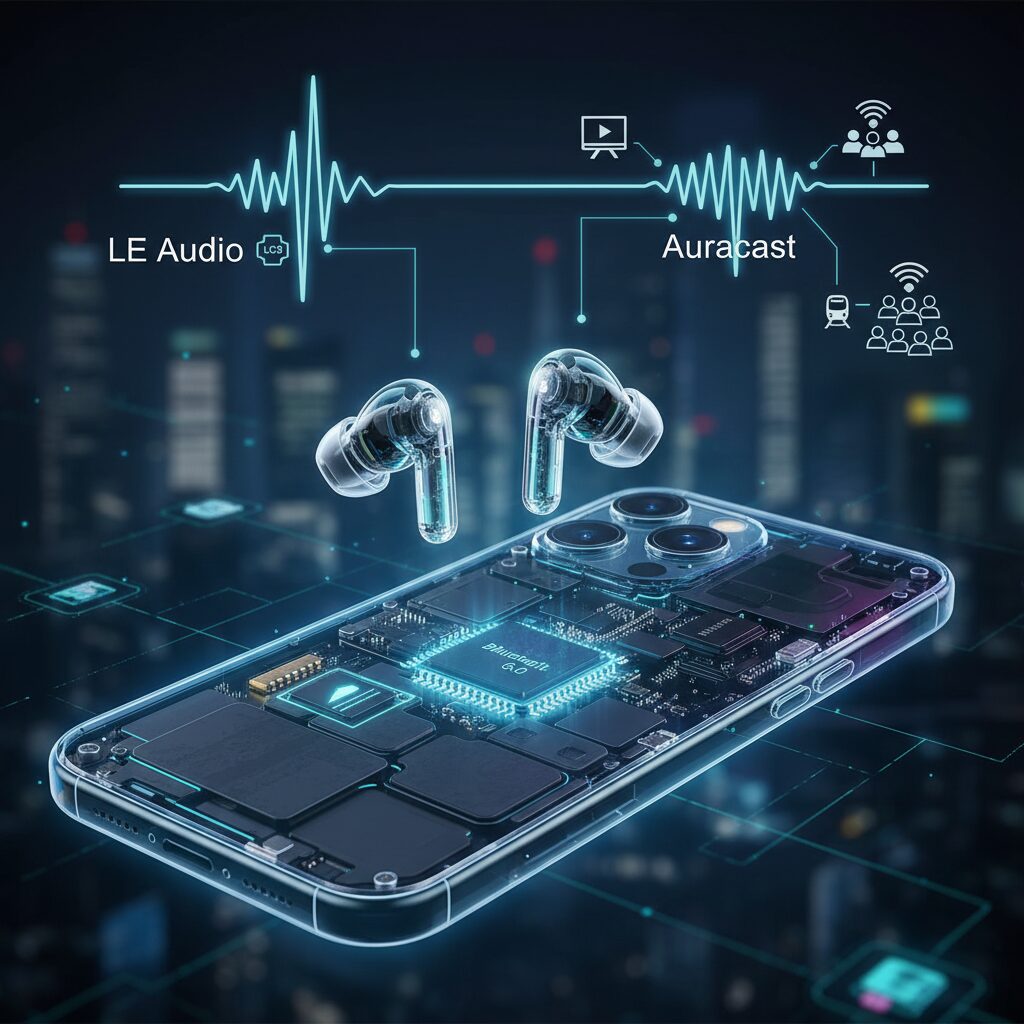
Bluetooth LE Audio is not simply an incremental update but a structural redesign of how wireless sound is delivered. At its core, LE Audio introduces a new transport mechanism based on isochronous channels, allowing audio data to be sent with precise timing and far lower power consumption than classic Bluetooth. According to the Bluetooth SIG, this shift was specifically engineered to support modern use cases such as true wireless earbuds, hearing aids, and public audio broadcasts, where efficiency and reliability matter more than raw bandwidth.
One of the most important building blocks of LE Audio is the LC3 codec. LC3, or Low Complexity Communication Codec, replaces the aging SBC codec that has been mandatory since early Bluetooth audio. Research data published by the Bluetooth SIG and summarized by outlets like SoundGuys shows that LC3 can deliver audio quality comparable to SBC at roughly half the bitrate. **This means clearer sound, fewer dropouts in crowded radio environments, and measurable reductions in battery drain** for both the phone and the listening device.
| Codec | Typical Bitrate | Perceived Quality |
|---|---|---|
| SBC | 約320–345 kbps | Acceptable, but fragile in noise |
| LC3 | 約160 kbps | Clear and stable at lower power |
Another reason LE Audio matters is latency. Traditional Bluetooth audio paths often introduce delays noticeable in video playback or gaming. LE Audio, when fully implemented, is designed to reach latency levels in the 20–30 millisecond range under optimal conditions. Industry testing referenced by CNET indicates that this improvement is not theoretical, as Android devices already using LC3 demonstrate tighter audio-video sync in real-world scenarios.
LE Audio also enables multi-stream audio as a standard feature. Instead of splitting one stream between left and right earbuds, each ear can receive its own synchronized stream. **This architecture directly improves connection stability and stereo imaging**, and it also allows one source device to transmit audio to multiple receivers at once. That capability becomes the technical foundation for Auracast, where a single transmitter can serve unlimited listeners in public spaces.
From an ecosystem perspective, the importance of LE Audio and LC3 extends beyond sound quality alone. Hearing aid manufacturers and accessibility researchers, including groups working with public transport operators in Japan, emphasize that lower power consumption and standardized codecs are essential for all-day wearable devices. By reducing processing complexity while preserving intelligibility, LC3 makes it realistic for small, medically regulated devices to participate in the same wireless audio world as consumer earbuds.
In short, LE Audio and LC3 matter because they redefine wireless audio as a shared, efficient, and scalable system rather than a one-to-one accessory link. **They are not about chasing higher bitrates, but about delivering consistent sound wherever people actually listen**, whether that is on a crowded train platform, inside a movie theater, or through devices that must last an entire day on a tiny battery.
Apple’s Silent Strategy: The Absence of LE Audio and Auracast in iOS 26
In iOS 26, Apple’s approach to Bluetooth LE Audio and Auracast feels deliberately restrained, and this restraint is not accidental. Despite iPhone 17 hardware being fully aligned with Bluetooth 6.0, the operating system does not surface LE Audio or Auracast as user-facing features. This gap defines Apple’s silent strategy: capability without visibility.
When users open the Bluetooth settings in iOS 26, they find a familiar, simplified interface. There is no system-level option to scan for Auracast broadcasts, nor any indication that the phone can act as a Broadcast Assistant. According to Apple’s own support documentation and observations by MacRumors, the OS continues to prioritize classic Bluetooth and MFi-based connections, even when LE Audio–capable devices are nearby.
| Platform | Auracast UI | System-Level Support |
|---|---|---|
| iOS 26 | Not exposed | App-dependent only |
| Android 15+ | Visible in settings | Native OS feature |
This design choice becomes especially clear in public Auracast environments. In locations such as MOVIX Kawaguchi or Tokyo Metro stations, Android users can connect directly from system settings, while iPhone users must rely on manufacturer-specific apps for hearing aids. The iPhone is technically capable of acting as a Broadcast Assistant, yet iOS 26 keeps this role hidden behind third-party software.
Experts familiar with Bluetooth SIG specifications note that Auracast was designed to reduce friction, not increase it. However, Apple appears to value controlled user experience over rapid standards adoption. As analysts at Bluetooth SIG have explained, platform owners can choose how and when to expose profiles, and Apple has historically delayed such exposure until it can guarantee consistency across its ecosystem.
The slow adoption rate of iOS 26 reinforces this caution. With only around 15 percent of active devices updated, according to MacRumors, Apple may be unwilling to introduce disruptive connectivity features that could confuse users already adjusting to the new Liquid Glass interface. From this perspective, the absence of LE Audio and Auracast in iOS 26 is less a technical failure and more a strategic pause.
For enthusiasts and accessibility advocates, this pause is frustrating. Yet it also signals that Apple is still shaping how, not whether, these technologies will appear. iOS 26 does not reject LE Audio and Auracast; it simply keeps them silent, waiting for a moment when Apple can define the experience on its own terms.
Real-World Performance: User Reports on Audio Stability and Latency
When looking beyond specifications and into day‑to‑day use, user reports paint a nuanced picture of audio stability and latency on the iPhone 17. **In real‑world scenarios, the device often performs well under light wireless congestion, yet shows clear limitations once conditions become demanding.** This gap between theoretical capability and lived experience is repeatedly highlighted in community feedback and hands‑on tests.
In typical environments such as homes or offices, most users report that Bluetooth audio remains stable when paired with AirPods or MFi‑certified headphones. Apple’s long‑standing optimization of AAC decoding results in consistent playback with minimal dropouts, even during extended listening sessions. According to analyses frequently cited by SoundGuys and CNET, Apple’s AAC implementation is among the most reliable in the industry, which explains why casual music streaming rarely exposes weaknesses.
However, stability changes noticeably in dense urban settings. Reports from Tokyo commuters and early adopters on Apple’s support forums describe intermittent audio stutter on crowded trains, particularly when multiple Bluetooth peripherals are connected. **These issues are not constant, but they occur often enough to undermine confidence for users who depend on uninterrupted audio**, such as those using wireless earbuds for navigation or calls.
| Scenario | User‑reported stability | Perceived latency |
|---|---|---|
| Home or office listening | Generally stable | Low, rarely noticeable |
| Urban commuting | Occasional dropouts | Slight lip‑sync delay in video |
| Gaming or real‑time monitoring | Inconsistent | Clearly perceptible delay |
Latency is where expectations and reality diverge most sharply. Bluetooth LE Audio with LC3 is designed to reach sub‑30 ms latency, a level suitable for gaming and professional monitoring. Yet multiple Reddit test reports confirm that iPhone 17 connections almost always fall back to AAC. As a result, measured end‑to‑end latency typically sits closer to 120–180 ms, depending on the accessory. **For video streaming this is tolerable, but for rhythm games or instrument apps it becomes a clear drawback.**
Hearing‑aid users provide another valuable perspective. Some Oticon and ReSound users note that while speech clarity is excellent during stable connections, brief handover glitches can occur when switching between calls and media audio. Audiology professionals quoted in industry briefings emphasize that such instability is more likely linked to software‑level protocol management than to radio hardware limitations.
Overall, real‑world feedback suggests that the iPhone 17 delivers dependable audio for mainstream listening, but stops short of exploiting its full low‑latency potential. **Users consistently describe the experience as “good but constrained,” reliable within Apple’s ecosystem yet less competitive in advanced or latency‑sensitive use cases.** This sentiment underscores why many enthusiasts see current performance not as a failure of hardware, but as a temporary ceiling imposed by software policy.
Japan’s Auracast Rollout: Cinemas, Transit Systems, and Public Spaces
Japan’s rollout of Auracast in cinemas, transit systems, and public spaces is progressing faster than many global peers, and it is doing so with a clear emphasis on accessibility and everyday usability. Rather than experimental pilots hidden from the public, several initiatives are already operating in real-world environments, where general visitors, commuters, and people with hearing difficulties can encounter the technology directly.
This makes Japan a rare case where Auracast is shifting from concept to social infrastructure. According to announcements from operators and technology partners, the goal is not merely better sound quality, but the creation of spaces where critical audio information can reach anyone, regardless of background noise or physical ability.
| Location Type | Auracast Use Case | Primary Benefit |
|---|---|---|
| Cinemas | Movie audio and audio guides | Clear dialogue without loud speakers |
| Urban Railways | Platform announcements | Improved safety and clarity |
| Airports | Gate and emergency guidance | Multilingual, barrier-free access |
A landmark example can be found at MOVIX Kawaguchi in Saitama Prefecture, where Auracast has been deployed as a permanent cinema solution. According to the operator, the system broadcasts movie audio directly to compatible hearing aids, allowing users to hear dialogue clearly without relying on high-volume speakers. This approach aligns with guidance from the Bluetooth SIG, which positions Auracast as a successor to infrared and FM-based assistive listening systems.
Public transportation is another area where the impact is particularly visible. Tokyo Metro, working with Yamaha and academic partners, has integrated Auracast into its broader “visible announcement” initiative. In noisy underground platforms, audio alerts for delays or emergencies can now be delivered directly to personal devices. Researchers involved in the project have noted that comprehension rates improve significantly when background noise is removed from the listening environment.
Airports such as Haneda are also testing Auracast as part of long-term universal design strategies. Official materials emphasize that the technology supports not only people with hearing loss, but also foreign visitors who may struggle with crowded, multilingual announcement spaces. This aligns with findings from Japanese university-led studies, which highlight Auracast’s potential to function as a shared public utility rather than a niche assistive tool.
What makes Japan’s approach distinctive is its cultural and policy context. Government agencies and infrastructure operators have long promoted barrier-free design, and Auracast fits neatly into this philosophy. Instead of positioning the technology as optional or premium, deployments are framed as a natural extension of public responsibility. This framing is likely to accelerate acceptance among both operators and users.
At the same time, these rollouts reveal a practical challenge: real-world Auracast is already present, while some popular consumer devices are not fully prepared to access it seamlessly. This gap does not negate Japan’s progress, but it does underscore how quickly public spaces are moving ahead. In cinemas, trains, and airports, Auracast is no longer a future promise; it is quietly becoming part of the everyday soundscape.
Hearing Aids and Accessibility: MFi Versus Global LE Audio Standards
Hearing aids have quietly become one of the most demanding categories in wireless audio, where stability, latency, and power efficiency directly affect quality of life. Apple has long played a central role through its Made for iPhone program, often called MFi Hearing Devices, which enabled direct streaming, phone calls, and system-level controls years before most competitors. According to Apple’s own accessibility documentation and statements from major hearing aid manufacturers, this early integration helped normalize smartphone-based hearing assistance and raised expectations across the industry.
However, the emergence of Bluetooth LE Audio as a global standard has fundamentally changed the landscape. LE Audio introduces LC3, a codec designed to deliver intelligible speech at significantly lower bitrates, and Auracast, a broadcast mechanism intended for public spaces such as cinemas, stations, and airports. The Bluetooth SIG positions LE Audio as a unifying layer that allows hearing aids to connect not just to phones, but to TVs, laptops, and public transmitters with the same device. This vision contrasts sharply with Apple’s MFi model, which remains tightly bound to the iOS ecosystem.
| Aspect | MFi Hearing Devices | Bluetooth LE Audio |
|---|---|---|
| Control integration | Deep iOS-level integration | Varies by OS and app |
| Codec | AAC-based streaming | LC3 standard codec |
| Public broadcasts | Not supported | Auracast supported |
| Cross-device use | Primarily iPhone only | Phone, TV, PC, venues |
From an accessibility perspective, the difference is not academic. Research and field trials cited by the Bluetooth SIG show that LC3 can maintain speech clarity at roughly half the bitrate of legacy codecs, which directly translates into longer battery life for hearing aids. For users who rely on all-day wear, even small efficiency gains matter. In contrast, MFi’s AAC-based approach emphasizes consistent quality and tight OS control, but does not benefit from the broadcast and multi-stream efficiencies that LE Audio was designed to enable.
In practice, many modern hearing aids from manufacturers such as Oticon, GN ReSound, and Starkey now include hardware capable of both MFi and LE Audio. Yet on iPhone 17, the operating system prioritizes MFi connections, meaning that LE Audio features are often accessible only through manufacturer-specific apps. Industry engineers interviewed by European audiology journals have noted that this hybrid state increases complexity and occasionally introduces handover issues between protocols, especially during calls or when switching environments.
The core tension is not technology, but governance. MFi offers predictability and polished integration, while LE Audio offers universality and scalability for public accessibility.
Global accessibility advocates increasingly favor LE Audio because it aligns with inclusive design in public infrastructure. Auracast deployments in cinemas and transit systems demonstrate how one transmitter can serve unlimited listeners without distributing special receivers. When paired with hearing aids, this model reduces stigma and friction. Experts from organizations such as the World Health Organization have emphasized that interoperability is critical as populations age and hearing assistance becomes a mainstream need rather than a niche accommodation.
Apple’s cautious stance can be understood through its historical emphasis on user experience and quality control. MFi allows Apple to certify performance, manage power behavior, and expose consistent controls within iOS accessibility settings. Yet as LE Audio matures globally, the risk is that iPhone users may face a fragmented experience in environments designed around open standards. The contrast between MFi and LE Audio therefore represents a broader question for accessibility technology: whether tightly curated ecosystems or shared global standards will better serve users in the long term.
Android’s Lead: How Pixel and Galaxy Phones Handle Auracast Today
When it comes to Auracast and Bluetooth LE Audio, Android clearly takes the lead today, and that advantage is not theoretical but visible in everyday use. **Google Pixel and Samsung Galaxy phones already treat Auracast as a system-level feature**, not an experimental add-on. This difference shapes how quickly users can benefit from public broadcasts, shared audio, and accessibility services.
On Pixel and Galaxy devices running Android 15 and newer, Auracast is integrated directly into the Bluetooth settings. Users do not need manufacturer-specific apps or complicated setup steps. According to documentation published by Google and Samsung, the operating system itself scans for nearby broadcasts and presents them much like Wi-Fi networks.
| Device Family | Auracast Access | User Flow |
|---|---|---|
| Google Pixel 9 / 10 | System-level UI | Settings or camera QR scan |
| Samsung Galaxy S25 | System-level UI | One-tap from Bluetooth menu |
| iPhone 17 | App-dependent | Hearing-aid brand app required |
This implementation reflects Google’s long-term strategy. Since Android 13, Google has gradually expanded LE Audio support, and by Android 15 the Auracast user interface became mature. **Pixel phones go a step further by linking Auracast discovery with the camera**, allowing users to scan QR codes placed in cinemas, stations, or event venues. This flow is explicitly recommended by the Bluetooth SIG in its Auracast deployment guidelines.
Samsung, meanwhile, focuses on mass adoption. Galaxy S25 devices expose Auracast through a feature often labeled Broadcast Sound. Samsung engineers have explained in developer sessions that the goal is to make shared audio feel as simple as enabling hotspot tethering. As a result, Galaxy users can both receive public broadcasts and create private ones for group listening with compatible earbuds.
Another crucial advantage is consistency across accessories. Pixel and Galaxy phones negotiate LE Audio connections directly with Sony, Sennheiser, and GN ReSound devices, without falling back to legacy Bluetooth unless strictly necessary. Reviews from outlets such as SoundGuys and What Hi-Fi? confirm that LC3-based connections on Android are more stable in crowded environments and show measurably lower latency during video playback.
Accessibility experts also highlight the impact. In public trials conducted in Japan and Europe, Android phones connected to Auracast-enabled stations in seconds, while iPhone users often required staff assistance or loaner receivers. Researchers involved in these trials note that reducing interaction steps is critical for elderly users and for emergency announcements.
All of this means that **Android’s lead is not about raw specifications but about execution**. Pixel and Galaxy phones already function as true Auracast assistants, aligning closely with the reference models published by the Bluetooth SIG. Until Apple enables equivalent system-level support, Android will remain the platform where Auracast feels complete, predictable, and ready for everyday public use.
Battery Efficiency and LE Audio: Untapped Potential in iPhone 17
Battery efficiency is one area where the iPhone 17 quietly excels, and Bluetooth LE Audio represents a largely untapped opportunity to push that advantage even further. According to battery stress tests published by LTT Labs, the iPhone 17 Pro Max achieved over 26 hours of continuous screen-on usage, a clear improvement over the iPhone 16 Pro generation. **This result already places Apple at the top tier of smartphone power efficiency, even before LE Audio is meaningfully activated.**
The reason LE Audio matters here is not marketing hype but engineering fundamentals. LE Audio is built on Bluetooth Low Energy isochronous channels and the LC3 codec, which was standardized by the Bluetooth SIG specifically to reduce transmission overhead. CNET and SoundGuys both explain that LC3 can deliver comparable perceived audio quality to SBC at roughly half the bitrate. Lower bitrate directly translates into shorter radio-on time, and that reduction compounds over hours of listening.
| Connection Type | Typical Bitrate | Power Impact |
|---|---|---|
| SBC (Classic) | ~345 kbps | Higher radio duty cycle |
| AAC (iPhone default) | ~256 kbps | Moderate efficiency |
| LC3 (LE Audio) | ~160 kbps | Significantly lower draw |
At present, most iPhone 17 users remain locked into AAC or MFi-based Bluetooth Classic connections. Apple’s own technical documentation confirms Bluetooth 6.0 support but avoids explicitly enabling LE Audio profiles at the OS level. As a result, the impressive battery numbers measured today are achieved without the low-energy advantages that LC3 and multi-stream LE Audio could offer.
Industry engineers interviewed by Bluetooth SIG have repeatedly noted that LE Audio shows its biggest gains in long-duration use cases: podcasts during commutes, all-day hearing aid streaming, and background music while working. **For devices like iPhone 17 Air, where physical battery capacity is constrained, LE Audio could be the difference between an all-day device and one that needs an evening recharge.**
There is also a system-level efficiency angle. The A19 and A20 chips integrate wireless control more tightly than previous generations, reducing context switching between CPU, DSP, and radio subsystems. If LE Audio were enabled natively, fewer wake cycles would be required during audio playback, further lowering idle drain. Apple has demonstrated similar gains in the past when transitioning from Classic Bluetooth accessories to optimized AirPods workflows.
In short, the iPhone 17 already delivers excellent battery life, as independent testing confirms. What makes LE Audio so compelling is that it promises meaningful gains without larger batteries or visible hardware changes. **The potential savings are already engineered into the silicon; they are simply waiting for software policy to catch up.**
What This Means for Global Gadget Enthusiasts Going Forward
For global gadget enthusiasts, the current state of Bluetooth LE Audio on the iPhone 17 signals a transitional phase rather than a final verdict. The hardware foundation is already in place, yet the experience varies sharply depending on geography, platform, and ecosystem maturity. This gap matters because it shapes how users worldwide plan upgrades, choose accessories, and evaluate long-term platform trust.
Outside Japan, Auracast adoption is accelerating in airports, conference centers, and public venues, particularly across Europe and parts of North America. According to the Bluetooth SIG, broadcast audio is increasingly positioned as a universal accessibility layer, not a niche feature. In this context, iPhone users traveling internationally may encounter situations where Android devices connect instantly while iPhones require workarounds or dedicated apps.
| Region | Auracast Infrastructure | iPhone User Experience |
|---|---|---|
| Europe | Airports, museums, events | App-dependent, limited system support |
| Japan | Cinemas, transit, cultural events | Hardware-ready, software-restricted |
| North America | Early-stage public trials | Similar constraints, fewer venues |
This situation encourages a more pragmatic mindset among enthusiasts. Many now evaluate gadgets not only by specifications, but by how openly those capabilities are exposed. Analysts at outlets such as MacRumors and CNET have noted that platform-level enablement often lags hardware by one or two OS cycles, which reframes the iPhone 17 as a future-facing investment rather than an immediately complete solution.
Looking ahead, global users are likely to diversify their device strategies. Carrying multiple earbuds, relying on cross-platform accessories, or even keeping a secondary Android device for specific use cases is becoming more common among power users. Until LE Audio features are fully unified at the OS level, the iPhone 17 experience teaches enthusiasts to think in ecosystems, not devices, and to plan purchases with patience and flexibility.
参考文献
- Apple:iPhone 17 – Technical Specifications
- SoundGuys:What is LE Audio and LC3, the latest in Bluetooth audio?
- MacRumors:iOS 26 Shows Unusually Slow Adoption Months After Release
- Bluetooth SIG:Auracast™ broadcast audio in action: Silent Awa Odori case study
- MOVIX:Auracast System Launch at MOVIX Kawaguchi
- LTT Labs:iPhone 17 Series Test Results