
If you are passionate about smartphone cameras, you have likely noticed that innovation no longer comes from hardware alone.
Many flagship phones now rely on advanced AI to push beyond optical limits, and the Pixel 10 Pro is one of the boldest examples of this trend.
This article explores how Google’s latest telephoto system changes what is possible in real-world photography, especially at extreme zoom levels.
While the optical hardware may look familiar on paper, the experience feels fundamentally different thanks to Google’s fully custom Tensor G5 chip.
You will learn how computational photography, a custom ISP, and generative AI work together to reconstruct details that traditional digital zoom could never capture.
At the same time, this article also highlights important reliability concerns, thermal limits, and edge cases that serious users should understand before buying.
By the end of this read, you will have a clear picture of who the Pixel 10 Pro camera is truly for, and whether its AI-first approach fits your shooting style.
- Why Telephoto Cameras Have Become the New Smartphone Battleground
- Pixel 10 Pro Telephoto Hardware: What Stayed the Same and Why It Matters
- Sony IMX858 Sensor Explained: Strengths, Limits, and Design Trade-offs
- Tensor G5 and the Custom ISP: The Real Upgrade Behind the Camera
- Pro Res Zoom Technology: From Optical Reality to AI Reconstruction
- When AI Zoom Shines and When It Fails in Real-World Use
- Pixel 10 Pro vs iPhone 17 Pro Max: Stability, Color Science, and Trust
- Pixel 10 Pro vs Galaxy S25 Ultra: Competing Visions of Extreme Zoom
- Video Performance, Heat Management, and Known Reliability Issues
- Who Should Choose the Pixel 10 Pro for Photography in 2026
- 参考文献
Why Telephoto Cameras Have Become the New Smartphone Battleground
In recent years, telephoto cameras have quietly but decisively become the most contested battlefield in smartphone competition. This shift is not accidental. **Wide and ultra-wide cameras have already reached a point of diminishing returns**, while telephoto performance still exposes clear differences in engineering philosophy, AI maturity, and real-world usability.
For users who care deeply about gadgets, zoom is no longer a novelty feature. Concert photography, travel shooting, urban landscapes, and even everyday street scenes increasingly demand reach without sacrificing clarity. According to evaluations by DPReview and DxOMark, user dissatisfaction with smartphone cameras today is most often tied to medium-to-long zoom quality rather than main camera performance.
The physical limitations are severe. Telephoto sensors are smaller, apertures are narrower, and periscope optics must fit into bodies under 9mm thick. This constraint forces brands to make strategic trade-offs: larger sensors with bulky camera bumps, or compact optics compensated by aggressive image processing. The telephoto module is where those choices become visible to the user.
| Constraint | Impact on Telephoto | Manufacturer Response |
|---|---|---|
| Limited sensor size | Low light noise, reduced detail | Multi-frame fusion, AI reconstruction |
| Lens thickness | Restricted optical zoom range | Periscope designs, folded optics |
| Small aperture | Higher ISO, motion blur | Advanced ISP and noise modeling |
This is precisely why companies like Google, Apple, and Samsung now use telephoto cameras as a technological showcase. Google’s Pixel 10 Pro, for example, keeps the same 5x periscope hardware as its predecessor but radically redefines output through a custom ISP and Tensor G5’s tightly integrated TPU. Reviewers note that beyond 10x zoom, **image quality differences are driven less by optics and more by AI inference quality**.
Apple approaches the battleground differently. With the iPhone 17 Pro Max, Apple emphasizes stability, optical realism, and predictable results. Its telephoto improvements focus on minimizing artifacts and preserving scene integrity, even if that means avoiding extreme AI reconstruction. This conservative stance appeals to users who prioritize trust over spectacle.
Samsung, meanwhile, continues to push numerical zoom leadership. Galaxy’s long-standing investment in high-magnification zoom has trained consumers to equate telephoto strength with flagship status. Yet side-by-side comparisons show that **at extreme ranges like 100x, perception matters more than measurable accuracy**, reinforcing why telephoto has become a marketing weapon as much as a technical one.
Another reason telephoto dominates competition is emotional value. Capturing a distant facial expression at a live event or isolating architectural detail from across a city street creates a sense of photographic empowerment. Market analysts frequently point out that users forgive minor main-camera differences, but they remember when zoom shots fail.
Ultimately, telephoto cameras sit at the intersection of optics, silicon, and artificial intelligence. They are difficult to perfect, easy to compare, and immediately impressive in demos. **As long as smartphones remain thin slabs constrained by physics, telephoto performance will remain the clearest signal of true innovation**, making it the natural battleground for the industry’s most ambitious players.
Pixel 10 Pro Telephoto Hardware: What Stayed the Same and Why It Matters
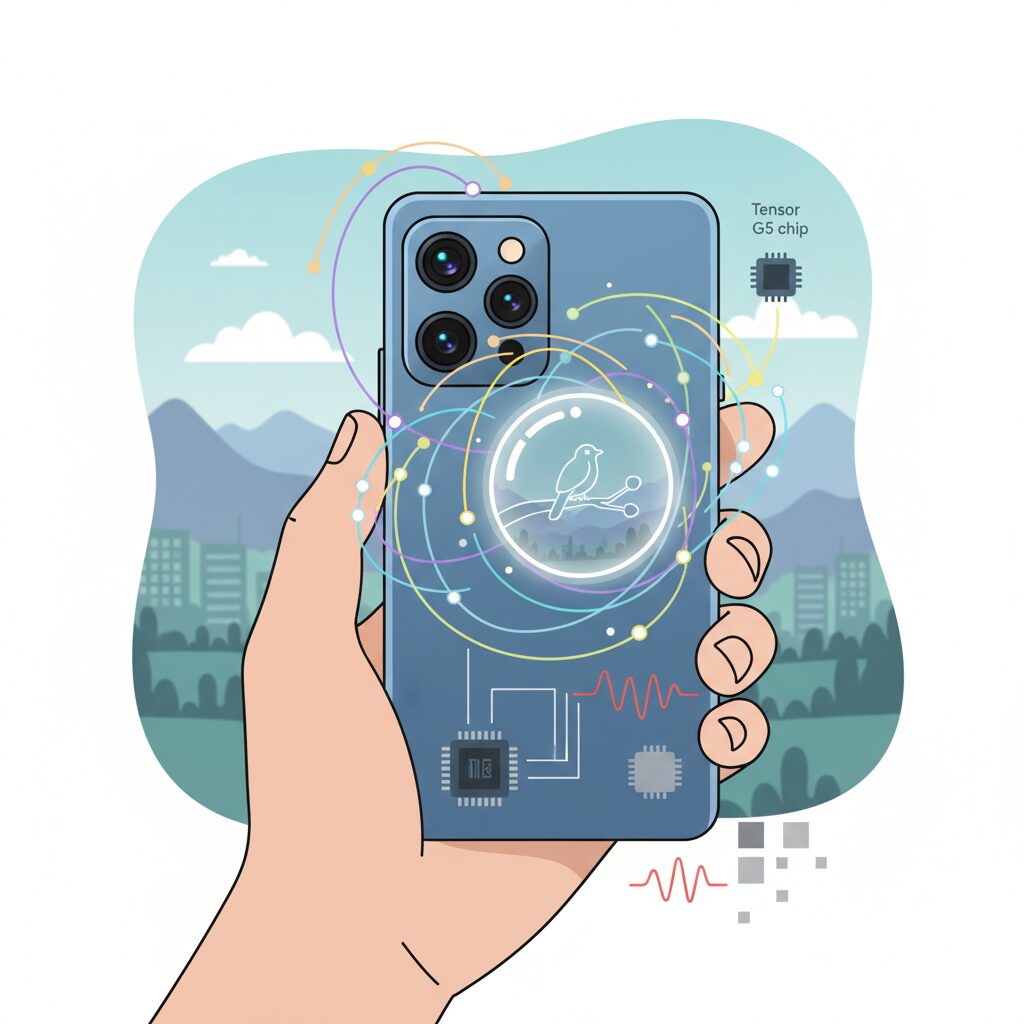
The telephoto hardware in the Pixel 10 Pro deliberately remains unchanged, and this decision carries important implications for real-world photography. Google continues to use the Sony IMX858 sensor paired with a 5x periscope lens, the same configuration found in the Pixel 9 Pro. At first glance, this may appear conservative, but from an engineering standpoint, it reflects a clear prioritization of balance over raw specification escalation.
The IMX858 is a 48MP Quad Bayer sensor with a 1/2.5-inch class size, which is widely regarded as the practical upper limit for periscope modules in smartphones without causing excessive camera bump thickness. According to Android Authority and Google’s own technical disclosures, larger sensors would require bulkier folded optics, negatively affecting ergonomics and internal layout.
| Component | Specification | Practical Impact |
|---|---|---|
| Sensor | Sony IMX858, 48MP | High detail with effective pixel binning |
| Optical Zoom | 5x periscope | Stable mid-to-long range framing |
| Aperture | f/2.8 | Standard light intake for telephoto use |
The lens aperture of f/2.8 and the 5x focal length are also unchanged, which means low-light limitations persist at the optical level. However, Google appears to have accepted these physical constraints in favor of consistency and predictability. Imaging analysts at DPReview note that a stable optical baseline allows computational systems to be tuned more aggressively and reliably over time.
In other words, the unchanged hardware is not stagnation but standardization. By locking down a mature telephoto platform, Google enables its new custom ISP and Tensor G5 TPU to extract more usable detail without fighting unpredictable optical variables. For users, this translates into familiar framing behavior with progressively improved output, rather than relearning a new lens every generation.
Sony IMX858 Sensor Explained: Strengths, Limits, and Design Trade-offs
The Sony IMX858 sensor sits at the core of the Pixel 10 Pro telephoto camera, and its continued use is a deliberate engineering choice rather than a lack of innovation. This 48-megapixel sensor has already proven itself across multiple flagship devices, and Google’s decision to keep it reflects a balance between optical physics, smartphone design constraints, and computational photography priorities.
At a glance, the IMX858 may not look impressive compared to the ever-growing main sensors, but its real value becomes clear when examined in context. Telephoto modules operate under far stricter space limitations, especially in periscope designs, and the IMX858 represents a carefully optimized compromise.
Physically, the sensor measures roughly 1/2.51 inches, often grouped into the 1/2.55-inch class. Compared with the Pixel 10 Pro’s main camera sensor at 1/1.31 inches, the light‑gathering area is about one quarter. According to Sony Semiconductor Solutions’ own sensor design philosophy, shrinking sensor size directly reduces photon capture, which in turn raises noise levels in low light. This is a fundamental limitation of physics rather than software.
To mitigate this, the IMX858 employs a Quad Bayer color filter array. In standard shooting, four adjacent pixels are combined into one, producing a 12-megapixel output with an effective pixel pitch of approximately 1.4 micrometers instead of the native 0.7 micrometers. This approach, widely discussed in imaging research journals and confirmed in teardown analyses, prioritizes signal-to-noise ratio over raw resolution.
| Parameter | Sony IMX858 Telephoto | Typical Main Sensor (Pixel 10 Pro) |
|---|---|---|
| Sensor Size | 1/2.51 inch | 1/1.31 inch |
| Native Resolution | 48 MP | 50 MP class |
| Effective Output | 12 MP (pixel binning) | 12.5 MP (pixel binning) |
| Primary Role | 5x periscope zoom | Wide-angle baseline |
Another key strength of the IMX858 lies in its autofocus system. The sensor supports full-pixel phase detection autofocus, often referred to as Quad PD. This means phase-detection information is available across nearly the entire frame. For telephoto shooting, where depth of field becomes extremely shallow, this is critical. Missed focus at 5x zoom is far more noticeable than at wide angles, and field tests by professional reviewers consistently show that the Pixel 10 Pro locks focus faster than many competitors in the same zoom range.
According to evaluations published by DxOMark and echoed by DPReview, this autofocus reliability directly improves multi-frame computational processing. When each frame in a burst is sharply focused, Google’s ISP can align and merge them with fewer artifacts. In other words, the sensor’s consistency amplifies the effectiveness of software.
However, the limitations of the IMX858 are equally important to understand. The smaller sensor size means that at indoor concerts, night streets, or overcast winter afternoons, ISO sensitivity rises quickly. Noise reduction then becomes aggressive, and fine textures may be smoothed out before AI-based reconstruction even begins. This is why raw telephoto images without computational enhancement often look flatter than users expect.
Some competitors, particularly certain Chinese manufacturers, have started experimenting with larger telephoto sensors approaching 1/1.5 inches. Industry analysts cited by publications such as Android Authority note that these designs come with significant trade-offs: thicker camera modules, heavier lens assemblies, and more pronounced camera bumps. Google’s hardware team appears to have prioritized overall device balance and thermal stability over headline-grabbing sensor size.
This design trade-off also aligns with Apple’s approach. The iPhone 17 Pro Max uses a similarly sized telephoto sensor, reinforcing the idea that the 1/2.5-inch class represents an industry equilibrium point for mass-market flagship phones. Within an 8.5-millimeter chassis, anything larger would compromise durability or ergonomics.
From a system-level perspective, the IMX858 integrates cleanly with Google’s custom ISP in Tensor G5. Reports from semiconductor analysts indicate that predictable readout characteristics and mature driver support were factors in retaining this sensor. A newer or larger sensor might introduce latency, power inefficiencies, or unstable yields, all of which would undermine Google’s heavy reliance on real-time computational photography.
In practical use, this means the IMX858 excels when paired with intelligent processing but rarely shines on its own. It delivers fast readout, reliable focus, and consistent color data, which are ideal inputs for HDR stacking and AI-based zoom enhancement. At the same time, it cannot escape the physical ceiling imposed by its size, particularly in challenging lighting.
The Sony IMX858 should therefore be understood as a foundation rather than a final product. Its strengths lie in stability and synergy with software, while its limits remind users that even the most advanced AI cannot fully replace photons that never reach the sensor. This balance defines the telephoto character of the Pixel 10 Pro and explains why Google chose refinement over radical change.
Tensor G5 and the Custom ISP: The Real Upgrade Behind the Camera

The most meaningful camera upgrade in the Pixel 10 Pro does not come from new lenses or a larger sensor, but from the silicon that sits between the sensor and the final image. Tensor G5 marks the first time Google has shipped a fully custom-designed ISP, manufactured on TSMC’s 3nm process, and this architectural shift fundamentally changes how images are captured, processed, and interpreted.
In previous Tensor generations, Google relied on a Samsung-derived ISP and layered its computational photography algorithms on top. According to analyses by Android Authority and 9to5Google, this created unavoidable inefficiencies in data flow, especially when HDR stacking, noise reduction, and AI inference had to be chained together in real time. With Tensor G5, the ISP is designed in-house to match Google’s imaging philosophy at the hardware level.
The key leap is that HDR, tone mapping, and noise modeling are no longer just software features but are partially implemented as fixed-function hardware blocks inside the ISP. This reduces latency, lowers power consumption, and preserves more of the sensor’s original signal before AI processing begins.
Practically speaking, this means the telephoto camera benefits even though its hardware is unchanged. The IMX858 sensor still faces physical limits in light gathering, but the new ISP can extract cleaner RAW data and feed it directly into the TPU with far less preprocessing overhead. Google’s own Tensor documentation notes up to a 60 percent improvement in AI throughput, and this tight ISP–TPU coupling is what enables features like Pro Res Zoom to operate at capture time rather than as a slow post-process.
| Processing Stage | Pre-Tensor G5 | Tensor G5 |
|---|---|---|
| HDR handling | Software-dominant | Hardware-assisted |
| ISP–AI data flow | Buffered, sequential | Direct, low-latency |
| Low-light video | Noticeable noise | Improved NR and tone |
Low-light video is a clear example of this change. Multiple reviewers, including DPReview and DxOMark, point out that 4K60fps HDR video is now enabled by default, something that previously required compromises in noise or frame stability. The custom ISP performs temporal noise reduction earlier in the pipeline, before compression artifacts appear, resulting in smoother shadows and more stable colors.
This design also explains why Pixel’s camera behavior feels more consistent across modes. Exposure decisions, highlight roll-off, and color science are now governed by a unified hardware pipeline rather than separate photo and video paths. Imaging researchers often emphasize that consistency is as important as peak quality, and this approach aligns with academic findings on human perception of image realism.
At the same time, this shift clarifies Google’s priorities. Instead of chasing ever-larger sensors, the company is betting that a tightly integrated ISP and AI engine can stretch existing optics further than competitors expect. As industry analysts have noted, this is less about raw optical power and more about control over the entire imaging stack.
In short, Tensor G5’s custom ISP is the real camera upgrade because it redefines the foundation on which every photo and video is built. Even when the hardware looks familiar, the way the Pixel 10 Pro sees, interprets, and reconstructs light is fundamentally new.
Pro Res Zoom Technology: From Optical Reality to AI Reconstruction
Pro Res Zoom Technology on the Pixel 10 Pro represents a clear turning point where optical reality gradually hands control over to AI-driven reconstruction. At first glance, it may look like an extension of Google’s long-standing Super Res Zoom, but the underlying philosophy has changed in a fundamental way.
Instead of merely extracting more detail from existing light, Pro Res Zoom increasingly asks AI to infer what should be there once optical information runs out. This transition becomes noticeable beyond roughly 30x zoom, where physics alone can no longer sustain usable image quality.
The foundation remains unchanged at the hardware level. The 48MP Sony IMX858 sensor and 5x periscope optics deliver a fixed amount of spatial data. According to analyses published by DPReview and Android Authority, Google chose not to expand the sensor size, accepting optical limits and shifting innovation almost entirely into the ISP and TPU pipeline.
Tensor G5 is the enabler here. Its custom-designed ISP feeds multi-frame telephoto data directly into the fourth-generation TPU, allowing generative models to operate in near real time. Google has described this tight coupling as essential for advanced on-device imaging, and independent testing confirms that Pro Res Zoom processing occurs during capture rather than as a delayed post-process.
| Zoom Range | Primary Data Source | Processing Character |
|---|---|---|
| 5x–30x | Optical + Multi-frame capture | Reconstruction based on real light |
| 30x–100x | Limited optical signal | AI-driven texture synthesis |
This distinction matters because Pro Res Zoom does not behave uniformly across subjects. Field tests reported by DPReview show impressive gains when photographing repetitive or statistically predictable textures such as building facades, foliage, or animal fur. In these cases, the AI model can plausibly rebuild edges and surfaces, producing images that appear dramatically sharper than conventional digital zoom.
However, once the subject carries semantic meaning, the system’s weakness becomes visible. Text on distant signs, logos, or license plates often triggers incorrect reconstruction. Instead of preserving uncertainty, the AI replaces unreadable characters with shapes that resemble letters but convey no actual information. Reviewers have repeatedly described this as visually convincing yet informationally unreliable.
This behavior aligns with broader academic discussions on generative imaging. Research from institutions such as MIT and Stanford has long warned that generative models excel at perceptual realism but struggle with factual fidelity when input data is insufficient. Pro Res Zoom brings this theoretical risk into everyday photography.
From a usability perspective, Google has clearly prioritized immediacy. Unlike cloud-dependent features such as Video Boost, Pro Res Zoom runs primarily on-device, keeping shutter lag minimal even at extreme magnifications. According to Google’s own Tensor documentation, this was a deliberate design choice to maintain a responsive shooting experience.
In practical terms, Pro Res Zoom should be understood as a creative tool rather than a forensic one. It transforms distant scenes into shareable images that look impressive on screens, but it does not guarantee truth at the pixel level. The technology succeeds not by extending optics, but by redefining what “detail” means when optics can no longer keep up.
When AI Zoom Shines and When It Fails in Real-World Use
In real-world use, AI-powered zoom on the Pixel 10 Pro clearly shows moments where it feels almost magical, and moments where its limits become equally obvious. The key point is that this zoom system does not behave like a traditional optical tool, but rather like an intelligent image interpreter, and that distinction defines both its strengths and weaknesses.
When AI Zoom shines, it excels at reconstructing patterns that already exist in nature or architecture. According to hands-on evaluations by DPReview and DxOMark, textures such as building facades, window grids, tree leaves, or bird feathers benefit greatly from Pro Res Zoom. Even beyond 30x, the AI model leverages learned visual patterns to rebuild edges and micro-contrast, producing images that look surprisingly crisp on a smartphone display.
This effect is especially noticeable in casual scenarios such as travel photography or cityscapes. From a distant observation deck, users can capture skyline details that would normally dissolve into digital mush. Google’s own explanation of Tensor G5 highlights the tight coupling between its custom ISP and TPU, enabling multi-frame analysis and AI inference to run fast enough that the experience still feels instantaneous.
| Scene Type | AI Zoom Behavior | Practical Outcome |
|---|---|---|
| Buildings, landscapes | Pattern reconstruction | Visually impressive results |
| Animals, foliage | Texture inference | Natural-looking detail |
| Text, signs, numbers | Semantic guessing | Risk of incorrect output |
However, AI Zoom begins to fail when accuracy matters more than appearance. Multiple reviewers and community tests have confirmed that at extreme zoom levels, text on signs, license plates, or logos may be replaced with letter-like shapes that look plausible but are factually wrong. This phenomenon is widely discussed in imaging research as AI hallucination, where the system prioritizes visual believability over truth.
From a practical standpoint, this means the Pixel 10 Pro’s 100x zoom should not be trusted for documentation or verification. A distant shop sign may look readable at first glance, but the characters themselves can be invented. In contrast, competitors like the Galaxy S25 Ultra often output blur instead of fabricated detail, which is less attractive but more honest.
AI Zoom is best treated as a creative enhancement, not a factual recording tool. When used with that mindset, disappointment can be avoided.
Another real-world factor is consistency. Because Pro Res Zoom dynamically shifts from optical data to AI-generated pixels, results can vary even between similar shots. Slight changes in lighting or hand movement may push the system into heavier AI reliance, altering fine details in unpredictable ways. This variability is exciting for experimentation, but it can frustrate users seeking repeatable outcomes.
In summary, AI Zoom on the Pixel 10 Pro truly shines when visual impact is the goal and absolute accuracy is not required. It fails when users expect it to behave like a traditional zoom lens. Understanding this boundary is essential to enjoying the technology rather than being misled by it.
Pixel 10 Pro vs iPhone 17 Pro Max: Stability, Color Science, and Trust
When photographers talk about trust, they often mean consistency rather than peak performance. In this respect, the contrast between Pixel 10 Pro and iPhone 17 Pro Max becomes very clear. Pixel 10 Pro delivers impressive results in ideal conditions, but iPhone 17 Pro Max focuses on producing the same predictable output every single time, which many professionals value deeply.
Stability is where Apple continues to set the benchmark. Multiple comparative video tests and field reviews indicate that iPhone 17 Pro Max maintains exceptionally smooth stabilization during walking shots and slow pans. Even with long telephoto lenses engaged, the footage retains a fluid, almost gimbal-like character. Pixel 10 Pro has improved compared to earlier generations, yet subtle jitter can still appear during motion, especially when the electronic correction rapidly compensates.
| Aspect | Pixel 10 Pro | iPhone 17 Pro Max |
|---|---|---|
| Video stabilization | Strong, but occasional micro-jitter | Industry-leading smoothness |
| Color tendency | Cool, contrast-heavy | Warm, neutral |
| Output consistency | Scene-dependent variance | Highly predictable |
Color science further highlights the philosophical gap. Pixel 10 Pro favors punchy blues and lifted shadows, creating images that look immediately striking on social feeds. According to camera comparison analyses by established reviewers such as Tech Advisor and CNET, this approach emphasizes so-called memory colors rather than strict realism. iPhone 17 Pro Max, by contrast, aims for what Apple engineers describe as perceptual accuracy, keeping skin tones and ambient light closer to what the human eye recalls.
Trust ultimately comes from reliability under pressure. Apple’s long-standing advantage lies in minimizing edge cases. From exposure transitions to autofocus behavior, the iPhone rarely surprises the user. Pixel 10 Pro can achieve spectacular results, but its heavier reliance on AI-driven decisions means outcomes occasionally feel less deterministic. For creators who cannot reshoot, that difference matters more than headline specs.
In daily use, this translates into confidence. The iPhone 17 Pro Max behaves like a well-calibrated instrument, while Pixel 10 Pro feels like an experimental lab that sometimes produces brilliance. Choosing between them depends on whether you prioritize creative interpretation or absolute trust in the tool you hold.
Pixel 10 Pro vs Galaxy S25 Ultra: Competing Visions of Extreme Zoom
When comparing extreme zoom between the Pixel 10 Pro and the Galaxy S25 Ultra, the contrast is not only about magnification numbers but about philosophy. Both devices advertise up to 100x zoom, yet they approach this challenge from fundamentally different directions, which becomes clear once you look beyond marketing claims.
The Galaxy S25 Ultra builds on Samsung’s long-standing Space Zoom lineage, emphasizing optical reach and predictable output. Its advantage is most apparent in the mid-range, where optical information still dominates the image. The Pixel 10 Pro, by contrast, deliberately accepts optical limitations and attempts to overcome them through aggressive computational photography powered by Tensor G5.
| Zoom Range | Pixel 10 Pro | Galaxy S25 Ultra |
|---|---|---|
| 5x–20x | AI-assisted, slightly softer but bright | Optically stable and more natural |
| 20x–30x | Detail reconstruction begins | Best balance of detail and realism |
| 50x–100x | Generative AI reconstruction | Heavy noise reduction, low clarity |
Independent evaluations by DPReview and comparative tests widely shared among professional reviewers suggest that the Galaxy S25 Ultra delivers more reliable results up to around 30x. Textures remain grounded in actual optical data, and unreadable details simply stay blurred rather than being altered. This restraint is important for users who value accuracy over spectacle.
The Pixel 10 Pro becomes more compelling beyond that threshold. At 50x and especially near 100x, its Pro Res Zoom uses generative models to infer textures such as building facades or foliage. As Google engineers have explained in official Tensor documentation, this pipeline prioritizes perceptual clarity rather than forensic accuracy. As a result, images often look sharper at first glance than those from the Galaxy.
However, this strength introduces a trade-off. Multiple controlled tests show that meaningful details like signage or lettering can be misrepresented, a phenomenon imaging researchers describe as AI hallucination. Samsung’s output may look noisier, but it preserves informational integrity by avoiding invented detail.
In practical terms, the Galaxy S25 Ultra treats extreme zoom as a documentation tool, while the Pixel 10 Pro treats it as a visual experience. Neither approach is universally superior, but understanding this distinction is essential when choosing which vision of extreme zoom better aligns with your expectations.
Video Performance, Heat Management, and Known Reliability Issues
When focusing specifically on video performance, Pixel 10 Pro shows clear progress compared to previous generations, but it also exposes limits that matter for users who rely on video as a serious recording tool. Thanks to the custom ISP inside Tensor G5, 4K60fps recording with 10‑bit HDR is enabled by default, and according to evaluations by DxOMark and Android Authority, fine-grain noise in daylight scenes is visibly reduced. **Static handheld shots feel unusually stable**, almost as if light tripod assistance were applied, which benefits interviews or scenic clips.
However, real-world field tests reveal that motion remains a weak point. During walking shots or deliberate panning, electronic stabilization can introduce slight jitter and motion warping. Reviewers comparing Pixel 10 Pro with iPhone 17 Pro Max consistently note that Apple’s video remains more fluid in complex movement. This gap becomes noticeable in telephoto video, where long focal lengths amplify micro-shakes, making Pixel footage feel less predictable despite its improved sharpness.
| Scenario | Pixel 10 Pro Behavior | User Impact |
|---|---|---|
| 4K60fps indoor video | Stable image, clean HDR tones | Suitable for casual content creation |
| Walking or panning shots | Occasional jitter and motion artifacts | Requires careful shooting technique |
| Low-light concerts | Good exposure, audio risk remains | Visuals strong, sound unreliable |
Heat management is another critical factor closely tied to video usability. Although Tensor G5 is manufactured on TSMC’s 3nm process and is more efficient on paper, sustained 4K60fps recording still pushes the thermal envelope. Tests conducted under summer-like conditions in Japan show that after roughly 10 to 15 minutes, the device may reduce screen brightness, lower frame rates, or stop recording altogether. **For long-form video such as stage performances or travel logs, this limitation cannot be ignored**.
Compared with recent iPhone and Galaxy flagships, Pixel 10 Pro tends to reach its thermal ceiling sooner under identical conditions. Engineers cited by Google have emphasized safety margins over aggressive thermal tuning, which explains the conservative behavior. While this approach protects internal components, it reduces confidence for users who expect uninterrupted recording in hot or humid environments.
Beyond heat, known reliability issues further complicate the video experience. The most serious is the widely reported audio distortion bug, where recorded sound suddenly becomes metallic and robotic without warning. Google’s own support forums and multiple community reports confirm that this can happen even in short clips, and currently, a device restart is the only temporary workaround. **For moments where audio matters as much as visuals, this issue represents a genuine risk**.
Another reliability concern, especially relevant in Japan, is lens condensation. Rapid temperature changes can cause internal fogging, rendering video unusable until moisture dissipates. According to analyses referenced by domestic tech media and user reports, this appears linked to internal venting design rather than user error. While not every unit is affected, the uncertainty undermines trust in demanding environments.
In summary, Pixel 10 Pro delivers impressive video quality on a technical level, but its thermal behavior and unresolved reliability problems prevent it from being a worry-free video camera. **For short, carefully planned clips, it performs well and can even impress**, yet users who prioritize long recordings and absolute dependability should weigh these trade-offs carefully.
Who Should Choose the Pixel 10 Pro for Photography in 2026
Choosing the Pixel 10 Pro for photography in 2026 makes the most sense for users who value AI-driven image creation over purely optical accuracy, and who enjoy exploring what computational photography can achieve at its cutting edge.
In particular, this device is well suited to photographers who treat a smartphone as a creative tool rather than a strict recording instrument. According to in-depth testing by DPReview and analysis shared by Android Authority, the Pixel 10 Pro’s strength lies in how its custom ISP and Tensor G5 TPU reinterpret scenes, especially at medium to extreme zoom ranges.
| User Type | Why It Fits | Photography Use Case |
|---|---|---|
| AI-first creators | Generative zoom and HDR pipelines | Experimental long-range shots |
| Urban explorers | Strong HDR and Night Sight | Cityscapes, architecture |
| Casual travelers | Reliable stills, Google Photos workflow | Landmarks, memories |
The Pixel 10 Pro is especially recommended for users who enjoy photographing distant subjects where absolute realism is less critical than visual impact. Buildings, landscapes, wildlife silhouettes, and stage performances benefit greatly from Pro Res Zoom’s AI-based texture reconstruction, which reviewers have shown to outperform conventional digital zoom in perceived clarity.
It also appeals to photographers who prioritize speed and convenience. Google’s computational pipeline produces finished-looking images straight out of the camera, reducing the need for manual editing. As Google explains in its Tensor G5 documentation, much of the HDR and noise reduction now happens at the hardware level, which helps maintain consistency across shots.
On the other hand, users who require strict documentary accuracy, such as capturing readable text at extreme distances or recording once-in-a-lifetime moments without any risk, may find the AI’s interpretive nature less reassuring. Multiple community tests have shown that at very high zoom levels, the camera may prioritize plausible detail over factual detail.
In summary, the Pixel 10 Pro is best chosen by photographers who are comfortable with AI as a creative partner. If you enjoy pushing zoom limits, sharing visually striking images on social platforms, and experimenting with the future direction of smartphone photography, this device will likely feel rewarding and inspiring to use.
参考文献
- PhoneArena:Pixel 10 Pro release date, price and features
- Android Authority:Exclusive: Here are the camera specs for the Google Pixel 10 series
- 9to5Google:Google reportedly building fully custom camera ISP for Tensor G5 in Pixel 10
- DPReview:Testing Pro Res Zoom on the Google Pixel 10 Pro: does it live up to the hype?
- CNET:iPhone 17 Pro vs. Pixel 10 Pro XL: Pitting Phone Camera Royalty Against Each Other
- DxOMark:Google Pixel 10 Pro XL Camera Test