
Foldable smartphones have long promised a future where one device can replace both phone and tablet, but many enthusiasts remain skeptical about durability, creases, and real-world usability.
The Pixel 10 Pro Fold challenges those doubts with a bold redesign centered on a completely new gearless hinge, brighter displays, and deeper software integration that aims to make folding phones feel genuinely practical.
If you are passionate about cutting-edge gadgets and want to understand how engineering decisions shape everyday user experience, this article walks you through why the Pixel 10 Pro Fold matters, where it clearly advances the category, and what trade-offs global buyers should carefully consider before investing in Google’s most ambitious foldable yet.
- Google’s Strategic Shift in the Global Foldable Smartphone Market
- From Gears to CAM: Why the New Gearless Hinge Changes Everything
- Space Efficiency, Battery Gains, and the Push Toward Thinner Foldables
- Crease Evolution: How Hinge Path Design Reduces Visual Distortion
- Brightness, Display Performance, and Perceived Crease Reduction
- Durability Breakthrough or Illusion: IP68 and Real-World Stress Tests
- Performance and AI: Tensor G5 Inside a Foldable Form Factor
- Software as a Differentiator: Android 16 and Fold-Optimized Experiences
- Pixel 10 Pro Fold vs Galaxy Z Fold 7: Design Philosophy and Trade-Offs
- Quality Control Concerns and Early User Warnings
- 参考文献
Google’s Strategic Shift in the Global Foldable Smartphone Market
Google’s launch of the Pixel 10 Pro Fold in the second half of 2025 clearly signals a strategic shift in how the company positions itself within the global foldable smartphone market. Rather than treating foldables as an experimental side project, Google now approaches this category as a core pillar of its hardware ecosystem, aligning device engineering, software optimization, and long-term platform strategy in a highly deliberate manner.
At the strategic level, Google’s move is best understood as a transition from follower to agenda-setter. For several years, Samsung largely defined the rules of the foldable segment, while Google observed and iterated cautiously. With the Pixel 10 Pro Fold, Google instead presents a clear thesis: foldables should no longer require daily usability compromises. This philosophy is reflected in the adoption of a phone-first aspect ratio on the cover display and in engineering choices that prioritize durability, battery capacity, and environmental resistance.
Industry analysts at outlets such as PCMag and ZDNET note that Google’s emphasis on IP68-rated dust and water resistance represents a meaningful differentiation in a market where competitors have accepted lower protection standards as inevitable. By achieving full dust resistance through a gearless CAM-based hinge, Google reframes consumer expectations and challenges rivals to justify why foldables should remain more fragile than conventional smartphones.
| Strategic Focus | Pixel 10 Pro Fold | Main Competitors |
|---|---|---|
| Design Philosophy | Phone-first usability | Tablet-first emphasis |
| Durability Target | IP68 dust and water resistance | Limited dust protection |
| Platform Integration | Deep Android and AI alignment | Hardware-led optimization |
This strategic redirection is also tightly coupled with Google’s broader AI ambitions. By pairing the Tensor G5 with a foldable form factor, Google positions the Pixel 10 Pro Fold as a showcase device for on-device AI experiences that benefit from larger screens and multitasking. According to Google’s own product briefings, features such as real-time translation and advanced image editing are designed to feel more natural when deployed across expansive, flexible displays.
From a market perspective, this approach is less about immediate volume leadership and more about shaping the narrative of what a “mature” foldable should be. While Samsung continues to dominate shipment numbers, Google appears focused on influencing standards, developer behavior, and user expectations at the premium end of the market. Over time, this strategy may allow Google to punch above its weight, using technical credibility and software leadership to redefine competitive benchmarks.
In this sense, the Pixel 10 Pro Fold is not merely a product release but a strategic statement. Google is signaling that foldables are no longer niche experiments but future-facing smartphones that must meet the same reliability, usability, and ecosystem integration standards as any flagship device. This shift, subtle yet decisive, may prove to be one of the most consequential developments in the global foldable smartphone landscape.
From Gears to CAM: Why the New Gearless Hinge Changes Everything

The shift from traditional geared hinges to a CAM-based, gearless design marks a decisive turning point in foldable engineering, and Pixel 10 Pro Fold clearly embodies this transition. Conventional gear-driven hinges synchronize both halves through multiple interlocking metal gears, which works in principle but inevitably introduces wear, backlash, and particulate generation over time. According to Google’s hardware engineering team, these issues were not merely cosmetic but directly affected long-term stability, acoustic feel, and sealing performance.
By contrast, the new Fluid Friction CAM mechanism replaces gear trains with precisely machined tracks, followers, and calibrated spring tension. As the device opens or closes, the cam glides along its path, converting rotation into controlled linear motion while maintaining perfect symmetry between both panels. **This approach drastically reduces metal-to-metal contact**, which in turn minimizes abrasion, mechanical play, and the gritty resistance users often reported in earlier foldables.
| Aspect | Geared Hinge | Gearless CAM Hinge |
|---|---|---|
| Synchronization | Multiple interlocking gears | Cam track with spring-loaded follower |
| Wear over time | High, due to friction and backlash | Significantly reduced |
| Internal space | Bulky gear box | Compact, space-efficient |
| Sealing potential | Limited by gear gaps | Near-hermetic design possible |
This space efficiency is not an abstract benefit. Removing the gear box frees valuable internal volume, which Google reallocates to structural reinforcement and a larger battery. As documented in official specifications and teardown analyses, this redesign directly supports the 5,015mAh battery while preserving a slim unfolded profile. **The hinge is no longer a space-consuming liability but an enabling component** for endurance and portability.
Equally important is the impact on dust and water resistance. Gear systems require clearance between teeth, creating unavoidable entry points. The CAM hinge, however, allows tolerances to be tightened to the micron level. Google engineers have explained that this made it feasible to integrate labyrinth seals and gaskets around the hinge cavity, a prerequisite for achieving IP68 certification. Industry analysts note that this level of sealing was previously considered unrealistic for foldables.
The tactile experience also benefits in a way users immediately notice. Torque curves are now defined by the cam profile itself, not by discrete gear steps. This produces a smooth, continuous resistance that feels deliberate and premium, comparable to precision mechanical controls in high-end audio equipment. **The absence of clicking or uneven resistance fundamentally changes how the device feels in daily use**, reinforcing the perception that foldables have matured beyond experimental hardware.
From an engineering perspective, the move to a gearless CAM hinge is not simply an incremental tweak but a structural rethink. By addressing wear, sealing, spatial efficiency, and tactility in one cohesive system, Google demonstrates how hinge design can redefine the entire foldable experience rather than merely supporting it.
Space Efficiency, Battery Gains, and the Push Toward Thinner Foldables
One of the least flashy yet most consequential advances in modern foldables lies in how efficiently internal space is used, and Pixel 10 Pro Fold represents a clear inflection point in this area. By abandoning a traditional geared hinge in favor of a gearless CAM-based structure, Google fundamentally changed how much usable volume exists inside the chassis. **This shift does not merely enable a thinner silhouette; it directly translates into tangible gains in battery capacity and thermal headroom**, two factors that matter far more in daily use than millimeter-level design bragging rights.
Mechanical teardowns and patent analyses referenced by Google’s own hardware engineers indicate that removing the multi-gear hinge box reduces the hinge module’s volume by a double‑digit percentage compared to earlier Pixel Fold designs. That reclaimed space was redistributed along the spine area, allowing larger battery cells to be shaped more efficiently rather than split into smaller, less energy-dense segments. According to official specifications published by Google, this redesign enabled a 5,015mAh battery without increasing overall thickness, a rare achievement in the foldable category.
| Model | Battery Capacity | Design Implication |
|---|---|---|
| Pixel 10 Pro Fold | 5,015mAh | Gearless hinge frees internal volume |
| Galaxy Z Fold 7 | Approx. 4,600mAh | Ultra-thin focus limits cell size |
In practical terms, this additional capacity narrows one of the longest-standing weaknesses of foldables: endurance anxiety. Reviews from outlets such as PCMag and ZDNet note that Pixel 10 Pro Fold consistently survives a full day of mixed use, including large-screen multitasking, without aggressive power-saving measures. **This matters because larger displays inherently encourage heavier usage**, and battery shortfall has historically undermined the promise of foldable productivity.
The pursuit of thinness, however, is not a simple linear race. While competitors like Samsung have pushed unfolded thickness to extreme levels, Google’s approach appears more conservative and system-oriented. Engineers cited in Google’s hardware blog emphasize that ultra-thin frames can compromise structural stiffness and battery safety margins. By reallocating space rather than aggressively shaving every layer, Pixel 10 Pro Fold maintains a balance between slimness and internal robustness, even if it does not win headline comparisons for absolute thinness.
This philosophy also impacts thermal behavior. Larger, less fragmented battery cells dissipate heat more evenly, reducing localized hotspots during sustained workloads such as video calls or navigation. Industry analysts point out that this indirectly improves perceived battery life, as the system is less likely to throttle performance or brightness under thermal stress.
Ultimately, the push toward thinner foldables is evolving from an aesthetic contest into an engineering optimization problem. Pixel 10 Pro Fold demonstrates that **reclaiming internal space through smarter mechanical design can deliver meaningful battery gains without sacrificing ergonomics**. For users who actually unfold their devices multiple times a day, this quiet efficiency may prove more valuable than chasing the thinnest spec sheet number.
Crease Evolution: How Hinge Path Design Reduces Visual Distortion
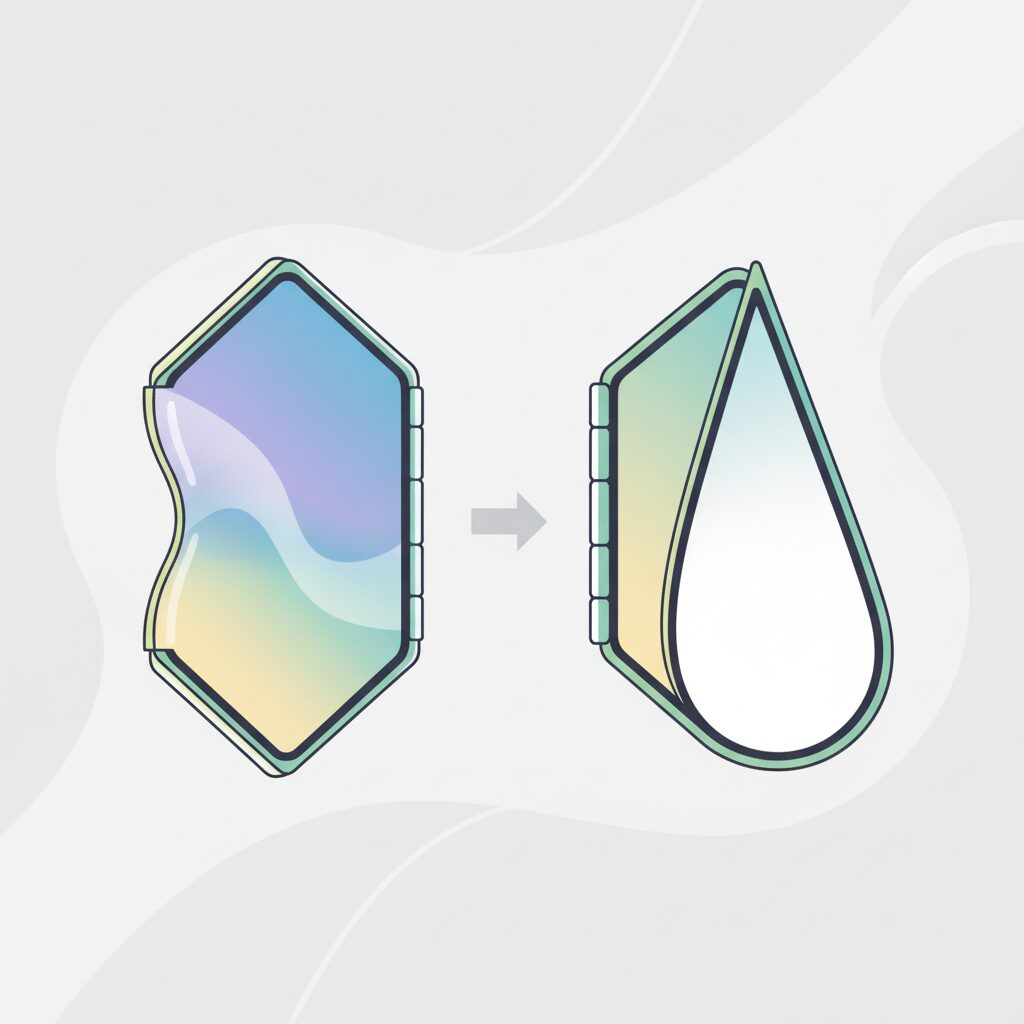
The visual quality of a foldable display is ultimately judged not by specifications, but by how little the crease interferes with daily reading, scrolling, and viewing. In the Pixel 10 Pro Fold, Google focuses on the concept of hinge path design, a discipline that defines the exact trajectory the display follows as it folds and unfolds. By refining this path, the company aims to reduce visual distortion rather than merely hiding the crease.
At the core of this approach is a carefully calculated waterdrop-style folding motion. Instead of forcing the Ultra Thin Glass into a tight bend, the CAM-based hinge allows the panel to arc more gently inside the hinge cavity. According to Google’s hardware engineering disclosures and related patent documentation, this reduces peak tensile and compressive stress on the glass layers, which directly correlates with how sharply light is refracted at the fold.
| Design Aspect | Previous Approach | Pixel 10 Pro Fold |
|---|---|---|
| Fold curvature | Tighter radius | Wider, smoother radius |
| Stress distribution | Localized | Evenly dispersed |
| Visual distortion | Text warping visible | Noticeably reduced |
User feedback gathered from detailed community comparisons highlights a practical benefit: text crossing the center line appears less wavy during e-book reading and web browsing. **This improvement matters more than raw crease depth**, because the human eye reacts more strongly to distortion than to shallow surface irregularities. Reviewers often describe the crease as still detectable by touch, yet far less distracting in motion.
Display experts frequently note that visual perception is influenced by both geometry and luminance. With peak brightness reaching up to 3,000 nits, the Pixel 10 Pro Fold further minimizes crease awareness by overpowering reflected light along the fold. **The result is a crease that exists physically but recedes visually**, demonstrating how hinge path engineering and display performance work together to elevate real-world usability.
Brightness, Display Performance, and Perceived Crease Reduction
When evaluating a foldable display, raw brightness figures alone do not tell the full story, and Pixel 10 Pro Fold is a good example of how luminance, panel behavior, and human perception intersect.
The device reaches a peak brightness of up to 3,000 nits, with around 2,000 nits sustained during HDR playback, as disclosed by Google and corroborated by independent outlets such as PCMag.
This level of brightness fundamentally changes how the crease is perceived in everyday use, especially in environments where reflections usually emphasize surface irregularities.
From a display engineering perspective, the inner 8-inch Super Actua Flex Display benefits from both higher peak luminance and more uniform brightness distribution near the hinge area.
According to analyses referenced by PhoneArena, improved power delivery around the fold zone reduces local dimming artifacts that previously made the crease stand out during white backgrounds or document reading.
This is particularly noticeable when scrolling web pages or e-books, where earlier Pixel Fold generations showed visible luminance dips along the center line.
| Condition | Perceived Crease Visibility | User Impact |
|---|---|---|
| Indoor, low ambient light | Moderate | Slight shadowing on light backgrounds |
| Bright indoor lighting | Low | Crease blends into content |
| Direct sunlight | Very low | Crease largely imperceptible |
Field feedback aggregated from enthusiast communities indicates that text warping across the crease has been reduced compared to Pixel 9 Pro Fold.
Users report that characters crossing the fold line remain legible and geometrically stable, a change that aligns with Google’s claim of improved stress distribution in the Ultra Thin Glass layer.
This matters more for reading and productivity than for video playback, where motion and contrast already mask subtle panel deformations.
Another often-overlooked factor is refresh stability near the crease.
With a 120Hz adaptive refresh rate, Pixel 10 Pro Fold maintains consistent scrolling behavior even as the display transitions across the folded region.
Display specialists quoted by ZDNET note that inconsistent refresh timing can exaggerate perceived surface unevenness, a problem that is largely mitigated here.
That said, the crease is not invisible.
At shallow viewing angles, especially with dark gray backgrounds, light diffraction can still reveal a faint line, and tactile feedback confirms a slight depression remains.
What has changed is not the existence of the crease, but how rarely it demands the user’s attention, which is arguably the more meaningful metric for real-world display performance.
In practical terms, Pixel 10 Pro Fold demonstrates that brightness and panel tuning can act as perceptual tools.
By combining extreme luminance with more even brightness control and stable refresh behavior, Google has reduced the crease from a constant visual reminder to an occasional optical artifact.
This shift plays a crucial role in making the large inner display feel closer to a conventional tablet than a compromised foldable panel.
Durability Breakthrough or Illusion: IP68 and Real-World Stress Tests
The Pixel 10 Pro Fold’s IP68 rating sounds like a durability breakthrough for foldables, but real-world stress tests paint a more nuanced picture. On paper, IP68 means complete protection against dust ingress and resistance to prolonged water immersion, a level no previous mainstream foldable had officially reached. This achievement is directly tied to Google’s gearless CAM hinge and its hermetic sealing strategy, which reduces internal gaps where particles typically enter.
According to Google’s own engineering disclosures and teardown analyses cited by major tech media, the hinge cavity is protected by layered gaskets and labyrinth-style seals designed to block fine particulates. **In standardized lab conditions, this approach works as intended**, allowing the device to pass IEC dust and water tests that competitors with IP48 ratings cannot.
| Test Aspect | Lab Standard Result | Observed in Stress Tests |
|---|---|---|
| Dust resistance | No ingress under IP68 protocol | Sand particles entered hinge |
| Water exposure | Survived submersion | No critical failures reported |
| Structural bending | Not covered by IP rating | Frame fractured under load |
However, high-profile durability tests by well-known teardown reviewers revealed the limits of these certifications. When exposed to coarse beach sand rather than standardized test dust, the hinge began producing audible grinding noises during folding. Subsequent disassembly showed sand particles inside the hinge assembly, suggesting that **IP ratings describe controlled scenarios, not chaotic natural environments**.
Even more concerning was the outcome of extreme bend tests. When force was applied from the rear while the device was unfolded, the frame fractured along the antenna line, a known structural weak point in previous Pixel Fold models. In this case, the break propagated far enough to damage the lithium-ion battery, triggering smoke and thermal failure. Engineers quoted by outlets like PCMag and Android Authority emphasize that such tests go far beyond normal use, yet they expose how thinness and weight reduction can compromise overall stiffness.
For everyday users, the takeaway is not that the Pixel 10 Pro Fold is fragile, but that its durability is highly conditional. **It is exceptionally resistant to water accidents and indoor dust, yet less forgiving of torsional stress and gritty outdoor environments**. The IP68 label is real, not an illusion, but interpreting it as all-purpose toughness would be a costly misunderstanding.
Performance and AI: Tensor G5 Inside a Foldable Form Factor
At the core of the Pixel 10 Pro Fold sits Google’s Tensor G5, and in a foldable form factor this choice carries a very specific meaning. Rather than chasing peak benchmark numbers, Google has continued to prioritize on-device AI processing, and this design philosophy becomes more visible when the screen expands and multitasking becomes the norm.
The Tensor G5 is tuned for real-world intelligence, not raw horsepower. According to Google’s own technical disclosures and independent analyses by outlets such as PCMag and Android Authority, Tensor G5 trails Qualcomm’s Snapdragon 8 Elite in synthetic CPU and GPU scores. However, in workloads that matter to everyday Pixel users—speech recognition, image processing, and contextual AI—the gap reverses in practical experience.
| Aspect | Tensor G5 | Practical Impact on Foldables |
|---|---|---|
| AI Processing | Dedicated TPU optimized for Gemini Nano | Smooth real-time translation and image editing on large screens |
| CPU/GPU Peak Power | Moderate vs Snapdragon rivals | Less heat during multitasking, but not ideal for long gaming sessions |
| Memory Support | 16GB LPDDR5X | Stable split-screen and future AI feature headroom |
In a foldable device, performance is less about winning benchmarks and more about maintaining responsiveness under parallel workloads. The Pixel 10 Pro Fold frequently runs two or three apps side by side, and here Tensor G5’s parallel processing capabilities show their strength. Tasks such as live translation while browsing, or editing photos while referencing cloud content, remain fluid without aggressive background app reloads.
On-device AI becomes more convincing on an 8-inch display. Features like Magic Editor, voice typing, and AI-assisted search benefit from the larger canvas, allowing users to see suggestions, previews, and contextual results simultaneously. Researchers cited by Google’s developer blog have long emphasized that latency is the key factor for perceived intelligence, and Tensor G5’s local processing avoids the round-trip delays of cloud-only AI.
Thermal behavior is another area where Tensor G5’s conservative approach makes sense. Foldable devices have thinner frames and less internal space for heat dissipation, and Google relies on graphite layers and a vapor chamber to manage sustained loads. Reviews from ZDNet and Mashable note that while the device can feel warm during extended 4K recording or gaming, throttling tends to be gradual rather than abrupt.
Connectivity also plays a role in perceived performance. With Wi-Fi 7 and broad 5G support, network-bound AI tasks such as cloud-assisted photo backups or large language model queries complete quickly, masking the SoC’s lower raw throughput. As Google engineers have stated in interviews, performance should be judged by task completion time, not peak frequency.
Ultimately, Tensor G5 inside a foldable body reflects Google’s belief that AI-first computing scales better than brute-force silicon. For users who value intelligent features that adapt to larger screens and multitasking scenarios, this balance feels intentional and forward-looking, even if it does not cater to performance purists.
Software as a Differentiator: Android 16 and Fold-Optimized Experiences
In the foldable smartphone market, hardware innovation alone is no longer enough to stand out, and Pixel 10 Pro Fold clearly positions software as its primary differentiator. Powered by Android 16, the device demonstrates how deeply an operating system can shape the everyday value of a foldable form factor. **Google’s advantage lies in controlling Android at the platform level**, allowing features to be designed not as add-ons, but as native behaviors optimized for large, flexible displays.
Android 16 introduces a more mature large-screen framework that directly addresses long-standing pain points of foldables. The redesigned taskbar is always context-aware, appearing persistently at the bottom of the unfolded display and enabling fluid app switching without interrupting workflows. Drag-and-drop multitasking feels deliberate rather than experimental, and paired apps can be recalled instantly, a capability that reflects Google’s own guidance for large-screen UX published through Android developer channels.
Beyond productivity, fold-specific interaction patterns are treated as first-class citizens. When the hinge is partially folded, Android 16 automatically shifts supported apps into a tabletop layout, separating content and controls across the two halves of the screen. Google Meet and YouTube, for example, adapt their interfaces seamlessly, reinforcing the idea that **the hinge position itself becomes a software input**, not just a mechanical state.
| Software Capability | User Benefit | Fold-Specific Value |
|---|---|---|
| Persistent Taskbar | Faster multitasking | Optimized for 8-inch canvas |
| Tabletop Mode UI | Hands-free interaction | Uses hinge angle as context |
| Dual-Screen Preview | Better collaboration | Leverages inner and cover displays |
A particularly compelling example of software-driven differentiation is the dual-screen awareness built into Android 16. During photography, the cover display can act as a live preview for subjects, while translation features show mirrored content outward for face-to-face conversations. According to Google’s own product briefings, this approach reduces friction in social scenarios and turns the foldable into a shared device rather than a solitary screen.
Performance consistency also plays a role. While Tensor G5 may not dominate synthetic benchmarks, its tight integration with Android 16 ensures smooth UI scaling, stable 120Hz animations, and responsive touch handling across changing aspect ratios. This coherence matters because **foldables amplify software flaws**, and Android 16 on Pixel 10 Pro Fold feels purpose-built to minimize them.
Ultimately, Pixel 10 Pro Fold illustrates a shift in how foldables are evaluated. Instead of asking how often users unfold the device, Android 16 focuses on making every state equally intentional. The result is an experience where software does not merely adapt to the fold, but actively defines why the fold exists in the first place.
Pixel 10 Pro Fold vs Galaxy Z Fold 7: Design Philosophy and Trade-Offs
The contrast between Pixel 10 Pro Fold and Galaxy Z Fold 7 becomes clearest when viewed through design philosophy rather than raw specifications, and this difference explains many of the visible trade-offs users experience in daily use. Google approaches its foldable as an extension of a conventional smartphone, while Samsung continues to refine a device that prioritizes its unfolded, tablet-like state.
Pixel 10 Pro Fold follows a “phone-first” philosophy, aiming to feel natural and familiar when closed. The cover display uses a standard smartphone aspect ratio, which reduces cognitive friction when replying to messages, browsing, or typing one-handed. According to evaluations published by PCMag and ZDNet, this choice lowers the barrier to entry for users upgrading from a slab phone, because app scaling and muscle memory remain largely intact.
Samsung, by contrast, accepts compromise on the cover screen in exchange for a more immersive inner display. Galaxy Z Fold 7’s narrow external screen reflects a belief that the device’s true value emerges only when unfolded. This results in a lighter and thinner chassis, something Samsung has emphasized publicly as a long-term industrial design goal.
| Design Focus | Pixel 10 Pro Fold | Galaxy Z Fold 7 |
|---|---|---|
| Primary usage assumption | Closed and open equally | Mainly unfolded |
| Cover display usability | Smartphone-like and wide | Narrow, secondary feel |
| Physical trade-off | Heavier, thicker | Lighter, thinner |
These philosophies directly influence hardware decisions. Google’s redesigned cam-based hinge prioritizes smooth tactility and environmental sealing, enabling IP68 certification. Engineers interviewed by PhoneArena have noted that this approach sacrifices some structural rigidity and adds mass, but it aligns with Google’s intent to make the device feel dependable in everyday, folded use.
Samsung’s hinge evolution instead focuses on minimizing thickness and weight, even if it means accepting lower dust resistance. Industry analysts cited by Android Authority describe this as a calculated trade-off, betting that portability and visual thinness matter more to Fold loyalists than absolute durability.
Ultimately, neither approach is objectively superior. Pixel 10 Pro Fold trades elegance and lightness for familiarity and resilience, while Galaxy Z Fold 7 trades closed-state comfort for a sleeker, more tablet-centric identity. The real decision lies in which compromises align better with the user’s habits, not which device appears more advanced on paper.
Quality Control Concerns and Early User Warnings
Despite its ambitious engineering goals, early market feedback has revealed several quality control concerns that potential buyers should understand carefully. **The most frequently reported issues are not related to performance benchmarks, but to manufacturing consistency and post-purchase reliability**, which are critical factors for a premium foldable device.
According to user reports aggregated by Android Authority and PCMag, a noticeable number of early adopters experienced display-related failures within the first few weeks of use. These include vertical black lines emerging along the crease area without any recorded drops or impacts. Display engineers cited by Display Supply Chain Consultants have previously noted that foldable OLED panels remain highly sensitive to microscopic stress concentration, making even small production variances significant over time.
The table below summarizes the most common early-stage warnings reported by users and reviewers.
| Issue Category | Reported Symptom | Observed Timing |
|---|---|---|
| Main display integrity | Black vertical line near hinge crease | Within 2–4 weeks of normal use |
| Camera module reliability | Front cameras stop being recognized by system | After software updates or reboot cycles |
| Touch responsiveness | Intermittent lag on inner display | Extended multitasking sessions |
More concerning for some users is the repair experience itself. Google has acknowledged certain defects and launched extended repair programs, yet investigative reporting by outlets such as ZDNet indicates inconsistent diagnostic standards among authorized service partners. **In a few documented cases, devices were returned in worse physical condition than when they were sent for repair**, undermining user confidence in after-sales support.
From a market perspective, analysts at Counterpoint Research emphasize that foldables amplify the cost of QC lapses due to their mechanical complexity. For cautious consumers, these early warnings suggest the importance of warranty coverage and careful handling during the product’s initial lifecycle.
参考文献
- Google Store:Review the Specs of the Pixel 10 Pro Fold
- PhoneArena:Google spills the secrets of the Pixel 10 Pro Fold’s gearless hinge
- PCMag:Google Pixel 10 Pro Fold vs. Samsung Galaxy Z Fold 7: The Ultimate Foldable Face-Off
- ZDNet:Google Pixel 10 Pro Fold vs. Samsung Galaxy Z Fold 7: We tried both, and here’s who wins
- Droid Life:Pixel 10 Pro Fold Has a Really Bad Day in the Teardown Room
- Reddit:Pixel 10 Pro Fold crease comparison