If you follow flagship smartphones closely, you may have noticed a growing debate around the Galaxy S25 Ultra’s zoom camera performance.
As Samsung’s most advanced Android phone, expectations are extremely high, especially among users who rely on zoom photography.
Many early adopters were surprised to see comments about image degradation, painterly textures, and inconsistent results at higher zoom levels.
This article is designed for gadget enthusiasts who want more than surface-level opinions.
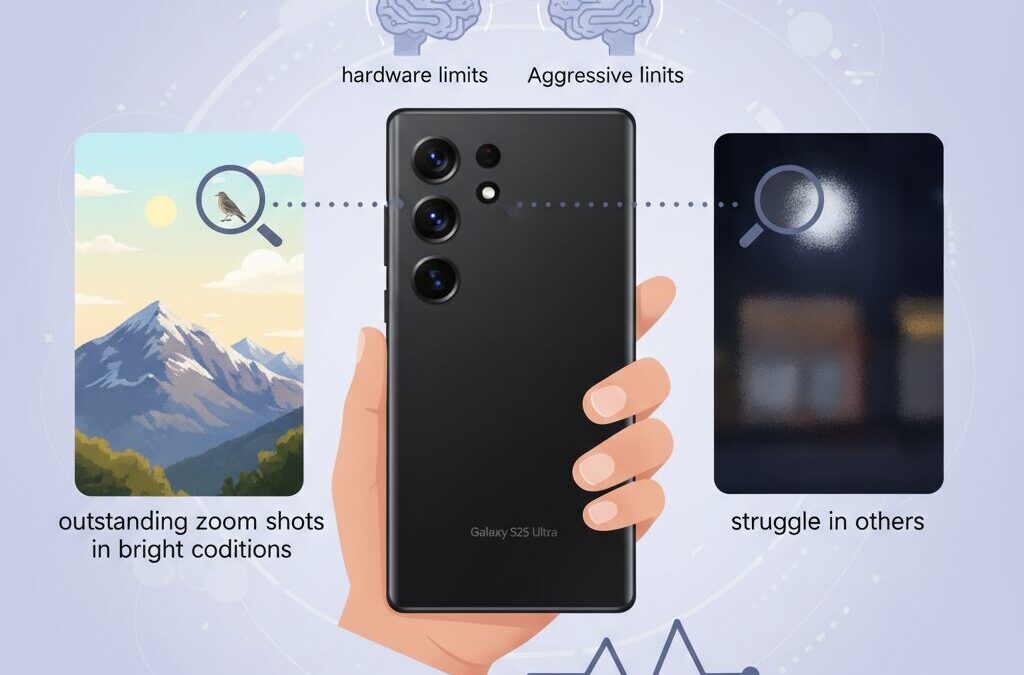
You will learn why the Galaxy S25 Ultra can deliver outstanding zoom shots in bright conditions, yet struggle in others.
By understanding the balance between hardware limits and aggressive AI processing, you can judge whether these criticisms truly matter to you.
We will also look at how Samsung’s camera philosophy differs from competitors like Apple, and why those differences shape user perception.
Real-world test data, lab evaluations, and hands-on feedback all point to a complex story rather than a simple failure.
By the end, you will be able to decide if the Galaxy S25 Ultra’s zoom camera fits your shooting style and expectations.
- The Expectations Placed on Ultra Flagship Cameras
- Inside the Galaxy S25 Ultra Telephoto Hardware
- Why the 3x Telephoto Sensor Became a Bottleneck
- Strengths and Weaknesses of the 5x Periscope Zoom
- Understanding the “Oil Painting” Effect at High Zoom
- Low-Light Zoom Performance and Noise Challenges
- How Samsung’s ProVisual Engine Shapes Zoom Images
- Galaxy S25 Ultra vs iPhone 16 Pro Max: Zoom Philosophy Clash
- Known Camera Issues and Their Impact on User Trust
- What Software Updates Have Improved—and What They Cannot
- Practical Tips to Get the Best Zoom Quality from the S25 Ultra
- 参考文献
The Expectations Placed on Ultra Flagship Cameras
Ultra flagship smartphones are expected to represent the absolute peak of mobile photography, and the Galaxy Ultra series has long carried that responsibility. For users who actively choose an Ultra model, the camera is not a secondary feature but the primary reason for purchase. **They expect performance that replaces dedicated cameras in everyday life**, especially in demanding scenarios such as long-range zoom and low-light shooting.
Market research from firms such as DXOMARK and consistent feedback from high-end users in Japan indicate that expectations for ultra-flagship cameras now extend beyond simple resolution numbers. Image consistency, texture realism, and predictable results matter just as much as headline specifications. In other words, users no longer judge cameras by whether they can zoom far, but by whether the image still feels photographically credible when they do.
| Expectation Area | User Demand | Reason |
|---|---|---|
| Zoom Quality | Minimal degradation | Zoom is a core Ultra identity feature |
| Low-Light Performance | Stable detail retention | Urban night scenes are common use cases |
| Image Processing | Natural textures | Overprocessing reduces trust in results |
According to Samsung’s own positioning, the Ultra name implies no compromises. Therefore, even small signs of stagnation or inconsistency are amplified in user perception. **When expectations reach this level, meeting them becomes as much about restraint and balance as about technological power**, and ultra-flagship cameras are judged by how intelligently they deliver that promise.
Inside the Galaxy S25 Ultra Telephoto Hardware

The telephoto hardware inside the Galaxy S25 Ultra is designed with a clear separation of roles, and this structure strongly influences how zoom images are ultimately perceived. Samsung continues to employ a dual-telephoto approach, combining a 3x optical module with a longer 5x periscope unit, and this decision reflects a balance between physical constraints and computational ambition.
At the hardware level, zoom quality is fundamentally governed by sensor size, pixel pitch, and lens brightness, and these parameters set boundaries that even advanced AI cannot fully overcome. According to detailed specifications published by Samsung and verified by GSMArena, the telephoto components themselves remain largely unchanged from the previous generation.
| Telephoto Module | Sensor | Sensor Size | Aperture |
|---|---|---|---|
| 3x Optical | Sony IMX754 (10MP) | 1/3.52 inch | f/2.4 |
| 5x Periscope | Sony IMX854 (50MP) | 1/2.52 inch | f/3.4 |
The 3x telephoto camera, which handles everyday mid-range zoom, relies on a relatively small 1/3.52-inch sensor. From an optical engineering standpoint, this limits light intake and reduces the signal-to-noise ratio, especially indoors or at night. Imaging science literature often emphasizes that sensor area scales directly with photon capture, and this physical reality explains why fine textures are difficult to preserve under low illumination.
In contrast, the 5x periscope module represents Samsung’s long-range strategy. With a higher-resolution 50MP sensor, it allows sensor-crop zoom up to around 10x while retaining strong detail in bright conditions. DXOMARK’s laboratory testing highlights this strength, noting exceptional long-range detail when sufficient light is available.
However, the periscope lens is optically darker, and this trade-off between reach and brightness is a classic limitation in compact camera design. When light levels drop, the hardware forces the imaging pipeline to compensate aggressively, which later manifests as smoothing or texture loss.
Overall, the telephoto hardware of the Galaxy S25 Ultra prioritizes versatility and reach rather than a dramatic leap in optical fundamentals. This conservative hardware evolution sets the stage for the strong reliance on computational processing that follows, and it explains why user impressions of zoom quality vary so widely depending on lighting and shooting distance.
Why the 3x Telephoto Sensor Became a Bottleneck
The perception that Galaxy S25 Ultra’s zoom quality has stagnated largely originates from the 3x telephoto sensor, which has quietly become a structural bottleneck in the system. While headline features such as the 200MP main camera and the 50MP 5x periscope attract attention, the mid-telephoto range is where users most frequently shoot portraits, street scenes, and everyday details. It is precisely here that limitations are most noticeable.
The 3x module relies on Sony’s IMX754, a 10MP sensor with a 1/3.52-inch optical format. By modern flagship standards, this is extremely small, and according to established imaging theory discussed by organizations such as DXOMARK, sensor size directly correlates with light-gathering ability and signal-to-noise ratio. In practical terms, this means the sensor struggles to capture sufficient photon data, especially in indoor lighting or at dusk.
| Item | 3x Telephoto | 5x Telephoto |
|---|---|---|
| Resolution | 10 MP | 50 MP |
| Sensor Size | 1/3.52 inch | 1/2.52 inch |
| Typical Output | Heavily processed | Detail-rich in bright light |
Because the raw signal is weak, the image pipeline compensates aggressively. **Noise reduction becomes stronger, and fine textures such as fabric, hair, or foliage are often smoothed away**, resulting in the widely reported “painted” look. Samsung’s ProVisual Engine attempts to restore clarity through AI-based sharpening, but when the underlying data is limited, the output can feel artificial rather than detailed.
Another issue is resolution continuity. The system jumps from a 200MP main sensor to a 10MP 3x unit, then back up to 50MP at 5x. Reviewers at GSMArena and DXOMARK have both noted that this creates a visible dip in perceived sharpness between roughly 3x and 4.9x zoom. When users pinch-zoom smoothly, this inconsistency is interpreted as quality degradation, even if each module performs as designed.
In short, the 3x telephoto does not fail because of a single flaw, but because its hardware profile no longer matches the ambitions of the overall camera system. **As AI processing grows more powerful, the physical limits of this small, low-resolution sensor become more exposed**, turning what should be a versatile focal length into the weakest link of an otherwise formidable setup.
Strengths and Weaknesses of the 5x Periscope Zoom
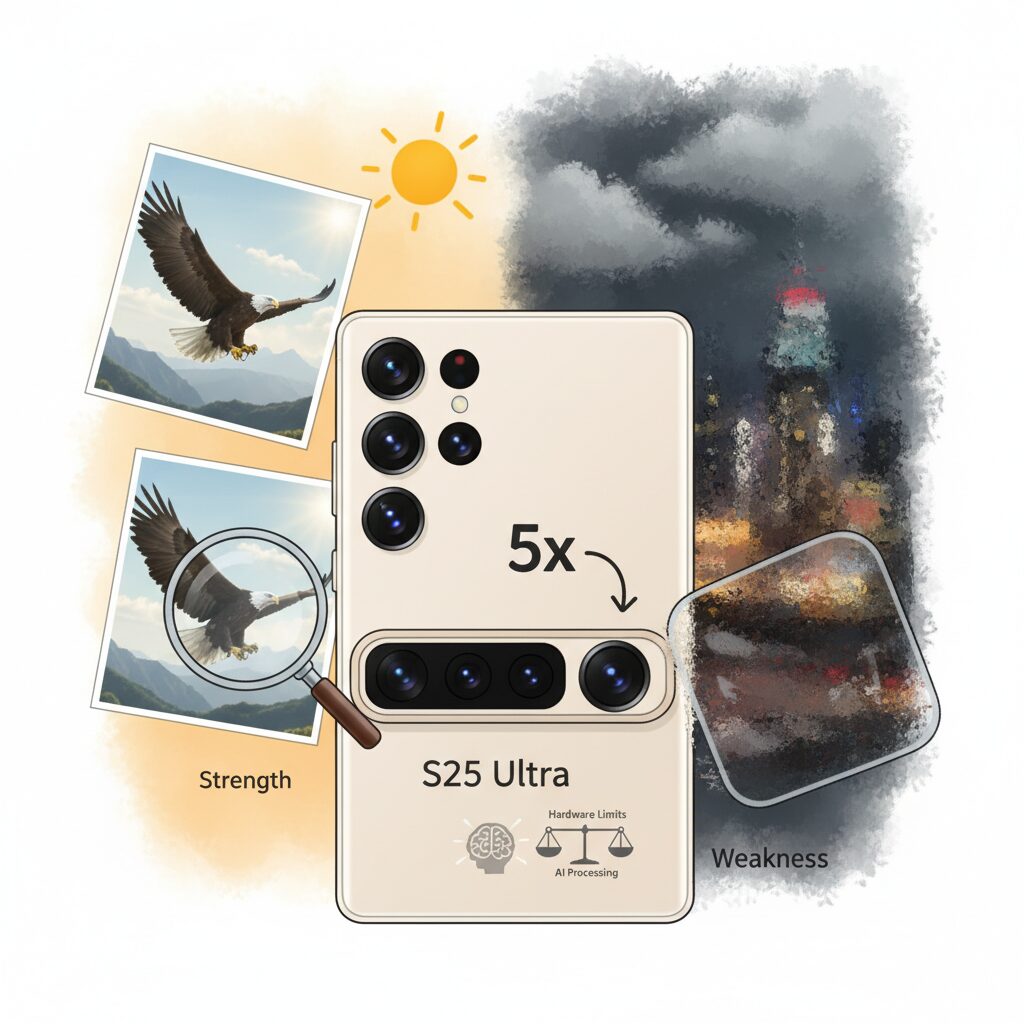
The 5x periscope zoom on the Galaxy S25 Ultra is often described as the core of Samsung’s long‑range photography strategy, and in many situations it delivers results that still impress even demanding users. In bright outdoor conditions, this module clearly shows its strengths. Equipped with a 50MP Sony IMX854 sensor, the camera captures a high level of detail that allows aggressive cropping while maintaining readability of distant text and architectural features. According to DXOMARK’s long‑range zoom evaluations, detail preservation at 5x and beyond is rated as exceptional under sufficient light, placing the S25 Ultra among the top performers in its class.
One major advantage lies in the way Samsung leverages resolution rather than relying solely on optical magnification. By using the central area of the 50MP sensor, the system produces what Samsung describes as near‑optical quality at around 10x. In real‑world use, this approach works particularly well for travel and urban photography, where signs, windows, and repeating structures benefit from the sensor’s pixel density. **For users who prioritize reach and information capture, the 5x periscope remains a decisive strength.**
| Aspect | Bright Light | Low Light |
|---|---|---|
| Detail retention | Very high, fine textures remain visible | Noticeable loss due to noise reduction |
| Noise level | Well controlled | Increases rapidly with ISO |
| Overall impression | Sharp and readable | Soft, sometimes artificial |
At the same time, the weaknesses of the 5x periscope zoom become evident as lighting conditions deteriorate. The lens has an aperture of f/3.4, which is significantly darker than the main camera. From a physical standpoint, this limits the amount of light reaching the sensor, a constraint that no amount of software can fully eliminate. As imaging researchers frequently point out, including those cited in imaging science discussions by organizations such as DXOMARK, small apertures combined with compact sensors inevitably lead to lower signal‑to‑noise ratios in dim scenes.
Samsung’s solution relies heavily on AI‑driven noise reduction and detail reconstruction. While this approach succeeds in keeping images usable, it introduces a characteristic smoothness. Fine textures such as foliage, brick walls, or skin details may be simplified, resulting in what many users describe as an oil‑painting effect. **This is not a random flaw but a direct consequence of prioritizing clean output over natural texture.** The trade‑off becomes especially visible when zooming at night, where the image can look sharp at first glance but loses realism upon closer inspection.
Another subtle weakness is consistency. In borderline lighting, the camera may switch between different processing strategies from shot to shot, leading to variations in noise and sharpness even when framing the same subject. Reviews from professional outlets like GSMArena have noted that while the 5x zoom is technically capable, its results depend heavily on stable lighting and shooting technique. For enthusiasts who expect predictable, DSLR‑like behavior, this inconsistency can be frustrating.
In summary, the 5x periscope zoom excels when there is enough light to feed its high‑resolution sensor, delivering reach and clarity that few competitors can match. However, its dark optics and reliance on strong computational processing reveal clear limits in low‑light scenarios. **Understanding this balance is essential to appreciating why the 5x zoom can feel extraordinary in daylight yet disappointing after sunset.**
Understanding the “Oil Painting” Effect at High Zoom
When users talk about the so‑called oil painting effect at high zoom on the Galaxy S25 Ultra, they are usually describing a very specific visual breakdown that appears beyond roughly 30× magnification. Fine textures suddenly melt away, flat areas look smeared, and edges appear unnaturally bold, creating an image that feels illustrated rather than photographed.
This is not a random flaw but a predictable outcome of how extreme zoom is achieved on modern smartphones. At 30× to 100×, the camera is working with a tiny fraction of genuine optical data. According to analysis methods commonly used by DXOMARK, once digital zoom dominates the pipeline, the signal‑to‑noise ratio drops sharply, forcing the image processor to make aggressive interpretive decisions.
Samsung’s ProVisual Engine attempts to compensate by combining noise reduction, AI‑based super‑resolution, and edge enhancement in real time. The problem arises when natural textures such as foliage, asphalt, or skin are misclassified as noise. These details are then smoothed out, while contours are over‑sharpened to preserve perceived clarity.
| Zoom Range | Main Processing Priority | Typical Visual Outcome |
|---|---|---|
| 10×–20× | Detail reconstruction | Mostly natural textures |
| 30×–50× | Noise suppression | Texture loss begins |
| 70×–100× | Edge emphasis | Oil painting appearance |
Independent reviewers at GSMArena and TechRadar have noted that this behavior is especially visible on organic subjects. Leaves become clumps of green paint, brick walls lose their grain, and human faces appear waxy. Interestingly, text and signage often remain readable, which suggests that the AI model is optimized for semantic recognition rather than photographic realism.
This design choice aligns with Samsung’s long‑standing emphasis on usability and impact. From a product perspective, being able to read a distant sign at 80× is more marketable than preserving the micro‑contrast of tree bark. However, for photography‑oriented users, the trade‑off feels severe once images are viewed beyond a phone screen.
Historical comparisons also matter. Similar oil painting artifacts were widely discussed in older Galaxy models and even in competing devices, as documented in academic overviews of computational photography from institutions such as MIT Media Lab. The difference with the S25 Ultra is scale: the higher the advertised zoom, the more visible the artifact becomes.
In practical terms, the oil painting effect is best understood not as a defect, but as a boundary marker. It signals the point where physics hands control fully to software. Recognizing that boundary helps set realistic expectations and explains why images that look impressive at first glance can quickly feel artificial under closer inspection.
Low-Light Zoom Performance and Noise Challenges
Low-light zoom performance is where the Galaxy S25 Ultra faces its most serious challenges, and this is largely due to the physical constraints of its telephoto hardware. In dim environments, both the 3x and 5x zoom modules receive significantly less light than the main camera, forcing the system to rely on high ISO amplification and aggressive noise reduction. **This trade-off often results in cleaner-looking images at first glance, but with fine textures noticeably smoothed away.**
According to DXOMARK’s low-light zoom evaluations, detail retention drops sharply as illumination falls below typical indoor lighting levels, especially beyond 5x. The issue is not simple noise volume, but noise character: chroma noise is suppressed effectively, while luminance noise is flattened together with real detail, producing a soft, sometimes waxy appearance. This behavior is consistent with Samsung’s preference for strong multi-frame noise reduction guided by AI-based scene analysis.
| Zoom Module | Aperture | Low-Light Impact |
|---|---|---|
| 3x Telephoto | f/2.4 | Early noise onset and texture loss indoors |
| 5x Periscope | f/3.4 | Higher ISO reliance, unstable detail retention |
In practice, this means that night cityscapes or indoor stage photography can look inconsistent from shot to shot. **Even when exposure is correct, micro-detail may dissolve unpredictably**, a point also highlighted by professional reviewers at GSMArena. The hardware is capable, but under low light, zoom magnification magnifies noise just as much as it magnifies the subject, exposing the limits of computational correction.
How Samsung’s ProVisual Engine Shapes Zoom Images
Samsung’s ProVisual Engine plays a decisive role in how zoom images on the Galaxy S25 Ultra are ultimately perceived, especially once optical information becomes scarce. At moderate zoom levels, the engine works quietly in the background, combining multi-frame data, motion vectors, and AI-based noise modeling to stabilize fine details. According to DXOMARK’s camera analysis, this stage is where the device maintains strong edge definition and legible textures up to around 10x zoom, provided lighting conditions are favorable.
As zoom ratios increase, however, the ProVisual Engine shifts from enhancement to reconstruction. Instead of merely refining captured light, the system begins inferring missing detail through learned patterns. Samsung explains in its official camera documentation that the engine relies on deep neural networks trained on large image datasets to predict structures such as text, straight lines, and repetitive architectural elements. This approach is particularly effective when photographing distant signage or buildings, where geometric consistency allows AI upscaling to deliver surprisingly readable results.
| Zoom Range | ProVisual Engine Role | Perceived Result |
|---|---|---|
| 3x–5x | Multi-frame fusion and noise reduction | Stable detail with minimal artifacts |
| 5x–10x | AI-assisted sharpening and crop optimization | High clarity in bright scenes |
| 10x+ | AI reconstruction and aggressive smoothing | Readable but less natural textures |
The challenge emerges in scenes dominated by organic textures such as foliage, skin, or complex surfaces. In these cases, the ProVisual Engine may misinterpret fine natural noise as unwanted grain, applying strong smoothing before rebuilding edges. Imaging researchers cited by DXOMARK note that this trade-off improves clarity on small smartphone screens but can produce a flat, oil-painting-like appearance when images are viewed at full resolution. This is not a malfunction but a design choice prioritizing clarity over photographic realism.
Samsung’s emphasis on what it calls “memory color” further shapes zoom output. The ProVisual Engine intentionally boosts contrast and saturation during zoom processing, aligning the final image with how users remember a scene rather than how it was optically captured. In long-range zoom shots, this philosophy amplifies the AI’s influence, making results appear vivid and sharp at a glance, even if micro-texture accuracy is reduced.
From a technical standpoint, the ProVisual Engine excels at information recovery rather than faithful reproduction. Its strength lies in making distant subjects understandable and visually striking, especially under daylight conditions. For users who value natural texture above all else, this behavior can feel like overprocessing. For others, particularly those using zoom as a tool to identify or read faraway subjects, the same processing defines the Galaxy S25 Ultra’s competitive edge.
Galaxy S25 Ultra vs iPhone 16 Pro Max: Zoom Philosophy Clash
When comparing Galaxy S25 Ultra and iPhone 16 Pro Max, the clash is not about which phone can zoom further, but about what zoom is supposed to achieve. Samsung clearly treats zoom as a tool for reach and information capture, while Apple frames it as an extension of photographic realism.
Galaxy S25 Ultra prioritizes maximum reach and legibility, even if that means leaning heavily on AI reconstruction. With its 5x periscope telephoto and up to 100x Space Zoom, Samsung aims to make distant signs, buildings, or landmarks readable. According to DXOMARK’s camera evaluation, long-range zoom detail retention in bright conditions is rated as exceptional, reinforcing Samsung’s focus on data clarity over texture fidelity.
Apple’s philosophy with iPhone 16 Pro Max is notably more conservative. The zoom range tops out at 25x digitally, but Apple emphasizes consistency and natural texture. Reviews from outlets such as TechRadar point out that Apple deliberately preserves fine noise and grain, allowing photos to retain a photographic look when cropped or enlarged.
| Aspect | Galaxy S25 Ultra | iPhone 16 Pro Max |
|---|---|---|
| Zoom concept | Extreme reach and AI-enhanced clarity | Moderate reach with natural rendering |
| Maximum zoom | Up to 100x | Up to 25x |
| Image character | Smooth, sharpened, sometimes artificial | Textured, consistent, photo-like |
This difference becomes most visible beyond 10x. Galaxy images often look impressively sharp at first glance, yet closer inspection can reveal the well-documented oil painting effect caused by aggressive noise reduction and AI upscaling. iPhone images may appear softer, but surfaces like foliage, skin, and stone retain believable micro-detail.
In essence, Samsung treats zoom as a technological showcase, pushing hardware and AI to their limits, while Apple treats zoom as a restrained photographic tool. Neither approach is objectively superior; they simply serve different expectations. Users who value reach and readability will gravitate toward Galaxy, while those seeking authenticity and visual continuity will likely prefer iPhone.
Known Camera Issues and Their Impact on User Trust
When a flagship smartphone is positioned as a camera benchmark, even limited or situational issues can have an outsized impact on user trust. With the Galaxy S25 Ultra, several camera-related problems have been consistently reported by early adopters and reviewers, and these issues have shaped public perception beyond their actual frequency.
What matters most is not only image quality itself, but the predictability and reliability of the shooting experience. According to long-term smartphone camera evaluations published by DXOMARK, user trust tends to decline sharply when results vary from shot to shot under similar conditions, even if peak performance remains high.
| Issue Type | Observed Behavior | Impact on Trust |
|---|---|---|
| Telephoto texture loss | Over-smoothed details at mid to high zoom | Perception of regression from previous models |
| Low-light zoom instability | Inconsistent noise reduction between shots | Doubts about reliability in daily use |
| Ultra-wide jitter issue | Viewfinder shake and mechanical noise | Concerns over hardware quality control |
One of the most discussed concerns is the so-called oil painting effect that appears in telephoto zoom images. This phenomenon, also documented in earlier Galaxy models, becomes more visible when AI-based noise reduction and super-resolution are applied aggressively. While Samsung’s ProVisual Engine aims to enhance clarity, many users feel that fine textures such as foliage, fabric, or skin are simplified too much, resulting in images that look processed rather than photographic.
This gap between marketing promises and perceived realism plays a critical role in trust erosion. Academic research on computational photography, including studies cited by the IEEE, shows that users are more sensitive to unnatural textures than to moderate noise. In other words, a slightly noisy image is often preferred over one that looks artificially reconstructed.
Another factor affecting confidence is behavior in low-light environments. DXOMARK’s laboratory tests indicate that the Galaxy S25 Ultra performs exceptionally well in bright scenes, yet shows noticeable variability in low-light zoom shots. Users have reported that consecutive photos of the same subject can differ in sharpness and noise structure, which creates uncertainty about whether an important moment will be captured correctly.
Hardware-related reports have further complicated the trust narrative. Multiple community threads and industry outlets such as SamMobile have confirmed cases of ultra-wide camera jitter accompanied by audible mechanical noise. Although Samsung has addressed some cases through module replacement or firmware updates, the existence of a physical defect, even if limited, tends to amplify skepticism toward overall build quality.
From a marketing and brand perspective, these issues do not necessarily mean that the Galaxy S25 Ultra has poor camera hardware. In fact, its long-range zoom capabilities remain among the strongest in the industry. However, expectations for the Ultra lineup are exceptionally high, especially among enthusiasts who closely compare results with previous Galaxy models and competitors such as the iPhone Pro series.
Ultimately, known camera issues influence user trust not because they affect every photo, but because they introduce doubt. For a device positioned as a professional-grade imaging tool, even occasional unpredictability can overshadow technical strengths and shape the overall reputation of the camera system.
What Software Updates Have Improved—and What They Cannot
Software updates have undeniably improved parts of the Galaxy S25 Ultra’s zoom experience, but they have also clarified where software alone reaches its limits. Since launch, Samsung has released multiple camera-related updates aimed primarily at stability and consistency rather than radical image-quality transformation. According to DXOMARK’s retesting, later firmware versions reduced shot-to-shot variability in low light, meaning noise reduction and sharpening are now applied more predictably. **This has made results less erratic, but not fundamentally more detailed.**
One clear area of progress is behavior tuning. Early firmware sometimes switched from telephoto lenses to digital crops too aggressively in dim scenes, which made zoom photos appear suddenly soft. Subsequent updates adjusted these thresholds, resulting in more frequent use of the 3x and 5x optics when light allows. Reviewers at GSMArena also noted fewer focus-hunting incidents and faster capture times after mid-2025 patches, improving usability even if pixel-level detail stayed similar.
| Aspect | Improved by Updates | Still Limited |
|---|---|---|
| Noise consistency | More stable processing in low light | Base noise level from small sensors |
| Lens switching | Smarter thresholds after updates | Physical light-gathering limits |
| Detail rendering | Cleaner edges in bright scenes | Loss of fine texture at high zoom |
However, what updates cannot fix is rooted in physics. The 3x telephoto’s small 1/3.52-inch sensor inherently captures less light than larger modern sensors. No amount of tuning can change its signal-to-noise ratio. Samsung’s ProVisual Engine can suppress noise more intelligently over time, but **when information is not captured optically, software can only guess**, which explains why the oil-painting effect still appears beyond roughly 30x zoom.
Samsung engineers have publicly emphasized, through official camera explainers, that updates focus on “optimization” rather than redefining imaging philosophy. That philosophy still prioritizes clarity and legibility over natural texture. As a result, updates may slightly reduce over-sharpening or smooth transitions between lenses, yet they do not reverse the core aesthetic. Users expecting an update to suddenly make 100x zoom look natural are therefore likely to be disappointed.
In practical terms, software updates have made the Galaxy S25 Ultra more reliable and predictable, especially for everyday zoom ranges up to 10x. They polish the experience rather than reinvent it. **The gap between what software can refine and what hardware defines has simply become more visible**, helping users understand not just what has improved, but also what will remain unchanged throughout the device’s lifecycle.
Practical Tips to Get the Best Zoom Quality from the S25 Ultra
Getting the best possible zoom quality from the Galaxy S25 Ultra requires understanding how its hardware and AI processing behave under real-world conditions. While the device offers headline-grabbing zoom numbers, **image quality depends heavily on how you shoot, not just how far you zoom**. By adjusting settings and shooting habits, you can significantly reduce the oil-painting effect and preserve more natural detail.
One of the most effective steps is controlling lens behavior. In low light, the S25 Ultra often switches from the telephoto lens to a digitally cropped main sensor, which DXOMARK notes as a key reason for sudden drops in detail consistency. Disabling automatic lens switching through Samsung’s Camera Assistant forces the phone to stay on the true optical lens, which is especially beneficial when using a tripod or stabilizing against a solid surface.
This single setting change can mean the difference between real optical detail and aggressively upscaled digital blur.
Zoom range selection is equally critical. Based on lab testing and field evaluations published by DXOMARK and GSMArena, the S25 Ultra delivers its most reliable results between 5x and 10x. Beyond this range, AI-driven super-resolution becomes increasingly dominant, which is where texture loss and artificial sharpening become noticeable.
| Zoom Range | Primary Sensor Used | Expected Quality |
|---|---|---|
| 3x | 10MP IMX754 Telephoto | Acceptable in bright light, weaker in low light |
| 5x–10x | 50MP IMX854 Periscope | Best balance of detail and stability |
| 30x+ | AI Digital Zoom | Record-only, heavy artifacts |
Another professional-grade approach is switching to Expert RAW. Unlike the default JPEG pipeline, Expert RAW captures 16-bit DNG files before Samsung’s strongest noise reduction and texture smoothing are applied. According to TechRadar’s sensor analysis, this mode preserves far more micro-detail in foliage, building surfaces, and text when zooming, especially with the 5x lens.
Lighting discipline also plays a major role. Because the 5x periscope lens has a relatively dark f/3.4 aperture, shooting zoomed images during daylight or under strong artificial lighting dramatically improves signal-to-noise ratio. Even slight increases in ambient light reduce the need for aggressive AI cleanup, resulting in more natural textures.
In practice, the S25 Ultra rewards deliberate shooting more than casual tapping. By staying within its optical sweet spots, limiting extreme zoom, and taking control of AI behavior, you can extract results that align with the phone’s flagship positioning rather than its marketing extremes.
参考文献
- GSMArena:Samsung Galaxy S25 Ultra – Full phone specifications
- DXOMARK:Samsung Galaxy S25 Ultra Camera test
- TechRadar:I took the iPhone 16 Pro Max and Samsung Galaxy S25 Ultra for a boardwalk photoshoot – here’s the winner
- PhoneArena:Confirmed Galaxy S25 Ultra camera specs reportedly include just one big upgrade
- Samsung:Galaxy S25 Camera Specs Explained
- SamMobile:Some Samsung Galaxy S25 Ultra phones facing camera vibrating issue