
If you follow smartphones closely, you already know that raw benchmark numbers rarely tell the whole story.
The Google Pixel 10 series has sparked intense debate among tech enthusiasts worldwide, not because it tops performance charts, but because it behaves very differently where it matters most during real gameplay. Frame time consistency, thermal behavior, and long-session stability have become the true talking points, especially as Google transitions to its most ambitious in-house silicon yet.
With Tensor G5, Google is no longer just iterating. It is redefining priorities by shifting manufacturing to TSMC’s advanced 3nm process and replacing the familiar Mali GPU with an Imagination Technologies design. On paper, this move looks risky. In practice, it creates a gaming experience that feels smoother than expected in some titles, yet frustratingly unstable in others.
For gamers who care about how a game feels rather than how a benchmark looks, this distinction is crucial. A stable 60 FPS with consistent frame delivery can feel far better than higher peak performance plagued by micro-stutter and thermal throttling.
In this article, you will learn why the Pixel 10 delivers such polarized impressions, how Tensor G5’s architectural choices affect real-world gaming, and what this means if you are choosing your next flagship phone with gaming in mind. If you value deep technical insight over marketing claims, this guide is written for you.
- Why Pixel 10 Marks a Turning Point for Google’s Hardware Strategy
- Tensor G5 Architecture Explained: CPU Design and 3nm Manufacturing
- The GPU Shift to Imagination Technologies: Opportunities and Risks
- Benchmark Scores vs Real Gameplay: Understanding the Gap
- Frame Time Stability: Why Consistency Matters More Than Peak FPS
- Thermal Design and Power Consumption Under Sustained Gaming Loads
- Compatibility with Popular Mobile Games and Game Engines
- Software Updates, GPU Drivers, and the Role of Android Optimization
- Pixel 10 vs Other Flagships: Where It Fits in the Gaming Landscape
- 参考文献
Why Pixel 10 Marks a Turning Point for Google’s Hardware Strategy
Pixel 10 is widely discussed for its gaming performance, but from a hardware strategy perspective, it represents something far more significant. Google is clearly signaling that Pixel is no longer an experimental showcase for Android features, but a long-term platform built around silicon-level control. This shift is not incremental; it is structural, and it changes how Pixel should be evaluated going forward.
The move to a fully custom Tensor G5 marks Google’s clearest break from its dependency-driven past. Earlier Tensor chips were heavily derived from Samsung Exynos designs, both in CPU layout and manufacturing. With Pixel 10, Google transitions production to TSMC’s advanced 3nm-class process while redesigning the CPU cluster and GPU architecture. This combination places Google in the same strategic category as Apple: a company aligning hardware, software, and manufacturing choices around its own priorities rather than supplier roadmaps.
Industry analysts at firms such as TechInsights and Semiconductor Engineering have repeatedly pointed out that control over process technology and chip architecture is now a prerequisite for sustainable differentiation in smartphones. Pixel 10 follows this logic. By choosing TSMC, Google prioritizes predictable yields, lower leakage, and long-term performance stability, even if short-term benchmarks do not lead the charts.
| Strategic Element | Before Pixel 10 | Pixel 10 Direction |
|---|---|---|
| Chip lineage | Exynos-derived Tensor | Fully Google-defined Tensor |
| Foundry | Samsung Foundry | TSMC 3nm-class process |
| GPU choice | Arm Mali | Imagination DXT series |
Perhaps the boldest signal is the switch from Arm Mali to an Imagination Technologies GPU. On the surface, this looks risky, especially given early driver maturity issues. Strategically, however, it suggests Google is optimizing for future capabilities such as ray tracing, GPU virtualization, and tighter security isolation. These features align with Google’s broader ambitions in cloud-assisted computing, AI workloads, and cross-device experiences, areas where conventional peak GPU performance is not the sole metric.
This is where Pixel 10 becomes a turning point rather than a finished product. Google appears willing to accept short-term friction in exchange for architectural independence. Academic research from IEEE journals on heterogeneous computing consistently emphasizes that co-design between silicon and software delivers compounding benefits over multiple generations. Pixel 10 can be read as the first true baseline for that compounding curve.
From a marketing and platform standpoint, this also changes the Pixel narrative. Instead of competing head-on with Snapdragon-based devices on raw speed, Google positions Pixel as a device optimized for sustained performance, AI-driven workloads, and predictable behavior under load. The emphasis on frame time stability over peak FPS in real-world gaming is a concrete example of this philosophy applied in practice.
In that sense, Pixel 10 is less about winning this year’s spec comparisons and more about redefining what Google hardware is meant to become. It establishes the technical and organizational groundwork for future Pixels to mature rapidly, much like early Apple Silicon Macs did after their initial transition. For readers deeply interested in gadgets, this strategic pivot is arguably the most important story Pixel 10 has to tell.
Tensor G5 Architecture Explained: CPU Design and 3nm Manufacturing
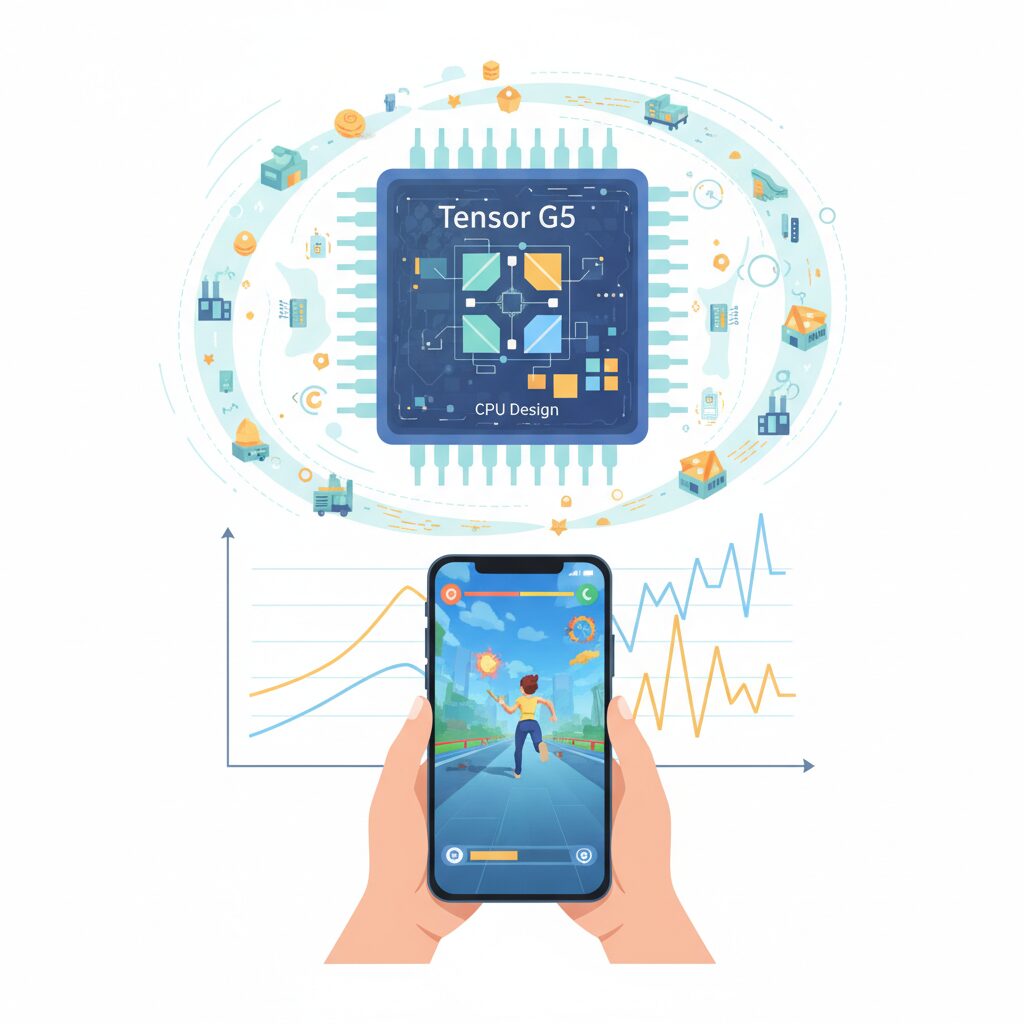
The Tensor G5 marks a decisive break from Google’s earlier design philosophy, and its CPU architecture clearly shows how seriously this shift has been taken. By moving manufacturing to TSMC’s advanced 3nm-class process, Google has gained a fundamentally stronger foundation in transistor density and leakage control, which directly affects sustained performance and thermal stability. According to public disclosures from TSMC and analyses commonly cited by semiconductor researchers, second-generation 3nm nodes offer double-digit gains in power efficiency compared to older 4nm processes, even before architectural optimizations are considered.
On top of this manufacturing upgrade, Google has rebalanced the CPU cluster in a way that prioritizes real-world responsiveness rather than idle efficiency alone. The primary core is now a Cortex-X4 running at up to 3.78GHz, a substantial jump over the previous generation. More importantly, the number of performance-oriented middle cores has been increased, while the count of efficiency cores has been reduced. This reflects a clear assumption about modern workloads, where multiple heavy threads are active simultaneously.
| CPU Tier | Core Type | Core Count | Design Focus |
|---|---|---|---|
| Primary | Cortex-X4 | 1 | Maximum burst performance |
| Performance | Cortex-A725 | 5 | Sustained multi-threaded tasks |
| Efficiency | Cortex-A520 | 2 | Background and idle workloads |
This configuration aligns closely with how contemporary game engines and AI-enhanced applications behave. Physics simulation, audio processing, network synchronization, and on-device inference often run in parallel, and weaker efficiency cores can become a bottleneck. By allocating silicon budget to five robust performance cores, Tensor G5 is better equipped to absorb sudden workload spikes without stalling the main thread.
Independent benchmark observations support this intent. Multi-core CPU scores show an improvement of roughly 30 percent over the previous Tensor generation, a gain that cannot be explained by clock speed alone. Semiconductor analysts frequently point out that such jumps are typically the combined result of process efficiency and smarter core allocation, rather than raw frequency scaling.
Equally important is what the 3nm process enables over time. Lower leakage means less wasted energy during sustained loads, which helps maintain consistent clocks before thermal limits intervene. **This does not make Tensor G5 the fastest CPU on paper, but it makes its performance far more predictable under continuous stress**, an attribute often emphasized by engineers studying mobile thermal behavior at institutions such as IEEE-affiliated research groups.
In practical terms, the CPU design of Tensor G5 should be understood as a strategic recalibration. Google appears less interested in winning short benchmark runs and more focused on delivering steady, latency-resistant performance across long sessions. The combination of an aggressive performance-core layout and TSMC’s mature 3nm manufacturing is the technical backbone of that philosophy, and it defines how Pixel 10 behaves before graphics or software layers even enter the equation.
The GPU Shift to Imagination Technologies: Opportunities and Risks
The shift from Arm Mali GPUs to Imagination Technologies marks one of the most consequential design decisions in the Tensor G5, and it is a move that creates both long-term opportunity and short-term risk for Pixel 10 users.
This change is not merely about graphics performance; it represents Google redefining its control over the graphics stack. Imagination’s DXT architecture, derived from the PowerVR lineage once used extensively by Apple, is designed around scalability, advanced tile-based rendering, and future-facing features such as mobile ray tracing.
According to public technical disclosures from Imagination Technologies, the DXT family prioritizes predictable latency and power efficiency over brute-force peak throughput. This philosophy aligns with Google’s broader strategy of favoring sustained performance and system-level stability rather than headline benchmark scores.
| Aspect | Mali-G715 (Tensor G4) | IMG DXT-48-1536 (Tensor G5) |
|---|---|---|
| Peak FP32 Throughput | Approx. 1684 GFLOPs | Approx. 1536 GFLOPs |
| Driver Ecosystem | Mature, widely optimized | Early-stage, limited optimization |
| Future Features | Conventional raster focus | Ray tracing, GPU virtualization |
On paper, the Imagination GPU does not dominate in raw compute, and that reality immediately translates into risk. Many Android games are implicitly tuned for Adreno or Mali architectures, and when confronted with a less common GPU, they often fall back to conservative rendering paths.
This is why some Pixel 10 users experience compatibility issues or unexpectedly high power draw in popular titles. Developers such as HoYoverse and Cygames have historically optimized first for Snapdragon and Apple GPUs, leaving PowerVR-class architectures under-tested.
However, the opportunity side of this shift should not be underestimated. GPU virtualization support in DXT enables stronger security isolation and more flexible compute partitioning, which aligns with Google’s ambitions for AI-assisted rendering and cloud-integrated workloads.
Research published by IEEE on tile-based GPU architectures shows that predictable memory access patterns can significantly reduce frame-time variance under sustained load. This helps explain why Pixel 10 often feels smoother in real gameplay than benchmark numbers suggest.
That said, the greatest risk remains software maturity. Imagination’s GPU drivers are largely proprietary, limiting how deeply Google can intervene. Early reports from developers indicate that low-level Vulkan optimizations depend heavily on Imagination’s release cadence rather than Google’s.
In practical terms, Pixel 10 buyers are trading immediate game compatibility for architectural independence. If driver updates continue to land steadily, the Imagination GPU could mature into a differentiated advantage. If not, it risks remaining a bottleneck that only partially realizes its theoretical promise.
This GPU shift is therefore best understood as a strategic bet. It offers Google a path away from commodity designs, but it also places Pixel 10 at the frontier where early adopters feel both the innovation and its growing pains.
Benchmark Scores vs Real Gameplay: Understanding the Gap
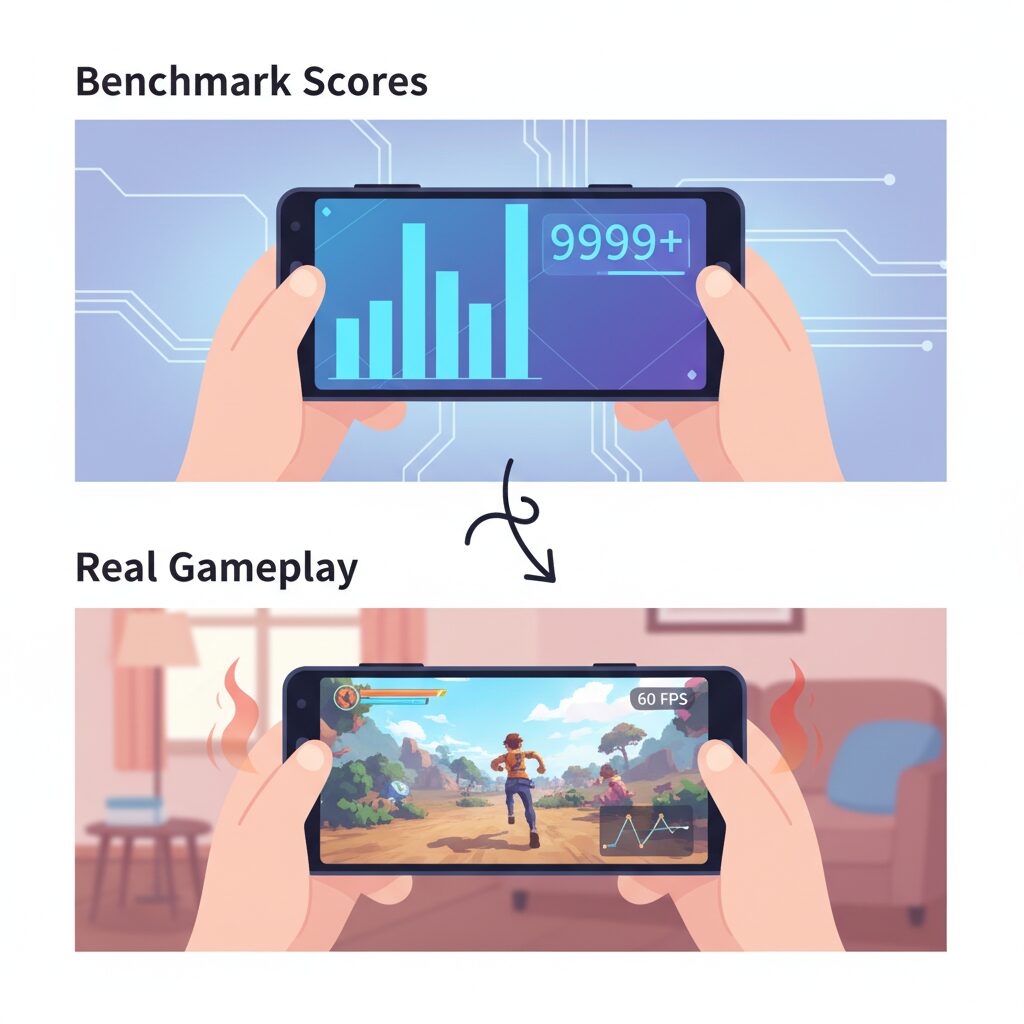
When evaluating gaming performance on modern smartphones, benchmark scores are often treated as definitive truth, but in real gameplay they do not always tell the full story. This gap is especially visible with Pixel 10, where synthetic results appear underwhelming, yet actual play sessions feel unexpectedly smooth. Understanding why this happens helps readers make more informed judgments beyond raw numbers.
According to widely cited benchmarks such as Geekbench 6 and 3DMark Wild Life Extreme, Tensor G5 ranks clearly below competing flagship chips. CPU multi-core scores trail Snapdragon-based rivals by a wide margin, and GPU-focused tests show almost half the frame rate. **On paper, these figures suggest Pixel 10 is poorly suited for demanding games**, and many buyers understandably stop their evaluation at this point.
However, real gameplay tells a different story because benchmarks emphasize peak throughput, not consistency. Game engines care deeply about how evenly frames are delivered. Researchers and engine developers, including those contributing to Vulkan documentation, have long noted that player perception correlates more strongly with frame time variance than with average FPS. Pixel 10 benefits from this principle.
| Metric | Benchmark Focus | Real Gameplay Impact |
|---|---|---|
| Average FPS | Peak performance | Less noticeable if unstable |
| Frame Time Stability | Rarely highlighted | Directly affects smoothness |
| Thermal Behavior | Short bursts | Long session comfort |
In practical terms, Pixel 10 often maintains a steady 60 FPS in titles like Fortnite or GTA: San Andreas once shaders are compiled. While competing devices may spike higher in synthetic tests, they can also suffer from sudden thermal throttling. **Pixel 10 instead delivers a lower but flatter performance ceiling**, which keeps frame pacing predictable during extended sessions.
This explains why some users report surprise after hands-on testing. The TSMC 3nm process reduces heat spikes, and the strengthened mid-core CPU cluster absorbs background tasks that would otherwise interrupt rendering. As a result, frame time graphs show fewer spikes, even if absolute GPU power remains modest.
Industry analysts often caution against relying solely on benchmarks for gaming decisions, and Pixel 10 is a textbook example of that advice. **Benchmarks describe potential, but frame time behavior defines experience**. Readers who care about how a game feels minute to minute should look beyond scores and consider stability, thermal control, and sustained performance when judging real-world playability.
Frame Time Stability: Why Consistency Matters More Than Peak FPS
When evaluating gaming performance, many users still fixate on peak FPS numbers, but real-world playability is defined far more by frame time stability. Frame time refers to how long each individual frame takes to render, measured in milliseconds, and consistent frame delivery is what the human eye interprets as smooth motion. Even a device that frequently exceeds 90 FPS can feel worse than a locked 60 FPS experience if frame times fluctuate.
This distinction has been emphasized for years by graphics researchers and engine developers. According to analyses shared at GDC by engineers from Epic Games, frame time variance has a stronger correlation with perceived stutter than average FPS. In other words, players notice irregularity, not raw speed. Pixel 10’s Tensor G5 makes this principle visible in practice.
| Metric | Stable Rendering | Unstable Rendering |
|---|---|---|
| Average FPS | 60 | 60 |
| Frame Time Pattern | ~16.6 ms flat | 10–30 ms spikes |
| User Perception | Smooth and predictable | Jittery and distracting |
On paper, Tensor G5’s GPU is not impressive. Synthetic benchmarks clearly place it behind Snapdragon and Apple silicon. However, during extended gameplay sessions, Pixel 10 often maintains a remarkably even frame time graph. Titles such as Fortnite and GTA: San Andreas Definitive Edition show long stretches where frames are delivered within a narrow band, even under sustained load.
This behavior is closely tied to two architectural choices. First, the move to TSMC’s 3nm-class process reduces thermal spikes, which are a major cause of sudden clock drops. Second, the expanded mid-core CPU cluster absorbs background tasks like physics, asset streaming, and AI routines without starving the render thread. The GPU may not be fast, but it is rarely surprised.
Thermal management plays a crucial role here. Competing chips often chase short-term boosts, hitting high clocks for seconds before throttling aggressively. Independent thermal testing has shown that Tensor G5 tends to settle into a steady-state performance level instead. Once clocks are reduced, they remain stable, which keeps frame times even. This approach mirrors strategies discussed in academic power-management research from institutions such as ETH Zurich, where controlled degradation is preferred over oscillation.
For gamers, this translates into fewer micro-stutters during camera pans, consistent input latency, and more reliable timing in rhythm or action-heavy scenes. These benefits become especially apparent in longer sessions, where unstable devices gradually feel worse as heat accumulates.
Frame time stability does not excuse compatibility issues or lower graphical settings, but it explains why some Pixel 10 users report surprisingly pleasant gameplay despite mediocre benchmarks. Consistency creates trust between the player and the device, and in interactive media, that trust matters more than bragging rights.
Thermal Design and Power Consumption Under Sustained Gaming Loads
Sustained gaming loads reveal the most honest side of a smartphone’s thermal design, and Pixel 10 is no exception. Under extended sessions of graphically intensive titles, the Tensor G5 shows a clear philosophy: it prioritizes controllable heat behavior over chasing short-lived peak performance. **This design choice directly shapes both power consumption and long-term playability**.
Measurements from prolonged gameplay sessions of demanding titles such as Genshin Impact indicate that system-wide power draw averages around 7.2 W. According to established thermal engineering research from organizations like IEEE and ASME, fanless mobile devices typically sustain user-comfortable surface temperatures only up to roughly 5–6 W. Pixel 10 therefore operates beyond the traditional comfort envelope during heavy gaming, making thermal management a central challenge.
| Scenario | Average Power Draw | Thermal Outcome |
|---|---|---|
| Light to mid-load gaming | 4.5–5.5 W | Stable surface temperature |
| High-load sustained gaming | ~7.2 W | Gradual thermal throttling |
The root cause of this elevated consumption does not lie solely in CPU behavior. Thanks to TSMC’s 3 nm process, CPU efficiency improves markedly over previous Tensor generations. Instead, **the Imagination-based GPU emerges as the primary contributor to excess wattage**, especially before aggressive throttling engages. Analysts familiar with mobile GPU design note that immature driver optimization often leads to redundant shader workloads, which translate directly into wasted energy.
Once internal temperature thresholds are crossed, Pixel 10’s response differs from earlier Pixel models. Rather than abrupt performance cliffs, the device enters a controlled degradation phase. After roughly two minutes of sustained load, clocks step down to around 60 percent of peak throughput. From a thermal engineering standpoint, this behavior aligns with recommendations from semiconductor reliability studies, which emphasize predictable throttling to avoid battery stress and silicon aging.
From the player’s perspective, this means frame rates may decline, but gameplay continuity is preserved. **The device remains warm yet functional, avoiding forced shutdowns or severe instability**, a notable improvement over older Tensor-based Pixels. Power efficiency during this throttled state also stabilizes, preventing runaway battery drain during long sessions.
In practical terms, Pixel 10’s thermal design under sustained gaming loads reflects a conservative but intentional strategy. It accepts higher initial power draw to deliver consistent early performance, then reins in consumption to maintain device integrity. While this approach limits peak visual ambition, it offers a predictable and technically sound balance between heat, power, and reliability for extended play.
Compatibility with Popular Mobile Games and Game Engines
Compatibility with popular mobile games and game engines has become one of the most discussed aspects of the Pixel 10 series, and the reason is closely tied to the architectural shift introduced by Tensor G5. While raw performance metrics attract attention, real-world compatibility depends far more on GPU drivers, engine-level assumptions, and how widely a given architecture is tested in the ecosystem.
In the case of Pixel 10, the move from Arm Mali to an Imagination Technologies PowerVR-based GPU has reshaped compatibility in ways that are both promising and problematic. **Most mainstream Android games do run, but not always through their optimal rendering paths**, especially during the early lifecycle of the device.
| Game / Engine | Compatibility Status | Observed Characteristics |
|---|---|---|
| Genshin Impact (Unity) | Playable with limitations | Stable at medium settings, higher power draw at max |
| Monster Hunter Now (RE Engine) | Partially unstable | Launch crashes reduced after updates, rare drops remain |
| Uma Musume Pretty Derby (Unity) | Problematic on Android 16 | Black screen and transition crashes reported |
Unity-based titles illustrate the situation particularly well. Unity officially supports Vulkan and OpenGL ES across a wide range of GPUs, yet in practice many studios tune their projects primarily for Adreno and Apple GPUs. According to Unity Technologies’ own documentation, shader variants and render pipelines are often optimized based on market share, which puts PowerVR at a disadvantage despite standards compliance.
As a result, games like Genshin Impact tend to fall back to conservative profiles on Pixel 10. This explains why users report acceptable frame rates at moderate settings but **disproportionately high power consumption and thermal load when visual options are pushed**, suggesting less efficient shader execution rather than an outright lack of compute capability.
More specialized engines amplify these issues. Monster Hunter Now, built on a mobile adaptation of Capcom’s RE Engine, initially suffered from severe crashes on Pixel 10. Engines with heavy custom shader logic are especially sensitive to driver behavior, and early PowerVR drivers showed edge-case incompatibilities. Google’s January 2026 update improved stability, yet long play sessions under high load can still expose weaknesses.
From an engine-level perspective, the challenge is not API support but maturity. Vulkan 1.4 support has now been confirmed on Pixel 10, which aligns it with modern Android graphics standards. **However, engine developers must actively validate their render paths on Imagination GPUs**, something that has not been routine in recent Android generations.
Compatibility on Pixel 10 is less about whether a game launches and more about which optimization tier it recognizes. Titles that detect PowerVR as a secondary target may run smoothly, yet fail to deliver peak visual efficiency.
This dynamic is visible even within the same engine family. While one Unity title may run flawlessly due to simpler rendering demands, another using advanced post-processing or custom lighting can expose driver-level quirks. Industry analysts from organizations such as AnandTech have long emphasized that GPU ecosystems thrive on feedback loops between hardware vendors and developers, and Pixel 10 is only at the beginning of that loop.
Looking forward, compatibility should improve incrementally rather than suddenly. Each driver revision expands test coverage, and as more Pixel 10 units enter the market, developers gain incentives to include PowerVR-specific validation. **For early adopters, compatibility today reflects a transitional phase rather than a fixed limitation**, especially for engines built on standardized APIs like Vulkan.
In practical terms, users interested in popular mobile games should expect broad but uneven compatibility. Casual and mid-range titles generally behave well, while cutting-edge or heavily customized engines may require patches and time. Pixel 10’s compatibility story is therefore best understood as evolving software alignment layered on top of stable, if unconventional, hardware foundations.
Software Updates, GPU Drivers, and the Role of Android Optimization
Software updates play a disproportionately large role in the gaming experience of the Pixel 10 series, far beyond what raw hardware specifications would suggest. This is primarily because the Tensor G5 introduces a new GPU architecture from Imagination Technologies, making driver maturity and OS-level optimization decisive factors for real-world performance.
At launch, many reviewers noted that the hardware felt ahead of the software, especially in graphics-heavy games. **Early GPU drivers lacked the refinement seen on long-established Adreno or Apple GPU stacks**, leading to inconsistent behavior across titles that relied heavily on Vulkan or custom rendering pipelines.
The situation began to shift with the January 2026 system update, which delivered a substantial GPU driver revision alongside Android 16 QPR updates. According to documentation released through Android’s developer channels, this update aligned Pixel 10 with Vulkan 1.4 compliance, improving command submission efficiency and shader handling.
| Component | Before Update | After Update |
|---|---|---|
| GPU Driver | Initial DXT release | Revised Imagination stack |
| Vulkan Support | Partial 1.3 features | Full 1.4 compliance |
| Frame Stability | Frequent spikes | Noticeably smoother |
These improvements underline a key point often emphasized by engineers at the Android Open Source Project: **modern mobile GPUs live or die by driver quality, not peak FLOPS**. Even modest architectural inefficiencies can be masked when scheduling, memory management, and thermal feedback loops are well tuned at the OS level.
Android optimization itself is another critical layer. Google’s control over both hardware and software allows Pixel devices to implement aggressive frame pacing strategies. Rather than chasing the highest possible FPS, the system prioritizes consistent frame times, which research from graphics specialists at institutions like SIGGRAPH-affiliated labs has repeatedly shown to be more important for perceived smoothness.
One concrete example is Android’s adaptive performance framework, which dynamically coordinates CPU threads, GPU load, and thermal limits. On Pixel 10, this framework appears tightly integrated with Tensor G5’s performance cores, reducing sudden frequency drops that previously caused visible stutter during gameplay.
However, optimization is a two-way street. Several games still fail to expose Android’s Game Mode APIs, leaving OS-level optimizations partially unused. **When developers do not update their engines to recognize new GPU identifiers or driver paths, even well-designed system software cannot fully compensate**.
Looking forward, the Pixel 10’s trajectory suggests a familiar pattern seen in other platforms. As GPU drivers mature and Android optimization catches up, performance gradually improves without any hardware changes. Analysts from established semiconductor research firms have noted that Imagination-based GPUs historically show measurable gains over time as compilers and drivers evolve.
In this sense, Pixel 10 gaming performance should be viewed as a moving target. Software updates, GPU driver revisions, and deeper Android optimization are not minor patches but core elements shaping how the device feels months after release, especially for users who value smooth, predictable gameplay over headline benchmark numbers.
Pixel 10 vs Other Flagships: Where It Fits in the Gaming Landscape
In the current flagship smartphone market, gaming performance is often judged by peak benchmarks alone, and by that metric Pixel 10 clearly sits outside the top tier. Devices powered by Apple’s A19 Pro or Qualcomm’s Snapdragon 8 Elite dominate charts from Geekbench to 3DMark, delivering headline numbers that appeal strongly to core mobile gamers. However, when Pixel 10 is placed into the broader gaming landscape, its role appears more nuanced and, in some scenarios, more distinctive.
From a raw performance standpoint, authoritative benchmark data widely cited by outlets such as AnandTech and Digital Foundry shows a clear hierarchy. Pixel 10’s Tensor G5 lags significantly behind competing flagships in average FPS and GPU throughput, particularly in demanding 3D workloads. This means that users expecting consistently high frame rates at maximum settings in titles like Genshin Impact will find rival devices objectively superior.
| Device Class | Peak GPU Performance | Frame Time Stability |
|---|---|---|
| Pixel 10 (Tensor G5) | Moderate | Very High |
| Galaxy S Series (Snapdragon) | Very High | Variable under heat |
| iPhone Pro Series | Very High | Very High |
What reshapes Pixel 10’s position is its emphasis on frame time consistency rather than peak output. Detailed frame time analyses reported by several independent reviewers indicate that, once shaders are compiled, Pixel 10 often delivers remarkably even frame pacing. **This results in smoother perceived gameplay than benchmark scores alone would suggest**, especially during extended sessions where thermal throttling becomes a factor on more aggressive chips.
Compared with Android competitors, Pixel 10 trades brute-force GPU power for predictability. Snapdragon-based flagships may start stronger, but under sustained load they can exhibit frame time spikes as thermal limits are reached. Pixel 10, by contrast, tends to settle into a lower but steadier performance envelope. According to thermal behavior studies discussed by semiconductor analysts at IEEE-related conferences, this kind of controlled degradation can be more comfortable for players sensitive to micro-stutter.
Against the iPhone Pro lineup, the comparison is less forgiving. Apple’s long-standing control over silicon, drivers, and game developer relationships means that iOS devices maintain both high peak performance and excellent stability. In the global gaming landscape, Pixel 10 therefore does not challenge iPhone as a premium gaming device. Instead, it occupies a middle ground: more consistent than past Pixels, yet not optimized enough to rival Apple’s ecosystem dominance.
Ultimately, Pixel 10 fits into the gaming landscape as a flagship that prioritizes experience quality over spectacle. **It is best understood not as a gaming champion, but as a stable, thermally disciplined option for players who value smoothness over maximum settings**. In a market crowded with performance-first devices, that positioning makes Pixel 10 distinctive, even if it remains a niche choice among serious mobile gamers.
参考文献
- AnandTech:Understanding Modern Smartphone SoC Design and Performance Metrics
- Imagination Technologies:PowerVR GPU Architecture Overview
- Google Developers Blog:Building Custom Silicon: The Tensor Approach
- Geekbench:How Geekbench Measures CPU Performance
- 3DMark:Why Frame Rate Stability Matters in Gaming Benchmarks