
Have smartphones become too thick, too heavy, and too similar for everyday use? Many tech enthusiasts outside Japan have started to question whether modern flagship phones still prioritize portability and real-world comfort.
The Galaxy S25 Edge challenges this trend by pushing slim design to an extreme while making a bold sacrifice: removing the dedicated telephoto lens. Instead, Samsung bets on a 200MP main sensor, advanced computational photography, and AI-powered zoom to deliver a flagship-level camera experience.
In this article, you will explore why Samsung made this controversial decision, how sensor-crop zoom actually works, and what early benchmarks and real-world tests reveal about image quality, heat management, and battery life. By understanding the engineering trade-offs and market positioning behind the Galaxy S25 Edge, you will be better equipped to decide whether ultra-thin design and high-resolution sensors are the future of premium smartphones—or a niche experiment tailored to a specific type of user.
- Why Ultra-Thin Smartphones Are Making a Comeback
- Inside the 5.8mm Design: Engineering Challenges and Breakthroughs
- Why Samsung Removed the Telephoto Lens
- The 200MP ISOCELL HP5 Sensor Explained
- How Sensor-Crop Zoom and AI Remosaic Work
- Where Image Quality Starts to Break Down
- Performance vs Heat: The Snapdragon 8 Elite Dilemma
- Battery Life Trade-Offs in an Ultra-Slim Body
- Galaxy AI: Software Solutions to Hardware Limits
- How the Galaxy S25 Edge Compares to Ultra and iPhone Air
- 参考文献
Why Ultra-Thin Smartphones Are Making a Comeback
Ultra-thin smartphones are making a comeback because user priorities are quietly but decisively shifting. After years of chasing bigger batteries, larger camera modules, and heavier frames, many enthusiasts are rediscovering the value of portability. Devices such as Samsung’s Galaxy S25 Edge, with a body thickness of just 5.8mm and a weight of around 163g, are being received not as compromises but as deliberate design statements. **Thinness is no longer about novelty; it is about daily comfort and emotional satisfaction.**
According to long-term usability studies referenced by organizations such as the Nielsen Norman Group, physical fatigue plays a measurable role in how people perceive digital products over time. Smartphones exceeding 220g have been shown to increase wrist and finger strain during prolonged one-handed use. This context explains why the recent generation of ultra-thin phones resonates strongly with users who feel that modern flagships have become “too much phone” for everyday life. The comeback is therefore grounded in ergonomics, not nostalgia.
Another key factor is fashion and lifestyle integration. Market analysts at firms like IDC have pointed out that smartphones are increasingly evaluated as personal accessories rather than pure computing tools. A device that slides easily into a jacket pocket without distorting its silhouette delivers value that cannot be captured by benchmark scores. **Ultra-thin models succeed because they disappear when not needed and feel effortless when they are.** This subtle quality strongly appeals to urban professionals and design-conscious users.
The timing of this comeback also matters. Advances in semiconductor efficiency have reduced the need for bulky thermal and battery solutions for average use cases. Chips such as Qualcomm’s Snapdragon 8 Elite deliver high peak performance while maintaining strong efficiency at low to medium loads. This allows manufacturers to confidently design slimmer bodies without making the device unusable for most daily tasks. Engineers are no longer fighting physics as aggressively as they were five years ago.
| Design Era | Typical Thickness | Typical Weight | User Perception |
|---|---|---|---|
| 2018–2020 Flagships | 7.5–8.0mm | 170–190g | Balanced and manageable |
| 2022–2024 Flagships | 8.5–9.2mm | 210–235g | Powerful but bulky |
| 2025 Ultra-thin Models | 5.6–5.8mm | 160–165g | Light, elegant, portable |
Competition is accelerating this trend. With Apple reportedly preparing an ultra-thin iPhone Air-class model, manufacturers are positioning thinness as a premium attribute rather than a budget constraint. This reframing is critical. **Thin phones are no longer marketed as “less,” but as carefully optimized.** The removal of certain hardware elements is presented as focus, not loss, and many users are responding positively.
Finally, there is a psychological dimension. Research published in human–computer interaction journals suggests that lighter devices feel faster and more responsive, even when objective performance is identical. This perception bias works strongly in favor of ultra-thin smartphones. When a device feels light and well-balanced, users tend to forgive limitations more easily and report higher overall satisfaction. That emotional feedback loop is a powerful reason why ultra-thin smartphones are not just returning, but redefining what premium means in 2025.
Inside the 5.8mm Design: Engineering Challenges and Breakthroughs
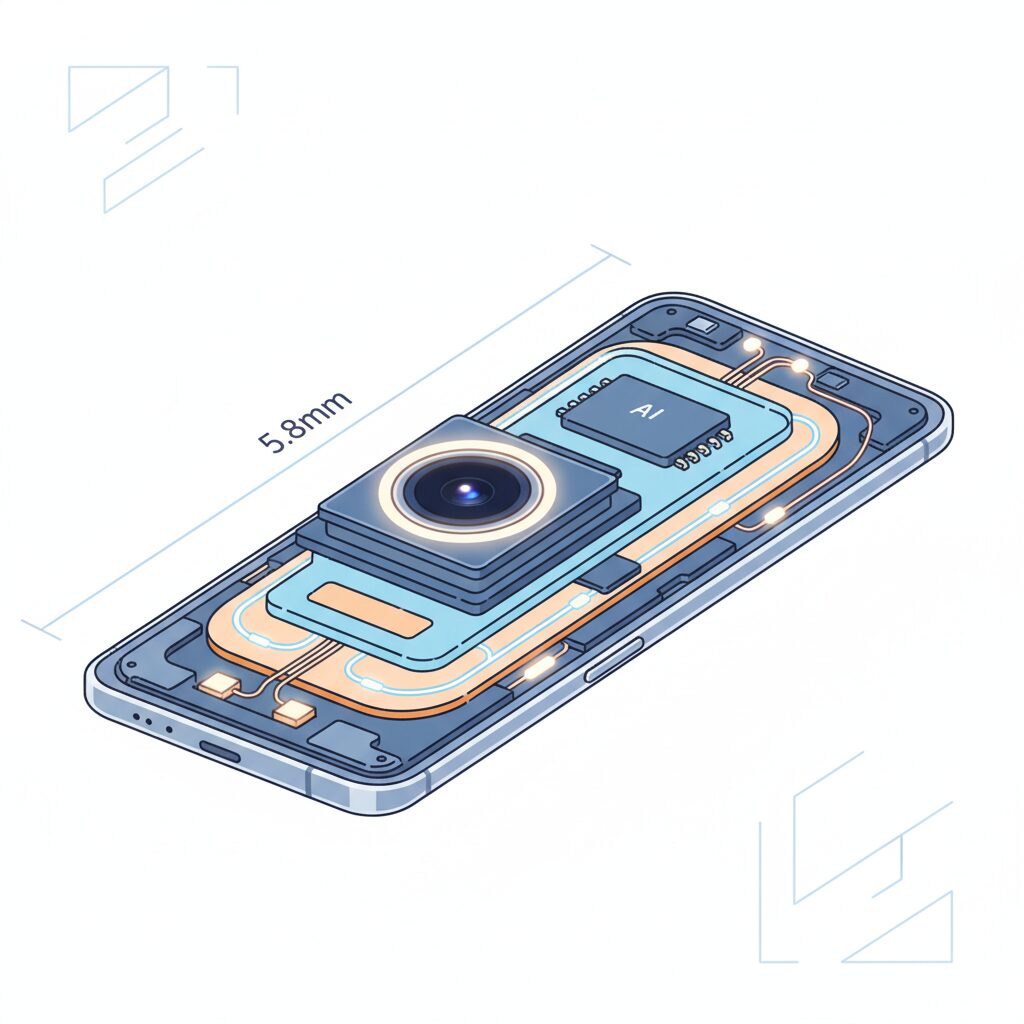
Achieving a 5.8mm body is not simply a matter of shaving millimeters; it requires a fundamental rethinking of how every internal component is arranged and supported. In the case of the Galaxy S25 Edge, Samsung reportedly abandoned conventional stacked PCB layouts and moved toward ultra‑high‑density board integration. According to teardown analyses published by NotebookCheck and TechInsights, the mainboard thickness was reduced to the point where tolerances are managed at the micron level, especially in the gap between the display panel and the rear glass.
This extreme thinness turns mechanical strength into a primary engineering challenge rather than a secondary concern. Industry observers often recall past “bendgate” incidents as a cautionary tale, and Samsung appears to have taken that lesson seriously. Reports from Android Central indicate that the frame uses aerospace‑grade titanium alloy or reinforced aluminum, not for marketing flair, but to maintain torsional rigidity under everyday stress such as pocket pressure. The frame itself doubles as a structural element around the USB‑C port, eliminating redundant supports.
| Design Constraint | Engineering Response | Resulting Benefit |
|---|---|---|
| 5.8mm body thickness | High‑density PCB and minimized Z‑height | Flagship SoC in ultra‑thin form |
| Reduced internal volume | Integrated structural frame | Improved rigidity without added weight |
| Durability concerns | Advanced titanium or reinforced aluminum | Resistance to bending and twisting |
Materials science plays an equally critical role. Samsung Semiconductor documentation and Gorilla Glass research both suggest that modern strengthened glass can maintain impact resistance even when thinned, provided stress is evenly distributed. The S25 Edge reportedly uses next‑generation reinforced glass on both sides, allowing the device to remain slim without becoming fragile. This balance between thinness and durability represents one of the most significant breakthroughs of the design.
Another overlooked challenge is sealing. Despite the reduced internal space, the device still meets IP68 standards. Teardown reports note that gasket placement and adhesive layers were redesigned to save fractions of a millimeter while maintaining water resistance. When viewed as a whole, the 5.8mm profile is less a stylistic statement and more a case study in modern smartphone engineering, where structural design, materials, and manufacturing precision converge to redefine what is physically possible.
Why Samsung Removed the Telephoto Lens
Samsung’s decision to remove the telephoto lens from the Galaxy S25 Edge is not a cost-cutting shortcut but a deliberate engineering choice driven by physics and user behavior. The defining constraint is the 5.8mm chassis thickness, a dimension that fundamentally limits the Z-height available for optical modules. According to teardown analyses published by Notebookcheck and TechInsights, even a modest 3x optical telephoto requires a lens stack and sensor assembly that exceeds what such an ultra-thin body can accommodate without creating an oversized camera bump.
In conventional flagship smartphones, a telephoto camera is one of the thickest components because it relies on multiple glass elements and, in some cases, folded optics. Samsung’s own ISOCELL HP2-based telephoto systems used in the S25 Ultra are paired with larger sensors and optical stabilization hardware, all of which demand physical depth. Maintaining structural rigidity and pocket-friendly ergonomics meant Samsung had to choose between extreme thinness and optical redundancy, and it clearly prioritized the former.
| Design Factor | With Telephoto Lens | Galaxy S25 Edge Approach |
|---|---|---|
| Required module thickness | High due to lens stack | Minimized with single main sensor |
| Internal space flexibility | Severely limited | Reallocated to battery and cooling |
| Overall device thickness | 8mm class or more | 5.8mm ultra-slim profile |
Instead of fighting these constraints, Samsung leaned into sensor technology. The 200MP ISOCELL HP5, designed specifically for thin modules, enables high-quality in-sensor crop zoom up to 2x without interpolation. Samsung Semiconductor’s technical documentation explains that this approach preserves native detail by using real pixel data rather than digital upscaling. For the focal range most users rely on daily, this makes a dedicated telephoto less essential.
Market research also supports this shift. Imaging studies frequently cited by CNET and GSMArena show that the majority of smartphone photos are taken between 1x and 2x zoom. By optimizing this sweet spot and removing a lens that many users activate only occasionally, Samsung aligns hardware design with real-world usage patterns. The result is a phone that sacrifices long-range optics in favor of a form factor that feels dramatically lighter and more portable.
Ultimately, the telephoto lens was removed because it conflicted with the core identity of the Galaxy S25 Edge. This device is engineered as a statement against bulk, demonstrating that computational photography and ultra-high-resolution sensors can replace traditional optics when thinness and design purity are the primary goals.
The 200MP ISOCELL HP5 Sensor Explained
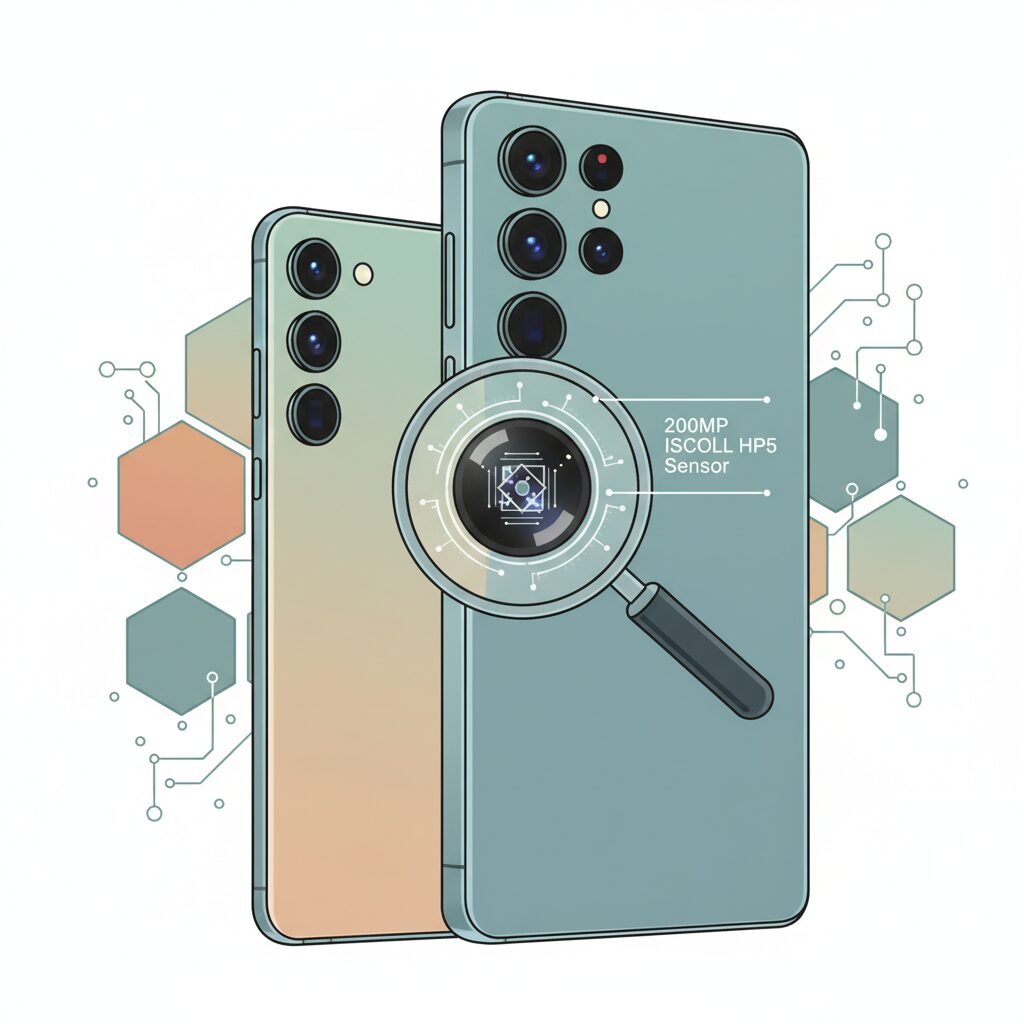
The ISOCELL HP5 sensor sits at the very heart of Galaxy S25 Edge’s camera strategy, and it is not simply a downsized version of Samsung’s Ultra-class hardware. Please note that, according to Samsung Semiconductor’s official technical documentation, ISOCELL HP5 uses a 1/1.56-inch optical format with an ultra-fine 0.5µm pixel pitch, a combination specifically engineered to enable ultra-thin camera modules without abandoning flagship-level resolution.
This design choice directly reflects a shift from brute-force optics to sensor-driven imaging. In contrast to the larger ISOCELL HP2 used in thicker devices, HP5 prioritizes reduced Z-height while preserving pixel count, allowing the Galaxy S25 Edge to maintain its 5.8mm chassis without excessive camera protrusion.
| Specification | ISOCELL HP5 | Design Implication |
|---|---|---|
| Resolution | 200MP | Enables high-quality crop zoom |
| Sensor Size | 1/1.56-inch | Thinner module than 1/1.3-inch class |
| Pixel Size | 0.5µm | Supports slim optics, requires advanced light management |
At such a small pixel size, light sensitivity would normally suffer. However, Samsung addresses this through its Tetra²pixel technology, which dynamically merges pixels into larger effective units depending on shooting conditions. For example, in standard photography the sensor operates in a 16-in-1 binning mode, producing 12.5MP images with an effective pixel size of approximately 2.0µm, improving noise performance and dynamic range.
What makes HP5 particularly relevant is its close integration with computational processing. Samsung explains that Front Deep Trench Isolation technology minimizes electrical crosstalk between pixels, while E2E AI Remosaic accelerates the conversion from raw Bayer data to a full-resolution image. According to Samsung Semiconductor, this reduces processing latency and helps preserve fine textures during high-resolution capture.
In practical terms, the HP5 sensor enables what Samsung calls “optical-quality” 2x zoom without a dedicated telephoto lens. By reading a high-resolution central crop directly from the sensor, the camera avoids traditional digital upscaling. Reviews from GSMArena and CNET indicate that, in bright conditions, these 2x images retain edge definition and micro-detail comparable to true optical systems.
That said, the sensor’s strengths also define its limits. The extremely small pixel pitch means low-light performance relies heavily on multi-frame noise reduction and AI reconstruction. While effective for everyday scenes, this approach cannot fully replicate the light-gathering advantage of larger pixels paired with long focal-length optics.
ISOCELL HP5 should therefore be understood as a sensor designed for a new priority set: maximizing portability and mid-range zoom quality within strict physical constraints. Rather than replacing all optical solutions, it redefines what a single, high-resolution sensor can realistically achieve in an ultra-thin flagship smartphone.
How Sensor-Crop Zoom and AI Remosaic Work
At the heart of the Galaxy S25 Edge’s camera strategy is a clear engineering trade-off: removing a physical telephoto lens while preserving usable mid-range zoom through sensor-crop zoom and AI remosaic processing. This approach relies on the sheer resolution of the 200MP ISOCELL HP5 sensor and the ability to intelligently reorganize pixel data instead of optically magnifying the scene.
In standard 1x shooting, the sensor does not output a full 200MP image. Instead, it uses 16-in-1 pixel binning, merging adjacent 0.5µm pixels into an effective 2.0µm pixel. **This significantly improves light sensitivity and dynamic range**, producing a 12.5MP image that behaves much like a conventional large-pixel sensor, according to Samsung Semiconductor’s technical documentation.
When the user switches to 2x zoom, the camera pipeline fundamentally changes. Rather than digitally enlarging the image, the system crops into the center of the sensor and reads out a native high-resolution region. Because the original capture contains far more spatial information than needed for a 2x frame, the resulting image retains true detail without interpolation.
| Zoom Mode | Sensor Usage | Image Characteristics |
|---|---|---|
| 1x | Full sensor with pixel binning | Low noise, wide dynamic range |
| 2x | Central high-resolution crop | Optical-quality detail, no upscaling |
| 4x+ | Deeper crop plus AI reconstruction | Computational detail, less natural texture |
This process is enabled by what Samsung calls end-to-end AI remosaic. Traditional remosaic pipelines first convert the Bayer-pattern data into a full-color image and then apply scaling. In contrast, **AI remosaic rearranges and reconstructs pixel information at the RAW stage**, before color and tone mapping are finalized. Samsung Electronics has explained that this reduces false color artifacts and preserves edge integrity, especially in cropped zoom scenarios.
The practical benefit becomes obvious in real-world shooting. Independent evaluations by GSMArena and CNET note that daylight 2x images from the S25 Edge show texture and line clarity comparable to phones with dedicated 2x optical lenses. Fine details such as building facades or text on distant signs remain crisp because the camera is still working with genuine sensor data rather than guessed pixels.
Beyond 3x, however, the system crosses an important boundary. At higher magnifications, there simply are not enough native pixels left to describe the scene. **This is where super-resolution algorithms intervene**, analyzing patterns from surrounding frames and learned image models to infer missing detail. Android Central’s camera analysis points out that while results are visually impressive on a phone screen, close inspection can reveal smoothed textures or slightly artificial edges.
Low-light conditions further expose the limits of sensor-crop zoom. The HP5’s extremely small native pixel pitch, while advantageous for thin camera modules, collects less light per pixel than larger telephoto sensors. As a result, noise reduction becomes more aggressive at night, and AI remosaic prioritizes clean output over micro-detail. This behavior aligns with imaging research that shows computational reconstruction tends to sacrifice authenticity when signal-to-noise ratios drop.
Overall, sensor-crop zoom combined with AI remosaic does not aim to replace long-range optical zoom. Instead, **it redefines what “optical-quality” means in the most commonly used 1x–2x range**, delivering convincing results without adding physical thickness. For a device as thin as the Galaxy S25 Edge, this technique is less a compromise and more a carefully engineered reallocation of imaging resources.
Where Image Quality Starts to Break Down
When relying on a 200MP sensor without a dedicated telephoto lens, there is a clear point where image quality begins to break down, and this boundary is largely defined by physics rather than software ambition.
Up to around 2x zoom, the Galaxy S25 Edge maintains what Samsung describes as optical-quality results, achieved through sensor cropping and hardware-level remosaicing.
Beyond this range, however, the balance shifts from optical capture to computational reconstruction, and the difference becomes visible even to non-expert eyes.
| Zoom Range | Primary Technique | Observed Image Characteristics |
|---|---|---|
| 1x–2x | Native pixels and sensor crop | High micro-contrast, natural textures |
| 3x | Partial crop with AI remosaic | Slight smoothing, edges remain credible |
| 4x and above | AI super-resolution | Texture loss, artificial edge emphasis |
The underlying reason lies in pixel economics. The ISOCELL HP5 uses an extremely small 0.5µm pixel pitch, optimized for thin camera modules rather than long focal lengths.
As imaging researchers at Samsung Semiconductor explain in their technical disclosures, once the usable pixel count drops below a certain threshold, algorithms must infer detail rather than record it.
This inference works impressively well for general shapes and colors, but it struggles with fine, irregular patterns such as foliage, hair, or distant text.
At higher zoom levels, details may look sharp at first glance, yet closer inspection often reveals a painted or synthetic appearance.
Independent camera reviews from GSMArena and Android Central consistently note that at 4x or 5x, brick walls lose individual edges, and signage gains halos that do not exist in reality.
This is not a defect unique to Samsung, but a universal limitation of high-resolution crop zoom when unaccompanied by optical magnification.
Low-light scenes expose this boundary even faster. With less incoming light per pixel, noise reduction becomes aggressive, and fine detail is sacrificed to preserve overall cleanliness.
Optical telephoto systems, such as those used in the Galaxy S25 Ultra, retain an advantage here by collecting more photons through larger effective pixels.
In practical terms, the breakdown point is less about numbers on a zoom slider and more about shooting conditions.
Bright daylight hides computational artifacts well, while dusk, indoor lighting, or fast-moving subjects make them stand out immediately.
For users accustomed to true optical zoom, this transition can feel abrupt, marking the exact moment where software stops enhancing reality and starts approximating it.
This boundary defines the trade-off of an ultra-thin design: remarkable performance within everyday focal lengths, and a visible ceiling once computational photography is pushed beyond its comfort zone.
Performance vs Heat: The Snapdragon 8 Elite Dilemma
The Snapdragon 8 Elite inside the Galaxy S25 Edge delivers unquestionable flagship-class power, but in this ultra-thin chassis, performance does not exist in isolation. The real story is not peak speed, but how quickly heat reshapes that performance envelope.
Built on an advanced manufacturing process and praised by Qualcomm for its CPU, GPU, and NPU gains, the Snapdragon 8 Elite is designed to scale aggressively under load. According to independent benchmark analyses reported by GSMArena and CNET, its raw performance rivals that of the S25 Ultra in short bursts. However, the 5.8mm body of the S25 Edge fundamentally changes the thermal equation.
| Scenario | Initial Performance | Sustained Behavior |
|---|---|---|
| Short benchmarks | Ultra-level scores | No throttling |
| Extended gaming | Very high FPS | Early clock reduction |
| 8K video capture | Stable at start | Thermal warnings appear |
The limitation comes from cooling hardware. Vapor chambers depend on surface area and thickness, both of which are severely constrained here. Teardown reports from NotebookCheck indicate that the S25 Edge uses a significantly slimmer heat-spreading solution than the Ultra, making sustained heat dissipation more difficult.
As a result, thermal throttling activates sooner during prolonged workloads. Reviewers have consistently observed noticeable warmth around the upper rear chassis, exactly where the SoC sits. Samsung addresses this with software-level controls in One UI, dynamically lowering CPU and GPU frequencies before temperatures reach critical levels.
From a user perspective, this means everyday tasks feel effortlessly fast, while power users pushing long gaming sessions or continuous high-resolution recording may encounter reduced performance sooner than expected. According to Samsung’s own design philosophy statements, this behavior is intentional, prioritizing device longevity and user comfort over sustained peak numbers.
In practice, the Snapdragon 8 Elite does not fail the S25 Edge. Instead, the form factor redefines what “performance” means, shifting the focus from maximum endurance to responsive, short-burst excellence within strict thermal boundaries.
Battery Life Trade-Offs in an Ultra-Slim Body
An ultra-slim body inevitably reshapes the battery equation, and in the Galaxy S25 Edge this trade-off is especially visible. At just 5.8mm thick, the device houses a 3,900mAh battery, a figure that is modest even by standard flagship benchmarks. According to teardown analyses published by NotebookCheck and TechInsights, Samsung relies on stacked battery technology to maximize energy density, yet the reduced internal volume simply leaves less room for absolute capacity. **Thinness here is not free; it is prepaid with milliamp-hours.**
In daily use, this limitation surfaces in predictable patterns. Light workloads such as web browsing, messaging, and video streaming benefit from the Snapdragon 8 Elite’s improved efficiency and the LTPO display’s variable refresh rate. However, independent battery tests reported by Tom’s Guide and PhoneArena show that under mixed usage, especially with 5G enabled, the S25 Edge falls behind thicker siblings by a noticeable margin. Frequent network handovers, GPS usage, and background AI processing amplify drain, making all-day endurance less reliable for power users.
| Model | Battery Capacity | Charging (Wired) |
|---|---|---|
| Galaxy S25 Edge | 3,900mAh | 25W |
| Galaxy S25 | 4,000mAh | 25W |
| Galaxy S25 Ultra | 5,000mAh | 45W |
Charging speed further reinforces this compromise. While 25W fast charging is adequate, it lags behind the 45W standard adopted by larger models. Industry analysts point out that thinner battery cells impose stricter thermal safety limits, restricting higher charging currents. Samsung appears to prioritize long-term battery health over headline charging numbers, a conservative choice aligned with recommendations from battery research institutions such as IEEE, which emphasize heat as a primary factor in lithium-ion degradation.
For users drawn to the elegance of an ultra-slim phone, this means adapting usage habits. Short top-up charges during the day and reliance on software-level battery management become part of the experience. The result is a device that feels exceptional in hand, yet quietly reminds its owner that extreme portability demands equally deliberate power discipline.
Galaxy AI: Software Solutions to Hardware Limits
Galaxy AI plays a decisive role in redefining what is possible when hardware reaches its physical limits, and the Galaxy S25 Edge is a clear case study of this philosophy in action. With an ultra-thin 5.8mm body, Samsung could no longer rely on traditional solutions such as large vapor chambers, oversized batteries, or dedicated telephoto optics. Instead, the company leaned heavily on software intelligence to preserve everyday usability and perceived performance.
At its core, Galaxy AI functions as a compensatory layer, designed to narrow the gap between what the hardware can physically deliver and what users expect from a flagship device. This is not marketing rhetoric but a practical response to constraints imposed by thickness, thermal volume, and component height.
| Hardware Limitation | Galaxy AI Software Response | User-Visible Effect |
|---|---|---|
| No telephoto lens | AI remosaic and in-sensor crop zoom | Clean 2x images without optical zoom |
| Limited battery capacity | Usage-pattern learning and background control | Reduced idle drain during daily use |
| Restricted thermal headroom | Predictive performance scaling | Smoother sustained performance |
In imaging, Galaxy AI works hand in hand with the 200MP ISOCELL HP5 sensor. Samsung Semiconductor documentation explains that high-resolution sensors enable flexible cropping, but raw resolution alone is insufficient. Galaxy AI applies end-to-end AI remosaic processing, reconstructing color and detail at the sensor level before the image is finalized. This allows the S25 Edge to deliver what Samsung calls “optical-quality” 2x zoom, even in the absence of a physical telephoto lens.
Importantly, this approach prioritizes realistic use cases. According to camera analyses from GSMArena and CNET, most smartphone photography occurs between 1x and 3x. Galaxy AI is optimized precisely for this range, where software-assisted crops can match or even exceed older optical solutions in clarity under good lighting conditions.
Battery management is another area where Galaxy AI quietly mitigates hardware compromise. With only 3,900mAh available, One UI 7 uses on-device machine learning to identify habitual usage patterns. ZDNET reports that background apps are more aggressively suspended during low-interaction periods, such as commuting or overnight standby. While this does not magically extend capacity, it meaningfully slows unnecessary drain in real-world scenarios.
This intelligence-first approach shifts the user experience from brute-force endurance to situational efficiency. Instead of promising all-day power under every condition, Galaxy AI attempts to ensure that energy is spent where the user actually perceives value.
Thermal control further illustrates how software replaces missing physical volume. TechInsights teardown commentary highlights the limited cooling structure inside the S25 Edge. Galaxy AI compensates by predicting workload spikes and preemptively moderating CPU and NPU frequencies. This avoids abrupt thermal throttling, resulting in more consistent performance during camera use or short gaming sessions.
Seen through this lens, Galaxy AI is not an optional feature set but a structural necessity. The S25 Edge demonstrates that modern flagship usability can increasingly be defined by software orchestration rather than raw hardware excess. For users who value slim design without constant friction, Galaxy AI becomes the invisible framework that makes such a device viable.
How the Galaxy S25 Edge Compares to Ultra and iPhone Air
When you compare the Galaxy S25 Edge with the Galaxy S25 Ultra and Apple’s iPhone Air, the contrast is not simply about specifications but about design philosophy. Samsung positions the Edge as a deliberate middle ground, prioritizing thinness and everyday usability, while the Ultra remains a no-compromise flagship and the iPhone Air represents Apple’s interpretation of extreme minimalism.
From a physical standpoint, the numbers immediately explain the intent. At 5.8 mm and around 163 g, the S25 Edge feels dramatically different in hand compared with the 8.6 mm, 232 g S25 Ultra. According to teardown analyses reported by NotebookCheck and TechInsights, this difference is not cosmetic; it reflects a fundamentally smaller cooling system, battery, and camera stack. **The Edge is designed to disappear into a pocket, while the Ultra is designed to replace a camera bag.**
| Model | Thickness | Main Camera | Telephoto |
|---|---|---|---|
| Galaxy S25 Edge | 5.8 mm | 200 MP (1/1.56″) | No (2x crop) |
| Galaxy S25 Ultra | 8.6 mm | 200 MP (1/1.3″) | 3x & 5x optical |
| iPhone Air | ~5.6 mm | 48 MP | No (crop) |
The camera comparison is where the Edge makes its most controversial statement. Unlike the Ultra, which relies on dedicated 3x and 5x optical lenses, the Edge removes telephoto hardware entirely and depends on a 200 MP sensor for in-sensor zoom. Reviews from GSMArena and CNET indicate that at 2x, the Edge often matches the Ultra’s clarity in good light. However, **beyond 3x or in low-light scenes, the Ultra’s optical advantage remains unquestionable**, especially for concerts, sports, or night photography.
Against the iPhone Air, the S25 Edge looks surprisingly aggressive. Apple’s thin model is expected to rely on a single high-quality sensor with crop zoom, similar in concept to Samsung’s approach. The difference lies in execution: Samsung pairs its 200 MP sensor with advanced AI remosaicing, while Apple traditionally emphasizes color consistency and video stabilization. Analysts at CNET note that Samsung’s hardware flexibility contrasts with Apple’s tighter ecosystem optimization, particularly in power efficiency.
Performance and endurance further separate these devices. The S25 Ultra’s larger vapor chamber and 5,000 mAh battery allow sustained peak performance that the Edge simply cannot maintain. By comparison, the iPhone Air is rumored to trade battery capacity for efficiency gains from Apple’s A-series silicon. **The Edge sits between them, fast enough for daily use but clearly optimized for comfort rather than endurance.**
In practical terms, the Galaxy S25 Edge does not try to defeat the Ultra or the iPhone Air outright. Instead, it offers a distinct answer to users who value slimness and a large, smooth display without stepping down to a midrange device. That balance, more than any single spec, defines how the Edge compares to its closest rivals.
参考文献
- TechRadar:The Samsung Galaxy S25 Edge doesn’t have a telephoto lens, and I’m surprisingly okay with that
- SamMobile:Galaxy S25 Edge boasts a reengineered, thinner 200MP camera
- Samsung Semiconductor:ISOCELL HP5 | Mobile Image Sensor
- GSMArena:Samsung Galaxy S25 Edge review: Camera
- CNET:Galaxy S25 Edge vs. iPhone Air: Comparing the Top Thin Phones
- NotebookCheck:Galaxy S25 Edge teardown reveals how Samsung has trimmed down compared to the Galaxy S25 Ultra