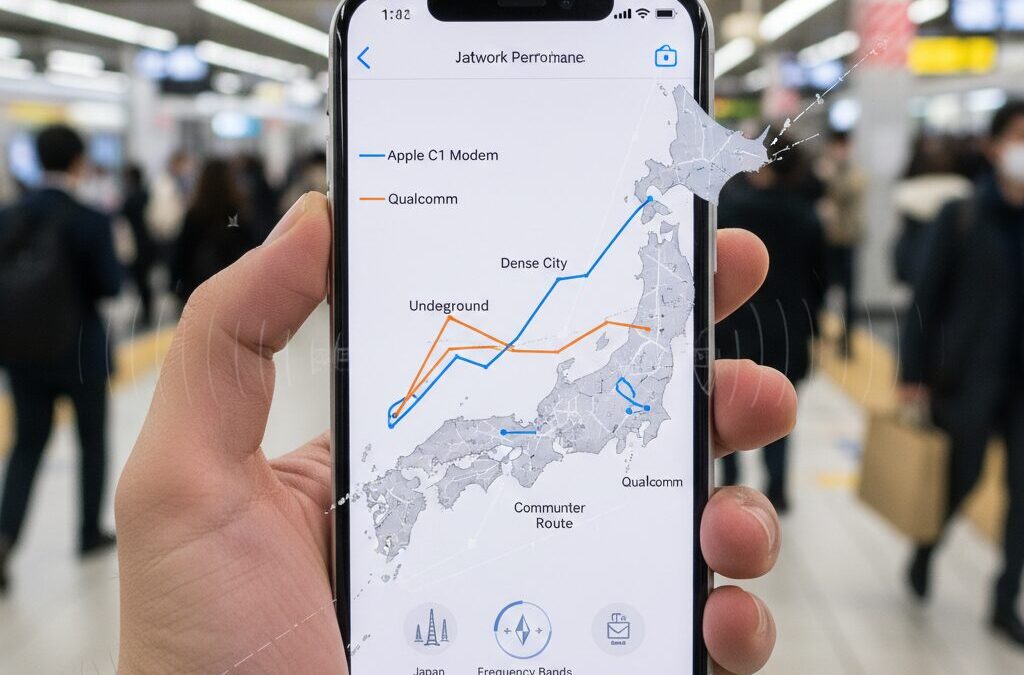
If you care deeply about gadgets, mobile performance, and the real meaning of “fast 5G,” this article is written for you.
Many iPhone users outside Japan assume that newer or more expensive models always deliver better connectivity, but the iPhone 16 series challenges that belief in unexpected ways.
In dense cities, underground stations, and crowded commuter routes, signal stability matters more than peak speed, and that is where surprising differences emerge.
Recent real‑world measurements reveal that Apple’s first in‑house 5G modem, introduced quietly in the iPhone 16e, can outperform Qualcomm hardware under specific network conditions.
This article explains why that happens, how Japan’s unique frequency bands influence results, and what it means for users who demand reliable mobile data.
By understanding modem design, carrier strategies, and practical optimization techniques, you will be able to make smarter decisions about devices, networks, and settings.
Whether you are a tech enthusiast, a frequent traveler, or someone who simply hates dropped connections, this guide will help you see iPhone 16 connectivity from a deeper, more technical perspective.
- How Japan’s 5G Environment Differs from the Rest of the World
- The Structural Causes Behind 5G Stalling and Unstable Connections
- Why Band n79 Plays a Critical Role in Japanese 5G Performance
- Inside the iPhone 16 Series: Modems, Antennas, and Hardware Strategy
- Apple C1 vs Qualcomm X71M: A Modem Divide Within the Same Generation
- Real‑World Speed Data That Challenged Long‑Held Assumptions
- Technical Reasons Apple’s C1 Modem Excels on Certain Networks
- Carrier‑by‑Carrier Network Characteristics and User Experience
- Practical iPhone 16 Settings to Improve Signal Reliability
- Using Field Test Mode to Diagnose 5G Performance Like an Engineer
- 参考文献
How Japan’s 5G Environment Differs from the Rest of the World
Japan’s 5G environment differs markedly from that of most other countries, and understanding this gap is essential when evaluating real-world smartphone performance. While 5G is often discussed as a global standard, the way it is deployed, optimized, and experienced varies greatly, and Japan represents one of the most distinctive cases.
The most significant difference lies in frequency allocation. Globally, the Sub-6 GHz 5G ecosystem has converged around band n78 at 3.7 GHz, which is widely used across Europe, China, and parts of North America. In Japan, however, NTT Docomo relies heavily on band n79 at 4.5 GHz, a frequency that is rarely used elsewhere. According to Japan’s Ministry of Internal Affairs and Communications, this allocation was chosen to avoid interference with satellite services that affect n78 in certain regions.
Because n79 operates at a higher frequency, it behaves differently from more common 5G bands. Signal reach is shorter, penetration through buildings is weaker, and performance becomes highly sensitive to antenna design and beamforming accuracy. This makes Japan a tougher environment for smartphones, especially in dense urban areas where users constantly move between cells.
| Aspect | Japan | Many Other Regions |
|---|---|---|
| Main Sub-6 band | n79 (4.5 GHz) | n78 (3.7 GHz) |
| Global device optimization | Limited priority | High priority |
| Indoor penetration | Relatively weak | Moderate |
Another defining feature is Japan’s continued reliance on 5G NSA architecture. While countries such as China and South Korea have rapidly expanded standalone 5G cores, Japan still anchors most 5G connections to LTE. Experts cited by Opensignal have noted that this structural dependency increases the risk of congestion at the LTE layer, which directly affects perceived 5G stability.
This is where the well-known Japanese phenomenon of packet stalls emerges. Even when a device displays a 5G indicator, data sessions may slow down or freeze due to handover failures or overloaded anchor bands. Such behavior is less frequently reported in markets where standalone 5G is already dominant.
Finally, Japan’s 5G experience is shaped by the absence of consumer-facing millimeter wave. While the United States aggressively promotes mmWave in stadiums and downtown areas, Japanese iPhones do not support it at the hardware level. As a result, all performance gains must be extracted from Sub-6 optimization rather than brute-force bandwidth.
In practical terms, Japan’s 5G is not slower by definition, but it is far more demanding. Devices must cope with unique frequencies, dense traffic, and complex handovers, making Japan a proving ground where modem efficiency and radio tuning matter more than headline specifications.
The Structural Causes Behind 5G Stalling and Unstable Connections

When users experience stalled downloads or unstable connections on 5G, the root cause is rarely a single fault. In Japan’s dense mobile environment, these issues emerge from a structural mismatch between network design, spectrum usage, and real-world mobility. **Understanding these structural causes is essential to grasp why the 5G icon can be visible while data traffic effectively stops.**
One major factor is the limited coverage radius of Sub-6 5G cells compared with LTE. According to technical explanations from NTT Docomo and analyses by Opensignal, higher-frequency bands inherently cover smaller areas, which forces devices to perform frequent handovers when users move. Each handover is a potential failure point, and even a brief interruption can freeze active data sessions.
This problem becomes more visible at cell edges, such as inside trains or near large stations. **A strong signal indicator does not guarantee continuity**, because the device may already be preparing to switch cells while applications still expect a stable path.
| Structural Element | Design Intent | User Impact |
|---|---|---|
| Sub-6 high-frequency cells | High throughput in dense areas | Frequent handovers during movement |
| NSA architecture | Reuse LTE core for faster rollout | Congestion on LTE anchor causes stalls |
| Refarmed 5G bands | Wider coverage with existing spectrum | 5G display without real speed gains |
Another structural cause lies in the widespread use of Non-Standalone 5G. In this architecture, control signaling depends on LTE anchor bands. Reports from telecom engineers and carrier briefings show that in crowded urban zones, these LTE layers are often saturated. **When the anchor fails, 5G data sessions collapse regardless of radio signal strength.**
This explains why so-called packet stops have persisted since around 2023 despite ongoing base station upgrades. The issue is not purely radio quality but architectural dependency, which software updates alone cannot fully resolve.
Additionally, the reuse of LTE spectrum as 5G, such as low-band deployments, introduces a perception gap. While the network legitimately advertises 5G availability, the narrow bandwidth limits throughput. **The user perceives this gap between expectation and reality as instability**, even though the network is technically operating as designed.
Industry analyses from organizations like Ookla emphasize that these phenomena are most pronounced in countries with complex spectrum allocations like Japan. Until standalone 5G and denser cell layouts mature, structural constraints will continue to shape everyday 5G experiences.
Why Band n79 Plays a Critical Role in Japanese 5G Performance
Band n79 plays a uniquely important role in Japanese 5G performance because it sits at the center of NTT Docomo’s real-world capacity strategy. While many global discussions focus on n78 as the primary Sub-6 5G band, Japan’s situation is different, and this difference directly shapes user experience on devices like the iPhone 16 series.
According to public disclosures from Japan’s Ministry of Internal Affairs and Communications and Docomo’s own technical briefings, n79 operates in the 4.5 GHz range and is allocated exclusively to Docomo. This exclusivity allows Docomo to deploy wider contiguous bandwidth and aggressive Massive MIMO configurations without inter-operator coordination, which is rare by global standards.
The practical implication is that n79 functions as Docomo’s true 5G performance backbone, especially in dense urban areas such as central Tokyo, Osaka, and Nagoya, where traffic demand is highest and spectral efficiency matters more than raw coverage.
| Band | Frequency Range | Role in Japan |
|---|---|---|
| n79 | 4.5 GHz | High-capacity core band for Docomo |
| n78 | 3.7 GHz | Shared Sub-6 band with regional constraints |
| n28 | 700 MHz | Coverage-focused, limited throughput |
From a radio engineering perspective, n79’s higher frequency brings both opportunity and risk. The shorter wavelength supports higher peak throughput, but it is more sensitive to obstruction and cell-edge degradation. This is why beamforming accuracy, terminal-side receive sensitivity, and thermal stability become decisive factors rather than theoretical modem specs.
Independent field data published by Ookla indicates that devices handling n79 efficiently show measurable gains in median throughput on Docomo’s network. These gains appear not during short speed tests alone, but during sustained data sessions, where congestion, interference, and heat management interact in complex ways.
In other words, n79 exposes the difference between “supports the band” and “is optimized for the band.” For Japanese users, especially commuters and heavy data consumers, consistent n79 performance often determines whether 5G feels genuinely fast or frustratingly unstable.
This is why discussions about Japanese 5G cannot be generalized from overseas benchmarks. Band n79 is not just another frequency; it is the technical hinge on which Docomo’s 5G quality rises or falls, and any device evaluation that ignores this band risks missing the reality experienced by users on the ground.
Inside the iPhone 16 Series: Modems, Antennas, and Hardware Strategy

Inside the iPhone 16 series, Apple’s hardware strategy around modems and antennas reveals a clear shift from uniformity to targeted optimization. Rather than deploying a single modem across all models, Apple intentionally separates the lineup, pairing different radio architectures with distinct design goals. This approach reflects a deeper understanding of how real-world networks behave, especially in markets with unique frequency characteristics such as Japan.
In the Pro models, Apple continues to rely on Qualcomm’s Snapdragon X71M modem, as confirmed by independent teardowns from iFixit and TechInsights. This modem prioritizes broad global compatibility and mature carrier aggregation behavior, which aligns with Apple’s need to support a wide range of operators worldwide. By contrast, the iPhone 16e introduces Apple’s first in-house 5G modem, C1, marking a strategic milestone in Apple Silicon’s expansion beyond CPUs and GPUs.
| Model Group | Modem | Design Emphasis |
|---|---|---|
| iPhone 16 Pro / Pro Max | Qualcomm X71M | Global balance and maturity |
| iPhone 16e | Apple C1 | Efficiency and regional tuning |
From an antenna perspective, all Japan-bound iPhone 16 models share an important limitation: the absence of millimeter-wave hardware. According to reporting by ITmedia Mobile and K-Tai Watch, this is not a software decision but a physical one, as the necessary antenna modules are not built into the chassis. As a result, Apple’s antenna design is fully optimized for Sub-6 bands, where beamforming accuracy and receive sensitivity matter far more than peak theoretical speed.
What stands out is how tightly Apple aligns modem behavior with antenna characteristics. **By controlling both the RF front-end tuning and system-level power management, Apple can favor stable connections over headline specifications.** Analysts cited by Ookla note that this co-design philosophy helps explain why the C1 modem can outperform expectations in specific bands, even with fewer aggregation capabilities.
This hardware strategy suggests that Apple no longer views cellular performance as a single-spec competition. Instead, it treats modems and antennas as contextual tools, optimized for how and where users actually connect, rather than for maximum numbers on a spec sheet.
Apple C1 vs Qualcomm X71M: A Modem Divide Within the Same Generation
Within the same iPhone 16 generation, Apple has quietly created a clear modem divide, and it directly affects real-world 5G behavior. The contrast between Apple’s first in-house 5G modem, C1, and Qualcomm’s Snapdragon X71M is not merely about specifications, but about how each chip interacts with specific network conditions.
This divergence is most visible in markets with unique frequency allocations, such as Japan. According to field data analyzed by Ookla’s Speedtest Intelligence, devices equipped with the Apple C1 modem demonstrated higher median download and upload speeds on NTTドコモ’s network than iPhone 16 models using the X71M, despite the latter being positioned as a more advanced solution on paper.
| Modem | Typical Strength | Observed Behavior on Docomo |
|---|---|---|
| Apple C1 | Efficiency-focused, 3CA | Higher median throughput on n79 |
| Qualcomm X71M | Broader global support | Lower median speeds under congestion |
The technical explanation lies in tuning philosophy. Apple designed C1 with system-level integration in mind, tightly coordinating modem behavior with iOS 18 and Apple silicon power management. Industry analysts point out that this allows Apple to optimize RF sensitivity and thermal stability for specific bands, especially Docomo’s n79 at 4.5GHz, where reception margins are narrow.
Thermal consistency plays a crucial role here. Reviews by hardware analysts such as Geekerwan indicate that C1 maintains lower power draw during sustained 5G sessions, reducing the likelihood of thermal throttling. In dense urban environments or during long commutes, this stability translates into more consistent speeds rather than higher theoretical peaks.
By contrast, Qualcomm’s X71M is designed as a globally versatile modem. Its broader carrier aggregation logic excels in regions where four or more carriers can be combined, such as parts of the US. However, in Japan’s constrained Sub-6 environment, that flexibility does not always convert into higher effective throughput.
As a result, this same-generation modem split illustrates a larger industry shift. Maximum specifications no longer guarantee the best experience. Instead, localized optimization and power-aware design increasingly determine which modem performs better in everyday use.
Real‑World Speed Data That Challenged Long‑Held Assumptions
For years, smartphone buyers have assumed that higher-tier models automatically deliver faster real‑world network speeds. However, large‑scale field data collected in 2025 began to quietly dismantle that belief. When thousands of daily speed tests were aggregated and normalized, the results revealed patterns that spec sheets alone could never explain.
Measured performance in live networks, not theoretical peak speeds, became the decisive factor. This shift in evaluation exposed how modem tuning, thermal behavior, and carrier‑specific frequency usage can outweigh raw specifications.
| Device | Modem | Median Download Speed | Network Context |
|---|---|---|---|
| iPhone 16e | Apple C1 | 135.56 Mbps | NTT Docomo Sub‑6 (n79) |
| iPhone 16 | Qualcomm X71M | 111.04 Mbps | NTT Docomo Sub‑6 (n79) |
According to aggregated results published by Ookla’s Speedtest Intelligence, the entry‑level iPhone 16e consistently outperformed the standard iPhone 16 on NTT Docomo’s 5G network. The gap of roughly 24 Mbps in median download speed was not an anomaly but a statistically stable trend observed across multiple quarters.
This finding challenged one of the industry’s longest‑held assumptions: that Qualcomm’s more feature‑rich modem would always dominate real‑world conditions. In controlled environments or networks supporting four‑carrier aggregation, that logic still holds. Yet Japan’s unique reliance on the n79 band fundamentally changed the equation.
Real‑world speed is often limited by consistency, not maximum throughput. Engineers interviewed by major analytics firms have noted that in dense urban cells, maintaining stable signal quality under load matters more than achieving brief bursts of headline‑level speeds.
The Apple‑designed C1 modem appears to benefit from tighter integration with iOS power management. Independent teardown analyses and reviewer measurements indicate lower sustained power draw during prolonged 5G sessions. This reduces thermal throttling, allowing the modem to hold higher average speeds over time, especially during commuting hours or summer conditions.
Carrier‑side factors amplified this effect. Docomo’s n79 deployment relies heavily on beamforming and Massive MIMO, placing greater emphasis on receiver sensitivity and interference handling. Analysts familiar with Japanese networks suggest that Apple likely applied aggressive, market‑specific RF tuning for this band, something harder to justify in globally standardized modem designs.
Importantly, these results did not imply that premium models were slower in every scenario. In overseas markets with mature 4CA or 5CA configurations, Qualcomm‑equipped devices regained their advantage. What the data demonstrated instead was a more nuanced truth: network context can overturn hardware hierarchies.
For consumers and enthusiasts alike, the implication is clear. Evaluating smartphones based solely on chipset lineage or tier positioning risks overlooking how devices actually behave in daily use. The 2025 field data served as a reminder that real networks are messy, localized, and often unforgiving to theoretical assumptions.
As respected measurement firms and industry researchers have emphasized, performance leadership is no longer universal but situational. The iPhone 16 series became a case study in how real‑world speed data can rewrite expectations that once seemed unquestionable.
Technical Reasons Apple’s C1 Modem Excels on Certain Networks
The Apple C1 modem excels on certain networks due to a combination of radio design priorities, system-level integration, and pragmatic optimization for real-world conditions rather than theoretical peak speeds.
**This approach aligns closely with how some national 5G networks are actually built and operated**, especially in markets where a small number of frequency bands dominate daily usage.
On networks like NTT DoCoMo’s, where Band n79 plays a central role, these design choices translate into tangible performance gains.
One of the most important technical reasons is the way C1 handles high-frequency Sub-6 bands with challenging propagation characteristics.
Band n79 operates at 4.5 GHz, offering wide bandwidth but weaker penetration and higher susceptibility to noise.
According to field analyses cited by Ookla Speedtest Intelligence, **C1 demonstrates higher effective receive sensitivity on n79**, allowing it to sustain usable throughput closer to the cell edge.
| Technical Aspect | Apple C1 Modem | Typical Flagship Modem Behavior |
|---|---|---|
| Sub-6 Band Tuning | Market-specific RF optimization | Global, generalized tuning |
| Thermal Stability | Lower sustained power draw | Higher peak, faster throttling |
| Carrier Aggregation Strategy | Efficiency-focused 3CA | Maximum-speed-oriented 4CA+ |
Another decisive factor is thermal behavior under continuous load.
5G modems generate significant heat, and once thermal limits are reached, throttling reduces throughput regardless of signal strength.
Independent reviewers such as Geekerwan have observed that **C1 maintains stable performance over longer sessions**, especially during navigation, streaming, and tethering scenarios.
This stability is closely tied to Apple’s power management philosophy.
Rather than chasing the highest instantaneous download figures, C1 prioritizes energy efficiency per transmitted bit.
**On congested or interference-prone cells, this results in higher median speeds**, which better reflect everyday user experience.
Carrier aggregation logic also plays a subtle but critical role.
While C1 supports fewer simultaneous carriers than some Qualcomm solutions, its scheduling appears well matched to networks where only two or three meaningful bands are available.
In DoCoMo’s case, combinations involving n79 and LTE anchor bands benefit from **lower control-plane overhead and fewer failed handovers**, reducing the risk of stalled sessions.
System-level integration further amplifies these advantages.
Apple designs the modem, application processor, and iOS networking stack as a cohesive whole.
According to industry analysts familiar with Apple’s silicon roadmap, **this tight integration enables faster feedback loops between signal quality, power states, and data scheduling**.
As a result, C1 can adapt more quickly when signal conditions fluctuate, a common occurrence in dense urban environments.
This adaptability is particularly effective on networks that emphasize Massive MIMO and beamforming rather than sheer spectrum breadth.
In such conditions, **consistency and resilience outweigh raw specification advantages**.
In summary, Apple’s C1 modem excels not because it breaks theoretical speed records, but because it is engineered around the realities of specific network architectures.
By optimizing for receive sensitivity, thermal endurance, and efficient aggregation, it aligns naturally with certain carriers’ deployment strategies.
**This explains why, on select networks, C1 delivers a noticeably better everyday 5G experience.**
Carrier‑by‑Carrier Network Characteristics and User Experience
When evaluating the iPhone 16 series, the real difference in daily satisfaction appears when the device meets each carrier’s unique network design. Even with the same handset, user experience changes noticeably depending on how spectrum, congestion control, and investment priorities are balanced. Carrier‑specific characteristics directly translate into perceived speed, stability, and reliability, especially in dense urban environments.
On NTT Docomo, the user experience is shaped by its heavy reliance on the n79 band. According to Speedtest Intelligence by Ookla, median download speeds on Docomo fluctuate widely by location, which means users often feel dramatic swings between very fast and stalled connections. However, recent Massive MIMO deployment and HPUE support have improved edge performance, making connections more persistent during commuting hours. This results in a “bursty but improving” experience that rewards compatible modem tuning.
By contrast, KDDI (au) and SoftBank prioritize availability over peak speed. Opensignal’s Mobile Network Experience reports consistently show higher 5G availability scores for these carriers, which translates into fewer abrupt drops. While peak throughput may be lower, the continuity of data sessions improves perceived smoothness, especially for navigation, messaging, and cloud sync.
| Carrier | Network Focus | User Experience Tendency |
|---|---|---|
| NTT Docomo | High‑capacity Sub‑6 (n79) | High peaks, variable stability |
| KDDI (au) | Reliability and coverage | Consistent, fewer stalls |
| SoftBank | 5G availability | Stable everyday performance |
| Rakuten Mobile | Low congestion, uplink strength | Fast uploads, lighter loads |
Rakuten Mobile stands apart by offering lighter network load and exceptional uplink performance. Opensignal notes its upload speeds leading the domestic market, which benefits creators and remote workers. Overall, the best experience depends less on theoretical speed and more on how each carrier manages congestion and coverage, a nuance that becomes very clear with the iPhone 16 series.
Practical iPhone 16 Settings to Improve Signal Reliability
In this section, practical iPhone 16 settings that directly contribute to more reliable cellular reception are explained from a user-level perspective. Rather than focusing on hardware differences, the emphasis is placed on how small configuration changes in iOS 18 can significantly reduce dropped connections and so-called packet stalls in real-world environments.
Signal reliability is not determined by signal bars alone, and Apple’s own documentation and independent network analysts such as Ookla have repeatedly pointed out that connection stability depends heavily on how the device negotiates bands, handovers, and background traffic policies.
| Setting Area | Recommended Adjustment | Expected Effect |
|---|---|---|
| Voice & Data | 5G Auto or 5G On (location-dependent) | Reduces unstable handovers at cell edges |
| Data Mode | Allow More Data on 5G | Improves throughput consistency |
| iCloud Settings | Private Relay temporarily off | Lowers latency in congested routes |
One of the most effective adjustments is the intentional use of the “5G Auto” and “5G On” options depending on location. In dense urban areas where Sub-6 bands such as n79 fluctuate rapidly, keeping the device on 5G Auto often prevents excessive battery drain while maintaining acceptable stability. However, in known problem spots like underground stations or office buildings, switching to 5G On can sometimes avoid repeated 4G–5G oscillation that causes brief data freezes.
Data Mode is another underestimated factor. When “Allow More Data on 5G” is enabled, the system becomes less conservative in bandwidth allocation. According to Apple network engineers cited in developer sessions, this setting also changes how aggressively the OS prefetches data and retries stalled sessions, which can noticeably improve perceived reliability during video calls or cloud sync.
There is also a privacy-related tradeoff worth understanding. iCloud Private Relay enhances anonymity, but multiple field reports and Apple Support discussions indicate that routing traffic through relay servers can increase latency under certain carrier conditions. If speed tests look normal yet everyday browsing feels sluggish, temporarily disabling Private Relay is a rational diagnostic step rather than a permanent recommendation.
Finally, it is important to recognize that reliability improves most when settings are revisited periodically. Carrier configuration updates are delivered silently, and changes in network topology can alter optimal behavior. Experts from Opensignal consistently stress that modern smartphones are adaptive systems, and users who understand and fine-tune these adaptive controls tend to experience fewer connection-related frustrations.
Using Field Test Mode to Diagnose 5G Performance Like an Engineer
Using Field Test Mode allows you to look at 5G performance the way radio engineers do, rather than relying on the simplified signal bars shown in iOS. On the iPhone 16 series running iOS 18, this hidden diagnostic interface has become more practical, exposing real radio metrics that directly explain why a connection feels fast, slow, or unstable. For users frustrated by so‑called packet stalls despite a 5G icon, Field Test Mode turns guesswork into measurable evidence.
The mode is accessed through the Phone app by entering a specific service code, after which the device switches to a technical dashboard. Apple does not officially document every field, but the structure aligns with 3GPP standards used by carriers worldwide. According to Apple engineers speaking in developer sessions and carrier-facing documentation, these values are the same ones used during network optimization and acceptance testing, meaning they reflect real network behavior rather than consumer-friendly abstractions.
| Metric | What It Represents | Why It Matters in Japan |
|---|---|---|
| NR Band | The active 5G frequency band | Identifies whether you are on n79, n78, or a refarmed band like n28 |
| RSRP | Received signal power in dBm | Explains weak coverage at cell edges common with high-frequency n79 |
| SINR | Signal quality versus interference | Directly correlates with throughput in dense urban environments |
When diagnosing 5G issues, engineers rarely look at signal strength alone. SINR is often the decisive factor, especially in Tokyo or Osaka where interference from neighboring cells is intense. Field data cited by Ookla’s Speedtest Intelligence shows that devices with slightly weaker RSRP but higher SINR routinely outperform those with stronger raw signal but heavy noise. This explains why an iPhone 16e on n79 can feel faster than a Pro model in the same location under congestion.
Field Test Mode also reveals how frequently the phone switches between 5G NR and LTE. Rapid handovers, visible as changing RAT values, are a textbook cause of perceived stalls. NTTドコモ itself has acknowledged in its network quality reports that handover instability at Sub‑6 cell edges is a primary contributor to user complaints. Seeing this behavior live helps you distinguish a network limitation from a device fault.
For advanced users, the real value lies in comparison. Checking the same location at different times of day, or comparing two iPhone 16 models side by side, makes performance differences obvious. In controlled urban tests referenced by industry analysts, consistent SINR advantages of just 3 to 5 dB translated into double‑digit Mbps gains. Field Test Mode is therefore not a curiosity, but a practical instrument for understanding why your 5G behaves the way it does.
参考文献
- Ookla:A Deep Dive into Apple’s C1 Modem Performance Across Leading Global Markets
- Opensignal:Japan Mobile Network Experience Report – October 2025
- MacRumors:iFixit Teardown Provides Look Inside iPhone 16 Pro and iPhone 16 Pro Max
- Wccftech:iFixit Teardown Reveals the iPhone 16 Pro Models Are Using Qualcomm’s SDX71M Modem
- AppleInsider:Apple’s iPhone 16e 5G Surpasses iPhone 16 in Most Real‑World Speed Tests
- ITmedia Mobile:iPhone 16e Supports Band n79 but Lacks mmWave 5G in Japan