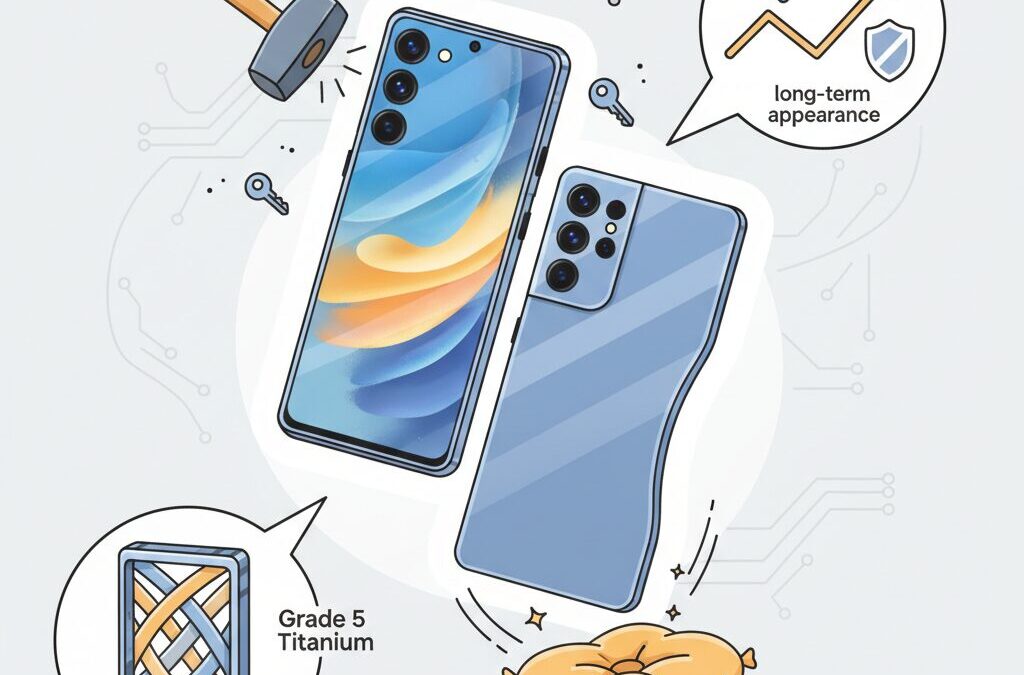
If you follow smartphones closely, you may feel that raw performance numbers are no longer as exciting as they once were. Flagship chips are already incredibly fast, cameras are excellent across the board, and most premium phones look similar at first glance.
What truly separates a next-generation flagship today is how it is built, how it ages, and how well it survives real life. For expensive devices that now rival luxury goods in price, durability, scratch resistance, and long-term appearance matter more than ever.
The Galaxy S25 Ultra and the newly introduced Galaxy S25 Edge bring materials engineering to the center of the conversation. Samsung’s move to a Grade 5 titanium frame, combined with ultra-thin design and advanced glass technologies, raises an important question: does this new construction actually make the phone tougher, or does it simply change where weaknesses appear?
This article carefully explores what titanium really does for structural strength, why some scratches are more visible despite harder materials, and how ultra-slim designs challenge traditional durability assumptions. You will gain a clear, practical understanding of how these devices perform under stress, not just on spec sheets.
If you are considering a premium Android flagship or are simply curious about how far smartphone engineering has evolved, this deep dive will help you evaluate durability as an investment, not just a feature. By the end, you will know exactly what to expect from the Galaxy S25 series in everyday use and over the long term.
- Why Smartphone Durability Has Become a Premium Feature
- Galaxy S25 Ultra and Edge: A Shift Toward Materials Engineering
- Grade 5 Titanium vs Previous Smartphone Frame Materials
- Structural Strength Gains and Real-World Drop Resistance
- The Scratch Resistance Paradox of Titanium Frames
- Display Protection and the Role of Gorilla Armor Glass
- Galaxy S25 Edge and the Engineering Challenge of Extreme Thinness
- Camera Module Design as a Hidden Durability Risk
- What Long-Term Owners Should Know About Wear, Aging, and Resale Value
- 参考文献
Why Smartphone Durability Has Become a Premium Feature
In today’s mature smartphone market, durability has shifted from a secondary consideration to a defining premium feature. As processing power and camera performance have reached a point of diminishing returns, users now evaluate high-end devices through the lens of longevity, physical resilience, and the ability to retain value over time. This change is especially visible in the ultra-premium price range, where smartphones increasingly resemble long-term assets rather than short-lived gadgets.
According to materials science research frequently cited by institutions such as ASM International, structural materials directly influence not only product lifespan but also user trust. **When a device costs over two thousand dollars, buyers expect it to withstand years of drops, pressure, and daily abrasion without compromising functionality or appearance.** This expectation has elevated durability from a hidden specification to a headline feature.
The Galaxy S25 series illustrates this shift clearly. Independent durability testing by JerryRigEverything shows that consumers actively watch bend tests, scratch tests, and teardown analyses before making purchase decisions. These videos routinely attract millions of views, signaling how durability has become part of mainstream buying behavior rather than a niche concern for enthusiasts.
| Consumer Priority | Past Focus | Current Premium Focus |
|---|---|---|
| Performance | CPU speed | Sustained performance without damage |
| Design | Thinness | Thin yet structurally rigid frames |
| Value | New features | Resale value and cosmetic preservation |
Another reason durability commands a premium lies in behavioral economics. Research referenced by Harvard Business School on consumer loss aversion suggests that users feel damage more acutely than performance gains. **A single visible scratch or frame deformation often outweighs multiple incremental feature upgrades in perceived satisfaction.** Manufacturers therefore invest heavily in materials such as titanium alloys and advanced glass to minimize these negative moments.
Display durability further reinforces this trend. Corning has publicly emphasized that modern users drop phones less often but expose them to harsher micro-abrasions from sand, dust, and pockets. As a result, scratch resistance and impact resistance are now balanced to reduce catastrophic failure, even if that means accepting minor surface wear.
Ultimately, durability has become premium because it protects time, money, and peace of mind. **A phone that survives daily life with minimal visible aging delivers a sense of reliability that raw specifications cannot match.** In an era where smartphones are expected to last several years, structural integrity is no longer optional—it is a core part of what defines true flagship quality.
Galaxy S25 Ultra and Edge: A Shift Toward Materials Engineering
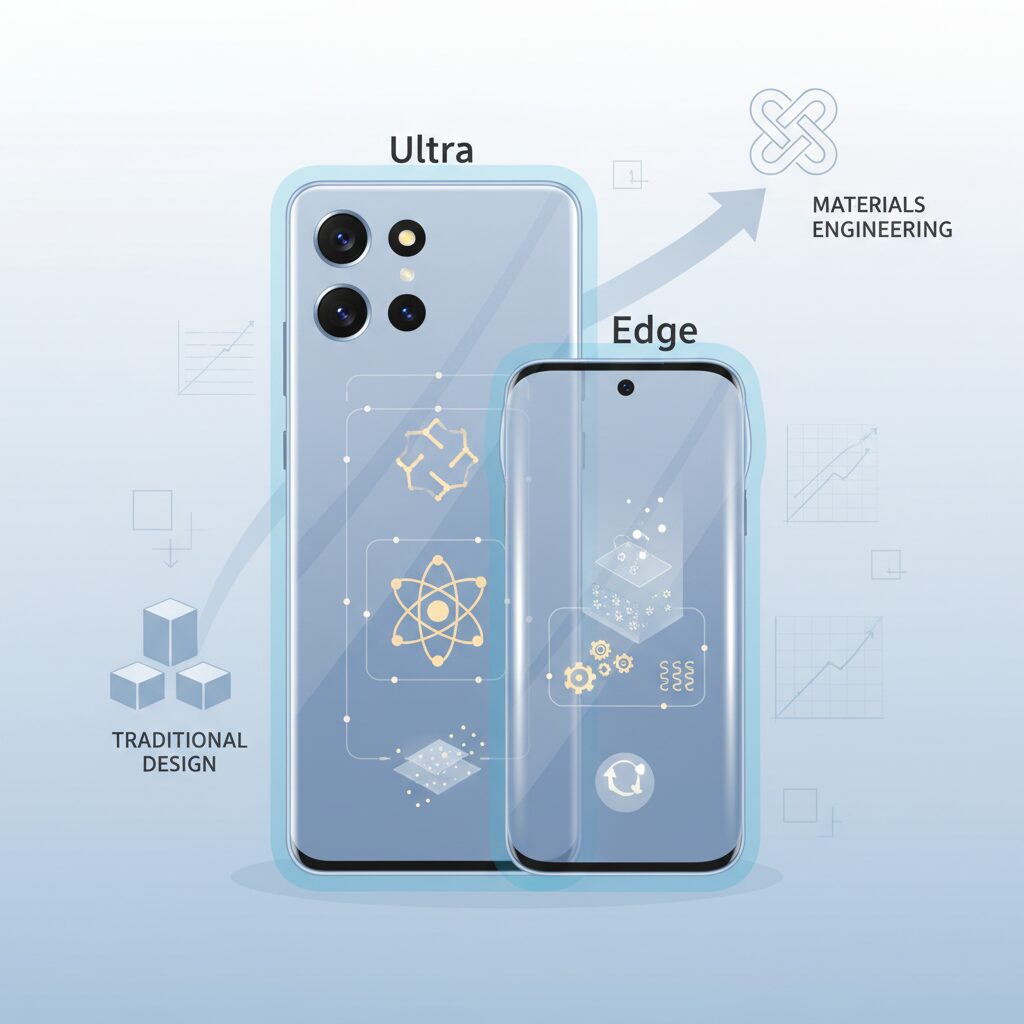
With the Galaxy S25 Ultra and the newly introduced S25 Edge, Samsung clearly signals that smartphone evolution has entered an era where materials engineering matters as much as silicon performance. Rather than chasing raw benchmarks, these models focus on how advanced materials directly shape durability, ergonomics, and long-term value for users who treat a flagship phone as a daily tool and a long-term asset.
The most consequential shift is the move to Grade 5 titanium in the Galaxy S25 Ultra, a material widely known in aerospace and medical implants for its exceptional strength-to-weight ratio. According to established metallurgical data, Grade 5 titanium offers nearly three times the tensile strength of commercially pure Grade 2 titanium, while remaining significantly lighter than steel. This allows Samsung to reduce frame thickness without sacrificing rigidity, contributing to the S25 Ultra’s slimmer 8.2 mm profile while maintaining structural integrity.
Independent durability tests by well-known teardown and stress-testing channels have shown that this material upgrade is not merely cosmetic. In bend and torsion scenarios, the S25 Ultra resists permanent deformation more effectively than its predecessor, indicating that the titanium frame now plays a true structural role rather than acting as a decorative shell.
| Material | Tensile Strength | Typical Industrial Use |
|---|---|---|
| Grade 2 Titanium | Approx. 345 MPa | Corrosion-resistant panels |
| Grade 5 Titanium | Approx. 900–1000 MPa | Aerospace frames, implants |
However, materials engineering is always about trade-offs. Titanium’s low thermal conductivity is well documented in academic literature, including studies cited by materials science journals and Corning’s own discussions on device heat management. Compared to aluminum, titanium conducts heat far less efficiently, which could theoretically trap heat inside a high-performance smartphone.
Samsung addresses this limitation through internal design rather than relying on the frame itself. Enlarged vapor chambers and wider heat-spreading plates redistribute thermal energy across the display and rear glass. Early reviewer feedback suggests that during sustained workloads, the frame remains relatively cool to the touch, a sign that heat is being diffused internally rather than concentrated at the edges.
The Galaxy S25 Edge pushes materials engineering even further. At just 5.8 mm thick, its existence challenges long-held assumptions about thin phones being inherently fragile. Stress tests conducted by third-party evaluators demonstrate that, while the Edge can flex slightly under extreme force, it avoids catastrophic failure. This outcome highlights how high-strength titanium combined with reinforced glass ceramics enables mechanical resilience even at extreme thinness.
Yet, this approach introduces new mechanical behaviors. Under severe bending pressure, some tests observed partial separation between the rear glass and frame, a phenomenon linked to adhesive limits rather than material fracture. From an engineering perspective, this suggests Samsung prioritized controlled flex over brittle breakage, a choice often supported in structural engineering research as a safer failure mode.
Another subtle but important aspect is surface treatment. While titanium itself is highly resistant to dents, scratch visibility depends heavily on the PVD coating applied for color finishes. As demonstrated in controlled scratch tests, darker coatings can reveal underlying silver titanium more clearly when abraded. This is not a weakness of the metal, but a reminder that aesthetic durability is governed by coatings as much as by base materials.
In practical terms, the Galaxy S25 Ultra and Edge show how modern smartphones are becoming products of integrated materials science rather than isolated component upgrades. By borrowing alloys and design philosophies from aerospace and industrial engineering, Samsung reframes durability not as a single spec, but as a system-level outcome that balances strength, weight, heat, and visual longevity.
Grade 5 Titanium vs Previous Smartphone Frame Materials
When Samsung introduced Grade 5 titanium to the Galaxy S25 series, the decision was not merely about following a premium trend but about fundamentally redefining how a smartphone frame behaves compared to previous materials.
Until recently, flagship smartphones relied mainly on aluminum alloys or stainless steel frames. Aluminum, especially the 6000 and 7000 series, has been favored for its light weight and ease of machining, while stainless steel gained popularity for its visual luxury and scratch tolerance.
Grade 5 titanium changes this balance by offering a rare combination of extreme strength and low density. According to widely cited materials engineering references such as ASM International, Ti‑6Al‑4V delivers tensile strength close to 1,000 MPa while remaining significantly lighter than stainless steel.
| Frame Material | Typical Tensile Strength | Relative Weight |
|---|---|---|
| Aluminum Alloy | ~500–570 MPa | Very Light |
| Stainless Steel | ~500–800 MPa | Heavy |
| Grade 5 Titanium | ~900–1,000 MPa | Light |
In practical terms, this means the S25 Ultra’s frame can be thinner without sacrificing rigidity. Previous aluminum frames often required internal reinforcements to pass bend and drop tests, while stainless steel achieved stiffness at the cost of added mass.
Titanium allows Samsung to reduce structural bulk while maintaining confidence in durability. Independent bend tests, including those conducted by JerryRigEverything, show that the S25 series resists permanent deformation more effectively than aluminum-framed predecessors.
However, titanium is not an unconditional upgrade. Compared with aluminum, it conducts heat poorly, and compared with stainless steel, it is less forgiving when surface coatings are scratched. This is why earlier aluminum frames sometimes appeared more resistant to cosmetic wear despite being structurally weaker.
From a user perspective, the shift to Grade 5 titanium represents a philosophical change. Previous materials optimized either comfort or appearance, while titanium prioritizes long-term structural integrity.
For a device positioned as a long-term asset rather than a disposable gadget, this distinction matters. The Galaxy S25 series uses its frame not just as decoration, but as a core mechanical component designed to withstand years of stress.
Compared to earlier smartphones, the titanium frame does not promise a scratch-free surface, but it does deliver something more fundamental: confidence that the device will keep its shape, alignment, and usability even under demanding real-world conditions.
Structural Strength Gains and Real-World Drop Resistance

The shift to Grade 5 titanium in the Galaxy S25 Ultra and Edge delivers tangible gains in structural strength that matter when accidents happen, especially drops from everyday heights. Compared with the previous generation’s commercially pure titanium, the new alloy dramatically increases rigidity, allowing the frame to act as a true load-bearing structure rather than a cosmetic shell.
From a materials engineering perspective, this matters because **drop damage is governed less by surface hardness and more by how effectively impact energy is distributed**. According to data widely cited in aerospace and biomedical engineering literature, Ti‑6Al‑4V offers roughly three times the tensile strength of pure titanium, which translates into reduced frame deformation at the moment of impact.
| Material | Tensile Strength (MPa) | Structural Role in Drops |
|---|---|---|
| Grade 2 Titanium | Approx. 345 | Prone to micro-bending under shock |
| Grade 5 Titanium | Approx. 900–1000 | Maintains frame integrity, disperses force |
Real-world testing reinforces this theoretical advantage. In controlled drop and bend evaluations conducted by JerryRigEverything, the S25 Ultra showed **minimal frame distortion even after repeated high-stress handling**, a notable improvement over earlier Galaxy models that relied on internal aluminum subframes.
This predictability is critical in everyday scenarios such as pocket-height drops onto concrete. With a stiffer titanium skeleton, the shock is spread across the chassis, reducing the likelihood of catastrophic failures like display delamination or internal solder joint cracking, issues frequently discussed in mobile reliability studies by organizations such as iFixit.
For the ultra-thin Galaxy S25 Edge, the achievement is arguably more impressive. At just 5.8 mm, thin devices typically flex and amplify impact forces. Yet testing shows controlled elastic flex rather than permanent bending, indicating that **structural resilience has been prioritized alongside thinness**, a balance rarely achieved in smartphones.
In everyday use, this means accidental drops are more likely to result in cosmetic scuffs than functional failure. For users investing in a premium device, that difference defines real-world durability, not lab numbers alone.
The Scratch Resistance Paradox of Titanium Frames
Titanium frames are widely perceived as the ultimate solution to everyday wear, yet real-world testing of the Galaxy S25 series reveals a subtle paradox that challenges this assumption. **While the structural strength of grade 5 titanium is undeniably superior, its visible scratch resistance depends far more on surface treatment than on the metal itself.** This distinction is often overlooked, leading to a gap between user expectations and actual long-term aesthetics.
From a materials science perspective, titanium alloys such as Ti-6Al-4V exhibit high tensile strength and excellent resistance to permanent deformation. According to established metallurgical references cited by organizations like ASM International, titanium’s hardness is sufficient to resist dents from impacts that would deform aluminum. However, hardness alone does not equate to scratch immunity, especially at the surface level where coatings and finishes dominate user perception.
| Aspect | Underlying Titanium | PVD Surface Layer |
|---|---|---|
| Role | Structural strength and rigidity | Color and aesthetic finish |
| Relative hardness | High for impact resistance | Lower, microns-thin coating |
| Visible scratches | Rare in daily use | Common under abrasion |
The Galaxy S25 Ultra and Edge both rely on PVD coating to achieve their distinctive titanium colors. Independent durability tests, including controlled scratch tests conducted by well-known teardown specialists, show that **what users perceive as “scratches on titanium” are often the removal of this thin coating rather than damage to the alloy beneath**. Once the darker PVD layer is abraded, the bright silver tone of raw titanium becomes exposed, creating high visual contrast.
This effect explains why darker finishes tend to attract more complaints despite identical structural durability. Materials researchers frequently note that human perception exaggerates contrast-based damage, and consumer psychology studies from institutions such as MIT Media Lab support the idea that color mismatch amplifies perceived wear. In practical terms, a light-colored titanium frame may age more gracefully even if the same micro-abrasions are present.
Another overlooked factor is particulate abrasion. **Quartz-based dust and sand, common in urban environments, are harder than titanium alloys**. When trapped between a case and the frame, these particles act as a polishing compound. Reports from early adopters align with tribology research published in peer-reviewed engineering journals, which describes how repeated micro-motion under low pressure can gradually erode surface coatings.
In essence, the Galaxy S25 titanium frame embodies a modern materials trade-off. The core alloy delivers exceptional durability and longevity, yet the pursuit of refined aesthetics through ultra-thin coatings introduces vulnerability at the surface. **Understanding this duality allows users to set realistic expectations and appreciate titanium not as a flawless shield, but as a high-performance material whose beauty depends on how it is finished and protected.**
Display Protection and the Role of Gorilla Armor Glass
Display protection is one of the most quietly decisive factors in long‑term smartphone satisfaction, and in the Galaxy S25 series, Gorilla Armor glass plays a far more strategic role than its name alone suggests. While marketing often emphasizes scratch resistance in abstract terms, the real story lies in how Corning’s latest glass chemistry balances optical performance, durability, and real‑world usability.
According to Corning’s own materials research, Gorilla Armor was engineered not only for surface hardness but also for controlled elasticity. **This balance directly affects how micro‑scratches form and how cracks propagate under stress**, especially during accidental drops. In the Galaxy S25 Ultra, third‑party testing by JerryRigEverything shows visible scratches beginning at Mohs level 6, with deeper grooves at level 7. On paper, this appears less impressive than the previous generation, yet the context matters.
Samsung and Corning appear to have deliberately shifted priorities. By slightly reducing surface hardness, Gorilla Armor glass can dissipate impact energy more effectively, lowering the probability of catastrophic screen cracks. This design philosophy aligns with findings published in materials science journals, where tempered aluminosilicate glass demonstrates improved drop survival when internal stress profiles are optimized rather than maximized.
| Aspect | Gorilla Armor | Conventional Toughened Glass |
|---|---|---|
| Scratch onset | Mohs 6–7 | Mohs 6 |
| Drop resistance focus | High | Moderate |
| Anti‑reflection performance | Very high | Limited |
Another defining characteristic is the advanced anti‑reflective layer bonded to the glass surface. Display experts frequently note that reflections, rather than resolution, are the primary limiter of outdoor readability. **Gorilla Armor significantly reduces surface reflectance**, improving contrast under sunlight and lowering eye fatigue during prolonged use. However, this coating layer is also more susceptible to cosmetic abrasion, meaning some scratches may affect the coating rather than the structural glass itself.
From a user perspective, this creates a nuanced trade‑off. Minor scratches may appear sooner, yet the screen remains less likely to crack from daily drops, and visibility remains class‑leading. For users investing in a premium device like the Galaxy S25 Ultra, Gorilla Armor glass represents a pragmatic, research‑driven approach to display protection rather than a simple pursuit of maximum hardness.
Galaxy S25 Edge and the Engineering Challenge of Extreme Thinness
The Galaxy S25 Edge represents one of the most ambitious hardware experiments Samsung has attempted in recent years. At just 5.8 mm thick, it pushes smartphone design into territory where traditional structural assumptions no longer apply. Please note that achieving this level of thinness is not simply a matter of shaving material away; it requires rethinking how stress, heat, and impact forces travel through the device.
From a mechanical engineering perspective, the primary challenge is bending stiffness. According to established materials science research cited by institutions such as ASM International, stiffness decreases exponentially as thickness is reduced. This means that even a reduction of less than one millimeter can dramatically increase the risk of flexing. To counter this, Samsung relies on a Grade 5 titanium frame, whose tensile strength approaches 900–1000 MPa, allowing the chassis to remain structurally coherent despite its extreme thinness.
| Parameter | Galaxy S25 Edge | Conventional Flagship |
|---|---|---|
| Body thickness | 5.8 mm | 8.0–8.5 mm |
| Frame material | Grade 5 titanium | Aluminum or steel |
| Battery capacity | 3,900 mAh | 4,800–5,000 mAh |
Independent stress tests, including those conducted by JerryRigEverything, show that the S25 Edge can flex slightly under extreme force without catastrophic failure. This controlled flex is not a weakness but an intentional design choice. **Allowing minimal elastic deformation helps dissipate energy**, reducing the likelihood of sudden cracks in the glass or frame. This approach aligns with findings from mechanical fatigue studies published by engineering bodies such as SAE International.
Thermal management presents another paradox. A thinner body leaves less room for heat diffusion, while the titanium frame itself has low thermal conductivity. Samsung addresses this by integrating an ultra-thin vapor chamber that spreads heat laterally across the internal surface. Early reviewer measurements indicate that surface temperatures remain moderate, suggesting that heat is distributed rather than concentrated, which is critical for both performance stability and long-term component health.
However, please understand that these engineering solutions come with trade-offs. Adhesive layers must absorb more stress, and tolerances become tighter than in thicker devices. This is why extreme thinness should be viewed not as a cosmetic upgrade, but as a deliberate engineering compromise that prioritizes elegance and portability while carefully managing risk.
In this sense, the Galaxy S25 Edge is less about minimalism for its own sake and more about demonstrating how far modern materials engineering can be pushed without crossing the line into fragility.
Camera Module Design as a Hidden Durability Risk
At first glance, the camera module of the Galaxy S25 series looks solid and premium, with metal accents and a confident protrusion that signals flagship imaging performance. However, from a durability perspective, the camera module design represents one of the most underestimated risk factors in long-term use, especially for users who value structural integrity as much as raw specifications.
Independent teardown and durability inspections, including analyses widely referenced by professional reviewers, have revealed that the decorative metal rings surrounding each rear camera lens are not mechanically integrated into the chassis. **They are fixed primarily with adhesive rather than screws or a unified metal housing**, which fundamentally changes how stress is distributed when the device experiences impact or torsion.
| Design Element | Observed Structure | Durability Implication |
|---|---|---|
| Camera ring | Adhesive-mounted metal part | Higher risk of detachment under shear force |
| Lens protection | Glass lens recessed below ring | Lens survives, cosmetic damage remains |
| Module integration | Separated from frame structure | No contribution to chassis rigidity |
This approach is not necessarily a manufacturing shortcut. According to materials engineers cited in smartphone teardown literature, adhesive-only fixation is often chosen to allow tighter tolerances, reduce weight, and simplify replacement during repairs. That said, **the trade-off is long-term reliability under real-world conditions**, not controlled lab environments.
Repeated thermal cycling is a particular concern. Smartphones routinely experience temperature swings from near-freezing outdoor air to over 40°C during gaming or fast charging. Over time, these cycles can weaken adhesive bonds. Research published by the Fraunhofer Institute on industrial adhesives notes that even high-performance bonding agents gradually lose shear strength under combined heat and micro-vibration stress. In a camera module that protrudes and frequently contacts pockets or bags, this effect is amplified.
There is also a behavioral factor unique to camera modules. Users instinctively place phones camera-side down on desks, assuming the metal ring offers protection. In reality, **the ring absorbs friction and lateral force that it was never structurally designed to handle**. Minor snags on fabric or bag linings can introduce peeling forces, which adhesives resist poorly compared to compression forces.
Importantly, the detachment of a camera ring does not immediately impair photo or video performance. The lens assembly itself remains sealed, and water resistance is generally unaffected in the short term. This creates a false sense of security. Cosmetic degradation, however, has measurable economic consequences. According to resale pricing data aggregated by major Japanese refurbishers, visible camera module damage consistently results in appraisal reductions, even when functionality is intact.
The key risk is not catastrophic failure, but silent value erosion. A partially loosened or missing camera ring turns a premium device into a visibly compromised one, directly impacting long-term ownership satisfaction.
Design-wise, the choice reflects a prioritization of visual refinement and modular aesthetics over monolithic durability. Apple, for example, moved toward more integrated camera housings in recent generations, precisely to reduce stress concentration points, as noted by analysts at iFixit. Samsung’s decision goes in the opposite direction, favoring distinct visual separation.
For durability-conscious users, this means the camera module should be treated as a vulnerable external component rather than a reinforced structure. **Protective cases with raised and continuous camera lips are not optional accessories but functional countermeasures**. Thin cases that leave individual rings exposed may preserve design intent, but they do little to mitigate the underlying mechanical risk.
Ultimately, the camera module design of the Galaxy S25 series demonstrates how advanced materials like Grade 5 titanium can coexist with surprisingly delicate details. Durability is not defined by the strongest material in the system, but by its weakest interface, and in this case, that interface is hiding in plain sight around the lenses.
What Long-Term Owners Should Know About Wear, Aging, and Resale Value
For buyers planning to keep the Galaxy S25 Ultra or S25 Edge for several years, daily wear and visible aging become just as important as raw performance. **The move to Grade 5 titanium fundamentally changes how these devices age**, but it does not eliminate cosmetic decline altogether. Long-term ownership is best understood as a balance between structural durability and surface-level aesthetics.
From a materials science perspective, Grade 5 titanium is widely used in aerospace and medical implants because of its resistance to fatigue and deformation. According to metallurgical references cited by ASTM and academic materials engineering literature, Ti-6Al-4V maintains structural integrity under repeated stress far better than aluminum alloys. In practical terms, this means frame bending, permanent warping, or corner deformation are far less likely to accumulate over years of use.
| Aspect | Long-Term Behavior | User Impact |
|---|---|---|
| Frame rigidity | Very stable over time | Low risk of structural distortion |
| PVD surface coating | Gradual wear possible | Cosmetic aging becomes visible |
| Adhesive components | Sensitive to heat cycles | Potential resale penalties |
Where aging becomes noticeable is the PVD-coated titanium surface. Independent durability testing by JerryRigEverything has shown that scratches often remove the colored coating rather than damaging the titanium itself. **This creates a contrast effect that becomes more pronounced with time**, especially on darker finishes. Owners who frequently place the phone on hard surfaces or use tight cases may see cosmetic wear even when the device remains mechanically sound.
Display aging follows a similar duality. Gorilla Armor 2 prioritizes crack resistance, which is beneficial over multiple years of drops and thermal expansion cycles. However, slightly reduced surface hardness means micro-scratches can accumulate faster than on the previous generation. Over time, these fine abrasions may not affect usability, but they are often flagged during resale inspections in Japan’s secondhand market.
Resale value is where long-term material choices translate directly into money. Japanese used-device buyers and refurbishers apply strict grading standards, often influenced by guidelines similar to those used by major marketplaces and carrier trade-in programs. **Frame discoloration, missing camera rings, or visible coating loss can reduce buyback prices by thousands of yen**, even when battery health and performance remain excellent.
Thermal aging also deserves attention. Titanium’s low thermal conductivity means heat cycles are managed internally by vapor chambers and adhesives. Over several summers of heavy use, adhesive-only parts such as camera rings are more likely to loosen than the frame itself. This aligns with observations from teardown specialists who note that adhesive degradation, not metal fatigue, is the primary long-term risk.
Ultimately, long-term owners should view the Galaxy S25 series as **devices that age structurally better than they age cosmetically**. The core chassis is built to last well beyond typical upgrade cycles, but maintaining resale value requires proactive care. Choosing lighter color finishes, minimizing abrasive contact, and protecting adhesive-mounted elements are not cosmetic obsessions—they are rational strategies for preserving asset value in a high-price smartphone.
参考文献
- Samsung Newsroom:Samsung Introduces New Galaxy S Series at Galaxy Unpacked
- JerryRigEverything:Galaxy Smartphone Durability and Scratch Tests
- Corning:Gorilla Glass and Advanced Glass Technologies
- Android Authority:Titanium Frames in Smartphones: Benefits and Trade-Offs
- GSMArena:Samsung Galaxy Flagship Build Quality Analysis