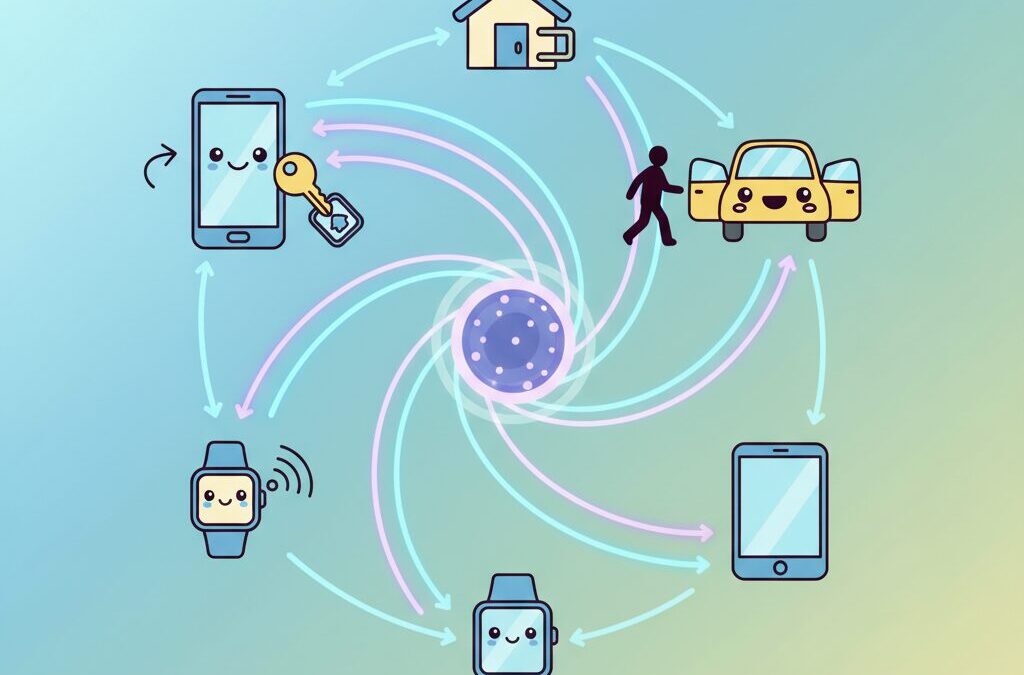
Have you ever wondered why your smartphone can now guide you to a lost key with an arrow, or why modern cars unlock themselves securely as you approach them?
Behind these seemingly magical experiences is Ultra-Wideband (UWB), a wireless technology that is quietly redefining how devices understand physical space.
Unlike Wi-Fi or Bluetooth, which mainly focus on data transfer, UWB excels at knowing where things are, how far away they are, and even which direction they are moving.
For gadget enthusiasts outside Japan, UWB is especially fascinating because it represents a shift from devices that simply connect to devices that perceive their surroundings.
From Apple AirTag and Android trackers to next-generation digital car keys and smart locks, UWB is becoming a core feature of premium and soon mainstream products.
In this article, you will discover how UWB works at a technical level, why it is far more accurate indoors than other wireless technologies, and how it is being adopted across consumer gadgets, mobility, and even healthcare.
By the end, you will understand why UWB is often described as the foundation of spatial computing and why it is poised to become an essential technology in everyday life.
- From Connectivity to Spatial Understanding: Why UWB Matters Now
- Impulse Radio and Physics: How UWB Achieves Centimeter-Level Accuracy
- Time of Flight and Angle of Arrival: The Core Positioning Technologies
- Why UWB Works So Well Indoors: Multipath Resistance Explained
- Security Advantages: How UWB Stops Relay Attacks Physically
- UWB in Consumer Gadgets: Trackers, Smart Locks, and Smartphones
- Automotive Applications: Digital Keys and Child Presence Detection
- Industrial and Healthcare Use Cases: RTLS and Contactless Sensing
- Market Growth and Future Outlook Toward 2030
- 参考文献
From Connectivity to Spatial Understanding: Why UWB Matters Now
For more than two decades, short-range wireless technologies have been evaluated primarily by how fast and how efficiently they can move data. Wi‑Fi pushed throughput into the gigabit era, and Bluetooth untethered audio and peripherals from cables. However, as these technologies matured, a critical gap became increasingly visible: they can connect devices, but they cannot truly understand where those devices are in physical space. Ultra-Wideband, or UWB, matters now because it directly addresses this long‑standing limitation.
UWB represents a shift from simple connectivity to spatial understanding. Instead of asking only whether two devices are linked, UWB continuously answers more human questions: How far away is it? In which direction? Is there a wall or an obstacle between us? According to analyses by the FiRa Consortium and semiconductor leaders such as Qorvo, this transition is possible because UWB measures time and space at the nanosecond scale, something legacy short‑range radios were never designed to do.
This change is not theoretical. The resurgence often described as “UWB 2.0” is driven by concrete needs in today’s devices. Smartphones have become functionally similar across brands, pushing manufacturers to seek differentiation through contextual experiences. At the same time, industries such as automotive and smart home have faced real security and usability problems that signal-strength-based wireless cannot solve. UWB’s ability to measure true distance using time of flight has turned spatial accuracy into a practical feature rather than a laboratory experiment.
| Aspect | Conventional Short-Range Wireless | Ultra-Wideband |
|---|---|---|
| Primary focus | Data transfer and connection stability | Distance, direction, and spatial context |
| Typical accuracy | Meters, highly environment-dependent | Centimeters, even indoors |
| User experience | Manual interaction often required | Implicit, location-aware interaction |
Authoritative sources such as Murata Manufacturing and IEEE working groups emphasize that this precision fundamentally changes how digital systems interact with the real world. Devices equipped with UWB no longer rely on probabilistic guesses derived from signal strength. Instead, they operate on measurable physical properties, aligning digital logic with the laws of physics. This is why UWB is increasingly described not as a faster radio, but as a new type of sensor.
In markets like Japan, where indoor environments are dense and spatial constraints are tight, the value of this capability becomes even clearer. Accurate spatial awareness enables devices to behave appropriately without explicit commands, reducing friction and errors. UWB matters now because modern computing has reached a point where understanding space is more valuable than simply moving more data. As connectivity becomes a given, spatial intelligence is emerging as the next competitive frontier.
Impulse Radio and Physics: How UWB Achieves Centimeter-Level Accuracy
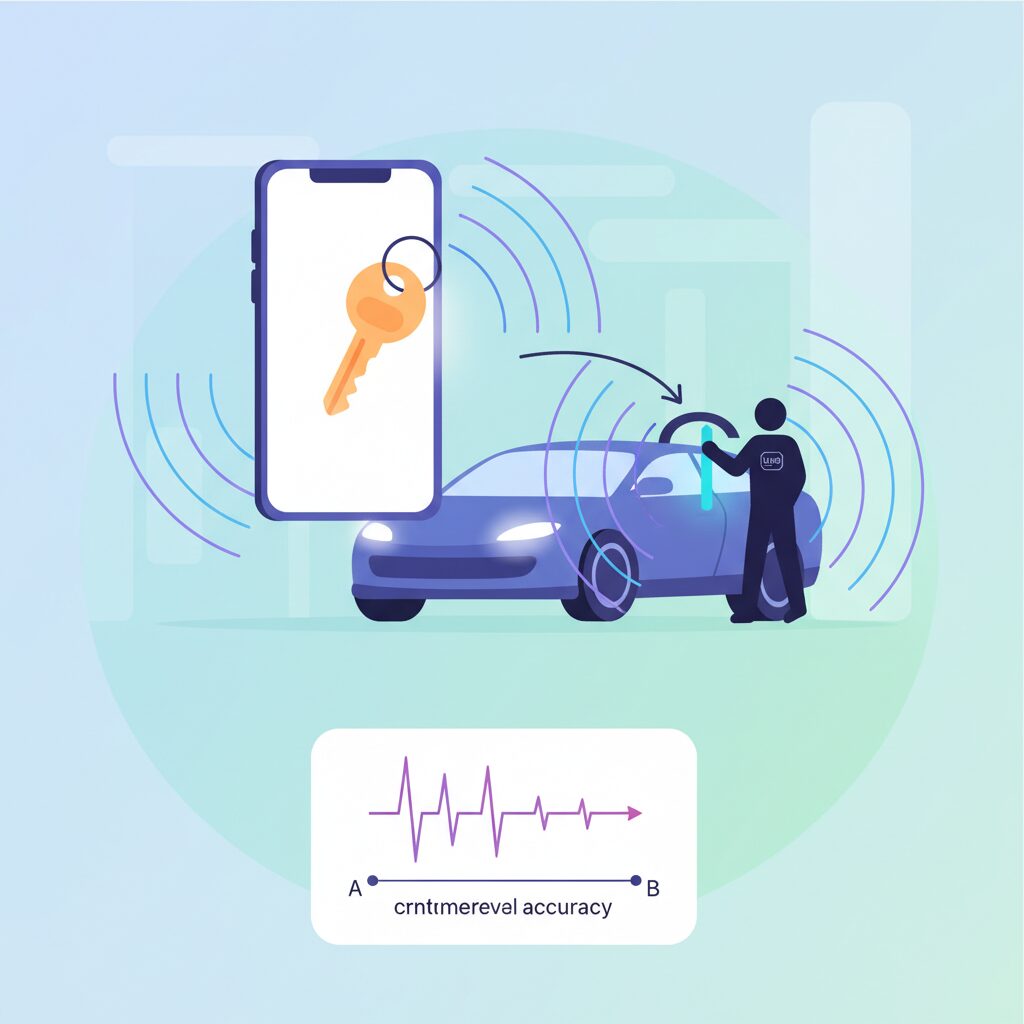
Ultra-Wideband reaches centimeter-level accuracy because it relies on impulse radio, a signaling method that treats time itself as the primary measurement axis. Instead of transmitting a continuous carrier wave, UWB emits extremely short pulses on the order of nanoseconds or even picoseconds. **By compressing energy into such brief moments, the system gains the ability to resolve distance with extraordinary precision**, something conventional narrowband radios cannot achieve.
From a physics perspective, distance estimation is reduced to a simple but unforgiving equation: distance equals propagation time multiplied by the speed of light. A pulse width of one nanosecond corresponds to roughly 30 centimeters of spatial resolution. According to white papers published by Qorvo and Murata Manufacturing, modern UWB chipsets control timing at sub-nanosecond granularity, allowing practical accuracy to improve from tens of centimeters down to just a few centimeters under real-world conditions.
This timing-centric approach is reinforced by the ultra-wide bandwidth itself. Because UWB spreads its signal over more than 500 MHz, the power spectral density remains extremely low, often at or below the environmental noise floor. **This enables precise pulse detection without disturbing or being disturbed by Wi‑Fi or cellular signals**, a coexistence property emphasized in IEEE 802.15.4z technical documentation.
| Radio Property | Conventional Wireless | UWB Impulse Radio |
|---|---|---|
| Signal duration | Continuous or long symbols | Nanosecond-scale pulses |
| Distance metric | Signal strength (RSSI) | Time of flight |
| Typical accuracy | Meters | Centimeters |
Another crucial advantage emerges in multipath environments. In indoor spaces filled with walls, furniture, and metal surfaces, reflected signals usually corrupt measurements. With impulse radio, however, the direct path arrives earlier in time than reflected paths. Receivers simply lock onto the first detected pulse, discarding later echoes. Research summarized in MDPI Sensors confirms that this temporal separation is a key reason why UWB maintains accuracy in homes, factories, and vehicles.
In practice, this physics translates directly into user experience. When a smartphone points unambiguously toward a lost object or a car unlocks only when the owner is truly nearby, it is not software cleverness alone at work. **It is the raw measurability of space enabled by impulse radio**, turning time resolution into spatial awareness with a level of certainty that earlier wireless technologies were never designed to deliver.
Time of Flight and Angle of Arrival: The Core Positioning Technologies
Ultra-Wideband positioning reaches its true potential through the combination of Time of Flight and Angle of Arrival, two measurement techniques that translate raw radio signals into spatial awareness. Rather than estimating proximity from signal strength, UWB measures space itself, which is why modern devices can point you toward an object instead of merely telling you that it is nearby.
Time of Flight, often implemented as Double-Sided Two-Way Ranging, calculates distance by measuring how long a radio pulse takes to travel between devices. Because UWB pulses are transmitted in nanosecond or even picosecond durations, distance resolution becomes extremely fine. According to technical explanations published by Qorvo and Murata Manufacturing, this approach reliably achieves accuracy on the order of several centimeters, even when devices use independent internal clocks.
The key advantage of DS-TWR is clock error cancellation. By exchanging multiple timestamps in both directions, each device mathematically removes clock drift from the calculation. This is fundamentally different from Bluetooth RSSI methods, where fluctuating signal strength and environmental noise directly translate into distance errors.
Angle of Arrival complements this distance measurement by determining direction. AoA relies on multiple antennas placed a few millimeters apart on the receiving device. When a UWB pulse arrives from an angle, it reaches each antenna at a slightly different time. These phase differences are processed geometrically to estimate direction, such as whether the signal is coming from the left, right, or straight ahead.
Research summaries from IEEE 802.15.4z working groups describe how AoA transforms UWB from a ranging tool into a true positioning system. Distance alone defines a circle around the receiver, but adding angle collapses that uncertainty into a precise point in space. This is the technical foundation behind arrow-based guidance interfaces seen in high-end trackers and smartphones.
| Technique | Primary Output | Typical Accuracy |
|---|---|---|
| Time of Flight | Linear distance | Several centimeters |
| Angle of Arrival | Horizontal direction | Within a few degrees |
| Combined Use | Full 2D/3D position | Centimeter-level positioning |
What makes this pairing especially powerful is its robustness indoors. UWB pulses arrive at the receiver as a sequence of distinct paths: the direct signal first, followed by reflections from walls or furniture. Because these pulses are so short, the receiver can isolate the earliest arrival and ignore later echoes. As documented in multiple Rohde & Schwarz and IEEE analyses, this time-domain separation allows ToF and AoA to remain stable even in dense multipath environments.
From a user perspective, this technical rigor translates into intuitive experiences. When a smartphone guides you toward a lost item with real-time arrows, it is continuously recalculating distance via ToF while refining direction via AoA. Apple and Google have both emphasized in developer documentation that neither technique alone would deliver this level of responsiveness or trust.
In essence, Time of Flight provides certainty about how far away something is, while Angle of Arrival explains where to move next. Together, they form the core positioning logic that elevates UWB from a wireless protocol into a spatial interface, one that understands physical relationships rather than abstract signal levels.
Why UWB Works So Well Indoors: Multipath Resistance Explained
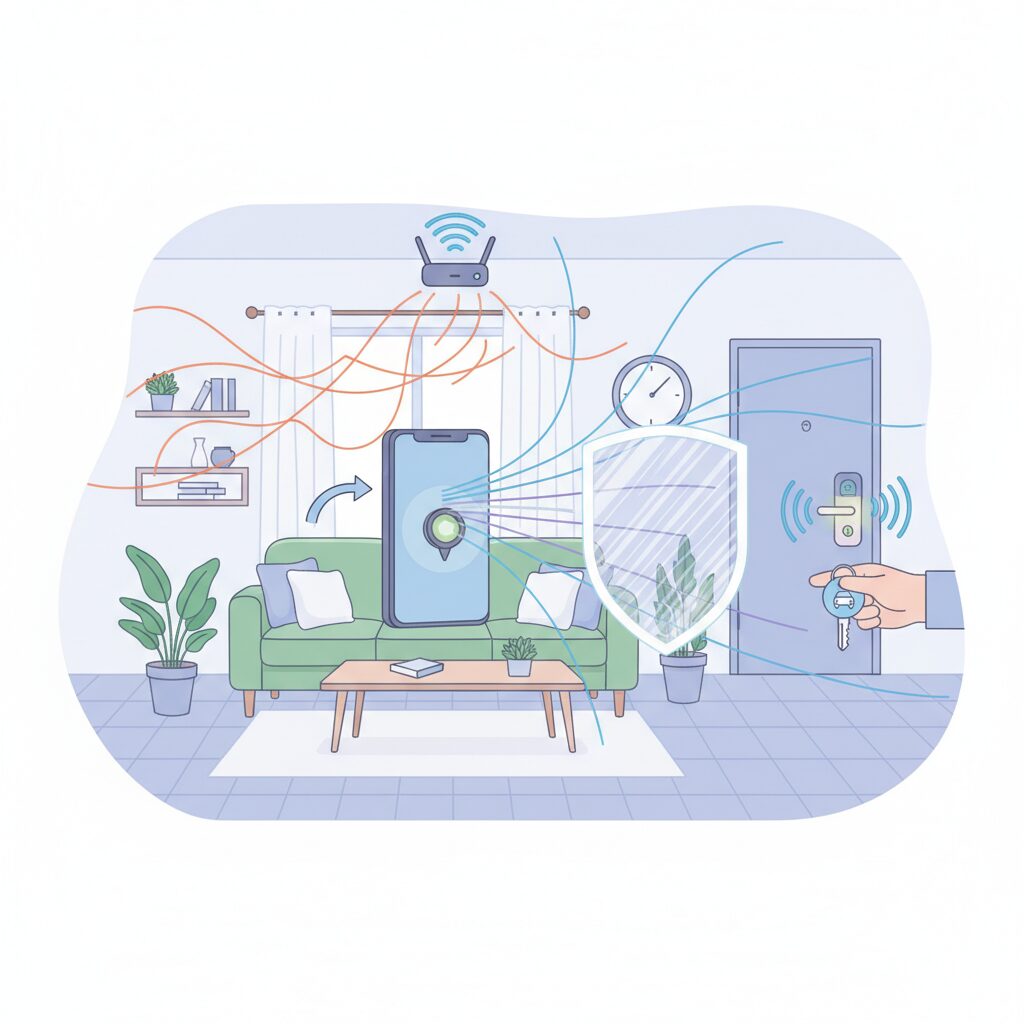
Ultra-Wideband performs exceptionally well indoors because its signal design directly addresses the core problem of multipath propagation. In homes and offices, radio waves constantly reflect off walls, ceilings, furniture, and metal objects. **These reflections confuse conventional wireless systems, but UWB is engineered to separate them rather than average them.**
At the heart of this advantage is impulse radio. UWB transmits extremely short pulses on the order of nanoseconds, which makes time resolution far finer than Bluetooth or Wi-Fi. According to explanations published by Qorvo and Murata Manufacturing, this temporal sharpness allows the receiver to distinguish individual signal paths in the time domain instead of merging them into one unstable measurement.
| Technology | Measurement Basis | Indoor Multipath Impact |
|---|---|---|
| Bluetooth (RSSI) | Signal strength | Highly unstable due to reflections |
| Wi-Fi RTT | Round-trip timing | Affected by overlapping paths |
| UWB | First-path time of flight | Minimal error even in dense reflections |
In practical terms, the receiver simply locks onto the very first pulse that arrives. Reflected signals arrive a few nanoseconds later and are ignored. **This ability to extract the direct path is why UWB distance estimates remain stable even in cluttered Japanese apartments or steel-framed offices.**
Academic studies summarized in IEEE 802.15.4z documentation and MDPI Sensors also show that this first-path detection drastically reduces non-line-of-sight errors. Instead of guessing based on fluctuating power levels, UWB measures physics itself: propagation time at the speed of light.
For gadget users, this means indoor positioning that feels reliable rather than probabilistic. When a device says it is 1.2 meters away, that number does not jump erratically as you move. **Multipath resistance is not a side benefit of UWB; it is the very reason indoor spatial awareness finally works as expected.**
Security Advantages: How UWB Stops Relay Attacks Physically
One of the most compelling reasons UWB is being adopted in high‑value gadgets and vehicles is its ability to stop relay attacks at the physical layer. Traditional wireless authentication relies heavily on signal strength or encrypted challenge–response schemes. These can be mathematically strong, yet they still assume that the radio path itself is trustworthy. **Relay attacks exploit this assumption by extending the radio path**, making a distant device appear deceptively close.
In contrast, UWB bases trust not only on cryptography but also on immutable laws of physics. By measuring the exact time it takes for radio pulses to travel between devices, UWB can verify proximity with centimeter‑level certainty. This approach fundamentally changes the threat model, because an attacker cannot cheat the speed of light.
| Technology | Proximity Check | Relay Attack Resistance | Typical Risk |
|---|---|---|---|
| Bluetooth LE | Signal strength (RSSI) | Low | Signal amplification and replay |
| NFC | Very short range | Medium | Specialized relay hardware |
| UWB | Time of Flight (ToF) | Very High | Physically impractical |
UWB systems implement what security researchers call distance bounding protocols. According to analyses referenced by the FiRa Consortium and IEEE 802.15.4z documentation, the device sends nanosecond‑scale challenge pulses and expects an immediate response. **Any attempt to relay or buffer these pulses introduces measurable delay**, often just a few nanoseconds, yet enough to correspond to tens of centimeters of extra distance.
For example, in a car digital key scenario, a legitimate smartphone inside a pocket near the driver’s door may measure a round‑trip time consistent with one meter. A relay attacker standing outside the house would inevitably add processing and transmission delay, pushing the measured distance beyond the vehicle’s acceptance threshold. The system does not need to “suspect” an attack; it simply concludes that the key is too far away.
UWB does not try to detect malicious behavior. It verifies physical reality.
This distinction is crucial. Security experts from semiconductor vendors such as Qorvo emphasize that UWB’s protection works even if the attacker has powerful radios and perfect knowledge of the protocol. Unlike encryption algorithms, which may weaken over decades, **time‑of‑flight verification remains robust as long as physics remains unchanged**.
Another advantage is predictability in complex indoor environments. Because UWB can separate direct paths from reflected signals, attackers cannot rely on multipath effects to mask delay. Studies summarized in MDPI Sensors note that impulse‑based ranging maintains accuracy even in non‑line‑of‑sight conditions, closing off another common exploitation path.
For gadget enthusiasts, this means everyday security gains that are invisible yet profound. Cars unlock only when you are truly next to them. Smart locks respond to intentional presence, not amplified radio echoes from another room. **UWB turns proximity from a guess into a measurable fact**, and in doing so, it raises the cost of attack from clever hacking to near‑impossible physical manipulation.
UWB in Consumer Gadgets: Trackers, Smart Locks, and Smartphones
Ultra-wideband has quietly moved from a niche radio technology to a defining feature of everyday consumer gadgets. In trackers, smart locks, and smartphones, UWB is valued not for raw data speed but for its ability to understand precise distance and direction, which fundamentally changes how users interact with devices.
What distinguishes UWB in consumer products is centimeter-level accuracy in real-world indoor environments. According to analyses published by the FiRa Consortium and semiconductor vendors such as Qorvo, impulse-based ranging allows devices to identify the first arriving signal path, minimizing errors caused by reflections from walls or furniture. This reliability is what makes visual guidance and hands-free authentication practical rather than gimmicky.
| Device Category | Primary Benefit of UWB | User Impact |
|---|---|---|
| Trackers | Precise ranging and direction finding | Visual, arrow-based guidance instead of sound-only search |
| Smart Locks | Distance-bounded authentication | Intent-aware, hands-free unlocking with higher security |
| Smartphones | Spatial awareness for nearby devices | Contextual interactions triggered by proximity |
In item trackers, UWB has redefined expectations. Apple’s Precision Finding demonstrated that knowing whether an object is 1.5 meters ahead or behind matters more than hearing a beep. Industry observers note that this shift has pushed competitors to redesign both hardware and user interfaces around spatial cues rather than signal strength alone.
Smart locks represent another turning point. Traditional Bluetooth-based systems often struggled with false positives or delays. By contrast, UWB enables distance bounding that physically resists relay attacks, a point emphasized in security briefings by the Car Connectivity Consortium and academic researchers. For users, this translates into doors that unlock only when they are truly in front of them.
Smartphones act as the hub that connects these experiences. With UWB chips embedded in flagship models from Apple and Google, proximity itself becomes an input method. The device no longer waits for a tap or command but responds to where the user is standing. This subtle change signals a broader shift toward spatially aware consumer electronics.
Automotive Applications: Digital Keys and Child Presence Detection
In the automotive domain, UWB is redefining how drivers interact with vehicles, particularly through digital keys and child presence detection. These applications move UWB beyond convenience and position it as a core safety and security technology. **The key shift is that the car no longer just receives a signal, but understands distance, direction, and context in real time**, which fundamentally changes in‑vehicle intelligence.
Digital keys based on the Car Connectivity Consortium’s Digital Key Release 3.0 are a representative example. Unlike NFC-based solutions that require intentional tapping, UWB-enabled digital keys allow hands-free access while maintaining strong security. According to the CCC and BMW’s implementation of Digital Key Plus, the vehicle continuously measures precise distance using time-of-flight, making relay attacks physically impractical. This approach has been highlighted by FiRa Consortium as a breakthrough in access control because it relies on immutable physical laws rather than signal strength alone.
| Aspect | Conventional Smart Key | UWB Digital Key |
|---|---|---|
| Authentication range | Ambiguous, RSSI-based | Centimeter-level accuracy |
| Relay attack resistance | Limited | Physically enforced |
| User action | Button or tap required | Completely hands-free |
This precision also enables nuanced behavior. For example, the car can unlock only when the authorized smartphone is detected at the driver’s door, not merely nearby. Industry engineers note that this directional awareness reduces false unlocks in dense urban parking, a concern often raised in Japan. **Security and usability improve simultaneously**, which is why major OEMs are accelerating UWB adoption even in mid-range models.
Equally impactful is child presence detection, an area where UWB’s radar capability becomes critical. Research and product demonstrations by Tokai Rika and MinebeaMitsumi show that in-cabin UWB sensors can detect micro-motions such as breathing. Unlike camera-based systems, UWB does not rely on visibility and works even when a child is covered by a blanket. This capability has been acknowledged in Euro NCAP discussions, where CPD is increasingly treated as a safety differentiator.
The architectural advantage is cost efficiency. By sharing hardware between digital key communication and in-cabin sensing, manufacturers can reduce component count. **This convergence lowers the barrier for mass-market vehicles**, making advanced safety features viable beyond premium segments. Analysts from MarketsandMarkets point out that such multi-purpose use cases are a major driver behind the rapid growth of automotive UWB deployments.
From a user perspective, these technologies quietly change expectations. Drivers no longer think about unlocking, and parents gain an invisible layer of protection without cameras or wearables. As automotive researchers frequently emphasize, UWB succeeds here because it blends into the background, providing safety and trust without demanding attention. This subtlety may ultimately be its strongest value proposition.
Industrial and Healthcare Use Cases: RTLS and Contactless Sensing
In industrial and healthcare settings, UWB is valued less for flashy user interfaces and more for its ability to deliver reliable spatial truth in complex environments. Factories, warehouses, and hospitals are filled with metal, walls, and moving people, where conventional radio-based positioning often becomes unstable. **UWB-based RTLS provides centimeter-level accuracy even under severe multipath conditions**, which fundamentally changes how assets, people, and workflows can be managed.
In manufacturing and logistics, UWB RTLS has already been validated by large-scale deployments. According to analyses cited by MarketsandMarkets and IEEE-related industry reports, UWB systems routinely achieve 10–30 cm accuracy indoors, compared to several meters for Wi‑Fi or BLE. This precision allows companies to move beyond “zone-level” tracking and toward process-level optimization, such as identifying which workstation a tool is at or how long a pallet waits before the next operation.
| Use Case | Required Accuracy | Operational Impact |
|---|---|---|
| Tool tracking in factories | 10–20 cm | Prevents loss and reduces search time |
| AGV navigation | 20–30 cm | Stable autonomous routing indoors |
| Hospital asset tracking | 30–50 cm | Improves equipment utilization |
Japanese manufacturers in particular see UWB RTLS as a practical foundation for DX initiatives. Research referenced by the Ministry of Internal Affairs and Communications highlights that **precise location histories enable quantitative analysis of worker movement**, revealing bottlenecks that were previously invisible. This data-driven approach aligns closely with lean manufacturing and continuous improvement practices long established in Japan.
In healthcare, UWB’s contactless sensing capability is gaining attention alongside RTLS. Clinical studies conducted by Japanese university hospitals, including work reported through national clinical research portals, show that UWB radar can detect respiration and body motion during sleep without attaching electrodes. **This reduces patient burden while still providing medically useful signals**, especially for screening sleep apnea or monitoring elderly patients at risk of nocturnal incidents.
Unlike camera-based systems, UWB respects privacy by capturing motion rather than images. Companies such as NOVELDA, frequently cited in international sensor research journals, demonstrate that UWB can reliably detect human presence and falls even in bathrooms or behind obstacles. For aging societies, this balance between safety and dignity is critical.
Across both industry and healthcare, the common value proposition is trust. **UWB delivers location and presence data that operators and clinicians can rely on**, not averages blurred by radio noise. As adoption expands, RTLS and contactless sensing are no longer experimental tools but quietly becoming core infrastructure for safer, more efficient real-world operations.
Market Growth and Future Outlook Toward 2030
The global UWB market is entering a decisive expansion phase toward 2030, driven not by raw data throughput, but by the monetization of spatial intelligence. According to market analyses by MarketsandMarkets and Stratistics MRC, the worldwide UWB market is projected to grow from approximately USD 2.4 billion in 2024 to between USD 7.8 billion and USD 17.6 billion by 2030, representing a CAGR of 15–21 percent. **This growth trajectory places UWB among the fastest-growing short-range wireless technologies**, alongside Wi‑Fi 7 and advanced automotive radar.
A defining characteristic of this growth is the diversification of demand sources. Early adoption was heavily skewed toward smartphones and asset trackers, but momentum is now shifting toward automotive, smart infrastructure, and sensing-centric use cases. Analysts at Yano Research Institute highlight that Japan, in particular, is transitioning from B2B-led RTLS deployments to B2C-driven consumer and mobility applications, a structural shift expected to accelerate after 2025.
| Segment | Growth Driver | 2030 Outlook |
|---|---|---|
| Smartphones & Wearables | Platform-level UWB APIs | Mass-market standard feature |
| Automotive | Digital Key 3.0, CPD | Mandatory in mid-range vehicles |
| Smart Home | Hands-free authentication | Integrated with Matter |
| Healthcare & Elder Care | Non-contact sensing | Rapid institutional adoption |
From an investment perspective, UWB’s future outlook is strengthened by ecosystem-level commitment. The FiRa Consortium and IEEE 802.15.4z standardization have reduced fragmentation, while Apple, Google, Samsung, and major automotive OEMs are aligning roadmaps around interoperable UWB stacks. **This convergence significantly lowers the risk profile for developers and hardware vendors**, encouraging long-term R&D and cost reduction through scale.
Japan’s market outlook deserves special attention. Following regulatory relaxation by the Ministry of Internal Affairs and Communications, outdoor UWB usage has become viable, unlocking automotive and urban infrastructure scenarios. Combined with societal factors such as an aging population and dense indoor environments, UWB-based presence detection and safety monitoring are forecast to see above-global-average growth rates domestically, according to industry observers and academic research groups.
Looking toward 2030, the most important shift is qualitative rather than quantitative. UWB is evolving from a discrete feature into an invisible layer of context awareness embedded across devices and environments. **As costs decline and power efficiency improves, UWB is expected to transition from premium differentiation to baseline capability**, much like GPS or Bluetooth today. This transformation positions UWB not as a niche wireless option, but as a foundational technology for spatially aware computing in the coming decade.
参考文献
- Wikipedia:Ultra-wideband
- FiRa Consortium:Introduction to Impulse Radio UWB Seamless Access Systems
- Qorvo:Getting Back to Basics with Ultra-Wideband (UWB)
- Murata Manufacturing:What Is Ultra-wideband (UWB) Wireless Communication?
- MarketsandMarkets:Ultra-Wideband Market Forecast to 2030
- MDPI Sensors:Human Being Detection from UWB NLOS Signals