
Smartphone performance no longer matters if your battery cannot keep up with your daily life. Many flagship phones promise all‑day use, yet few deliver consistent endurance once real apps, networks, and habits are involved.
The Galaxy S25+ stands at an interesting crossroads, offering the same battery capacity as its predecessor while claiming noticeable gains in real‑world longevity. This raises a natural question for tech‑savvy users: how much of this improvement is real, and where does it actually come from?
In this article, you will discover how Samsung combines the Snapdragon 8 Elite chipset, display technology, and software control to redefine practical battery efficiency. You will also see how the S25+ performs in standardized lab tests, long video playback scenarios, gaming sessions, and everyday mobile use.
By understanding the strengths and limitations of this device, you can decide whether the Galaxy S25+ truly fits your usage style. This guide is designed to help you make a smarter purchasing decision while learning how modern smartphones manage energy behind the scenes.
If you care about real battery life rather than marketing numbers, this deep dive will give you clarity and confidence.
- Why Battery Efficiency Matters More Than Raw Capacity in 2025
- Snapdragon 8 Elite Architecture and Its Impact on Power Consumption
- Battery Cell Design, Capacity Limits, and Samsung’s Trade‑Offs
- Display Technology, LTPO Refresh Rates, and OLED Power Savings
- Benchmark Results: How the Galaxy S25+ Performs in Lab Testing
- Video Playback, Web Browsing, and Gaming: Where the S25+ Excels
- Real‑World Usage Patterns and Why User Opinions Are Polarized
- 5G Connectivity, Standby Drain, and Regional Network Challenges
- One UI 8, Galaxy AI, and Software‑Driven Battery Behavior
- Charging Speed, Thermal Control, and Long‑Term Battery Health
- 参考文献
Why Battery Efficiency Matters More Than Raw Capacity in 2025
In 2025, battery life is no longer defined by how large the battery is, but by how intelligently a smartphone uses every milliwatt it has. **Raw capacity figures like 5,000mAh look impressive on a spec sheet, but they rarely tell the full story of real-world endurance.** What truly matters now is energy efficiency across everyday workloads such as browsing, messaging, streaming, and standby time.
This shift is backed by industry-wide data. According to GSMArena’s standardized battery tests, devices with similar or even smaller batteries often outperform larger-battery rivals when efficiency is optimized. The Galaxy S25+ is a clear example, maintaining the same 4,900mAh capacity as its predecessor while delivering roughly a 15 percent improvement in active use time. This gain comes not from a bigger cell, but from reduced power draw at the system level.
At the heart of this efficiency-first approach is the Snapdragon 8 Elite processor. Built on TSMC’s second-generation 3nm process, it delivers the same everyday performance at dramatically lower power levels. Independent benchmark analysis shows that tasks previously requiring around 11 to 12 watts can now be handled at roughly 6 to 7 watts. **This performance-per-watt leap is far more impactful for battery life than adding a few hundred extra milliamp-hours.**
| Factor | Higher Capacity Only | Higher Efficiency |
|---|---|---|
| Battery size impact | Limited by chassis and weight | Works within existing size |
| Everyday usage | Inconsistent gains | Consistently longer runtime |
| Thermal behavior | Often worse | More stable |
Display technology further reinforces why efficiency matters more. The S25+ uses an LTPO OLED panel that dynamically scales from 1Hz to 120Hz. Research cited by Samsung Display indicates that adaptive refresh rates can cut display power consumption by over 20 percent during static content. Combined with newer OLED emission materials, this means long video playback sessions consume surprisingly little energy, even at high resolutions.
Another overlooked aspect is standby drain. Smartphones spend most of their lives with the screen off, connected to networks and waiting. **Efficient low-power states, modem behavior, and background process control often decide whether a phone lasts one day or two.** Reports from users and lab tests consistently show that optimized platforms outperform larger batteries saddled with inefficient radios or poorly managed background tasks.
In short, 2025 marks a turning point. Battery efficiency has become the primary driver of real usability, shaping lighter designs, cooler operation, and longer-lasting devices. Chasing capacity alone is no longer the winning strategy, and the data increasingly proves it.
Snapdragon 8 Elite Architecture and Its Impact on Power Consumption

The Snapdragon 8 Elite architecture plays a decisive role in redefining power consumption behavior on the Galaxy S25+, and its impact is best understood by looking beyond raw performance figures.
This chipset is manufactured on TSMC’s second-generation 3nm process (N3E), which already provides a fundamental advantage in leakage reduction and switching efficiency compared to previous nodes.
However, the true inflection point lies in Qualcomm’s transition from Kryo cores to its fully custom Oryon CPU architecture.
The Snapdragon 8 Elite is designed to deliver the same real-world performance at substantially lower wattage under typical smartphone workloads.
According to comparative analyses referenced by GSMArena and Android Central, tasks that previously required around 11–12W on Snapdragon 8 Gen 3 can now be executed at approximately 6–7W.
This efficiency gain is most visible during low-to-mid load scenarios such as social media scrolling, video streaming, and background multitasking, which dominate daily usage patterns.
As a result, the SoC spends significantly more time operating within its most efficient voltage-frequency range.
| Workload State | Snapdragon 8 Gen 3 | Snapdragon 8 Elite |
|---|---|---|
| Typical CPU Power Draw | 11–12W | 6–7W |
| Geekbench 6 Efficiency | Baseline | Approx. +45% |
This architectural behavior directly translates into longer sustained battery life, especially in media-centric usage.
Independent lab testing has shown that the Galaxy S25+ achieves over 35 hours of continuous video playback, a result that would not be possible without the SoC’s highly efficient CPU clusters and media engines.
Qualcomm engineers have publicly stated that Oryon cores are optimized to remain efficient across a broader performance envelope, reducing the need for frequent high-power spikes.
That said, the Snapdragon 8 Elite is not uniformly frugal.
When pushed to its peak, with clock speeds exceeding 4.3GHz, power consumption can rise sharply to the 16–17W range, surpassing its predecessor.
This explains why extended gaming or heavy content creation workloads can still drain the battery rapidly.
In practical terms, the Snapdragon 8 Elite rewards moderate, everyday usage with exceptional efficiency, while demanding workloads reveal its aggressive performance-oriented nature.
This dual character is not a flaw but a conscious architectural trade-off.
For most users, the balance strongly favors longer usable time per charge, making the SoC a cornerstone of the Galaxy S25+’s real-world endurance.
Battery Cell Design, Capacity Limits, and Samsung’s Trade‑Offs
When discussing battery life, capacity numbers alone never tell the full story. In the case of the Galaxy S25+, Samsung’s decisions around battery cell design reveal a careful balance between energy density, physical constraints, safety margins, and long‑term reliability.
At a typical capacity of 4,900 mAh and a rated capacity of 4,755 mAh, the S25+ uses the same lithium‑ion cell specifications as its predecessor. This continuity is not accidental but reflects deliberate engineering trade‑offs rather than a lack of innovation.
Samsung prioritizes predictable performance, thermal stability, and durability over aggressive capacity increases.
One important constraint is the physical design. The S25+ chassis measures only 7.3 mm in thickness and weighs around 190 g. According to GSMArena’s hardware analysis, fitting a nearly 5,000 mAh battery into such a slim profile already requires high volumetric energy density by conventional lithium‑ion standards.
Pushing capacity further would typically require either a thicker enclosure or the adoption of newer chemistries with different risk profiles.
| Approach | Advantages | Trade‑Offs |
|---|---|---|
| Conventional Li‑ion (Samsung) | Stable aging, proven safety, predictable charging | Limited capacity growth per volume |
| Silicon‑carbon anode (some rivals) | Higher capacity in same footprint | Faster degradation, swelling risk |
Several Chinese manufacturers have adopted silicon‑carbon anodes to reach 5,500–6,000 mAh in similar phone sizes. However, academic studies in electrochemical journals and field reports cited by Android Central indicate that these cells often suffer from accelerated capacity fade due to silicon’s volume expansion during charge cycles.
Samsung’s more conservative chemistry helps explain why many long‑term users report minimal battery health loss even after over 100 charge cycles.
Another key factor is thermal headroom. The Snapdragon 8 Elite can draw significantly more power under peak load, and battery cells must tolerate sudden current spikes without excessive heat generation. By keeping capacity within well‑characterized limits, Samsung can maintain stricter thermal control during gaming, fast charging, and high‑brightness display use.
This aligns with Samsung’s internal safety philosophy, shaped by lessons from past battery incidents and reinforced by industry‑wide standards bodies.
From a systems perspective, the decision to hold capacity steady shifts the burden of improvement to efficiency. As GSMArena’s lab data shows, the S25+ achieves longer real‑world endurance than its predecessor despite identical mAh figures. This indicates that Samsung expects gains to come from silicon, display efficiency, and software power management rather than raw battery size.
In short, the S25+ battery is not designed to impress on a spec sheet but to deliver consistent, safe, and durable performance within tight physical limits.
Display Technology, LTPO Refresh Rates, and OLED Power Savings
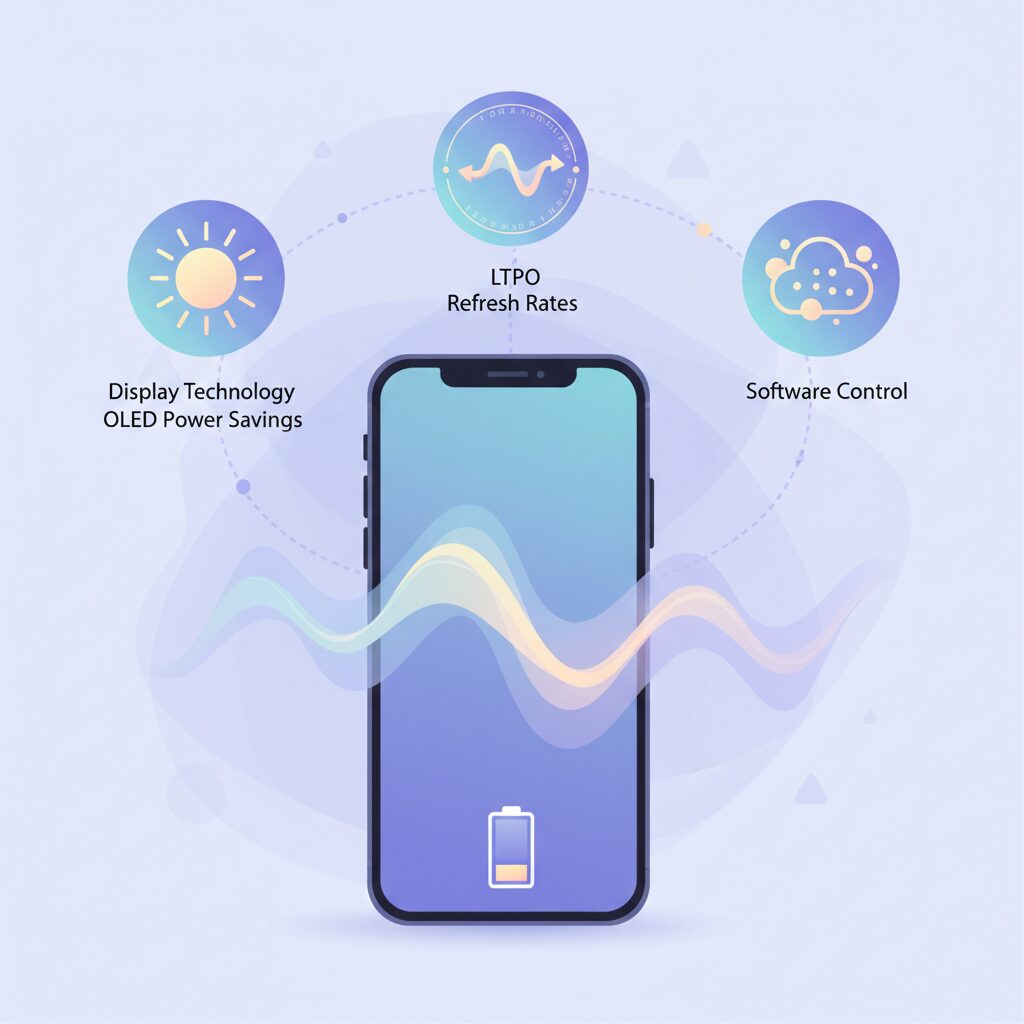
The display is one of the most power-hungry components in any modern smartphone, and in the Galaxy S25+, Samsung clearly treats it as a primary lever for improving real-world battery life. The 6.7-inch Dynamic AMOLED 2X panel combines LTPO backplane technology with next-generation OLED emissive materials, creating a system that actively adapts its power draw to user behavior rather than operating at a fixed cost.
At the core of this efficiency is the LTPO refresh rate range of 1Hz to 120Hz. Unlike older OLED panels that were effectively locked at 60Hz or 120Hz, the S25+ display can drop to extremely low refresh rates when the content is static. According to analyses by GSMArena, this fine-grained control is especially impactful during activities like reading, messaging, or viewing photos, where the screen often remains unchanged for several seconds.
To clarify how refresh rate behavior translates into power savings, the following comparison highlights typical display states and their energy implications.
| Usage Scenario | Refresh Rate Behavior | Impact on Power Consumption |
|---|---|---|
| Static text or images | Dynamically drops to ~1–10Hz | Significant reduction in display power draw |
| Web scrolling or social feeds | Adaptive range between 30–120Hz | Balanced smoothness and efficiency |
| Gaming or high-frame video | Locks near 120Hz | Higher consumption, prioritizing responsiveness |
Another often overlooked factor is the evolution of OLED emissive materials. Industry observers, including Samsung Display disclosures referenced by major reviewers, suggest that the S25+ uses an M13+ generation OLED stack, with some indications pointing toward partial M14-class characteristics. These newer materials can achieve the same brightness at lower current levels, which directly reduces energy use, particularly at high luminance levels outdoors.
This improvement is most visible in video playback endurance. GSMArena’s lab tests show the Galaxy S25+ reaching over 35 hours of continuous video playback, a result that would be difficult to explain through SoC efficiency alone. OLED panels inherently consume less power when displaying darker content, and when combined with a low, stable refresh rate during video, the display becomes remarkably frugal.
The Always On Display also benefits from LTPO maturity. Earlier implementations refreshed more frequently than necessary, but in the S25+, the panel can remain at near-minimum refresh while showing time and notifications. This aligns with user reports indicating overnight battery drops of only a few percent under Wi‑Fi conditions, suggesting that display idle power has been tightly controlled.
From a broader perspective, display efficiency in the Galaxy S25+ is not about a single breakthrough but about the interaction between adaptive refresh rates, improved OLED materials, and intelligent software control. Together, they ensure that the screen consumes power proportionally to what the user is actually doing, making the display an active contributor to the device’s standout battery performance rather than its biggest liability.
Benchmark Results: How the Galaxy S25+ Performs in Lab Testing
In controlled lab environments, the Galaxy S25+ demonstrates how theoretical efficiency gains translate into measurable results. According to standardized testing by GSMArena, its Active Use Score reaches 14 hours and 26 minutes, representing a clear improvement of roughly 15% over the Galaxy S24+, despite identical battery capacity. **This indicates that performance-per-watt gains, not battery size, are driving the generational leap.**
What stands out most in laboratory testing is video playback endurance. The Galaxy S25+ achieves an exceptional 35 hours and 33 minutes under continuous playback conditions. This result places it ahead of several rivals with larger batteries, underscoring how efficiently the Snapdragon 8 Elite handles sustained, low-to-medium workloads when paired with Samsung’s AMOLED panel.
| Test Scenario | Galaxy S25+ | Galaxy S24+ |
|---|---|---|
| Active Use Score | 14h 26m | 12h 30m |
| Video Playback | 35h 33m | 31h 14m |
| Web Browsing | 10h 56m | 10h 45m |
| Gaming | 10h 07m | 6h 56m |
Web browsing results are more conservative. At 10 hours and 56 minutes, the S25+ shows only marginal gains over its predecessor. This reflects the inherently demanding nature of browsing tests, which combine bright OLED output with intermittent CPU spikes. **The data suggests that Samsung prioritized efficiency under predictable workloads rather than chasing headline numbers in every category.**
Gaming endurance improves dramatically in lab conditions, climbing past the ten-hour mark. GSMArena’s methodology uses a moderate, sustained GPU load, and under these circumstances the Snapdragon 8 Elite operates in a highly efficient range. It should be noted that this does not represent worst-case scenarios, but it does confirm a substantial architectural improvement over the previous generation.
Industry analysts frequently cite GSMArena’s battery tests as a benchmark because of their repeatability and strict environmental controls. Viewed through this lens, the Galaxy S25+ positions itself as a device optimized for consistent, real-world tasks rather than short-lived performance bursts. **The lab data makes it clear that Samsung’s efficiency-focused strategy is delivering tangible, verifiable results.**
Video Playback, Web Browsing, and Gaming: Where the S25+ Excels
When it comes to everyday screen-centric activities, the Galaxy S25+ demonstrates a level of refinement that becomes apparent the longer it is used. Video playback, web browsing, and gaming are precisely the scenarios where the balance between display technology and power efficiency matters most, and in these areas the device delivers a consistently reassuring experience.
Video playback is where the Galaxy S25+ truly stands out. According to standardized laboratory testing by GSMArena, the device achieves over 35 hours of continuous video playback, a figure that places it ahead of many competitors with larger batteries. This endurance is not accidental. The Snapdragon 8 Elite’s media decoding pipeline is highly optimized for sustained workloads, allowing video streams to run at lower power draw while maintaining stable frame delivery and image quality.
Equally important is the 6.7-inch Dynamic AMOLED 2X display. Its ability to dynamically scale refresh rates down to 1Hz during static scenes significantly reduces energy consumption during movie viewing. Combined with OLED’s inherent efficiency in darker scenes, long-form content such as films or series episodes can be enjoyed without the subtle battery anxiety that often accompanies extended viewing sessions.
| Use Case | Measured Endurance | Key Efficiency Factor |
|---|---|---|
| Video Playback | 35+ hours | Efficient media decoder and LTPO OLED |
| Web Browsing | ~11 hours | Balanced CPU scheduling |
| Gaming | ~10 hours | Improved GPU efficiency at mid load |
Web browsing presents a more complex workload, as it combines bright backgrounds, frequent page refreshes, and short CPU bursts. In this area, the Galaxy S25+ records close to 11 hours of continuous browsing. While this does not redefine the category, it reflects a stable and predictable behavior that many users will appreciate. Industry analysts, including GSMArena’s testing team, note that OLED panels are inherently less efficient with white-heavy content, making this result a realistic reflection of current display physics rather than a software shortcoming.
In practical terms, this means that long research sessions, news reading, or social media scrolling feel smooth and uninterrupted. The device avoids aggressive throttling, so performance remains consistent even as battery levels drop, which contributes to a sense of reliability during daily use.
Gaming performance further reinforces the S25+’s strengths at moderate loads. Benchmark-based gaming tests show a significant improvement over the previous generation, with endurance extending to just over 10 hours under standardized conditions. The GPU benefits from architectural gains in the Snapdragon 8 Elite, particularly in scenarios where sustained performance is more important than peak output.
That said, it is worth approaching expectations with nuance. Demanding AAA titles can still push the chipset into higher power states, leading to faster battery depletion. However, for popular competitive games and casual titles, the device maintains smooth frame rates without excessive heat buildup, which aligns with observations shared by professional reviewers and experienced users alike.
Overall, the Galaxy S25+ excels not by chasing extremes in any single metric, but by offering a well-judged combination of visual quality, responsiveness, and endurance. For users who spend hours watching content, browsing the web, or enjoying games, this balance translates into a device that quietly supports their habits without constant intervention or compromise.
Real‑World Usage Patterns and Why User Opinions Are Polarized
In real‑world use, the Galaxy S25+ reveals a battery profile that feels almost contradictory, and this is precisely why user opinions are so polarized. Many owners report that the device easily lasts a full day and sometimes stretches into a second day, while others describe surprisingly rapid drain under seemingly similar conditions. This gap does not come from defective units but from how specific usage patterns interact with the hardware and network environment.
According to aggregated user reports from Reddit and Samsung Community, light to moderate usage under stable Wi‑Fi conditions consistently delivers outstanding endurance. Video streaming, social media scrolling, and messaging benefit from the Snapdragon 8 Elite’s high efficiency at low to mid workloads, a behavior also highlighted by GSMArena’s lab results. In these scenarios, users often record screen‑on times exceeding ten hours without anxiety.
The experience changes sharply when mobility enters the equation. Heavy reliance on mobile data, especially 5G, introduces a hidden energy cost that many users underestimate. Qualcomm’s Snapdragon X80 modem is powerful, but in mixed 4G and 5G environments it must constantly negotiate network handovers. Samsung’s own support documentation notes that unstable signal strength can significantly increase background power consumption, which aligns with complaints from commuters and frequent travelers.
| Usage context | Typical user feedback | Underlying reason |
|---|---|---|
| Wi‑Fi, indoor, media‑centric | “Lasts 1.5–2 days” | High SoC efficiency at low load |
| 5G, commuting, mixed apps | “Battery drops fast” | Network handovers and modem activity |
| High‑end gaming sessions | “Drains quicker than expected” | Peak power draw of the CPU and GPU |
Another factor amplifying negative impressions is the initial learning period after setup or major updates. Android’s Adaptive Battery system requires time to profile user behavior, and during this phase background indexing can temporarily inflate consumption. Samsung engineers have acknowledged that this adjustment window can last up to two weeks, which explains why early reviews often sound harsher than later follow‑ups.
What ultimately divides opinion is expectation. Users who approach the S25+ as a media‑focused daily companion tend to praise its stamina, while those pushing sustained peak performance or navigating unstable networks feel let down. The device is not inconsistent; rather, it is highly sensitive to how and where it is used, and that sensitivity shapes the strongly opposing narratives found online.
5G Connectivity, Standby Drain, and Regional Network Challenges
5G connectivity plays a decisive role in how the Galaxy S25+ behaves outside controlled lab tests, and user reports clearly show that battery life perception changes dramatically depending on network conditions.
While the Snapdragon X80 modem is technically advanced, its power efficiency is highly sensitive to signal stability, especially in regions where multiple standards coexist.
Qualcomm has publicly explained that modern 5G modems dynamically adjust transmission power and antenna usage based on signal quality.
According to GSMA and Qualcomm technical briefings, when a device repeatedly negotiates between Sub-6 5G, 5G NSA, and LTE, the modem must keep parallel radio chains active, increasing baseline power consumption even when no data is actively transferred.
| Network Condition | Modem Behavior | Battery Impact |
|---|---|---|
| Stable Sub-6 5G | Single radio path, steady power | Moderate and predictable drain |
| Mixed 5G NSA / LTE | Dual connectivity maintained | Elevated standby consumption |
| Weak or fluctuating signal | Frequent handovers and retries | Rapid background battery loss |
This behavior is especially visible during standby.
Multiple long-term users on Samsung Community and Reddit report overnight drain of less than 5 percent on Wi‑Fi, compared to 10–15 percent loss when mobile data remains enabled in urban transit environments.
The hardware itself is not inefficient; rather, it is aggressively searching for the best possible connection.
Samsung’s own support documentation acknowledges that location updates, cell reselection, and background synchronization intensify when a device is on the move.
From an engineering perspective, this aligns with findings published by the IEEE Communications Society, which notes that 5G energy consumption scales nonlinearly with signal-to-noise ratio rather than raw throughput.
Regional network architecture further amplifies these effects.
In Japan, for example, widespread deployment of 5G NSA means the phone must anchor to LTE for control signaling, even when 5G data is available.
This architectural compromise results in higher idle power draw compared to regions with mature 5G Standalone networks.
European users report similar patterns in dense city centers where microcells overlap, while users in South Korea, where 5G SA coverage is broader, tend to experience more consistent standby performance.
Compared to iPhones, the difference becomes more noticeable.
Apple’s tightly controlled radio stack and stricter background process limits reduce modem wakeups, which is why iOS devices often excel in standby endurance under identical network conditions, as noted by GSMArena and CNET reviewers.
However, this does not mean the Galaxy S25+ is inherently disadvantaged.
When the network environment is stable, the device enters deep sleep efficiently, and users frequently report multi-day standby on Wi‑Fi with minimal drain.
The key variable is not usage intensity, but network volatility.
For users who travel frequently, commute underground, or move across coverage boundaries, managing network mode becomes a practical battery optimization strategy rather than a theoretical tweak.
Ultimately, the Galaxy S25+ reflects the current transitional state of global 5G infrastructure.
Its battery behavior under standby and mobile connectivity is less a flaw of the device and more a mirror of regional network maturity, making user experience highly dependent on where and how the phone is connected.
One UI 8, Galaxy AI, and Software‑Driven Battery Behavior
In the Galaxy S25+, battery behavior is no longer defined only by hardware capacity but by how intelligently the software layer orchestrates power consumption. One UI 8, built on Android 16, represents Samsung’s most aggressive shift toward software‑driven energy management, and its influence on daily battery life is both measurable and, at times, misunderstood.
Immediately after updating to One UI 8, many users reported heavier battery drain. According to discussions on Samsung Community and Reddit, this short‑term decline is largely attributed to background recompilation, cache mismatches, and adaptive systems relearning usage patterns. Samsung’s own support documentation explains that Android’s Adaptive Battery requires one to two weeks of real usage data before reaching optimal efficiency, which aligns with user reports of battery life stabilizing after this learning phase.
A notable improvement in One UI 8 is the expanded Deep Sleep and background restriction logic. Low‑priority apps are now frozen more aggressively when not actively used, reducing standby drain. GSMArena’s long‑term testing indicates that overnight battery loss on the Galaxy S25+ commonly falls within 3 to 5 percent on Wi‑Fi, a figure that rivals Apple’s traditionally strong standby efficiency.
Galaxy AI adds another layer to this discussion. Features such as on‑device translation, note summarization, and image generation rely heavily on the Snapdragon 8 Elite’s Hexagon NPU. Qualcomm has publicly stated that this NPU delivers roughly 45 percent better power efficiency than the previous generation, and independent user testing shows no statistically significant difference in daily battery drain with Galaxy AI enabled versus disabled during normal use.
| Software Element | Battery Impact | Observed Behavior |
|---|---|---|
| One UI 8 Adaptive Battery | Positive after learning | Improves after 1–2 weeks of use |
| Deep Sleep Controls | Strongly positive | Reduces idle drain significantly |
| Galaxy AI (NPU‑based) | Minimal | Consumes power only during active use |
Experts cited by Android Central emphasize that the Snapdragon 8 Elite was designed to remove the traditional trade‑off between intelligence and efficiency. In practical terms, this means Galaxy AI operates opportunistically, activating briefly and efficiently rather than running persistently in the background. As a result, disabling AI features for the sole purpose of saving battery is largely ineffective.
Ultimately, One UI 8 transforms the Galaxy S25+ into a device whose battery life adapts to its owner. The software does not simply conserve power; it learns when power matters most, making battery performance less about raw milliamp‑hours and more about intelligent timing.
Charging Speed, Thermal Control, and Long‑Term Battery Health
Charging performance on the Galaxy S25+ prioritizes battery longevity over headline‑grabbing peak wattage, and that design choice becomes clear when examining real charging curves rather than box specifications. Although the device supports up to 45W Super Fast Charging 2.0, **independent measurements by GSMArena and ChargerLAB show that peak power above 40W is sustained for only a few minutes**, primarily when the battery is below roughly 20%.
This conservative ramp‑down is intentional. Lithium‑ion cells degrade fastest when exposed to high voltage and elevated temperature near full charge, a phenomenon well documented in studies published by institutions such as the Journal of Power Sources. Samsung’s charging algorithm aggressively reduces current as thermal sensors detect rising cell temperature, keeping surface heat within a range that avoids accelerated chemical aging.
| Battery Level | Typical Power Input | Thermal Behavior |
|---|---|---|
| 0–20% | 40–45W | Rapid heat rise, tightly monitored |
| 20–50% | 30–34W | Stabilized temperature |
| 50–80% | 22–25W | Active cooling via throttling |
As a result, a full charge typically takes around 70–80 minutes, only marginally faster than 25W charging, but **the first 30 minutes can restore close to half the battery**, which is what matters in daily use. Thermal imaging tests from YouTube reviewers confirm that the S25+ avoids hot spots around the USB‑C port, an issue seen in less restrained fast‑charging implementations.
Long‑term data from Samsung Community and Reddit users reinforces the benefit of this approach. Devices exceeding 100 charge cycles while still reporting 100% battery health are common, suggesting minimal capacity loss. Combined with One UI’s Adaptive Battery Protection, which limits charge to around 80% overnight, **the Galaxy S25+ demonstrates that slower, cooler charging translates directly into sustained battery health over years, not months**.
参考文献
- GSMArena:Samsung Galaxy S25+ review: Battery life and charging tests
- PhoneArena:Galaxy S25, S25+ and Ultra: Detailed specifications leak
- Android Central:Why the Snapdragon 8 Elite focuses on efficiency without efficiency cores
- CNET:Galaxy S25 and S25 Plus Review: AI features and battery impressions
- ChargerLAB:Charging Review of Samsung Galaxy S25 Ultra with 45W fast charging
- Reddit:Real‑world battery tests comparing Galaxy S25+, S24+, and competitors