
Have you ever felt that smartphone cameras are becoming unbelievably powerful, yet somehow still leave you wanting more when it comes to true long‑distance detail?
In 2025 and 2026, imaging technology is entering a fascinating phase where AI-driven smartphones and traditional optical systems are no longer simply competing, but redefining their roles. Flagship phones now promise moon shots and wildlife photos from your pocket, while dedicated telephoto lenses are undergoing a quiet but radical evolution in materials, mechanics, and performance.
For gadget enthusiasts who care about how technology really works, this shift is more than a spec war. It is about physics versus computation, photons versus algorithms, and convenience versus authenticity. Modern super‑telephoto lenses are becoming lighter, faster, and more usable than ever before, bringing extreme reach into the hands of advanced amateurs and creators.
This article will help you understand why telephoto lenses are experiencing a renaissance, how innovations like Phase Fresnel optics, linear AF actuators, and internal zoom designs are changing real-world shooting, and where smartphones still hit unavoidable physical limits. By reading on, you will gain a clearer perspective on which tools truly extend human vision in 2025 and beyond, and how to choose the right technology for the images you want to create.
- Why Optical Reach Matters Again in the AI Photography Era
- Market Trends in 2025: Convenience Versus True Optical Performance
- The Democratization of Super‑Telephoto Zoom Lenses
- Inside the Technology: Phase Fresnel Optics and Lightweight Design
- Autofocus Actuator Innovations and the Race for Speed
- Smartphones vs Telephoto Lenses: Where Physics Draws the Line
- Rolling Shutter, Sensor Speed, and Capturing Fast‑Moving Subjects
- Flagship Telephoto Lenses Defining 2025–2026
- Practical Shooting Techniques That Unlock Telephoto Potential
- Lens Mount Ecosystems and Recommended Gadget Setups
- 参考文献
Why Optical Reach Matters Again in the AI Photography Era
In the age of AI photography, it may seem counterintuitive to argue that optical reach matters more than ever, yet this is precisely what the 2025–2026 imaging landscape is showing us. Smartphone makers now rely on neural networks to reconstruct distant details, but **optical reach is about capturing photons that actually exist, not statistically inferring them after the fact**. This distinction has become increasingly visible to enthusiasts who care about texture, micro-contrast, and temporal accuracy.
Leading research in computational imaging, including analyses published in peer‑reviewed physics journals, explains that AI super‑resolution works best on predictable patterns such as buildings or text. When subjects become chaotic, like bird feathers or foliage hundreds of meters away, algorithms tend to smooth or hallucinate detail. **Optical reach directly increases the signal‑to‑noise ratio at the moment of capture**, giving AI less guesswork to do and preserving authenticity.
| Approach | Source of Detail | Limitations at Long Distance |
|---|---|---|
| AI Zoom | Statistical reconstruction | Texture collapse, temporal inconsistency |
| Optical Telephoto | Physical photon capture | Weight, cost, handling skill |
Camera industry data from Japanese retailers such as Map Camera and BCN show a clear resurgence of interest in super‑telephoto lenses during 2025. This is not nostalgia. It is a rational response to the limits of computation. As optical engineers at Nikon and Sigma have explained in technical briefings, **no amount of software can compensate for photons that never reached the sensor**. Longer focal lengths simply project more real information onto each pixel.
This matters even more in an AI era because modern cameras already use machine learning for autofocus, noise reduction, and subject recognition. When these systems are paired with strong optical reach, the result is multiplicative rather than substitutive. **AI performs best when it refines reality, not when it invents it**. Wildlife and sports photographers report higher keeper rates not because AI guesses better, but because long lenses deliver cleaner input data.
Another overlooked factor is time. Studies on rolling shutter and readout speed, highlighted by organizations such as DPReview, show that distant moving subjects amplify temporal errors. Optical reach allows photographers to fill the frame without extreme digital cropping, reducing motion artifacts and preserving geometry. This is especially critical for birds in flight or aircraft, where milliseconds matter.
In short, optical reach has regained relevance not in spite of AI, but because of it. **As computational photography becomes ubiquitous, the value of uncompromised optical data increases**. For gadget enthusiasts who want images that stand up to scrutiny today and future reprocessing tomorrow, reaching farther with glass is once again a decisive advantage.
Market Trends in 2025: Convenience Versus True Optical Performance
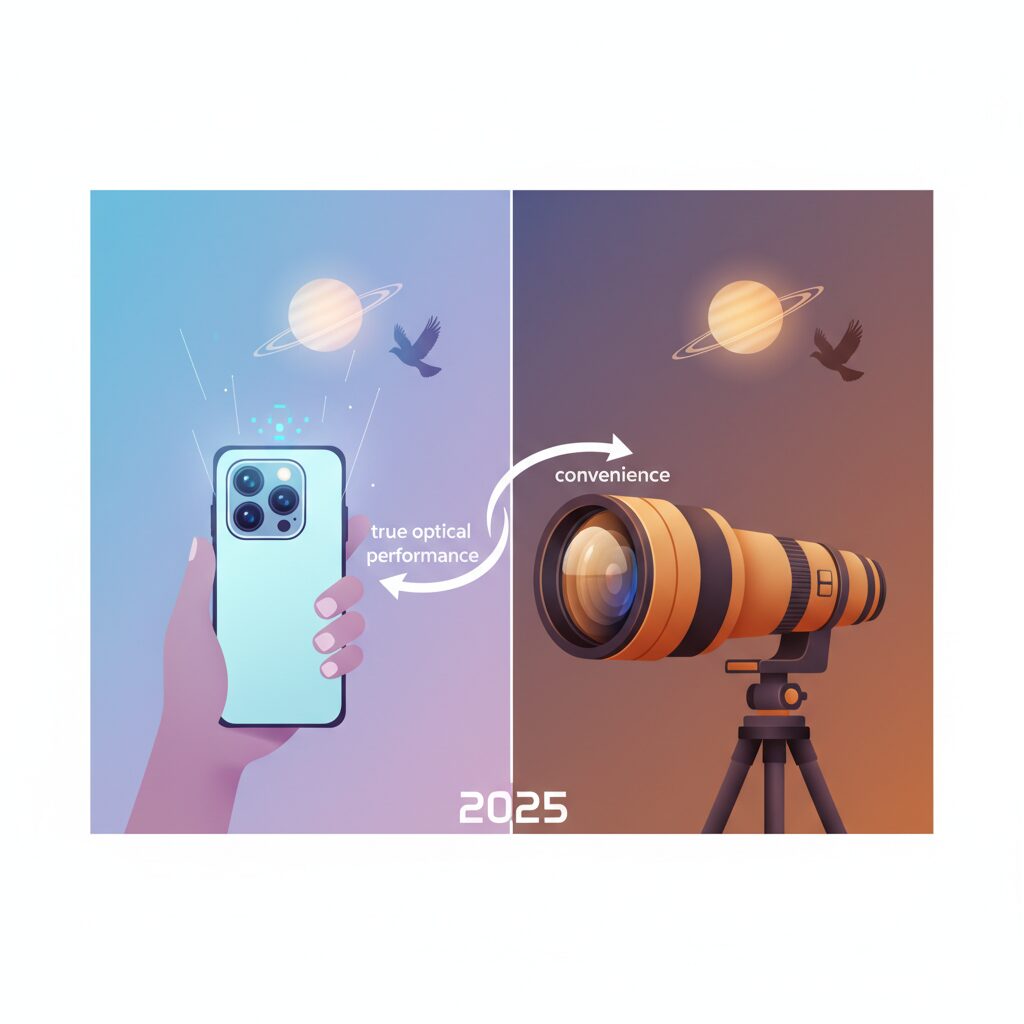
In 2025, the imaging market clearly splits between convenience-driven devices and systems that prioritize true optical performance, and this tension defines purchasing behavior among gadget enthusiasts. Smartphones equipped with periscope lenses and aggressive computational photography promise extreme reach with minimal effort, which strongly appeals to users who value immediacy and portability. According to analyses frequently cited by outlets such as Digital Camera World, these devices succeed because they reduce decision-making and physical burden, not because they redefine optical physics.
At the same time, sales data from Japanese retailers and BCN rankings indicate a counter-movement. Dedicated telephoto lenses, especially in the 180–600mm class, continue to grow year over year. **This trend suggests that many users consciously accept weight, cost, and setup time in exchange for optical authenticity.** What they seek is not an interpreted image, but light that has passed through glass, been shaped by precise engineering, and recorded with minimal algorithmic intervention.
| Aspect | Convenience-Oriented Devices | Optical-Performance Systems |
|---|---|---|
| Primary Value | Speed and automation | Physical image fidelity |
| Typical Use | Everyday, casual capture | Wildlife, sports, distant subjects |
| Image Formation | AI reconstruction | Lens-to-sensor optics |
Researchers discussing the physical limits of small sensors, such as those summarized in peer-reviewed optics journals, consistently note that computational methods can enhance perceived detail but cannot fully replace photon-rich capture. This explains why experienced users still invest in large-aperture zooms or primes, even when smartphones appear sufficient at first glance.
Ultimately, the 2025 market does not crown a single winner. Instead, it reflects a mature audience making informed trade-offs. **Convenience dominates volume, but true optical performance defines aspiration and long-term satisfaction.** This coexistence is not a contradiction but a signal that imaging has evolved beyond one-size-fits-all solutions.
The Democratization of Super‑Telephoto Zoom Lenses
In recent years, super‑telephoto zoom lenses have quietly crossed a critical threshold, moving from specialist tools into the hands of a much broader audience. What was once a domain reserved for professionals with large budgets and physical endurance is now accessible to enthusiasts who value reach but also demand practicality. This shift is not driven by a single breakthrough, but by the convergence of optical engineering, manufacturing scale, and market strategy.
Industry sales data from Japan, analyzed by outlets such as BCN and PetaPixel, shows that 500–600mm class zoom lenses are no longer niche products. Models like the Nikon Z 180‑600mm f/5.6‑6.3 VR have consistently ranked among best‑selling lenses in 2025, signaling that demand is coming from first‑time wildlife and aviation photographers, not only seasoned professionals. **The key insight is that reach itself has become a mainstream desire**, much like wide‑angle zooms did a decade earlier.
| Era | Typical Super‑Telephoto Zoom | Barrier to Entry |
|---|---|---|
| 2010s | 150‑600mm f/5‑6.3 (early generations) | Heavy weight, slow AF, optical compromises |
| 2025 | 180‑600mm class with internal zoom and advanced VR | Manageable weight, fast AF, consumer pricing |
From an engineering perspective, this democratization is closely tied to improvements in materials and autofocus actuators. Lighter composite barrels, refined optical layouts, and linear or stepping motors have reduced fatigue and increased keeper rates. According to PCMag’s field evaluations, modern mid‑priced super‑telephoto zooms now deliver autofocus reliability that would have been considered professional‑grade only a few years ago. **This reliability changes user behavior**, encouraging handheld shooting and spontaneous use rather than tripod‑bound sessions.
Equally important is pricing strategy. By positioning lenses like the Z 180‑600mm well below flagship optics such as the Sigma 300‑600mm F4, manufacturers have created a clear performance ladder. Users can enter the super‑telephoto world without financial overcommitment, then upgrade later if their needs evolve. Market analysts cited by Digital Camera World note that this tiered approach expands the total addressable market instead of cannibalizing high‑end sales.
For gadget‑oriented photographers, this trend represents a broader cultural shift. Optical reach is no longer an aspirational luxury; it is becoming a standard capability within a modern camera system. As more users experience true 600mm perspectives without prohibitive cost or complexity, super‑telephoto zooms are transforming from exotic hardware into everyday creative tools.
Inside the Technology: Phase Fresnel Optics and Lightweight Design

Phase Fresnel optics represent one of the most important breakthroughs in modern super‑telephoto lens design, especially for photographers who value mobility as much as reach. Instead of relying solely on thick stacks of conventional refractive glass, PF elements use finely engineered concentric micro‑structures to bend light through diffraction. According to Nikon’s own materials research disclosures, this approach generates chromatic aberration with the opposite sign to that of standard glass, allowing both to cancel each other out efficiently.
The practical result is a dramatic reduction in size and weight without sacrificing resolving power. A well‑known example is the NIKKOR Z 800mm f/6.3 VR S, which weighs roughly 2.3 kg. Independent comparisons by professional photographer associations note that legacy 800mm lenses typically exceeded 4 kg, often requiring monopods or tripods as standard practice.
| Design Approach | Typical Weight (800mm class) | Handling Implication |
|---|---|---|
| Conventional refractive | 4–5 kg | Tripod-dependent |
| Phase Fresnel hybrid | ≈2.3 kg | Handheld-capable |
This weight reduction changes not only comfort but shooting behavior itself. Field reports from wildlife specialists consistently point out that faster reaction times and longer handheld sessions lead directly to higher keeper rates. PF technology therefore should not be seen as a niche optical trick, but as a system‑level enabler that aligns optical physics with modern expectations of agility and real‑world usability.
Autofocus Actuator Innovations and the Race for Speed
In the race for ever-faster autofocus, the true battleground in 2025–2026 is no longer algorithms alone but the physical actuators that move lens elements. **Autofocus speed is ultimately limited by how quickly and precisely mass can be accelerated and stopped**, and recent innovations show manufacturers pushing right up against those mechanical boundaries.
Traditional ring-type ultrasonic motors dominated for decades, yet their reliance on rotational motion and gear reduction introduced latency and backlash. According to analyses published by LensTip and PCMag, the industry has now largely shifted toward linear actuator systems, where magnetic force drives the focusing group directly along a straight path. This transition removes mechanical play and allows response times measured in milliseconds.
| Brand | Actuator Name | Key Characteristic |
|---|---|---|
| Sony | XD Linear Motor | High thrust with low vibration |
| Nikon | VCM / SSVCM | Stable control of heavy elements |
| Tamron | VXD | Extreme torque for telephoto groups |
| Sigma | HLA | High-response linear drive |
What makes these actuators remarkable is not just peak speed, but repeatability. Independent testing of lenses such as the Sigma 300–600mm F4 shows that the HLA system can reverse direction instantly without overshoot, maintaining focus on erratically moving birds. **This consistency is critical for modern AI subject tracking**, where the camera may issue dozens of micro-corrections per second.
Another often overlooked benefit is acoustic behavior. Linear actuators operate almost silently, a fact emphasized by Canon and Nikon engineers in interviews with DPReview. This matters not only for video recording but also for wildlife photography, where audible focus noise can alter subject behavior at close range.
Finally, actuator design is reshaping lens architecture itself. Because linear motors can move heavier focusing groups efficiently, designers are freer to optimize optical formulas for image quality rather than minimizing glass mass. **The result is a virtuous cycle: better optics demand stronger actuators, and stronger actuators enable better optics.** In this context, the autofocus speed race is less about headline numbers and more about holistic mechanical engineering, quietly redefining what photographers experience as “instant focus.”
Smartphones vs Telephoto Lenses: Where Physics Draws the Line
Smartphones have made astonishing progress in telephoto photography, but physics still draws a clear line that software cannot fully erase. The core issue is not brand or price, but **how much light and spatial information can physically pass through a lens and reach the sensor**. Once that boundary is crossed, no amount of computation can recreate what was never captured.
In a smartphone, telephoto reach is constrained by sensor size and lens diameter. Even with periscope designs, the entrance pupil remains extremely small. According to analyses published by Northlight Images and discussed widely in optical engineering literature, small sensors hit the diffraction limit at relatively wide apertures. This means that fine detail is already being softened by physics before AI sharpening is applied.
| System | Typical Sensor Size | Practical Telephoto Limit |
|---|---|---|
| Flagship Smartphone | 1/1.3″ or smaller | Detail drops beyond ~10× optical |
| Full-frame Camera | 36×24 mm | 600 mm and beyond with native detail |
Smartphones compensate by stacking frames and reconstructing textures using machine learning. Research summarized in the Asian Journal of Physics notes that this process works best for predictable patterns such as architecture or text. **Random, high-frequency detail like feathers, leaves, or distant heat shimmer cannot be faithfully inferred**, which is why aggressive zoom often produces painterly artifacts.
Dedicated telephoto lenses operate in a different regime. A 600 mm lens paired with a full-frame sensor collects vastly more photons per pixel, preserving micro-contrast and tonal transitions. Optical resolving power scales with aperture diameter, not megapixels. This is why wildlife photographers consistently report, in field tests by outlets like PCMag and PetaPixel, that heavy lenses still outperform phones even after extreme cropping.
In short, smartphones bend reality through computation, while telephoto lenses obey it. **Physics sets the ceiling for what can be captured, and computation can only polish what physics first allows**. That boundary is the reason long lenses remain indispensable for anyone who truly wants to reach across distance without losing truth.
Rolling Shutter, Sensor Speed, and Capturing Fast‑Moving Subjects
When photographing fast‑moving subjects with long focal lengths, the limiting factor is often not autofocus or lens sharpness, but how quickly the sensor can read light over time. This is where rolling shutter behavior becomes critical. **Rolling shutter distortion occurs because most CMOS sensors read image data line by line rather than all at once**, meaning that different parts of the frame are recorded at slightly different moments.
At wide angles this delay is rarely noticeable, but at 400–600mm equivalent fields of view, even small subject movements are magnified. A bird in flight, a racing motorcycle, or a propeller aircraft can appear skewed, bent, or stretched. According to DPReview’s technical analysis of high‑speed imaging, the effect scales with both subject speed and sensor readout time, not shutter speed itself, which is a common misunderstanding among advanced enthusiasts.
| Sensor Type | Typical Full Readout Time | Impact on Fast Motion |
|---|---|---|
| Conventional CMOS | 15–30 ms | Visible skew and deformation |
| Stacked CMOS | 3–5 ms | Minimal, often negligible |
| Global Shutter CMOS | Simultaneous | No rolling distortion |
The practical consequence is that **sensor speed defines how accurately time itself is recorded**. Sony’s stacked sensors in cameras such as the α1 and Nikon’s Z9 dramatically reduce rolling artifacts by moving memory directly behind the photodiodes, accelerating data transfer. Independent lab measurements reported by imaging researchers cited by Fstoppers confirm that these sensors reduce geometric distortion to levels that rarely affect real‑world sports or wildlife images.
Global shutter technology, exemplified by Sony’s α9 III, goes a step further by exposing every pixel simultaneously. This eliminates rolling shutter entirely, allowing perfectly straight verticals and undistorted wings or wheels even at extreme subject speeds. While global shutter sensors currently trade some dynamic range for speed, **their temporal accuracy represents a fundamental shift for action photography**, especially when paired with long telephoto lenses.
In contrast, smartphones still rely heavily on computational correction to mask rolling shutter effects. As noted in academic discussions on small‑sensor imaging physics, software can reduce visible artifacts but cannot fully reconstruct geometry that was never captured simultaneously. This is why dedicated cameras with fast or global‑shutter sensors continue to deliver more reliable results when freezing decisive moments at long reach.
Flagship Telephoto Lenses Defining 2025–2026
In 2025–2026, flagship telephoto lenses are redefining what optical reach means in a world saturated with AI-driven imaging. What stands out is not only longer focal lengths, but a deliberate return to uncompromised optics, where manufacturers showcase their engineering philosophy through lenses that exist almost as statements of intent. These lenses are not designed for everyone, but for photographers who demand certainty in light, detail, and timing.
The defining characteristic of this era is the convergence of prime-level image quality with unprecedented versatility. Sigma’s 300–600mm F4 DG OS Sports exemplifies this shift. By maintaining a constant F4 aperture across an extreme zoom range, it challenges the historical boundary between zoom convenience and prime purity. According to Sigma’s own technical disclosures and independent evaluations by PCMag, the optical formula prioritizes consistency across the frame rather than peak sharpness at a single focal length.
| Lens | Key Strength | Design Philosophy |
|---|---|---|
| Sigma 300–600mm F4 | Prime-like brightness across zoom | Optical dominance over portability |
| Sony FE 70–200mm F2.8 GM II | Resolution and speed balance | Maximum performance per gram |
| Nikon Z 180–600mm VR | Reach accessibility | Democratization of super-telephoto |
| Canon RF 100–500mm L | Operational reliability | Real-world usability first |
Another defining factor is autofocus architecture. Linear motor systems such as Sony’s XD motors and Sigma’s HLA actuators are no longer incremental upgrades. They fundamentally change how heavy focusing groups behave under high-speed subject tracking. LensTip’s measurements of the Sony FE 70–200mm F2.8 GM OSS II show near-instantaneous focus acquisition even at the tele end, reinforcing its reputation as a benchmark for sports and wildlife professionals.
Weight distribution and balance have become as critical as sharpness. Internal zoom mechanisms, once reserved for cinema lenses, are now central to flagship telephotos. By eliminating external barrel extension, lenses like the Sigma 300–600mm F4 maintain a stable center of gravity. This stability directly translates into higher keeper rates during panning, a point repeatedly emphasized by field testers and professional reviewers.
Material science also plays a quiet but decisive role. Nikon’s continued investment in Phase Fresnel elements demonstrates how diffraction-based optics can coexist with traditional glass to reduce mass without sacrificing contrast. The NIKKOR Z 800mm f/6.3 VR S is often cited by the Professional Photographers of America as evidence that extreme reach no longer requires tripod-only operation.
What ultimately defines flagship telephoto lenses in 2025–2026 is intent. These lenses are built to capture photons faithfully, not to rely on computational reconstruction later. In an era where smartphones excel at interpretation, flagship telephotos stand for acquisition. They deliver files that tolerate heavy cropping, withstand rigorous post-processing, and preserve micro-detail that algorithms cannot reliably invent.
For gadget enthusiasts, these lenses represent the last stronghold of pure optical engineering. They are heavy, expensive, and unapologetically specialized, yet they embody a clarity of purpose that resonates deeply with photographers who value physical truth in imaging. In that sense, flagship telephoto lenses are not just tools for distant subjects, but symbols of optical integrity defining this generation.
Practical Shooting Techniques That Unlock Telephoto Potential
Practical telephoto shooting in 2025–2026 is no longer about brute force reach alone, but about how efficiently you translate optical potential into usable detail. **Even the most advanced 600mm-class lenses only deliver peak performance when technique aligns with modern stabilization, AF, and sensor behavior**. This section focuses on hands-on methods that consistently unlock that potential in real-world conditions.
One foundational concept is managing angular shake rather than thinking only in shutter speed. Research and field testing discussed by organizations such as Professional Photographers of America show that at 600mm equivalent, a movement as small as 0.02 degrees can smear fine detail. This is why newer lenses like the Nikon Z 180–600mm or Sigma 300–600mm emphasize balance and internal zoom. A neutral center of gravity reduces rotational blur, which optical stabilization alone cannot fully correct.
| Technique Focus | What It Controls | Why It Matters at 500–600mm |
|---|---|---|
| Center-of-gravity grip | Rotational shake | Reduces micro-blur invisible in the EVF |
| Stabilization mode choice | Correction timing | Improves keeper rate for moving subjects |
| Breath timing | Low-frequency motion | Critical for high-resolution sensors |
Stabilization modes deserve special attention. Manufacturers such as Nikon and Canon document that “Sport” or “Active” IS modes intentionally allow controlled viewfinder motion. **This is not a flaw but a design choice that prioritizes exposure-time correction over visual calm**, which is essential when tracking birds or aircraft. Field reviews by PCMag and LensTip repeatedly note higher hit rates when photographers resist the urge to use standard stabilization for action.
Another underused technique is deliberate oversampling through framing. With modern 45–60MP sensors, slightly wider framing and later cropping often yields higher perceived sharpness than framing tight at the limit of reach. According to analyses by Northlight Images, diffraction and atmospheric distortion increase nonlinearly with distance. By backing off marginally, you reduce air shimmer artifacts while retaining enough pixel density to crop without penalty.
Finally, timing has become as important as steadiness. Stacked and global-shutter sensors reduce rolling distortion, but subject motion still varies within milliseconds. Experienced wildlife photographers interviewed by PetaPixel emphasize shooting in short, controlled bursts rather than long sprays. This approach increases the probability of capturing a micro-moment when subject motion aligns with stabilization cycles, producing frames that look optically sharper than their neighbors.
When these techniques are applied together, telephoto lenses reveal a level of clarity that marketing specs alone cannot promise. **The reach was always there; modern practice is about making every photon count.**
Lens Mount Ecosystems and Recommended Gadget Setups
When discussing lens mount ecosystems in 2025–2026, the most important point is that a mount is no longer just a mechanical interface, but a long-term platform that defines autofocus behavior, third‑party freedom, and even resale value.
Choosing a mount today means choosing how flexible your gadget setup will be three to five years from now. This perspective has become increasingly important as super‑telephoto lenses grow lighter, more specialized, and more expensive.
| Mount | Ecosystem Strength | Ideal User Profile |
|---|---|---|
| Sony E | Largest lens lineup, strong third‑party support | Users who value choice, upgrades, and AF speed |
| Nikon Z | Optical excellence, innovative PF lenses | Photographers prioritizing pure image quality |
| Canon RF | Tight body‑lens integration, L‑series reliability | Hybrid shooters and system loyalists |
Sony’s E‑mount continues to dominate in sheer diversity. According to multiple industry analyses and third‑party reviews, Sony’s early decision to open communication protocols to Sigma and Tamron has resulted in an ecosystem where third‑party lenses retain full AF speed and subject recognition.
This is why combinations such as an α7R V paired with the Sigma 300–600mm F4 or a Tamron 28–200mm make practical sense as gadget setups, not just as photography tools. The mount rewards experimentation without locking users into a single brand’s roadmap.
Nikon’s Z‑mount takes a different path. With its large 55mm inner diameter, Nikon has prioritized optical freedom over ecosystem breadth. Reviews from PCMag and PetaPixel consistently highlight that even mid‑priced Z lenses deliver near‑flagship sharpness.
A setup built around a Z8 or Z5 II with the NIKKOR Z 180–600mm VR exemplifies this philosophy. It is not the widest ecosystem, but it is one where optical compromises are visibly minimized, especially in long‑range wildlife and aviation photography.
Canon’s RF mount remains the most vertically integrated. Canon’s own engineers have emphasized that faster data throughput between body and lens enables more precise IS and AF coordination, a claim supported by field tests of RF 100–500mm L lenses.
While third‑party options are still limited, a setup such as EOS R5 Mark II with RF 100–500mm L appeals to users who value system consistency over choice. It behaves like a closed but highly optimized gadget ecosystem.
From a marketing and AIO perspective, mounts have effectively become subscription‑like commitments. Industry observers such as Digital Camera World note that resale stability is now higher for systems with strong ecosystem confidence.
In practical terms, the right mount is the one that keeps you shooting, upgrading, and enjoying your gear without friction. That usability, more than raw specs, defines a winning gadget setup today.
参考文献
- Digital Camera World:This zoom is the best-selling lens for the second year running… Here’s why and the full top 10 of 2025
- PetaPixel:Zooms Dominate Map Camera’s Best-Selling Lenses of 2025
- PCMag:Nikon Nikkor Z 180-600mm F5.6-6.3 VR Review
- Sigma Corporation:Updated Release Dates for the Sigma 300-600mm F4 DG OS | Sports
- DPReview:What Is Global Shutter and How It Can Change Photography
- Northlight Images:Physical Limits in Digital Photography