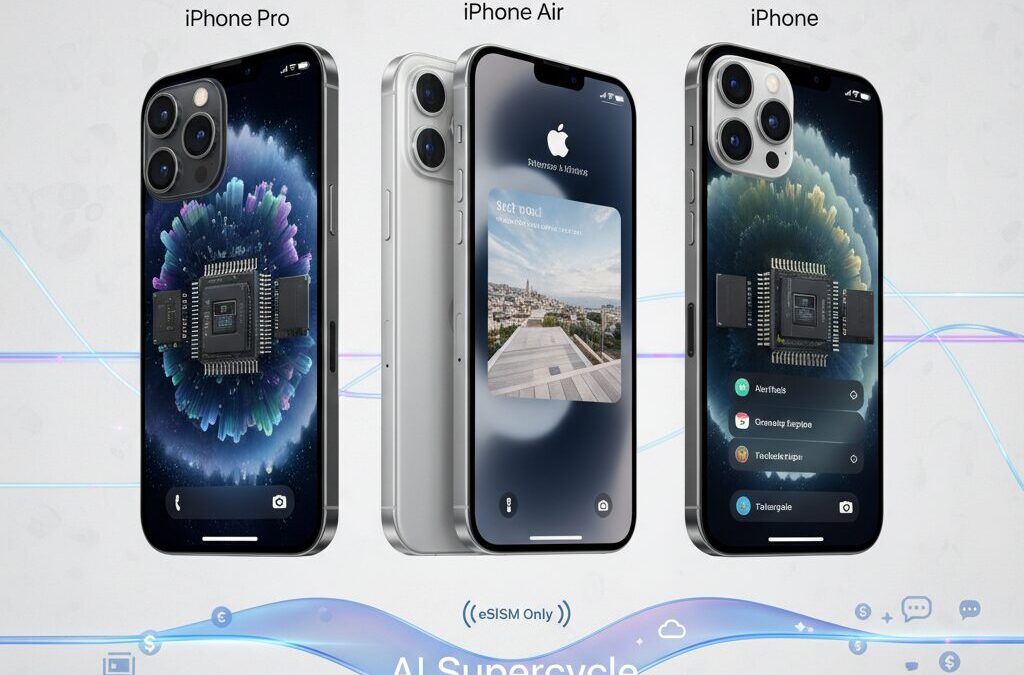
Smartphones have reached a point where yearly upgrades often feel incremental, and many tech enthusiasts wonder whether a new model is truly worth the investment.
In 2025, however, Apple’s iPhone lineup signals a far more meaningful shift, blending hardware evolution, artificial intelligence, and lifestyle-focused design into a single ecosystem.
For gadget lovers outside Japan, understanding this lineup offers valuable insight into where the global smartphone market is heading.
This generation introduces a rare combination of democratized flagship features and bold experimentation.
High-refresh-rate displays are no longer reserved for Pro users, while a radically thin iPhone Air challenges the long-standing belief that more specs always mean a better device.
At the same time, Apple’s A19-series chips push on-device AI performance to new levels, changing how everyday tasks, photography, and communication are handled.
Beyond raw specifications, the 2025 iPhones reflect deeper strategic decisions.
Pricing pressure from currency fluctuations, the transition toward eSIM-only devices, and staggered language support for Apple Intelligence all shape how and when users upgrade.
These factors influence not just purchasing behavior, but also how long devices are kept and how tightly users are bound to Apple’s ecosystem.
This article helps you navigate that complexity.
You will gain a clear overview of each model’s positioning, the real-world implications of A19 performance and AI features, and the trade-offs behind Apple’s thinnest iPhone ever.
By the end, you will be better equipped to judge which 2025 iPhone best fits your priorities, whether you value performance, design, longevity, or sheer technological curiosity.
- Why the 2025 iPhone Lineup Marks a Turning Point
- Four Clear Product Pillars: Standard, Pro, Air, and Essential
- A19 and A19 Pro Chips: What the Benchmarks and AI Gains Really Mean
- The iPhone Air Experiment: Ultra-Thin Design Versus Everyday Usability
- Display Evolution: ProMotion Becomes the New Normal
- 48MP Everywhere: How Apple Redefined iPhone Camera Hierarchy
- Apple Intelligence: On-Device AI, Privacy, and Language Expansion
- Pricing, Storage Changes, and the End of the 128GB Era
- eSIM-Only iPhones and the Risks of Full Digital Connectivity
- Market Reactions: Why the Standard iPhone 17 Became the Sweet Spot
- 参考文献
Why the 2025 iPhone Lineup Marks a Turning Point
The 2025 iPhone lineup marks a genuine turning point because Apple is no longer optimizing around a single definition of “the best iPhone,” but instead redesigning the entire portfolio around how people actually use their devices. According to Apple’s own product briefings and coverage by outlets such as The Wall Street Journal and MacRumors, this is the first year where performance, display fluidity, and AI readiness are treated as baseline expectations rather than premium privileges.
The clearest signal of this shift is the democratization of core technologies. Features once reserved for Pro models, most notably 120Hz ProMotion displays, now reach standard models. This eliminates a long-standing experiential gap and fundamentally changes purchase logic: users are no longer forced into higher-priced tiers just to avoid a compromised daily experience.
| Design Axis | Previous Strategy | 2025 Lineup |
|---|---|---|
| Display Fluidity | Pro-only | Standardized |
| AI Processing | Incremental | Core Requirement |
| Form Factor | Uniform | Diversified |
At the same time, Apple introduces deliberate diversity in form and philosophy. The arrival of an ultra-thin model reframes design as a primary value, not a secondary aesthetic choice. Industry analysts at IDC have noted that this move mirrors Apple’s historical pattern: redefining desirability first, then allowing the market to recalibrate around it.
Equally important is the timing of on-device AI. With Apple Intelligence designed to run locally on new silicon, the 2025 lineup is architected for a multi-year software trajectory. Semiconductor experts cited by Nikkei Asia emphasize that this level of neural processing headroom is unprecedented in mass-market smartphones.
Taken together, these decisions signal a strategic inflection point. The iPhone is no longer evolving as a single flagship with compromises below it, but as an ecosystem of equally intentional choices, each optimized for a distinct definition of value.
Four Clear Product Pillars: Standard, Pro, Air, and Essential
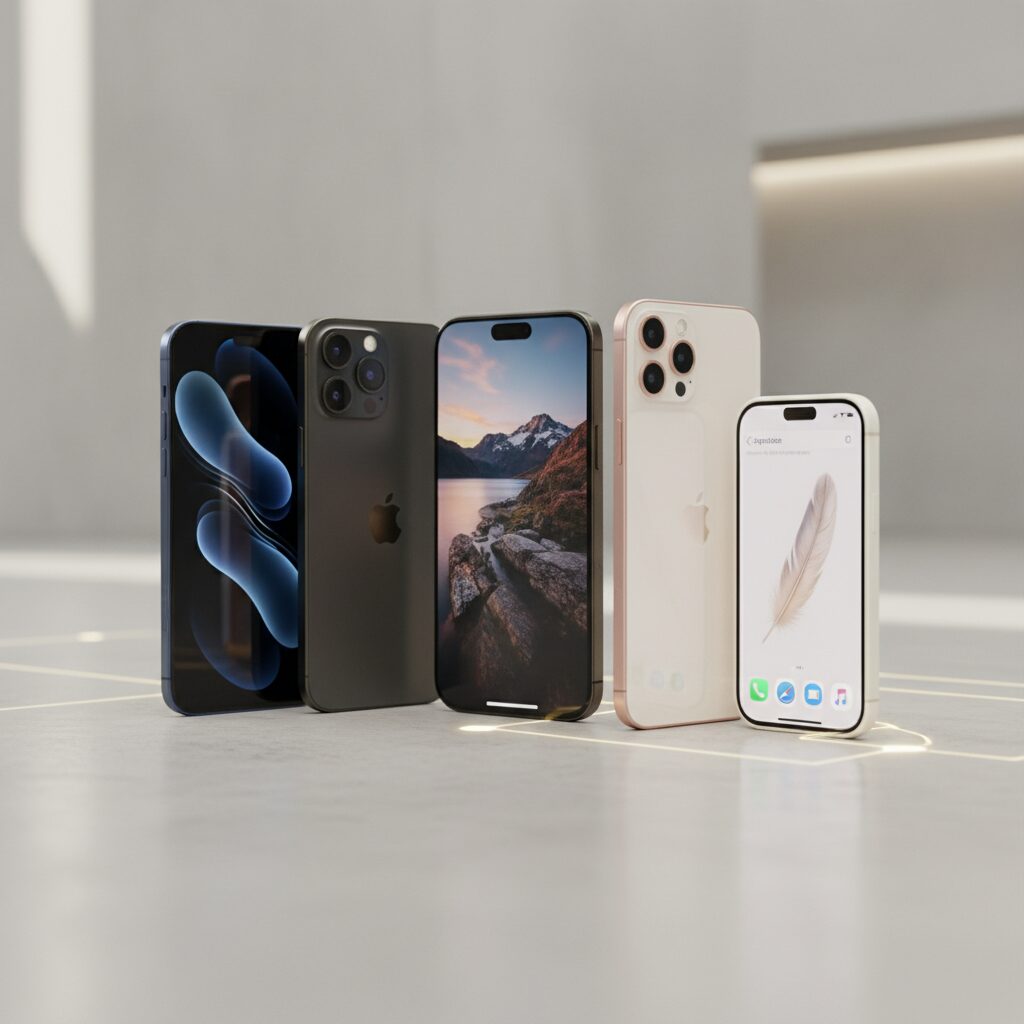
The 2025 iPhone lineup is organized around four clearly defined product pillars: Standard, Pro, Air, and Essential. This structure is not cosmetic marketing but a deliberate response to increasingly fragmented user expectations. Apple is no longer asking users to climb a simple price ladder. Instead, it is inviting them to choose based on values such as balance, creative power, design philosophy, or minimum sufficiency.
What makes this strategy notable is that the baseline experience has been significantly elevated. According to Apple’s official specifications and reporting by outlets such as MacRumors, features once reserved for premium tiers are now widely available. This shift reduces frustration in the lineup and reframes each model as a confident choice rather than a compromise.
The Standard model, represented by iPhone 17, is positioned as the default answer for most users. With ProMotion finally enabled, a 48MP main camera, and the A19 chip’s strengthened Neural Engine, it delivers a fluid, AI-ready experience without pushing users into professional pricing. Industry analysts cited by IDC describe this model as Apple’s new “sweet spot,” especially in markets like Japan where cost sensitivity and longevity matter.
The Pro pillar, consisting of Pro and Pro Max, is explicitly framed as a tool rather than a luxury. Triple 48MP cameras, expanded RAM, and advanced thermal design are not headline features for casual use, but they are critical for creators, developers, and mobile professionals. Reviews in outlets such as The Verge and Bloomberg consistently emphasize sustained performance under load, reinforcing the Pro identity as a work instrument.
| Pillar | Core Value | Primary Audience |
|---|---|---|
| Standard | Balanced performance | Mainstream users |
| Pro | Maximum capability | Creators, professionals |
| Air | Design and lightness | Style-focused users |
| Essential | Necessary fundamentals | Cost-conscious users |
The Air pillar is the most experimental. At just 5.64mm thick, it represents a design-first philosophy that intentionally trades versatility for elegance. Commentators at ZDNET have noted that this model challenges the industry’s spec-driven mindset, appealing to users who see a smartphone as something to carry effortlessly rather than push to limits.
Finally, the Essential pillar, embodied by iPhone 16e, redefines entry-level expectations. OLED, Face ID, and an AI-capable chip at a lower price point signal Apple’s belief that “essential” no longer means outdated. This aligns with broader research from Counterpoint Research showing that long software support and baseline quality now outweigh raw specs for first-time and budget buyers.
Taken together, these four pillars clarify choice rather than complicate it. Apple’s lineup no longer asks which model is better, but which philosophy fits the user’s life.
A19 and A19 Pro Chips: What the Benchmarks and AI Gains Really Mean
The real story behind the A19 and A19 Pro chips is not about raw speed alone, but about how benchmarks translate into everyday and AI-driven experiences. According to Geekbench 6 results widely cited by Apple-focused analysts, the standard A19 records around 3,573 in single-core and 9,143 in multi-core performance. **That already surpasses last year’s A18 Pro**, meaning Apple has effectively erased the historical gap where only Pro models felt truly fast.
This matters because single-core performance still dominates perceived responsiveness. App launches, UI animations, and camera processing rely heavily on burst performance rather than sustained throughput. In practical terms, even non‑Pro users gain a device that feels consistently instant, not just on day one but across several iOS generations.
| Chip | Geekbench 6 Single | Geekbench 6 Multi |
|---|---|---|
| A19 | ~3,573 | ~9,143 |
| A19 Pro | Higher than A19 | Higher with sustained loads |
The A19 Pro, however, justifies its existence once workloads become continuous and GPU‑heavy. Reports from long‑form gaming and 4K/120fps video capture tests show that the Pro’s expanded GPU cores and cache maintain peak clocks longer, thanks to superior thermal design. **Benchmarks alone cannot show throttling behavior**, but this is where Pro users see tangible gains.
AI performance is where the generational leap becomes most meaningful. Both chips feature a reinforced 16‑core Neural Engine, but the Pro integrates additional neural accelerators directly into GPU cores. Apple engineers, as referenced in company briefings and echoed by outlets like MacRumors, emphasize that this architecture is designed for on‑device large language model inference rather than cloud fallback.
In practice, this means tasks such as live transcription, image segmentation, and generative text rewriting execute faster and more privately. For example, early Apple Intelligence demos show multi‑step prompts completing locally in under a second on A19 devices, while the A19 Pro handles longer contextual chains without thermal slowdown. **The difference is not whether AI works, but how far it can scale before latency appears.**
Industry analysts at IDC have noted that Apple’s silicon advantage increasingly lies in efficiency per watt, not headline frequencies. The A19 generation reinforces this trend by delivering higher AI throughput at similar or lower power draw than its predecessor. For users, that translates into smarter features running continuously without the battery anxiety traditionally associated with AI workloads.
Ultimately, the benchmarks tell only half the story. The deeper shift is that Apple has normalized high‑end AI and CPU performance across the lineup, while reserving the A19 Pro for creators and power users who push sustained, graphics‑intensive, and AI‑heavy workflows. **That balance is what defines the A19 era more than any single score.**
The iPhone Air Experiment: Ultra-Thin Design Versus Everyday Usability

The iPhone Air represents Apple’s most radical physical experiment in years, and its ultra-thin 5.64mm body is not just a design choice but a philosophical statement. By prioritizing thinness above all else, Apple challenges the long-held assumption that everyday usability must scale with hardware volume. This device is designed to feel invisible in the hand, and at 165 grams, it delivers on that promise with remarkable immediacy.
However, thinness is not a neutral attribute; it actively reshapes daily interactions. Independent endurance tests reported by ZDNET and other established tech media indicate that the reduced internal volume directly limits battery capacity. In mixed-use scenarios such as web browsing, messaging, and short-form video, the iPhone Air consistently trails thicker models by several hours. For users accustomed to all-day reliability, this difference is not theoretical but behavioral, influencing charging habits and accessory choices.
| Design Aspect | Advantage | Usability Trade-off |
|---|---|---|
| 5.64mm chassis | Exceptional pocket comfort | Smaller battery volume |
| Lightweight frame | Reduced hand fatigue | Less thermal mass |
| Minimal camera bump | Flat desk stability | Single-lens limitation |
Thermal behavior is another subtle but important consequence. With less surface area to dissipate heat, sustained high-load tasks such as gaming or extended 4K recording can trigger performance throttling sooner than on thicker devices. According to analyses cited by AppleInsider, this is not a flaw but an inevitable outcome of extreme miniaturization under current material constraints.
The iPhone Air therefore asks users to consciously trade endurance and thermal headroom for aesthetic and ergonomic purity. For commuters, readers, and style-focused users, the comfort gains may outweigh the compromises. For power users, the experiment clearly illustrates where the practical limits of ultra-thin smartphone design still lie.
Display Evolution: ProMotion Becomes the New Normal
The most symbolic change in the 2025 iPhone lineup is that ProMotion is no longer a premium-only feature, and this shift quietly transforms how users perceive everyday performance.
For years, the 120Hz adaptive refresh rate was deliberately reserved for Pro models, creating a clear experiential gap during scrolling, gaming, and UI animations. With ProMotion now extended to the standard iPhone 17 and iPhone Air, that gap effectively disappears, and smoothness becomes the default expectation rather than a paid upgrade.
This change is made possible by the full standardization of LTPO OLED panels across the lineup. According to Apple’s technical disclosures, these displays dynamically scale from 120Hz down to 1Hz depending on on-screen activity, which is critical not only for fluid motion but also for energy efficiency.
In practical terms, users benefit in two directions at once. High-refresh responsiveness enhances perceived speed during navigation, while ultra-low refresh rates enable features like Always-On Display without a battery penalty that would have been unacceptable on non-Pro devices in previous generations.
| Display Aspect | Before 2025 | 2025 Standard Models |
|---|---|---|
| Max Refresh Rate | 60Hz | 120Hz (ProMotion) |
| Minimum Refresh Rate | Fixed | 1Hz (LTPO) |
| Always-On Display | Pro Only | Supported |
Equally important is that Apple did not dilute panel quality while democratizing refresh rates. Peak outdoor brightness reaches up to 3,000 nits, and minimum brightness drops to 1 nit, matching Pro-level readability in both harsh sunlight and dark environments.
Industry analysts at IDC have long emphasized that display experience heavily influences replacement cycles, often more than raw CPU benchmarks. By removing the visual downgrade from standard models, Apple effectively shortens the psychological distance between “good enough” and “best,” especially for users upgrading from older 60Hz iPhones.
Durability also plays a role in normalizing high-end displays. The introduction of Ceramic Shield 2, with Apple claiming up to three times higher scratch resistance than the previous generation, reinforces the idea that users no longer need protective compromises to enjoy advanced screen technology.
Ultimately, ProMotion’s expansion reshapes buying decisions in subtle ways. When smoothness, brightness, and power efficiency are no longer reasons to choose Pro, users are free to prioritize cameras, thermal performance, or industrial design instead, signaling a mature phase in smartphone display evolution where excellence is assumed, not advertised.
48MP Everywhere: How Apple Redefined iPhone Camera Hierarchy
The phrase “48MP everywhere” does not simply describe a sensor upgrade, but it represents a deliberate restructuring of Apple’s camera hierarchy. In the 2025 iPhone lineup, Apple has made a strategic decision to standardize high-resolution imaging across models, while redefining what truly separates Pro users from the rest.
By elevating 48MP from a premium feature to a baseline expectation, Apple has shifted the conversation from megapixels to how those pixels are used. This change reflects a broader industry trend noted by analysts at Counterpoint Research, where computational photography now delivers more value than raw sensor counts.
At the core of this strategy is the Fusion Camera system. Even non-Pro models benefit from pixel binning and high-resolution crop zoom, allowing a single 48MP wide camera to simulate multiple focal lengths with minimal quality loss. According to Apple’s own technical disclosures, the 2x crop mode uses the center of the sensor without digital upscaling, preserving true optical detail.
| Model Tier | 48MP Implementation | Practical Impact |
|---|---|---|
| Standard / Air | Single 48MP Fusion Camera | High-quality 1x and 2x shots with simplified shooting |
| Pro Series | Triple 48MP system | Advanced zoom, macro, and cropping flexibility |
This table highlights how Apple has intentionally narrowed the quality gap for everyday photography. For casual users, travel snapshots and social media content now look remarkably similar regardless of model. Reviews from publications such as Macworld emphasize that daylight photos from standard iPhone 17 models are often indistinguishable from Pro shots at first glance.
However, Apple has not diluted the Pro identity. The differentiation now lies in depth and versatility. The Pro models’ triple 48MP setup enables consistent resolution across ultra-wide, wide, and telephoto lenses. This consistency is crucial for professionals who rely on seamless lens switching during video recording or post-production cropping.
In essence, Apple has democratized image quality while preserving creative headroom for experts. This recalibration of the camera hierarchy makes the lineup easier to understand: everyone gets excellent photos, but only Pro users gain maximum control. It is a subtle yet powerful redefinition of what “Pro” truly means in smartphone photography.
Apple Intelligence: On-Device AI, Privacy, and Language Expansion
Apple Intelligence is designed around a clear principle: **AI should work primarily on the device, not in the cloud**. With the A19 generation, Apple has significantly expanded the role of the Neural Engine, enabling many language, image, and context-aware tasks to be processed locally. This approach reduces latency and ensures that sensitive personal data, such as messages, photos, and schedules, remain on the user’s iPhone whenever possible.
According to Apple’s official statements, only tasks that exceed on-device capabilities are routed to its Private Cloud Compute infrastructure. Even in those cases, data is processed on Apple Silicon–based servers, is not stored, and is architecturally inaccessible to Apple itself. **This privacy-first design clearly differentiates Apple Intelligence from cloud-centric AI models**, a point that has been repeatedly emphasized by Apple executives and security researchers following the platform’s launch.
| Aspect | On-Device Processing | Private Cloud Compute |
|---|---|---|
| Typical tasks | Text rewriting, summaries, image analysis | Complex multi-step reasoning |
| Data storage | None | None |
| Privacy exposure | Local only | Stateless, encrypted |
Language expansion is another critical pillar. Apple has confirmed that additional languages, including Japanese, are rolling out from April 2025. This delay reflects the complexity of adapting large language models to honorifics, contextual ambiguity, and cultural nuance. **Rather than rushing coverage, Apple has prioritized linguistic accuracy and trust**, a strategy that aligns with its long-standing human interface guidelines.
For users, this means Apple Intelligence feels less like a remote service and more like an extension of the operating system itself. The result is an AI experience that is fast, private, and increasingly multilingual, without forcing users to trade convenience for control over their personal data.
Pricing, Storage Changes, and the End of the 128GB Era
Pricing in the 2025 iPhone lineup reflects a clear strategic shift by Apple, and it is closely tied to one decisive change: the complete removal of the 128GB base storage option. **This marks the official end of the “128GB era,” a configuration that had defined entry-level iPhones for nearly a decade.** From iPhone 17 onward, all mainstream models start at 256GB, fundamentally altering how users should interpret headline prices.
At first glance, the higher starting prices may feel aggressive, especially in markets like Japan where currency weakness continues to exert pressure. However, Apple’s pricing logic becomes more nuanced when storage economics are considered. According to global pricing analyses by Android Headlines and regional breakdowns from The Mac Index, the price gap between 128GB and 256GB tiers in previous generations often ranged from the equivalent of 15,000 to 22,000 yen. By eliminating the lower tier entirely, Apple effectively bakes that upgrade into the base model.
| Model | Base Storage | Estimated Japan Price |
|---|---|---|
| iPhone 17 | 256GB | ¥129,800〜 |
| iPhone Air | 256GB | ¥159,800〜 |
| iPhone 17 Pro | 256GB | ¥179,800〜 |
From a user-experience perspective, this decision aligns closely with real-world usage trends. Independent research firms such as Counterpoint Research have repeatedly noted that average storage consumption per smartphone user continues to rise year over year, driven by 4K video recording, ProRAW photography, offline media, and increasingly large on-device AI models. **In this context, 128GB had become a false economy**, often forcing users into iCloud upgrades or early device replacement.
Apple executives have not explicitly framed the change as a cost-saving measure for users, but industry observers widely interpret it that way. By standardizing 256GB, Apple reduces decision fatigue at purchase while ensuring smoother long-term performance, especially as Apple Intelligence relies more heavily on local storage for on-device processing. This approach mirrors Apple’s earlier transition away from 64GB base models, which was initially controversial but later accepted as inevitable.
In Japan specifically, pricing perception is further softened by carrier installment and trade-in programs. While the official retail price now comfortably exceeds the psychological 100,000-yen threshold, effective monthly costs remain relatively stable when amortized over two years. **The key difference in 2025 is that users are paying more upfront, but receiving a configuration that is realistically viable for the entire ownership cycle.**
Ultimately, the end of the 128GB era is less about raising prices and more about redefining the baseline of what a “usable” flagship smartphone should be in 2025. Apple is signaling that modern iPhone experiences—AI features included—are no longer compatible with minimal storage. Whether users welcome or resist this change, it is clear that storage is no longer an optional upsell, but a core part of the product’s value proposition.
eSIM-Only iPhones and the Risks of Full Digital Connectivity
The shift toward eSIM-only iPhones represents a bold vision of full digital connectivity, but it also introduces new categories of risk that deserve careful attention. By removing the physical SIM tray, Apple is clearly signaling a future where connectivity is entirely software-defined, remotely provisioned, and deeply integrated with the operating system. For highly connected users, this promises convenience, yet it also tightens the dependency between device, carrier infrastructure, and cloud-based authentication.
One immediate risk lies in single-point-of-failure scenarios. With a physical SIM, users could theoretically move their card to another device in an emergency. In an eSIM-only environment, network access depends entirely on carrier servers being available and responsive. As reported by ITmedia Mobile following the September 2025 launch of the iPhone 17 in Japan, a failure in NTT DOCOMO’s eSIM issuance system temporarily rendered newly purchased devices unable to connect, effectively turning premium smartphones into offline devices.
| Aspect | Physical SIM Era | eSIM-Only Era |
|---|---|---|
| Activation | Manual insertion, offline-capable | Server-dependent, fully online |
| Emergency recovery | SIM swap possible | Carrier support required |
| User control | High | Relatively limited |
Another concern is the growing asymmetry of control between users and carriers. With eSIM, line provisioning, suspension, or reactivation can be executed remotely and instantly. While this improves security against theft, it also means that accidental account flags, billing disputes, or identity verification errors may immediately cut off connectivity. Experts in telecommunications policy, including analysts cited by Nikkei and IEEE-affiliated researchers, have warned that software-defined networks tend to amplify the impact of operational mistakes.
International travel highlights both the strengths and weaknesses of full digital connectivity. App-based eSIM purchases make short-term data plans easier than ever, a point praised by frequent travelers and documented by outlets such as The Wall Street Journal. However, if the primary Apple ID is locked, compromised, or inaccessible, users may find themselves unable to add or manage eSIM profiles abroad, without any physical fallback option.
From a security standpoint, Apple emphasizes encryption and hardware-backed key storage, and institutions like the Electronic Frontier Foundation have acknowledged the company’s strong device-level protections. Still, concentrating identity, payment, and connectivity within a single digital framework increases the potential blast radius of account-level breaches. A locked Apple ID can now mean not only lost apps and data, but also lost network access.
In summary, eSIM-only iPhones are not inherently unsafe, but they do change the nature of risk. Users gain speed, flexibility, and a cleaner hardware design, while simultaneously accepting deeper dependence on invisible systems. For tech-savvy consumers, understanding this trade-off is essential, because in a world of full digital connectivity, downtime is no longer a minor inconvenience but a complete disconnect.
Market Reactions: Why the Standard iPhone 17 Became the Sweet Spot
Market reactions over the past few months clearly show why the standard iPhone 17 has emerged as the sweet spot in Apple’s 2025 lineup. **Consumers are not simply buying the cheapest or the most expensive option; they are converging on the model that feels “complete enough” without excess trade-offs.** This shift is visible across sales data, reviews, and carrier feedback.
According to IDC, Apple’s 2025 shipment growth has been strongly supported by the iPhone 17, which outperformed internal forecasts in multiple regions. In Japan, BCN rankings for December 2025 placed the iPhone 17 at the top in unit sales, indicating broad mainstream acceptance rather than niche enthusiasm. Analysts at MacRumors have described this model as the device that “quietly absorbs demand from both Pro-curious users and Air skeptics.”
| Model | Key Market Perception | Purchase Barrier |
|---|---|---|
| iPhone 17 | Balanced, future-proof | Minimal |
| iPhone 17 Pro | Overkill for most users | High price |
| iPhone Air | Stylish but compromised | Battery anxiety |
A decisive factor is the democratization of ProMotion. Once Apple extended the 120Hz LTPO display to the standard iPhone 17, the most visible everyday advantage of the Pro models disappeared for many buyers. Reviewers from major tech publications have consistently noted that **scrolling smoothness and UI responsiveness now feel identical to Pro in daily use**, making the premium harder to justify unless advanced photography is a priority.
Carrier sales staff in Japan have also reported a change in customer conversations. Instead of asking “Which Pro should I get?”, more buyers are now asking whether there is any practical downside to choosing the iPhone 17. With A19 performance surpassing last year’s Pro chips and full support for Apple Intelligence, sales representatives often struggle to point out meaningful disadvantages beyond camera specialization.
Importantly, market sentiment suggests that the iPhone 17 benefits from negative contrast as well. Battery life concerns and thermal limitations surrounding the ultra-thin iPhone Air have pushed cautious users toward the safer option. **The standard iPhone 17 is perceived as the model with the fewest regrets**, a device that aligns with real-world usage rather than spec-sheet extremes.
In aggregate, expert commentary and hard sales numbers reinforce a simple conclusion: the iPhone 17 resonates because it aligns price, performance, and longevity in a way that feels rational. In a lineup defined by bold experiments and premium escalation, the market has rewarded the device that quietly gets everything right.
参考文献
- Apple Newsroom:Apple Intelligence features expand to new languages and regions today
- MacRumors:iPhone 17 Pro: Everything We Know
- AppleInsider:iPhone 17 | Features, specs, price
- Macworld:New iPhone Air, 17, 17 Pro & Max release date, specs, features & more
- IDC:Worldwide Smartphone Market to Grow 1.5% in 2025, Boosted by Record Apple Shipments
- StatCounter:Mobile Vendor Market Share Japan