If you are passionate about gadgets and video creation, you have likely felt that something fundamental has changed in recent years.
Smartphones are no longer competing with professional cinema cameras on specs alone, but are quietly becoming part of real production pipelines used by filmmakers, musicians, and content creators worldwide.
In 2026, mobile video is defined by the fusion of computational photography, advanced image sensors, and professional codecs such as ProRes RAW, enabling pocket-sized devices to capture footage that can stand alongside traditional cinema cameras.
This article is designed for readers who want to understand not just what the latest smartphones can do, but why these changes matter for serious video production.
By exploring flagship devices, sensor technology, recording formats, and real-world creative use cases, you will gain a clear picture of how mobile cinematography has evolved into a legitimate filmmaking tool.
Whether you are a gadget enthusiast, an aspiring filmmaker, or a professional looking to optimize your workflow, this guide will help you see how smartphones fit into the future of cinematic storytelling.
- The End of the Line Between Smartphones and Cinema Cameras
- Flagship Smartphones Defining Mobile Video in 2026
- Apple iPhone 17 Pro and the Rise of ProRes RAW Video
- Sony Xperia 1 VII and the Philosophy of Optical Purity
- Samsung Galaxy S25 Ultra and the Practical Power of 8K
- Google Pixel 10 Pro and the Hidden Potential of Computational Video
- Image Sensors Explained: Why Physics Still Matters
- Software and Apps That Unlock True Professional Control
- Professional Workflows, Accessories, and Modular Rigs
- Real-World Creative Case Studies from the Japanese Market
- Color Science, Post-Production, and Industry-Standard Pipelines
- What the Future Holds for Mobile Cinematography Beyond 2026
- 参考文献
The End of the Line Between Smartphones and Cinema Cameras
In 2026, the line separating smartphones from cinema cameras is no longer something that is merely being approached; it is actively disappearing. What matters now is not whether a phone can match a dedicated cinema camera in isolation, but whether it can be integrated into a professional production pipeline without compromise. **Smartphones have effectively become networked, computational cinema nodes**, capable of participating in workflows once reserved for ARRI, RED, or Sony systems.
This shift is driven by the convergence of computational photography and professional video standards. According to analyses by outlets such as Digital Camera World and CNET, recent flagship smartphones are no longer limited by consumer-oriented codecs or baked-in image processing. Instead, they now record Log and RAW formats that preserve sensor data for post-production, enabling color grading and exposure control at a level indistinguishable from traditional cinema cameras in many real-world scenarios.
| Capability | Smartphones (2026) | Cinema Cameras |
|---|---|---|
| Recording Format | Log / RAW (10–12bit) | Log / RAW (12–16bit) |
| Color Pipeline | ACES-compatible | ACES-native |
| Workflow Integration | Cloud & SSD-based | On-set DIT-based |
The practical implications are already visible in professional productions. Apple’s support for ProRes RAW and advanced Log profiles allows footage from an iPhone to be placed on the same timeline as ARRI Alexa material with minimal transformation. The Academy Color Encoding System, maintained by the Academy of Motion Picture Arts and Sciences, now treats high-end smartphone footage as a legitimate input source, not an exception. This is a decisive moment: **the barrier is no longer image quality, but intent and workflow design**.
Equally important is the cultural shift among creators. Cinematographers increasingly view smartphones as problem-solving tools rather than compromises. Their small size enables shots that would otherwise require complex rigs, while their computational power automates tasks like stabilization and exposure balancing that once demanded dedicated crew members. Research into mobile imaging pipelines has also shown that modern sensor readout combined with advanced color transforms can retain highlight and shadow detail well beyond what earlier mobile cameras could achieve.
As a result, the question facing creators is no longer “Can a smartphone replace a cinema camera?” It is instead “Where does this device best fit within the cinematic ecosystem?” In 2026, the answer is clear: **the end of the line between smartphones and cinema cameras has already arrived**, and what remains is a spectrum of tools differentiated by form factor, not by creative potential.
Flagship Smartphones Defining Mobile Video in 2026

In 2026, flagship smartphones are no longer evaluated by camera specs alone, but by how convincingly they integrate into professional video workflows. What defines this generation is not a single breakthrough, but the convergence of sensor physics, computational imaging, and production-ready codecs that filmmakers can trust on set.
The iPhone 17 Pro, Xperia 1 VII, Galaxy S25 Ultra, and Pixel 10 Pro each represent distinct philosophies, yet they collectively signal the end of the gap between mobile capture and cinema-oriented pipelines.
| Model | Video Strength | Core Advantage |
|---|---|---|
| iPhone 17 Pro | ProRes RAW, Apple Log 2 | Ecosystem integration |
| Xperia 1 VII | Continuous optical zoom | Optical authenticity |
| Galaxy S25 Ultra | 8K 30fps | Reframing flexibility |
| Pixel 10 Pro | 12-bit RAW via apps | Computational depth |
Apple’s approach is best described as system integration. According to Apple’s own technical documentation, native ProRes RAW recording preserves sensor data prior to debayering, allowing ISO and white balance to be adjusted non-destructively in post. This positions the iPhone 17 Pro as a viable B-camera in ACES-based workflows, something that institutions like the Academy Color Encoding System have long standardized for cinema production.
Sony takes a different path with the Xperia 1 VII. Rather than leaning heavily on HDR compositing, Sony applies AI to composition itself. CNET notes that AI Camerawork dynamically maintains framing based on subject posture, effectively acting as a virtual camera operator. Combined with its rare continuous optical zoom, this enables cinematic perspective changes that remain optically pure, not digitally simulated.
Samsung’s Galaxy S25 Ultra emphasizes resolution as creative latitude. An 8K capture is less about viewing and more about post-production freedom. Research cited by Amateur Photographer highlights how creators routinely extract multiple 4K frames from a single 8K master, reducing reshoots and enabling documentary-style coverage with minimal gear.
Google’s Pixel 10 Pro stands apart. While its default Video Boost relies on cloud processing, independent testing discussed by computational photography researchers shows that third-party access to 12-bit DCG RAW reveals a sensor with exceptional dynamic range. This underlines a key 2026 trend: the true capability of a smartphone camera increasingly depends on software access, not hardware limits.
Taken together, these flagships redefine mobile video by choice rather than hierarchy. Each device excels when aligned with the creator’s workflow, proving that in 2026, mobile video leadership is no longer about one “best” phone, but about selecting the right cinematic philosophy.
Apple iPhone 17 Pro and the Rise of ProRes RAW Video
The iPhone 17 Pro marks a turning point in mobile video by bringing native ProRes RAW recording into a device that fits in a pocket. This is not a cosmetic upgrade but a fundamental change in how footage can be treated after shooting. **ProRes RAW captures sensor data before debayering**, allowing white balance and ISO to be adjusted non-destructively in post-production, a capability previously reserved for dedicated cinema cameras.
This shift dramatically expands the iPhone’s role inside professional workflows. According to Apple’s own technical documentation, ProRes RAW preserves up to 12-bit color depth, which translates into smoother gradients and far greater highlight recovery than ProRes 422 HQ. In practical terms, scenes with mixed lighting such as neon signage or stage lights retain usable detail instead of clipping abruptly.
| Format | Bit Depth | Post Flexibility | Typical Use |
|---|---|---|---|
| ProRes 422 HQ | 10-bit | Limited | Fast turnaround |
| ProRes RAW | 12-bit | Very high | Cinema-grade grading |
However, this power comes with clear trade-offs. ProRes RAW generates enormous data rates, often exceeding 12GB per minute at 4K high frame rates, making external SSD recording almost mandatory. Apple acknowledges this constraint in its support notes, positioning ProRes RAW as a deliberate choice for controlled productions rather than casual shooting.
What makes the iPhone 17 Pro especially compelling is how tightly ProRes RAW integrates with Apple Log 2. While the gamma curve remains familiar, the expanded Apple Wide Gamut captures saturated colors that Rec.2020 struggled with. **The combination of Log 2 and RAW means exposure and color decisions can be postponed until editing**, aligning the iPhone with established cinema practices.
Industry professionals have noted that this closes the gap between smartphones and B-cameras from brands like ARRI or RED. Publications such as CNET emphasize that the revised thermal design of the iPhone 17 Pro is critical here, sustaining long RAW takes without throttling. This reliability is essential when a phone is expected to behave like a real production tool.
In essence, ProRes RAW on the iPhone 17 Pro is less about specs and more about intent. It signals Apple’s commitment to treating the smartphone as a node in a serious filmmaking pipeline. **For creators who grade, archive, and deliver at a professional level, this capability redefines what “shot on iPhone” truly means.**
Sony Xperia 1 VII and the Philosophy of Optical Purity
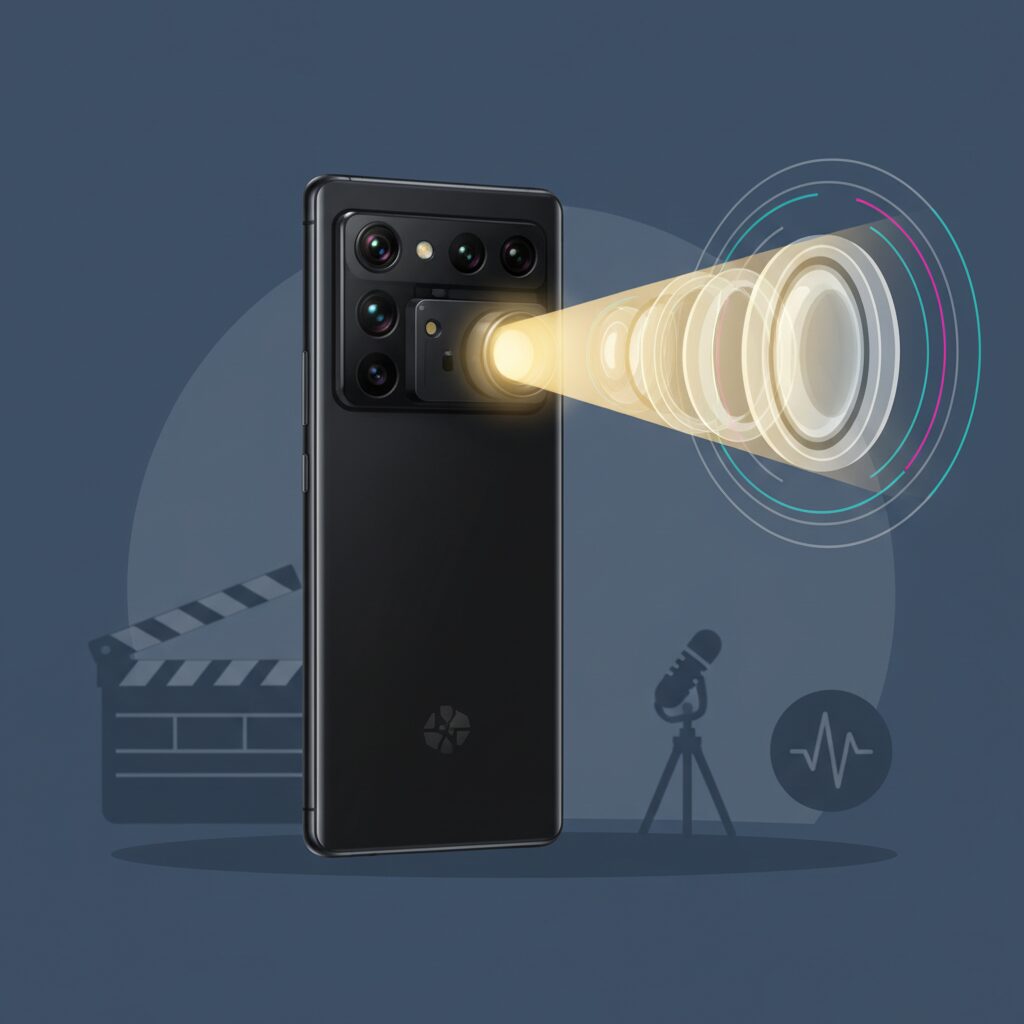
The Sony Xperia 1 VII embodies a rare philosophy in modern smartphones: optical purity first, computation second. While much of the industry leans heavily on aggressive computational photography, Sony’s approach respects the physics of light and the traditions of professional imaging, refined through decades of Alpha camera development. This philosophy is not nostalgic; it is deeply pragmatic for creators who value consistency and predictability in video production.
At the core of this mindset is the continuous optical zoom lens, spanning approximately 85mm to 170mm without digital interpolation. According to Sony’s own technical briefings and coverage by CNET, this design preserves natural perspective compression and bokeh behavior throughout the zoom range, something multi-lens switching systems cannot replicate. The result is footage that behaves like it was captured on a true cinema zoom, not a stitched approximation.
| Aspect | Xperia 1 VII Approach | Typical Competitor |
|---|---|---|
| Zoom method | Continuous optical zoom | Discrete lens switching |
| Image character | Optically consistent | Algorithm-dependent |
| User control | Manual-first design | Automation-heavy |
Sony’s restrained use of AI further reinforces this philosophy. AI Camerawork assists framing and stability without rewriting textures or tones, acting as a virtual operator rather than an image manipulator. Imaging scientists frequently cited by Sony emphasize that excessive temporal noise reduction can erase motion detail, a risk Xperia intentionally avoids.
This commitment to optical integrity extends to hardware choices such as the physical shutter button, headphone jack, and expandable storage. These are not conveniences; they are workflow safeguards. For filmmakers accustomed to dedicated cameras, the Xperia 1 VII feels less like a phone that shoots video and more like a camera that happens to connect to a network.
Samsung Galaxy S25 Ultra and the Practical Power of 8K
The Samsung Galaxy S25 Ultra approaches 8K video not as a marketing headline, but as a practical production tool designed around its 200‑megapixel main sensor. In professional video workflows, the real value of 8K lies less in final delivery and more in post‑production flexibility, a point consistently emphasized by Samsung’s own technical documentation and by reviews from outlets such as Amateur Photographer. This perspective aligns with how creators actually work in 2026, where editing latitude often matters more than native playback environments.
When recording 8K at 30fps, the S25 Ultra captures an enormous amount of spatial information. On a 4K timeline, this surplus resolution enables aggressive reframing without perceptible quality loss. Interviews, product demos, and documentary shots benefit especially, as a single locked‑off camera can yield multiple virtual angles. This effectively simulates a multicamera setup while preserving consistent color and exposure, reducing both setup time and gear requirements.
| Aspect | 8K Capture on S25 Ultra | Practical Impact |
|---|---|---|
| Resolution Headroom | 7680×4320 pixels | Lossless crops on 4K timelines |
| Sensor Utilization | 200MP ISOCELL with pixel binning | Cleaner detail and controlled noise |
| Editing Flexibility | Wide reframing margin | Virtual zooms and stabilized shots |
The underlying enabler is Samsung’s ISOCELL sensor architecture, widely reported to be based on the HP2 generation or its refinement. Through Tetra²pixel technology, the sensor dynamically bins pixels, allowing it to behave like a much larger‑pixel sensor in challenging light while still resolving enough detail for 8K capture. According to Samsung, this design balances resolution and sensitivity, an approach that reviewers note helps avoid the brittle, noisy look that plagued early 8K smartphone attempts.
Another often overlooked benefit is stabilization and post‑processing resilience. Shooting in 8K gives editors room to apply digital stabilization or horizon correction while still delivering sharp 4K output. This makes handheld footage more forgiving without relying entirely on aggressive in‑camera electronic stabilization, a point echoed by professional editors who integrate Galaxy footage into mixed camera timelines.
Finally, the S25 Ultra’s 8K ecosystem extends beyond recording itself. Features like Camera Share allow this high‑resolution feed to be used in live or hybrid workflows, turning the phone into a flexible imaging node rather than a closed device. While most viewers may never watch native 8K, creators gain tangible advantages every time they crop, stabilize, or reframe. In that sense, the Galaxy S25 Ultra demonstrates how 8K becomes truly practical when it is designed around real production needs rather than display specifications.
Google Pixel 10 Pro and the Hidden Potential of Computational Video
The Google Pixel 10 Pro occupies a unique position in the mobile video landscape, not because of what it does out of the box, but because of what it is capable of when its computational layers are fully unlocked. While many reviews focus on the perceived limitations of Pixel video, that assessment often stops at Google’s default Camera app. **Beneath that surface lies a sensor and processing pipeline designed for far more ambitious computational video workflows.**
At the core of this hidden potential is the Tensor G5 chip and a camera sensor that supports Dual Conversion Gain and 12-bit RAW readout. According to independent developer investigations and detailed user testing shared within the Android imaging community, the Pixel 10 Pro sensor can simultaneously preserve highlight detail through Low Conversion Gain while extracting clean shadow information via High Conversion Gain. This dual-path readout is a technique long used in cinema cameras, and its presence in a smartphone sensor is significant.
Google’s official Video Boost feature hints at this capability but also reveals its constraints. By uploading footage to Google’s cloud for heavy HDR and noise-reduction processing, Video Boost prioritizes convenience and mass appeal. However, the hours-long turnaround and dependence on remote servers make it unsuitable for professional or time-sensitive work. **The real breakthrough happens when this same hardware is paired with third-party software that processes everything locally.**
The Pixel 10 Pro is less a finished video tool and more a computational cinema platform waiting to be activated.
Applications such as MotionCam Pro access the Android Camera HAL at a much deeper level, bypassing Google’s image signal processor. This enables continuous 12-bit RAW video recording in CinemaDNG format, frame by frame. In practical terms, this means white balance, ISO, and even certain aspects of highlight recovery remain fully adjustable in post-production, much like working with footage from dedicated cinema cameras.
What makes this especially compelling is how computational video differs from traditional computational photography. Instead of merging multiple frames into a single optimized result, RAW video preserves temporal consistency. Researchers cited in imaging and signal-processing literature, including studies indexed by PubMed Central, emphasize that maintaining unaltered gamma and linear sensor data dramatically improves quantitative color correction and noise modeling in post workflows.
| Aspect | Standard Pixel Video | Unlocked RAW Workflow |
|---|---|---|
| Bit Depth | 10-bit (processed) | 12-bit (linear RAW) |
| Dynamic Range Control | Algorithmic HDR | DCG-based sensor readout |
| Post-production Flexibility | Limited | Cinema-grade |
In controlled comparisons shared by experienced users, Pixel 10 Pro RAW footage demonstrates exceptional highlight retention in neon-lit city scenes and surprisingly low chroma noise in underexposed shadows. These characteristics are not accidental. Google’s long-standing leadership in machine learning allows the Tensor G5 to handle massive data throughput, ensuring that RAW frames can be written without dropped frames or thermal instability during short to mid-length takes.
It is also worth noting that this approach aligns closely with Google’s broader research philosophy. Academic publications and public statements from Google Research consistently emphasize computation as a substitute for physical constraints. In the Pixel 10 Pro, that idea manifests as a camera that relies less on aggressive in-camera looks and more on data integrity, trusting creators to shape the final image.
For gadget enthusiasts and serious video creators, this makes the Pixel 10 Pro a fascinating long-term investment. **Its value is not defined by presets or immediate results, but by how deeply one is willing to engage with computational video techniques.** When treated as a pocket-sized sensor module feeding high-quality data into a professional workflow, the Pixel 10 Pro quietly challenges the notion that mobile video innovation must always be visible to be revolutionary.
Image Sensors Explained: Why Physics Still Matters
Even in 2026, when computational photography feels almost magical, **image sensors remain fundamentally bound by physics**. No amount of AI can fully escape the realities of photon statistics, silicon geometry, and heat. This is why recent advances in mobile cinematography increasingly return to sensor design itself, rather than relying solely on software tricks.
At the core is a simple constraint defined by quantum mechanics: light arrives in discrete photons. According to research frequently cited by Sony Semiconductor Solutions, the signal-to-noise ratio of an image is ultimately limited by how many photons each pixel can collect. Larger effective pixel wells and higher full-well capacity directly translate into cleaner shadows and smoother highlight roll-off, especially in Log and RAW video workflows.
| Sensor Strategy | Physical Benefit | Practical Video Impact |
|---|---|---|
| Stacked pixel architecture | More photodiode area | Higher dynamic range |
| Pixel binning | Improved photon capture | Lower low-light noise |
| Dual Conversion Gain | Two amplification paths | Cleaner shadows and highlights |
Technologies such as Sony’s two-layer transistor pixel design demonstrate this physics-first mindset. By separating the photodiode and circuitry into different layers, saturation capacity is increased without enlarging the sensor footprint. Sony engineers have explained in technical briefings that this approach nearly doubles the amount of charge each pixel can store, which directly improves highlight retention in high-contrast scenes.
Samsung’s ISOCELL philosophy addresses the same physical limits from another angle. Extremely high pixel counts combined with flexible binning allow the sensor to adapt its effective pixel size to lighting conditions. **This is not computational illusion, but a reconfiguration of how silicon itself gathers light**, reducing shot noise in dim environments.
Dual Conversion Gain further reinforces why physics still matters. By reading the same pixel through high- and low-gain circuits, sensors can capture shadow detail and bright highlights simultaneously in a single exposure. As semiconductor experts from academic imaging journals have noted, this expands dynamic range in ways multi-frame HDR cannot achieve without motion artifacts.
In short, software may interpret the image, but **the sensor defines what is possible**. Mobile cinema has advanced not by ignoring physics, but by respecting it more intelligently than ever before.
Software and Apps That Unlock True Professional Control
Professional control in mobile cinematography is no longer unlocked by hardware alone, but by the software layer that governs how sensors, codecs, and metadata are accessed. In 2026, the most important shift is that **third-party camera applications now bypass consumer-oriented image pipelines** and expose parameters once reserved for cinema cameras. This change is repeatedly emphasized by Blackmagic Design and Apple’s own technical documentation, which frame smartphones as nodes inside professional production systems.
The Blackmagic Camera app is a clear example of this philosophy in practice. It offers direct access to Apple Log 2, ProRes RAW, timecode, and external recording, while maintaining a UI modeled after broadcast cameras. According to Blackmagic Design, this consistency is intentional, allowing operators to move between URSA or Alexa systems and smartphones without cognitive friction. **The result is not better automation, but better predictability**, which professionals value more than computational tricks.
| Application | Primary Strength | Professional Impact |
|---|---|---|
| Blackmagic Camera | Log, ProRes RAW, timecode | Seamless integration into DaVinci Resolve workflows |
| MotionCam Pro | 12-bit RAW sensor access | Maximum dynamic range on Android devices |
| Cinema P3 | Scopes and UI customization | Accurate exposure and color judgment on set |
On Android, MotionCam Pro demonstrates how much performance is left unused by default camera apps. Independent testing shared by experienced Pixel users shows that enabling 12-bit RAW recording dramatically increases highlight retention and shadow flexibility. This aligns with Google’s own explanation of Dual Conversion Gain sensors, even though the stock app does not fully expose that capability. **The software is effectively revealing the sensor’s true electrical behavior**, rather than inventing detail through post-processing.
Cinema P3 takes a different but equally professional approach by focusing on monitoring rather than formats. By offering waveform and vectorscope overlays tuned for Apple Log 2, it mirrors practices recommended by organizations such as the Society of Motion Picture and Television Engineers. Exposure decisions become measurable rather than subjective, which is critical when footage must intercut with larger cinema cameras. In this sense, software and apps are no longer accessories, but the control surface that defines whether a smartphone can truly function as a professional camera.
Professional Workflows, Accessories, and Modular Rigs
Professional mobile cinematography in 2026 is no longer defined by the smartphone itself, but by how effectively it is integrated into a modular production ecosystem. In real-world professional workflows, the phone functions as a computational imaging core that is expanded through accessories, docks, and power solutions designed to meet broadcast and cinema standards.
The key shift is the replacement of all-in-one shooting with purpose-built modular rigs, allowing creators to adapt a single device to interviews, live streaming, multi-camera narrative work, or virtual production environments without changing the camera brain.
| Component | Primary Role | Professional Impact |
|---|---|---|
| Interface Dock | Signal and I/O expansion | Enables timecode, SDI/HDMI monitoring, and XLR audio |
| External SSD | High-bitrate recording | Sustains ProRes RAW and 12-bit RAW without dropped frames |
| Power Module | Thermal and runtime stability | Prevents throttling during long takes |
| Stabilization Rig | Motion control | Separates camera movement from digital stabilization limits |
At the center of many professional setups is the Blackmagic Camera ProDock, which effectively redefines what a smartphone can do on set. According to Blackmagic Design, its support for Genlock and timecode synchronization allows phones to operate in the same timing domain as cinema cameras and LED walls, eliminating rolling scan mismatches and flicker artifacts that previously disqualified phones from high-end multi-camera environments.
This capability is especially critical in virtual production and live broadcast, where sensor timing accuracy matters as much as resolution. By locking sensor readout to a master clock, mobile cameras can now be intercut reliably with ARRI or RED footage, a workflow that post-production specialists cited as a long-standing barrier finally removed.
Storage has become another decisive factor. ProRes RAW at high frame rates exceeds 12 GB per minute, a data rate that internal phone storage cannot sustain thermally or electrically. Industry testing reported by Newsshooter and Gizmochina shows that MagSafe-mounted NVMe SSDs with sustained write speeds above 1,000 MB/s are required to avoid frame drops during extended takes.
Thermal behavior is as important as raw speed. Drives with passive silicone or aluminum heat dissipation maintain consistent throughput, while uncooled enclosures frequently throttle within minutes. This directly affects production reliability, not just convenience.
Power architecture further distinguishes professional rigs from casual setups. Continuous ProRes or RAW capture draws far more current than consumer recording modes. V-mount or high-capacity external battery systems feeding docks and phones simultaneously stabilize voltage and reduce internal heat buildup, extending continuous recording time beyond what internal batteries allow.
Stabilization accessories have also evolved beyond simple gimbals. DockKit-compatible stabilizers, integrated at the OS level, allow subject tracking and framing control directly from professional camera apps without proprietary processing layers. Apple’s developer documentation emphasizes that this avoids latency and compression penalties introduced by third-party camera pipelines.
The result is a workflow where movement, framing, recording, monitoring, and synchronization are all decoupled into dedicated modules. This mirrors the design philosophy of modular cinema cameras and explains why mobile rigs are increasingly accepted in professional environments.
Industry observers at CNET and Digital Camera World note that the credibility of mobile cinematography now depends less on sensor specs and more on system integration. In practice, a well-built modular rig determines whether a smartphone is treated as a consumer device or as a legitimate production camera.
For creators willing to design their workflow around these accessories, mobile cinematography in 2026 is no longer a compromise solution. It is a scalable, professional imaging platform that rewards technical planning as much as creative vision.
Real-World Creative Case Studies from the Japanese Market
The Japanese market offers some of the most instructive real-world case studies for mobile cinematography, because experimentation is not limited to marketing demos but is actively embraced by working artists and filmmakers. In 2025 and 2026, several projects clearly demonstrated how smartphones have been integrated into professional creative workflows in ways that would have been unthinkable only a few years ago.
One of the most widely discussed examples is the music video “Method” by the band Kroi, which was filmed using forty iPhone 16 Pro units. According to reporting by AppleInsider and Pro AVL Central, this was not a gimmick but a deliberate production strategy. By distributing multiple lightweight cameras across instruments, ceilings, and narrow spaces, the crew achieved angles that traditional cinema rigs could not physically reach, while maintaining consistent color and codec handling through ProRes and synchronized workflows.
| Project | Device Used | Creative Advantage |
|---|---|---|
| Kroi “Method” MV | iPhone 16 Pro (40 units) | Extreme multi-angle coverage and spatial freedom |
| Yusuke Okawa Works | Xperia 1 VI / VII | Optical zoom continuity and manual control |
This approach resonated strongly in Japan, where creators value both technical rigor and playful experimentation. Apple executives publicly praised the project, but more importantly, other Japanese artists quickly adopted similar multi-iPhone setups combined with Blackmagic Cloud collaboration, signaling a shift toward distributed camera thinking rather than reliance on a single “hero” camera.
On the Sony side, filmmaker Yusuke Okawa’s ongoing work with Xperia devices provides a contrasting but equally valuable case study. His footage from locations such as Thailand’s lantern festivals highlights the appeal of continuous optical zoom and Sony’s S-Cinetone color science. In interviews and published videos, Okawa emphasizes that the Videography Pro interface allows him to work instinctively, much like with Alpha cameras, which is critical in fast-changing documentary environments.
What makes these Japanese examples particularly meaningful is their grounding in production reality. According to analyses by CNET and Sony’s own technical briefings, these creators are not bypassing professional standards but aligning smartphones with established practices such as Log recording, external monitoring, and disciplined exposure control. The result is content that audiences often cannot distinguish from footage shot on dedicated cinema cameras.
These case studies show that in Japan, mobile cinematography is no longer framed as a compromise. Instead, it is treated as a distinct creative toolset, chosen intentionally for its form factor, computational strengths, and ecosystem integration. This mindset, more than any single specification, explains why the Japanese market continues to lead in practical, credible adoption of smartphone-based filmmaking.
Color Science, Post-Production, and Industry-Standard Pipelines
In 2026 mobile cinematography, color science and post-production workflows have become the true dividing line between casual video and cinema-grade output. What matters is not only how much dynamic range a sensor captures, but how predictably that data travels through an industry-standard pipeline. **Smartphones now succeed or fail based on their color management discipline**, not just their computational tricks.
The most striking shift is the normalization of wide-gamut, scene-referred workflows. Apple Log 2 is a representative example, where the gamma curve remains familiar while the color gamut expands to Apple Wide Gamut. According to analyses by professional colorists at Gamut.io, this change dramatically reduces saturation clipping in cyan and red regions, which are historically fragile in LED-lit urban scenes. As a result, footage from neon-heavy environments retains texture that previously collapsed into flat color blocks.
To clarify the practical implications at the grading stage, the relationship between log profiles, gamuts, and delivery targets can be summarized as follows.
| Recording Profile | Input Color Space | Recommended Working Space | Typical Output |
|---|---|---|---|
| Apple Log 2 | Apple Wide Gamut | DaVinci Wide Gamut Intermediate | Rec.709 Gamma 2.4 |
| ProRes RAW | Sensor Native | ACEScct | Rec.709 or HDR10 |
This discipline is critical because mismatched assumptions silently destroy image quality. Apple itself warns that legacy Apple Log LUTs do not correctly interpret Apple Log 2 footage, often producing broken skin tones and unnatural saturation. Leading post-production houses therefore recommend mathematical color space transforms rather than LUT-based shortcuts, a stance echoed in Blackmagic Design’s official Resolve training materials.
Another major inflection point is the full compatibility with ACES. Once confined to high-end cinema cameras, ACES now accepts smartphone footage as a first-class citizen. When iPhone ProRes or ProRes RAW clips are converted via proper IDTs, they can coexist seamlessly with ARRI Alexa or RED material. **For independent filmmakers, this means a phone can function as a true B-camera without visual penalties**, provided color management is respected.
RAW video on mobile further reinforces this paradigm. With formats such as ProRes RAW or 12-bit CinemaDNG, white balance and ISO are no longer destructive decisions baked in at capture. Academic research on camera gamma correction published via PubMed Central shows that scene-referred linear data preserves measurable color accuracy across multiple transforms, a finding that directly supports the move toward RAW-first mobile workflows.
Finally, post-production efficiency has improved alongside quality. Resolve and similar tools now auto-detect smartphone metadata, apply correct input transforms, and maintain color consistency through export. This alignment between capture devices and professional software ecosystems marks a historic convergence. **Mobile cinematography in 2026 is no longer about fighting limitations, but about respecting the same color science principles that govern Hollywood pipelines.**
What the Future Holds for Mobile Cinematography Beyond 2026
The future of mobile cinematography beyond 2026 is expected to evolve not through a single breakthrough, but through the quiet convergence of computation, connectivity, and professional standardization. Industry observers such as Digital Camera World have noted that the key shift is no longer image quality alone, but how seamlessly mobile footage integrates into existing cinematic pipelines. **Smartphones will increasingly behave as networked cinema nodes rather than isolated cameras**, and this change will redefine both scale and speed in production.
One clear direction is the maturation of on-device AI. Advances in neural processing units, already visible in Apple Silicon and Google Tensor architectures, indicate that real-time semantic understanding of scenes will become commonplace. This means exposure, focus, stabilization, and even preliminary color decisions will be guided by context-aware models trained on professional datasets. According to commentary from Blackmagic Design engineers, such intelligence reduces setup friction and allows creators to concentrate on narrative intent rather than technical correction.
| Area | Pre-2026 State | Post-2026 Trajectory |
|---|---|---|
| AI Processing | Assistive and selective | Context-aware and continuous |
| Workflow | Device-centric | Cloud-synchronized pipelines |
| Role on Set | B-camera or specialty | Fully integrated capture unit |
Another major development will be standardization. As Apple Log 2 and ProRes RAW have demonstrated, once a mobile format gains acceptance in professional color pipelines, adoption accelerates rapidly. Beyond 2026, more manufacturers are expected to align with ACES-compatible color science and timecode synchronization as default features. **This effectively removes the remaining psychological barrier between mobile and traditional cinema cameras**, especially for independent filmmakers.
Finally, distribution-aware capture will shape creative decisions. Smartphones are uniquely positioned to understand aspect ratios, compression targets, and platform algorithms at the moment of recording. Research cited by ShiftCam suggests that future devices will preview not just color grades, but platform-specific outcomes in real time. As a result, mobile cinematography will not merely imitate cinema; it will define a new, adaptive form of visual storytelling optimized from capture to audience.
参考文献
- Digital Camera World:The 3 camera phone trends that defined 2025 – and what might happen next in 2026
- Apple:iPhone 17 Pro and 17 Pro Max – Technical Specifications
- AppleInsider:Kroi uses 40 iPhones to film new music video
- Sony:Sony Introduces its Latest Flagship Smartphone Xperia 1 VII
- Samsung:Samsung Galaxy S25 Ultra Specifications
- Gamut:Apple Log vs. Apple Log 2: What’s Actually Different?