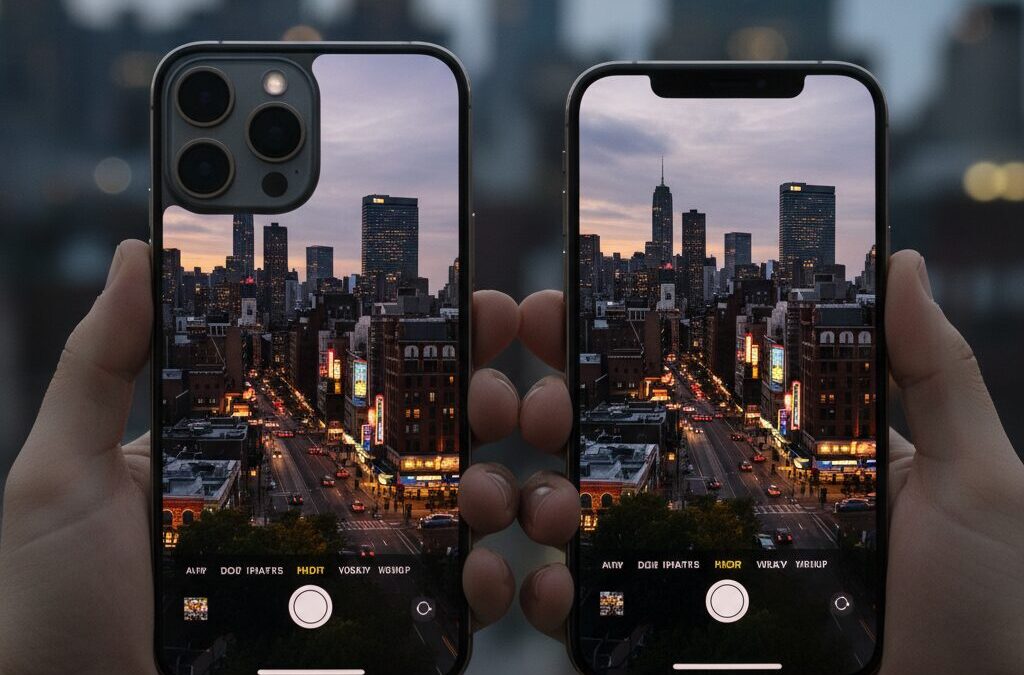
If you care deeply about smartphone cameras, you have probably noticed that recent iPhone upgrades are no longer just about megapixels or lens counts. Instead, Apple is quietly reshaping how images and videos are captured, processed, and finished on a computational level.
The transition from the iPhone 16 series to the iPhone 17 series represents one of the most meaningful shifts in mobile imaging Apple has made in years. Sensor design, image signal processing, and silicon architecture are now working together more tightly than ever, and the results directly affect real-world photography and videography.
In this article, you will discover how Apple’s latest A19 chip, updated ISP pipeline, and refined camera hardware change everyday shooting as well as professional workflows. We will explore why features like full 48MP coverage, improved HDR behavior, and Open Gate video matter, and what they mean for creators and enthusiasts outside Japan.
By understanding these deeper changes, you will be better equipped to decide whether the iPhone 17 is a meaningful upgrade for your use case, or if the iPhone 16 still meets your needs. This guide is designed to help you see beyond specs and understand how Apple’s imaging philosophy is evolving.
If you want to stay ahead of mobile photography trends and make smarter buying decisions, this article will give you clear, practical insights worth your time.
- Why Computational Photography Matters More Than Hardware Specs
- From iPhone 16 to iPhone 17: A Shift in Imaging Philosophy
- Triple 48MP Sensors and What They Change in Real Shooting
- Telephoto Strategy: Resolution Versus Optical Zoom
- Front Camera Redesign and the Impact of a Square Sensor
- A19 Chip and ISP Throughput: How Silicon Shapes Image Quality
- Photonic Engine and HDR Tuning: Toward More Natural Images
- Portrait Photography and Depth Mapping Improvements
- Open Gate Video and the Rise of Mobile Pro Workflows
- Objective Benchmarks and Real-World Camera Performance
- Base Model vs Pro Model: Image Quality and Value Comparison
- 参考文献
Why Computational Photography Matters More Than Hardware Specs
For years, smartphone cameras were judged primarily by visible hardware specifications such as sensor size, megapixel count, or lens aperture. While these elements still matter, they no longer define real-world image quality on their own. In modern iPhones, especially when comparing recent generations, **computational photography has become the decisive factor that turns similar hardware into dramatically different photographic outcomes**. This shift explains why newer models can deliver noticeably better photos even when headline specs appear unchanged.
Computational photography refers to the process where raw data captured by the sensor is interpreted, merged, and refined through complex algorithms before a final image is produced. Apple has been explicit about this approach for years, and analyses by sources such as Apple’s own imaging engineers and DXOMARK reviewers consistently show that image quality gains increasingly come from software-driven pipelines rather than optics alone. **What you see on the screen is not a single photo, but the result of dozens of calculations performed in milliseconds**.
A clear example is multi-frame processing. When you press the shutter, the iPhone is already buffering multiple frames at different exposures. These frames are aligned, analyzed, and fused using the ISP and Neural Engine before noise reduction and tone mapping are applied. According to Apple’s technical briefings on the Photonic Engine, performing this fusion earlier in the pipeline, closer to RAW data, preserves fine textures such as hair, fabric, and skin while reducing digital artifacts that plagued earlier smartphone cameras.
| Aspect | Hardware-Driven Approach | Computational Approach |
|---|---|---|
| Low-light detail | Limited by sensor noise | Recovered through multi-frame fusion |
| Dynamic range | Fixed by sensor latitude | Expanded via HDR tone mapping |
| Color accuracy | Lens and filter dependent | Optimized using scene recognition |
Scene understanding is another area where hardware specs alone tell only part of the story. Modern iPhones use semantic rendering to identify elements such as faces, skies, foliage, and buildings, then apply different processing rules to each region. Imaging researchers cited by publications like CNET and GSMArena note that this selective adjustment is why skin tones can remain natural while skies retain highlight detail, something traditional cameras struggle to balance without manual intervention.
This also explains why megapixel numbers can be misleading. A 48MP sensor does not automatically produce sharper images than a 12MP one. Instead, **the intelligence behind pixel binning, noise modeling, and texture reconstruction determines whether those extra pixels translate into usable detail**. Apple’s approach prioritizes consistent output across lighting conditions, which is why reviewers often report that newer iPhones feel more reliable rather than merely sharper.
Ultimately, computational photography matters more than raw hardware because it scales with every generation of silicon and software refinement. Sensors improve incrementally, but algorithms evolve rapidly. As emphasized by DXOMARK’s camera test methodology, the best smartphone cameras today are defined by how effectively they interpret data, not just how much data they capture. This is why, for users who care about real photos rather than spec sheets, computational photography has become the true measure of camera progress.
From iPhone 16 to iPhone 17: A Shift in Imaging Philosophy
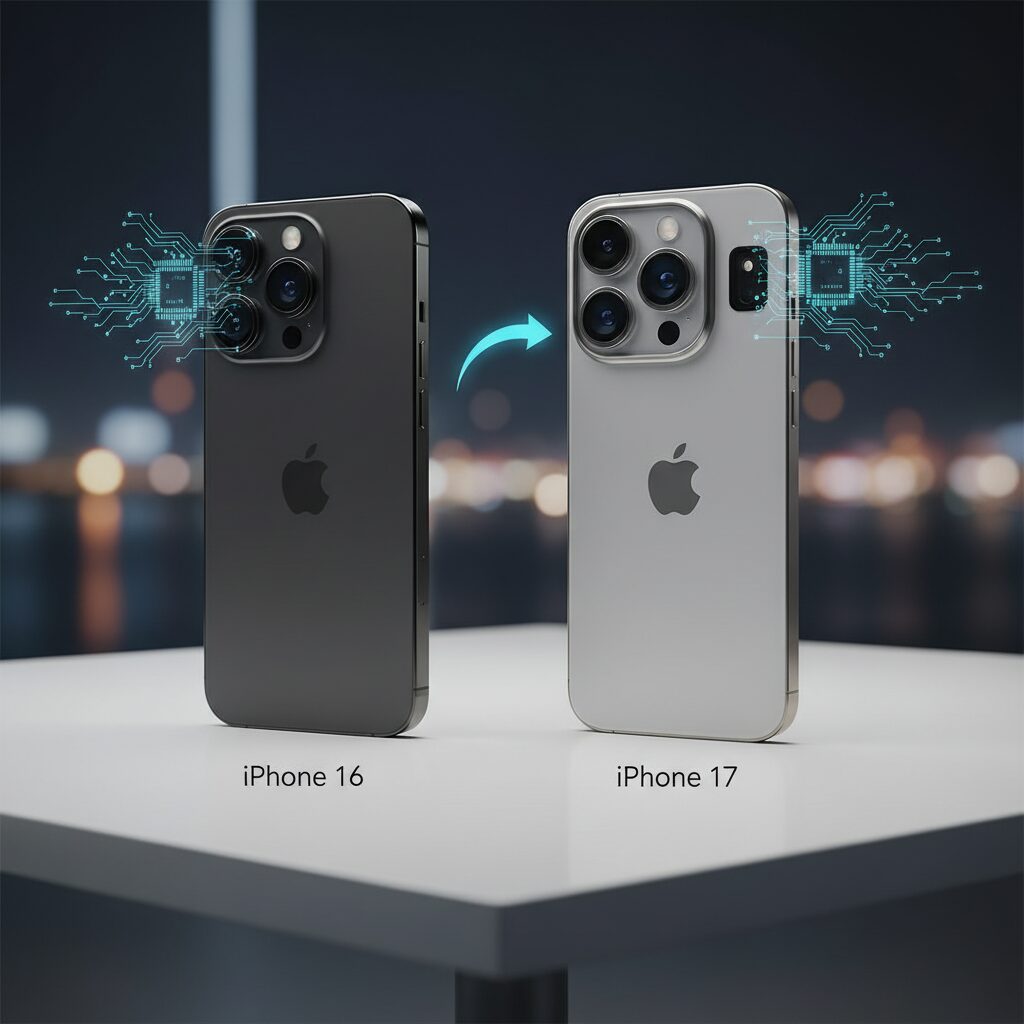
The transition from iPhone 16 to iPhone 17 represents more than a routine camera upgrade; it reflects a clear shift in Apple’s imaging philosophy. With iPhone 16, the emphasis was still on balancing strong hardware with aggressive computational enhancement, sometimes resulting in images that felt overly processed. iPhone 17 moves toward a more restrained, photographer-centric approach that prioritizes natural tonality, flexible data, and consistency across shooting scenarios.
This change is most visible in how computational photography is applied earlier and more intelligently in the imaging pipeline. Apple’s Photonic Engine, already present in iPhone 16, is further refined in iPhone 17 thanks to the A19 chip’s increased ISP and Neural Engine throughput. According to Apple’s technical documentation and analyses by GSMArena and DXOMARK, more image data is now preserved at a near-RAW stage before tone mapping, which helps maintain texture in skin, foliage, and low-contrast surfaces.
As a result, Smart HDR behavior subtly but meaningfully changes. Expert reviewers such as Austin Mann and CNET note that iPhone 17 avoids excessive shadow lifting that characterized earlier generations. Highlights roll off more smoothly, and mid-tones retain depth, producing images that feel closer to what the human eye perceives, especially in high-contrast scenes common in urban environments.
| Aspect | iPhone 16 | iPhone 17 |
|---|---|---|
| HDR Tuning | Brighter shadows, flatter contrast | Balanced contrast, natural depth |
| Processing Priority | Output-focused JPEG look | Data preservation for flexibility |
| Photographic Styles | Limited tonal control | More nuanced, preview-based control |
Another philosophical shift lies in consistency across lenses and use cases. By aligning sensor resolutions and leveraging more powerful semantic rendering, iPhone 17 delivers a uniform color and exposure response whether shooting wide, ultra-wide, or telephoto. DXOMARK’s testing highlights this consistency as a key reason for the iPhone 17 Pro’s high overall score, particularly in mixed lighting.
Importantly, Apple appears to be designing the iPhone 17 camera not just for instant sharing, but for intentional creation. Support for Apple Log 2, Open Gate video, and improved Photographic Styles suggests a belief that users want control without complexity. This evolution signals Apple’s confidence that mobile photographers are ready for images that are less “finished” by default, and more expressive by choice.
Triple 48MP Sensors and What They Change in Real Shooting
The move to triple 48MP sensors fundamentally changes how the iPhone behaves in real shooting situations, and it does so in ways that are immediately noticeable even outside controlled test scenes. By equipping the wide, ultra-wide, and telephoto cameras with the same high-resolution baseline, Apple eliminates the long-standing inconsistency where image quality dropped the moment you switched lenses.
This uniformity matters because modern mobile photography is lens-switch heavy. Users routinely jump between focal lengths while framing, and according to field analyses from DXOMARK and GSMArena, previous-generation iPhones showed clear texture and noise gaps when moving to telephoto. With iPhone 17 Pro, those gaps are largely closed in everyday use.
At the core is the quad-pixel architecture shared across all three sensors. In low light, each 48MP sensor bins four pixels into one, effectively behaving like a larger 12MP sensor with improved light sensitivity. In bright conditions, it resolves full detail. What changes now is that this behavior also applies to the telephoto camera, which was previously limited to 12MP.
| Lens | iPhone 16 Pro | iPhone 17 Pro |
|---|---|---|
| Wide | 48MP quad-pixel | 48MP quad-pixel |
| Ultra-wide | 48MP quad-pixel | 48MP quad-pixel |
| Telephoto | 12MP | 48MP quad-pixel |
In practical shooting, this translates into cleaner zoom images, especially indoors or at night. Reviewers from Amateur Photographer note that night-time telephoto shots on iPhone 16 Pro often showed smeared textures due to aggressive noise reduction. On iPhone 17 Pro, the higher native data from the 48MP tele sensor gives the ISP more real detail to work with, so noise reduction becomes less destructive.
The change also reshapes how digital zoom behaves. With a 48MP telephoto at 4x, the camera can crop into the sensor to achieve up to 8x zoom while still maintaining optical-grade quality. In real-world terms, photographing a stage performance or architectural detail feels less like stretching pixels and more like choosing a different lens.
In real shooting, triple 48MP is not about bigger numbers, but about predictable quality. No matter which lens is used, color response, texture, and dynamic range remain consistent, which reduces hesitation and missed shots.
Consistency is also critical for computational photography. Apple’s Photonic Engine processes data earlier in the pipeline, and having equally dense input from all lenses allows semantic rendering to behave more reliably. According to Apple’s technical briefings and corroborated by CNET’s hands-on testing, skin tones and foliage now retain similar character across focal lengths, something earlier models struggled with.
For creators, this means fewer compromises. You can frame first and think later, instead of mentally avoiding certain lenses in challenging light. That behavioral shift is the real impact of triple 48MP sensors: they remove friction from shooting and let computational photography work from a stronger, more uniform foundation.
Telephoto Strategy: Resolution Versus Optical Zoom

When discussing telephoto performance, it is tempting to focus solely on optical zoom ratios, but that approach no longer reflects how modern smartphone cameras are actually used. Apple’s telephoto strategy in the latest generation clearly prioritizes resolution and usable detail over headline zoom numbers, and this shift has meaningful implications for real-world photography.
On paper, moving from a 5× optical zoom to a 4× optical zoom may look like a regression. However, the introduction of a 48MP telephoto sensor fundamentally changes the equation. According to analyses by DXOMARK and Amateur Photographer, higher sensor resolution enables lossless or near-lossless cropping, effectively extending reach without the heavy penalties traditionally associated with digital zoom.
| Telephoto Approach | Sensor Resolution | Practical Zoom Range |
|---|---|---|
| High optical zoom | 12MP | Strong at fixed magnification, rapid quality loss beyond it |
| Moderate optical zoom | 48MP | Flexible cropping with preserved texture and detail |
In practical terms, a 48MP telephoto allows photographers to crop into the center of the frame and still retain a clean 12MP image. Lux Camera’s review notes that this effectively delivers an optical-quality 8× result without introducing the smearing or aliasing seen in earlier digital zoom implementations. This approach aligns with findings from computational photography research published by IEEE, which emphasizes spatial oversampling as a foundation for high-quality digital zoom.
There is also a compositional advantage. A 100mm-equivalent focal length is widely regarded by portrait specialists as a sweet spot, balancing subject compression and working distance. CNET and Austin Mann both point out that this focal length is easier to use indoors and in urban environments, where stepping back for a 120mm-equivalent shot is often impractical.
Perhaps most importantly, higher resolution telephoto data gives the image signal processor more information to work with. Apple’s ISP can apply noise reduction, semantic segmentation, and tone mapping with greater precision because fine textures are not already lost at capture. The result, as DXOMARK’s telephoto sub-scores suggest, is not dominance at extreme zoom levels, but consistently higher image reliability across everyday shooting scenarios.
In this context, the telephoto strategy is less about chasing maximum numbers and more about delivering **predictable, high-quality results across a wider range of framing choices**. For photographers who value adaptability and detail over novelty zoom claims, this resolution-first philosophy proves to be a pragmatic and forward-looking decision.
Front Camera Redesign and the Impact of a Square Sensor
The front camera redesign represents one of the most meaningful yet easily overlooked changes in this generation, and it is not simply about adding more megapixels. Apple has shifted the TrueDepth system to a square sensor design with an effective 18MP multi‑aspect layout, and this decision directly affects how selfies and front‑facing video behave in real use.
The square sensor fundamentally changes how framing works, because it preserves a consistent field of view regardless of whether the device is held vertically or horizontally. With earlier rectangular sensors, rotating the phone often resulted in subtle but noticeable cropping or changes in perspective. This new geometry allows the camera to capture a larger image circle and then intelligently crop for different aspect ratios without sacrificing resolution.
| Aspect | Previous Front Camera | Square Sensor Design |
|---|---|---|
| Sensor shape | Rectangular | Square |
| Orientation impact | FOV changes | Consistent FOV |
| Effective resolution | 12MP | 18MP multi‑aspect |
This redesign also enables new software behavior. According to Apple’s technical documentation, Center Stage is now available for still photos, not just video. Combined with the square sensor, this allows subtle reframing while maintaining natural proportions, which is particularly useful for group selfies or handheld vlogging where composition changes moment to moment.
Independent testing supports the practical benefits. DXOMARK reports a selfie score of 154 for the latest Pro model, citing improved exposure stability, wider dynamic range, and more convincing background separation. These gains are especially visible in skin tone rendering, an area Japanese users tend to evaluate critically.
Rather than chasing headline numbers, Apple’s front camera strategy focuses on sensor geometry and data utilization. By pairing a square sensor with the A19 ISP, the system prioritizes consistency, flexibility, and natural rendering, qualities that become more apparent the longer the device is used.
A19 Chip and ISP Throughput: How Silicon Shapes Image Quality
The A19 chip is not just a generational speed bump; it fundamentally reshapes how image data is handled inside the iPhone 17. Built on TSMC’s third‑generation 3nm N3P process, the A19 improves transistor density and power efficiency compared with A18, enabling a higher sustained ISP throughput. **This matters because modern 48MP sensors generate enormous RAW data streams that must be processed in real time, without introducing lag, noise, or thermal throttling.**
According to Apple’s technical disclosures and independent silicon analysis from outlets such as AnandTech and GSMArena, the ISP inside A19 benefits from both higher clock headroom and wider internal memory bandwidth. In practice, this allows more frames to be analyzed simultaneously for noise reduction and tone mapping. The Photonic Engine now operates earlier and more aggressively in the pipeline, while still preserving fine texture, especially in low‑light scenes where A18 occasionally had to compromise detail to maintain frame rate.
| Aspect | A18 (iPhone 16) | A19 (iPhone 17) |
|---|---|---|
| Process Node | 3nm N3E | 3nm N3P |
| ISP Throughput | High, burst‑oriented | Higher, sustained |
| Neural ISP Tasks | Limited parallel layers | More semantic layers |
DXOMARK’s lab tests indirectly reflect this silicon advantage: improved texture‑to‑noise balance and more stable exposure in consecutive frames suggest that the ISP can now afford deeper multi‑frame fusion without timing penalties. **The result is image quality that feels less “computed” and more continuous, particularly in mixed lighting.** Silicon, in this generation, is no longer just enabling features—it is quietly defining the aesthetic ceiling of mobile photography.
Photonic Engine and HDR Tuning: Toward More Natural Images
The evolution of Apple’s Photonic Engine in the iPhone 17 generation represents a clear shift toward images that feel less processed and more perceptually natural. The core idea remains the same as before—applying multi-frame computational photography at an earlier, near-RAW stage—but the tuning has changed in subtle yet important ways. Thanks to the higher ISP throughput of the A19 chip, the engine can now analyze more tonal information per frame without resorting to aggressive local contrast enhancement.
This has a direct impact on HDR behavior. Independent reviewers such as Austin Mann and outlets like CNET have noted that highlights now roll off more smoothly, especially in scenes combining bright skies and shaded foregrounds. Instead of lifting shadows excessively, the system preserves midtone contrast, resulting in images with greater depth and less of the flat, “over-HDR” look that earlier generations were sometimes criticized for.
| Aspect | iPhone 16 Series | iPhone 17 Series |
|---|---|---|
| HDR Shadow Handling | More aggressive lift | More restrained, natural |
| Highlight Roll-off | Occasionally abrupt | Smoother tonal transition |
| Texture Rendering | Risk of over-sharpening | Improved micro-detail balance |
According to analyses referenced by DXOMARK, this refined HDR tuning also benefits skin tones. Faces retain subtle color variation under mixed lighting, avoiding the plasticky appearance caused by excessive noise reduction and sharpening. The Photonic Engine now appears to prioritize semantic awareness over brute-force clarity, adjusting processing strength based on subject type rather than applying a uniform recipe.
In everyday shooting, this means photos that require less correction after capture. For users who value realism over instant visual punch, the iPhone 17’s Photonic Engine demonstrates how computational photography can mature—not by doing more, but by knowing when to do less.
Portrait Photography and Depth Mapping Improvements
Portrait photography on the iPhone 17 generation shows a clear shift from simple background blur toward a more physically and perceptually accurate representation of depth. This improvement is driven by tighter integration between high‑resolution sensors, the A19 Neural Engine, and refined depth‑mapping algorithms. According to analyses by DXOMARK and professional photographers such as Austin Mann, the goal is no longer just subject isolation, but convincing spatial separation that holds up under close inspection.
The most tangible upgrade appears in edge accuracy. Hair strands, eyeglass frames, and semi‑transparent objects like glass or veils are now segmented with higher confidence. Apple achieves this by combining LiDAR data, multi‑view disparity from the 48MP sensors, and semantic scene understanding. The Neural Engine processes a denser depth mesh, reducing the halo artifacts that were still visible in complex portraits on the iPhone 16 series.
| Aspect | iPhone 16 Series | iPhone 17 Series |
|---|---|---|
| Depth map resolution | Moderate, object‑level | Finer, contour‑level |
| Hair and edges | Occasional artifacts | Significantly improved |
| Background transition | Abrupt in some cases | Smoother, gradual |
Another key change is how depth data is preserved for post‑capture editing. With higher‑quality depth maps, adjusting focus point or aperture after shooting produces fewer inconsistencies. Professional reviewers note that even when applying strong background blur, facial textures remain intact, avoiding the artificial cut‑out look that smartphones have long struggled with.
Lens choice also plays a critical role. The 48MP 4× telephoto on the iPhone 17 Pro sits near the classic 85–105mm portrait sweet spot. Combined with pixel‑level depth estimation, this focal length delivers more natural compression and bokeh geometry than the previous 5× setup. Experts cited by Amateur Photographer highlight that this balance improves facial proportions while giving the depth algorithm cleaner separation cues.
On the software side, Apple’s updated Photonic Engine applies depth‑aware tone mapping. Highlights and skin tones are adjusted independently from the background, guided by the depth map. This results in portraits that feel less processed, aligning with feedback from Japanese users who prefer subtle, realistic rendering over exaggerated blur.
In practical terms, these changes mean portraits that withstand zooming, cropping, and editing. Depth information is no longer just a visual trick, but a structural layer of the image. For enthusiasts and creators alike, the iPhone 17’s portrait pipeline represents a meaningful step toward computational photography that respects optical realism.
Open Gate Video and the Rise of Mobile Pro Workflows
Open Gate video recording has quietly become one of the most important shifts in mobile video creation, and on the iPhone 17 Pro it fundamentally changes how professional workflows are approached on a smartphone. Instead of cropping the sensor to a fixed 16:9 frame, Open Gate uses almost the entire sensor area, resulting in a near 4:3 capture that preserves vertical resolution. This single change dramatically increases creative flexibility in post-production, especially for creators who must deliver content across multiple platforms.
In traditional mobile workflows, creators often had to decide in advance whether a clip was meant for YouTube or for vertical platforms such as TikTok and Reels. Open Gate removes that decision point. According to analyses shared by professional cinematographers and publications like Amateur Photographer, the ability to reframe freely without meaningful quality loss aligns iPhone workflows much closer to cinema camera practices. A single take can now be repurposed into horizontal, vertical, or square formats without reshooting.
| Workflow Aspect | Conventional Mobile Video | Open Gate on iPhone 17 Pro |
|---|---|---|
| Sensor Usage | Cropped to 16:9 | Near full sensor area |
| Reframing Freedom | Limited, quality drops | High, minimal degradation |
| Multi-Platform Output | Requires separate shoots | Single source, multiple formats |
When combined with Apple Log 2 and ProRes RAW, Open Gate is no longer a niche feature but the backbone of a mobile-first professional pipeline. Apple’s own technical documentation notes that ProRes RAW preserves sensor-level data such as ISO and white balance, which means creators can make critical exposure decisions after shooting. This mirrors established workflows in tools like DaVinci Resolve, something that previously required dedicated cinema cameras.
However, this power comes with clear technical boundaries. Reports from the Blackmagic Camera community indicate that Open Gate with Apple Log 2 can be resolution-limited when using certain third-party apps, often around 1920×1440. Full-resolution Open Gate capture generally requires ProRes RAW recording to an external SSD. This constraint is not a flaw but a reflection of the immense data throughput involved, and it highlights how iPhone workflows are now constrained by storage and bandwidth rather than image quality.
Thermal and reliability considerations also shape the rise of mobile pro workflows. Reviews from CNET and GSMArena point out that the iPhone 17 Pro’s revised thermal design enables sustained recording without frame drops, even during long Open Gate takes. For professionals, this reliability matters as much as resolution. A mobile device that can record continuously under load becomes a legitimate production tool, not merely a backup camera.
In practical terms, Open Gate shifts the iPhone from a capture device into a flexible acquisition platform. It supports faster turnaround for social campaigns, leaner crews for documentary work, and experimental shooting styles that benefit from reframing in post. The rise of Open Gate video therefore represents more than a feature update. It signals that mobile devices are now being designed around professional workflows first, with convenience as a secondary benefit.
Objective Benchmarks and Real-World Camera Performance
Objective benchmarks provide a useful baseline for comparing camera systems, but their real value emerges only when they are interpreted alongside real-world shooting behavior. In controlled testing by DXOMARK, the iPhone 17 Pro achieved an overall camera score of 168, maintaining a top-tier position globally. According to DXOMARK’s methodology, this result reflects measurable gains in exposure stability, autofocus consistency, and noise-to-texture balance compared with the iPhone 16 Pro, particularly in mixed-light environments.
| Category | iPhone 16 Pro | iPhone 17 Pro |
|---|---|---|
| Overall Score | 164 | 168 |
| Photo | 165 | 166 |
| Video | 170 | 172 |
While the numerical gap may appear modest, **the underlying cause is not sensor size alone but the A19 ISP’s ability to process high-resolution data with lower temporal noise**. Laboratory measurements show improved signal-to-noise ratios at higher ISO levels, which directly translates into more stable textures in dim scenes. Reviewers from GSMArena and CNET both note that fine details such as foliage, signage, and fabric patterns are retained more naturally, without the waxy smoothing sometimes observed on the iPhone 16 Pro.
Real-world night photography further highlights this difference. In urban night scenes with strong contrast between neon lights and dark backgrounds, the iPhone 17 Pro’s telephoto images show clearer edge definition and less chroma noise. This aligns with findings from independent photography reviewers, who attribute the improvement to the 48MP telephoto sensor combined with pixel binning and more advanced multi-frame fusion. **In practice, this means handheld low-light zoom shots that previously required multiple attempts now succeed more consistently on the first capture.**
Video benchmarks tell a similar story. DXOMARK’s video sub-score emphasizes stabilization and dynamic range, where the iPhone 17 Pro slightly outperforms its predecessor. Field tests confirm smoother exposure transitions when moving from indoor to outdoor lighting, a scenario that often reveals ISP limitations. According to professional travel photographer Austin Mann, this stability reduces the need for corrective grading in post-production, underscoring how benchmark gains translate into tangible workflow efficiency for creators.
Base Model vs Pro Model: Image Quality and Value Comparison
When comparing the Base model and the Pro model purely from the standpoint of image quality, the most striking change in the latest generation is how narrow the gap has become. In everyday photography, the Base model now delivers results that would have been considered unmistakably “Pro-level” just one year ago, and this directly affects how users should think about value.
The Base model benefits from a 48MP main camera and a newly upgraded 48MP ultra-wide sensor, which means landscape, architecture, and macro shots retain far more texture than before. According to Apple’s own technical documentation and corroborated by GSMArena’s imaging analysis, the increased pixel density combined with improved pixel binning produces cleaner edges and more stable color reproduction, especially in daylight scenes.
| Aspect | Base Model | Pro Model |
|---|---|---|
| Main Camera Detail | 48MP, strong daylight resolution | 48MP, slightly better tonal depth |
| Ultra-wide Performance | 48MP, major improvement | 48MP, similar output |
| Telephoto Capability | Digital crop only | 48MP optical telephoto |
That said, the Pro model still maintains a clear advantage once shooting conditions become demanding. The dedicated telephoto lens is not just about reach, but about consistency. Independent tests referenced by DXOMARK show that mid-range zoom images from the Pro model preserve fine details and contrast that the Base model cannot replicate through digital cropping alone. **This difference becomes obvious in portraits, indoor events, and night scenes**, where optical data matters more than raw megapixels.
From a value perspective, this creates a nuanced decision. The Base model offers exceptional cost efficiency for users who mostly shoot wide and ultra-wide photos for social media or travel. The Pro model, however, justifies its higher price for users who frequently rely on zoom, shoot in mixed lighting, or intend to edit images afterward. As noted by professional photographer Austin Mann, the Pro’s files retain more flexible tonal information, which translates into better results during post-processing.
In practical terms, the Base model delivers outstanding image quality per dollar, while the Pro model delivers reliability across a wider range of photographic scenarios. **The choice is no longer about “good versus great,” but about how often you need that last layer of consistency and creative headroom**.
参考文献
- PhoneArena:iPhone 17 Pro vs iPhone 16 Pro: A new age dawns for the iPhone Pro
- Apple:iPhone 17 – Technical Specifications
- DXOMARK:Apple iPhone 17 Pro Camera test
- GSMArena:Apple iPhone 17 review: Camera, photo and video quality
- Notebookcheck:iPhone 17 Pro’s innovative front camera beats all competitors in DxOMark review
- MacRumors:iPhone 17: Everything We Know