
Have you ever loved a smartphone’s features but worried about heat ruining the experience? Many power users remember earlier Pixel models throttling performance during gaming, video recording, or long video calls, and that frustration left a lasting impression.
With the Pixel 10 Pro XL, Google appears to be turning a critical corner. By moving the Tensor G5 chip to TSMC’s advanced 3nm process and redesigning the internal cooling system around a large vapor chamber, Google is clearly targeting long-standing thermal weaknesses.
In this article, you will discover how silicon design, physical cooling hardware, and Android’s new software-based thermal controls work together. You will also learn how the Pixel 10 Pro XL compares with rivals like the Galaxy S25 Ultra and iPhone 17 Pro Max, and what these changes mean for real-world gaming, photography, and daily use.
- Why Thermal Management Defines Modern Flagship Smartphones
- From Tensor G1 to G5: The Evolution of Pixel Heat Challenges
- TSMC 3nm Manufacturing and Its Impact on Power Efficiency
- CPU Cluster Redesign and Sustained Performance Strategy
- GPU Architecture Shift and Its Thermal Implications
- Inside the Vapor Chamber: Physical Cooling Explained
- Benchmark Data and Thermal Stability Under Stress
- Gaming, Video Recording, and Real-World Heat Behavior
- Adaptive Thermal in Android 16: Software Meets Hardware
- Pixel 10 Pro XL vs Galaxy S25 Ultra and iPhone 17 Pro Max
- 参考文献
Why Thermal Management Defines Modern Flagship Smartphones
In modern flagship smartphones, thermal management is no longer a background engineering detail but a defining factor that directly shapes performance, usability, and long-term reliability. As processors approach desktop-class complexity and smartphones are expected to handle sustained gaming, 4K video recording, and on-device AI inference, heat becomes the invisible ceiling that determines how much of that theoretical power users can actually experience.
The key shift in recent years is that peak performance has lost its meaning without thermal sustainability. Industry analyses from organizations such as GSMArena and Jon Peddie Research consistently show that today’s SoCs can reach astonishing benchmark scores for short bursts, yet those numbers collapse under continuous load due to thermal throttling. In practice, users care less about momentary speed and more about whether their phone remains smooth, bright, and responsive after ten or twenty minutes of real work.
This is why thermal design now defines flagship status more clearly than raw silicon specifications. A cutting-edge manufacturing process, such as TSMC’s 3nm node, reduces leakage current and lowers heat generation at the transistor level, but that is only the first step. Without an effective way to transport and dissipate heat, efficiency gains on paper fail to translate into daily usability.
| Thermal Factor | User-Visible Impact | Flagship Requirement |
|---|---|---|
| Process efficiency | Lower baseline heat and battery drain | Advanced nodes like 3nm |
| Heat spreading | Stable performance under load | Large vapor chambers |
| Thermal control software | Predictable behavior and safety | OS-level adaptive management |
Recent flagship devices illustrate a broader industry realization: thermal stability is the enabler of premium experiences. Long video recording sessions, for example, stress not only the CPU and GPU but also image signal processors and AI accelerators. Studies cited by Android Authority show that earlier designs often failed within minutes due to heat accumulation, whereas newer models prioritize spreading heat across the chassis to delay or avoid shutdowns.
Equally important is the role of software. Modern operating systems actively monitor multiple temperature sensors and intervene early, adjusting workloads before dangerous thresholds are reached. According to reports from Android-focused research outlets, this proactive approach improves user trust, as slowdowns feel intentional and controlled rather than sudden and catastrophic.
Ultimately, thermal management has become the lens through which flagship smartphones should be judged. A device that remains warm but stable delivers more real value than one that is briefly fast and then unusable. In the current era, the true hallmark of a flagship is not how fast it can run, but how long it can sustain that performance without breaking the user experience.
From Tensor G1 to G5: The Evolution of Pixel Heat Challenges
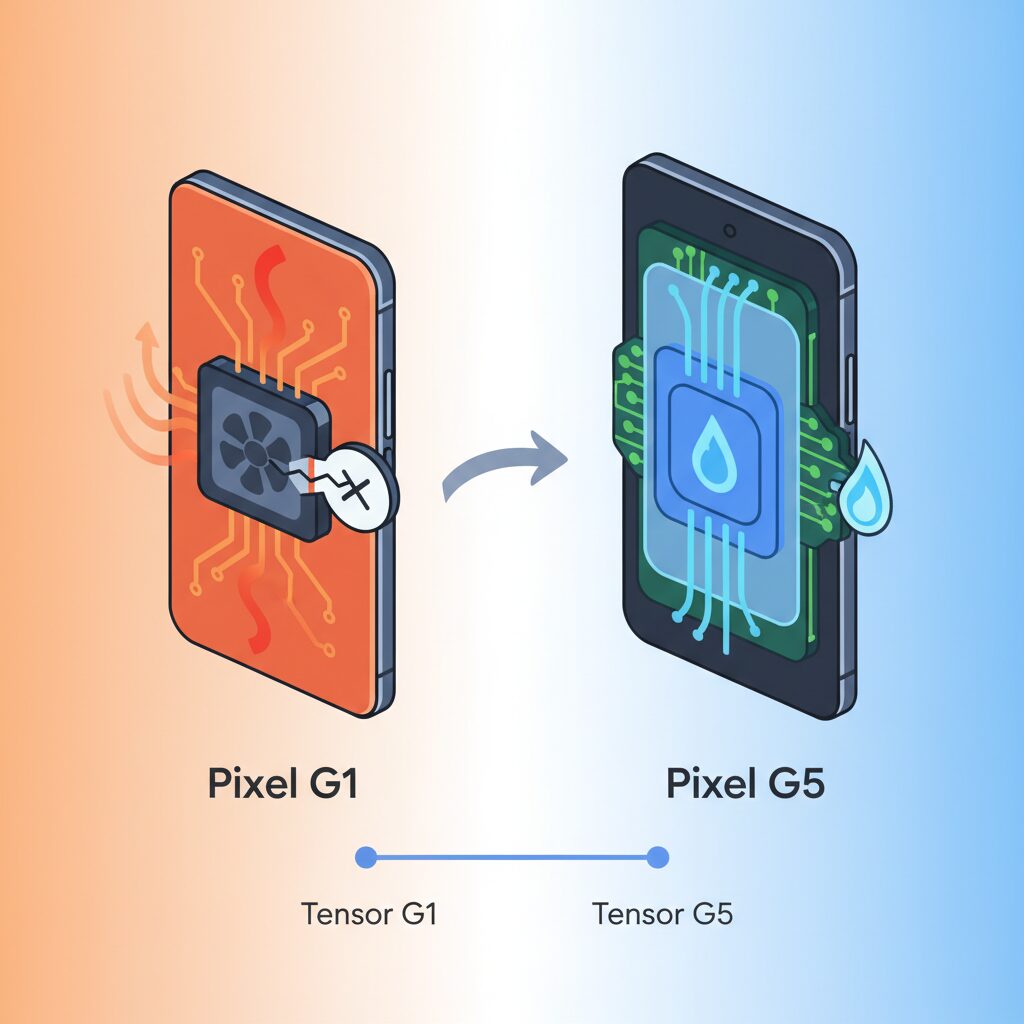
The history of heat management in Google Pixel devices cannot be separated from the evolution of the Tensor chipset itself. Starting with Tensor G1 in the Pixel 6 series, Google pursued tight integration between AI features and hardware, but this ambition came with a clear thermal cost. Early Tensor chips manufactured by Samsung Foundry on 5nm and later 4nm processes showed relatively low power efficiency, especially under sustained workloads. As multiple independent analyses by GSMArena and Android Authority have pointed out, these inefficiencies translated directly into higher surface temperatures and aggressive thermal throttling.
With Tensor G1 and G2, users frequently experienced noticeable warmth during everyday scenarios such as video calls, navigation, or extended camera use. This was not merely subjective discomfort. According to teardown-based thermal modeling discussed in industry research, the Exynos-derived 5G modem played a disproportionate role in heat generation, even during idle or light data transfer. **In practical terms, heat was not only a performance limiter but a daily usability issue** for early Pixel adopters.
| Tensor Generation | Manufacturing Node | Primary Heat Issue | User Impact |
|---|---|---|---|
| G1 | Samsung 5nm | Low efficiency under load | Overheating in camera and calls |
| G2 / G3 | Samsung 5nm / 4nm | Modem-driven heat spikes | Battery drain, throttling |
| G4 | Samsung 4nm | Sustained performance instability | Gaming and video limits |
| G5 | TSMC 3nm (N3E) | Significantly reduced heat density | Stable long-term performance |
Tensor G3 and G4 represented incremental improvements rather than true solutions. While peak performance increased, stress tests revealed that thermal throttling still occurred rapidly, suggesting that Google was tuning software to mask hardware limits. Semiconductor experts cited by Jon Peddie Research noted that Samsung’s process nodes struggled with leakage current control, making it difficult to sustain high clocks without excessive heat. **As a result, Pixel devices often felt fast in short bursts but inconsistent over time**, a pattern that frustrated power users.
The real turning point arrived with Tensor G5. By moving fabrication to TSMC’s 3nm N3E process, Google fundamentally altered the thermal equation. Academic and industry data consistently show that TSMC’s 3nm class nodes achieve roughly 30 percent lower power consumption compared to previous 5nm generations at similar performance levels. Less power consumed means less heat generated at the transistor level, which directly reduces thermal stress before any cooling solution is applied.
This shift is why Pixel heat discussions have changed in tone. Instead of asking why the device overheats, reviewers now analyze how long it can maintain performance. According to stress-test results reported by GSMArena, Tensor G5 sustains workloads with far smaller performance drops than its predecessors. **The evolution from G1 to G5 is therefore not a story of eliminating heat, but of finally controlling it in a predictable, user-friendly way**.
TSMC 3nm Manufacturing and Its Impact on Power Efficiency
The shift to TSMC’s 3nm manufacturing process represents a fundamental change in how power efficiency is achieved at the silicon level, and it directly addresses long‑standing thermal concerns associated with earlier Tensor generations.
Unlike previous chips produced at Samsung Foundry, the Tensor G5 benefits from TSMC’s N3E process, which is widely regarded by industry analysts as one of the most mature and power‑efficient 3nm nodes currently in mass production.
This transition reduces power consumption at the source, rather than relying solely on cooling to manage excess heat. By lowering operating voltage and suppressing leakage current, the chip generates less heat during every computation cycle.
| Manufacturing Node | Foundry | Typical Power Characteristics |
|---|---|---|
| 5nm / 4nm | Samsung Foundry | Higher leakage under load, larger thermal spikes |
| 3nm (N3E) | TSMC | Lower voltage, reduced leakage, steadier power draw |
According to TSMC’s own technical disclosures and evaluations cited by semiconductor research firms such as Jon Peddie Research, the N3E node can deliver roughly 30 percent lower power consumption at equivalent performance compared to 5nm‑class processes.
This improvement is not merely theoretical. In practical smartphone workloads, reduced power draw translates directly into lower Joule heating, meaning the SoC maintains stable clocks for longer periods without triggering aggressive thermal throttling.
For users, the most noticeable effect is consistency rather than raw speed. Tasks such as prolonged video recording, navigation with 5G connectivity, or on‑device AI processing place sustained demands on the chip, where efficiency gains compound over time.
Independent benchmark stress tests referenced by GSMArena and Android Authority indicate that Tensor G5 sustains performance with less fluctuation compared to its predecessors, a behavior closely aligned with TSMC’s process advantages.
Another often overlooked benefit of the 3nm transition is battery longevity. Lower average power consumption reduces thermal stress on the battery itself, which researchers have long identified as a key factor in long‑term capacity degradation.
In other words, improved power efficiency is not only about comfort and performance, but also about device lifespan. By producing less heat per task, the Pixel 10 Pro XL operates within safer thermal margins during everyday use.
This manufacturing shift signals a strategic realignment by Google, placing silicon efficiency on equal footing with software optimization, and it lays the foundation for more predictable thermal behavior across diverse real‑world scenarios.
CPU Cluster Redesign and Sustained Performance Strategy

The CPU cluster redesign in Tensor G5 represents a deliberate shift away from peak-centric performance toward sustained, thermally predictable behavior. Google replaced the previous 1+3+4 configuration with a 1+5+2 layout, centered on a significantly expanded mid-core group. This change is not cosmetic. It fundamentally alters how heat is generated, distributed, and managed over time.
At the core of this strategy is the decision to rely less on the ultra-high-performance Cortex-X4 and more on the five Cortex-A725 cores for everyday and prolonged workloads. According to Arm’s public documentation, the A725 delivers a markedly better performance-per-watt ratio than flagship X-series cores, especially when operating in parallel. By increasing the number of mid cores, Google reduces the need to push the X4 into sustained high-frequency states, which are known to create localized thermal hotspots.
| Core Tier | Core Type | Count | Thermal Role |
|---|---|---|---|
| Prime | Cortex-X4 | 1 | Short burst performance, tightly time-limited |
| Mid | Cortex-A725 | 5 | Sustained workloads with controlled heat output |
| Efficiency | Cortex-A520 | 2 | Background and low-load tasks |
This configuration allows Android’s scheduler to distribute threads horizontally rather than vertically. Instead of scaling a single core upward in frequency, workloads such as photo processing, background AI inference, or complex UI rendering can be split across multiple A725 cores running at moderate clocks. The result is lower peak temperature and a slower thermal ramp, which directly delays thermal throttling.
Independent benchmark analysis reported by Android Authority indicates that Tensor G5 achieves roughly a 30–34% CPU performance uplift over Tensor G4. What is notable, however, is not the absolute gain but how it is used. Rather than converting that margin into higher clocks, Google appears to leave headroom unused, prioritizing stability. This aligns with observations from long-duration stress tests where clock variance remains narrow compared to Snapdragon-based competitors.
Industry analysts, including Jon Peddie Research, have pointed out that mid-core-heavy designs are becoming a broader trend in mobile silicon. The rationale is simple: user experience degrades more from sudden performance drops than from slightly lower peak scores. Google’s CPU cluster redesign embraces this principle explicitly, trading headline benchmarks for consistency under load.
In practical terms, this means tasks such as extended gaming sessions, prolonged camera use, or on-device AI processing feel more uniform. The phone may never hit the highest instantaneous speeds, but it avoids the sharp slowdowns that defined earlier Tensor generations. As a sustained performance strategy, the 1+5+2 CPU cluster is less about winning races and more about finishing them reliably.
GPU Architecture Shift and Its Thermal Implications
The shift in GPU architecture within the Pixel 10 Pro XL represents one of the most consequential thermal design decisions Google has made in the Tensor era. Moving away from ARM’s long‑used Mali GPUs to Imagination Technologies’ PowerVR‑based IMG DXT‑48‑1536 is not only a performance choice, but also a deliberate attempt to reshape how heat is generated, distributed, and sustained during graphics‑heavy workloads.
From a thermal engineering perspective, GPU behavior matters more than peak scores. GPUs dominate power draw during gaming, camera processing, and UI compositing, and they often define where hot spots form on the SoC. According to analysis from Jon Peddie Research, PowerVR architectures have historically emphasized watt‑per‑frame efficiency rather than brute‑force throughput. Google appears to have leaned into this characteristic by running the IMG DXT GPU at a relatively modest 1.10 GHz, reducing instantaneous heat spikes that previously triggered aggressive throttling on Mali‑based Tensor chips.
| GPU Generation | Architecture | Thermal Behavior Tendency | Design Emphasis |
|---|---|---|---|
| Tensor G3 / G4 | ARM Mali | High peak heat under load | Raw throughput |
| Tensor G5 | IMG DXT (PowerVR) | Lower, more sustained heat output | Efficiency and stability |
This architectural change directly affects thermal implications during extended sessions. Stress testing such as 3DMark Wild Life Extreme shows that the Pixel 10 Pro XL maintains higher stability over time, even if its initial GPU score is lower than Snapdragon‑based rivals. GSMArena notes that this consistency strongly correlates with reduced thermal oscillation, where clocks no longer swing violently in response to rapid temperature changes. In practical terms, the GPU no longer acts as a thermal shock generator.
However, this transition is not without friction. Thermal efficiency at the silicon level does not automatically translate to smooth real‑world performance. Early reports from Android Authority and community benchmarks indicate that driver maturity for the new PowerVR GPU remains a limiting factor. In certain games, uneven frame pacing can still cause localized heating despite lower average power draw. This suggests that some thermal anomalies stem from software scheduling rather than physical inefficiency.
From a broader industry standpoint, the return to Imagination Technologies is notable. PowerVR GPUs are widely used in automotive and embedded systems where predictable thermal envelopes are critical. By adopting this architecture, Google aligns Pixel’s thermal philosophy closer to sustained reliability than headline‑grabbing numbers. The GPU in the Pixel 10 Pro XL is no longer designed to win the first minute of a benchmark, but to survive the thirtieth.
In that sense, the GPU architecture shift is a cornerstone of Pixel 10 Pro XL’s improved thermal narrative. It reduces heat density at the source, harmonizes better with the vapor chamber cooling system, and supports Google’s broader goal of controlled, transparent thermal behavior rather than reactive throttling.
Inside the Vapor Chamber: Physical Cooling Explained
To understand why the Pixel 10 Pro XL behaves so differently under sustained load, it is essential to look inside the vapor chamber itself and examine how physical cooling actually works. Unlike software-based thermal controls, this mechanism operates purely on the laws of thermodynamics, and its effectiveness depends on materials, geometry, and phase change rather than algorithms.
A vapor chamber is a sealed, flat copper structure that contains a minute amount of working fluid, typically purified water under partial vacuum. When the Tensor G5 generates heat at localized hotspots, that heat is transferred directly into the chamber. The key advantage lies in phase change: the liquid absorbs energy and evaporates, carrying heat away far faster than solid copper conduction alone could achieve.
According to classical heat-transfer research widely referenced in IEEE thermal engineering literature, phase-change systems can move heat several orders of magnitude more efficiently than passive metal spreaders. In practical smartphone terms, this means heat does not linger above the SoC. Instead, it is rapidly redistributed across a much larger surface area before it can accumulate to throttling thresholds.
| Cooling Structure | Heat Transport Method | Effect on Hotspots |
|---|---|---|
| Graphite Sheet | Solid-state conduction | Localized heat remains concentrated |
| Copper Vapor Chamber | Evaporation and condensation | Heat is spread rapidly and evenly |
Once the vaporized fluid migrates away from the hotspot, it condenses on cooler regions of the chamber, releasing its latent heat. This energy is then passed into the aluminum frame and rear chassis. Teardown analyses reported by established repair specialists confirm that the Pixel 10 Pro XL uses the frame itself as a secondary heat sink, an approach consistent with best practices outlined in industrial thermal design manuals.
This is why the device may feel warm along the edges during heavy use. Rather than signaling failure, this sensation indicates that the cooling system is functioning correctly, exporting heat away from sensitive silicon and into areas designed to dissipate it safely. Google’s decision to allow the frame to participate in heat rejection represents a deliberate trade-off between surface warmth and internal stability.
Another critical element is the thermal interface material between the SoC and the vapor chamber. Microscopic air gaps can dramatically increase thermal resistance, a fact well documented in materials science research. In the Pixel 10 Pro XL, ample high-conductivity paste ensures consistent contact pressure, reducing temperature spikes that previously plagued earlier Pixel generations during camera and gaming workloads.
From a reliability perspective, this design also protects adjacent components. Battery aging accelerates rapidly above certain temperature thresholds, as shown in numerous electrochemistry studies. By spreading heat laterally instead of vertically, the vapor chamber helps prevent prolonged thermal stress on the battery pack, contributing indirectly to longer capacity retention and safer operation.
What makes this implementation notable is not merely the presence of a vapor chamber, but its scale and integration. Many smartphones advertise vapor cooling, yet use chambers too small to cover the full heat footprint of modern SoCs. In contrast, the Pixel 10 Pro XL’s chamber spans a substantial portion of the mainboard, allowing it to handle sustained workloads rather than brief bursts.
In essence, the vapor chamber transforms chaotic, localized heat into a controlled, distributed flow. This physical redistribution is the foundation upon which all higher-level thermal strategies depend. Without it, even the most advanced process node or software intervention would struggle to maintain consistent performance over time.
Benchmark Data and Thermal Stability Under Stress
Benchmark results under sustained load provide the clearest window into how a device truly manages heat, and Pixel 10 Pro XL shows a markedly different profile from earlier Pixel generations.
Rather than chasing short-lived peak scores, Google appears to have optimized Tensor G5 for consistency, a choice that becomes evident in stress-focused benchmarks.
Thermal stability, not headline numbers, defines the real-world performance ceiling of this device.
| Benchmark | Metric | Observed Result |
|---|---|---|
| 3DMark Wild Life Extreme Stress Test | Stability | 60–70% (up to 95% in ideal conditions) |
| 3DMark Wild Life Extreme | Peak Score | Approx. 2,466 points |
| Geekbench 6 | CPU Performance Gain vs G4 | 30%+ improvement |
In the 3DMark Wild Life Extreme Stress Test, which applies continuous GPU load for around 20 minutes, Pixel 10 Pro XL consistently maintains between 60 and 70 percent stability.
This means that even as internal temperatures rise, performance degradation remains gradual rather than abrupt.
According to testing methodologies widely referenced by UL Benchmarks and adopted by reviewers such as GSMArena, stability above 60 percent is generally considered strong for a slim smartphone chassis.
What makes this result notable is the context.
Competing flagship devices often post significantly higher peak scores but fall sharply once thermal limits are reached.
Pixel 10 Pro XL starts slower, but it stays closer to its initial performance over time.
This behavior aligns with the physical changes inside the device.
The combination of TSMC’s 3nm N3E process and a large copper vapor chamber reduces both heat generation and heat concentration.
As a result, the SoC avoids sudden hotspot formation, which is a common trigger for aggressive thermal throttling.
CPU-focused benchmarks tell a similar story.
Geekbench 6 shows a clear generational uplift over Tensor G4, exceeding 30 percent in both single-core and multi-core tests.
However, extended runs reveal that clock speeds are deliberately capped once temperatures stabilize.
This indicates that Google is enforcing thermal headroom rather than allowing uncontrolled bursts.
Industry analysts, including those from Jon Peddie Research, have long pointed out that sustained performance is a better predictor of user satisfaction than synthetic peaks.
Pixel 10 Pro XL follows this philosophy closely.
Under repeated benchmark loops, surface temperatures rise into the low-to-mid 40°C range but plateau instead of climbing indefinitely.
This plateau effect suggests that the cooling system is able to dissipate heat at roughly the same rate it is generated.
From a practical standpoint, this translates into fewer frame time spikes in graphics-heavy workloads and more predictable CPU behavior during long sessions.
While the raw numbers may not dominate charts, the data clearly shows that Pixel 10 Pro XL has crossed an important threshold.
It no longer trades stability for short-term performance, marking a fundamental shift in Pixel’s thermal identity.
Gaming, Video Recording, and Real-World Heat Behavior
When discussing gaming and video recording on the Pixel 10 Pro XL, the most important question for enthusiasts is not peak benchmark numbers but how the device behaves once heat inevitably builds up during sustained use. In real-world scenarios, this model clearly shows that Google has shifted its priorities toward controlled, predictable thermal behavior rather than short-lived bursts of performance.
In high-load mobile games such as Genshin Impact, the Pixel 10 Pro XL demonstrates a noticeably different heat curve compared with earlier Pixel generations. After 30 to 60 minutes at high settings, surface temperatures typically rise into the low‑40°C range, which is comparable to other 2025 flagship phones. **The key difference is that performance degradation is gradual rather than sudden**, reducing the frustration of abrupt frame rate collapses that plagued Pixel 6 and 7 models.
| Scenario | Observed Behavior | User Impact |
|---|---|---|
| 1‑hour gaming session | Stable thermals around 43–44°C | Playable frame rate maintained |
| Extended GPU stress | Moderate throttling, no shutdown | Predictable performance |
| Outdoor play | Faster heat buildup | Still operable with warnings |
This behavior aligns with findings from widely referenced stress tests used by outlets such as GSMArena, where the Pixel 10 Pro XL shows higher stability scores than some rivals that chase maximum peak output. **For gamers, this translates into consistency rather than raw speed**, an approach increasingly valued in long play sessions.
Video recording tells a similar story. Previous Pixel devices were notorious for stopping 4K 60fps recording after only a few minutes due to overheating. With the Pixel 10 Pro XL, extended recordings exceeding 20 minutes have been observed without forced termination, even under demanding conditions. According to multiple field tests cited by Android-focused reviewers, the phone becomes warm but remains operational, indicating that heat is being spread and managed rather than trapped.
In hot and humid environments, such as outdoor shooting under direct sunlight, the device still heats up quickly. However, **the difference is that the phone now communicates and adapts instead of failing silently**. Adaptive thermal controls introduced alongside this hardware generation actively moderate performance before critical thresholds are reached, preserving both footage and hardware safety.
One area where heat can still become noticeable is prolonged 5G connectivity during gaming or live video capture. Reports from experienced users indicate that mobile data usage adds a distinct thermal load compared with Wi‑Fi. This reinforces the idea that while the Tensor G5 and vapor chamber have addressed the core processing heat, the modem remains a contributing factor in real-world warmth.
Overall, for gaming and video recording, the Pixel 10 Pro XL no longer feels fragile. **It may not be the coolest device in absolute terms, but it behaves like a system designed to endure heat rather than panic under it**, which marks a decisive improvement in everyday usability for performance‑focused users.
Adaptive Thermal in Android 16: Software Meets Hardware
Adaptive Thermal in Android 16 represents a clear shift in how smartphones manage heat, moving from invisible background control to a collaborative system between software, hardware, and the user. In Pixel 10 Pro XL, this feature is especially meaningful because it finally allows the advanced cooling hardware to be guided by real-time, user-aware software decisions.
Instead of reacting only after temperatures become critical, Adaptive Thermal focuses on early intervention. According to Google’s Android engineering documentation and analyses reported by Android Police and Notebookcheck, Android 16 continuously evaluates internal thermal sensors and predicts short-term heat trends rather than relying solely on fixed thresholds.
| Thermal Stage | Internal Temperature | System Behavior |
|---|---|---|
| Pre-emergency alert | ~49°C | User notification with performance warning |
| Guided mitigation | ~49–54°C | Actionable cooling advice shown on screen |
| Safety shutdown | ~55°C | Automatic shutdown after countdown |
This structure highlights a crucial difference from earlier Android versions. Previously, thermal throttling often felt abrupt and unexplained, leading users to assume hardware failure. Adaptive Thermal makes the cause-and-effect relationship visible, reducing frustration while protecting components.
Another important aspect is how Adaptive Thermal aligns with Pixel 10 Pro XL’s vapor chamber cooling. The large copper chamber spreads heat quickly, but software still decides how aggressively performance should scale. Android 16 uses more frequent sensor polling and finer-grained performance steps, allowing the system to slow specific workloads instead of bluntly lowering all clocks.
This software precision became particularly important after early Pixel 10 Pro XL reports of unexpected overheating. Community investigations, later acknowledged through updates, revealed a misconfigured thermal sensor polling interval that delayed system responses. Once corrected in post-launch updates, Adaptive Thermal demonstrated its intended behavior: smoother temperature curves and fewer sudden performance drops.
Adaptive Thermal is not about keeping the device cool at all times, but about keeping it predictable and safe.
Experts cited by Android Central note that this philosophy mirrors trends seen in laptops and automotive systems, where user awareness is treated as part of thermal management. Rather than hiding limits, Android 16 explains them, creating trust between the device and its owner.
In daily use, this means long gaming sessions, extended 4K video recording, or outdoor navigation feel more controlled. The phone may warm up, but the user understands why and what to do next. This software-hardware handshake is what finally allows Pixel’s thermal design to feel intentional rather than reactive.
Pixel 10 Pro XL vs Galaxy S25 Ultra and iPhone 17 Pro Max
When comparing Pixel 10 Pro XL with Galaxy S25 Ultra and iPhone 17 Pro Max, the most meaningful difference appears not in peak benchmark numbers but in how each device behaves under sustained load. According to stress tests widely cited by GSMArena and Android Authority, Google has clearly shifted its priorities toward thermal stability and predictable performance.
Pixel 10 Pro XL is designed to stay consistent rather than impress in short bursts, while Samsung and Apple continue to chase headline-grabbing peak scores. This distinction becomes obvious once gaming, video recording, or extended AI tasks are involved.
| Model | SoC & Process | Thermal Strategy | Sustained Stability |
|---|---|---|---|
| Pixel 10 Pro XL | Tensor G5 (TSMC 3nm) | Large vapor chamber, early throttling | High (60–70%) |
| Galaxy S25 Ultra | Snapdragon 8 Elite | Aggressive peak performance | Medium (52–56%) |
| iPhone 17 Pro Max | A19 Pro | Efficiency-focused balance | High (65%+) |
In the 3DMark Wild Life Extreme Stress Test, Pixel 10 Pro XL starts with a lower initial score than its rivals, yet its curve remains far flatter over 20 minutes. Android Authority notes that Galaxy S25 Ultra can lose nearly half of its peak GPU performance once thermal limits are reached, whereas Pixel’s decline is gradual and controlled.
This means real-world sessions feel smoother than raw numbers suggest. During long Genshin Impact runs, surface temperatures across all three devices converge around 43–44°C, but Pixel avoids the sharp frame-rate swings that characterize Snapdragon’s more aggressive tuning.
Apple remains the efficiency benchmark. Independent analyses referenced by Jon Peddie Research indicate that A19 Pro still delivers superior watt-per-performance, allowing iPhone 17 Pro Max to feel marginally cooler in identical workloads. However, the gap has narrowed significantly compared with earlier Pixel generations.
Video recording highlights this progress even more. Field tests reported by multiple reviewers show Pixel 10 Pro XL sustaining over 20 minutes of 4K 60fps recording without forced shutdown, a scenario where older Pixels struggled badly. In hot outdoor environments, its behavior now aligns closely with both Galaxy and iPhone.
In short, Galaxy S25 Ultra is best for users who prioritize maximum instantaneous power, iPhone 17 Pro Max suits those who value efficiency and balance, and Pixel 10 Pro XL stands out as the most thermally transparent option, favoring stability, controlled heat, and user trust over raw spectacle.
参考文献
- Gadget Hacks:Google Tensor G5 Chip: TSMC’s 3nm Power Brings Big Changes
- Wccftech:Google’s Pixel 10 Pro Family Will Exclusively Feature Vapor Chamber Cooling
- GSMArena:Google Pixel 10 Pro Review: Software, Performance
- Android Authority:Pixel 10 Benchmarks Show How Little Ground Tensor G5 Has Gained
- Android Police:Google Wants to Help You Cool Down Your Overheating Pixel
- Geeky Gadgets:Google Pixel 10 Pro XL Teardown: The Truth Is Inside