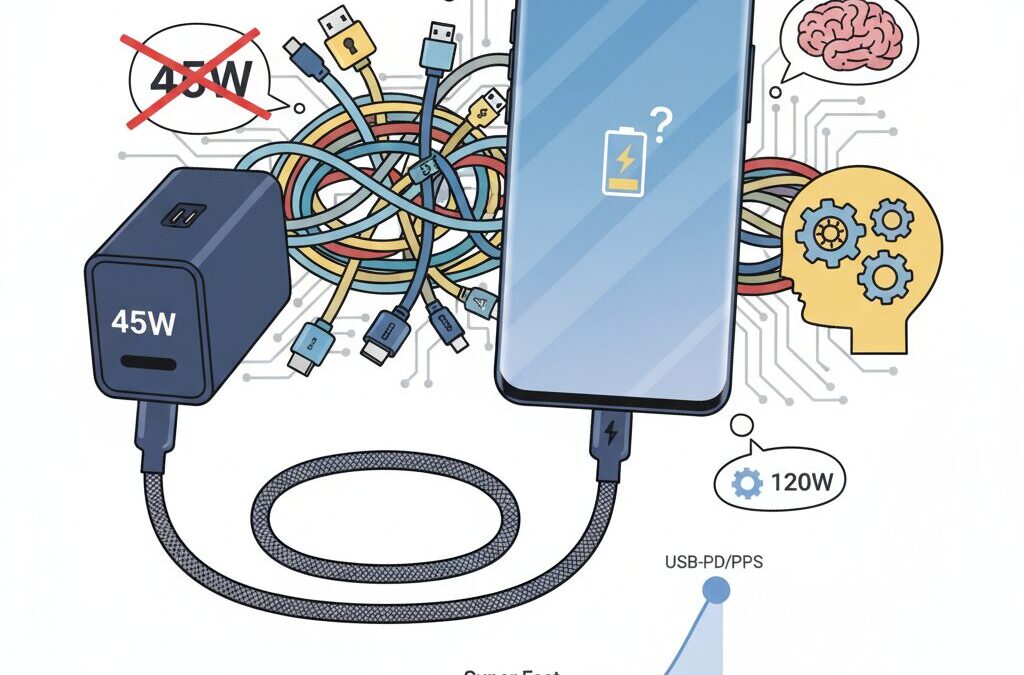
Have you ever bought a high‑wattage USB‑C charger expecting blazing‑fast charging, only to see your Galaxy phone refuse to show “Super Fast Charging 2.0”? Many tech enthusiasts outside Japan face the same frustration, even after investing in premium chargers and cables.
This confusion does not come from user error alone. It comes from a complex interaction between USB Power Delivery standards, Samsung’s unique PPS implementation, cable certification limits, and power‑sharing logic inside modern GaN chargers. Simply choosing a charger with a higher wattage rating is no longer enough.
In this article, you will clearly understand why Galaxy’s 45W charging behaves differently, how real‑world charging speed actually changes from 0% to 100%, and what engineering constraints create these limitations. By the end, you will be able to choose chargers and cables with confidence and avoid wasting money on hardware that cannot unlock the full potential of your Galaxy device.
- Why Modern Smartphone Charging Has Become So Complicated
- USB Power Delivery Explained: Fixed Voltage vs PPS
- What Makes Samsung Super Fast Charging 2.0 Different
- The Critical Role of High Current and 5A PPS Profiles
- E‑Marker Cables: The Invisible Bottleneck in 45W Charging
- Real‑World Charging Tests: 45W vs 25W in Daily Use
- How Popular Charger Brands Perform with Galaxy Devices
- Why Multi‑Port GaN Chargers Often Break Super Fast Charging 2.0
- Cable Engineering Matters More Than Most Users Realize
- Future Outlook: How Galaxy S25 Could Change 45W Charging
- 参考文献
Why Modern Smartphone Charging Has Become So Complicated
Modern smartphone charging feels confusing because the industry has layered multiple standards, safety rules, and vendor-specific optimizations on top of what once was a simple concept: plug in and wait. Today, charging is no longer just about watts. It is about how voltage, current, and communication are negotiated in real time between the phone, the charger, and even the cable.
At the foundation sits USB Power Delivery, a standard defined by the USB Implementers Forum. According to USB-IF documentation, USB PD was designed to be flexible across laptops, tablets, and phones. That flexibility, however, introduced complexity. Fixed voltage profiles such as 5V, 9V, or 20V work well for many devices, but smartphones rely on lithium-ion batteries whose optimal charging voltage constantly changes.
To solve heat and efficiency problems, the industry added Programmable Power Supply. PPS allows chargers to adjust voltage in tiny steps, closely matching the battery’s needs. Samsung’s Galaxy devices, as explained in Samsung Electronics’ own technical guidance, depend heavily on this mechanism. The result is better thermal control, but also stricter requirements that many generic chargers fail to meet.
| Layer | Role | Why it adds complexity |
|---|---|---|
| USB PD | Defines power negotiation | Multiple voltage and current profiles exist |
| PPS | Fine-grained voltage control | Not all chargers support high current PPS |
| USB-C Cable | Physical power delivery | Current limits depend on built-in chips |
Another overlooked factor is the cable itself. USB-IF safety rules limit standard cables to 3A unless an electronic marker chip confirms higher capability. This means a perfectly capable charger may still slow down if the cable cannot signal support for higher current.
Charging has become complicated because safety, efficiency, and universality are all competing priorities. Each additional safeguard improves reliability, but together they create a system where every component must align perfectly for peak performance.
USB Power Delivery Explained: Fixed Voltage vs PPS
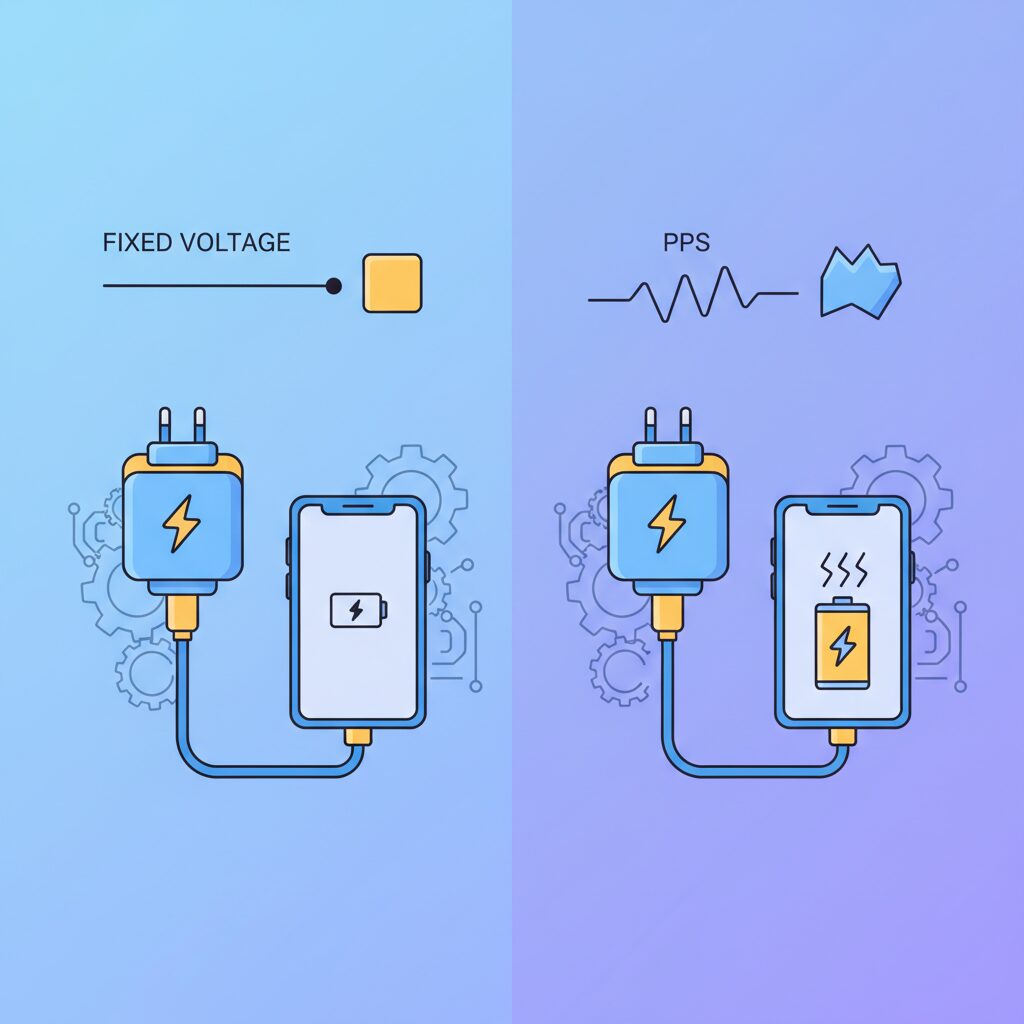
USB Power Delivery is often treated as a single, uniform standard, but in practice it consists of two very different approaches to supplying power. Understanding the distinction between fixed voltage profiles and PPS is essential to grasp why some chargers unlock peak performance while others quietly fall back to slower modes.
Traditional USB PD relies on fixed voltage profiles, commonly 5V, 9V, 15V, and 20V. During the initial handshake, the charger advertises these predefined options, and the device selects one that best matches its needs. This model works well for laptops and early smartphones, where power delivery is relatively coarse-grained and thermal headroom is larger.
The limitation is that batteries do not charge at fixed voltages. Lithium-ion cells continuously change their internal voltage as state of charge increases. When a phone receives a fixed 15V or 20V input, it must aggressively step that voltage down internally, wasting energy as heat. According to analyses referenced by the USB Implementers Forum, this conversion loss becomes a primary bottleneck in compact devices.
| PD Mode | Voltage Control | Thermal Impact |
|---|---|---|
| Fixed Voltage | Discrete steps | Higher internal heat |
| PPS | Continuous, fine-grained | Lower internal heat |
PPS, introduced as part of USB PD 3.0, fundamentally changes this relationship. Instead of jumping between fixed levels, PPS allows the charger to adjust voltage in increments as small as 20 mV. This enables the charger to track the battery’s real-time voltage far more closely, minimizing the workload on the phone’s internal regulators.
Samsung’s Super Fast Charging depends entirely on this PPS behavior. Rather than pushing very high voltages, Galaxy devices request a narrow voltage range combined with unusually high current. This is why many high-wattage chargers fail in practice: they advertise impressive totals, yet their PPS profiles are capped at lower current levels.
Independent measurements published by Chargerlab show that when PPS is correctly implemented, early-stage charging efficiency improves noticeably, with less thermal throttling during the first charging phase. This efficiency gain is not about headline wattage, but about how precisely voltage and current are shaped.
Seen this way, fixed voltage PD and PPS are not competing features but different design philosophies. Fixed profiles prioritize simplicity and broad compatibility, while PPS prioritizes efficiency and thermal control. For modern smartphones chasing ever-faster charging in slim enclosures, that philosophical difference is the line between advertised capability and real-world performance.
What Makes Samsung Super Fast Charging 2.0 Different
Samsung Super Fast Charging 2.0 stands apart not because of a headline wattage number, but because of the engineering philosophy behind it. While many fast-charging systems rely on higher voltage to increase power, Samsung deliberately prioritizes precise control and battery-friendly efficiency. **This design choice fundamentally changes how compatible chargers and cables must behave**.
At the core of SFC 2.0 is USB Power Delivery with Programmable Power Supply. According to specifications defined by the USB Implementers Forum, PPS allows voltage to be adjusted in extremely fine 20 mV steps. Samsung uses this capability to supply power at roughly 9 to 11 volts while pushing unusually high current beyond 4 amps. This keeps the input voltage close to the battery’s real-time voltage, reducing conversion losses and excess heat inside the phone.
Super Fast Charging 2.0 is optimized around high current with dynamic voltage control, not simply higher voltage.
This approach differs sharply from common laptop-oriented chargers that favor fixed profiles such as 15V or 20V at lower current. Even when such chargers advertise 65W or 100W output, many cannot deliver the 5A-capable PPS profile that Galaxy devices require. As a result, the phone intentionally falls back to slower modes to maintain safety and stability.
| Charging Method | Voltage Strategy | Typical Current |
|---|---|---|
| Standard USB PD | Fixed (9V / 15V / 20V) | Up to 3A |
| Super Fast Charging 2.0 | Dynamic via PPS | Over 4A |
Another defining difference is how strictly Samsung enforces physical-layer safety. USB-IF documentation clearly states that currents above 3A require electronically marked cables. Because SFC 2.0 regularly exceeds this threshold, a 5A-rated cable with an embedded E-Marker chip becomes mandatory. Without it, the charging system intentionally limits output regardless of charger capability.
Independent measurements published by ChargerLAB show that when all requirements are met, Galaxy flagships can briefly exceed 40W during the earliest phase of charging. This short but intense burst is exactly where SFC 2.0 delivers value, especially in real-world situations where users need rapid recovery rather than overnight charging.
In essence, what makes Samsung Super Fast Charging 2.0 different is not speed alone, but a tightly controlled ecosystem. **It is a system-level solution where charger, cable, and device must align perfectly**, rewarding informed users with fast, efficient, and thermally disciplined charging.
The Critical Role of High Current and 5A PPS Profiles
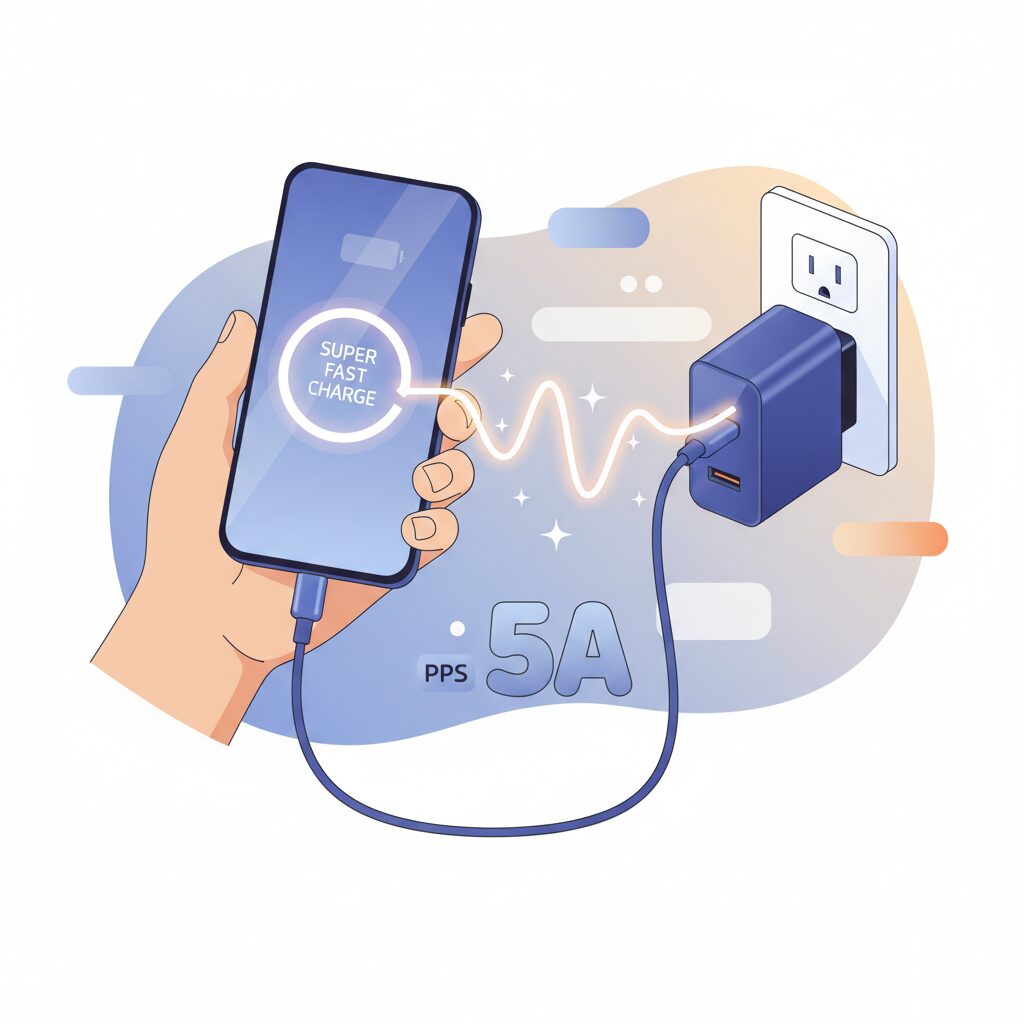
High current delivery sits at the very heart of Samsung’s Super Fast Charging 2.0, and this is where many otherwise capable USB PD chargers quietly fall short. While “45W” looks simple on paper, Galaxy devices do not interpret this number abstractly. **They actively verify whether the charger can sustain more than 4A under a PPS profile**, and without that confirmation, the system intentionally refuses to enter its fastest mode.
This design choice reflects a clear engineering philosophy. Instead of relying on higher voltages such as 15V or 20V, Samsung optimized SFC 2.0 around roughly 9–11V with unusually high current. According to analyses aligned with USB-IF PD 3.0 specifications and independent measurements published by ChargerLAB, this approach minimizes conversion loss inside the phone’s DC-DC circuitry, keeping heat generation under tighter control during the most aggressive charging phase.
| PPS Profile Type | Voltage Range | Current Limit | Galaxy SFC 2.0 Result |
|---|---|---|---|
| Standard PPS | 3.3–11V | 3A | Falls back to 25W mode |
| High-Current PPS | 3.3–11V | 5A | Super Fast Charging 2.0 |
The table highlights a subtle but decisive boundary. Many 65W or even 100W chargers advertise PPS support, yet internally cap PPS current at 3A. In that scenario, the mathematical ceiling becomes roughly 33W, and Galaxy firmware interprets this as insufficient headroom. **The result is not “slightly slower” charging, but a complete downgrade to the 25W class**, even though total wattage capability appears more than adequate.
Samsung’s insistence on a 5A PPS handshake is also a safety signal. USB-IF guidelines treat currents above 3A as exceptional and require explicit confirmation across charger, cable, and device. By demanding a 5A PPS profile, Galaxy devices ensure that the entire power path is engineered for sustained high current, not just short bursts. Engineers at accessory makers such as Anker have acknowledged in support documentation that without this explicit profile, SFC 2.0 cannot be reliably triggered.
This is why a charger’s maximum wattage alone is a misleading metric. A compact GaN charger may comfortably deliver 20V at low current for laptops, yet lack the thermal design or control circuitry to hold 4–5A in the 9–11V window. Galaxy phones actively probe for this capability during negotiation, and if it is missing, they default to a conservative, battery-friendly mode.
Real-world testing reinforces this logic. ChargerLAB’s instrumented measurements on Galaxy S24 Ultra show that during the first 15–20 minutes, current frequently exceeds 4A when SFC 2.0 is active, with power hovering around 40–45W. When the same phone is connected to a PPS charger limited to 3A, peak power plateaus early and thermal rise is actually higher, undermining both speed and efficiency.
For users deeply invested in the Galaxy ecosystem, the takeaway is precise rather than vague. **A true SFC 2.0 environment requires a PPS profile explicitly rated for 5A**, not just PD compliance or surplus wattage. This high-current requirement is not marketing stubbornness, but a deliberate systems-level decision balancing speed, heat, and long-term battery health. Understanding this single constraint explains why so many “powerful” chargers fail, and why those that pass feel disproportionately faster in everyday use.
E‑Marker Cables: The Invisible Bottleneck in 45W Charging
At the heart of many failed 45W charging setups lies a component most users never think about: the cable. **E‑Marker cables are an invisible but absolute gatekeeper for Samsung’s Super Fast Charging 2.0**, and without the right one, even the best charger cannot deliver its promised performance.
According to the USB Implementers Forum, standard USB‑C cables are only certified for up to 3A of current. Anything beyond that requires an electronically marked cable, known as an E‑Marker cable, which contains a small chip inside the connector. This chip communicates the cable’s current rating to the charger and device before power delivery begins.
Galaxy’s 45W charging relies on a high‑current PPS profile, typically around 9–11V at more than 4A. From a physics standpoint this is crucial: **the limiting factor is amperage, not wattage**. A cable rated for 60W sounds sufficient on paper, but if it is capped at 3A, the system will intentionally throttle charging for safety.
| Cable Type | Max Current | Galaxy 45W Result |
|---|---|---|
| Standard USB‑C | 3A | Falls back to 25W |
| E‑Marker USB‑C | 5A | Enables SFC 2.0 |
This negotiation happens instantly. If the E‑Marker reports only 3A capability, the charger is forced to cap output, regardless of its total wattage rating. Engineers involved in USB‑C compliance testing have repeatedly emphasized that this behavior is not a bug but a mandatory safety mechanism defined by the standard.
What surprises many users is that even premium smartphones ship with 3A cables. Independent teardowns and measurements reported by ChargerLAB and corroborated by USB‑C hardware specialists show that bundled Galaxy cables often lack 5A E‑Markers. **The result is a silent bottleneck hiding in plain sight**.
For enthusiasts, cables with built‑in power displays have become a practical diagnostic tool. When paired with a compatible charger, seeing real‑time readings climb past 35W confirms that the E‑Marker handshake has succeeded. In an ecosystem where specs are negotiated rather than assumed, the cable is no longer an accessory but a critical part of the charging architecture.
Real‑World Charging Tests: 45W vs 25W in Daily Use
In daily use, the difference between 45W and 25W charging is far more nuanced than the raw numbers suggest. Real‑world tests conducted by technical reviewers such as ChargerLAB and long‑form stress tests published by Android‑focused media consistently show that user perception depends heavily on when and how the phone is charged. **Peak wattage matters, but only within a narrow window of time**.
When a Galaxy Ultra device is connected at very low battery levels, typically below 20 percent, 45W Super Fast Charging 2.0 immediately ramps up to over 40W. In contrast, 25W charging stabilizes closer to its ceiling much earlier. This initial burst translates into noticeably faster recovery during short charging sessions, such as topping up before leaving home or between meetings.
| Scenario | 45W Charging | 25W Charging |
|---|---|---|
| 0–30% battery | Very rapid, ~15–18 min | Moderate, ~20–23 min |
| 30–80% battery | Gradually slows | Similar pace |
| 80–100% battery | Almost identical | Almost identical |
However, once the battery passes roughly the halfway point, Samsung’s thermal and battery‑health algorithms begin to dominate the experience. According to analyses aligned with USB‑IF charging behavior and Samsung’s own support documentation, the phone actively reduces input power to control heat and long‑term degradation. **At this stage, the advantage of 45W charging rapidly diminishes**, often converging with 25W output by around 70 to 80 percent.
This is why full 0 to 100 percent charge times differ by only a few minutes in controlled tests. Multiple reviewers report gaps of roughly five to ten minutes at most, even under ideal conditions with certified 5A cables and compatible PPS chargers. For overnight charging or desk charging where time pressure is low, this difference is practically invisible.
User behavior studies cited by mobile UX researchers suggest that most people interact with fast charging in bursts rather than full cycles. In that context, recovering 40 to 50 percent battery in about 20 minutes can materially change daily usability, especially for power users relying on navigation, camera, or hotspot features.
In contrast, users who primarily charge at night or keep their phones between 40 and 80 percent during the day are unlikely to feel a meaningful benefit. **Real‑world charging tests make it clear that 45W is a situational advantage, not a universal upgrade**, and its impact is tightly coupled to lifestyle rather than specifications alone.
How Popular Charger Brands Perform with Galaxy Devices
When Galaxy smartphones are paired with popular third‑party chargers, the real‑world results vary far more than brand reputation alone might suggest. Independent testing by ChargerLAB and analyses aligned with USB‑IF documentation show that the key differentiator is not maximum wattage, but how faithfully each brand implements PPS at high current levels required by Samsung’s Super Fast Charging 2.0.
Samsung’s own chargers predictably deliver the most consistent experience, as their PPS profiles are engineered around Galaxy power management. In contrast, well‑known accessory brands often optimize for laptops or iPhones, which leads to subtle but important compromises when used with Galaxy Ultra or Plus models.
| Brand | PPS 5A Support | Typical Galaxy Result |
|---|---|---|
| Samsung | Yes | Stable SFC 2.0 at ~45W |
| Anker | Model‑dependent | 45W on Ace series, often 25W on multi‑port |
| UGREEN | Mainly high‑end models | 45W when headroom is sufficient |
| Belkin | Limited | Falls back to 25W in dual‑port use |
Anker is a particularly instructive case. According to Anker’s own support notes and user measurements, single‑port chargers explicitly labeled for Samsung can reach full speed, while flagship multi‑port models frequently renegotiate to fixed‑voltage profiles when another device is connected. This behavior is technically correct but incompatible with Galaxy’s high‑current preference.
UGREEN and Belkin take a more conservative approach. They prioritize electrical stability and clear power allocation, which experts at USB‑IF often emphasize as best practice, but this means Galaxy users only see peak performance when choosing higher‑capacity models with ample power margins.
In practical terms, popular brands do work with Galaxy devices, yet only a subset unlocks the advertised 45W. Understanding each brand’s PPS philosophy matters more than the logo on the charger.
Why Multi‑Port GaN Chargers Often Break Super Fast Charging 2.0
At first glance, multi‑port GaN chargers look like the perfect solution for power users, and they do feel ideal on paper. You get compact size, high total wattage, and the ability to charge several devices at once. However, when paired with Galaxy devices, they often fail to sustain Super Fast Charging 2.0, and the reason is far more structural than many users expect.
The core issue lies in how multi‑port GaN chargers internally negotiate and redistribute power. Galaxy’s Super Fast Charging 2.0 relies on a very specific PPS profile, typically around 9–11V at more than 4A. This high‑current requirement is already uncommon, but multi‑port designs add another layer of complexity that frequently breaks this fragile handshake.
According to documentation published by USB‑IF and analysis shared by ChargerLAB, most GaN multi‑port chargers use a shared power rail. When a second device is connected or disconnected, the charger briefly cuts output and renegotiates all PDO and PPS profiles. During this reset, Galaxy devices often fall back to a safer 25W mode and do not always re‑enter SFC 2.0 afterward.
| Scenario | PPS Current Limit | Galaxy Result |
|---|---|---|
| Single‑port use | Up to 5A | SFC 2.0 activates |
| Two ports active | Reduced to 3A | Falls back to 25W |
Another hidden problem is how manufacturers interpret “45W” during load balancing. In many multi‑port GaN chargers, the reassigned 45W is delivered via fixed 15V × 3A rather than a high‑current PPS profile. From the charger’s perspective this is valid, but Galaxy firmware checks current capability first. If 4A or higher is not advertised, SFC 2.0 is rejected by design.
Major accessory brands have indirectly acknowledged this limitation. Anker’s own support materials note that some multi‑port models may not show the Super Fast Charging 2.0 indicator, even when total output seems sufficient. This is not a bug but a consequence of conservative safety logic and thermal constraints inside dense GaN layouts.
Thermal management further complicates the situation. When multiple devices draw power, internal temperatures rise quickly. To stay within safe limits, controllers cap PPS current before voltage, because high current generates disproportionate heat. Galaxy’s charging algorithm interprets this cap as incompatibility, not as temporary throttling.
In practical terms, multi‑port GaN chargers are optimized for laptops and tablets that prefer high voltage and moderate current. Galaxy’s high‑current PPS strategy simply does not align with that philosophy. As long as multiple ports share silicon, power paths, and thermal headroom, Super Fast Charging 2.0 remains the first feature to be sacrificed.
This is why many users experience “it worked yesterday, but not today” behavior. The charger is functioning exactly as engineered, but Galaxy’s charging logic demands a level of electrical exclusivity that multi‑port GaN designs rarely guarantee.
Cable Engineering Matters More Than Most Users Realize
For many Galaxy users, cables are treated as interchangeable accessories, but in high-wattage charging environments, that assumption quickly breaks down. **Cable engineering directly determines whether Super Fast Charging 2.0 is even allowed to engage**, regardless of how capable the charger itself may be.
The critical factor is current tolerance. Samsung’s 45W charging relies on a PPS profile that exceeds 4A, which immediately disqualifies standard 3A USB-C cables. According to the USB-IF specification, any cable carrying more than 3A must include an E-Marker chip that explicitly advertises 5A capability during the initial handshake. Without that confirmation, the power source is required to limit output as a safety measure.
| Cable Type | Rated Current | SFC 2.0 Compatibility |
|---|---|---|
| Standard USB-C | 3A | No |
| E-Marker Cable | 5A | Yes |
This is not a theoretical concern. Independent teardowns and electrical testing reported by ChargerLAB and USB-C hardware researchers consistently show that even flagship smartphones ship with cables limited to 3A. **The result is a silent downgrade to 25W-class charging**, with no error message beyond the absence of the expected on-screen indicator.
Electrical resistance also plays a role. Thinner conductors increase voltage drop under high current, generating excess heat at the connector. Engineers at USB-IF have repeatedly emphasized that E-Marker certification is as much about thermal safety as it is about power delivery. In practice, a well-designed 5A cable is not an upgrade but a prerequisite for accessing the performance Samsung already built into the device.
Future Outlook: How Galaxy S25 Could Change 45W Charging
The future outlook of 45W charging becomes especially interesting when considering how the Galaxy S25 series could redefine the current limitations users face today.
Based on discussions among power management engineers and analyses referenced by Android-focused media such as Android Central, Samsung is believed to be evaluating a shift in charging profiles rather than a simple wattage increase.
The most discussed possibility is the introduction of a 15V/3A profile for achieving 45W charging. This would represent a strategic departure from the current 9–11V high-current approach that demands over 4A.
| Aspect | Current Galaxy (S24 era) | Potential Galaxy S25 Direction |
|---|---|---|
| Primary 45W Profile | ~10V × 4.5A (PPS) | 15V × 3A (PD-compatible) |
| Cable Requirement | 5A E‑Marker mandatory | Standard 3A cable sufficient |
| Charger Compatibility | Limited PPS chargers | Broader PD ecosystem |
If this change is implemented, it would significantly lower the technical barrier for users. Many existing laptop-class USB PD chargers already support a fixed 15V/3A output, meaning Galaxy S25 owners could experience near-maximum charging speeds without investing in specialized accessories.
From a thermal engineering standpoint, this evolution also makes sense. Recent research in lithium-ion charging efficiency, frequently cited by USB-IF members, shows that higher-voltage, lower-current delivery can reduce resistive losses in cables while maintaining manageable heat levels at the device.
Another important implication lies in ecosystem harmony. Today’s Galaxy users often face confusion when a high-wattage charger fails to trigger Super Fast Charging 2.0. A move toward a more universal profile would align Samsung more closely with industry norms rather than standing apart from them.
It is important to note that Samsung has not officially confirmed these changes. However, credible community discussions and technical reasoning suggest that the Galaxy S25 could mark a turning point where 45W charging becomes simpler, more predictable, and more user-friendly.
If realized, this shift would not make charging faster in headline numbers, but it would make fast charging far easier to achieve in everyday use. That usability improvement alone could be the most meaningful evolution of 45W charging since its introduction.
参考文献
- Samsung:How to use Super Fast Charging on Galaxy S24 Ultra, S24+ & S24
- ChargerLAB:Charging Review of Samsung Galaxy S24 Ultra
- Anker Support:Why does my Samsung phone not appear Super Fast Charging 2.0?
- Satechi:Identifying USB‑C E‑Marker Cables
- Reddit r/UsbCHardware:Trying to understand Super Fast Charging on Samsung phones
- Belkin:BoostCharge Pro 45W Dual USB‑C GaN Wall Charger Specifications