
Have you ever experienced losing signal while hiking, sailing, or traveling through remote areas, even with a premium smartphone in your pocket?
Many gadget enthusiasts have accepted this limitation as unavoidable, despite rapid progress in mobile technology.
Now, a new wave of innovation is quietly changing that assumption.
Direct to Cell satellite communication allows standard smartphones to connect directly to satellites without special hardware.
This breakthrough is powered by advances in low Earth orbit satellites, 5G standards, and modern modem design.
As a result, coverage is expanding beyond cities and cell towers to almost anywhere on Earth.
In this article, you will learn how this technology works, why it has become viable only recently, and which companies are leading the race.
Real-world examples, technical insights, and market data will help you understand what this means for future smartphones.
By the end, you will see why satellite connectivity is becoming a must-have feature for next-generation gadgets.
- The Third Revolution in Mobile Communication
- Why Ordinary Smartphones Can Now Talk to Satellites
- Link Budget Limits and the Physics Behind Space Connectivity
- Doppler Shift, Latency, and How Networks Overcome Them
- Using Terrestrial Mobile Frequencies from Space
- 3GPP NTN Standards and the Road to 5G and 6G Integration
- Chipset Innovation: Qualcomm, MediaTek, and Satellite Support
- Technology Strategies of Starlink, AST SpaceMobile, and Skylo
- How Satellite Connectivity Changes the Smartphone Experience
- From Emergency Use to Everyday Coverage Worldwide
- 参考文献
The Third Revolution in Mobile Communication
In the mid-2020s, mobile communication is entering what many experts describe as the third major revolution. The first came in the 1980s, when analog cellular technology liberated voice communication from fixed locations. The second arrived in the 2000s, when mobile internet freed data access from desks and cables. **The third revolution is fundamentally different, because it liberates connectivity itself from geography.**
Until now, even the most advanced smartphones have been constrained by the physical reach of terrestrial base stations. According to analyses by organizations such as Ericsson and 3GPP, conventional cellular networks are inherently dependent on dense ground infrastructure. Mountainous regions, open oceans, and disaster-stricken areas have remained blind spots, regardless of handset performance or network generation.
This limitation is now being dismantled by the convergence of low Earth orbit satellite constellations, standardized cellular protocols, and smartphone radio design. Direct to Cell technology allows ordinary, unmodified smartphones to connect directly to satellites hundreds of kilometers above Earth, without relying on cell towers. **This shift effectively turns the entire planet into a single, continuous coverage area.**
| Era | Core Breakthrough | User Impact |
|---|---|---|
| 1st Revolution | Analog cellular voice | Calls anywhere within cities |
| 2nd Revolution | Mobile internet | Data access on the move |
| 3rd Revolution | Direct satellite connectivity | Connectivity without dead zones |
What makes this revolution especially significant is that it does not require users to adopt niche hardware. Historically, satellite communication meant bulky antennas and dedicated satellite phones. In contrast, Direct to Cell relies on existing cellular frequency bands and standardized protocols defined by 3GPP. As 3GPP formally incorporated Non-Terrestrial Networks into Release 17, satellite links ceased to be exotic exceptions and became part of the mainstream mobile ecosystem.
From a user perspective, the impact is subtle yet profound. A smartphone automatically switches from terrestrial networks to satellites when no ground signal is available. **There is no manual mode change, no special setup, and no visible technological barrier.** This seamless behavior is precisely why the change qualifies as a revolution rather than a feature update.
Authoritative industry voices underline the importance of this moment. Ericsson’s technology reviews note that integrating satellites into cellular standards marks a structural expansion of mobile networks rather than a speed upgrade. Similarly, 3GPP positions NTN as a foundational step toward future unified networks, where users are unaware of whether their data travels through towers, aircraft, or space.
In practical terms, this third revolution redefines reliability. Emergency alerts can reach users during large-scale disasters when ground infrastructure fails. Remote workers, explorers, and maritime users gain baseline connectivity by default. **Connectivity is no longer a privilege of populated areas but an assumed property of the device itself.**
As smartphones evolve into truly global terminals, mobile communication shifts from being location-dependent to being location-agnostic. This conceptual leap, more than raw bandwidth or latency figures, is why Direct to Cell represents the third revolution in mobile communication.
Why Ordinary Smartphones Can Now Talk to Satellites
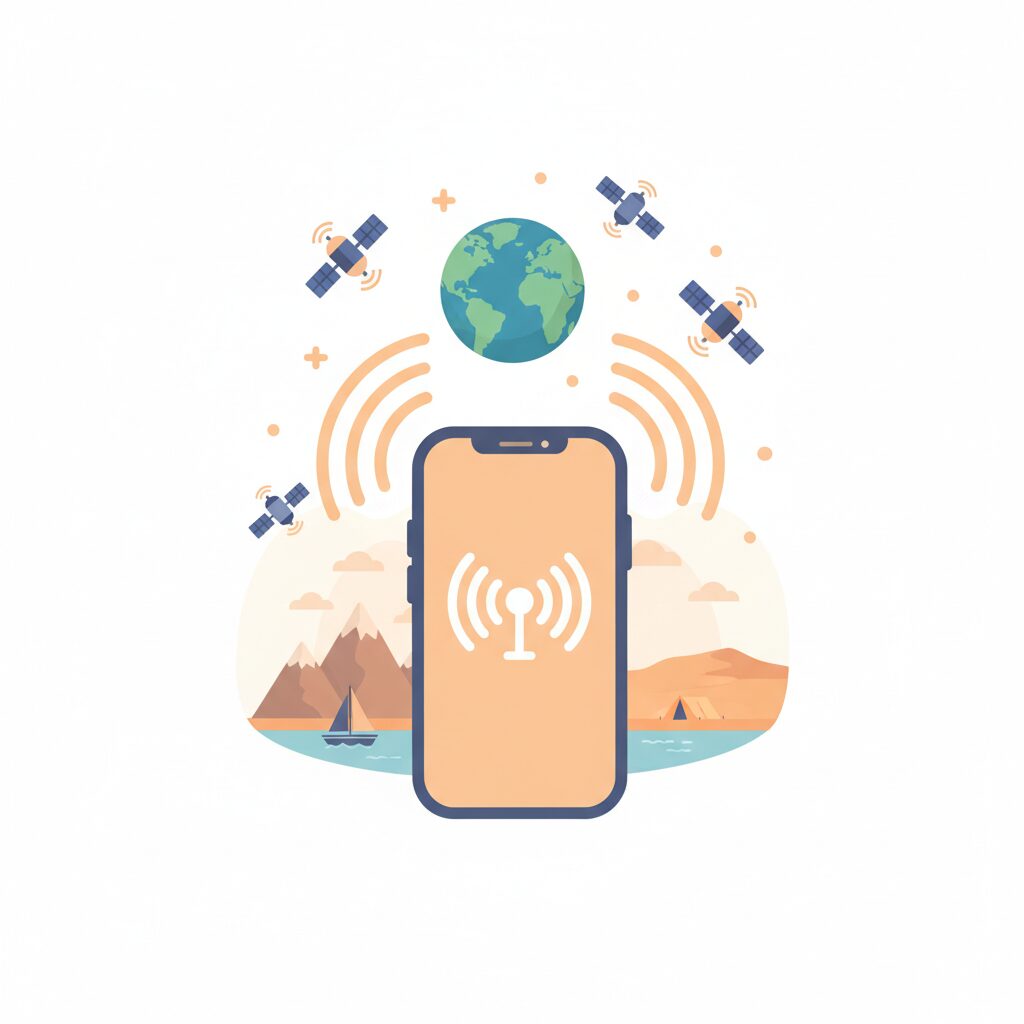
Until very recently, satellite communication was something that required bulky terminals, deployable antennas, and a clear awareness that you were using a special kind of device. What has changed is not that smartphones suddenly became more powerful transmitters, but that the entire system around them evolved to meet their limitations. **Ordinary smartphones can now talk to satellites because satellites learned how to listen to phones**, not the other way around.
From a radio engineering perspective, the biggest obstacle is sheer distance. A typical smartphone transmits at around 23 dBm, roughly 200 milliwatts, designed for cell towers a few kilometers away. Low Earth Orbit satellites, by contrast, operate hundreds of kilometers above the ground. According to analyses cited by Ericsson and peer-reviewed research, the signal arriving at the satellite can be weaker than minus 120 dBm, close to the noise floor. The breakthrough came from satellites equipped with massive phased-array antennas and beamforming, allowing them to focus sensitivity on very small ground areas, almost like pointing a directional microphone from space.
Another invisible enemy is motion. LEO satellites travel at about 7.5 kilometers per second, creating Doppler shifts far beyond what LTE and 5G were originally designed to handle. Here, software became as important as hardware. SpaceX engineers have explained that Starlink Direct to Cell satellites effectively behave as “flying base stations,” compensating for Doppler shift and propagation delay on the satellite side so that the smartphone believes it is connected to an ordinary terrestrial cell. AST SpaceMobile achieves a similar illusion through pre-compensation calculated on the ground, based on precise orbital data.
| Constraint | Smartphone Reality | Satellite-Side Solution |
|---|---|---|
| Transmit power | ~23 dBm maximum | High-gain phased-array antennas |
| Doppler shift | Designed for trains, not orbit | Predictive and adaptive correction |
| Supported bands | Standard LTE/5G bands | Reuse of terrestrial spectrum |
A particularly important factor is spectrum strategy. Traditional satellite phones relied on dedicated L-band or S-band frequencies, which smartphones do not support. Direct to Cell services instead reuse existing cellular bands, such as those around 1.7 to 2.1 GHz. Because these are the same frequencies already handled by smartphone modems, no new antennas or chipsets are required. The 3GPP, the international body behind LTE and 5G standards, formally embraced this idea in Release 17 by defining Non-Terrestrial Networks as part of the cellular ecosystem.
Chipmakers then translated standards into silicon. Qualcomm and MediaTek both confirmed that their latest modems natively support NTN features, meaning timing advance extensions and satellite-aware synchronization are handled at the modem level. As a result, when a phone connects to a satellite today, it is not using a hack or a proprietary mode. **It is still speaking LTE or 5G, just across an absurdly long cell radius.**
What makes this moment feel sudden is that all these elements matured at once. LEO constellations reached sufficient scale, standards caught up with physics, and smartphone components became flexible enough to adapt through software. The phone in your pocket did not fundamentally change. The network did, expanding upward until space itself became part of the cell.
Link Budget Limits and the Physics Behind Space Connectivity
When discussing Direct to Cell connectivity, the concept that ultimately defines what is possible and what is not is the link budget. This is not an abstract engineering exercise but a strict expression of physics that determines whether a smartphone can be heard from space at all. **In satellite-to-smartphone links, the margin for error is extraordinarily small**, and every decibel matters.
The core challenge comes from free-space path loss, which increases with the square of distance. A terrestrial base station is usually a few kilometers away, whereas a low Earth orbit satellite remains hundreds of kilometers above the user. According to analyses published by Ericsson and measurements reported in recent academic work, a smartphone signal arriving at a LEO satellite can approach sensitivities near minus 120 dBm, a level that was historically considered impractical for consumer devices.
This constraint is compounded by the smartphone itself. Regulatory limits cap handset transmit power at roughly 23 dBm, and the antenna embedded inside a slim phone chassis offers minimal gain. From a physics standpoint, the phone cannot simply “shout louder.” As a result, the burden shifts almost entirely to the satellite, which must compensate for these limitations without violating spectrum rules.
| Parameter | Terrestrial Cell | LEO Direct to Cell |
|---|---|---|
| Typical distance | 1–5 km | 350–550 km |
| Path loss | Relatively low | Extremely high |
| Handset transmit power | Up to 23 dBm | Up to 23 dBm |
To overcome this gap, modern Direct to Cell satellites rely on massive phased-array antennas and advanced beamforming. SpaceX has disclosed that its Starlink Direct to Cell satellites form extremely narrow beams, concentrating energy on small ground cells. From a physical perspective, this increases the effective isotropic radiated power in the desired direction, allowing the satellite to “listen” to signals that would otherwise be buried in noise.
What makes this especially interesting is that these systems operate using terrestrial mobile spectrum, not traditional satellite-only bands. Research summarized by 3GPP shows that mid-band frequencies around 2 GHz are far less forgiving over long distances than classic L-band satellite frequencies. **This choice deliberately trades propagation robustness for ecosystem compatibility**, ensuring that unmodified smartphones can participate at the cost of a brutally tight link budget.
Another often overlooked limit is capacity. Physics dictates that even if a single link can be closed, the total power and antenna aperture on a satellite are finite. When dozens or hundreds of phones share the same beam, each user’s available signal-to-noise ratio drops. This is why early Direct to Cell services emphasize messaging and low-rate data rather than continuous broadband. According to evaluations referenced by the IEEE community, this is not a software limitation but a direct consequence of Shannon’s law applied in space.
In practical terms, link budget physics explains why clear sky visibility matters, why indoor connectivity remains challenging, and why services are rolled out in stages. **The promise of space connectivity is real, but it is bounded by immutable physical laws**, and the most successful implementations are those that respect these limits rather than attempt to ignore them.
Doppler Shift, Latency, and How Networks Overcome Them
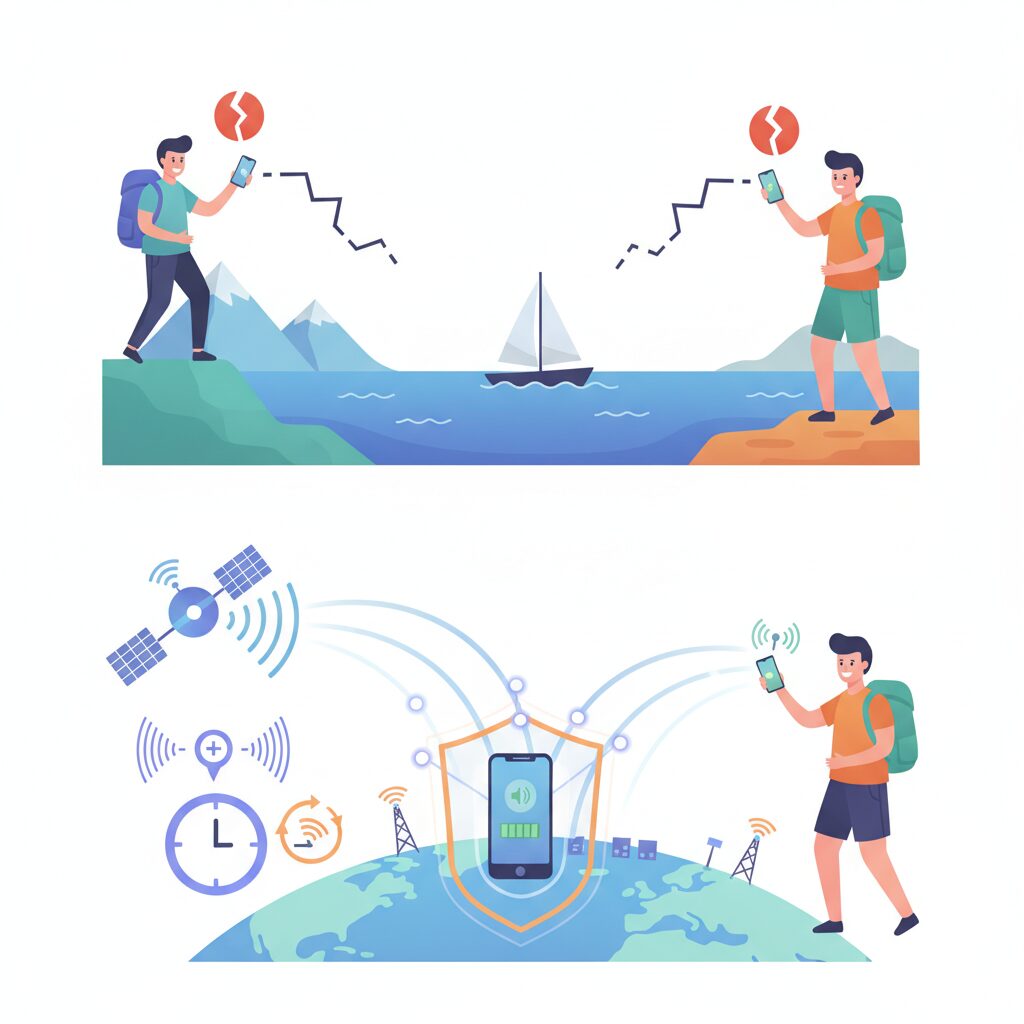
When a smartphone talks directly to a fast‑moving satellite, two physical effects immediately become critical: Doppler shift and latency. Both are well understood in theory, yet they push conventional cellular design far beyond its original assumptions, especially when the device in question is an unmodified consumer handset.
| Link Type | Relative Speed | Typical Doppler Shift | Round‑Trip Latency |
|---|---|---|---|
| Terrestrial LTE/5G | Up to ~300 km/h | Hundreds of Hz | 10–30 ms |
| LEO Satellite (D2C) | ~27,000 km/h | Tens of kHz | 50–100 ms |
| GEO Satellite | Earth‑relative stationary | Near zero | 600 ms+ |
The Doppler shift arises because LEO satellites orbit the Earth roughly every 90 minutes. From the phone’s perspective, the base station is approaching and receding at hypersonic speed. According to analyses published by Ericsson and 3GPP contributors, the resulting frequency offset can be tens of kilohertz in mid‑band spectrum, far beyond what standard LTE receivers expect. **Without active compensation, the handset would fail to lock onto the signal at all.**
What makes Direct to Cell remarkable is not that this problem exists, but how invisibly it is handled. In the Starlink approach, the satellite itself behaves like an LTE base station and continuously predicts its own motion relative to every ground cell. Custom silicon and software dynamically adjust frequency and timing so that, from the phone’s point of view, the signal appears to stay within normal terrestrial limits. Industry papers describe this as making the network absorb the physics, rather than asking the device to do so.
Latency presents a different kind of challenge. Even at light speed, a signal traveling hundreds of kilometers to space and back introduces unavoidable delay. Measurements and simulations referenced in academic and operator studies consistently place LEO round‑trip times in the 50 to 100 millisecond range. This is slower than urban 4G, yet dramatically better than traditional geostationary satellites, whose altitude alone adds more than half a second.
Here, network architecture becomes the deciding factor. SpaceX mitigates latency by using optical inter‑satellite links, allowing traffic to stay in space until it reaches a convenient gateway. This reduces detours through distant ground stations and stabilizes delay, which matters more for applications than raw speed. 3GPP documentation emphasizes that predictable latency is often preferable to fluctuating low latency, especially for messaging and control traffic.
AST SpaceMobile takes a complementary route by pre‑compensating Doppler and timing at the gateway before transmission. Because the satellite’s position and velocity are precisely known, the network can send a signal that arrives already corrected. **To the smartphone, the link behaves like a strangely distant but otherwise ordinary cell tower.**
For users, the practical implication is subtle but important. Text messaging, location sharing, and low‑rate data feel natural despite the physics involved. Real‑time gaming or ultra‑low‑latency trading does not. The success of Direct to Cell lies in the fact that these limitations are managed at the network level, allowing everyday devices to work unchanged, even when the base station is moving faster than a bullet train in orbit.
Using Terrestrial Mobile Frequencies from Space
One of the most disruptive ideas behind Direct to Cell is the use of terrestrial mobile frequencies from space, rather than relying on traditional satellite-only spectrum. This approach allows ordinary smartphones to connect without hardware modifications, because the signals are transmitted in the same frequency bands already supported by LTE and 5G devices.
In practice, satellites act as space-based cell towers, broadcasting familiar mobile bands such as 1.7 to 2.1 GHz. According to 3GPP and technical analyses published by Ericsson, this design choice dramatically lowers the barrier to adoption, since billions of existing smartphones are already tuned to these frequencies.
However, using terrestrial spectrum from orbit introduces unique engineering and regulatory constraints. Frequencies originally allocated for ground use were optimized for distances of a few kilometers, not hundreds of kilometers. Free-space path loss, atmospheric attenuation, and strict power limits mean that satellites must compensate with extremely high-gain phased array antennas and precise beamforming.
| Aspect | Terrestrial Network | Direct to Cell from Space |
|---|---|---|
| Typical distance | 1–5 km | 350–550 km (LEO) |
| Frequency bands | LTE / 5G mid-band | Same terrestrial bands |
| Infrastructure | Fixed cell towers | Moving satellites |
From a spectrum policy perspective, this model depends on close cooperation with mobile network operators. SpaceX, for example, does not own global mobile spectrum; instead, it transmits using bands licensed to partners such as T-Mobile in the US or KDDI in Japan. Regulators allow this because the signal footprint is tightly controlled to avoid interference with ground networks.
The result is a subtle but profound shift in how spectrum is perceived. Terrestrial frequencies are no longer confined to the ground; they become part of a three-dimensional network extending into orbit. Researchers involved in 3GPP NTN standardization have noted that this blurs the historical boundary between cellular and satellite systems, laying the groundwork for future unified networks.
For users, the significance is simple but powerful. The same frequencies that power everyday mobile connectivity in cities can now reach remote mountains, oceans, and disaster zones, turning existing smartphones into truly global communication tools.
3GPP NTN Standards and the Road to 5G and 6G Integration
The integration of Non-Terrestrial Networks into cellular standards has been driven almost entirely by the work of 3GPP, and this process has fundamentally changed how satellite connectivity is positioned within 5G and beyond. Rather than treating satellites as a parallel or proprietary system, **3GPP has redefined them as a native extension of the mobile network**, enabling smartphones to roam between ground and space using the same logical framework.
The decisive milestone came with Release 17, finalized in 2022, where NTN was formally specified for both IoT and broadband use cases. According to 3GPP documentation and technical reviews published by Ericsson, this release addressed core challenges such as extended propagation delay, extreme Doppler shift, and satellite ephemeris awareness without requiring modifications to user devices. This approach has allowed existing LTE and 5G handsets to connect to satellites as if they were unusually distant base stations.
| 3GPP Release | NTN Scope | Practical Impact |
|---|---|---|
| Release 17 | IoT-NTN, NR-NTN | First standardized satellite support for smartphones and sensors |
| Release 18 | 5G-Advanced NTN | Improved mobility handling and wider coverage |
| Release 19+ | 6G-oriented NTN | Unified terrestrial and non-terrestrial networks |
Release 18, often described as the first phase of 5G-Advanced, builds directly on this foundation. It enhances satellite mobility management, handover stability, and spectrum efficiency, which are essential for Direct to Cell services operating with fast-moving LEO constellations. Industry participants such as Qualcomm and MediaTek have publicly stated that Release 18 alignment is critical for scaling NTN from emergency messaging to routine consumer usage.
Looking further ahead, **3GPP’s roadmap toward Release 19 and early 6G discussions introduces the concept of a unified network**, where terrestrial cells, satellites, and even high-altitude platforms are orchestrated under a single control plane. Research groups contributing to 3GPP have emphasized that users should no longer need to know which layer they are connected to, as routing and access selection will be automated at the network level.
This standards-led evolution is what makes large-scale Direct to Cell deployments viable. By anchoring satellite connectivity firmly within 5G and future 6G specifications, 3GPP has ensured interoperability, chipset economies of scale, and long-term backward compatibility. As a result, satellite integration is no longer an experimental feature but a predictable step on the official roadmap of mobile communications.
Chipset Innovation: Qualcomm, MediaTek, and Satellite Support
Chipset innovation sits at the very center of making Direct to Cell a practical feature rather than a niche experiment, and the roles of Qualcomm and MediaTek are especially decisiveです。Satellite connectivity is no longer an external accessory or a special modem add-on; it is becoming a native capability of the smartphone’s core siliconです。This shift dramatically changes scalability, cost, and long-term software support for satellite servicesです。
Qualcomm’s recent strategy highlights a clear pivot toward standards-based satellite integrationです。After initially promoting Snapdragon Satellite in partnership with Iridium, the company redirected its roadmap to align tightly with 3GPP Release 17 NTN specificationsです。According to Qualcomm’s official disclosures, modern Snapdragon modems such as the X80 natively support NB-NTN, enabling satellite messaging without proprietary stacksです。This approach allows device makers to rely on globally standardized behavior rather than vendor-specific implementationsです。
A notable implication is power managementです。Qualcomm engineers have emphasized that NB-NTN is designed for intermittent, low-duty-cycle transmission, which helps limit battery drain when a handset operates at maximum uplink power toward a LEO satelliteです。This is consistent with analyses published by Ericsson Technology Review, which point out that standardized NTN waveforms allow smarter scheduling and sleep cycles compared to early experimental solutionsです。
| Vendor | NTN Focus | Strategic Impact |
|---|---|---|
| Qualcomm | NB-NTN in integrated 5G modems | High-end and wearable devices gain native satellite SOS |
| MediaTek | Standalone NTN and midrange modem support | Broader market access and faster feature democratization |
MediaTek, by contrast, has pursued a more aggressive path toward market expansionです。The early release of its MT6825 standalone NTN chipset allowed rugged and specialty smartphones to ship satellite features ahead of flagship cyclesです。Industry analysts at Moor Insights & Strategy have noted that this move lowered the entry barrier for OEMs that do not use top-tier SoCs, effectively accelerating real-world deploymentsです。
The significance of MediaTek’s approach lies in scale rather than prestigeです。By integrating Release 17–compliant NTN into its M90 5G modem, MediaTek is positioning satellite connectivity as a midrange expectation rather than a luxury featureです。This has direct consequences for emerging markets and mass-volume Android devices, where cost sensitivity traditionally slows adoption of new radio technologiesです。
Another critical dimension is satellite support flexibilityです。Both Qualcomm and MediaTek emphasize compatibility with multiple satellite operators instead of tight coupling to a single constellationです。This design choice reflects guidance from 3GPP itself, which envisions NTN as an extension of terrestrial roaming rather than a closed ecosystemです。As a result, future smartphones can theoretically switch between different satellite partners through software updates aloneです。
From a long-term perspective, chipset-level NTN support reshapes product planning cyclesです。When satellite capability is embedded in the modem IP, OEMs can activate it selectively via firmware and carrier certificationです。This mirrors how features like VoLTE or 5G carrier aggregation were rolled out historically, and it strongly suggests that satellite connectivity will follow a similar adoption curveです。
In practical terms, Qualcomm defines the premium experience, while MediaTek defines ubiquityです。Together, they form the silicon foundation that makes Direct to Cell viable at global scale, ensuring that satellite support is no longer an exception but a baseline expectation in modern mobile chipsetsです。
Technology Strategies of Starlink, AST SpaceMobile, and Skylo
The technology strategies of Starlink, AST SpaceMobile, and Skylo diverge sharply, reflecting different answers to the same fundamental question: how can an ordinary smartphone reliably communicate with a satellite hundreds or even tens of thousands of kilometers away? Each company optimizes a different layer of the system, from orbital architecture to antenna physics and standards compliance.
Starlink’s strategy is built on scale and vertical integration. SpaceX treats the satellite as a fully fledged LTE base station in orbit, embedding eNodeB functionality directly into its LEO spacecraft. According to SpaceX disclosures and analyses by Ericsson, this approach allows unmodified smartphones to connect using terrestrial cellular bands while the satellite side absorbs the complexity of Doppler shift and timing errors through predictive algorithms.
Crucially, Starlink leverages its existing constellation of thousands of satellites and optical inter-satellite links. This means coverage gaps can be filled by sheer density rather than per-satellite capacity. The trade-off is spectral efficiency: with limited bandwidth per cell, the system is initially optimized for SMS and low-rate data rather than continuous broadband.
| Company | Orbital Strategy | Primary Technical Lever |
|---|---|---|
| Starlink | Dense LEO constellation | Onboard LTE base station and beamforming |
| AST SpaceMobile | Sparse LEO constellation | Extremely large phased-array antenna |
| Skylo | GEO satellites | 3GPP IoT-NTN software integration |
In contrast, AST SpaceMobile bets on antenna physics rather than fleet size. Its BlueWalker 3 and upcoming BlueBird satellites deploy antennas spanning hundreds of square meters, among the largest ever used for commercial communications. Peer-reviewed measurements and demonstrations with partners such as Rakuten Mobile show that this massive gain margin enables voice calls and even video calls directly between standard smartphones.
AST’s patented Doppler pre-compensation shifts much of the signal correction to the gateway, allowing the handset to perceive the link as nearly stationary. From a technology perspective, this opens the door to MIMO and higher-order modulation schemes, pushing satellite-to-phone links closer to terrestrial 4G performance. The risk lies in manufacturing complexity and deployment speed, as each satellite is costly and slow to build.
Skylo takes a fundamentally different path, prioritizing standards and pragmatism. Rather than launching new spacecraft, Skylo aggregates unused capacity on existing geostationary satellites and exposes it through a 3GPP Release 17–compliant IoT-NTN platform. Analysts and industry bodies such as 3GPP highlight this as a textbook example of software-defined networking applied to space.
The result is a service optimized for reliability and cost rather than throughput. Latency is inherently higher due to GEO distance, but for messaging, tracking, and emergency signaling, Skylo’s approach minimizes device power consumption and accelerates commercial rollout by aligning tightly with chipset roadmaps from Qualcomm and MediaTek.
From a broader technology standpoint, the coexistence of these models is significant. Research from Ericsson and 3GPP suggests future NTN ecosystems will blend dense LEO layers, high-capacity macro-satellites, and GEO-based IoT links. Starlink, AST SpaceMobile, and Skylo are effectively prototyping different slices of that future, turning satellites into complementary components of the cellular network rather than isolated alternatives.
How Satellite Connectivity Changes the Smartphone Experience
Satellite connectivity fundamentally reshapes what a smartphone means in daily life. Until now, a smartphone’s value has been implicitly tied to the presence of terrestrial cell towers. With Direct to Cell technology, that assumption quietly disappears, and the device in your pocket begins to function as a location‑independent communication tool.
The most immediate change is psychological rather than technical. Users no longer plan connectivity around maps of coverage areas. Hikers, sailors, researchers, and even ordinary travelers gain the confidence that basic communication remains possible almost anywhere, which alters behavior long before bandwidth-heavy use cases become common.
| Aspect | Terrestrial Only | With Satellite Connectivity |
|---|---|---|
| Coverage mindset | Avoid dead zones | Assume minimum connectivity |
| Primary use | Data-centric apps | Messaging, safety, continuity |
| Failure tolerance | Low during disasters | High even with infrastructure loss |
From a user-experience perspective, satellite links introduce a new performance profile. According to analyses published by Ericsson and measurements discussed in recent academic work, latency typically sits higher than urban 4G, and throughput is limited. As a result, smartphones begin to prioritize intent over volume: sending a message, sharing a location, or confirming safety becomes more important than rich media consumption.
This constraint-driven environment pushes operating systems to adapt. Modern Android and iOS versions already adjust background activity, UI feedback, and retry logic when a satellite link is active, ensuring that critical interactions succeed first while non-essential tasks wait.
Perhaps the most profound shift is that satellite connectivity reframes smartphones as resilience tools. In disasters where ground networks fail, the same device used for social media becomes a lifeline. Researchers and industry bodies such as 3GPP emphasize that this seamless fallback, invisible to the user, is what truly differentiates satellite-enabled smartphones from past satellite phones.
In practical terms, the smartphone experience evolves from “fast when available” to “always available at a minimum level,” a change subtle in interface yet transformative in how users trust and depend on their devices.
From Emergency Use to Everyday Coverage Worldwide
What began as an emergency-only lifeline is now steadily transforming into a form of everyday mobile coverage worldwide. Early satellite-to-smartphone services were intentionally limited to SOS messaging, disaster alerts, and location sharing, because bandwidth, regulatory approval, and device power constraints made broader use unrealistic. **The strategic goal at that stage was reliability, not convenience**, ensuring that a single message could get through when terrestrial networks failed.
This philosophy is clearly reflected in the first commercial deployments. According to GSMA-aligned industry briefings and 3GPP documentation, initial Direct to Cell services prioritized text-based communication over LTE or NB-IoT profiles, as these modes tolerate latency and weak signal conditions far better than voice or video. Apple’s emergency satellite messaging and KDDI’s Phase 1 au Starlink Direct rollout both followed this pattern, focusing on human safety rather than daily data consumption.
| Service Stage | Main Use | Typical Data Type |
|---|---|---|
| Emergency Phase | Disaster response, SOS | Text, location |
| Transition Phase | Maps, weather, social feeds | Low-rate data |
| Everyday Phase | Voice, apps, messaging | Broadband data |
The transition toward everyday use is driven by three converging factors. First, LEO satellite density is increasing rapidly, improving revisit times and usable capacity per cell. SpaceX has emphasized that constellation scale, rather than raw satellite power, is what enables non-emergency usage. Second, **3GPP Release 17 NTN compliance allows smartphones to treat satellites as part of the standard cellular network**, dramatically lowering the barrier for app compatibility. Ericsson’s technology reviews describe this as a shift from “special mode” connectivity to background roaming.
Third, regulators and mobile operators are reframing satellite coverage as a complement to terrestrial networks, not a competitor. MarketsandMarkets notes that this regulatory softening is a key reason the D2D market is forecast to grow at over 35 percent CAGR through 2030. As a result, services are expanding beyond crisis scenarios into hiking, maritime leisure, rural work, and cross-border travel, where intermittent but usable connectivity is sufficient.
In this context, Direct to Cell is no longer defined by emergencies alone. It is becoming a thin but persistent layer of global coverage, filling the gaps where traditional networks remain economically or geographically impractical. That shift marks the true beginning of satellite connectivity as an everyday feature of modern smartphones.
参考文献
- Ericsson Technology Review:Satellite direct to device: 4G or 3GPP NTN?
- Starlink:Direct to Cell First Text Update
- 3GPP:Non-Terrestrial Networks (NTN) Overview
- Rakuten Today:Rakuten Mobile and AST SpaceMobile achieve satellite-to-mobile video call
- MarketsandMarkets:Direct-to-Device (D2D) Market Revenue Trends and Growth Drivers