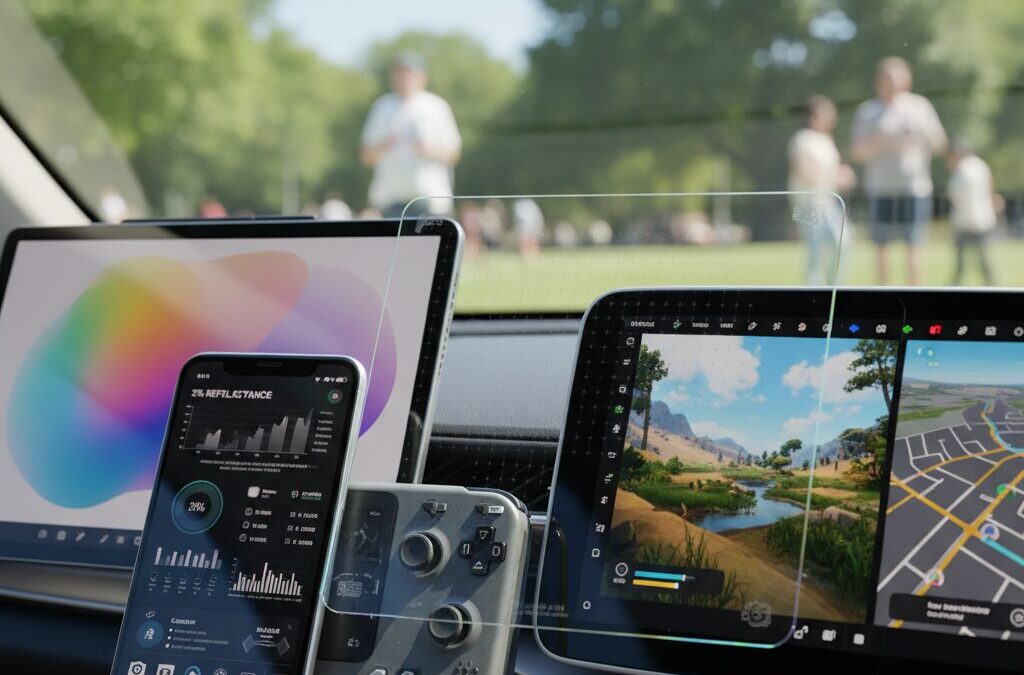
Have you ever struggled to read your smartphone outdoors, even though it boasts thousands of nits of peak brightness? In 2026, display innovation is no longer just about higher resolution or more vivid colors. It is about controlling light itself, and more specifically, eliminating reflection.
With flagship smartphones now reaching up to 3,000 nits of peak brightness, simply increasing luminance is no longer an efficient solution. Higher brightness drains battery life and generates heat. That is why manufacturers are aggressively reducing reflectance, in some cases down to around 2.0%, fundamentally transforming how we experience screens in sunlight.
At the same time, screen protectors have evolved from passive scratch guards into advanced optical components. From multi-layer AR coatings and high-precision etched anti-glare glass to moth-eye nanostructures achieving sub‑0.5% reflectance in automotive displays, 2026 marks a structural shift in both device engineering and the global protection film market. In this article, you will discover the physics, the data, and the real-world products shaping the next generation of low-reflection displays across smartphones, gaming devices, creative tablets, and even cars.
- Why 2026 Marks a Structural Shift from Brightness Competition to Light Control
- The 2% Reflectance Shock: How iPhone 17’s Integrated AR Glass Changed the Industry
- The Accessory Paradox: Why Non‑AR Screen Protectors Can Worsen Visibility
- From Protection to Performance Upgrade: The Rise of 1% Reflectance AR Films
- Anti-Glare vs Anti-Reflection vs Moth‑Eye: The Physics Behind Modern Low-Reflection Displays
- High-Precision Etching and 89%+ Transmittance: Solving the Matte Trade-Off Problem
- Automotive Revolution: 0.5% Reflectance Films and the Wet-Coating Breakthrough
- Infrared Transparency and Seamless Cockpits: Enabling Hidden Driver Monitoring Systems
- Device-Specific Optimization: Smartphones, Android Fingerprint Sensors, and Gaming Consoles
- Paper-Like Friction and Creative Precision: Anti-Glare in Professional Pen Displays
- Installation Innovation: Bubble-Free, Alignment-Guided Application Systems
- Eye Health and Blue-Light Reduction: Reducing Visual Fatigue in High-Luminance Environments
- Sustainability Trends: Recycled PET, Eco Packaging, and Responsible Manufacturing
- How to Choose the Right Low-Reflection Film in 2026 Based on Your Usage Scenario
- 参考文献
Why 2026 Marks a Structural Shift from Brightness Competition to Light Control
In 2026, display innovation clearly shifts from a race for higher brightness to a far more strategic battle: how precisely light is controlled. For years, manufacturers competed on peak nit numbers, pushing flagship smartphones toward an astonishing 3,000 nits. While this delivers undeniable impact outdoors, it also exposes a fundamental limitation: brightness alone cannot defeat reflection.
As Apple’s technical documentation for the iPhone 17 generation indicates, peak luminance has reached levels once reserved for professional monitors. Yet real-world visibility depends not only on emitted light, but on how much ambient light is reflected back to your eyes. When reflection remains high, increasing brightness simply becomes an inefficient arms race against the sun.
This is where 2026 marks a structural shift. Instead of amplifying output, manufacturers are minimizing loss. The introduction of integrated anti-reflective layers in devices such as iPhone 17, reducing reflectance from around 3.8% to approximately 2.0%, demonstrates that cutting reflection by half can be more impactful than adding hundreds of nits.
| Generation | Peak Brightness | Reflectance | Strategic Focus |
|---|---|---|---|
| Pre-2025 Flagships | Up to ~2,000 nits | ~3.5–4% | Brightness escalation |
| 2026 Flagships | Up to 3,000 nits | ~2.0% | Integrated light control |
According to reflection tests published by Astropad, applying a non-AR glass protector to a 2026 flagship can increase reflectance to 4.6%, effectively negating built-in optical engineering. This reveals a deeper transformation: display performance is now a system-level optical design problem, not a single-spec contest.
There are three structural reasons behind this pivot.
First, power efficiency. Driving a panel at 3,000 nits significantly increases battery consumption and thermal load. Reducing reflectance achieves higher perceived contrast without proportional energy cost. From an engineering perspective, lowering reflection is a far more scalable solution.
Second, perceptual contrast. The human visual system responds strongly to black depth and glare suppression. By leveraging destructive interference in multilayer AR coatings, manufacturers suppress reflected waves before they reach the eye. The result is not just brighter whites, but darker blacks under ambient light.
Third, usage context. Smartphones are now outdoor-first devices. Navigation, mobile gaming, and social media are consumed in daylight. In such environments, glare—not insufficient brightness—is the primary visibility barrier. Academic research on optical coatings has long shown that reducing surface reflection dramatically enhances readability under high illuminance conditions.
What makes 2026 different is integration. Anti-reflective performance is no longer an aftermarket enhancement but embedded at the glass-material level, as seen in next-generation ceramic-based shields. This forces accessory makers to rethink design entirely, because adding a conventional layer can disrupt air-interface conditions required for optimal interference effects.
In short, 2026 transforms displays from light emitters into light managers. The industry recognizes that controlling incoming and outgoing photons is more sustainable, more efficient, and more perceptually effective than endlessly pushing luminance ceilings. The competition has not disappeared—it has simply moved from brightness numbers to optical precision.
The 2% Reflectance Shock: How iPhone 17’s Integrated AR Glass Changed the Industry
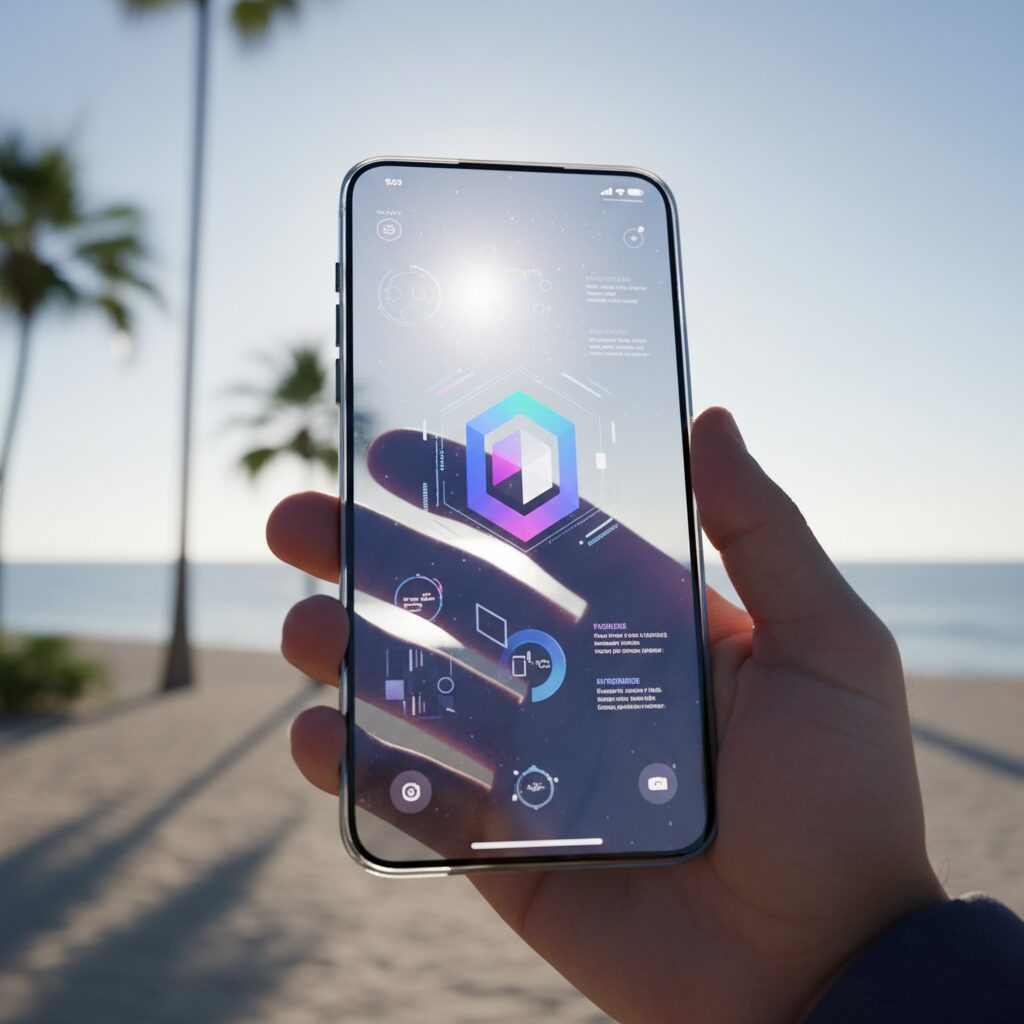
In 2026, the most disruptive number in the smartphone industry was not peak brightness or AI benchmark scores. It was 2.0% reflectance. With the introduction of Ceramic Shield 2 and its integrated anti-reflective structure, the iPhone 17 series fundamentally redefined how light interacts with a mobile display.
According to reflection measurements published by Astropad and industry testing sources, Apple reduced reflectance from 3.8% on the iPhone 16 Pro to approximately 2.0–2.1% on the iPhone 17 lineup. That represents nearly a 50% reduction in surface reflection without increasing power consumption.
| Device / Condition | Reflectance | Impact |
|---|---|---|
| iPhone 16 Pro | 3.8% | Previous generation baseline |
| iPhone 17 (bare) | 2.0–2.1% | Integrated AR via Ceramic Shield 2 |
| iPhone 17 + standard film | 4.6% | AR effect neutralized |
| iPhone 17 + dedicated AR protector | 1.0% | Performance enhanced beyond stock |
The technological core lies in destructive interference. Multiple ultra-thin optical layers are deposited directly onto the glass surface, carefully tuned so reflected light waves cancel each other out. As optical physics literature explains, when phase alignment is precisely controlled, surface reflection can be dramatically suppressed without diffusing image sharpness.
The shockwave through the industry was immediate. Independent testing showed that attaching a conventional non-AR glass protector increased reflectance to 4.6%. This occurs because AR coatings require air-interface conditions to function properly, and adhesive layers disrupt that optical balance. In practical terms, a protective accessory could erase Apple’s biggest display advantage.
This created what analysts began calling the “accessory paradox” of 2026. Protection no longer meant preservation of performance. It could mean degradation.
Third-party manufacturers were forced into rapid innovation cycles. Astropad’s Fresh Coat demonstrated reflectance near 1.0%, effectively doubling reflection suppression compared to the naked iPhone 17. Japanese brands such as Elecom responded with advanced multi-layer “Super AR” treatments that improved transmittance while maintaining interference-based reflection control.
Industry observers note that this transition marks a structural shift. Previously, display competition centered on brightness escalation, reaching peaks near 3,000 nits. However, increasing luminance alone raises thermal and battery constraints. By cutting reflection instead of overpowering it, Apple changed the efficiency equation.
The result is perceptual, not merely numerical. Dark scenes appear deeper because ambient light no longer washes out blacks. Outdoor usability improves without aggressive brightness spikes. Video contrast holds even under direct illumination.
Most importantly, the 2% benchmark reset expectations across the supply chain. Glass manufacturers, coating specialists, and accessory brands must now design for optical compatibility rather than simple durability. In 2026, reflectance became a first-class specification. The iPhone 17 did not just improve a screen. It redefined what “premium display” means in the era of integrated AR glass.
The Accessory Paradox: Why Non‑AR Screen Protectors Can Worsen Visibility
In 2026, adding a screen protector is no longer a neutral decision. It can fundamentally change how your display handles light.
With devices like the iPhone 17 series integrating anti-reflective layers directly into the glass, the optical balance is precisely engineered at the factory. When a non‑AR screen protector is placed on top, that balance can collapse.
This is the Accessory Paradox: a product meant to protect your screen can measurably worsen its visibility.
What Actually Happens to Reflectance
| Configuration | Reflectance | Impact on Visibility |
|---|---|---|
| iPhone 17 (bare) | 2.0–2.1% | Integrated AR minimizes glare |
| iPhone 17 + non‑AR film | 4.6% | Reflections more than double |
| iPhone 17 + dedicated AR protector | ~1.0% | Further reduction in glare |
According to reflection tests published by Astropad and industry analyses covering the iPhone 17 launch, the device’s native reflectance drops to around 2.0% thanks to its integrated multi-layer AR structure. However, when a standard non‑AR tempered glass protector is applied, reflectance rises to approximately 4.6%.
That is not a subtle shift. It effectively cancels out the advantage of the built-in coating and pushes the screen closer to pre‑AR performance levels.
The physics behind this is straightforward. AR coatings rely on destructive interference at the air–glass boundary. When you apply a non‑AR protector, you introduce additional interfaces: air–protector and protector–adhesive–glass.
The original interference conditions no longer align, and reflections that were previously canceled begin to reappear.
Some reports have emphasized that AR systems are optimized assuming direct exposure to air. Once that boundary condition changes, the carefully tuned optical stack cannot perform as designed.
In practical terms, this means brighter hotspots under sunlight, reduced perceived contrast outdoors, and higher effective glare indoors under ceiling lights.
There is also an energy implication. Modern smartphones already reach peak brightness levels approaching 3,000 nits. Increasing reflectance forces users to raise brightness further to compensate, which can accelerate battery drain and heat buildup.
Ironically, the more advanced the display technology becomes, the more harmful a generic accessory can be. On older devices without integrated AR, a basic protector may not significantly degrade performance. On 2026 flagship panels, the mismatch is far more pronounced.
For gadget enthusiasts who care about color accuracy, contrast depth, and outdoor readability, this paradox is critical. Protection is still essential, but optical compatibility now matters just as much as hardness ratings or drop resistance.
In the era of engineered low reflectance, not all glass is optically equal.
From Protection to Performance Upgrade: The Rise of 1% Reflectance AR Films
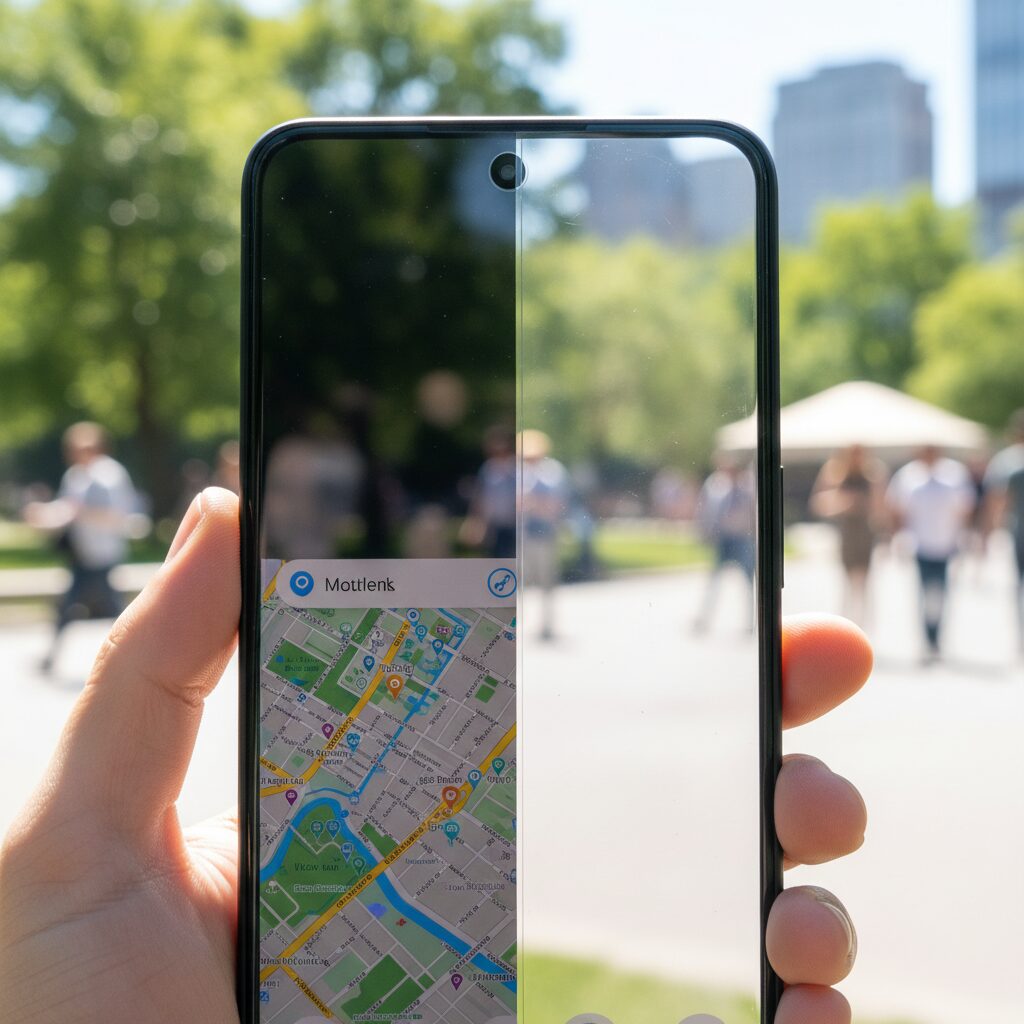
Until recently, screen protectors were passive accessories designed simply to prevent scratches. In 2026, that role has fundamentally changed. The emergence of 1% reflectance AR films marks a decisive shift from protection to performance upgrade, transforming a thin layer of glass into a precision optical component.
The trigger for this evolution was the arrival of devices such as the iPhone 17 series, whose integrated AR coating reduced reflectance to around 2.0%. According to reflection tests published by Astropad, combining that baseline with a purpose-built AR protector can further lower total reflectance to approximately 1.0%, effectively halving surface reflections again.
A 1% reflectance surface does not just protect a display. It amplifies contrast, deepens blacks, and preserves outdoor readability without increasing brightness or battery drain.
The optical logic is straightforward but powerful. AR films employ multilayer structures engineered for destructive interference, cancelling reflected light waves at the air–film interface. Unlike conventional non-AR glass, which can raise reflectance above 4% when layered over an AR-treated screen, a matched 1% AR film maintains the interference condition instead of disrupting it.
| Configuration | Approx. Reflectance | User Impact |
|---|---|---|
| Integrated AR display only | ~2.0% | Strong outdoor visibility |
| Display + non-AR glass | ~4.6% | Noticeable glare increase |
| Display + dedicated AR film | ~1.0% | Enhanced contrast and clarity |
For gadget enthusiasts who care about measurable gains, this is a rare case where an accessory can outperform the naked device. Lower reflectance directly improves perceived contrast ratio because less ambient light washes out dark pixels. The result is a richer black level and more stable color perception in mixed lighting environments.
This shift is also energy-relevant. As Apple’s technical specifications confirm, peak brightness levels now reach up to 3,000 nits in certain modes. However, boosting luminance to overcome glare increases thermal load and battery consumption. Reducing surface reflection to 1% achieves readability gains optically rather than electrically, preserving efficiency.
Importantly, modern 1% AR films no longer suffer from the classic trade-offs of earlier anti-glare solutions. Advanced multilayer stacks integrate oleophobic coatings to resist fingerprint-induced interference breakdown. Japanese manufacturers such as Elecom have demonstrated that high transmittance and low reflectance can coexist, supporting vivid video playback without the milky haze typical of older matte films.
The rise of 1% AR films signals a new mindset: users are no longer merely shielding their screens, they are tuning them. In a market where core hardware differences narrow year by year, optical optimization at the surface level has become a legitimate path to premium visual performance.
For performance-driven consumers, the question is no longer whether to use a protector, but whether it preserves the optical architecture of the device. In 2026, the best answer is clear: a precisely engineered 1% AR film that upgrades protection into measurable display enhancement.
Anti-Glare vs Anti-Reflection vs Moth‑Eye: The Physics Behind Modern Low-Reflection Displays
Modern low-reflection displays rely on three fundamentally different optical strategies: Anti-Glare (AG), Anti-Reflection (AR), and Moth‑Eye structures. Each manipulates light at a different physical level—scattering, interference, or refractive index control—and understanding this distinction is essential if you care about absolute image fidelity.
The key difference lies in whether the technology diffuses light, cancels it, or prevents it from forming in the first place.
| Technology | Primary Mechanism | Typical Reflectance | Optical Trade-off |
|---|---|---|---|
| AG | Surface micro-roughness (diffuse scattering) | Varies, reduces glare perception | Slight haze, lower contrast |
| AR | Destructive interference (multi-layer) | ~2.0% on iPhone 17 Pro | Sensitive to surface contamination |
| Moth‑Eye | Gradual refractive index transition (nano-cones) | <0.5% achievable | Structural durability challenges |
AG works by introducing micron-scale surface irregularities that scatter incoming light in multiple directions. Instead of seeing a sharp reflection of the sun, you see a softened glow. According to Panasonic’s technical disclosures on automotive films, this diffusion improves usability under strong ambient light but inevitably introduces a slight reduction in perceived contrast because scattered light still reaches the eye.
AR coatings take a more elegant wave-optics approach. By stacking ultra-thin layers with carefully tuned thicknesses, reflected light waves cancel each other through destructive interference. Apple’s Ceramic Shield 2 reduces reflectance from 3.8% to around 2.0% by applying this principle. Astropad’s independent measurements show that adding a dedicated AR layer can push reflectance close to 1.0%, approaching the perceptual threshold where reflections become dramatically less intrusive.
Where AG modifies geometry, AR manipulates phase. This is why AR preserves deep blacks and color saturation far better than traditional matte finishes.
Moth‑Eye structures move into the nanoscale. Inspired by the compound eyes of moths, these surfaces feature 100–200 nm conical protrusions. As described in materials science literature and Sharp’s engineering briefings, the refractive index transitions gradually from air to substrate, suppressing Fresnel reflection at the interface itself. Theoretical reflectance can drop below 0.5%, which rivals high-end optical lenses.
Unlike interference-based AR, Moth‑Eye performance is broadband and angle-independent, making it particularly suitable for automotive displays and outdoor signage. However, because the anti-reflective effect depends on physical nanostructures, mechanical abrasion has historically been a concern. Recent hydrophobic and hard-coat integrations are addressing this limitation.
For enthusiasts chasing the cleanest blacks and maximum luminance efficiency, understanding these physical foundations changes how you evaluate a display. You are not just choosing a finish—you are choosing the optical philosophy that governs how light behaves at the surface.
High-Precision Etching and 89%+ Transmittance: Solving the Matte Trade-Off Problem
For years, matte anti-glare films have been associated with a clear compromise: less reflection, but also less clarity. In 2026, that trade-off is being fundamentally redefined through high-precision etching and optical optimization that pushes total light transmittance beyond 89%.
The core challenge of matte processing lies in physics. By introducing micro-scale surface roughness, incident light is diffused to suppress specular reflection. However, excessive diffusion also scatters emitted display light, lowering contrast and creating the familiar “whitish haze.” The breakthrough comes from controlling that roughness at a far more precise scale.
According to product disclosures from Elecom’s advanced AR-etched models, refined etching processes have increased transmittance from around 85% in conventional anti-glare glass to over 89%, while maintaining effective reflection suppression. This 4-point gain may appear modest, but perceptually it significantly restores black depth and text sharpness.
| Processing Type | Typical Transmittance | Visual Impact |
|---|---|---|
| Conventional Matte (AG) | ~85% | Reduced glare, noticeable haze |
| High-Precision Etched AG | 89%+ | Glare reduction with improved contrast |
| Pure AR Coating | 95%+ | Maximum clarity, minimal diffusion |
The key is microstructure control aligned with pixel density. On high-resolution OLED panels, poorly tuned matte textures can interfere with subpixel layouts, causing sparkle or grain. Advanced etching now tailors surface irregularities to minimize interaction with pixel pitch, preserving perceived resolution even under strong ambient light.
This directional optimization explains why modern matte films no longer feel like a downgrade for video consumption. With 89%+ transmittance, color saturation remains stable and shadow gradation is preserved, making them viable even for HDR-capable displays operating at peak brightness levels.
Equally important is tactile consistency. Fine etching contributes to a smoother, more uniform surface profile, reducing uneven friction that previously accompanied aggressive matte finishes. For users engaged in long gaming sessions or extended scrolling, this balance between optical precision and surface feel directly impacts comfort.
In practical terms, high-precision etched films now occupy a distinct middle ground: they approach the clarity of AR coatings while retaining the reflection diffusion advantages of matte technology. The traditional matte trade-off is no longer a fixed limitation, but a design parameter that can be engineered with measurable optical performance targets.
Automotive Revolution: 0.5% Reflectance Films and the Wet-Coating Breakthrough
Low-reflection technology is no longer confined to smartphones. In 2026, the most dramatic transformation is unfolding inside vehicles, where large-format displays must remain legible under direct sunlight while enduring extreme heat and vibration.
The breakthrough comes from achieving sub‑0.5% reflectance, a level once considered impractical for mass automotive deployment due to cost and manufacturing constraints.
This shift is redefining the cockpit as a seamless digital interface rather than a collection of glare-prone panels.
| Metric | Performance | Impact in Vehicles |
|---|---|---|
| Average Reflectance | ≤0.5% | Clear visibility under strong sunlight |
| Total Light Transmittance | 95.6% | No loss of display brightness or contrast |
| Infrared Transmittance | 90%+ | Supports driver monitoring sensors |
| Heat Resistance | DIN 75220 compliant | Stable performance at 80°C cabin temps |
According to Panasonic’s official release, the company achieved this performance using a proprietary wet-coating process combined with nano-level multilayer design. Traditionally, ultra-low reflection films relied on vacuum-based dry deposition, which increased production cost and limited scalability.
By contrast, wet coating applies precisely engineered resin layers in a liquid phase, enabling uniform large-area coverage while shortening manufacturing lead time.
The cost-performance balance is what makes 0.5% reflectance viable for mass-market vehicles rather than niche luxury models.
Technically, the film suppresses reflection through controlled destructive interference across multiple refractive layers. At the same time, it preserves over 95% total light transmission, ensuring that high-brightness automotive displays do not require additional power to compensate for optical loss.
This efficiency matters because modern cockpits often integrate dual or triple displays exceeding 12 inches each. Reducing reflection without increasing backlight output directly contributes to thermal stability and energy optimization.
Equally important is infrared transparency. With over 90% IR transmission, driver monitoring systems can be placed discreetly behind the display surface, maintaining both safety compliance and minimalist interior design.
Sharp’s evolution of moth-eye structures further expands this revolution. By engineering nano-scale surface textures that gradually shift refractive index, reflections approach theoretical limits while adding hydrophobic and anti-fog properties, which are critical for outdoor and all-weather use.
The automotive display is no longer just a screen. It is becoming an optical control surface engineered at the nanometer level.
As vehicles transition toward software-defined platforms, glare-free readability becomes a safety parameter rather than a cosmetic upgrade. The emergence of wet-coated 0.5% films signals a structural turning point: optical engineering is now as essential to mobility as horsepower or battery capacity.
Infrared Transparency and Seamless Cockpits: Enabling Hidden Driver Monitoring Systems
As cockpit displays grow larger and more integrated, designers face a paradox: they must embed more sensors while making them disappear visually. The key to solving this challenge lies in infrared transparency combined with ultra‑low reflectance coatings.
Panasonic’s automotive anti‑glare film demonstrates how optical engineering enables this balance. According to the company’s technical release, the film achieves an average visible reflectance of 0.5% while maintaining over 90% infrared transmittance, even when laminated over sensor areas.
This combination allows driver monitoring systems to operate through the display surface itself, without visible cutouts or bezels.
| Parameter | Performance | Impact on Cockpit Design |
|---|---|---|
| Average visible reflectance | 0.5% | Minimizes glare under sunlight |
| Infrared transmittance | 90%+ | Enables hidden IR cameras |
| Total light transmittance | 95.6% | Preserves display clarity |
| Heat resistance | DIN 75220 compliant | Stable in high‑temperature cabins |
The breakthrough is not only low reflection, but selective transparency. Driver Monitoring Systems typically rely on near‑infrared illumination to track eye movement, blink rate, and gaze direction. If a protective layer blocks or scatters IR wavelengths, detection accuracy drops significantly.
By engineering multilayer coatings that suppress visible reflections while allowing infrared light to pass, manufacturers make it possible to place IR cameras behind the display cover glass. The sensor remains optically active but visually invisible.
This shift enables what designers call a “seamless cockpit.” There are no black sensor windows interrupting the panel surface, no asymmetrical bezels, and no visual noise. The entire dashboard becomes a unified digital plane.
Sharp’s evolution of moth‑eye inspired nanostructures further illustrates this direction. While originally developed to suppress reflection through gradual refractive index transitions, the technology also maintains high transmission efficiency. In automotive contexts, this ensures that both visible content and infrared sensing coexist without compromise.
The implications extend beyond aesthetics. Regulatory bodies increasingly emphasize driver attentiveness monitoring to reduce accidents caused by distraction or drowsiness. Embedding DMS hardware invisibly encourages broader adoption because it does not constrain interior design or user experience.
In practical terms, low reflectance improves daytime readability, while infrared transparency safeguards safety functionality. The two properties reinforce each other rather than compete.
As display surfaces expand from instrument clusters to pillar‑to‑pillar panoramic panels, the importance of optical layering grows. A film that blocks IR would force visible sensor modules. A film that reflects too much visible light would degrade usability under direct sun. Only a precisely tuned multilayer stack solves both.
Infrared‑transparent anti‑reflection films therefore represent more than incremental refinement. They redefine the display as an active sensing membrane, enabling hidden intelligence beneath a flawless glass surface.
Device-Specific Optimization: Smartphones, Android Fingerprint Sensors, and Gaming Consoles
Anti-reflective strategy in 2026 is no longer one-size-fits-all. Smartphones, Android devices with in-display fingerprint sensors, and gaming consoles each require fundamentally different optical tuning. Optimizing for one without considering device-specific hardware often degrades performance rather than improving it.
The key is aligning film structure with the device’s sensing, brightness, and interaction model. Let us break this down by device category.
| Device Type | Primary Constraint | Optimal Approach |
|---|---|---|
| Flagship Smartphones (e.g., iPhone 17) | Integrated AR glass (≈2.0% reflectance) | Matched AR film to preserve interference layers |
| Android w/ In-Display Fingerprint | Ultrasonic/optical signal transmission | Full-surface silicone adhesive, controlled thickness |
| Gaming Consoles (Switch OLED) | Glare during long sessions | High-precision AG with ≥98% transmittance |
For flagship smartphones such as iPhone 17, Apple’s Ceramic Shield 2 integrates multi-layer AR coatings that reduce reflectance to around 2.0%, according to published technical testing. If a conventional non-AR film is added, reflectance can rise to 4.6%, effectively canceling the built-in optical advantage. This happens because destructive interference requires precise air-glass boundary conditions. A mismatched adhesive layer disrupts this balance.
Specialized AR protectors, such as those benchmarked by Astropad, demonstrate that reflectance can be reduced further to around 1.0% when optical layers are properly tuned. In these cases, the film acts not as protection alone but as an optical extension of the display stack.
Android devices introduce a different challenge. Google Pixel 9a and Samsung Galaxy S25 series rely on optical or ultrasonic in-display fingerprint authentication. Matte anti-glare films historically interfered with recognition accuracy due to micro-surface diffusion and added thickness. However, manufacturers like DEFF and Samsung have adopted full-surface silicone adhesive layers designed to maintain signal fidelity comparable to a bare screen.
Here, reflectance control must never compromise biometric reliability. Precision thickness management and uniform adhesive distribution are more important than achieving the lowest theoretical reflection value.
Gaming consoles such as the Nintendo Switch OLED prioritize immersion over biometric compatibility. According to product specifications from AGC-based glass film suppliers, high-temperature reinforced coatings combined with anti-glare processing can maintain approximately 98% light transmittance while suppressing harsh reflections. For portable consoles used under ceiling lighting or near windows, this balance directly impacts visual fatigue during multi-hour sessions.
Unlike smartphones, gaming optimization also considers surface friction durability. Stronger coating treatments, including extended high-heat reinforcement processes, help prevent texture degradation from repeated touch interaction.
Device-specific optimization therefore means understanding the display as a system: optical layers, sensors, brightness output, and human interaction patterns. The most advanced anti-reflective solution in 2026 is not the one with the lowest raw reflectance number, but the one precisely engineered for the hardware beneath it.
Paper-Like Friction and Creative Precision: Anti-Glare in Professional Pen Displays
For professional illustrators and designers, anti-glare technology is no longer just about visibility. It directly shapes how the pen feels on the surface and how precisely lines respond to subtle hand movements. In 2026, this tactile dimension of low-reflection treatment has become a defining factor in high-end pen displays.
On devices such as the Wacom Movink 13, specialized anti-glare films like Sanwa Supply’s LCD-WM13P introduce a carefully engineered micro-texture. Instead of merely diffusing ambient light, the surface is tuned to generate controlled friction that mimics paper. This transforms the glass panel from a slippery interface into a responsive drawing plane.
The difference can be summarized across three dimensions that matter to creators:
| Aspect | Standard Glass | Paper-Like Anti-Glare |
|---|---|---|
| Surface Friction | Very low, pen glides easily | Moderate resistance, controlled drag |
| Reflected Light | Specular reflections visible | Diffused reflections, reduced glare |
| Stroke Stability | Higher risk of overshooting | Improved micro-control |
From an optical standpoint, anti-glare processing relies on micro-scale surface irregularities that scatter incoming light. However, in creative workflows, those same irregularities also generate mechanical resistance against the pen tip. The key in 2026 is precision: high-resolution displays demand that the texture be fine enough to avoid visible grain or pixel interference.
According to product disclosures from Sanwa Supply, the Movink 13-compatible film balances reflection suppression with clarity, ensuring that line edges remain crisp even under studio lighting. This is critical for color grading and fine inking, where subtle tonal differences must remain intact.
There is also a measurable ergonomic benefit. When friction is optimized, artists can reduce grip force because the pen no longer slips uncontrollably. Over long sessions, this helps lower hand fatigue. In practice, many creators report that controlled drag improves confidence during slow, deliberate strokes such as cross-hatching or vector tracing.
Importantly, the latest anti-glare films avoid the traditional trade-off of washed-out contrast. Advances in etching precision, similar to those seen in high-definition AG smartphone films, minimize light scatter while preserving transparency. The result is a surface that feels tactile yet visually sharp.
For professionals who rely on muscle memory developed through years of paper drawing, this matters deeply. The goal is not simply to reduce reflections from studio lamps or daylight. It is to recreate the familiar feedback loop between hand, pen, and surface—while maintaining the color accuracy and brightness of modern OLED pen displays.
In 2026, paper-like anti-glare is no longer an optional accessory. It is a calibrated performance layer that defines how precisely digital creativity translates from intention to pixel.
Installation Innovation: Bubble-Free, Alignment-Guided Application Systems
In 2026, installation has become as important as optical performance itself. As display reflectance drops to 2.0% on devices like iPhone 17 Pro, even a 0.1mm misalignment or a single trapped air bubble can measurably degrade clarity and negate advanced AR coatings. Manufacturers have responded with alignment-guided systems that transform installation from a stressful ritual into a precision-controlled process.
The core innovation lies in mechanical guidance and air management. Instead of relying on user intuition, modern kits physically constrain movement, ensuring that the film meets the glass at the correct angle and position from the very first contact.
Alignment-Guided Frame Systems
| System | Mechanism | User Benefit |
|---|---|---|
| NIMASO “Easy Frame” | Device is fixed inside a rigid guide frame | Two-step pull application with minimal positional error |
| Trinity “Position Marker” | Connector-based alignment reference | Prevents sub-millimeter horizontal drift |
| Rasta Banana Joint Method | Layered peel structure | Controlled adhesion from one edge to the other |
Retail reports from major Japanese electronics chains in 2026 highlight that guide-frame models significantly reduce customer complaints related to misalignment. By anchoring the device inside a molded frame, lateral deviation is virtually eliminated before adhesion begins.
This mechanical certainty is especially critical for edge-to-edge displays and ultra-thin 0.2mm glass protectors, where visual asymmetry is immediately noticeable. In high-end AR environments, even slight offset can disrupt perceived uniformity of reflection suppression.
Bubble-Free Adhesion Engineering
Equally transformative is the evolution of airless silicone adhesive layers. According to product specifications from Elecom, advanced air-diffusion structures allow microbubbles to disperse naturally within 24 hours. Instead of trapping air pockets permanently, the adhesive redistributes pressure across the surface.
This is not merely cosmetic. Air gaps introduce refractive inconsistencies that can increase localized reflectance and reduce effective transmittance. In a display ecosystem targeting reflectance near 1.0% with dedicated AR protectors, maintaining uniform optical contact is essential.
Some premium films now combine dust-absorption sheets, pre-cleaning kits, and controlled peel tabs to minimize contamination during installation. By staging adhesion progressively from one side to the other, internal stress is reduced, lowering the risk of edge lift over time.
The result is a paradigm shift: installation is no longer the weakest link in display optimization. Instead, it has become a carefully engineered extension of optical design, ensuring that advanced anti-reflective performance survives real-world application without compromise.
Eye Health and Blue-Light Reduction: Reducing Visual Fatigue in High-Luminance Environments
As smartphone peak brightness reaches 3,000 nits in 2026, visual fatigue is no longer caused by dim displays but by excessive luminance and environmental reflections. In high-luminance environments such as direct sunlight or brightly lit offices, the eyes continuously adjust pupil size and focus to compensate for glare and contrast loss.
According to ophthalmological insights referenced by the World Health Organization regarding digital eye strain, prolonged exposure to intense light and screen glare contributes to symptoms such as dryness, blurred vision, and headaches. Reducing reflectance and optimizing blue-light transmission are now essential strategies for protecting visual comfort, not optional enhancements.
The shift toward low-reflectance coatings directly impacts how much stray light reaches the retina. When reflectance drops from 3.8% to around 2.0%, as seen in next-generation integrated AR displays, less ambient light competes with on-screen content, reducing the need for extreme brightness compensation.
| Condition | Reflectance | Visual Impact |
|---|---|---|
| Standard glass (~3.8%) | Higher glare | Frequent pupil adjustment, contrast washout |
| Integrated AR (~2.0%) | Reduced reflections | Improved contrast stability |
| Advanced AR film (~1.0%) | Minimal glare | Lower luminance stress on eyes |
Lower reflectance means users do not need to push brightness to maximum levels outdoors. This indirectly reduces cumulative light exposure, which researchers studying VDT syndrome associate with ocular fatigue and accommodative stress.
Blue-light filtering adds another layer of protection. Several 2026 protective films reduce blue-light transmission by approximately 30–35% while maintaining high visible light transmittance. The goal is not to eliminate blue wavelengths entirely, as they are essential for color accuracy, but to moderate excessive short-wavelength energy that scatters more easily inside the eye.
Short-wavelength blue light scatters more strongly than longer wavelengths, increasing perceived glare and reducing contrast clarity. By selectively attenuating this band, modern films help stabilize perceived sharpness in high-brightness scenes.
Anti-glare (AG) surfaces further contribute by diffusing harsh point-source reflections. While older matte coatings reduced clarity, precision etching techniques in 2026 maintain high transmittance—up to 89% or more in advanced models—minimizing the traditional trade-off between comfort and resolution.
In practical terms, this combination delivers measurable ergonomic benefits:
Automotive display research provides additional evidence. Panasonic’s low-reflection films for in-vehicle displays achieve average reflectance around 0.5% while maintaining over 95% total light transmittance. Such specifications are not only about visibility but about preventing driver eye fatigue under rapidly changing light conditions.
For heavy gadget users—mobile gamers, outdoor professionals, or commuters—the cumulative effect is significant. Instead of battling reflections with extreme brightness, the display works with the environment. The eyes remain in a more relaxed adaptive state, reducing strain over extended sessions.
In 2026, eye health in high-luminance environments is no longer addressed by dimming screens alone. It is achieved through a precise balance of ultra-low reflectance optics, intelligent blue-light modulation, and high-transparency coatings that preserve visual fidelity while actively reducing fatigue.
Sustainability Trends: Recycled PET, Eco Packaging, and Responsible Manufacturing
As anti-reflective and anti-glare technologies become more sophisticated in 2026, sustainability is no longer a secondary consideration but a competitive differentiator. Manufacturers are being evaluated not only on reflectance rates and surface hardness, but also on how responsibly those products are designed, sourced, and packaged.
In Japan’s consumer electronics market, several accessory brands have begun integrating recycled PET into their protective films and packaging. According to product disclosures from major retailers such as Yamada Denki, some models now use 100% recycled PET substrates or shift part of their packaging away from petroleum-based plastics toward alternative materials. This transition reduces virgin plastic demand while maintaining the flexibility and optical clarity required for high-performance films.
Sustainability in 2026 is defined by measurable material choices, packaging reduction, and lifecycle awareness—without compromising optical precision or durability.
Recycled PET is particularly relevant in anti-glare film production because PET remains widely used for flexible, lightweight screen protectors. By reprocessing post-consumer PET into new film substrates, manufacturers can preserve key properties such as transparency and dimensional stability while lowering environmental impact. The challenge lies in maintaining strict optical tolerances, especially for AR and high-precision AG finishes, where surface uniformity directly affects reflectance performance.
Packaging innovation is advancing just as rapidly. Some brands have introduced paperless instruction manuals delivered via QR codes, reducing printed inserts and ink usage. Others display eco-label initiatives such as “THINK ECOLOGY,” signaling reduced accessory bundles and simplified packaging structures. These changes may seem incremental, but at scale—across millions of units—they significantly reduce material throughput.
| Area | Conventional Approach | 2026 Sustainable Shift |
|---|---|---|
| Film Substrate | Virgin PET or glass-only focus | Recycled PET integration |
| Packaging | Plastic trays, printed manuals | Reduced plastics, QR-based guides |
| Brand Communication | Performance-centric claims | Eco labeling and lifecycle messaging |
Responsible manufacturing also extends to durability engineering. A longer-lasting 9H–10H hardened surface or dual-strengthened glass reduces replacement frequency, indirectly lowering total resource consumption. This aligns with broader lifecycle thinking emphasized in global sustainability frameworks referenced by organizations such as the United Nations Environment Programme, which highlights product longevity as a key lever for reducing waste.
Importantly, sustainability in this segment does not dilute performance expectations. High-transmittance AR coatings, anti-fingerprint layers, and precision etching processes must remain intact even when recycled inputs are used. The leading brands demonstrate that eco-conscious design and ultra-low reflectance are not mutually exclusive, but technically compatible when materials science and supply chain control are optimized.
For environmentally conscious gadget enthusiasts, the choice of a screen protector in 2026 reflects more than surface feel or glare reduction. It represents participation in a manufacturing ecosystem that increasingly values recycled content, minimized packaging, and extended product lifespan. In a market driven by optical microns and nanostructures, sustainability has quietly become another dimension of precision engineering.
How to Choose the Right Low-Reflection Film in 2026 Based on Your Usage Scenario
In 2026, choosing a low-reflection film is no longer about simply reducing glare. It is about optimizing optical performance based on how and where you actually use your device. With smartphones reaching peak brightness levels of 3,000 nits and native reflectance as low as 2.0% on devices like the iPhone 17 Pro, the wrong film can literally downgrade your display.
According to reflection tests published by Astropad, applying a standard non-AR glass protector to an iPhone 17 can increase reflectance from around 2.0% to 4.6%, effectively canceling out Apple’s integrated AR coating. This makes scenario-based selection essential rather than optional.
Outdoor Power Users: Prioritize True AR Performance
If you frequently use your phone outdoors—navigation, photography, field work—AR (Anti-Reflection) technology should be your top priority. AR films reduce reflected light through destructive interference, preserving contrast even under direct sunlight.
High-end dedicated AR protectors can lower reflectance close to 1.0%, outperforming even the bare display in some cases. Panasonic’s automotive-grade films, for example, achieve average visible reflectance below 0.5% using multilayer designs, showing what is technically possible in advanced optical engineering.
For outdoor-heavy usage, choose films that clearly specify reflectance values (1–2%) rather than vague “anti-glare” labeling.
Mobile Gamers: Focus on High-Precision AG Surfaces
If you play competitive mobile games, finger glide and tactile feedback matter as much as visibility. In Japan’s gaming-driven market, manufacturers have refined high-definition AG (Anti-Glare) etching to reduce friction while minimizing the traditional “white haze” effect.
Recent etched AG models improve transmittance from around 85% to approximately 89%, reducing resolution loss compared to older matte finishes. This means smoother swipes without sacrificing too much clarity.
For fast-paced gaming, controlled surface diffusion often feels more important than achieving the absolute lowest reflectance number.
Video and Content Lovers: Maximize Transmittance
If you mainly stream movies or edit photos indoors, clarity and color fidelity should dominate your decision. AR or “Super AR” films with total light transmittance above 89% preserve deep blacks and saturated colors.
Research from optical coating studies shows that lowering surface reflection enhances perceived contrast disproportionately, meaning even small improvements in reflectance can make HDR content appear more immersive.
For cinematic viewing, avoid heavy matte AG unless reflections are extreme in your environment.
Business and Daily Productivity: Balance Eye Comfort
For office workers and students, visual fatigue is often the hidden factor. Combining anti-reflection with blue light reduction can reduce ocular strain associated with prolonged VDT use. Some commercial films cut blue light by around 35% while maintaining anti-glare functionality.
The key here is balance: too aggressive a filter may distort color accuracy, while insufficient glare control forces your eyes to constantly adjust.
| Usage Scenario | Recommended Technology | Key Metric to Check |
|---|---|---|
| Outdoor / Field Work | Multi-layer AR | Reflectance 1–2% |
| Mobile Gaming | High-precision AG | Improved transmittance (~89%) |
| Video Streaming | Super AR | High contrast, 89%+ transmittance |
| Office / Study | AR + Blue Light Cut | Balanced glare reduction |
Ultimately, the “best” low-reflection film in 2026 depends on whether you prioritize outdoor visibility, tactile control, cinematic fidelity, or eye comfort. Match the optical mechanism—interference, diffusion, or hybrid layering—to your real-world usage, not just marketing claims.
When you align technology with scenario, your display stops fighting ambient light and starts working with it.
参考文献
- Apple:iPhone 17 – Technical Specifications
- Astropad:iPhone 17 Anti-Reflective Test vs Fresh Coat [Data]
- Panasonic Newsroom:Productization of Anti-Glare Anti-Reflection Film for Automotive Displays
- Sharp Blog:Sharp’s Moth-Eye Technology: Evolution Beyond Low Reflection
- ELECOM:iPhone 17 Glass Film Anti-Reflection – PM-A25AFLGGM
- BicCamera:2026 Smartphone Film Recommendations