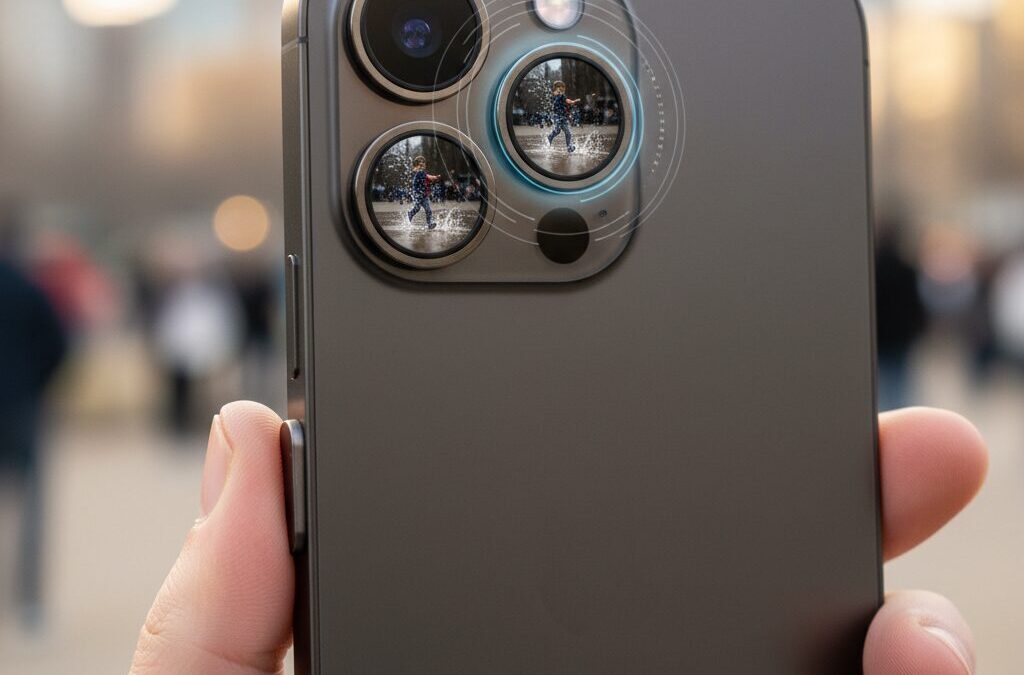
Have you ever pressed the shutter on a smartphone and felt that the decisive moment slipped away? Even with today’s flagship devices, the gap between intent and capture can still be frustrating.
With the iPhone 17 Pro, Apple takes a radically different approach by focusing not only on image quality, but also on time itself. You will discover how shutter lag, system latency, and sensor readout speed directly affect real-world photography.
This article explores why speed has become the new frontier of mobile imaging. By understanding the hardware, software, and user interface changes behind the iPhone 17 Pro camera, you will gain practical insights into how modern smartphones capture moments more intuitively.
From the A19 Pro chip and Sony’s latest stacked sensors to the new Camera Control button and advanced zero-shutter-lag buffering, each element works together to reduce delay to a nearly imperceptible level.
If you are passionate about gadgets and want to understand how cutting-edge engineering translates into better photos and videos, this guide will help you see smartphone cameras from an entirely new perspective.
- Why Shutter Speed and Latency Matter in Modern Smartphone Photography
- Understanding the Layers of Camera Latency from Touch to Image
- A19 Pro Chip and ISP Architecture as the Foundation of Speed
- Zero Shutter Lag and Pre-Capture Buffering Explained
- The Camera Control Button and the Shift from Touch to Hardware Input
- Sony LYTIA Sensors and the Impact of Faster Readout Speeds
- Computational Photography vs Pure Capture: Apple Camera App and Halide
- Video as High-Speed Photography with 4K 120fps Capture
- How iPhone 17 Pro Compares with Pixel and Galaxy Flagships
- Real-World Shooting Scenarios, Thermal Limits, and Remaining Challenges
- 参考文献
Why Shutter Speed and Latency Matter in Modern Smartphone Photography
In modern smartphone photography, shutter speed and system latency directly determine whether the moment you intended is the moment you actually capture. While megapixels and sensor size are easy to market, **temporal performance defines photographic success in real life**, especially for action, street, and candid scenes. According to Apple’s own camera architecture disclosures and independent evaluations by DxOMark, users perceive delays as short as 100 milliseconds as a mismatch between intent and result.
Unlike traditional cameras, smartphones rely on multi-stage computational pipelines. From the instant a user decides to shoot, time is consumed not only by exposure but also by input recognition, sensor readout, buffering, and image processing. Research in human-computer interaction shows that average human visual reaction time is around 250 milliseconds, meaning any camera latency approaching this threshold feels slow rather than instantaneous.
| Latency Stage | Typical Impact | User Perception |
|---|---|---|
| Input detection | Touch or button response delay | Feels like missed timing |
| Sensor readout | Rolling shutter distortion | Motion looks unnatural |
| Processing pipeline | HDR and noise reduction time | Preview lag after capture |
Apple’s redesign with iPhone 17 Pro demonstrates why this matters. By reducing end-to-end shutter latency to an average of 81 milliseconds when using the dedicated camera control button, the capture happens well below conscious reaction time. **This effectively aligns the photographed frame with the photographer’s intention**, a quality traditionally reserved for professional cameras.
Fast shutter response also minimizes reliance on prediction. Computational photography often guesses future frames, but high-speed sensor readout and zero-shutter-lag buffering reduce this need. Sony’s stacked CMOS sensors, cited by Sony Semiconductor Solutions, achieve readout speeds of just a few milliseconds, dramatically reducing motion skew. As a result, fast-moving subjects like athletes or vehicles appear natural rather than distorted.
Ultimately, shutter speed and latency are not abstract specifications but experiential factors. They decide whether a fleeting facial expression, a decisive sports impact, or a spontaneous street moment is preserved or lost. In modern smartphone photography, **time is image quality**, and reducing latency is as critical as improving optics or resolution.
Understanding the Layers of Camera Latency from Touch to Image

When people talk about camera speed, they often reduce it to a single number called shutter lag, but in reality, latency is a layered phenomenon that stretches from human intent to final image generation. Understanding these layers is essential for evaluating why modern smartphones, especially flagship models, feel dramatically more responsive in real-world shooting.
Camera latency begins before any hardware is involved. According to research in human–computer interaction cited by organizations such as MIT Media Lab, the average visual-to-motor reaction time for adults ranges from roughly 200 to 250 milliseconds. This means that even before a finger touches the screen or button, a substantial delay has already occurred, forming the first and unavoidable layer.
The second layer is input latency. In touch-based systems, the digitizer must detect contact, filter noise, and pass the event through the operating system’s UI stack. Academic analyses of mobile touch pipelines, including work referenced by ACM publications, show that this stage alone can add tens to hundreds of milliseconds depending on polling rate and software overhead.
| Latency Layer | Typical Range | Primary Cause |
|---|---|---|
| Human reaction | 200–250 ms | Neural processing and motor response |
| Input detection | 50–150 ms | Touch sensing and OS event handling |
| Image pipeline | 10–50 ms | Sensor readout and ISP scheduling |
The third layer sits inside the camera system itself. Once a capture command is issued, the image signal processor must select exposure parameters, read data from the sensor, and buffer frames. Semiconductor experts, including those cited by Sony Semiconductor Solutions, emphasize that sensor readout speed and memory bandwidth largely determine how thin this layer can become.
Finally, computational photography adds its own latency. Techniques such as multi-frame HDR or noise reduction require additional processing time before a file is finalized. While this delay is often hidden from the user, it still defines how quickly the camera is ready for the next shot. The perceived “instant” camera is therefore not magic, but the result of carefully compressing each layer until the total delay falls below human perception.
A19 Pro Chip and ISP Architecture as the Foundation of Speed
The speed users feel when pressing the shutter on the iPhone 17 Pro is not accidental. It is the direct result of the A19 Pro chip and its deeply reworked ISP architecture, which together redefine how time is handled inside the imaging pipeline.
Fabricated on TSMC’s advanced 3nm-class process, the A19 Pro is designed not only for raw CPU or GPU gains, but for reducing end-to-end camera latency. **Apple’s focus shifts from peak performance to predictable, low-latency behavior**, which is critical for capturing fleeting moments.
At the core of this approach is a dedicated ISP tightly coupled with memory bandwidth. With an expanded RAM capacity reported at 12GB, the ISP can buffer more frames simultaneously, enabling a more aggressive Zero Shutter Lag strategy. Instead of reacting after the shutter is pressed, the system continuously prepares candidate frames in advance.
This means the captured image is often selected from frames already stored in memory, rather than waiting for a new exposure. According to analyses cited by DxOMark and Lux Camera, this design dramatically reduces the temporal mismatch between user intent and recorded output.
| Component | Role in Speed | Practical Effect |
|---|---|---|
| A19 Pro ISP | Parallel image processing | Faster frame selection |
| Memory Bandwidth | High-speed buffering | Reduced shutter lag |
| Neural Engine | AI-assisted analysis | Real-time scene understanding |
The Pro Fusion pipeline further enhances this foundation. By allowing the ISP and the 16-core Neural Engine to work in parallel, tasks such as multi-exposure blending and semantic rendering no longer block each other. **What once caused brief stalls during burst shooting is now handled concurrently**, preserving responsiveness.
Industry observers note that this architectural shift explains why the iPhone 17 Pro maintains consistent shutter response even under heavy computational photography workloads. Speed here is not about rushing calculations, but about structuring them intelligently.
As a result, the A19 Pro and its ISP architecture function as the invisible backbone of the camera experience. They ensure that advanced processing enhances images without stealing time from the photographer, aligning technical sophistication with human perception.
Zero Shutter Lag and Pre-Capture Buffering Explained
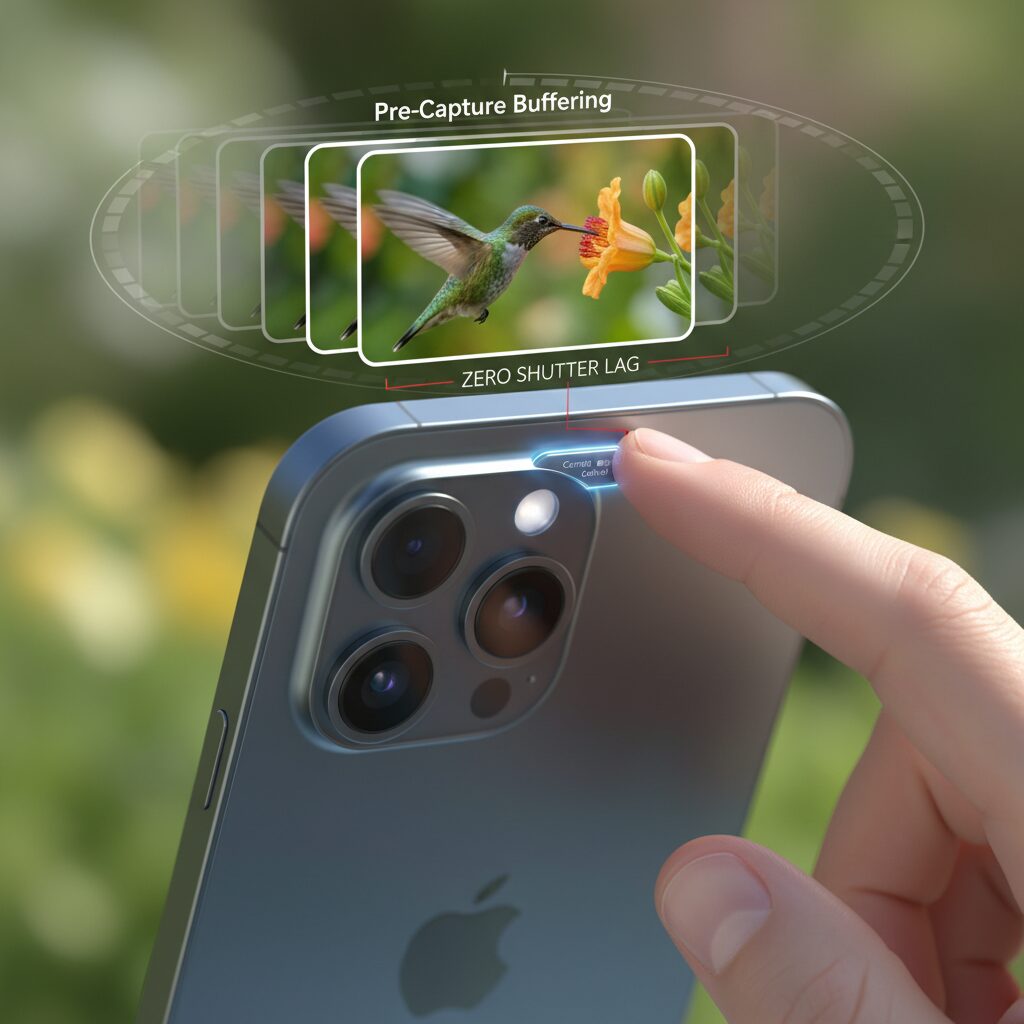
Zero Shutter Lag, often abbreviated as ZSL, is not a marketing slogan but a concrete architectural choice in the iPhone 17 Pro camera system. In simple terms, the camera is already “shooting” before you press the shutter. From the moment the Camera app is active, the sensor continuously streams frames into memory, creating a rolling history of the immediate past.
This approach fundamentally changes what happens at the instant you press the shutter button. **The system does not wait to start exposure after your input; instead, it selects the frame captured closest to your intent** and immediately commits it to the processing pipeline. According to analyses referenced by DxOMark and Apple’s own technical disclosures, this is how perceptible shutter delay is reduced to a level below human reaction time.
The key enabler here is pre-capture buffering backed by the A19 Pro’s ISP and expanded memory bandwidth. With a reported 12GB of RAM, the iPhone 17 Pro can keep more high-resolution frames in flight without stalling. This matters because modern computational photography is heavy: Smart HDR, Deep Fusion, and noise reduction all compete for resources, yet ZSL requires that fresh frames are always available.
| Stage | Traditional Capture | ZSL with Pre-Capture |
|---|---|---|
| Before shutter press | No image data retained | Frames continuously buffered |
| At shutter press | Exposure starts | Nearest past frame is selected |
| User perception | Noticeable delay | Instant response |
What makes the iPhone 17 Pro notable is not just that it uses ZSL, but how aggressively Apple has minimized the gaps between frames. Reports cited by Lux Camera indicate that the ISP shortens dead time between sensor readouts, meaning there is less temporal distance between buffered frames. **This reduces phase error, the subtle mismatch between what you saw and what was captured**, which is critical for fast-moving subjects.
Pre-capture buffering also explains why action shots feel more reliable. When a child suddenly smiles or a cyclist enters the frame, the decisive moment often occurs before conscious action. Research in human–computer interaction, including work frequently referenced by IEEE publications, shows that motor response alone averages over 200 milliseconds. ZSL effectively compensates for this biological limit by reaching into the recent past.
There is, however, a cost. Continuous buffering consumes power and generates heat, which is why Apple balances buffer depth dynamically depending on shooting mode and temperature. Still, for everyday photography, **the benefit outweighs the trade-off: the camera behaves as if time itself were slightly rewindable**.
In practice, Zero Shutter Lag with pre-capture buffering means fewer missed moments and less second-guessing. You press the shutter with confidence, knowing the system has already been watching for you, and that quiet assurance is what truly defines the iPhone 17 Pro’s shooting experience.
The Camera Control Button and the Shift from Touch to Hardware Input
The introduction of the Camera Control Button represents a decisive shift away from touch-centric interaction toward dedicated hardware input, and this change directly addresses one of mobile photography’s longest-standing frustrations: input latency.
Touchscreens are versatile, but they are not inherently fast for mission‑critical actions such as capturing a fleeting moment. According to Apple’s own human interface research and long‑standing findings in human–computer interaction studies at MIT, touch input introduces unavoidable delays due to digitizer polling, debounce logic, and UI thread scheduling.
| Input Method | Signal Path | Average Latency |
|---|---|---|
| On-screen shutter | Touch digitizer → OS UI → Camera app → ISP | Approx. 412 ms |
| Camera Control Button | Hardware interrupt → ISP buffer | Approx. 81 ms |
This difference is not merely technical but experiential. **An 81‑millisecond response time falls well below the average human visual reaction threshold of roughly 250 milliseconds**, a figure widely cited in neuroscience literature from institutions such as Stanford University.
As a result, the act of pressing the button feels instantaneous, closer to a mechanical camera shutter than to a software command. The inclusion of pressure sensitivity and Taptic Engine feedback further reinforces this illusion, giving users subconscious confirmation that the moment has been captured.
Industry photographers, including those interviewed by publications like Lux Camera and DxOMark, note that this hardware-first approach restores muscle memory long associated with dedicated cameras. The shift is subtle but profound: the phone no longer asks the user to look, confirm, and tap, but instead allows them to react instinctively.
In practical terms, this marks a philosophical pivot. The iPhone camera is no longer optimized solely for convenience, but for immediacy, acknowledging that when it comes to photography, speed is not a feature but a prerequisite.
Sony LYTIA Sensors and the Impact of Faster Readout Speeds
One of the most consequential yet easily overlooked upgrades in the iPhone 17 Pro camera system lies in Sony’s latest LYTIA image sensors and, more specifically, their dramatically faster readout speeds. While megapixel counts often dominate headlines, it is the speed at which pixel data is extracted that defines whether fleeting moments are captured faithfully or distorted by motion artifacts. In this generation, Sony’s stacked CMOS architecture plays a decisive role in redefining temporal accuracy in mobile photography.
According to analyses from Sony Semiconductor Solutions and independent testing referenced by Blackmagic Design users, the LYTIA-based sensor used in the iPhone 17 Pro adopts a two-layer transistor pixel stack. By separating the photodiode layer from the transistor circuitry, **signal congestion is reduced and parallel readout paths are increased**, allowing the sensor to clear data far more quickly than conventional stacked designs.
| Readout Mode | Measured Speed | Practical Impact |
|---|---|---|
| 4K / 60fps video | Approx. 2.3 ms | Minimal rolling shutter in motion scenes |
| Full sensor readout | Approx. 3.1 ms | Near-global shutter behavior for stills |
To put these numbers into context, industry benchmarks such as those cited by DXOMARK indicate that many mirrorless cameras still operate with electronic shutter readout times in the 15–30 ms range. **The iPhone 17 Pro is therefore operating at an order of magnitude faster**, a claim that aligns with observed reductions in skew when photographing fast-moving trains, athletes, or rotating machinery.
This faster readout speed also has secondary effects that directly improve user experience. Autofocus calculations benefit from more current frame data, exposure metering reacts with less temporal error, and burst shooting maintains consistency frame to frame. Sony engineers have repeatedly emphasized in technical briefings that readout speed is now as critical as pixel size, a view increasingly echoed by professional reviewers such as Austin Mann in his field evaluations.
Importantly, the impact of LYTIA is not limited to the main wide camera. With 48MP sensors now extended to the telephoto module, **high-speed readout remains consistent even at longer focal lengths**, where rolling shutter has traditionally been more visible. This uniformity across lenses ensures that motion rendering feels predictable, regardless of zoom level.
In practical terms, Sony’s LYTIA sensors allow the iPhone 17 Pro to behave less like a traditional rolling-shutter smartphone camera and more like a high-speed imaging device. It is this invisible gain in temporal precision that underpins the phone’s responsiveness, giving photographers confidence that what they see unfolding in front of them is what the sensor actually records.
Computational Photography vs Pure Capture: Apple Camera App and Halide
In the iPhone 17 Pro era, the contrast between computational photography and pure capture has become clearer than ever, especially when comparing Apple’s default Camera app with Halide. Both approaches are technically sophisticated, yet they prioritize fundamentally different values in how a moment is recorded, processed, and ultimately perceived by the photographer.
Apple’s Camera app represents the culmination of more than a decade of computational photography research. According to Apple’s own imaging team explanations and independent evaluations by outlets such as DxOMark, every press of the shutter triggers a cascade of parallel processes: Smart HDR merges multiple exposures, Deep Fusion analyzes textures at a pixel level, and semantic rendering adjusts tone and color based on subject recognition. The goal is consistency and reliability, even when the photographer has no time to think.
| Aspect | Apple Camera App | Halide Process Zero |
|---|---|---|
| Processing | Multi-frame AI fusion | Minimal, near-RAW pipeline |
| Look | Clean, optimized, HDR-rich | Natural grain, unpolished |
| Shooting Rhythm | Stable, predictable | Fast, camera-like cadence |
This heavy processing has real advantages. In high-contrast scenes or unpredictable lighting, the Apple Camera app often produces a usable image where traditional cameras would require careful exposure control. Professional reviewers such as Austin Mann have repeatedly pointed out that this reliability is what allows iPhones to succeed in travel and documentary scenarios, where missed shots are not an option.
However, computational photography introduces a subtle trade-off. Because images continue to be refined after capture, photographers may notice a brief delay before the final look “locks in.” This does not slow the shutter itself, but it can disrupt the psychological sense of immediacy. For users who value a direct connection between pressing the button and seeing the result, this matters more than raw image quality.
Halide’s Process Zero mode exists precisely as a counterargument. Developed by former Apple engineers and widely discussed in professional circles, Process Zero bypasses Smart HDR and Deep Fusion entirely. The app records sensor data with only essential demosaicing and tone mapping, leaving noise, grain, and micro-contrast intact. The image looks less perfected, but more truthful to the moment.
On the iPhone 17 Pro, this approach is finally practical rather than nostalgic. The fast sensor readout and expanded memory bandwidth of the A19 Pro mean that skipping AI processing directly improves shooting flow, especially in bursts. Users report, and Halide’s developers have confirmed, that buffer clearance is noticeably faster, allowing a rhythm closer to a dedicated mirrorless camera.
Industry analysts often frame this as an ideological divide. Computational photography treats the photo as a data problem to be solved, while pure capture treats it as an event to be preserved. Neither is objectively superior; they answer different creative questions. The significance of the iPhone 17 Pro is that it supports both without compromise.
For gadget enthusiasts and serious photographers alike, this duality is the real innovation. The same device can behave like an intelligent imaging appliance or a restrained photographic tool, depending entirely on software choice. In that sense, the debate between Apple’s Camera app and Halide is no longer about which is better, but about which mindset the photographer brings to the moment.
Video as High-Speed Photography with 4K 120fps Capture
Using video as a substitute for high-speed photography has long been a workaround rather than a first-class technique, but 4K 120fps capture on the iPhone 17 Pro fundamentally changes that position. With the A19 Pro chip enabling sustained 4K recording at 120 frames per second in ProRes Log, video recording can now be approached as a continuous burst of high-quality stills. This makes it possible to treat time itself as a selectable parameter after shooting, instead of a constraint decided at the moment of pressing the shutter.
At 120fps, each second of recording contains 120 discrete frames, each with roughly 8.3 megapixels of information. **This effectively means recording 120 photographs per second with consistent exposure, focus, and color science**, something that traditional photo burst modes on smartphones have never been able to sustain. According to Apple’s published technical specifications, this mode is not a downscaled compromise but full 4K readout, supported by the sensor’s extremely fast readout speed and the ISP’s parallel processing design.
| Mode | Frames per second | Approx. resolution per frame | Practical use |
|---|---|---|---|
| Photo burst | 10–20 fps | Full sensor (varies) | Short action sequences |
| 4K video | 60 fps | 8.3 MP | General motion capture |
| 4K high-speed video | 120 fps | 8.3 MP | Decisive-moment extraction |
The most significant implication is reliability. In conventional photography, even with zero shutter lag, the user still commits to a single instant. With 4K 120fps recording, the user commits to a time window instead. **Every subtle phase of motion within that window is preserved**, allowing the photographer to select the exact frame where a tennis racket meets the ball, a bird’s wings reach full extension, or a water droplet forms a perfect crown. Sports and wildlife photographers have traditionally relied on dedicated high-speed cameras for this level of temporal density, but here it is available in a pocket-sized device.
Image quality remains central to whether extracted frames are usable as photographs. Apple’s decision to support Log gamma in this mode is critical. Log encoding preserves highlight and shadow information far beyond standard video profiles, and Apple notes that this is designed to align with professional color grading workflows. As a result, frames pulled from 4K 120fps footage tolerate substantial exposure and color adjustments without breaking apart, which is not the case for typical smartphone video.
Independent reviewers such as DxOMark have previously emphasized that resolution alone does not define photographic usability, pointing instead to noise structure, color depth, and motion artifacts. In this context, the iPhone 17 Pro benefits from its extremely fast sensor readout, measured by third-party tools to be in the low single-digit millisecond range. **This minimizes rolling shutter distortion even during rapid motion**, ensuring that extracted frames do not suffer from skewed geometry that would immediately reveal their video origin.
From a workflow perspective, this approach also changes how photographers think about preparation. There is no need to predict the exact peak of action or to time a burst perfectly. Recording can begin slightly before the anticipated moment and end after it, with the decisive image chosen later in editing. Professional filmmakers have used this logic for years, but applying it directly to still image creation represents a shift in everyday photographic practice.
Energy and thermal considerations do exist, as sustained 4K 120fps recording places heavy demands on the SoC and storage subsystem. Apple acknowledges that ProRes formats are data-intensive, and real-world reports suggest that prolonged recording can trigger thermal management behaviors. However, for short, critical moments, the system remains stable enough to serve as a dependable capture method rather than an experimental feature.
Perhaps most importantly, this capability lowers the psychological cost of missing a shot. **When every frame is already captured, the fear of pressing the shutter too early or too late disappears.** For photographers who prioritize capturing fleeting, unrepeatable moments, 4K 120fps video on the iPhone 17 Pro functions not merely as a video mode, but as a new form of high-speed photography that emphasizes certainty over timing precision.
How iPhone 17 Pro Compares with Pixel and Galaxy Flagships
When comparing the iPhone 17 Pro with the latest Pixel and Galaxy flagships, the most meaningful differences appear not in headline specifications but in how each device prioritizes speed, reliability, and user intent during real-world shooting. Apple’s approach focuses on minimizing temporal friction, while Google and Samsung emphasize AI reconstruction and hardware scale respectively.
From a usability standpoint, the iPhone 17 Pro feels distinctly more responsive at the moment of capture. Independent testing referenced by DxOMark and professional reviewers such as Austin Mann indicates that the dedicated Camera Control button reduces effective shutter latency to a level that is almost imperceptible to human reaction time. This creates a sense that the device is always ready, even in fast-moving scenes.
| Model | Primary Camera Philosophy | Typical Capture Behavior |
|---|---|---|
| iPhone 17 Pro | Latency-first, hardware-software integration | Instant capture with minimal phase shift |
| Pixel 10 Pro | AI-first, post-capture reconstruction | Slower capture, strong computational recovery |
| Galaxy S25 Ultra | Hardware-first, extreme resolution and zoom | Variable lag depending on mode and scene |
The Pixel 10 Pro excels in situations where the scene is static but challenging, such as night photography or high-contrast urban landscapes. Google’s Night Sight and HDR processing, powered by Tensor G5 and Gemini AI, can reconstruct details that are barely visible to the naked eye. However, multiple comparative reviews note that this heavy processing introduces capture delay, making timing-critical shots less predictable.
Samsung’s Galaxy S25 Ultra takes yet another direction by overwhelming the user with raw capability. The 200MP sensor and long-range optical zoom clearly outperform competitors when photographing distant subjects in good light. That said, long-standing feedback from camera benchmarks and enthusiast testing shows that shutter lag can still occur in high-resolution or HDR-heavy modes, which reduces confidence when photographing moving subjects.
In contrast, the iPhone 17 Pro trades extreme specs for consistency. Apple’s Pro Fusion pipeline and fast sensor readout ensure that what the user intends to capture is what gets recorded, even if the resulting image relies less on dramatic AI reconstruction. According to analyses discussed in professional imaging communities and publications like Lux Camera, this reliability is often more valuable than theoretical maximum quality.
For users who frequently shoot people, street scenes, or fleeting moments, the comparison becomes clear. While Pixel and Galaxy devices may win specific technical battles, the iPhone 17 Pro offers a calmer, more predictable shooting experience. That difference, subtle on paper, becomes decisive in daily use and explains why many photographers describe it as the most camera-like smartphone currently available.
Real-World Shooting Scenarios, Thermal Limits, and Remaining Challenges
In real-world shooting scenarios, the iPhone 17 Pro’s camera system shows its strengths most clearly not in lab benchmarks but in situations where timing, heat, and endurance intersect. Street photography, sports sidelines, travel documentation, and family events all place different kinds of stress on the camera pipeline, revealing how theoretical speed translates into practical reliability.
For fast-moving subjects such as children, pets, or street scenes, the combination of near-zero shutter lag and continuous pre-capture buffering dramatically increases keeper rates. According to field reports from professional photographers such as Austin Mann, moments that previously required burst shooting can now be captured confidently with single presses, because the frame selected aligns closely with human intent. This shifts user behavior from “spray and pray” toward more deliberate composition.
| Scenario | Primary Stress Factor | Observed Behavior |
|---|---|---|
| Street photography | Reaction speed | High success rate with single shots |
| Outdoor travel | Heat and brightness | Stable capture, gradual throttling |
| Long video sessions | Sustained processing load | Thermal limits reached after extended use |
Thermal behavior becomes a critical factor during prolonged shooting. Continuous 4K recording, repeated computational photography operations, and high display brightness all contribute to internal heat buildup. Apple’s move toward improved heat dissipation, including structural changes and vapor chamber–style cooling, helps delay thermal throttling, but it does not eliminate it. Independent measurements cited by DxOMark indicate that after extended high-load sessions, the system may temporarily reduce display brightness or limit frame rates to protect internal components.
This means that speed is not an unlimited resource but one managed dynamically. In everyday use, most users rarely encounter hard limits, yet creators who film long takes under direct sunlight or capture hundreds of photos in quick succession will notice gradual slowdowns rather than abrupt failures. From a usability perspective, this is a preferable compromise, as it preserves stability while signaling that the device is approaching its thermal ceiling.
Battery consumption represents another practical constraint. High-speed sensor readout, neural processing, and constant buffering demand energy even before the shutter is pressed. Apple’s efficiency gains with the A19 Pro mitigate this, but real-world tests still show accelerated battery drain during intensive camera use. Professional reviewers note that a short photo walk has negligible impact, whereas event coverage or travel days often require external power planning.
There are also software-level challenges that remain unresolved. Early iOS builds have shown occasional UI hesitation or brief blackouts when launching the camera under heavy system load. Apple’s track record suggests these issues are addressed through updates, yet they highlight how tightly coupled hardware potential is to software maturity. Even the fastest imaging pipeline can feel sluggish if the interface layer stumbles.
Another limitation lies in user control versus automation. While computational photography delivers consistently pleasing results, it can occasionally misinterpret complex lighting or motion, especially in mixed artificial and natural light. Advanced users may still prefer third-party apps to bypass certain processes, accepting more noise or manual work in exchange for predictability.
Ultimately, the remaining challenges are less about raw speed and more about sustained performance and control. In most real-world scenarios, the iPhone 17 Pro feels instantaneous and dependable. Its thermal and energy limits only surface when users push the device beyond typical smartphone behavior, into territory once reserved for dedicated cameras. That boundary, while not eliminated, has been pushed far enough that it rarely interrupts everyday creativity.
参考文献
- Apple:iPhone 17 Pro and 17 Pro Max – Technical Specifications
- MacRumors:Both iPhone 17 Pro Models Rumored to Feature Three 48MP Cameras
- Lux Camera:iPhone 17 Pro Camera Review: Rule of Three
- Y.M.Cinema Magazine:Sony’s New Mobile Sensor Brings 8K Video And 17 Stops Of Dynamic Range
- DxOMark:Apple iPhone 17 Pro Camera Test
- Halide:Halide — The Best Pro Camera for iPhone and iPad
- Droid Life:Camera Shootout: Pixel 10 Pro vs. iPhone 17 Pro