
Foldable smartphones have finally moved beyond fragile prototypes and are becoming everyday devices, but many enthusiasts still hesitate because of one simple question: is the weight worth it?
If you are comparing the Pixel 10 Pro Fold with lighter rivals like the Galaxy Z Fold series, the number 258 grams may already be raising concerns about comfort, fatigue, and long-term usability.
In this article, you will discover why weight alone does not tell the full story and how balance, internal layout, and real-world ergonomics shape the actual user experience.
By looking at physics principles, teardown insights, and competitive benchmarks, this guide helps you understand what that extra mass really means in daily use.
If you care about premium build quality, durability, battery life, and how a device feels in your hand over hours of use, you will gain clear and practical insights before making your decision.
- Why Weight Matters in the Modern Foldable Smartphone Market
- Pixel 10 Pro Fold at 258g: What the Numbers Really Mean
- Battery Size, Materials, and Durability as Key Weight Drivers
- Internal Weight Distribution Revealed by Teardown Analysis
- Camera Bar Design and the Challenge of Top-Heavy Devices
- Qi2 Magnets and Their Unexpected Role in Balance Improvement
- Ergonomics and Physics: Holding Torque and Perceived Heaviness
- Comparing Pixel 10 Pro Fold with Galaxy Z Fold and Chinese Rivals
- Everyday Use Considerations: One-Handed Use, Fatigue, and Comfort
- Who Should Choose a Heavier but More Robust Foldable Phone
- 参考文献
Why Weight Matters in the Modern Foldable Smartphone Market
In the modern foldable smartphone market, weight matters far more than a simple number on a spec sheet. As foldables move from experimental devices to daily tools, users increasingly judge them by long-term comfort, not short demos in a store. A difference of even 30–40 grams can fundamentally change how a device feels after an hour of reading, multitasking, or commuting use, especially when the phone is frequently opened and closed.
Industry analysts at outlets such as CNET and Android Central consistently point out that foldables amplify weight sensitivity because they combine phone and tablet roles into a single object. Unlike slab phones, foldables introduce hinges, dual displays, and reinforced frames, all of which add mass. This makes weight a direct UX factor tied to hand fatigue, wrist strain, and perceived usability rather than a secondary specification.
| Device | Weight | Battery Capacity |
|---|---|---|
| Pixel 10 Pro Fold | 258 g | 5,015 mAh |
| Galaxy Z Fold 7 | 215 g | 4,400 mAh |
This comparison highlights a key market reality. Lighter models prioritize portability, while heavier designs often concentrate on endurance, durability, and camera hardware. Weight therefore represents a design philosophy choice rather than a simple engineering win or loss. Google’s approach, for example, reflects a willingness to accept extra mass in exchange for IP68 protection and a larger battery, which directly affects all-day reliability.
From an ergonomics perspective, research cited by IEEE and MDPI shows that perceived heaviness increases when mass is distributed away from the hand’s natural grip point. Foldables, being wider and more complex internally, magnify this effect. As a result, manufacturers now treat weight as a competitive differentiator on par with display quality or hinge durability.
In today’s foldable market, weight has become a proxy for trust, comfort, and usage intent. Users are no longer asking only how light a foldable is, but whether its weight aligns with how they actually live and work every day.
Pixel 10 Pro Fold at 258g: What the Numbers Really Mean
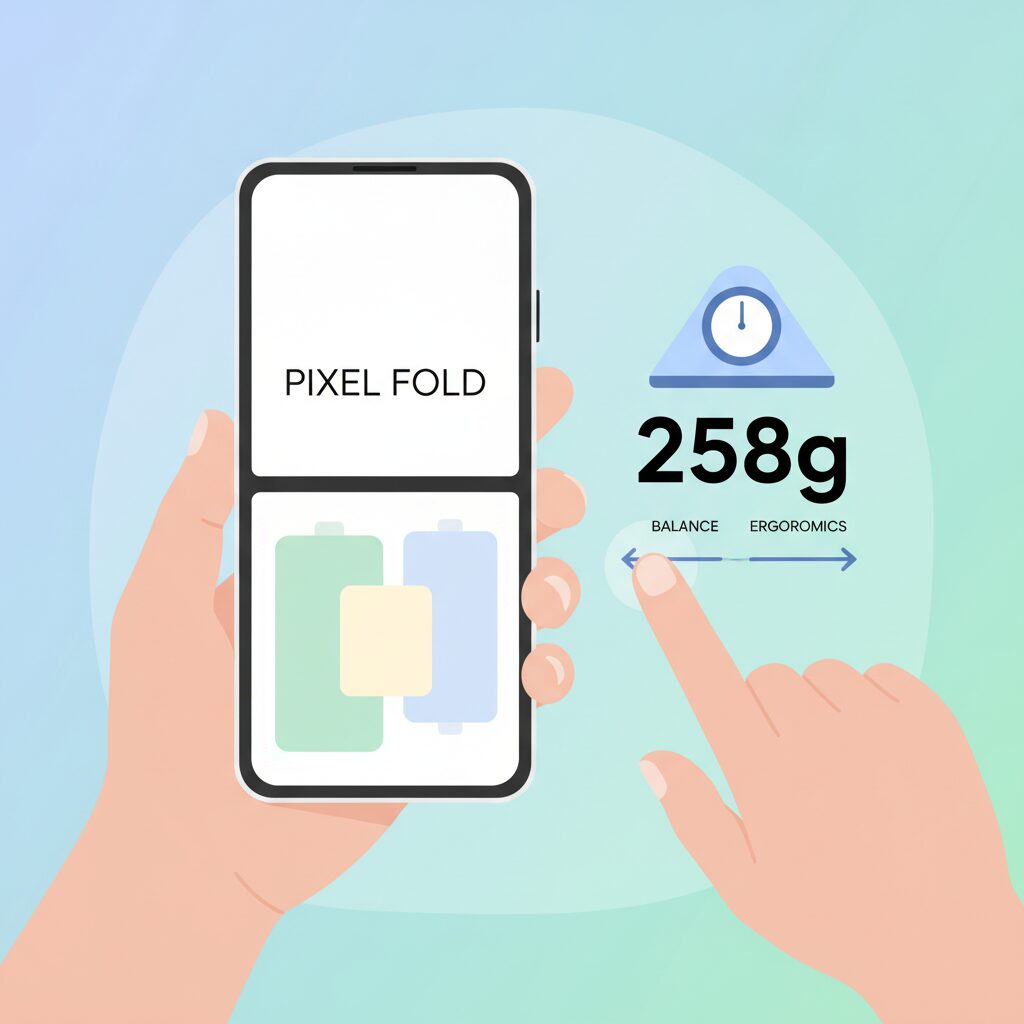
The number 258 grams can look like just another spec on a comparison chart, but in daily use it translates into a very specific physical experience. When you pick up the Pixel 10 Pro Fold, the weight immediately communicates density rather than bulk. **This is not a phone that feels accidentally heavy; it feels deliberately built.** According to analyses by outlets such as CNET and Android Central, Google appears to have accepted extra mass as the cost of durability, battery life, and thermal stability, rather than chasing headline-grabbing lightness.
To understand what 258g really means, it helps to place the device within the current foldable landscape. Most recent book-style foldables now cluster between 210g and 240g, a range many users associate with improved one-handed comfort. Pixel 10 Pro Fold sits clearly above that band, and the difference is not trivial over long sessions. Ergonomics research summarized in IEEE publications shows that even a 10 percent increase in handheld device mass can significantly raise perceived fatigue during continuous holding, especially when the device width is large.
| Model | Weight | Battery Capacity |
|---|---|---|
| Pixel 10 Pro Fold | 258g | 5,015 mAh |
| Galaxy Z Fold 7 | 215g | 4,400 mAh |
| Honor Magic V5 | 217g | 5,820 mAh |
Seen this way, the Pixel’s weight begins to tell a story. A battery exceeding 5,000 mAh alone accounts for a noticeable portion of the mass, and battery chemistry still obeys physical limits. Reports cited by PhoneArena indicate that Google did not adopt the latest silicon-carbon cells used by some Chinese competitors, instead prioritizing long-term reliability and thermal margins. **The result is a phone that carries more grams, but also promises more predictable endurance over years of use.**
Materials further reinforce this interpretation. The combination of an aluminum frame, Gorilla Glass Victus 2 on multiple surfaces, and a reinforced steel-based hinge adds grams one by one. Android Central’s hands-on impressions note that this construction gives the Pixel 10 Pro Fold a stiffness closer to a small tablet than a flexible gadget. In practical terms, the weight contributes to a sense of confidence when opening and closing the device, with less flex and fewer micro-vibrations during handling.
Another important aspect is balance. Weight alone does not define comfort; distribution matters just as much. Teardown-based commentary from 9to5Google suggests that Google spread internal components, including dual battery cells and the Qi2 magnetic array, across the chassis to avoid extreme top-heaviness from the camera bar. From a physics perspective, studies on center-of-gravity optimization show that lowering and centralizing mass can reduce wrist torque even when total weight remains high.
In everyday scenarios, this means the Pixel 10 Pro Fold tends to feel steadier when held with two hands or rested against the palm during reading. However, during prolonged one-handed use, especially on the cover display, the 258g mass becomes more noticeable. Medical literature on hand strain frequently cited in ergonomics discussions warns that sustained thumb extension under load increases tendon stress. **For users sensitive to hand fatigue, the number on the scale becomes a real consideration, not just a statistic.**
Ultimately, 258 grams signals Google’s positioning choice. Rather than competing in a lightweight race, Pixel 10 Pro Fold treats weight as part of its value proposition: durability, battery longevity, and structural integrity. For readers who equate lightness with comfort above all else, the number may raise doubts. For those who value a solid, uncompromising build that feels engineered for years of use, the same number can be read as reassurance.
Battery Size, Materials, and Durability as Key Weight Drivers
When discussing why the Pixel 10 Pro Fold reaches 258 grams, the most decisive contributors are the battery, structural materials, and durability-oriented design choices. These elements are not accidental side effects but deliberate engineering priorities, and understanding them is essential for evaluating the device fairly.
The largest single mass contributor is the battery system. The Pixel 10 Pro Fold integrates a 5,015mAh lithium-ion battery, which is notably larger than several direct competitors. According to analyses reported by outlets such as CNET and Android Central, current lithium-ion energy density improvements still scale imperfectly with capacity, meaning higher mAh almost inevitably translates into higher weight. **Google’s choice reflects a clear preference for sustained real-world endurance over aggressive weight reduction**, particularly important for a foldable that powers dual displays and continuous AI processing.
| Model | Battery Capacity | Weight | Battery per Gram |
|---|---|---|---|
| Pixel 10 Pro Fold | 5,015mAh | 258g | 19.4mAh/g |
| Galaxy Z Fold 7 | 4,400mAh | 215g | 20.4mAh/g |
Beyond the battery, material selection plays an equally important role. The Pixel 10 Pro Fold uses an aerospace-grade aluminum frame combined with Corning Gorilla Glass Victus 2 on both front and back surfaces. Corning’s own durability testing indicates that Victus 2 significantly improves drop resistance on rough surfaces, but this added toughness comes with increased thickness and density compared to polymer or ultra-thin glass alternatives. **In short, the reassuring solidity users feel in hand is inseparable from the added grams.**
The hinge mechanism further amplifies this effect. Teardown insights highlighted by 9to5Google indicate that Google adopted a steel-based, gearless hinge architecture optimized for longevity and consistent opening torque. Steel’s density is nearly three times that of aluminum, and while this choice raises mass, it directly addresses one of the most common failure points in early foldables. According to durability experts frequently cited by iFixit, hinge rigidity and wear resistance are among the strongest predictors of long-term foldable reliability.
Durability requirements extend beyond mechanical strength to environmental protection. The Pixel 10 Pro Fold is one of the first foldables to achieve an IP68 rating, offering full dust resistance alongside water immersion protection. Engineering sources explain that achieving true dust sealing demands thicker gaskets, reinforced ports, and additional internal barriers. **Each seal may weigh only fractions of a gram, but together they accumulate into a meaningful weight increase**, especially compared with devices rated only IPX8 or IP48.
From a market perspective, this weight profile signals intent. Rather than competing in the so-called thinness wars, Google positions the Pixel 10 Pro Fold as a robust, everyday tool designed to survive years of use. Publications like The Verge and Android Authority have repeatedly noted that user trust in foldables is closely tied to perceived sturdiness. In that context, the Pixel’s heavier build can be interpreted less as a drawback and more as a physical manifestation of durability, battery confidence, and long-term reliability.
Internal Weight Distribution Revealed by Teardown Analysis

Teardown analysis sheds light on how the Pixel 10 Pro Fold’s 258-gram mass is distributed internally, revealing that perceived balance is the result of deliberate component placement rather than sheer weight. According to detailed disassembly reports from well-established teardown specialists such as iFixit and long-running durability reviewers on YouTube, Google has prioritized symmetry and center-of-gravity control at a level rarely seen in foldable devices.
One of the most important findings is the use of a dual-cell battery layout. Instead of concentrating the entire 5,015mAh battery in one half of the chassis, Google splits it across both sides of the fold. This approach minimizes lateral imbalance when the device is opened and helps prevent the subtle twisting force that users often notice during long reading or browsing sessions.
Equally significant is the vertical placement of mass. The battery cells are positioned relatively low within each half of the device, extending toward the hinge area. From an ergonomic perspective, this lowers the overall center of gravity. Research in applied mechanics, including studies published by MDPI on center-of-gravity measurement, shows that even small downward shifts in mass distribution can noticeably reduce wrist strain during handheld use.
The camera bar, by contrast, represents a dense concentration of weight near the top edge. Teardown footage confirms that the triple-camera module incorporates multiple metal housings, optical image stabilization components, and reinforced mounting brackets. These elements are unavoidable for high-end imaging performance, but they naturally create a top-heavy tendency if left uncountered.
Here, Google introduces an unexpected balancing element: the Qi2-compatible magnetic ring integrated around the wireless charging coil. Disassembly images show that this ring consists of multiple strong magnets arranged in a circular pattern, adding measurable mass near the geometric center of the device. While originally intended for alignment and accessory support, this component also functions as a counterweight to the camera assembly above.
| Component Group | Primary Location | Effect on Balance |
|---|---|---|
| Dual Battery Cells | Lower sections of both halves | Lowers center of gravity and improves left-right symmetry |
| Camera Module | Upper rear (camera bar) | Introduces top-heavy torque during one-handed use |
| Qi2 Magnetic Ring | Central rear area | Acts as a stabilizing counterweight |
Another detail revealed during teardown is the revised battery removal system using pull tabs rather than aggressive adhesive. While this slightly increases material count, it enables broader battery placement and more even mass spread across the chassis. Repairability experts have noted that this design choice reflects a shift toward long-term usability rather than minimal weight at all costs.
From a physics standpoint, this internal arrangement directly influences holding torque and rotational inertia. When users rotate or tilt the device, mass located closer to the center reduces resistance to motion. This explains why early hands-on impressions often describe the Pixel 10 Pro Fold as feeling more stable than its raw weight suggests.
In summary, teardown analysis reveals that Google’s weight distribution strategy is not accidental. By combining split batteries, a reinforced but centrally anchored hinge, and a magnet array that doubles as a balance adjuster, the Pixel 10 Pro Fold demonstrates how internal architecture can meaningfully shape real-world ergonomics. The result is a device that manages its mass intelligently, even if it refuses to compete in the lightweight category.
Camera Bar Design and the Challenge of Top-Heavy Devices
The camera bar design has long been a visual signature of Pixel devices, and on the Pixel 10 Pro Fold it plays a far more complex role than aesthetics alone. From a usability standpoint, the biggest challenge it introduces is the tendency toward a top-heavy balance, a sensation that many users intuitively notice the moment they pick up the device. **This is not merely subjective discomfort but a predictable outcome of physics and component density**, especially in foldable form factors.
Modern smartphone camera modules are among the densest assemblies inside any handset. According to teardown analyses referenced by Android Central and iFixit, multi-lens systems with optical image stabilization concentrate several high-mass elements into a very small volume. When these modules are placed near the top edge, as with the Pixel camera bar, the center of gravity inevitably shifts upward. **In daily use, this shift amplifies wrist torque and finger strain, particularly during one-handed operation**.
| Component | Typical Mass Contribution | Impact on Balance |
|---|---|---|
| Triple camera module with OIS | High | Raises center of gravity |
| Steel-reinforced camera housing | Medium | Adds rigidity but increases top weight |
| Upper PCB and shielding | Medium | Concentrates mass near top edge |
Ergonomics research published through IEEE has shown that even small shifts in mass distribution can significantly affect perceived heaviness. When weight is biased away from the palm’s natural support point, users experience what is known as increased holding torque. **This explains why the Pixel 10 Pro Fold can feel heavier than its actual 258g specification suggests**, especially compared with lighter competitors that distribute components more evenly.
Google has attempted to mitigate this issue through internal counterbalancing. Battery cells are split and positioned lower in the chassis, and the Qi2-compatible magnet array is placed closer to the center. These measures are subtle but meaningful. Reviews cited by CNET note that while the device remains unmistakably substantial, the imbalance is less pronounced than in earlier Pixel Fold generations. **The top-heavy sensation has not disappeared, but it has been refined into something more manageable**.
From a marketing perspective, this trade-off reflects Google’s priorities. Rather than minimizing the camera bump at all costs, the company has chosen image quality and sensor size, aligning with its computational photography leadership. As reported by PhoneArena, larger sensors and periscope-style telephoto lenses simply require space and mass. **In this sense, the top-heavy feel is an honest byproduct of performance, not a design oversight**.
For users, adaptation becomes key. Slight changes in grip, two-handed usage during longer sessions, and accessories that redistribute load can all reduce fatigue. Importantly, these adjustments do not negate the design’s value. Instead, they highlight the reality that as foldables push closer to camera-centric flagships, balance challenges will persist. The Pixel 10 Pro Fold’s camera bar illustrates this tension clearly, offering exceptional imaging while asking users to accept, and understand, the physics that come with it.
Qi2 Magnets and Their Unexpected Role in Balance Improvement
Qi2 magnets are usually discussed in the context of faster and more reliable wireless charging, but in the Pixel 10 Pro Fold they appear to play a far more subtle role that directly affects how the device feels in the hand. From an ergonomic perspective, this is an unexpected but meaningful side effect that deserves careful attention.
The Qi2 standard, derived from Apple’s MagSafe architecture, requires a ring-shaped magnet array to be placed concentrically around the wireless charging coil. In the Pixel 10 Pro Fold, teardown analyses reported by 9to5Google indicate that this magnet ring is positioned close to the geometric center of the rear panel, slightly below the midpoint rather than near the camera bar.
Although the magnet ring weighs only several grams, physics explains why its effect can be disproportionate. According to classical mechanics, even a small mass can influence perceived balance if it shifts the center of gravity closer to the hand’s natural support point. Researchers in applied ergonomics have long noted that perceived heaviness is strongly correlated with torque, not absolute weight, a principle also discussed in IEEE literature on handheld device dynamics.
In practical terms, the Pixel 10 Pro Fold’s large camera bar concentrates dense components such as lenses, OIS actuators, and metal housings near the top edge. The Qi2 magnets, placed centrally, act as a counterweight that pulls the center of gravity downward. This reduces rotational torque around the wrist when the phone is held one-handed, especially in portrait orientation.
| Component | Typical Position | Effect on Balance |
|---|---|---|
| Camera module | Upper rear section | Increases top-heavy feel |
| Qi2 magnet ring | Central rear section | Pulls center of gravity downward |
| Dual-cell battery | Lower to mid chassis | Stabilizes overall mass distribution |
What makes this particularly interesting is that Google did not publicly market Qi2 as a balance-improving feature. However, user impressions and hands-on reports suggest that the Pixel 10 Pro Fold feels more neutral in hand than its predecessor, despite having almost identical overall weight. According to Android Central’s early evaluations, the device feels less likely to tip forward during casual browsing.
There is also a secondary effect once Qi2-compatible accessories are attached. When a magnetic ring grip or stand is snapped onto the back, the user effectively adds mass exactly where the hand makes contact. From an ergonomic standpoint, this can further reduce strain by aligning the load with the fingers rather than relying on pinch grip alone. Medical studies on thumb and wrist strain emphasize that redistributing load across larger muscle groups can significantly lower fatigue risk.
In other words, Qi2 magnets do not merely enable accessories; they enable balance tuning. This is a rare example of a charging-related component contributing to physical usability, not just electrical convenience.
For gadget enthusiasts, this detail highlights a deeper design philosophy behind the Pixel 10 Pro Fold. Instead of chasing extreme lightness, Google appears to have optimized how mass is placed and how it can be augmented intelligently. The Qi2 magnet array, while modest in weight, demonstrates how thoughtful internal layout can transform a heavy device into one that feels controlled and stable during real-world use.
Ergonomics and Physics: Holding Torque and Perceived Heaviness
When users describe the Pixel 10 Pro Fold as “heavier than expected,” they are rarely reacting to mass alone. The sensation is largely explained by ergonomics and classical physics, especially holding torque and perceived heaviness, concepts long discussed in human–machine interaction research according to studies in applied mechanics and ergonomics literature.
Holding torque is the rotational force applied to the wrist when a device is supported in one hand. In simplified terms, torque increases not only with weight, but with how far that weight’s center of gravity sits from the wrist. The Pixel 10 Pro Fold’s 258 g mass, combined with its wide folded width, increases this lever arm compared with narrower foldables.
From a physics standpoint, torque can be expressed as mass multiplied by gravity and distance from the pivot. Even a few millimeters of additional distance significantly raise wrist load when the device is held for minutes at a time, a phenomenon well documented in biomechanics research published by IEEE and MDPI.
| Device | Weight | Approx. Lever Arm | Relative Holding Torque |
|---|---|---|---|
| Pixel 10 Pro Fold | 258 g | Longer (wider body) | High |
| Galaxy Z Fold 7 | 215 g | Shorter (slimmer) | Moderate |
Another contributor is perceived heaviness, which differs from actual mass. Research in ergonomics shows that objects with uneven mass distribution feel heavier than balanced ones, even if total weight is identical. The Pixel’s camera bar concentrates dense components near the top, increasing rotational inertia when the phone is tilted or repositioned.
Moment of inertia plays a key role during dynamic actions, such as unfolding the device or rotating it from portrait to landscape. Because the Pixel 10 Pro Fold spreads mass across a wide, thin surface when opened, it resists rotational changes more than compact designs. This resistance is interpreted by the brain as “heaviness,” a finding consistent with human perception studies referenced by IEEE Xplore.
Importantly, Google partially counters this effect by placing batteries in a dual-cell layout and positioning the Qi2 magnet array closer to the center. This shifts the center of gravity inward, reducing extreme top-heaviness. Users often report that while the phone feels heavy at first lift, it feels more stable once properly supported.
The key takeaway is that perceived heaviness is governed by torque and inertia, not grams alone. The Pixel 10 Pro Fold feels demanding in one-handed use, yet comparatively stable in two-handed scenarios where torque on the wrist is minimized.
In practical terms, this explains why short interactions feel manageable, while prolonged one-handed sessions cause fatigue. The physics aligns closely with ergonomic guidelines from occupational health research, which warn that sustained torque loads, rather than absolute weight, are the primary risk factor for wrist and thumb strain.
Understanding this distinction reframes the Pixel 10 Pro Fold’s weight not as a simple flaw, but as a design trade-off whose impact depends heavily on how, and how long, the device is held.
Comparing Pixel 10 Pro Fold with Galaxy Z Fold and Chinese Rivals
When comparing the Pixel 10 Pro Fold with Samsung’s Galaxy Z Fold series and fast-evolving Chinese foldables, the contrast is less about raw specifications and more about design philosophy and priorities. Google positions the Pixel 10 Pro Fold as a durability- and reliability-focused device, even if that means accepting a higher weight and thicker body than its rivals.
Galaxy Z Fold 7, at around 215g, represents Samsung’s aggressive push toward everyday portability. According to analyses by CNET and Android Central, Samsung has optimized internal components and hinge structures to reduce mass, aiming to make the foldable feel closer to a conventional smartphone during daily use. This lighter approach clearly benefits commuters and users who rely heavily on one-handed operation.
| Model | Weight | Battery Capacity | Durability Focus |
|---|---|---|---|
| Pixel 10 Pro Fold | 258g | 5,015mAh | IP68 dust and water resistance |
| Galaxy Z Fold 7 | 215g | 4,400mAh | IP48 water resistance |
| Honor Magic V5 | 217g | 5,820mAh | Ultra-thin, lightweight design |
In contrast, the Pixel 10 Pro Fold’s 258g weight places it among the heaviest foldables on the market. However, teardown reports from 9to5Google and Android Central indicate that this mass is largely the result of intentional engineering choices. A larger battery, reinforced hinge components, and full IP68 dustproofing all contribute to a sense of solidity that competitors often sacrifice for thinness.
Chinese manufacturers such as Honor and OnePlus take a different route altogether. By adopting newer battery chemistries and aggressively thinning frames, they achieve impressive weight-to-capacity ratios. These devices often look unbeatable on paper, yet long-term durability, global software support, and consistent update policies remain open questions, as noted by reviewers at Stuff and Tom’s Guide.
From a user experience perspective, the Pixel 10 Pro Fold feels closer to a compact tablet than a slim notebook-style foldable. Google’s wide aspect ratio and balanced internal weight distribution reduce lateral imbalance when unfolded, even if the device still feels heavy during extended sessions. This is a clear contrast to Samsung’s narrower, lighter form factor, which favors mobility over stability.
Ultimately, the comparison reveals that the Pixel 10 Pro Fold is not trying to win the lightweight race. Instead, it competes on trust: stronger protection against dust and water, a larger battery for sustained AI-driven workloads, and a build designed to endure years of use. For readers evaluating foldables beyond showroom impressions, this difference in philosophy may matter more than grams on a scale.
Everyday Use Considerations: One-Handed Use, Fatigue, and Comfort
When discussing everyday usability, the abstract number of 258 grams quickly turns into a very concrete physical experience. In daily scenarios such as checking notifications while walking, scrolling through articles on public transport, or replying to messages one-handed, the Pixel 10 Pro Fold constantly reminds the user of its mass. The issue is not simply weight, but how that weight interacts with the human hand over time, especially during repeated short interactions that define modern smartphone use.
One-handed use is where fatigue becomes most apparent. According to ergonomic studies referenced by institutions such as the IEEE, sustained handheld devices above roughly 230 grams significantly increase wrist torque when operated with a single hand. With the Pixel 10 Pro Fold exceeding that threshold, users often unconsciously compensate by tightening their grip or supporting the device with the little finger. This posture may feel stable at first, but over extended periods it places localized stress on finger joints and tendons, which can accelerate discomfort.
| Use Pattern | Physical Load | User Sensation |
|---|---|---|
| Short checks (5–10 seconds) | Moderate wrist torque | Noticeable heaviness, manageable |
| Continuous scrolling (5–10 minutes) | High finger and thumb strain | Early fatigue, grip adjustment needed |
| Extended reading (15+ minutes) | Cumulative hand fatigue | Preference for two-handed use |
Comfort also depends heavily on balance rather than absolute weight. Teardown analyses reported by well-known repair specialists show that the Pixel 10 Pro Fold distributes its battery mass across both halves of the chassis. This design choice lowers the center of gravity when folded, which helps the device feel more stable in the palm. As a result, the phone feels less likely to tip forward compared to earlier Pixel Fold models, even though the total mass remains similar.
However, fatigue becomes more pronounced during dynamic movements. Simple actions like pulling the phone out of a pocket, rotating it to landscape, or adjusting grip mid-scroll require overcoming rotational inertia. Research published in Applied Sciences by MDPI highlights that devices with mass spread across a wider area feel heavier during motion than their static weight suggests. This explains why the Pixel 10 Pro Fold can feel surprisingly tiring during frequent orientation changes, despite feeling stable when held still.
In practical terms, this means that the device excels when users naturally shift to two-handed operation, such as reading long articles or watching videos. During these moments, the wide grip distributes load across both hands, dramatically reducing perceived weight. Conversely, quick one-handed tasks are best kept brief. From an everyday comfort perspective, the Pixel 10 Pro Fold feels designed for intentional use rather than constant casual handling, a distinction that becomes clear only after living with it day after day.
Who Should Choose a Heavier but More Robust Foldable Phone
This type of foldable phone is best suited for users who deliberately prioritize durability, stability, and long-term reliability over sheer lightness. A heavier but more robust foldable device is not designed for casual, one-handed scrolling during short breaks, but rather for people who treat their smartphone as a primary productivity and media tool.
Users who frequently work in demanding environments, such as commuting daily, traveling often, or using their phone outdoors, tend to benefit the most from added structural rigidity. According to industry durability analyses reported by outlets like Android Central, stronger hinges, thicker frames, and higher ingress protection ratings directly correlate with reduced long-term failure rates in foldable devices.
In particular, professionals who rely on their phone for navigation, document review, photography, or extended multitasking sessions often appreciate the psychological and physical reassurance that comes with a solid build. The additional mass usually reflects reinforced hinge assemblies, thicker protective glass, and better internal sealing, all of which contribute to consistent performance over years rather than months.
| User Priority | Lighter Foldable | Heavier, Robust Foldable |
|---|---|---|
| Daily portability | High | Moderate |
| Durability and sealing | Limited | High |
| Long sessions | Hand fatigue risk | Stable grip |
Another group that should seriously consider a heavier foldable phone is users who value battery endurance and thermal stability. Larger batteries and more substantial heat-dissipation structures inevitably add weight, but they also reduce throttling and anxiety during long workdays. Research cited by IEEE on mobile device thermals suggests that heavier internal frames can help distribute heat more evenly, improving sustained performance.
Camera-focused users are also a natural match. High-end camera modules with optical stabilization and multiple lenses require dense materials and rigid mounting. This weight contributes directly to image consistency and mechanical reliability, something that photography enthusiasts and content creators tend to notice immediately.
Finally, people who prefer intentional, two-handed use rather than constant one-handed interaction often find that a heavier foldable feels more balanced and trustworthy. Instead of feeling cumbersome, the device communicates solidity, making it easier to concentrate on reading, editing, or watching content without worrying about flex or fragility.
For these users, the added grams translate into confidence, longevity, and a sense that the device is built to withstand real life rather than optimized solely for showroom appeal.
参考文献
- PhoneArena:Epic new leak reveals every last Google Pixel 10 Pro Fold spec
- 9to5Google:Pixel 10 Pro Fold leak reveals UFS 4.0 storage, first foldable with IP68 rating
- CNET:Buying a Foldable? Here’s How the Pixel 10 Pro Fold and Galaxy Z Fold 7 Stack Up
- Android Central:Google Pixel 10 Pro Fold hands-on: The world’s first dustproof folding phone
- Stuff:Best foldable phone in 2026 reviewed and rated
- 9to5Google:Pixel 10 teardown reveals new battery removal system