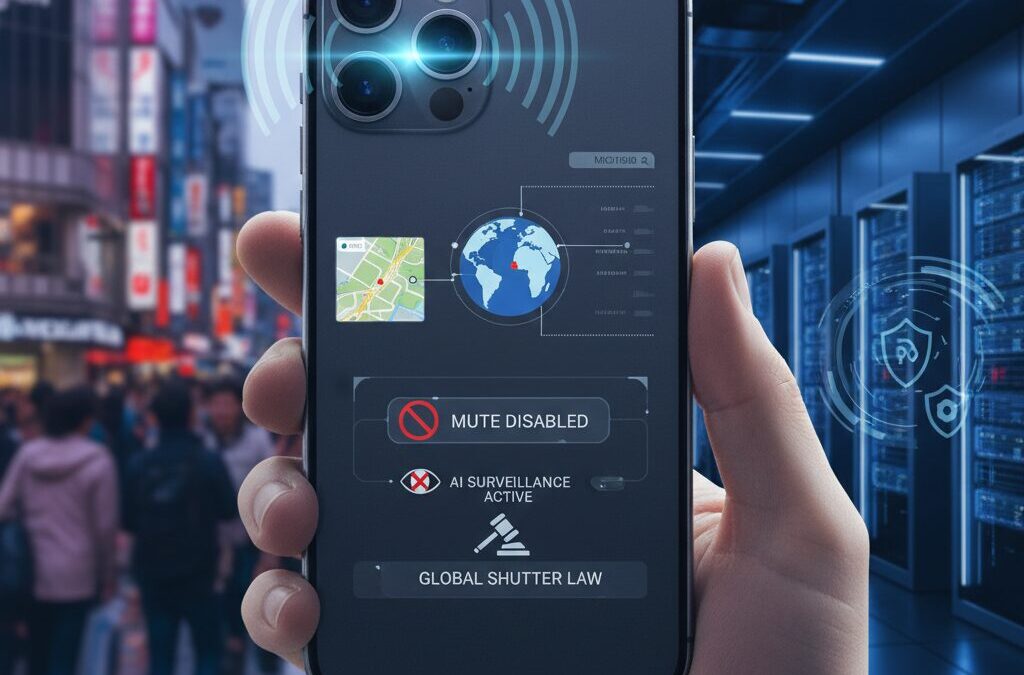
Have you ever wondered why some smartphones still make a loud camera shutter sound—even in silent mode—while others let you shoot discreetly? In 2026, this is no longer a simple design choice but the result of complex interactions between privacy laws, industry standards, AI technology, and cultural expectations.
In countries like Japan and South Korea, mandatory shutter sounds remain a de facto standard, originally introduced to deter voyeurism and upskirting. Yet today’s iPhone 17 running iOS 19 and Android 16 flagships rely on GPS data, SIM country codes, and advanced audio policies to dynamically decide whether your camera must make noise.
At the same time, lawmakers in the United States are advancing bills such as the Stop VOYEURS Act, while AI-powered on-device detection and smart surveillance systems are redefining how privacy is protected. In this article, you will discover how technology, regulation, and market demand are reshaping the future of smartphone photography—and what it means for global gadget enthusiasts like you.
- The Origins of Mandatory Camera Shutter Sounds in Japan and South Korea
- Industry Self-Regulation vs. National Standards: How the Rules Actually Work
- iPhone 17 and iOS 19: GPS, SIM Detection, and Dynamic Audio Control
- Android 16 and Configurable Audio Policy: System-Level Enforcement Explained
- Consumer Backlash and Market Data: 75% Want the Sound Off
- Parallel Imports, Hong Kong Variants, and the Legal Trade-Offs
- The Stop VOYEURS Act and the Expanding Legal Landscape in the United States
- AI-Powered Privacy Protection: From Theft Detection Lock to Knox Matrix
- Smart Surveillance and AI Agents in Public Spaces
- Does the Shutter Sound Actually Prevent Crime? Statistics and Academic Evidence
- Deepfakes, Digital Voyeurism, and the Shift Beyond Physical Cameras
- The Future of Context-Aware Audio, Digital Watermarking, and Smart Privacy Zones
- 参考文献
The Origins of Mandatory Camera Shutter Sounds in Japan and South Korea
In Japan and South Korea, the mandatory camera shutter sound did not emerge as a quirky design choice but as a direct response to real social crises in the early 2000s.
As camera-equipped feature phones rapidly spread, incidents of surreptitious photography—particularly upskirting in trains and stations—became a visible public concern.
The shutter sound was introduced as a social signal, designed to make invisible acts audible.
In Japan, the turning point is widely traced to a high-profile voyeurism case in 2000 involving a celebrity at a railway station.
According to reporting by Tokyo Weekender and ITmedia Mobile, mobile carriers such as NTT DoCoMo and J-PHONE, together with handset makers, agreed to implement a shutter sound that could not be muted—even in silent mode.
Importantly, this was not mandated by a specific statute but functioned as an industry-wide self-regulation aligned with local youth protection ordinances.
South Korea followed a more formal path.
In November 2003, the Ministry of Information and Communication and the Telecommunications Technology Association (TTA) coordinated with manufacturers to standardize audible shutter sounds on camera phones.
By 2004, a TTA recommendation specified an output level between 60 and 68 decibels for still and video capture, effectively creating a national technical norm.
| Country | Regulatory Basis | Sound Standard | Initial Trigger |
|---|---|---|---|
| Japan | Industry self-regulation by carriers and OEMs | No fixed dB, but clearly audible | Early 2000s voyeurism scandals |
| South Korea | TTA recommendation (government-backed) | 60–68 dB guideline | 2003 privacy protection agreement |
This difference in governance structure shaped how the rule evolved.
In Japan, the norm has persisted as a de facto requirement tied to domestic market expectations rather than explicit legislation.
In South Korea, the presence of a technical standard gave manufacturers clearer compliance benchmarks from the outset.
Academic analysis such as the study “Upskirting: A Statutory Analysis” (2017) suggests that audible alerts can increase the likelihood that victims detect illicit photography.
However, such measures primarily affect discoverability rather than underlying criminal intent.
Even so, at the time of introduction, policymakers and industry leaders viewed the shutter sound as a pragmatic, immediately deployable safeguard in an era before AI-based detection existed.
In both countries, the mandatory sound became embedded not only in firmware but in social expectations.
Consumers grew accustomed to equating the shutter click with accountability, and manufacturers optimized devices accordingly.
The origins of this feature therefore reflect a uniquely East Asian intersection of rapid mobile innovation, public transit density, and proactive privacy norms at the dawn of the camera phone age.
Industry Self-Regulation vs. National Standards: How the Rules Actually Work
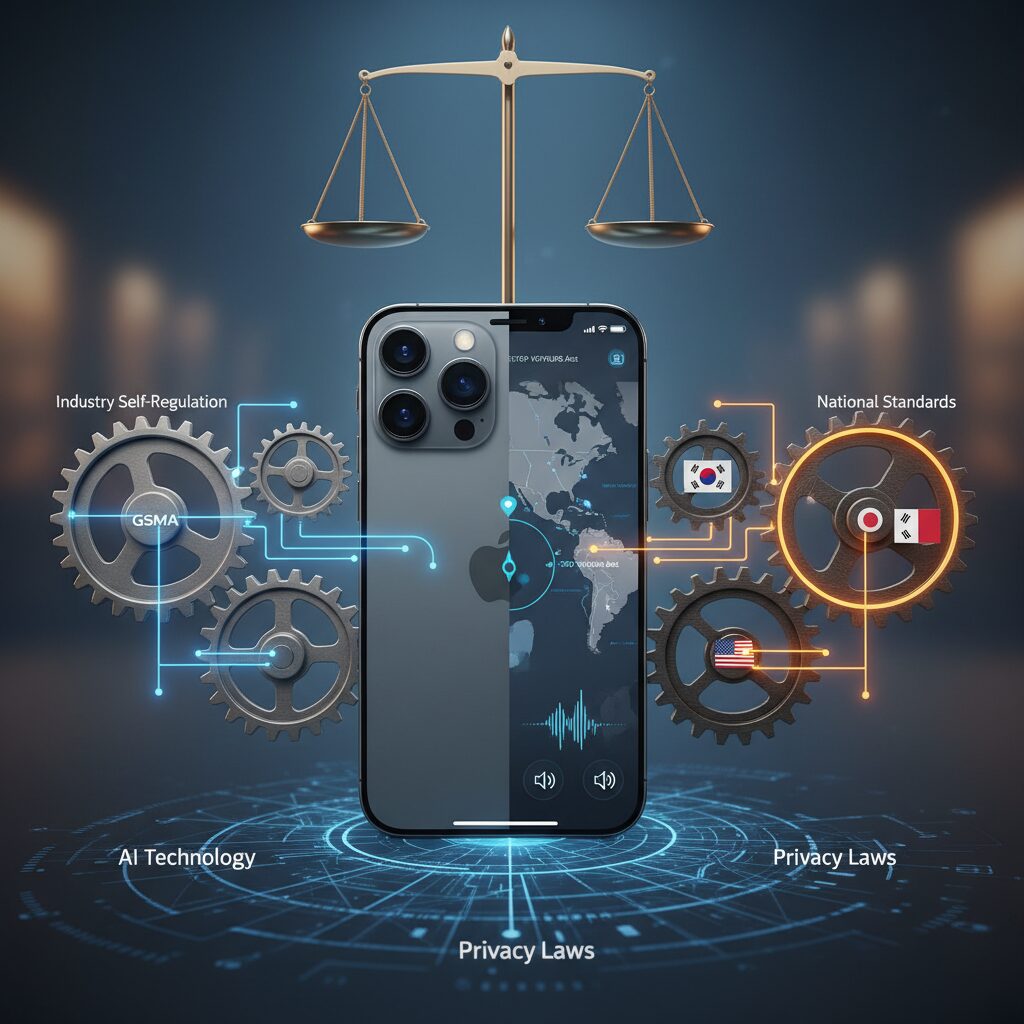
In 2026, the rules governing smartphone camera shutter sounds are shaped less by black‑letter law and more by a layered mix of industry agreements and national standards. For gadget enthusiasts, understanding this distinction is essential because it directly affects how devices behave across borders.
Japan represents a classic case of industry self-regulation. There is no explicit statute mandating a shutter sound. Instead, as reported by ITmedia Mobile and other domestic outlets, major carriers and manufacturers reached a consensus in the early 2000s to make the sound non‑disableable, particularly in response to rising concerns over upskirting incidents.
This agreement functions as a de facto rule. Devices sold through official Japanese channels are expected to comply, and manufacturers design firmware and OS configurations accordingly. The enforcement mechanism is commercial rather than criminal: non‑compliant devices simply do not enter mainstream carrier distribution.
| Country | Regulatory Basis | Enforcement Style |
|---|---|---|
| Japan | Industry self-regulation | Carrier and manufacturer compliance |
| South Korea | TTA national recommendation | Standardized technical guideline |
South Korea, by contrast, operates under a more formalized framework. In 2004, the Korea Information and Communication Technology Association established a recommendation requiring camera phones to emit a shutter sound between 60 and 68 decibels. While technically framed as a recommendation, in practice it functions as a national standard.
The practical difference lies in traceability and specification. Korea defines measurable acoustic thresholds, whereas Japan emphasizes audible presence without codified decibel values. This means Korean manufacturers must engineer devices to meet a quantifiable output range, while Japanese compliance centers on functional audibility.
From a systems perspective, both approaches now rely heavily on software-level enforcement. With iOS 19 and Android 16, region detection using SIM country codes and GPS data determines whether the shutter sound is locked. The rule is no longer burned permanently into hardware; it is conditionally activated.
This evolution reveals how self-regulation and national standards converge at the OS layer. Apple and Google implement geo-aware logic that satisfies Japan’s carrier expectations and Korea’s standardized requirements without fragmenting their global hardware lines.
According to release documentation from the Android Open Source Project, configurable audio policy frameworks allow system-level control over app audio routing. This makes bypassing regional shutter rules significantly harder without root access, reinforcing both industry and national compliance models.
Ultimately, the “rules” work through market access, certification pathways, and software gating rather than direct police enforcement. It is a compliance ecosystem, not a single law, that keeps the shutter sound active. For globally mobile users, this explains why the same device may behave differently depending on where it is physically used and which SIM it recognizes.
Understanding this regulatory architecture helps you see beyond the simple question of whether the sound can be turned off. It clarifies who actually sets the rules, how they are enforced, and why software has become the central battlefield where industry norms and national standards intersect.
iPhone 17 and iOS 19: GPS, SIM Detection, and Dynamic Audio Control
On iPhone 17 running iOS 19, camera shutter sound control is no longer a fixed hardware rule but a context-aware software decision. Instead of relying solely on the device’s regional model code, Apple now combines GPS location data and SIM information to determine whether the shutter sound must be enforced.
This shift from static ROM restrictions to dynamic environmental detection represents a fundamental architectural change. The system evaluates where the device is physically located and which mobile network it is connected to before deciding how audio policies are applied.
How iOS 19 Determines Shutter Sound Behavior
| Signal | What It Checks | Impact on Shutter Sound |
|---|---|---|
| Model Code | Region variant (e.g., Japan/Korea) | Initial compliance baseline |
| SIM (MCC/MNC) | Mobile Country Code & carrier | Confirms regulatory environment |
| GPS | Real-time geographic location | Enables or relaxes sound enforcement |
User reports in 2026 indicate that a Japanese-model iPhone 17 used abroad, with a local SIM inserted and GPS confirming it is outside Japan, may automatically allow shutter muting in silent mode. However, if the device is placed in Airplane Mode, iOS 19 maintains the last verified compliance state, meaning the shutter sound may continue to play.
This layered logic prevents simple bypass attempts while still adapting to global travel patterns. According to discussions cited by users in Korea and Japan, the system behavior clearly changes depending on both SIM authentication and geolocation status.
Dynamic Audio Control at the OS Level
Beyond shutter enforcement, iOS 19 refines dynamic audio routing. The camera app interacts with system-level audio policy that can override mute switches under specific regional conditions. Unlike earlier generations where firmware dictated behavior, the new model operates as a conditional software rule set.
The result is a compliance-aware audio framework rather than a hard-coded limitation. This design reduces the need for region-specific hardware builds while maintaining regulatory alignment.
In practical use, this means travelers, dual-SIM users, and eSIM adopters experience behavior that reflects their real-world environment rather than just their device’s origin. For gadget enthusiasts, this marks a significant evolution: GPS, SIM detection, and OS-level audio governance now work together as an intelligent control stack rather than isolated mechanisms.
Android 16 and Configurable Audio Policy: System-Level Enforcement Explained

Android 16 introduces a decisive shift in how camera shutter sound policies are enforced, moving from app-level settings to system-level audio governance. At the center of this transformation is Configurable Audio Policy (CAP), implemented through the AIDL-based Audio HAL, as documented in the Android Open Source Project release notes for Android 16.
Rather than relying on individual camera apps to respect regional requirements, Android 16 allows the operating system itself to determine how and when audio streams are routed, mixed, or locked. This architectural change is particularly relevant in markets such as Japan and South Korea, where shutter sounds are effectively mandatory under industry or national standards.
Under CAP, audio behavior can be dynamically configured based on contextual signals such as SIM country codes (MCC/MNC), device region, and verified system properties. When a camera app triggers a capture event, the request to play a shutter sound is processed through the system audio policy engine, which determines whether the sound must be forced, rerouted to a specific output, or prevented from being muted.
This design closes a loophole that existed in earlier Android versions. Previously, some users modified system database values such as csc_pref_camera_forced_shuttersound_key using third-party tools. As community discussions have noted, these workarounds have become largely ineffective in Android 16 due to strengthened integrity checks and tighter control over privileged system properties.
| Layer | Before Android 16 | Android 16 with CAP |
|---|---|---|
| Control Point | App or editable system flag | Framework-level audio policy |
| Bypass Difficulty | Moderate (no root in some cases) | High (root typically required) |
| Context Awareness | Static region config | Dynamic SIM and region evaluation |
From a technical perspective, CAP enables device manufacturers to define region-specific routing rules. For example, in a jurisdiction requiring audible confirmation, the shutter sound stream can be mapped to a non-mutable audio usage category and forced through the primary speaker path, regardless of silent mode. This enforcement occurs below the application layer, making it resilient against ordinary user-level modifications.
Google’s broader security direction, including AI-driven on-device protections reported by outlets such as Popular Science and AARP, complements this model. While those initiatives focus on fraud and theft detection, the underlying philosophy is similar: sensitive behaviors are monitored and constrained at the OS level rather than delegated to user discretion.
For power users and OEM developers, this means audio policy XML configurations and vendor overlays now carry significant regulatory weight. A device sold in one country can behave differently in another, not because the camera app changes, but because the audio policy engine reevaluates enforcement rules in real time.
In practical terms, Android 16 transforms shutter sound control from a configurable feature into a compliance mechanism. The shift reflects a maturation of Android’s audio stack, aligning technical enforcement with regional privacy expectations while reducing the surface area for circumvention.
Consumer Backlash and Market Data: 75% Want the Sound Off
In 2025, a survey conducted by ITmedia Mobile revealed a striking reality: approximately 75% of respondents said smartphone camera shutter sounds are unnecessary or should be optional. Even more notably, around 90% supported having the ability to turn the sound off depending on the situation. For a feature originally introduced as a social safeguard, this level of dissatisfaction signals a clear consumer backlash.
The frustration is not abstract. Respondents pointed to everyday scenarios where the forced shutter sound creates social friction rather than safety. Quiet museums that allow photography, libraries where documents are being scanned for study, cafés during remote work sessions, or moments capturing sleeping pets and infants were repeatedly cited as problem situations. In these environments, the sharp “click” is perceived less as a protective signal and more as a disruption.
What makes this backlash particularly interesting is that it comes from users who are highly engaged with technology. Gadget enthusiasts and power users are not arguing against privacy protection itself. Instead, they question whether a uniform acoustic alert is the most effective mechanism in 2026, especially when OS-level AI and contextual controls have evolved dramatically.
| Survey Indicator | Result |
|---|---|
| Shutter sound unnecessary or should be optional | Approx. 75% |
| Support situational on/off control | Approx. 90% |
The market implications are tangible. According to reporting by Counterpoint Research on Japan’s smartphone market, replacement demand is strengthening in 2026, meaning consumers are actively choosing new devices rather than passively upgrading. In such an environment, seemingly small UX constraints can influence purchasing decisions, especially among premium buyers who value control and customization.
Retailers and online communities reflect this sentiment. Threads discussing Japanese and Korean variants of flagship smartphones frequently revolve around shutter sound behavior, SIM-based unlocking abroad, and firmware differences. The tone is rarely about bypassing the law; rather, it centers on usability, global travel, and professional photography needs.
The data suggests a widening gap between regulatory intent and user expectation. While the original purpose of mandatory shutter sounds was deterrence, many users now experience it as an inflexible relic in a context where software can already detect region, environment, and user identity in real time.
This 75% figure is more than a complaint statistic. It represents a shift in consumer psychology: users increasingly expect adaptive technology that responds to context, not blanket restrictions. In a mature smartphone market, that expectation can translate directly into brand perception, cross-border purchasing behavior, and long-term ecosystem loyalty.
Parallel Imports, Hong Kong Variants, and the Legal Trade-Offs
Parallel imports and so-called Hong Kong variants have become a strategic workaround for users who want greater control over camera shutter sound behavior. In 2026, this is no longer just a niche topic among enthusiasts. It sits at the intersection of software-based geo-control, national technical certification rules, and evolving privacy norms.
At the core of the issue is a trade-off: acoustic freedom versus regulatory certainty. Devices sold officially in Japan are aligned with carrier expectations and domestic compliance frameworks. By contrast, Hong Kong or U.S. variants are designed for markets where mandatory shutter sound is not structurally embedded in distribution agreements.
| Variant | Shutter Sound in Japan | Compliance & Support |
|---|---|---|
| Japan Official Model | Forced in silent mode | Full technical certification, FeliCa, domestic warranty |
| Hong Kong Variant | Conditionally suppressible | Possible lack of technical certification, limited repair access |
| U.S. Variant | Suppressible | No FeliCa, no domestic warranty |
According to Counterpoint Research, Japan’s replacement-driven smartphone market in 2026 is highly structured around carrier programs and return cycles. This ecosystem reinforces demand for officially supported models. Choosing a parallel import therefore means stepping outside that tightly integrated system.
Hong Kong models are particularly attractive because they often retain physical dual SIM slots while allowing shutter sound suppression under certain conditions. However, users must consider Japan’s technical conformity certification requirements. Operating a device without appropriate certification may expose users to legal and regulatory uncertainty, even if enforcement varies in practice.
Warranty limitations are another decisive factor. Manufacturers may refuse domestic repair for overseas variants, and parts logistics can be complex. In high-end devices such as the iPhone 17 Pro class, out-of-warranty repairs can be costly, which shifts the economic equation significantly.
There is also a compliance optics dimension. As debates intensify in the United States around legislation like the Stop VOYEURS Act of 2025, and as AI-based detection mechanisms expand globally, manufacturers are increasingly sensitive to reputational risk. Devices that appear to bypass local deterrence norms may attract scrutiny in certain contexts.
From a risk management perspective, the decision can be framed as follows: acoustic discretion and hardware flexibility on one side; legal clarity, seamless ecosystem integration, and full-feature domestic services on the other. For gadget-focused users, the appeal of configurability is understandable. Yet in 2026’s software-defined regulatory environment, the implications extend beyond a simple sound setting.
Parallel import is not merely a hardware choice. It is a jurisdictional choice embedded in firmware logic, certification regimes, and evolving privacy governance.
The Stop VOYEURS Act and the Expanding Legal Landscape in the United States
In February 2025, the U.S. House of Representatives introduced H.R.1203, known as the Stop VOYEURS Act of 2025. The bill’s full title—Stop Victimizers and Offenders from Yielding Explicit Unconsented Recordings Surreptitiously Act—makes its intent unmistakable. It focuses on strengthening federal prohibitions against video voyeurism and the non‑consensual creation or distribution of explicit recordings.
Importantly, the Act does not mandate a universal camera shutter sound requirement for smartphones. Instead, it expands the legal scope of liability for surreptitious recording conducted through digital devices. According to the official congressional summary, the bill clarifies and reinforces penalties tied to privacy violations carried out with modern imaging technologies.
This distinction is critical for gadget enthusiasts. In Japan and South Korea, shutter sound enforcement evolved through industry standards and technical controls. In the United States, however, the regulatory momentum is shifting toward criminal accountability rather than device-level acoustic mandates.
| Aspect | Stop VOYEURS Act (U.S.) | Device-Level Sound Mandates |
|---|---|---|
| Regulatory Focus | Expansion of voyeurism prohibitions | Mandatory audible shutter alerts |
| Technical Requirement | No explicit hardware rule | Sound output enforced by OS/firmware |
| Compliance Pressure | Legal liability for offenders | Design constraints on manufacturers |
For Apple and Google, both U.S.-based companies, this legal trajectory creates a different type of compliance environment. Rather than engineering fixed acoustic signals, firms face pressure to demonstrate that their platforms do not facilitate unlawful recording. As legislative tracking on Congress.gov shows, the conversation centers on deterrence and prosecution, not sound decibels.
This shift matters because legal risk increasingly targets misuse, not mere capability. A smartphone camera is a neutral tool; liability arises when it is used to invade privacy. That framing contrasts with regions where preventive sound design is embedded into product specifications from the outset.
The broader U.S. legal landscape also includes state-level video voyeurism statutes, many of which already criminalize recording individuals in situations where they have a reasonable expectation of privacy. The Stop VOYEURS Act can be understood as an effort to modernize and harmonize federal enforcement in light of high-resolution cameras, discreet form factors, and frictionless digital sharing.
For the global device ecosystem, this creates a layered compliance model. A single iPhone or Android handset may operate under dynamic regional software controls abroad, while in the U.S. its primary regulatory exposure lies in how recorded content is handled and distributed. The absence of a nationwide shutter mandate does not imply regulatory leniency; it signals a preference for prosecuting harm over prescribing hardware behavior.
Another subtle but significant implication involves AI. As policymakers emphasize protection against surreptitious and explicit recordings, platform providers may proactively deploy on-device detection, metadata tracing, or abuse-reporting pipelines to demonstrate responsible governance. Legal expansion often accelerates technical safeguards, even when the law does not dictate specific engineering solutions.
For readers deeply invested in mobile technology, the takeaway is nuanced. The United States is not converging toward Japan-style forced shutter acoustics. Instead, it is expanding the accountability net around digital voyeurism itself. That distinction shapes product design decisions, risk management strategies, and ultimately the global debate over how best to balance privacy protection with technological freedom.
AI-Powered Privacy Protection: From Theft Detection Lock to Knox Matrix
In 2026, privacy protection is rapidly shifting from audible deterrence to AI-powered, context-aware defense systems. Instead of relying solely on a shutter sound to signal intent, modern smartphones analyze behavior, environment, and device integrity in real time.
Google’s enhanced Theft Detection Lock on Android 16 exemplifies this transition. According to reporting by Popular Science and AARP, the system leverages on-device AI to interpret motion patterns from accelerometers and gyroscopes, identifying suspicious grab-and-run behavior and instantly locking the screen. This same behavioral modeling framework can be extended to detect abnormal camera usage angles or sudden concealment movements, enabling proactive intervention before harm occurs.
| Technology | Core Mechanism | Privacy Impact |
|---|---|---|
| Theft Detection Lock | AI motion analysis | Automatic device lock on suspicious activity |
| Configurable Audio Policy | OS-level audio routing control | Prevents unauthorized shutter bypass |
| Knox Matrix | Cross-device trust verification | Networked integrity monitoring |
Samsung’s Knox Matrix, introduced as part of its 2026 security vision, expands protection beyond a single handset. As Samsung Electronics explains, the platform establishes a mutual trust chain between connected Galaxy devices, continuously verifying integrity. If one device is compromised, others can respond by isolating it, reducing systemic vulnerability.
This evolution reflects a broader industry pivot toward invisible intelligence. Rather than alerting bystanders with sound, AI systems now analyze patterns, authenticate environments, and enforce restrictions dynamically. The result is a layered privacy architecture that operates quietly but decisively—minimizing social friction while strengthening real-world protection.
Smart Surveillance and AI Agents in Public Spaces
In 2026, smart surveillance is no longer limited to passive recording devices. Cameras deployed in stations, malls, and public transportation hubs increasingly function as AI-driven agents that interpret behavior in real time.
According to Hanwha Vision’s 2026 surveillance trends report, second-generation AI cameras in the P series are designed not only to detect motion but to analyze intent-related patterns. This shift transforms cameras from simple sensors into decision-support systems for human operators.
The core transition is from “record and review” to “detect and respond instantly.”
These AI agents continuously process posture, movement trajectory, and contextual cues. For example, in escalator zones—historically associated with covert photography cases in Japan—AI models can flag unusual device angles or prolonged low-position hand movements and alert security staff before an incident escalates.
Unlike traditional CCTV systems that rely on human monitoring, AI-enabled platforms operate at scale. As industry analysis from Asmag highlights, AI innovation is one of the primary drivers of security market growth in 2026, largely because automation reduces response time and operator fatigue.
| Feature | Traditional CCTV | AI Agent Surveillance (2026) |
|---|---|---|
| Detection Method | Human visual monitoring | Real-time behavioral AI analysis |
| Response Speed | Post-incident review | Instant alerts to operators |
| Scalability | Limited by staff | Cloud/edge-based expansion |
Samsung’s discussion at CES 2026 around “Invisible Intelligence” extends this idea further. The concept envisions distributed trust frameworks where devices authenticate and evaluate contextual risk signals collaboratively, without exposing personal identity data.
This introduces a new paradigm: surveillance systems acting as semi-autonomous AI agents rather than static infrastructure. These agents do not merely observe; they classify behaviors, prioritize alerts, and integrate with digital signage or access control systems to issue warnings.
However, this evolution raises important privacy questions. The European approach under GDPR emphasizes data minimization and proportionality, meaning that AI systems must justify behavioral analysis within strict legal boundaries. The more intelligent surveillance becomes, the more transparency and auditability become critical.
Another emerging trend is edge AI processing. Instead of transmitting raw video to centralized servers, many 2026 systems analyze footage locally on-device. This reduces latency and mitigates large-scale data leakage risks while still enabling pattern recognition.
For tech enthusiasts, the key takeaway is that public-space cameras are increasingly part of a broader AI ecosystem. They interact with mobile devices, digital infrastructure, and cloud analytics platforms, forming what can be described as a distributed cognitive layer over urban environments.
Smart surveillance in 2026 therefore represents a structural shift in how societies manage safety. It is not simply about louder deterrents or more cameras, but about embedding algorithmic judgment into the fabric of public space—reshaping both security operations and the boundaries of personal privacy.
Does the Shutter Sound Actually Prevent Crime? Statistics and Academic Evidence
The core question is simple: does a mandatory shutter sound actually reduce crime? The available statistics and academic research suggest a nuanced answer rather than a clear yes or no.
According to Japan’s 2025 White Paper on Crime, arrests for illicit photography in 2024 remained high, with 1,321 cases reported in stations and trains and 1,000 cases on escalators. These figures indicate that even in an environment where shutter sounds are widely enforced, smartphone-based voyeurism has not disappeared.
This does not automatically mean the sound is ineffective. It suggests that audible notification alone is insufficient as a standalone deterrent, especially when offenders adapt technologically.
| Indicator | Observed Trend (2024–2025) | Implication |
|---|---|---|
| Arrests for illicit photography | Over 2,000 combined cases in transport settings | Problem persists despite sound mandate |
| Deepfake-related arrests | Increase in AI-generated sexual image cases | Shift from physical to digital abuse |
Academic research reinforces this mixed picture. The 2017 study “Upskirting: A Statutory Analysis” argues that shutter sound requirements may increase the likelihood that a victim notices the act, thereby improving detection. However, the study also notes that such measures do little to suppress underlying motivation, particularly when offenders can use silent third-party apps or modified devices.
In other words, the shutter sound functions more as a detection aid than a true preventive barrier. It raises the probability of exposure, which may deter opportunistic offenders, but it does not eliminate intent-driven behavior.
Another important data point is technological circumvention. As widely documented in consumer reporting and app marketplaces, silent camera applications have historically remained accessible, weakening the structural integrity of sound-based regulation. Even with tighter OS controls in 2026, complete technical enforcement has proven difficult.
Meanwhile, law enforcement trends show a parallel shift. Tokyo Metropolitan Police’s 2025 arrest related to mass-produced deepfake images demonstrates that sexual exploitation increasingly occurs without any physical shutter being pressed. In such cases, shutter sound policy becomes irrelevant.
This broader evolution suggests that crime displacement is occurring. As physical voyeurism faces stronger scrutiny and legal codification, some offenders migrate toward AI-assisted or digitally manipulated content. The deterrent value of acoustic alerts cannot address these new vectors.
From a criminological standpoint, deterrence theory emphasizes certainty of detection over severity of punishment. If shutter sounds meaningfully increase the perceived likelihood of being caught in crowded environments like trains or escalators, they may retain limited situational value. However, empirical arrest data does not show a clear downward trend attributable solely to the sound mandate.
Therefore, the statistical and academic evidence points to a restrained conclusion: mandatory shutter sounds may contribute to situational awareness and marginal deterrence, but they are neither comprehensive nor future-proof crime prevention tools. In a landscape increasingly shaped by AI and digital manipulation, their preventive capacity appears structurally constrained.
Deepfakes, Digital Voyeurism, and the Shift Beyond Physical Cameras
In 2026, the center of gravity in privacy violations is clearly shifting from physical cameras to algorithmic fabrication. While shutter sounds were originally designed to deter covert photography, deepfakes and AI-generated intimate imagery now bypass the need for any camera at all. The debate is no longer only about whether a device makes a sound, but whether an image was ever captured in the first place.
According to Sensity AI, Japanese law enforcement has increased arrests related to so-called “deepnude” and synthetic explicit content in 2025, signaling a structural pivot in criminal behavior. In one widely reported case, a 31-year-old suspect was arrested for generating and selling large volumes of AI-fabricated explicit images of celebrities. No shutter sound could have prevented that crime, because no physical act of photography occurred.
This evolution reframes digital voyeurism as a software-driven phenomenon rather than a hardware-triggered one. The traditional logic behind mandatory shutter sounds assumed three elements: a device, a victim in proximity, and an audible cue. Generative AI collapses that triangle into pure data manipulation.
| Aspect | Physical Voyeurism | AI-Driven Deepfake Abuse |
|---|---|---|
| Primary Tool | Smartphone camera | Generative AI models |
| Deterrence Method | Audible shutter sound | Platform moderation, watermarking |
| Victim Awareness | Possible via sound cue | Often unaware until distribution |
| Evidence Trail | Device logs, metadata | Cloud traces, model outputs |
Academic research such as “Upskirting: A Statutory Analysis” has long argued that shutter sound mandates may increase the chance of detection but have limited impact on underlying motivation. That limitation becomes more pronounced in the deepfake era. If intent can be executed entirely in silico, acoustic deterrence becomes structurally irrelevant.
Meanwhile, legislative efforts like the U.S. Stop VOYEURS Act of 2025 broaden the scope of prohibited conduct to include digital and surreptitious recording practices. Although the bill does not impose hardware requirements such as mandatory shutter sounds, it reflects a recognition that voyeurism has migrated into digital distribution and synthetic content creation.
From a technological standpoint, the response is also moving beyond audio signals. Major platforms are experimenting with provenance frameworks, cryptographic watermarking, and on-device AI analysis to flag manipulated media. Security industry reports in 2026 emphasize “trustworthy AI” as a design principle, focusing on traceability rather than noise-based alerts.
For gadget enthusiasts, this represents a profound paradigm shift. The question is no longer “Can I mute the shutter?” but rather “Can this image be authenticated?” and “Can misuse be traced?” The battlefield has expanded from the pocket to the cloud, where silent code can inflict reputational and psychological harm at scale.
Digital voyeurism in 2026 is therefore less about covert lenses and more about covert computation. As AI lowers the barrier to realistic image synthesis, privacy protection must evolve from audible warnings to verifiable integrity systems. In that landscape, the shutter sound feels like an artifact of an earlier era—symbolically important, but technologically outpaced by the rise of generative manipulation.
The Future of Context-Aware Audio, Digital Watermarking, and Smart Privacy Zones
As smartphones evolve beyond simple rule-based shutter control, the next frontier is context-aware audio, digital watermarking, and smart privacy zones. Instead of treating every environment the same, operating systems are beginning to interpret space, behavior, and risk in real time.
The future is not about louder sounds, but smarter signals. Advances in on-device AI and environmental sensing are redefining how devices balance transparency and discretion.
Context-Aware Audio
With iOS 19 and Android 16 already leveraging GPS and SIM-based regional logic, the logical next step is dynamic acoustic adaptation. Devices can measure ambient decibel levels and adjust shutter feedback accordingly, ensuring audibility without unnecessary disturbance.
Research cited in statutory analyses of voyeurism laws suggests that awareness—not volume alone—is what improves detection probability. A context-aware system could therefore emit a frequency optimized for human perception in quiet indoor spaces while blending naturally in louder public settings.
| Environment | Ambient Noise | Adaptive Response |
|---|---|---|
| Library or Museum | Low | Minimal but perceptible tone |
| Train Station | Medium | Standard audible confirmation |
| Outdoor Festival | High | Amplified compliance signal |
This approach reduces what Japanese users have described in ITmedia surveys as “noise nuisance,” while maintaining deterrence where it matters.
Digital Watermarking and Traceability
Another trajectory replaces acoustic signaling with cryptographic accountability. Instead of relying solely on sound, every captured image could embed tamper-resistant metadata: device identifier, timestamp, and coarse location hash.
As discussions around the U.S. Stop VOYEURS Act highlight, legal systems increasingly focus on traceability and enforcement rather than symbolic warnings. Embedding verifiable provenance directly into image files would shift deterrence from immediate exposure to long-term accountability.
Digital watermarking reframes privacy protection from prevention to evidence. If illicit distribution occurs, forensic validation becomes faster and more reliable, particularly as deepfake-related prosecutions rise, as reported by AI monitoring firms tracking synthetic abuse cases.
Smart Privacy Zones
Security industry forecasts for 2026, including analyses from Pelco and Hanwha Vision, point toward geofenced policy enforcement. In this model, physical spaces broadcast machine-readable privacy rules that smartphones interpret automatically.
In designated “privacy-sensitive zones” such as public transport hubs or escalators—areas identified in Japanese crime statistics as recurring locations for illicit filming—devices could automatically enforce shutter sound activation or temporarily restrict camera functions.
Conversely, certified studios, homes, or authorized media events could transmit clearance tokens, relaxing restrictions without manual intervention. The policy layer moves from static national regulation to dynamic spatial governance.
Together, these technologies represent a shift from uniform device-based rules to distributed, AI-mediated ecosystems. For gadget enthusiasts, this signals a future where compliance is not merely coded into hardware, but negotiated continuously between device, user, and space.
参考文献
- Tokyo Weekender:Why You Can’t Disable the Shutter Sound on Japanese Phones
- ITmedia Mobile:「スマホカメラのシャッター音」は75%が不要、90%が「オフの…
- Library of Congress:Shutter Sound of Cell Phone Cameras
- Android Open Source Project:Android 16 Release Notes
- Congress.gov:H.R.1203 – Stop VOYEURS Act of 2025
- Samsung Newsroom:Samsung Explores How Trust, Security and Privacy Shape the Future of AI at CES 2026
- Sensity AI:Japan Deepnude Arrests Signal Gen-AI Deepfake Focus for Law Enforcement