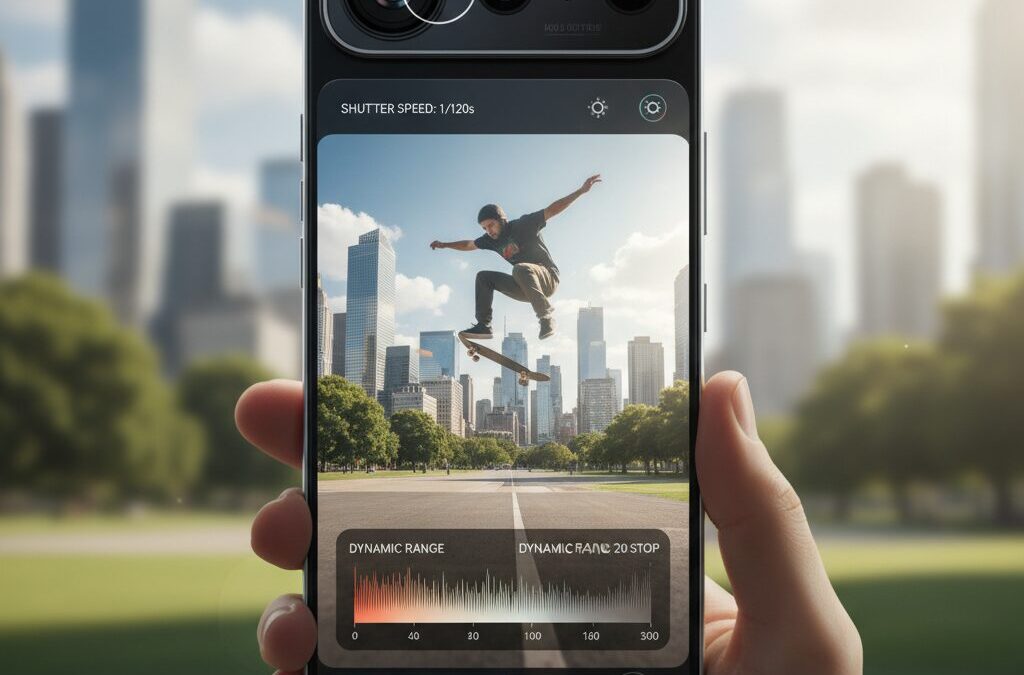
Smartphone videography in 2026 is no longer about simply increasing megapixels. It is about mastering shutter speed, dynamic range, and real-time AI reconstruction to create footage that rivals professional cinema cameras.
If you have ever wondered why some smartphone videos look cinematic while others feel unnaturally sharp or flickery, the answer often lies in shutter speed control, sensor architecture, and computational video processing. Understanding these elements allows you to move from casual shooting to intentional visual storytelling.
In this article, you will discover how the 180-degree shutter rule shapes motion, why 20-stop dynamic range sensors matter, how magnetic variable apertures reduce reliance on ND filters, and how real-time AI deblurring can simulate ultra-fast capture. By the end, you will clearly understand how 2026 flagship smartphones integrate physics and artificial intelligence to redefine what is possible in mobile filmmaking.
- Why 2026 Marks a Turning Point for Smartphone Videography
- The Physics of Shutter Speed and the 180-Degree Rule Explained
- Exposure Control in Bright Conditions: ND Filters, ISO Discipline, and Log Recording
- Flicker, Power Frequency, and Anti-Flicker Algorithms in Real-World Shooting
- Apple’s 20-Stop Dynamic Range Sensor and LOFIC Technology
- Samsung’s Magnetic Variable Aperture and True Optical Depth Control
- Autofocus Innovation: Split-Pixel Design and Resolution Preservation
- Computational Video and AI Segmentation: Scene-Aware Optimization in Real Time
- Real-Time AI Deblurring, DynaFlowNet, and On-Device Editing Breakthroughs
- Flagship Showdown: iPhone 17 Pro Max, Xperia 1 VII, Galaxy S26 Ultra, and AQUOS R Series
- What Research Says: Shutter Speed, MTF50, and Measurable Image Sharpness
- Future Workflows: NeRF, 3D Gaussian Splatting, and Post-Capture Freedom
- 参考文献
Why 2026 Marks a Turning Point for Smartphone Videography
In 2026, smartphone videography reaches a decisive inflection point. What was once driven by megapixel competition is now defined by precise shutter speed control, next-generation sensors, and real-time AI reconstruction working together. As research published by MDPI demonstrates, shortening shutter speed dramatically improves measurable sharpness such as MTF50, proving that motion rendering is grounded in physics, not marketing.
This year marks the shift from “capturing light” to “engineering time.” Devices now synchronize frame rate and shutter angle automatically based on the 180-degree principle, while advanced ISPs mitigate flicker caused by regional power frequencies. At the same time, computational photography—forecast by Coherent Market Insights to grow rapidly through 2032—has evolved into computational video that enhances motion, texture, and dynamic range in real time.
| Before 2026 | In 2026 |
|---|---|
| Megapixel-driven upgrades | Dynamic range & AI-driven motion control |
| Software-only blur fixes | Physics + real-time AI deblur integration |
With emerging sensor designs targeting up to 20 stops of dynamic range and magnetic variable apertures enabling optical exposure control, smartphones no longer imitate cinema tools—they begin to redefine them.
The Physics of Shutter Speed and the 180-Degree Rule Explained

Shutter speed in video is not merely an exposure parameter. It defines how each frame samples time, shaping the continuity our eyes perceive between frames. Because human vision naturally integrates motion with a certain amount of blur, the quantity of motion blur embedded in each frame directly affects whether footage feels cinematic or unnaturally sharp.
The so-called 180-degree rule originates from mechanical film cameras that used a rotating shutter with a 180° opening. With a half-circle exposure per frame, the effective shutter speed became approximately double the frame interval. At 24fps, this results in 1/48 second, commonly approximated as 1/50 second in digital systems.
The 180-degree rule synchronizes motion blur with frame rate, preserving temporal realism rather than maximizing sharpness.
In practical terms, the relationship can be expressed as follows.
| Frame Rate | Frame Interval | 180° Shutter Speed |
|---|---|---|
| 24 fps | 1/24 s | 1/48 s (≈1/50) |
| 30 fps | 1/30 s | 1/60 s |
| 60 fps | 1/60 s | 1/120 s |
When shutter speed becomes significantly faster than this ratio, motion blur decreases and moving subjects appear crisp but fragmented. Action scenes may look hyper-real or staccato. Conversely, when shutter speed is slower than the 180-degree equivalent, motion trails accumulate, producing smeared edges and reduced spatial clarity.
Empirical data supports how strongly shutter duration affects image integrity. A study published in Sensors (MDPI) examining high-speed motion capture in tunnel inspection demonstrated that shortening shutter speed from 500 microseconds to 50 microseconds increased MTF50 sharpness values from 0.0132 to 0.0981 at 70 km/h. The result illustrates that motion blur reduction dramatically improves measurable detail, even before computational enhancement.
However, maximum sharpness is not always perceptually optimal. Cinematic motion depends on controlled blur that bridges discrete frames into fluid movement. Research in computational imaging, including AIM 2025 challenge reports, indicates that while AI can reconstruct lost detail through real-time deblurring, the physical shutter decision still determines the integrity of the captured light data.
Modern smartphones increasingly automate this relationship. Some professional-oriented devices dynamically couple frame rate and shutter angle, preserving the 180-degree equivalent when fps changes. This approach reduces user error while maintaining motion consistency.
Ultimately, shutter speed governs how time itself is encoded into video. Frame rate defines how often we see; shutter speed defines how long we see within each frame. Understanding this physics allows creators to intentionally balance realism, sharpness, and cinematic motion rather than relying on defaults.
Exposure Control in Bright Conditions: ND Filters, ISO Discipline, and Log Recording
When you lock shutter speed to follow the 180-degree rule, bright daylight immediately becomes your biggest enemy. At 24fps, keeping shutter speed around 1/48–1/50 sec delivers natural motion blur, but under strong sun this often results in severe overexposure. Instead of breaking motion cadence by increasing shutter speed, professional workflows rely on controlling the light itself.
This is where ND filters, ISO discipline, and Log recording work as a unified exposure strategy. Each element plays a distinct role: ND reduces incoming light physically, ISO preserves sensor integrity, and Log protects highlight latitude for grading.
ND Filters: Preserving Motion While Taming Light
Neutral Density filters act like sunglasses for your lens. By reducing light without altering color, they allow you to maintain cinematic shutter speeds even in midday conditions. As widely recommended in professional iPhone Log shooting guides, outdoor 24p recording typically pairs 1/48–1/50 sec shutter with an ND filter rather than raising shutter speed.
| Frame Rate | Target Shutter | Bright Daylight Solution |
|---|---|---|
| 24fps | 1/48–1/50 sec | ND filter required |
| 30fps | 1/60 sec | ND filter recommended |
| 60fps | 1/120 sec | Stronger ND often needed |
Samsung’s magnetic variable aperture technology can partially reduce reliance on external ND by physically stopping down the lens, but fixed-aperture smartphones still depend heavily on ND filtration in high-luminance scenes.
ISO Discipline: Protecting Dynamic Range
Lowering ISO may seem like a quick fix for overexposure, but in Log workflows it must be handled carefully. Most Log profiles are optimized around a base ISO where dynamic range is maximized. Deviating from that base can compress highlight or shadow latitude.
Reports on next-generation sensors, including Apple’s LOFIC-based designs targeting up to 20 stops of dynamic range according to industry coverage, emphasize highlight retention as a priority. However, even with expanded dynamic range, clipping caused by careless ISO shifts cannot be fully recovered in post.
Log Recording: Exposure as Data Preservation
Log recording transforms exposure control from aesthetic choice into data management. By flattening contrast and preserving highlight detail, Log creates grading flexibility—but only if highlights are not clipped at capture.
Computational photography research and market analyses note that AI-based optimization increasingly refines tone mapping after capture. Still, no AI reconstruction can restore detail that never reached the sensor. Proper exposure in bright conditions therefore remains fundamentally physical before it becomes computational.
In practical outdoor shooting, this means exposing slightly to protect highlights, confirming waveform or histogram stability, and resisting the temptation to brighten shadows in-camera. With disciplined ND usage, fixed base ISO, and carefully monitored Log capture, you secure footage that withstands aggressive color grading without breaking motion realism.
Bright conditions do not demand faster shutters—they demand smarter light control.
Flicker, Power Frequency, and Anti-Flicker Algorithms in Real-World Shooting
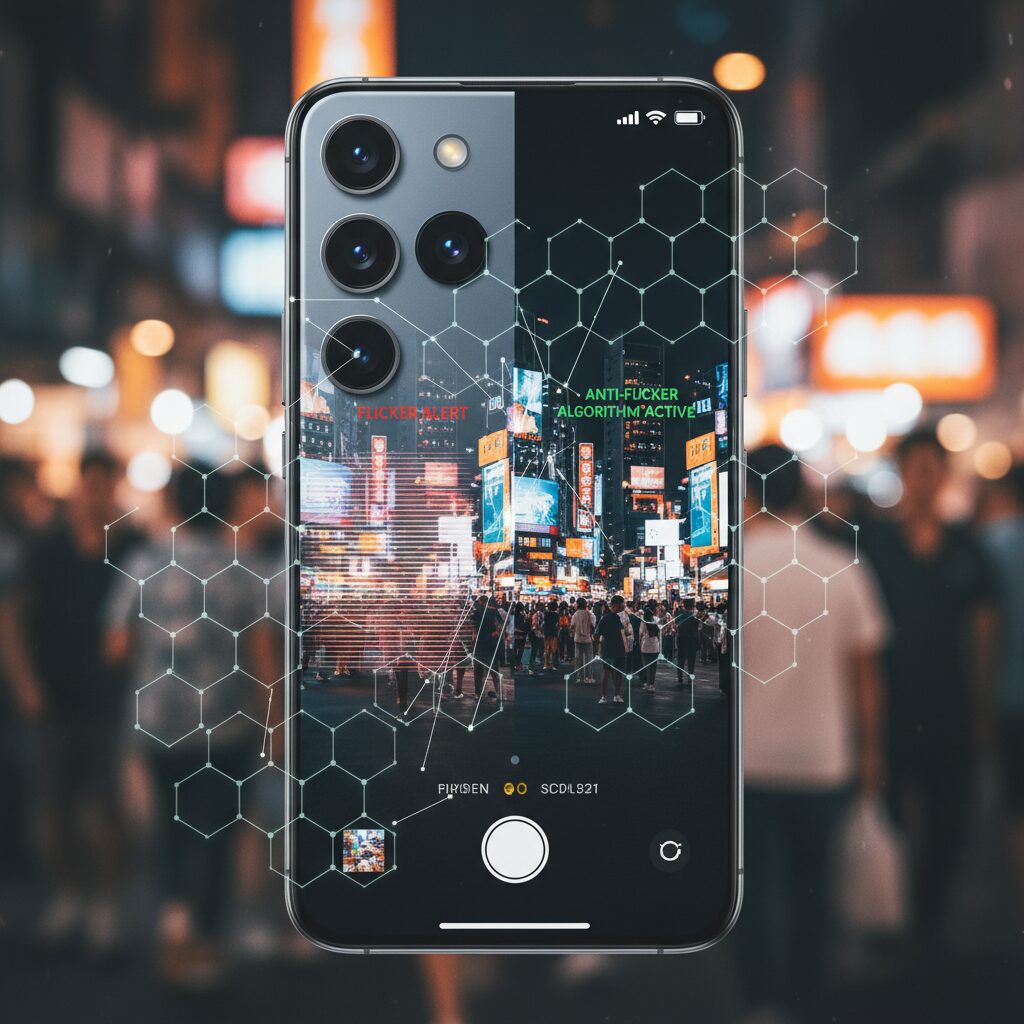
Flicker is not a minor annoyance but a physics-driven artifact that becomes painfully visible in real-world shooting. In Japan, the split power grid—50Hz in the East and 60Hz in the West—means indoor lighting often pulses at 100 or 120 times per second. When your shutter speed is out of sync with this cycle, dark bands and brightness fluctuations appear across the frame.
Fluorescent lamps and low-cost LEDs are especially prone to this behavior. According to technical explainers on flicker mechanisms in video production, the mismatch between shutter sampling and mains frequency is the core trigger. Even with perfect exposure and white balance, frequency misalignment alone can ruin otherwise cinematic footage.
| Region | Power Frequency | Recommended Shutter |
|---|---|---|
| Eastern Japan | 50Hz | 1/50s or 1/100s |
| Western Japan | 60Hz | 1/60s or 1/120s |
Matching shutter speed to these values minimizes phase conflict between sensor readout and light oscillation. This is particularly critical when you deliberately follow the 180-degree rule. For example, shooting 24fps at 1/48s in a 50Hz environment can introduce subtle flicker, whereas shifting to 1/50s often stabilizes the image without perceptible motion change.
Modern smartphones in 2026 address this through anti-flicker controls embedded in the ISP. Many Android devices allow manual selection of 50Hz or 60Hz in the camera settings. This forces exposure sampling to align with local power frequency, dramatically reducing banding under office lighting or retail LEDs.
iPhone takes a more automated route. While there is no explicit frequency toggle, exposure recalculation triggered by tapping the screen prompts the system to re-sample ambient light and suppress flicker algorithmically. Industry coverage of flicker countermeasures notes that this real-time detection relies on rapid luminance analysis before locking exposure parameters.
In practical terms, anti-flicker is a synchronization problem: your shutter, the sensor readout, and the lighting waveform must operate in harmonic alignment.
The issue extends beyond creative shooting. In remote work scenarios where smartphones double as webcams, control software such as PTZ-based utilities on Windows enables explicit 50Hz/60Hz selection. This ensures stable skin tones and prevents pulsing brightness during business calls, a detail that significantly affects perceived professionalism.
From a signal-processing perspective, anti-flicker algorithms analyze temporal luminance variation across frames. By detecting periodic intensity modulation consistent with mains frequency, the ISP can adjust exposure timing or subtly shift shutter intervals. This computational layer complements, but does not replace, correct manual configuration.
For creators who frequently move between regions, understanding local grid frequency becomes as important as choosing frame rate. A technically flawless log profile or high dynamic range sensor cannot compensate for frequency mismatch. In real-world interiors—gyms, train stations, conference halls—power frequency awareness remains a foundational discipline.
The most reliable workflow combines informed shutter selection with device-level anti-flicker activation. When physics and algorithms cooperate, footage remains stable, color-consistent, and free of distracting luminance artifacts—even under the most unforgiving artificial lighting.
Apple’s 20-Stop Dynamic Range Sensor and LOFIC Technology
Apple is reportedly testing a next-generation image sensor targeting up to 20 stops of dynamic range, a figure that approaches or even exceeds high-end cinema cameras. According to coverage by iDownloadBlog and 9to5Mac, the goal is to reproduce a tonal latitude closer to human vision, dramatically expanding what a smartphone can capture in a single exposure.
Dynamic range, measured in stops, represents how much detail a sensor can retain from deep shadows to bright highlights. Most current flagship smartphones operate in the 10–13 stop range, while premium cinema cameras typically exceed 15 stops. A 20-stop target would mark a structural leap rather than a marginal upgrade.
| Device Class | Typical Dynamic Range | Exposure Strategy |
|---|---|---|
| Flagship Smartphones (2024–2025) | 10–13 stops | Multi-frame HDR stacking |
| High-End Cinema Cameras | 15+ stops | Large sensor, log capture |
| Apple Next-Gen Sensor (Reported) | Up to 20 stops | LOFIC-based single exposure |
The technological core behind this ambition is LOFIC (Lateral Overflow Integration Capacitor). In conventional CMOS sensors, once a pixel well reaches saturation, highlight clipping occurs abruptly. LOFIC introduces an auxiliary capacitor adjacent to each pixel. When the primary well nears saturation, excess charge overflows laterally into this secondary storage area instead of being lost.
This structure enables the sensor to preserve highlight information without sacrificing shadow sensitivity. In practical terms, scenes such as backlit portraits or cityscapes with neon signage can be captured with significantly reduced highlight blowout, even before computational HDR is applied.
Another critical aspect is the adoption of a stacked architecture. By integrating a logic layer beneath the photodiode layer, Apple can perform real-time noise reduction and exposure management directly on the sensor. Industry analysis cited by 9to5Mac suggests this on-chip processing reduces read noise and improves tonal gradation before the ISP pipeline even begins.
This distinction matters for video. Multi-frame HDR techniques can introduce motion artifacts when subjects move between frames. A sensor capable of extreme dynamic range in a single exposure minimizes ghosting and preserves temporal consistency, which is essential for cinematic motion rendering.
From a workflow perspective, a 20-stop sensor fundamentally changes how creators expose footage. Instead of aggressively protecting highlights and lifting shadows in post, videographers can prioritize mid-tone placement with greater confidence. Log recording combined with LOFIC-based capture could significantly widen grading latitude without increasing noise.
While final commercial specifications remain unconfirmed, the reported development signals a transition from megapixel competition to tonal fidelity competition. If realized, this sensor design would position smartphones closer than ever to professional digital cinema systems in raw exposure latitude, redefining expectations for mobile video capture.
Samsung’s Magnetic Variable Aperture and True Optical Depth Control
Samsung’s latest breakthrough is a compact magnetic variable aperture system that brings true optical control back into the smartphone era. According to coverage by Y.M.Cinema, the mechanism uses magnetic repulsion and attraction to move physical aperture blades, allowing the lens to shift between multiple f-stops without relying solely on software simulation.
This is not a digital blur effect. It is real, mechanical light control happening inside an ultra-thin module.
The system is designed to support three physical aperture levels, enabling creators to adapt exposure and depth rendering directly at the optical stage.
| Aperture | Primary Use Case | Visual Impact |
|---|---|---|
| f/1.5 | Low light / subject isolation | Shallower depth, brighter image |
| f/2.8 | Balanced scenes | Controlled exposure, moderate depth |
| f/4.0 | Bright outdoor | Deeper focus, highlight control |
In practical videography, this matters most when you want to maintain a cinematic shutter angle. If you follow the 180-degree rule and lock shutter speed for natural motion blur, exposure traditionally had to be controlled through ISO or ND filters. With Samsung’s magnetic aperture, you can instead reduce incoming light optically while preserving motion cadence.
This directly reduces dependence on external ND filters and improves mobility for run-and-gun creators.
Another critical advantage is energy efficiency. Because the aperture blades are held in position magnetically, the system reportedly consumes no continuous power to maintain the selected f-stop. For long-form 4K or high-frame-rate recording, this contributes to thermal stability and battery endurance—both crucial for sustained professional workflows.
Equally important is what Samsung enables beyond simple exposure control: true optical depth control. Software-based portrait video relies on segmentation and edge detection, which, as computational photography research in journals such as those published by Taylor & Francis suggests, can struggle with hair, transparent objects, or complex foreground-background transitions. A physical aperture naturally alters depth of field through lens physics, eliminating artificial edge artifacts.
For example, at f/1.5, background highlights render with authentic optical bokeh characteristics shaped by the blade geometry itself. At f/4.0, environmental context becomes sharper, ideal for documentary or architectural storytelling. This flexibility gives creators expressive control that computational blur alone cannot fully replicate.
Magnetic variable aperture marks a return to optical fundamentals in an AI-dominated era.
Rather than replacing computational photography, it complements it. AI can refine color, stabilize motion, or enhance dynamic range, but depth rendering begins at the lens. By reintroducing mechanical aperture control in a compact smartphone form, Samsung bridges the gap between mobile convenience and cinema-grade optical discipline.
For serious gadget enthusiasts and mobile filmmakers, this is more than a spec upgrade. It represents a structural shift: exposure and depth are no longer purely computational decisions—they are once again physical, intentional, and creatively tactile.
Autofocus Innovation: Split-Pixel Design and Resolution Preservation
Autofocus performance has long involved a hidden trade-off in mobile video: speed versus resolution. Traditional on-sensor phase detection systems often sacrifice a portion of effective pixel area to enable focus calculation, which can subtly soften fine detail during continuous AF. In high-bitrate 4K or ProRes workflows, even minor micro-contrast loss becomes visible, especially along high-frequency edges such as hair, fabric texture, or architectural lines.
Apple’s patent US 20260006927 A1 introduces a split-pixel autofocus architecture designed to address this structural limitation. Instead of distributing AF structures uniformly across all color channels, the design strategically places autofocus elements beneath red and blue subpixels while preserving the integrity of green pixels. This matters because green pixels contribute most to perceived luminance resolution in a Bayer array, directly influencing edge sharpness and detail reproduction.
According to industry analysis reported by Y.M.Cinema, this configuration reduces the micro-degradation typically observed when autofocus is actively adjusting during video capture. In practical terms, when tracking a moving subject at 4K60fps, edge fidelity remains more stable frame-to-frame, minimizing the subtle “breathing softness” that cinematographers sometimes notice with conventional PDAF implementations.
| Aspect | Conventional On-Sensor AF | Split-Pixel (G-Protected) |
|---|---|---|
| AF Structure Placement | Across multiple color pixels | Primarily under R/B pixels |
| Impact on Green Channel | Partial structural compromise | Preserved for luminance detail |
| Perceived Sharpness in Video | Minor fluctuation during tracking | More stable edge definition |
The engineering logic aligns with established imaging science. Because demosaicing algorithms reconstruct luminance heavily from green channel data, maintaining its optical purity improves modulation transfer performance at the system level. While the MDPI study on motion blur emphasizes shutter speed’s effect on MTF50, this autofocus innovation addresses another axis of clarity: structural pixel efficiency rather than exposure timing.
For creators, the benefit is most visible in continuous eye-tracking or subject-tracking scenarios. Fast-moving interviews, handheld documentary footage, or gimbal shots often demand uninterrupted AF correction. With split-pixel design, focus transitions occur without a measurable drop in fine detail acuity, preserving cinematic sharpness even mid-adjustment.
Equally important is computational synergy. Modern ISPs and AI-driven subject recognition rely on accurate phase data for predictive tracking. By isolating AF functionality from the luminance-dominant channel, the system can deliver reliable phase detection inputs while allowing computational pipelines to maximize detail retention. This represents a structural, hardware-level solution rather than a purely algorithmic patch.
In 2026’s smartphone videography landscape, where dynamic range, shutter control, and AI reconstruction dominate discussion, autofocus integrity becomes a foundational pillar. Split-pixel design reframes AF not as a compromise but as an invisible enabler—ensuring that resolution preservation and real-time focus performance coexist without concession.
Computational Video and AI Segmentation: Scene-Aware Optimization in Real Time
In 2026, computational video is no longer a post-processing trick but a real-time decision engine running inside the ISP and neural cores of flagship smartphones. Every frame is analyzed not only for exposure and focus, but for semantic meaning. The camera understands what it is seeing, and optimizes accordingly while recording.
At the heart of this shift is panoptic segmentation. As discussed in recent computational photography research published by Taylor & Francis, modern mobile systems classify pixels into contextual categories such as sky, skin, hair, teeth, and background objects. This classification happens continuously across frames, enabling scene-aware optimization that adapts to motion and lighting changes.
| Detected Region | Real-Time Optimization | Primary Goal |
|---|---|---|
| Skin | Selective noise reduction, texture preservation | Natural complexion |
| Sky | Highlight compression, gradient smoothing | Prevent banding |
| Foreground subject | Edge-aware sharpening | Perceived clarity |
This segmentation layer works in tandem with dynamic range control. With next-generation sensors targeting up to 20 stops of dynamic range, as reported by 9to5Mac and iDownloadBlog, the hardware captures vast tonal data. AI then redistributes that data intelligently per region. Instead of globally raising shadows, the system lifts only relevant zones, preserving contrast where it matters.
Motion is another frontier. According to the AIM 2025 Challenge report on arXiv, efficient real-world deblurring models under five million parameters can operate within mobile constraints. Combined with high-speed pipelines such as DynaFlowNet—reported to achieve 134.77 FPS in research settings—smartphones now perform frame-by-frame motion analysis and selective reconstruction in real time.
This means a 1/30-second exposure does not necessarily look like one. The system identifies moving limbs versus static backgrounds and applies differential deblurring. Static architecture remains untouched to avoid artifacts, while motion-heavy regions receive targeted restoration. The result feels optically sharper without sacrificing light intake.
Qualcomm’s CVPR 2025 disclosures further reveal how temporal redundancy is leveraged through technologies like ADAPTOR, reducing computational cost by approximately 2.85×. By reusing motion-consistent information across adjacent frames, smartphones avoid recalculating identical regions. This efficiency is what enables semantic editing features such as near-instant text-guided adjustments directly on-device.
Crucially, all of this happens within milliseconds. Scene detection, segmentation masks, motion vectors, and exposure maps are generated simultaneously. The pipeline no longer treats video as a series of independent frames but as a coherent temporal structure. Optimization is aware of what moves, what matters, and what the viewer’s eye prioritizes.
For gadget enthusiasts and serious creators alike, this marks a philosophical shift. The camera is no longer passively recording photons. It is interpreting context, predicting motion, and reallocating computational resources per subject. Real-time AI segmentation transforms video capture from mechanical exposure control into adaptive visual synthesis, executed seamlessly in the palm of your hand.
Real-Time AI Deblurring, DynaFlowNet, and On-Device Editing Breakthroughs
By 2026, real-time AI deblurring has shifted from a post-production rescue tool to a core imaging layer embedded directly inside the mobile ISP pipeline. Instead of merely sharpening edges after capture, modern systems reconstruct motion trajectories at the pixel level, effectively redefining what shutter speed limitations mean in practice.
According to the AIM 2025 Challenge report published on arXiv, efficient real-world deblurring models now operate under five million parameters while maintaining competitive restoration accuracy on the RSBlur dataset. This constraint is critical, because smartphone SoCs must balance thermals, battery life, and latency in ways desktop GPUs do not.
Real-time deblurring in 2026 is not about cosmetic sharpening; it is about temporal reconstruction under strict mobile compute budgets.
One of the most discussed architectures in computational imaging research is DynaFlowNet. As summarized in recent computational imaging papers, it achieves processing speeds up to 134.77 FPS, reportedly around 117 times faster than diffusion-based approaches for comparable tasks. This performance leap is what enables true on-device deployment rather than cloud dependency.
The practical implication is profound. Even when footage is captured at 1/30 second in low light, AI can estimate optical flow between adjacent frames and reconstruct high-frequency details that would traditionally require a much faster physical shutter such as 1/500 second.
| Aspect | Conventional Deblur | DynaFlowNet-Class Models |
|---|---|---|
| Processing Location | Cloud or Desktop | On-device (mobile ISP/NPU) |
| Speed | Below real-time | Up to 134.77 FPS |
| Model Type | Diffusion / Heavy CNN | Lightweight flow-based |
| Mobile Suitability | Limited | Optimized for edge devices |
What makes this breakthrough particularly relevant for videographers is not only speed but determinism. Diffusion models, while powerful, introduce stochastic variations that are computationally expensive and less predictable in a live preview environment. Flow-based architectures like DynaFlowNet prioritize consistent frame-to-frame coherence, which is essential for cinematic motion rendering.
Qualcomm’s CVPR 2025 disclosures further illustrate how this efficiency translates into broader editing capabilities. Its ADAPTOR framework reduces computational overhead by approximately 2.85 times by leveraging temporal redundancy in video streams. Instead of recalculating every pixel for every frame, the system reuses motion-consistent regions and updates only what has changed.
This optimization layer enables features such as SwiftEdit, where text-driven video modifications are executed locally within roughly one second. The shift is strategic: editing is no longer a cloud-mediated event but an extension of capture itself.
From a workflow perspective, this changes the hierarchy of decisions on set. Historically, creators were forced to choose between motion blur realism and sharpness, especially in low-light environments. Now, physical exposure can be biased toward dynamic range preservation and noise control, while motion sharpness is partially delegated to AI reconstruction.
Academic analysis published in computational photography research highlights how panoptic segmentation is integrated into these pipelines. By classifying regions such as sky, skin, or foreground objects in real time, the deblurring process can be selectively applied. Skin tones may retain natural softness, while architectural edges are aggressively restored.
This region-aware deblurring reduces the “overprocessed” look that plagued earlier generations of mobile sharpening algorithms. Instead of uniform global correction, the system performs semantically informed temporal enhancement.
Another important dimension is energy efficiency. Mobile thermal envelopes remain constrained, as seen in high-bitrate recording scenarios where device temperatures can exceed 40°C. Lightweight deblurring models under five million parameters are not merely academic achievements; they are thermal management strategies.
On-device execution also enhances privacy and latency. When editing and reconstruction occur locally, creators avoid upload delays and data exposure risks. For journalists, documentary filmmakers, and field researchers, this autonomy can be operationally critical.
There is also a subtle aesthetic shift underway. Because AI can compensate for moderate motion blur, videographers may intentionally allow slightly slower shutter speeds in dim environments to capture richer shadow detail. The AI layer then restores edge clarity without fully eliminating cinematic motion trails.
Importantly, studies such as those referenced in the AIM 2025 report emphasize that real-world datasets, not synthetic blur simulations, are now the benchmark. Training on ISP-processed footage ensures robustness against rolling shutter artifacts, sensor noise, and color pipeline transformations unique to smartphones.
This alignment between academic benchmarks and consumer hardware pipelines marks a maturation of the field. The research community is no longer optimizing for abstract PSNR scores alone but for deployable, thermally sustainable, temporally stable systems.
For advanced users, the implication is clear: shutter speed is no longer a rigid ceiling on sharpness but a negotiable input within a hybrid optical–computational framework. Real-time AI deblurring, DynaFlowNet-class acceleration, and on-device editing engines collectively redefine what is possible within the palm of your hand.
The frontier of smartphone videography in 2026 is therefore not defined solely by sensor size or megapixels. It is defined by how intelligently motion is modeled, reconstructed, and edited in real time—directly on the device, under real-world constraints, without breaking the creative flow.
Flagship Showdown: iPhone 17 Pro Max, Xperia 1 VII, Galaxy S26 Ultra, and AQUOS R Series
The 2026 flagship battlefield is no longer defined by megapixels. It is defined by how precisely each device controls light, time, and computation. When comparing iPhone 17 Pro Max, Xperia 1 VII, Galaxy S26 Ultra, and AQUOS R series, the real difference emerges in how they integrate shutter speed control, sensor architecture, and AI reconstruction.
Each brand represents a distinct philosophy of video creation: Apple pursues sensor-driven dynamic range, Sony prioritizes manual cinematography control, Samsung innovates in optical mechanics, and SHARP refines tonal character with thermal trade-offs.
| Model | Core Video Strength | Control Philosophy |
|---|---|---|
| iPhone 17 Pro Max | Up to 20-stop DR (LOFIC sensor) | AI-coordinated automation |
| Xperia 1 VII | Full manual shutter angle control | Cinema-style precision |
| Galaxy S26 Ultra | Magnetic variable aperture | Optical adaptability |
| AQUOS R Series | Leica-supervised color tuning | Natural tonal rendering |
Apple’s approach centers on dynamic range expansion. According to reports covered by 9to5Mac and iDownloadBlog, the new stacked sensor with LOFIC structure targets up to 20 stops of dynamic range. By laterally redirecting excess charge before saturation, highlight clipping is dramatically reduced. In practical shooting, this means backlit subjects retain facial detail without sacrificing sky texture, even under a 180-degree shutter constraint.
Xperia 1 VII takes the opposite stance. Sony allows creators to define shutter speed via shutter angle, mirroring professional cinema cameras. As documented in Sony’s official help guide, users can manually lock SS, ISO, and white balance with a single toggle. For videographers who insist on maintaining 1/48 or 1/50 second at 24fps, this directness eliminates algorithmic interference and ensures predictable motion blur.
Samsung’s Galaxy S26 Ultra differentiates itself through hardware physics. Its compact magnetic-driven three-step aperture, reported by Y.M.Cinema Magazine, enables physical transitions such as f/1.5 to f/4.0 without continuous power draw. This matters when preserving motion cadence outdoors. Instead of increasing shutter speed and breaking cinematic blur, exposure can be corrected optically. It reduces reliance on ND filters and preserves motion integrity.
AQUOS R series focuses less on aggressive AI and more on texture fidelity. Reviews of the R10 highlight its restrained night rendering, avoiding artificially bright shadows. However, user tests indicate that chassis temperatures can exceed 44°C during sustained high-bitrate capture, suggesting that thermal management remains a practical consideration for extended 4K sessions.
From a quantitative standpoint, research published by MDPI demonstrates how shorter shutter speeds significantly increase MTF50 sharpness during high-speed motion capture. Yet in real-world flagship usage, the equation has shifted. AI-based real-time deblurring, as shown in the AIM 2025 challenge report on arXiv, can reconstruct detail even when physical shutter speeds remain slower for exposure stability.
This creates a philosophical divide. iPhone leverages sensor latitude and AI to “rescue” frames. Xperia ensures creators never need rescuing. Galaxy modifies light before it reaches the sensor. AQUOS prioritizes tonal authenticity over aggressive computational enhancement.
In 2026, choosing a flagship is choosing a workflow. Whether you value automation, manual purity, optical mechanics, or color realism determines which device aligns with your creative identity.
What Research Says: Shutter Speed, MTF50, and Measurable Image Sharpness
Shutter speed is often discussed as an artistic choice, but research shows it has a direct and measurable impact on objective image sharpness. The most widely used metric in optical engineering is MTF50 (Modulation Transfer Function at 50%), which quantifies how well a system preserves contrast at fine spatial frequencies.
Unlike subjective impressions of “crispness,” MTF50 provides a numerical indicator of edge definition. The higher the MTF50 value, the better the system reproduces detail before contrast drops to 50% of its original level.
A study published in Sensors (MDPI) examining high-speed tunnel inspection systems provides a clear example of how shutter speed influences this metric under motion.
| Shutter Speed | MTF50 Value | Test Condition |
|---|---|---|
| 1/2,000 sec (500 μs) | 0.0132 | 70 km/h motion |
| 1/20,000 sec (50 μs) | 0.0981 | 70 km/h motion |
When the shutter speed was reduced from 1/2,000 to 1/20,000 second at 70 km/h, the MTF50 value increased from 0.0132 to 0.0981. This nearly sevenfold improvement demonstrates that motion blur is not merely aesthetic—it measurably degrades spatial resolution.
The same study also evaluated illumination changes from 15,000 lux to 40,000 lux. While overall image quality improved with more light, the gain in sharpness was less dramatic than the improvement achieved by shortening shutter speed.
This finding is critical for smartphone videographers. It suggests that once exposure is sufficient, reducing motion blur through faster shutter speeds contributes more to edge acuity than simply increasing brightness.
However, there is a trade-off. Extremely fast shutter speeds reduce motion blur to near zero, which increases MTF50 but can produce unnaturally staccato motion in video. From a perceptual standpoint, higher MTF50 does not always equate to more pleasing footage.
Research in computational imaging further complicates the equation. According to reports from the AIM 2025 Real-World Deblurring Challenge on arXiv, efficient models with fewer than five million parameters can restore significant sharpness from motion-blurred frames in real time. This means post-capture processing can partially recover lost MTF performance.
For advanced users, this leads to a measurable workflow insight. If the scene involves high-speed motion, prioritizing faster shutter speeds improves the native MTF50 baseline. AI enhancement then works on higher-quality input data, producing more stable and artifact-free results.
In contrast, relying solely on computational correction when the original MTF50 is extremely low may introduce texture hallucination or edge instability, especially under real-world noise conditions documented in RSBlur-based evaluations.
Ultimately, research confirms that shutter speed is not just a stylistic dial. It is a quantifiable control over spatial frequency retention, directly influencing measurable sharpness before any computational intervention takes place.
Future Workflows: NeRF, 3D Gaussian Splatting, and Post-Capture Freedom
Smartphone videography in 2026 no longer ends when you press stop. It begins there. With the rise of NeRF (Neural Radiance Fields) and 3D Gaussian Splatting, captured footage is increasingly treated as spatial data rather than flat video.
Instead of recording only pixels across time, devices now interpret scenes as volumetric information. According to recent workflow analyses in AI-driven photography for 2025–2026, high-end smartphones can process depth cues and multi-frame data in the background, reconstructing a navigable 3D representation from ordinary handheld clips.
This fundamentally changes what “shutter speed” and “camera movement” mean after capture.
| Aspect | Traditional Video | NeRF / 3D Gaussian Splatting |
|---|---|---|
| Data Structure | 2D frames over time | Volumetric scene representation |
| Camera Movement | Fixed at capture | Adjustable in post |
| Focus & Blur | Baked into footage | Partially re-simulatable |
NeRF models a scene by learning how light behaves at every point in space. Once trained, it allows virtual camera repositioning within the recorded environment. 3D Gaussian Splatting, a more computationally efficient technique, represents the scene as millions of tiny spatial Gaussians, enabling faster rendering suitable for mobile-class hardware.
As industry observers have noted, this shift aligns with a broader movement in computational imaging: capture first, decide later. When your phone reconstructs spatial geometry from parallax and multi-frame data, you are no longer locked into the exact framing you chose in the moment.
Post-capture freedom becomes a creative parameter, not an emergency fix.
Imagine recording at 24fps with a 180-degree shutter for cinematic motion blur. Traditionally, that blur is permanent. But with a volumetric scene reconstruction, AI can simulate alternative motion paths or subtly alter virtual shutter characteristics in post, blending original exposure data with spatial inference.
This does not violate physics; it augments it. The original sensor data—dynamic range, noise profile, motion cadence—remains the foundation. However, spatial modeling enables selective reinterpretation of that data.
For example, a subject can remain perceptually sharp while the background is re-rendered with directional motion streaks derived from reconstructed depth layers. Such effects would be physically impossible in a single optical exposure.
3D Gaussian Splatting is particularly relevant for mobile workflows because of its rendering efficiency. Compared to classical volumetric neural fields, it reduces computational overhead, making near-real-time previews feasible on advanced smartphone chipsets.
This efficiency is crucial. As Qualcomm demonstrated in adjacent AI video pipelines at CVPR 2025, reducing computational cost while preserving perceptual fidelity is the only way spatial editing can move from research labs to consumer devices.
When combined with semantic segmentation, spatial reconstruction allows object-level relighting and depth-aware grading. You can shift virtual camera height, simulate dolly-ins, or refine perspective distortion—all after leaving the location.
For creators, this means shooting with intent but not fear. Instead of obsessing over perfect micro-adjustments in framing, you focus on stable exposure, dynamic range integrity, and motion discipline. The richer the captured data, the more flexible the reconstruction.
The future workflow rewards technically clean capture and creatively bold post-production.
In practical terms, smartphones are evolving from imaging devices into scene scanners. Your clip is no longer just footage—it is a lightweight 3D dataset. And once video becomes space, storytelling is no longer constrained by the path your hand originally traced through the air.
参考文献
- Reddit:Why is the 180 degree shutter rule called that?
- iDownloadBlog:Apple testing iPhone image sensor with human-eye dynamic range
- 9to5Mac:New Apple patent hints at a massive leap in camera sensor tech
- Y.M.Cinema Magazine:Samsung Develops Compact Magnetic Aperture for Smartphone Cameras
- Qualcomm:AI and computer vision insights at CVPR 2025
- MDPI Sensors:Quality Assessment of High-Speed Motion Blur Images for Mobile Automated Tunnel Inspection
- arXiv:Efficient Real-World Deblurring using Single Images: AIM 2025 Challenge Report
- Coherent Market Insights:Computational Photography Market Forecast, 2025-2032